Quotulatiousness

September 17, 2012

Volokh: When you reward certain kinds of behaviour, you get more of it

Filed under: Liberty, Media, Religion, USA — Tags: , , , , , , — Nicholas @ 12:52

The context here is the various arms of the US government scrambling to condemn the alleged maker of the alleged film Innocence of Muslims. Eugene Volokh explains that this is actually inviting further demands for “satisfaction” on the part of the offended:

In recent days, I’ve heard various people calling for punishing the maker of Innocence of Muslims, and more broadly for suppressing such speech. During the Terry Jones planned Koran-burning controversy, I heard similar calls. Such expression leads to the deaths of people, including Americans. It worsens our relations with important foreign countries. It’s intended to stir up trouble. And it’s hardly high art, or thoughtful political arguments. It’s not like it’s Satanic Verses, or even South Park or Life of Brian. Why not shut it down, and punish those who engage in it (of course, while keeping Satanic Verses and the like protected)?

I think there are many reasons to resist such calls, but in this post I want to focus on one: I think such suppression would likely lead to more riots and more deaths, not less. Here’s why.

Behavior that gets rewarded, gets repeated. (Relatedly, “once you have paid him the Dane-geld, you never get rid of the Dane.”) Say that the murders in Libya lead us to pass a law banning some kinds of speech that Muslims find offensive or blasphemous, or reinterpreting our First Amendment rules to make it possible to punish such speech under some existing law.

What then will extremist Muslims see? They killed several Americans (maybe itself a plus from their view). In exchange, they’ve gotten America to submit to their will. And on top of that, they’ve gotten back at blasphemers, and deter future blasphemy. A triple victory.

Would this (a) satisfy them that now America is trying to prevent blasphemy, so there’s no reason to kill over the next offensive incident, or (b) make them want more such victories? My money would be on (b).

September 12, 2012

The real reason for the Cairo and Benghazi attacks

Filed under: Africa, Media, Politics, Religion, USA — Tags: , , , , , — Nicholas @ 10:44

Tim Cavanaugh on the real as opposed to claimed reason for the attacks on American diplomats in Egypt and Libya:

Mohamed al-Zawahiri, brother of al Qaeda chief Ayman al-Zawahiri, says he called a “peaceful protest” in Cairo as part of the 9/11 anniversary attacks on U.S. embassies that left the U.S. ambassador to Libya dead and the U.S. embassy in Egypt in shambles.

The putative cause of the attack in Cairo was anger over a satirical movie depicting the founder of Islam’s life. The attacks in the adjacent North African countries, both of which last year saw secular autocrats toppled, came on a day commemorating the Zawahiri family’s direct role in coordinated terror attacks that killed more than 3,000 people from more than 60 nations.

[. . .]

But there is no real point in rebutting Zawahiri’s stated claims about a movie. I’m not even sure the movie Innocence of Muslims exists, given that producer Sam Bacile told the Wall Street Journal it had a budget of $5 million, and that doesn’t match up with the production value in Bacile’s trailer. (Bacile’s “100 Jewish donors” seem to be the real victims here.)

The purpose of the attacks in Egypt and Libya was for the Sunni leadership to show it can unleash mob attacks against American diplomatic assets. (There may be some historical exceptions, but it’s more or less axiomatic than mob attacks cannot happen without government approval.) That point has been received by everybody except U.S. State Department employees.

June 27, 2012

John Kay on the evils of rent-seeking

Filed under: Economics, Germany, Government, Politics — Tags: , , , , — Nicholas @ 08:08

Broadly speaking, wealth can be accumulated in two distinctly different ways. It can be earned through hard work, innovation, and competition, or it can be extracted from the public by use of coercive methods, corruption, and misappropriation:

Whatever the true extent of the Mubarak family fortune, it stands in stark contrast to the lot of most Egyptians. Gross domestic product per capita in Egypt is a mere $2,500. In western Europe and North America GDP per capita is about $40,000, yet the capacities of Egypt’s intellectual and entrepreneurial elite are the rival of any state in the world.

The real damage imposed by men such as Mr Mubarak is not the money they might have stolen. The tragedy is that the system that enables them to steal it destroys opportunities for others to generate wealth — not only for themselves but for the whole population.

The price of requiring a potential Mark Zuckerberg or Mr Gates to pay a $100 bribe to each of 10 officials before he can establish his new business is not the $1,000 creamed off by corrupt bureaucrats. It is the far greater one of lost businesses that never came into being because the licensing process that makes such corruption possible was not navigated. In the meantime, people who might be successful entrepreneurs choose instead to seek political power. If business is endlessly frustrating and politics endlessly rewarding, the career choice for able and enterprising people is obvious.

Institutions are the key influence on economic prosperity — West Germany did not outperform East Germany because of its excellent monetary policies. And, as Daron Acemoglou and James Robinson point out in their book, Why Nations Fail, a critical feature of successful economic institutions is that they limit the scope for what these authors call “extractive activity” — others have described it as predation or rent-seeking — which appropriates the wealth created by other people.

June 17, 2012

The only justifications for armed intervention

Filed under: Government, History, Military, Politics — Tags: , , , , , — Nicholas @ 00:12

George Jonas on the arguments being trotted out for military intervention in Syria and other hotspots:

Repeating for the record what I’ve written many times before, I think only three things justify resorting to arms: (A) self-defence, (B) treaty obligations, and (C) defending vital national interests, defined as interests that properly mandated governments on reasonable grounds honestly believe cannot be safeguarded or secured in other ways.

As far as I can see, nothing compels or even excuses belligerency except national defence obligations. Humanitarian components are icing on the cake. “Responsibility to protect” strikes me a slogan of liberal imperialism; the battle cry of post-modern civilization’s missionaries, the casus belli of self-appointed knights errant with an unquenchable thirst for running the world. Disguised as academics, adventurers, mercenaries, bureaucrats, bien-pensants and do-gooders, these 21st-century Don Quixotes consider themselves the new global aristocracy. They’re the enlightened ones, expecting to become the anointed ones before long, and rule as functionaries of various supranational bodies — governmental, non-governmental, or merely mental — in what no doubt many believe is humanity’s best interest.

[. . .]

Anyway, my main point was that the West’s moment of going off the rails in foreign policy didn’t come in the turbulent and error-prone 1960s, but in the seemingly level-headed 1950s, under the presidency of the popular wartime commander “Ike” Eisenhower. Instead of letting America’s allies, Britain, France and Israel, finish the job Egypt’s military dictator, Colonel Nasser, started when he arbitrarily nationalized the Suez Canal in 1956, Eisenhower’s America, aided by Lester B. Pearson’s Canada, rescued the aggressive nationalist. As Westerners, Eisenhower and Pearson may have expected credit; what they got was contempt.

“Weren’t they allies? Westerners are people whose enmity is preferable to their friendship,” was how a Libyan I interviewed commented some years later. I don’t think we learned much since.

October 22, 2011

Egyptian Facebook comments get man jailed for three years

Filed under: Africa, Law, Religion, Technology — Tags: , , , — Nicholas @ 11:37

The “Arab Spring” may have ousted the head of state in Egypt, but it has done little to liberalize the common experience of life. Things like speaking your mind on religious topics can get you jailed:

An Egyptian court sentenced a man to three years in jail with hard labour on Saturday for insulting Islam in postings on Facebook, the official MENA news agency reported.

The Cairo court found that Ayman Yusef Mansur “intentionally insulted the dignity of the Islamic religion and attacked it with insults and ridicule on Facebook,” the agency reported.

The court said his insults were “aimed at the Noble Koran, the true Islamic religion, the Prophet of Islam and his family and Muslims, in a scurrilous manner,” the agency reported.

It did not provide details on what he had written that was deemed to be offensive.

March 6, 2011

Foreign troops in Libya?

Filed under: Africa, Military — Tags: , , , — Nicholas @ 11:52

While some are debating the possibilities of providing troops to help the Libyan rebels, others may already be there:

The rebellion against the Kadaffi dictatorship in Libya has not produced any official outside help, but Egypt has apparently sent some of its commandos in to help out the largely amateur rebel force. Wearing civilian clothes, the hundred or so Egyptian commandos are officially not there, but are providing crucial skills and experience to help the rebels cope with the largely irregular, and mercenary, force still controlled by the Kadaffi clan. There are also some commandos from Britain (SAS) and American (Special Forces) operators are also believed wandering around, mainly to escort diplomats or perform reconnaissance (and find out who is in charge among the rebels).

The Egyptian commandos come from Unit 777, a force that was established in the late 1970s, but underwent some ups and downs in the next two decades before achieving its current form. Today, the 250-300 -man Unit 777 is a significantly improved force. They fall under the command of the Army Commando Command, both of whom are based in Cairo. Force 777 trains with the help of the German GSG-9, French GIGN, and American Delta Force commandos.

February 16, 2011

QotD: For dictators, storm troopers are not a luxury

Filed under: Government, Middle East, Military, Quotations — Tags: , , , , — Nicholas @ 09:11

A major reason for the inability of the recently deposed Egyptian dictatorship to suppress anti-government demonstrations was the lack of a large, loyal and reliable security force. Not having such a force handy was unthinkable for any security conscious dictator. For example, in Iraq, Saddam Hussein had his Republican Guard, a force that was filled with well paid, well armed men who were, above all, loyal to Saddam. All other successful dictatorships have similar forces. Russia had the KGB, which not only employed spies, but also several divisions of troops trained and equipped to deal with rebellions by the population, or the armed forces. Iran has a similar force, the Revolutionary Guard, that serves a similar role as the old KGB. During World War II, Adolf Hitler had the SS, Gestapo and his private army, the Waffen SS, all of which kept Germany fighting until the very end.

Former Egyptian ruler Hosni Mubarak got lazy and greedy by filling his “regime maintenance” forces with conscripts (as troops) and recent college graduates (as officers). Theses security forces, like the 325,000 paramilitary police in the Central Security Services (belonging to the Interior Ministry, nor the Defense Ministry), were more loyal to the people than to the small group of corrupt politicians running the country. Things had gotten so bad that the small secret police force had taken to hiring criminal gangs to harass or intimidate visible opponents of the government. These thugs fled if faced with serious opposition. And that’s what they got during February, 2011.

“Murphy’s Law: Storm Troopers Are Not A Luxury”, Strategy Page, 2011-02-16

February 13, 2011

Egypt’s long road to reform

Filed under: Bureaucracy, Middle East, Military, Religion — Tags: , , , , , , , , — Nicholas @ 11:50

Strategy Page lists some of the many difficulties facing Egypt:

Although deposed dictator Mubarak officially maintained the 1979 peace treaty with Israel, Mubarak also had the state controlled media constantly criticize Israel for real and (mostly) imagined crimes against Moslems. Mubarak allowed Hamas to bring in Iranian weapons and cash (for an eventual attack on Israel). Mubarak did what any dictator does, he found an external enemy to blame things on. But all of Egypt’s problems are internal, mostly in the form of corrupt government officials and most of the economy controlled by a few hundred families. It’s as the Russian czar said once, when asked about his great power, “I do not run Russia, 10,000 clerks do.” It’s the same in Egypt (or any other country). Replacing enough of the several hundred thousand officials (government and business), to really be in power, will be difficult for any reform politicians. Replacing all the current “clerks” with honest ones will be impossible. Eliminating corruption takes a generation or more, assuming you really try. There are centuries of history with that sort of thing, but Arabs tend to consult their own special history book, one found in the fiction section, and full of tales of imaginary Arab accomplishments, and a long list of self-inflicted injuries blamed on others. The fact is that Egypt, like most Arab nations, has long neglected education and economic opportunity. Literacy is only 71 percent, and corrupt officials make it impossible to start a legal business. Economic activity is monopolized by the several hundred families who see nothing wrong with crippling the economy for their own gain. The wealthy have not hesitated to use thugs and death squads to maintain their power. While often at each other’s throats over business or personal matters, the several hundred thousand officials and business leaders will largely unite at any attempts to dismantle their economic arrangements. Bribes, threats and all sorts of enticements will be offered cripple the reform efforts. While most Egyptians demand reform, those benefitting from the current arrangements know that they have thousands of years of Egyptian history on their side. Occasionally, foreigners would take advantage of this culture of corruption, which extended to the army, and invade. But the Egyptian ruling class would soon absorb the invaders, and the business of running Egypt would return to its normal ways.

Israel knows well how corrupt the Egyptian armed forces are. Except for a few years before the 1973 war, when a highly efficient Anwar Sadat was running the army, the Egyptian armed forces have been allowed to wallow in their usual incompetent self-delusion. Peacetime armies have long been seen as perfect sources of wealth for corrupt politicians. Thus, in the last three decades, the Egyptian forces have done their job in this department. A new Egyptian government, seeking to gain domestic and foreign popularity by cancelling the peace treaty with Israel, would restore the threat of Egypt foolishly starting another war they would lose. Israel would have to redeploy its forces to deal with this. That would cost money, and weaken the edge Israel has in the north against Hezbollah and Syria. All this would not really change the balance of power. What might do that is reforms in the Egyptian military, to eliminate corruption and raise standards. Good luck with that.

Egypt may achieve reform, to include a sharp reduction in corruption and true rule of law. What is less certain is dealing with the effects of three decades of anti-Israeli and anti-Semitic propaganda in the state controlled media. But the biggest problems are internal, and solving those are a long shot.

Many Egyptians have doubts that democracy will work in Egypt. They point to Lebanon and Iraq as examples of what happens when you allow Arabs to use democracy to rule themselves. The 22 year old Lebanese democracy fell apart in 1975, followed by fifteen years of civil war, then a peace deal that left the country divided into the “democratic” north, with the south ruled by a Shia religious dictatorship (Hezbollah) financed by Iran. Iraq has a barely functioning democracy that many Arabs despise because it was facilitated by an American/British invasion to remove an Arab dictator. What Arabs really find discouraging about Iraq’s democracy is that it reveals how difficult it is to run such a government. But as Westerners constantly point out, freedom isn’t free and democracy isn’t easy. If you want the goodies, you have to make the effort.

Update: Lawrence Solomon thinks that the path to democracy is even harder, and less likely to succeed:

In Egypt, the ends that democracy would bring are more likely death, submission and the pursuit of jihad, as defined by the country’s Muslim Brotherhood. “The Koran is our constitution, the Jihad is our way, and the Death for Allah is our most exalted wish,” it proclaims. The word Islam does mean “submission.”

Most Egyptians — three-quarters of its overwhelmingly Muslim population, public opinion polls say — want “strict imposition of Sharia law” and a larger proportion wants policies that most in the West would view as human rights abuses — 82% would stone adulterers and 84% want the death penalty for Muslims who leave their faith.

While most of the urban generation in Cairo’s Tahrir Square desires a modern Egyptian state of some kind, the Egyptian majority does not: 91% of Muslims want to keep “Western values out of Islamic countries.” For the vast majority outside the main cities, the outrages perpetrated by Mubarak lie mostly in his suppression of Islamic fundamentalist values, such as his ban on female genital mutilation and his moves to phase out polygamy and child brides. Most Muslim Egyptians not only oppose a modern Egyptian state, they would dismantle the existing Egyptian state, two-thirds wanting instead “to unify all Islamic countries into a single Islamic state or caliphate.”

But even with all of that said, he points out that things are not totally hopeless:

But traditional Egypt need not forever prevail. A poll just released by the Washington Institute for Near East Policy, taken between Feb. 5 and Feb. 8 of residents of Cairo and Alexandria, the two centres of protest, shows both how different the major cities are from the rest of the country, and how much hope there is for a modern Egypt in the future.

The protest was mostly driven by the economy, with 37% citing either “poor economic conditions” or “Unemployment/Job conditions.” Corruption came in next, at 22%, followed by “poor delivery of services like electricity and water” at 5%. The social causes touted by the Western media were all but non-existent: Just 3% cited “political repression/no democracy” and another 3% cited “abuses by security services/arrests/torture etc.” Neither are the populations in these urban centres motivated by fundamentalism. Only 4% complained of a “Regime not Islamic enough,” only 4% of a “Regime Too Connected to the U.S.,” and just 3% of a “Regime Too Supportive of Israel.” In a hypothetical election for president, one-third of the residents of these cities favoured either Mubarak (16%) or his vice-president, Omar Suleiman (17%), compared to 26% for Amr Musa, a prominent diplomat.

Mohammed ElBaradei, a diplomat endorsed by the Muslim Brotherhood, would receive just 3% of the vote.

February 6, 2011

US repositioning military forces near Egypt

Filed under: Middle East, Military, USA — Tags: , , — Nicholas @ 09:58

It should come as no surprise that the American government is changing the location and composition of forces around Egypt, as the situation becomes more volatile. Both US Navy and USMC units are involved in the moves. According to the L.A. Times, the USS Kearsarge is a key part of the redeployment:

The Pentagon is moving U.S. warships and other military assets to make sure it is prepared in case evacuation of U.S. citizens from Egypt becomes necessary, officials said Friday.

The Kearsarge, an amphibious assault ship carrying 700 to 800 troops from the 26th Marine Expeditionary Unit, and the Ponce have arrived in the Red Sea, putting them off Egypt’s shores in case the situation worsens.

Pentagon officials emphasized that military intervention in Egypt was not being contemplated and that the warships were being moved only for contingency purposes in case evacuations became necessary.

Business Insider reports that USMC units are being moved now:

A senior member of the US Marine corps is telling people “multiple platoons” are deploying to Egypt, a source tells us.

There is a system within the US Marines that alerts the immediate families of high-ranking marines when their marine will soon be deployed to an emergency situation where they will not be able to talk to their spouses or families.

That alert just went out, says our source.

For those of you not steeped in military jargon, a “platoon” is a small tactical unit of about 40 men, commanded by a lieutenant. This is not an “invasion force” sized move.

February 5, 2011

Unlike most media pundits, he’s actually been to Egypt

Filed under: Middle East — Tags: , — Nicholas @ 00:09

I’m referring to Victor, who was in Egypt just under two years ago, and recounts some of his experiences then:

This is where all my feelings for Egypt go downhill. We visit a Mosque first thing, we arrive between prayer, but honestly, you wouldn’t know it. We’re trying to move with the crowd, when suddenly a woman steps between my girlfriend and I (not current girlfriend), and smacks her before running off. Both a bit disturbed by this, we talk to our tour guide, who acts awkwardly, and apologizes to us. Once in the mosque, we are sort of at a loss for what to do with ourselves. It’s a beautiful place, but positively hostile; we’re glared at everywhere we go.

Leaving the Mosque, we head to the Pyramids, those claustrophobic (Me!) get to wait outside while everyone else goes in. Apparently it was dark, hot, smelly, and genuinely unenjoyable, so I’m just as glad I saw from the outside. Crossing a bit of a sand plane between the Pyramids and the Sphinx, however, a friend of mine was accosted by a man with a camel. He made the mistake of shaking this guy’s hand, and was suddenly wisked onto the camel, and they began to ride off. My friend jumped down and ran back after about 50 feet, but yeah, not great. Sphinx was sketchy as all hell, people constantly eyeing us, watching where we moved, etc. One small boy, egged on by an older man, followed closely behind us, and made several attempts to get into people’s pockets. We were all so flustered, I’m not sure anyone enjoyed the Sphinx.

After the Sphinx, we were moved to another location, where we were to have our camel rides. Cool, not a lot can go wrong on a camel ride that was arranged and paid for, right? The first group went out and came back without a hitch, so my group boarded, and our camels began their galumphing walk around the block. [. . .] two girls from the tour group are missing, and they went out on the same Camel ride that I did. [. . .] I witness some boys trying to torture a dog while sitting on the bus, and want to go smack them about. Then a police officer does my wishes for me himself, waving his bully club at them and letting the dog down. The girls appear around a corner, scrambling back on foot, relating that their camel drivers dropped back from the rest of the group and took a different rout from the rest, and when they got too far, the two of them jumped down and hauled back.

[. . .]

The author of the book talks about how resourceful and friendly the Egyptians are, and how nicely they treat foreigners, I saw none of that, to be honest, more a willingness to take advantage, or play on Westerner’s emotions. I won’t go back to Egypt, it was my worst travelling experience.

The joys of tourism . . .

February 3, 2011

Middle East unrest spreads to Yemen

Filed under: Liberty, Media, Middle East, Politics — Tags: , , , — Nicholas @ 07:37

First Tunisia, then Egypt, now Yemen:

Tens of thousands of Yemenis squared off in street protests for and against the government on Thursday during an opposition-led “Day of Rage,” a day after President Ali Abdullah Saleh offered to step down in 2013.

Anti-government activists drew more than 20,000 in Sanaa, the biggest crowd since a wave of protests hit the Arabian Peninsula state two weeks ago, inspired by demonstrations that toppled Tunisia’s ruler and threaten Egypt’s president.

But an equally large pro-Saleh protest also picked up steam, and supporters of the president who has ruled Yemen for more than three decades drove around the capital urging Yemenis over loudspeakers to join their counter-demonstrations.

The protests in Sanaa fizzled out by midday, with demonstrators on both sides dispersing peacefully ahead of a traditional afternoon break to chew qat, a mild stimulant leaf widely consumed in Yemen.

Tools for protest marchers: anti-kettling app

Filed under: Law, Liberty, Media, Middle East, Technology — Tags: , , , , , , — Nicholas @ 07:20

Patrick Kingsley talks to the developers of “Sukey”, a new mobile phone app intended to help protesters avoid being kettled by police:

Cairo, it wasn’t. But at about a quarter to four last Saturday afternoon, on a crowded backstreet in central London, something happened outside the Egyptian embassy that deserves at least a footnote in the annals of protest history. A crowd of students weren’t kettled.

In the context of recent British protests, this was a near-miracle. At each of the previous four major student protests in London since the Millbank riot on 10 November, police have kettled — or, in their terminology, “contained” — thousands of protesters, preventing them from leaving an area for several hours, and often from accessing basic amenities such as food, water and toilets.

Police kettle protesters supposedly to quell violence, but protesters arguably only turn to violence out of frustration at being kettled. Most notoriously, police trapped hundreds of teenage schoolchildren inside a tight grid on Whitehall on 24 November — and only subsequently did a few of them smash up a police van abandoned in their midst.

Saturday’s non-kettle, then, was a victory in itself. But the real excitement wasn’t that it didn’t happen — but how it didn’t happen. It is difficult to pinpoint exactly why police and protesters behave in a certain way at a certain time, but one explanation for the kettle’s failure to form lies with a new communications network, which launched that afternoon: Sukey.

February 1, 2011

Egypt still offline in advance of “million-man march”

Filed under: Liberty, Media, Middle East, Technology — Tags: , , , — Nicholas @ 07:46

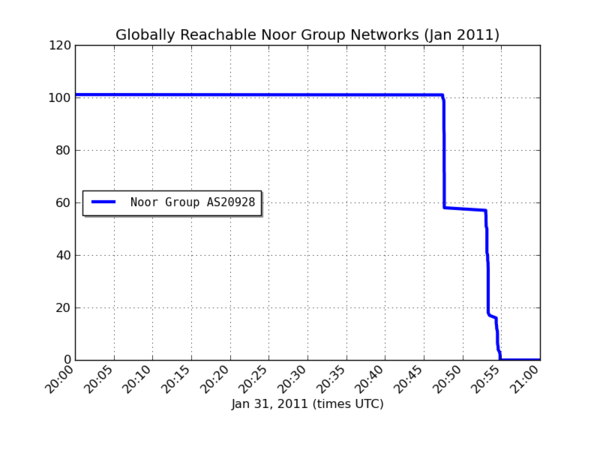
Renesys is still reporting almost no internet connectivity to or from known Egyptian sites:

As we observed last week, Egypt took the unprecedented step of withdrawing from the Internet. The government didn’t simply block Twitter and Facebook (an increasingly common tactic of regimes under fire), but rather they apparently ordered most major Egyptian providers to cease service via their international providers, effectively removing Egyptian IP space from the global Internet and cutting off essentially all access to the outside world via this medium. The only way out now would be via traditional phone calls, assuming they left that system up, or via satellite. We thought the Internet ban would be temporary, but much to our surprise, the situation has not changed. One of the few Egyptian providers reachable today, four days after the start of the crisis, is The Noor Group. In this blog, we’ll take a quick look at them and some of the businesses they serve.

January 31, 2011

QotD: A hopeful view of Egypt’s way forward

Filed under: Liberty, Middle East, Quotations — Tags: , , , , , — Nicholas @ 17:32

The Old Media — not to mention Hillary Clinton’s comic relief State Department — apparently don’t have a clue what’s really going on. Conservative talk radio already assumes that the whole thing has been orchestrated by militant “Islamists”, in particular, the 80-year-old Muslim Brotherhood. Whenever you see that word, mentally remove the first R to get a clearer picture if what they’re really up to.

The Botherhood of Man is gonna gitcha if you don’t look out.

But I digress.

America’s home grown would-be dictators clearly believe “It can’t happen here”, as demonstrated by their reactions — dazed at first, then hysterical — to the far gentler rise of the Tea Parties and the results of the 2010 election, which they are trying to believe never happened. They’ve spent all of their time since, not changing so that they won’t be despised any more, but trying to shut their critics up by destroying talk radio and requiring individuals to have Internet permits.

[. . .]

Out of sheer habit, if nothing else, it is very difficult not make the same mistake as the pundits and politicians. As Robert A. Heinlein observed, every revolution is a freak. By definition there can be no rules to govern or even understand them, and we must avoid thinking collectively about them. There are as many reasons to rebel as there are rebels, and that’s the only important truth we’ll ever glean from them.

It’s also very difficult to say from what we know now, and I could easily be wrong (I have been before), but it seems to me that this is not a fundamentalist uprising like we saw in Iran a generation ago — although the fundamentalists are desperately trying to coopt it — but an essentially secular revolt by the productive class against both fundamentalism and the fascist management states that dominate the region.

L. Neil Smith, “Egyptian Tea Party”, Libertarian Enterprise, 2011-01-30

January 29, 2011

Wired How-to: Get back on the internet after a government shut-down

Filed under: Liberty, Technology — Tags: , , , — Nicholas @ 11:47

A post at the Wired How-to wiki on getting back online after your government attempts to shut down internet access:

Scenario: Your government is displeased with the communication going on in your location and pulls the plug on your internet access, most likely by telling the major ISPs to turn off service.

This is what happened in Egypt January 25 prompted by citizen protests, with sources estimating that the Egyptian government has cut off approximately 88 percent of the country’s internet access. What do you do without Internet? Step 1: Stop crying in the corner. Then start taking steps to reconnect with your network. Here’s a list of things you can do to keep the communication flowing.

This article is part of a wiki anyone can edit. If you have advice to add, please log in and contribute.

« Newer PostsOlder Posts »

Powered by WordPress


