Quotulatiousness

September 7, 2025

The BEF and the German Sichelschnitt of May, 1940

Filed under: Britain, France, Germany, History, Military, WW2 — Tags: , , , , , , — Nicholas @ 05:00

Dr. Robert Lyman rebuts the common-since-the-1950s adulation of the Wehrmacht‘s attacks of May-June, 1940 through the Low Countries that drove the British Expeditionary Force off the continent and destroyed the flower of the French army prior to the surrender of France in June:
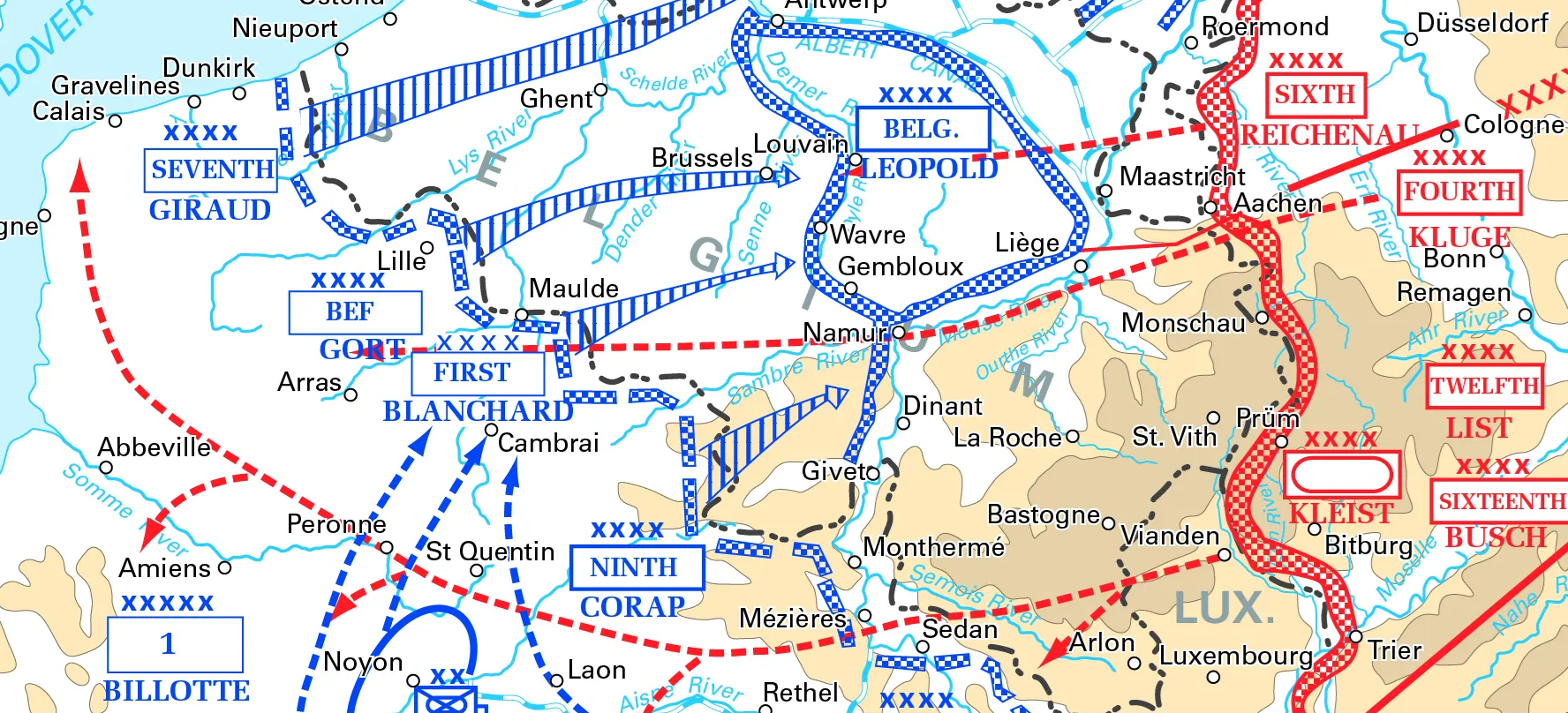
Detail from the West Point Military Atlas map of the “Campaign in the West, Disposition and Opposing Forces, 1940”
Full map.

The world has largely remembered Sichelschnitt as a brilliant German operation of war, but it was one that was fundamentally enabled by Allied ineptitude. Indeed, Blitzkrieg wasn’t particularly new, innovative or even a warfighting doctrine. It is best described, in the context of France 1940, as an event. It was simply the way that the Wehrmacht exerted its tactical and operational superiority over its more pedestrian enemies in 1940. In fact, it was the 1940 extension of what the German Army had first demonstrated in Flanders in March 1918, this time with tanks and Stukas. It was the Panzerwaffe (“tank force”) – combined with a tactical air force – which in 1940 would create the breakthrough that Ludendorff had been unable to achieve in 1918. Where it was applied, by Army Group A, it concentrated fast-moving armoured vanguards co-ordinated with tactical air power, such as 400 Ju 87 Stuka dive-bombers, to so overwhelm the enemy in both time and space that they were unable to respond quickly enough to the changing and challenging battlefield. In 1940 the panzer came into its own, the sound of clattering tracks on French cobblestones a new feature in the sound of battle and a key element in how France remembers its defeat in 1940.

It wasn’t the type of tank in the German inventory which mattered, but the way in which these tanks were employed. Only about 10 per cent of the army comprised tanks, the remainder relying on horse and wagons and the raw, painful feet of the marching infantry. Of the 2,539 tanks the Wehrmacht deployed in 1940, only 916, or 36 per cent were battleworthy, the remainder being clattering tin cans with machine guns (the obsolete Panzer Mark Is and Mark IIs). The only modern tanks were 683 Panzer Mark IIIs and Czech T38 tanks armed with a 37mm gun, and 278 of the larger Mark IVs with a short 75mm gun. But it was enough. The German operational strategy was to use this mass of armour not to fight a large confrontational tank battle, but to achieve breakthrough and breakout, bursting through the enemy’s linear defences. It was surprise and shock action that so discomforted the Allies, who had lazily and, given what we know of British failure to understand 1918, ignorantly assumed that the war would progress against a 1914 rather than a 1918 pattern. The armoured vanguard would surge through the outer skin of the enemy defences, concentrating heavy effort in one place, before driving hard into the heart of enemy territory. With an enemy intent on fighting a linear battle, the rear areas, behind this outer crust, would be weakly defended and full of rear-echelon, administrative and supply troops managing the lines of communication up to the front, not expecting to have to fight. It was by driving hard and fast behind the enemy front line, breaking the cycle of Allied battlefield decision-making, that Blitzkrieg was to achieve its psychological effect.

In contrast the Allies remained concerned about retaining the integrity of their defensive lines. The diaries of Major General Henry Pownall, for instance, are replete with concerns as the days spun past about the widening frontages on one defensive line or another. British concern was misplaced. It was to spread the ever-decreasing butter of the British infantry across ever-widening stretches of French and Belgian bread, without realising that the Germans were concerned not with rolling up a front line, but with driving hard to the rear. By so doing they would take risks with their flanks, but the discombobulatory effect on the enemy was considered to far outweigh any worry about the risk of counter- attack from an increasingly battered and disorganised enemy. Of course this operational concept was risky, but the risks taken were carefully calculated given what the German General Staff knew about British and French tactical doctrine, or the lack of it.

These German tactics were psychologically disconcerting for those not trained to expect them. As was demonstrated on the Meuse, artillery would batter a position in co-ordination with armoured columns bypassing fixed defences and attacking those it needed to clear from the flanks and the rear. The infantry accompanying the advancing armour – Panzergrenadiers (mechanised infantry) – arrived in tandem with the Stukas, which could drop their bombs from a screaming dive. Each Stuka seemed to those at the receiving end to be diving directly at them, personally. For untrained troops it was a terrifying experience. The panzers would sweep on while the truck-borne infantry would turn up to deal with survivors of this storm of fire and movement. By this time, of course, the disorientated French and British would now consider themselves cut off, behind their front line, with no prospect of being relieved. Surrender or a disorganised escape to the rear would seem to be a more sensible option than the forlorn hope of continued resistance when the surrounding fields were dotted with the grey-green uniforms and coal-scuttle helmets of their enemy. The psychological effect of Blitzkrieg was considerable. This wasn’t how their fathers had told them war was fought. How did the Germans manage to discomfort them on the battlefield so comprehensively? Were they inadequate soldiers, unable to meet the standards of campaigning set by the previous generation? Or was it that their tactics were simply not able to cope with the shock of a comprehensive assault by German infantry, armour and air power all descending on them at once? This was the battlefield that the British had entirely dominated, by virtue of their tactical innovations, in 1918. It was now Germany’s turn, a direct result of the failure of the British Army to develop its doctrine and approaches to warfighting at the end of the Great War. Brave men in 1940 did their duty, but against a battle-winning concept of their enemy, they were out-thought rather than out-fought. And critically, when an army thinks it is beaten, it is indeed beaten.

August 4, 2025

Day Ten – German Victory in the Battle of France – Ten Days in Sedan

World War Two
Published 3 Aug 2025

May 19, 1940. Ten days into Fall Gelb, Guderian’s panzers thunder toward the Channel, poised to slam a steel ring around nearly half a million Allied troops. In Paris, Paul Reynaud ousts Daladier and Gamelin, calling back Marshal Pétain and General Weygand as France’s last throw of the dice. The pocket is almost shut, yet the story is far from over. Is there time for one more twist? Keep watching as we follow the fight to its end and discuss the aftermath of this campaign.
(more…)

July 10, 2025

Was Matilda II the BEST Tank of WWII?

Filed under: Australia, Britain, History, Military, Pacific, Russia, Weapons, WW2 — Tags: , , , , — Nicholas @ 02:00

The Tank Museum
Published 21 Feb 2025

Forget the Sherman, forget the Panther, forget the T-34 … Should Matilda II be considered the best tank of WWII? 

Emerging from the request for a new and improved infantry tank, Matilda II debuted on the battlefield in France. The heroic actions of Matilda crews at Arras stopped Blitzkrieg in its tracks and allowed the British army to be evacuated from the beaches of Dunkirk.

The Matilda’s fighting peak was during the North Africa campaign, where the 2pdr gun was more than a match for any of the Italian armour it came up against. Despite some mechanical issues, the performance of Matilda II at this time would earn her the title “Queen of the Desert”. Once the Germans arrived in North Africa, Matilda started to become obsolete but remained useful as a testbed for experimental equipment that would eventually be used on D-Day.

Matilda II saw service in all theatres of the Second World War. Around 900 tanks were deployed by the Soviets in 1942, filling the gap as the Red Army increased its roster of T-34s. Matilda made great contributions to campaigns in the Pacific – its small and solid profile making it ideal for jungle bashing. The Australians made effective use of the Matilda, creating variants including a mortar launcher and a flamethrower.

Some say that if it wasn’t for Matilda II we would be speaking German right now. Watch this video to find out why …

00:00 | Introduction
00:36 | Heroics at Arras
03:29 | It Takes Two
06:00 | Matilda II – Inside and Out
13:03 | Queen of the Desert
18:14 | Soviet Service on The Eastern Front
19:49 | The Pacific – Welcome to the Jungle… 
(more…)

September 5, 2024

Matilda I – The Little Tank That Did | Tank Chat #176

Filed under: Britain, History, Military, Weapons, WW2 — Tags: , , , , — Nicholas @ 02:00

The Tank Museum
Published May 24, 2024

In 1940, this small but well armoured tank was pretty much all that stood between the German Blitzkrieg and a battered British Army that was retreating to the coast.

Slow, small, and armed only with a machine gun, the A11 Infantry Tank (Matilda I) would achieve great things in its only significant battlefield action – effectively saving the British Expeditionary Force from annihilation.

At Arras on 21st May 1940, Matilda Is and IIs of 4th and 7th Royal Tank Regiment counterattacked the rapidly advancing 7th Panzer Division. In doing so, they successfully halted the German advance and unnerved Hitler so much that he issued an order forbidding further advances — thus giving the British and French chance to organize the Dunkirk evacuation.

In this video, David Willey covers the history of this diminutive and often ridiculed little tank which altered the course of history by saving an entire army.

This video features archive footage courtesy of British Pathé.

June 26, 2024

Why the Allies Lost The Battle of France

Filed under: Britain, France, Germany, History, Military, WW2 — Tags: , , , , , — Nicholas @ 02:00

Real Time History
Published Mar 1, 2024

In May 1940, Nazi Germany attacks in the West. The Allied armies of France, Britain, Belgium, and the Netherlands have more men, guns, and tanks than the Germans do – and the French army is considered the best in the world. But in just six weeks, German forces shock the world and smash the Allies. So how did Germany win so convincingly, so fast?
(more…)

September 27, 2023

The British army between 1918 and 1940

Filed under: Britain, History, Military, WW1, WW2 — Tags: , , , — Nicholas @ 05:00

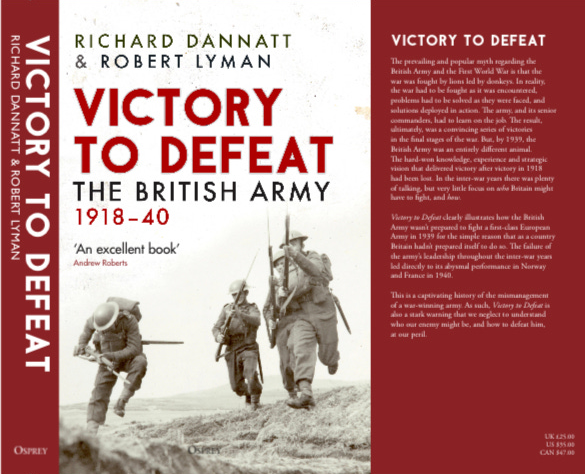
Richard Dannatt and Robert Lyman recently published Victory to Defeat, which chronicles the decline of the British army’s fighting capabilities in the interwar years. Robert Lyman posted a longer version of Gordon Corrigan’s review for Aspects of History (with permission):

The British Army ended the First World War well trained, well led, well equipped and capable of engaging in all arms intensive warfare. Of all the players, on both sides, this army was unquestionably the most capable of deployment against a first class enemy anywhere in the world. Twenty years later it found itself with very much the same equipment, but with very much less of it, and devoid of either the ability or the means to fight a war in Europe against an enemy which had absorbed the lessons of 1918 but which the British had forgotten. It was the British Army that had invented blitzkrieg (although of course they did not call it that, a term coined by the French press very much later) and used it during the Battle of Amiens and on into the “Hundred Days” that saw the defeat of the German Army on the battlefield, and whatever German myth later averred, it was the British Army that forced that victory on the Western Front, not the French and not the Americans. And yet, in 1939 and 1940 the British were roundly defeated in France and Belgium, in Greece, in Crete and in North Africa. In this important – and to this reviewer almost heart rending – book the authors describe how and why the victors of 1918 were allowed to become incapable of fighting intensive warfare a mere two decades later.

In the first part of the book the authors describe the build up to the First War, and their explanation of the so called “Curragh Mutiny” is much more accurate than many accounts by others (although the officers did not threaten to disobey orders, only to resign, and while Carson’s Ulster Volunteers were indeed incorporated into the British Army as the 36th Ulster Division, so were Redmond’s National Volunteers, into the 16th Irish Division). The authors then go on to show how the British government had, albeit reluctantly, accepted a continental commitment in 1914 and had despatched an expeditionary force to Belgium, described then and later as the finest body of troops ever to leave these shores. Fine they certainly were, well trained, well led and well equipped, but the British Expeditionary Force (BEF) of professional regular soldiers was pitifully small, and with experience of imperial policing and not of war against a first class enemy. With the need to expand enormously and rapidly, this army had to adapt to a theatre where massed artillery, machine guns and barbed wire made any attempt to manoeuvre almost impossible. The book shows how by trial and error, by analysis of operations and by a gradually developing doctrine the British learned to use a combination of all arms to break through German defences and eventually to defeat them. With the infantry, the artillery, the armour, the engineers and increasingly the air all working together to get inside the enemy’s decision making circle, to get him on the back foot and keep him there, these were the elements of blitzkrieg, but it was the defeated Germans who were to absorb those principles and perfect them until twenty years after their defeat they were the most competent army in Europe.

After an excellent account of the British journey from an imperial gendarmerie to a practitioner of intensive war, the next part of the book shows how and why by the time the Second World War came along the British were incapable, not only of deterring war, but of fighting it. The “ten year rule”; the reluctance of governments to spend on defence; the political refusal to contemplate another war in Europe and the reluctance of the public to contemplate another bloodletting like that of the First War; the inability to experiment or to develop tanks and armoured vehicles; the seeming impossibility of reconciling the twin requirements of imperial policing and any commitment to land operations in Europe with the assets available; the myth of the “bomber will always get through” and the absence of any consistent war fighting doctrine, all are lucidly explained. Much of the fault is shown to lie with politicians, and surely the most disgraceful example of political interference was the sacking of the Chief of the Imperial General Staff (CIGS), the professional head of the army, by the leaving of a note on his desk by the very dubious Secretary of State for War, Hore-Belisha. The generals are not spared, however. Despite restrictions on funding and refusal by governments to accept that another war was looming generals could have spoken out, although it does have to be recognised that in a democracy the civil power is paramount.

May 13, 2023

Arnold Ridley – “Private Charles Godfrey” – a real story from Dad’s Army

Filed under: Britain, History, Humour, Media, WW1, WW2 — Tags: , , , , , — Nicholas @ 02:00

The History Chap
Published 1 Feb 2023

The story of Arnold Ridley — Private Charles Godfrey — Dad’s Army

After my last video all about Lance Corporal Jones in Dad’s Army I have been inundated by requests for the real story of another character from the classic comedy series: Private Godfrey.

Private Charles Godfrey, played by Arnold Ridley, is an ageing and slightly doddery member of the Walmington-on-Sea Home Guard platoon. His comrades are somewhat surprised and concerned when he announces that he was a conscientious objector during the First World War. However, thanks to his sister, the platoon learn his real (well, fictitious as it is a TV comedy show) story. Godfrey was indeed a conscientious objector but like many others he did volunteer to serve his country – just not to kill. Many men who felt likewise, joined the Army Medical Corps. Whilst not fighting they not only served their country and played a valuable role in the war effort but they also put themselves in harm’s way. Many of them became stretcher bearers, going out into no man’s land to fetch the wounded to safety. And many were decorated for their bravery.
William Coltman, became the most decorated NCO in the entire British army during the First World War … and he never fired a shot in anger!

I will be telling the story of William Coltman VC in the near future.

Private Charles Godfrey was awarded the Military Medal for bravery during the battle of the Somme.

What makes Godfrey’s character all the more fascinating is that his actor, Arnold Ridley, was no conscientious objector but a volunteer in World War One. he was severly injured at the battle of the Somme in 1916 and discharged the following year.

Indeed, his injuries would influence how he played his character in Dad’s Army.

After the war, Ridley became a play writer. Arnold Ridley penned over 30 pays, the most famous of which was The Ghost Train written in 1923.

At the outbreak of the Second World War he once more volunteered to serve his country. Following the battle of Boulogne in 1940, he was evacuated to Britain, having been injured, once more, he was again given a medical discharge.

For the rest of the war he worked for ENSA – the forces entertainment organisation — and was a member of his local Home Guard. He continued his acting career through the 1940’s and 50’s before landing the role of Private Charles Godfrey in Dads Army in 1968. He was ever-present until the show ended in 1977. By then he was 81 years old.

Arnold Ridley died in 1984 and is buried in Bath Abbey.
(more…)

July 26, 2021

QotD: British Expeditionary Force (BEF) leadership in France, 1940

Filed under: Britain, Germany, History, Military, Quotations, WW2 — Tags: , , — Nicholas @ 01:00

The Commander-in-Chief of the BEF, Lord Gort, was widely acknowledged for his personal bravery (he was a VC holder) and fighting spirit. Contemporaries however were sceptical of his Conceptual Skill. Major General Sir Edward Spears described him as “a simple, straight-forward, but not very clever man.” General Brooke, the incisive and ruthless commander of II Corps during the campaign (later Lord Alanbrooke, Chief of the Imperial General Staff), though an admirer of Gort’s inspirational fighting spirit, frequently lamented the C-in-C’s total lack of strategic ability. This frustration is mentioned several times in Alanbrooke’s war diary, well before the German offensive began.

Gort was not a lone offender in Alanbrooke’s opinion. The latter believed that most of his fellow senior officers lacked Conceptual Skill. He suggested that the lack of strategic ability amongst British senior commanders was due to the best thinkers of his generation being lost in the Great War. Alanbrooke’s theory is questionable, for the Germans also lost many talented officers in the Great War, yet between the wars, actively promoted intellectual stimulation amongst its officer corps. Amongst the leading thinkers were Heinz Guderian, often regarded as the father of Blitzkrieg, although in his own book, Panzer Leader, is the first to admit that he took British ideas and developed them into something that worked. The British, it seems, were less stimulated by their own initial thinking on modern war.

This does not imply the Germans were unequivocal masters of big thinking. Many German army commanders were as locked into traditional thinking as their Allied opposite numbers. Guderian asserts that the sole reason the BEF was allowed to escape from Dunkirk was because the German Army High Command issued repeated halt orders to Guderian’s panzer corps, allowing the British the breathing space needed to avoid total defeat.

Both sides suffered in this area [interpersonal skills], and the problems arose mainly at senior level. Despite many British commanders speaking good French, the respective commanders on each side of this coalition had radically different opinions of how operations should be conducted and coordinated. There was virtually no attempt to ensure interoperability before May 1940 and the Anglo-French coalition was, at best, a well-mannered but reluctant partnership which did not stand the test of high-tempo operations well.

The lack of trust between the Allies ultimately drove Gort to contradict direct orders and use his last reserves to shore up the BEFs northern flank, rather than fritter them away in a joint counter-attack with the French that was dead in the water before it was launched. By the 25th May, just two weeks after the opening of combat operations, the Anglo-French coalition was crumbling. Bizarrely, this decision by Gort to abandon the French actually testifies to his one great moment of Conceptual Skill. He realised he was essentially committing career suicide when he ordered his troops towards the coast, but he also had the foresight to realise that the battle for France was already lost and that his sole duty from then on was to save Britain’s army.

Andy Johnson, “Dunkirk: Leadership Lessons in a Hard School”, The Wavell Room, 2017-08-01.

September 13, 2020

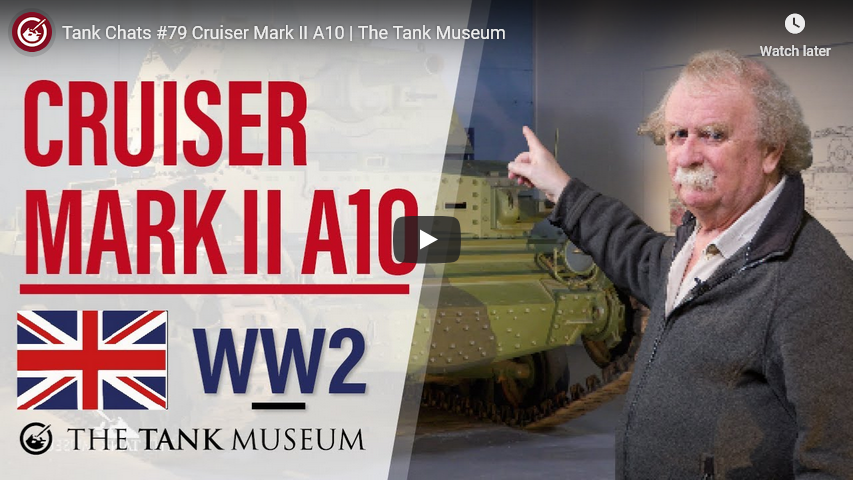
Tank Chats #79 Cruiser Mark II A10 | The Tank Museum

Filed under: Britain, History, Military, Weapons, WW2 — Tags: , , , , , — Nicholas @ 02:00

The Tank Museum
Published 29 Jun 2019

The Cruiser Mark II A10 was developed alongside the A9 and was intended to be a heavier version of the tank.

Support the work of The Tank Museum on Patreon: ► https://www.patreon.com/tankmuseum

Visit The Tank Museum SHOP: ► https://tankmuseumshop.org/

Twitter: ► https://twitter.com/TankMuseum
Instagram: ► https://www.instagram.com/tankmuseum/
Tiger Tank Blog: ► http://blog.tiger-tank.com/
Tank 100 First World War Centenary Blog: ► http://tank100.com/ #tankmuseum #tanks

September 6, 2020

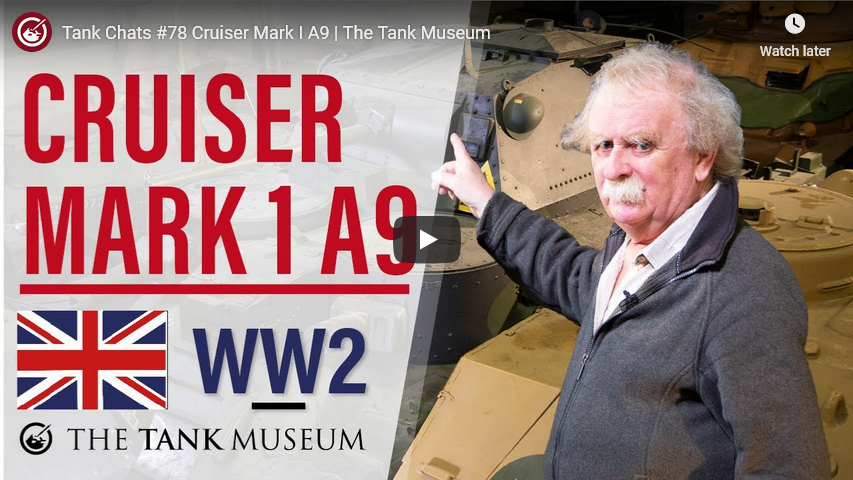
Tank Chats #78 Cruiser Mark I A9 | The Tank Museum

Filed under: Britain, History, Military, Weapons, WW2 — Tags: , , , , — Nicholas @ 02:00

The Tank Museum
Published 21 Jun 2019

The Tank Cruiser Mark I A9 is an interwar British tank. Tank Historian David Fletcher talks through the very first cruiser tank to go into service.

Support the work of The Tank Museum on Patreon: ► https://www.patreon.com/tankmuseum

Visit The Tank Museum SHOP: ► https://tankmuseumshop.org/

Twitter: ► https://twitter.com/TankMuseum
Instagram: ► https://www.instagram.com/tankmuseum/
Tiger Tank Blog: ► http://blog.tiger-tank.com/
Tank 100 First World War Centenary Blog: ► http://tank100.com/ #tankmuseum #tanks #tankchats

June 15, 2020

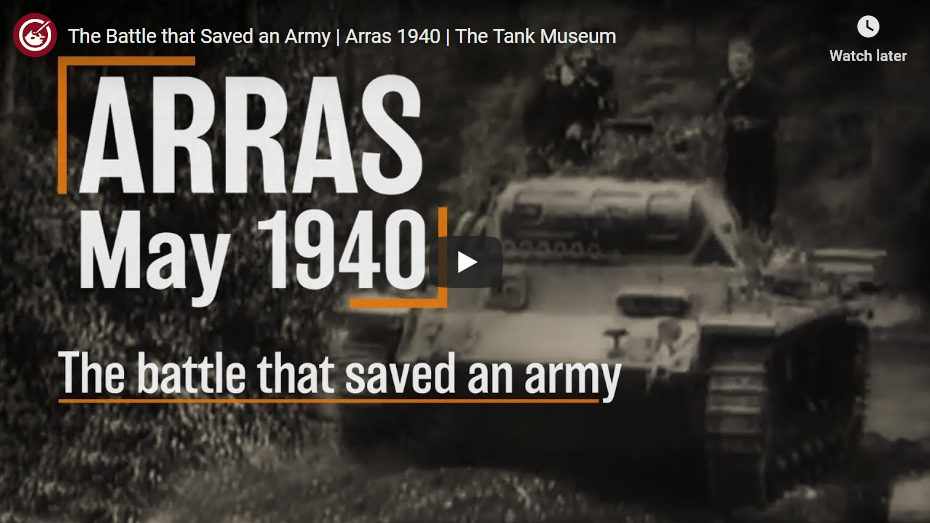
The Battle that Saved an Army | Arras 1940 | The Tank Museum

Filed under: Britain, Economics, France, Germany, History, Military, Weapons, WW2 — Tags: , , , , , , — Nicholas @ 04:00

The Tank Museum
Published 17 May 2020

Encircled by the Germans in North-West France, the Battle of Arras, 21st May 1940, was a successful Allied counter-attack which allowed French and British troops to be evacuated at Dunkirk. Curator David Willey, presents his talk on the WW2 Battle of Arras from home.

For more on the Blitzkrieg see David’s Tank Story Hall tour https://www.youtube.com/watch?v=eysQa…

Support the work of The Tank Museum on Patreon: ► https://www.patreon.com/tankmuseum
Visit The Tank Museum SHOP & become a Friend: ► https://tankmuseumshop.org/

Twitter: ► https://twitter.com/TankMuseum
Instagram: ► https://www.instagram.com/tankmuseum/
Tiger Tank Blog: ► http://blog.tiger-tank.com/
Tank 100 First World War Centenary Blog: ► http://tank100.com/

June 9, 2019

Will Britain Remain?! – WW2 – 041 – June 8 1940

Filed under: Britain, Europe, France, Germany, History, Military, WW2 — Tags: , , , — Nicholas @ 04:00

World War Two
Published on 8 Jun 2019

As the battle for France is still raging but looks like a ringing victory for Nazi Germany, and the encircled troops in Dunkirk have been evacuated, will Great Britain remain in the war? If so will British forces remain in continental Europe? In fact will Great Britain even be able to remain an independent nation, or also fall to the Nazis?

Join us on Patreon: https://www.patreon.com/TimeGhostHistory
Or join The TimeGhost Army directly at: https://timeghost.tv

Follow WW2 day by day on Instagram @World_war_two_realtime https://www.instagram.com/world_war_t…
Join our Discord Server: https://discord.gg/D6D2aYN.
Between 2 Wars: https://www.youtube.com/playlist?list…
Source list: http://bit.ly/WW2sources

Written and Hosted by: Indy Neidell
Produced and Directed by: Spartacus Olsson and Astrid Deinhard
Executive Producers: Bodo Rittenauer, Astrid Deinhard, Indy Neidell, Spartacus Olsson
Creative Producer: Joram Appel
Research by: Indy Neidell
Edited by: Iryna Dulka
Map animations: Eastory

Colorisations by Joram Appel, Spartacus Olsson and Norman Stewart.

Eastory’s channel: https://www.youtube.com/channel/UCEly…
Archive by Screenocean/Reuters https://www.screenocean.com.

Sources:
IWM: H 1622, H 1686, HU 1150, COL 294, H 1631, H 1700, HU 41240
The Royal Court Photo Archives

A TimeGhost chronological documentary produced by OnLion Entertainment GmbH.

From the comments:

World War Two
3 days ago
Insecurity reigns in Europe now that the Germans have managed to take the Netherlands, Belgium and force a large part of the British army out of mainland Europe. Is this it? Not much seems to stand in the way of a total German victory, and that raises questions in France and Britain. Many of you already know this, but it’d be a waste if not everyone does, so I’d like to point you all to our second YouTube Channel called ‘TimeGhost History’. We’re currently making a Between Two Wars series about the interwar years, which gives a lot of context and background to the things we tell on this channel. You can check that out right here: https://www.youtube.com/channel/UCLfMmOriSyPbd5JhHpnj4Ng

June 2, 2019

Brexit at Dunkirk – WW2 – 040 – June 1 1940

Filed under: Britain, France, Germany, History, Military, WW2 — Tags: , , , , — Nicholas @ 04:00

World War Two
Published on 1 Jun 2019

When the Germans Panzers move north from Calais, the British Expeditionary Force and France’s soldiers still fighting in Belgium and Northern France are trapped between a numerically superior German army. A big operation codenamed “Dynamo” is set up to evacuate as many as possible from Dunkirk.

Join us on Patreon: https://www.patreon.com/TimeGhostHistory
Or join The TimeGhost Army directly at: https://timeghost.tv

Follow WW2 day by day on Instagram @World_war_two_realtime https://www.instagram.com/world_war_t…
Join our Discord Server: https://discord.gg/D6D2aYN.
Between 2 Wars: https://www.youtube.com/playlist?list…
Source list: http://bit.ly/WW2sources

Written and Hosted by: Indy Neidell
Produced and Directed by: Spartacus Olsson and Astrid Deinhard
Executive Producers: Bodo Rittenauer, Astrid Deinhard, Indy Neidell, Spartacus Olsson
Creative Producer: Joram Appel
Post-Production Director: Wieke Kapteijns
Research by: Indy Neidell
Edited by: Daniel Weiss
Map animations: Eastory

Colorisations by Joram Appel, Spartacus Olsson and Norman Stewart.

Eastory’s channel: https://www.youtube.com/channel/UCEly…
Archive by Screenocean/Reuters https://www.screenocean.com.

Sources:

A TimeGhost chronological documentary produced by OnLion Entertainment GmbH.

From the comments:

World War Two
3 days ago (edited)
As many of you already know, people who support us on Patreon get three days early access to our content – which explains why some comments have been made before the video is published. We are very grateful to those who financially support us, because (as Indy mentions a lot) we really wouldn’t be able to do any of this without your support. This project is fully funded by our community and viewers. Right now, we are still very much working at the max of our capacity. That is partly because we take on new tasks whenever some time frees itself – we just can’t help making more and better content, but also because we still need more financial stability to hire more editors and researchers. Only then will we be able to deliver a steady flow of specials, Out of the Foxholes episodes and War Against Humanity videos at the quality that we would like them to be. You can support us on Patreon https://www.patreon.com/timeghosthistory or on our website http://www.timeghost.tv.

Thanks a lot!!

Cheers,
Joram

And, experimental image as fodder for social media link thumbnail:

May 26, 2019

The Allied Clusterf**k in France – WW2 – 039 – May 25 1940

Filed under: Britain, France, Germany, History, Military, WW2 — Tags: , , , , , , — Nicholas @ 04:00

World War Two
Published on 25 May 2019

While the massive invasion of the Benelux countries and France was going down last week, things were also developing on the fronts in Norway and China. But this week, the German beast is let loose. After breaking through its cage at Sedan last week, nothing seems strong enough to block its way to the English Channel. And if one thing becomes clear, it is that the Allied command structure and the way they communicate is one big smoking mess…

Join us on Patreon: https://www.patreon.com/TimeGhostHistory
Or join The TimeGhost Army directly at: https://timeghost.tv

Follow WW2 day by day on Instagram @World_war_two_realtime https://www.instagram.com/world_war_t…
Join our Discord Server: https://discord.gg/D6D2aYN.
Between 2 Wars: https://www.youtube.com/playlist?list…
Source list: http://bit.ly/WW2sources

Written and Hosted by: Indy Neidell
Produced and Directed by: Spartacus Olsson and Astrid Deinhard
Executive Producers: Bodo Rittenauer, Astrid Deinhard, Indy Neidell, Spartacus Olsson
Creative Producer: Joram Appel
Post-Production Director: Wieke Kapteijns
Research by: Indy Neidell
Edited by: Iryna Dulka
Map animations: Eastory

Colorisations by Joram Appel, Spartacus Olsson and Norman Stewart.

Eastory’s channel: https://www.youtube.com/channel/UCEly…
Archive by Screenocean/Reuters https://www.screenocean.com.

Sources:
FDR Presidential Library & Museum
National Portrait Gallery
IWM: H 9218, F 4484, F 4613, F 4578, F 4743б (F 4339
MUSÉE DES ETOILES
Nationaal Archief
Sound effect: LittleRobotSoundFactory

A TimeGhost chronological documentary produced by OnLion Entertainment GmbH.

February 7, 2019

Dunkirk (2017) | Based on a True Story

Filed under: Britain, Europe, History, Media, Military, WW2 — Tags: , , , — Nicholas @ 02:00

The Cynical Historian
Published on 25 Jan 2018

Dunkirk is a 2017 war film written, directed, and produced by Christopher Nolan that depicts the Dunkirk evacuation of World War II. Its ensemble cast includes Fionn Whitehead, Tom Glynn-Carney, Jack Lowden, Harry Styles, Aneurin Barnard, James D’Arcy, Barry Keoghan, Kenneth Branagh, Cillian Murphy, Mark Rylance, and Tom Hardy. The film is a British, American, French, and Dutch co-production, and was distributed by Warner Bros.
————————————————————
Wiki:
Dunkirk portrays the evacuation from three perspectives: land, sea, and air. It has little dialogue, as Nolan sought instead to create suspense from cinematography and music. Filming began in May 2016 in Dunkirk and ended that September in Los Angeles, when post-production began. Cinematographer Hoyte van Hoytema shot the film on IMAX 65 mm and 65 mm large-format film stock. Dunkirk has extensive practical effects, and employed thousands of extras as well as historic boats from the evacuation, and period aeroplanes.
————————————————————
Hashtags: #History #Dunkirk #WWII #Review #BasedOnATrueStory #PhoneyWar

Older Posts »

Powered by WordPress