
Quotulatiousness

May 6, 2014

What is Canada’s interest in Ukraine?

Filed under: Cancon, Europe, Military, Russia — Tags: , , , — Nicholas @ 08:41

In the Globe and Mail, J.L. Granatstein spells out why the situation in Ukraine deserves the attention of the Canadian government:

Canada has no direct economic or political interest in Ukraine. Canadians of Ukrainian descent surely do, but Canada’s national interests cannot and should not be determined by components of our multicultural society. Our national interests are, first and foremost, the protection of our people, territory, and national unity, co-operation with our great neighbour and economic growth and well-being.

But there is another precept in any list of Canadian national interests – co-operation with our allies in the defence and advancement of freedom and democracy. Canadians have fought wars for that principle in the past, and more than 100,000 Canadians have died for it. The Russian threat to Ukraine surely is a challenge to this Canadian national interest.

Nothing here suggests that Ukraine is a perfect democracy threatened by an expansionist Russia. The Kiev government has been a badly run kleptocracy, corrupt, and incompetent, as the pathetic present state of its military suggests. The toppling of the regime of Viktor Yanukovych was a populist, largely democratic revolt, led by democratic forces but with a sprinkling of far right nationalist groups. The presence of these quasi-fascist and anti-Semitic elements provided the Vladimir Putin government in Moscow with the pretext it needed to rescue Crimea from the clutches of anti-Russia forces and to claim, as it backs pro-Moscow elements in eastern Ukraine, that it is supporting the legitimacy of the Yanukovych government.

[…]

The Canadian government has not received much praise for its tough-talking stance. Though tepidly supported by the Opposition parties, Ottawa’s position has widely been seen as pandering to the large Ukrainian-Canadian vote, and many on the left and right have attacked the ultra-nationalist tilt of the “democratic” groups in Ukraine or called for isolationism to be the only proper Canadian stance. Their strictures may even be correct, and certainly none can deny that the Harper government plays domestic ethnic politics with skill.

But there remains that Canadian national interest in supporting freedom. Ukraine is no democracy but it might become one; it deserves the opportunity to find its place as part of the European Union, as a neutral state trading both east and west, or even as a federation with its eastern provinces leaning to Russia. But whatever the choice, that ought to be made by Ukrainians, not by Moscow’s agitators. The Canadian political response, while not exactly measured in its decibel count, has been appropriate, and so too are the Canadian and allied military moves. Mr. Putin has behaved like the KGB thug he was and remains, and the caution sign needed to be displayed lest he look beyond Ukraine.
April 30, 2014

American foreign policy in the Obama era

Filed under: Government, Politics, USA — Tags: , , — Nicholas @ 07:49

Victor Davis Hanson sketches out the way US foreign policy changed when Barack Obama was elected:

The first-term foreign policy’s assumptions went something like this. Obama was to assure the world that he was not George W. Bush. Whatever the latter was for, Obama was mostly against. Given that Bush had left office with polls similar to Harry Truman’s final numbers, this seemed to Obama a wise political approach.

[…]

Second, policy per se would be secondary to Obama’s personal narrative and iconic status. Obama, by virtue of his nontraditional name, his mixed-race ancestry, and his unmistakably leftist politics, would win over America’s critics to the point where most disagreements — themselves largely provoked by prior traditional and blinkered administrations — would dissipate. Rhetoric and symbolism would trump Obama’s complete absence of foreign-policy experience.

[…]

Third, Obama had a clever recipe for concocting a new disengagement. He would mesh the increasing American weariness with intervention abroad and fears over a shaky economy with his own worldview about the dubious past role of the United States. The result might be that both libertarians and liberals, for differing reasons, would agree that we should stay out of problems abroad, that a struggling lower class and middle class would agree that money spent overseas was money that could be better spent at home, and that critiques of America’s past would seem not so much effusions of leftist ideology as practical reasons why the United States should disengage abroad.

Finally, to the degree that any problems still persisted, Obama could either contextualize them (given his legal training and community-organizing experience), or talk loudly and threaten. For example, by referencing past American sins, by an occasional ceremonial bow or apology, by a bit of psychoanalysis about “macho shtick” or the schoolboy Putin cutting up in the back of the room, an exalted Obama would show the world that he understood anti-social behavior and could ameliorate it as a counselor does with his emotional client. The world in turn would appreciate his patience and understanding with lesser folk, and react accordingly. Again, in place of policy would be the towering personality of Barack Obama. And if all that did not work, a peeved Obama could issue deadlines, red lines, and step-over lines to aggressors — and reissue them when they were ignored.

April 27, 2014

Why the EU did not overtly support the Maidan protests

Filed under: Europe, Politics, Russia — Tags: , , , , — Nicholas @ 11:31

Ace sums it up nicely:

Why wasn’t the EU doing “more” to pressure Yanukovych, Putin’s choice for President?

Here’s the thing: Because the EU was thinking hard about the Ukraine and realistically about itself.

The EU didn’t want to force Yanukovych out of power, nor encourage the Maidan movement to force him out of power, because they knew that Russia would react as Russia has in fact reacted.

And the EU knew this about themselves: They were not prepared to do a damn thing about a Russian invasion.

So the EU made a cynical, self-serving decision to not encourage or support the Maidan movement, because they knew they would not be doing anything down the road to support the Maidan movement when the movement actually needed support.

This was an unpopular decision, and it makes them seem cowardly and weak… but it did have the benefit of comporting with reality.

The EU was clear-minded enough and had an honest enough appraisal of its interests and capabilities to make the honest, accurate assessment that they would do nothing in Putin but offer him diplomatic protests were he to invade Ukraine.

And the EU crafted its own policy response based on that accurate, honest appraisal of its own weakness and cowardice.

You can call them cowards, but you cannot call them self-deluded fools.

At least they understood themselves.

April 22, 2014

Obama’s afterthought appointment as US ambassador to Canada

Filed under: Cancon, USA — Tags: , , — Nicholas @ 09:13

Ezra Levant isn’t impressed with President Obama’s choice for ambassador:

Barack Obama waited nine months before replacing the last U.S. ambassador to Canada. The post was empty, and Obama just didn’t care.

He doesn’t much like Stephen Harper – compare Obama’s icy body language towards Harper, to Obama’s deep bow when he met the Saudi king, or his high fives with the Hugo Chavez, the late ruler of Venezuela.

Don’t feel singled out. That’s how Obama treats many of America’s traditional allies. He spied on German Chancellor Angela Merkel’s cellphone. The White House’s bust of Winston Churchill was returned to the United Kingdom when Obama became president.

Get used to it. Obama treats his friends worse than his enemies.

You’d think a $600-billion-a-year trade relationship between Canada and the U.S. would warrant sending a new ambassador quickly. Apparently not.

When Ottawa was finally blessed with Obama’s choice this month, it was yet another Chicago crony capitalist – Bruce Heyman, a former Goldman Sachs banker who, together with his socialite wife, bundled $1.7 million for Obama’s election campaign.

That’s what Obama thinks of the diplomatic corps: a reward for personal service, and an incentive to future donors.

April 21, 2014

Re-assuring friends and allies isn’t the main mission of the US government

Filed under: Europe, Government, Military, USA — Tags: , , — Nicholas @ 08:54

Doug Bandow argues that President Obama should worry more about re-assuring Americans rather than the “international community”:

The United States is busy in the world, with the Secretaries of Defense and State always on the international move. No function seems more important to Washington than acting as the world’s universal comforter, constantly “reassuring” friends and allies no matter where located.

Russia’s annexation of Crimea created a flood of European anxieties that America attempted to relieve. For instance, in early March the administration undertook what Secretary of State John Kerry termed “concrete steps to reassure our NATO allies.” The Military Times reported that Washington dispatched aircraft “to reassure NATO partners that border Russia.” Washington Post columnist Charles Krauthammer urged the administration to set as a top objective to “reassure NATO.”

[…]

Reassuring other nations — whether their leaders or peoples—is rarely a worthwhile objective for the U.S. government. In contrast, America should behave in ways that are naturally reassuring. For instance, it should be apparent from its actions that the United States does not intend to launch wars of conquest, seize other countries’ resources for profit, oust other governments’ leaders for convenience, or compel other societies’ compliance with America’s cultural, economic, political, or social preferences. Washington’s actions also should demonstrate that it is committed to shared liberty and prosperity with other nations and peoples in the great global commons. The U.S. should act to promote an international order rooted in the understanding that political institutions exist to serve human beings, not vice versa.

The notion of America having an obligation to constantly “reassure” others is particularly pernicious when applied to the military. Washington’s principal obligation is to protect the American people, not those who desire to be defended by the world’s greatest military power. Unfortunately, sometimes the latter seems include most everyone else on earth. When I visited North Korea two decades ago one official suggested that our two nations should cooperate against Japan, which Pyongyang reviled even more than the U.S.!

There are occasions when it is in America’s interest to defend other states, but only rarely. Today Washington collects allies like most people accumulate Facebook friends. The more the merrier, even when they are security black holes.

Unfortunately, almost all U.S. allies expect to be defended by America rather than to help defend America. Some contribute small troop contingents to Washington’s unnecessary wars elsewhere, such as in Iraq, but only after the U.S. helps fund and equip those forces. Alas, gaining marginal assistance from, say, Georgia in return for promising to face down nuclear-armed Russia on Tbilisi’s behalf would be a poor bargain indeed.

One of the worst consequences of America’s Asian and European alliances is discouraging prosperous and populous states from defending themselves. Europe has eight times Russia’s GDP — why is it relying on America at all? And why isn’t it moving forces into Eastern Europe if the continent’s security is at risk?

April 16, 2014

North Korean embassy officials upset over London hair salon ad

Filed under: Asia, Britain, Business — Tags: , , , — Nicholas @ 00:01

BBC News on the apparent diplomatic incident taking place at M&M Hair Academy in South Ealing:

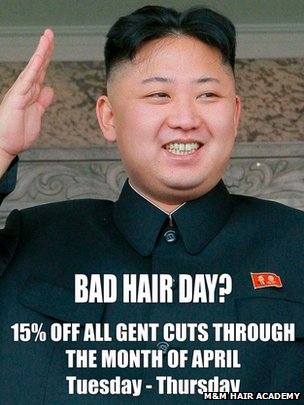
Kim Jong Un bad hair day adNorth Korean officials paid a visit to a London hair salon to question why it had used their leader Kim Jong-un’s picture in a poster offering haircuts.



The poster in M&M Hair Academy in South Ealing featured the words “Bad Hair Day?” below the leader’s picture.

Barber Karim Nabbach said embassy officials were shown the door and the salon’s manager spoke to the police.

The Met Police said: “We have spoken to all parties involved and no offence has been disclosed.”

The salon put up the poster on 9 April and the next day two men claiming to be officials from the North Korean embassy visited the salon and demanded to meet the manager, Mo Nabbach.

Karim Nabbach said: “We put up posters for an offer for men’s hair cuts through the month of April. Obviously in the current news there has been this story that North Korean men are only allowed one haircut.

H/T to Eric for the link.

April 15, 2014

Ukraine suffering Russian version of “Death by A Thousand Cuts”

Filed under: Europe, Military, Politics, Russia — Tags: , , , — Nicholas @ 08:02

In the Telegraph, former UK ambassador Charles Crawford says that Vladimir Putin is using Ukraine as a testing ground for rebuilding a new Russian empire:


Russian President Vladimir Putin visits the Cosmonautics Memorial Museum on April 11, 2014 in Moscow, Russia. Russia celebrates the Cosmonaut Day, marking the pioneering flight into space of Yuri Gagarin on April,12,1961.

It is no exaggeration to say that the historic deal that ended the Cold War is now unravelling. That deal was simple. Russia itself (largely on its own initiative) ended the Soviet Union in favour of a bold democratic modernisation process to be achieved in partnership with Western capitals. Confrontation in Europe and around the world would be replaced by cooperation. Huge sums of Western money would be made available to Russia on generous terms, to help it move from communism to sane economic and security policies. All the other Soviet republics would become independent countries and begin their own transitions in a similar partnership spirit.

[…]

Outside Russia’s already vast borders Putin is throwing down a momentous challenge to the rest of the world: “What if Russia drops all this namby-pamby European soft-power rubbish and decides instead to reclaim one way or the other historic Russian lands?”

That question does not fit any category of thinking that today’s Western leaders and their advisers can muster. Western leaders have come to see agreed rules and interminable meetings as a source of strength. Putin sees agreed rules and boring meetings as a source of weakness. Hence the Western and wider international response is muted and uncertain. The focus is on stepping up “economic pressure” on Russia in general and key Russians in particular. There is logic to this. Europe needs Russian energy, but Russia needs European money. Russia really has moved on from the Cold War period and joined the international marketplace. It ought to be impressed by the threat of investment bans and other targeted financial measures.

That approach does not, however, address the key problem. Putin might see the Russian economy hurting and ask Russians another question: “What if we reclaim historic Russian lands but at the cost of eating turnips again for a while?” A noisy majority of Russians might think that that is a sacrifice well worth making. This gives Putin hard policy options unavailable to Western leaders, for whom any equivalent question would be electoral suicide.

Ukraine is now the luckless space where Putin is experimenting with different ways to roll back the Cold War settlement and then reassert Russian imperial power in other parts of the former Soviet Union. Crimea has been annexed, but the rest of Ukraine is far bigger and much more complicated. All sorts of methods are being deployed both in Ukraine and through a sophisticated global propaganda operation to destabilise Ukraine. The key immediate goal is to make Ukraine ungovernable except on Russia’s terms. This means preventing a new legitimate government emerging in the forthcoming elections.

April 14, 2014

Canada’s potential influence in East Asia

Filed under: Cancon, China, History — Tags: , , — Nicholas @ 00:01

In The Diplomat, Anthony V. Rinna looks at Canada’s rather history of diplomatic and cultural exchanges with China:

Canadian Prime Minister Stephen Harper has noticeably changed his stance toward China. Previously, the Conservative prime minister maintained a hard line against the PRC based on what he perceived as a poor human rights record. That position has softened over recent years. This seems to be part of a broader strategy aimed at transforming Canada, traditionally Atlanticist in its political leanings, into a leading actor in the Asia-Pacific. Specifically there is ample opportunity for Canada and China to enter into a symbiotic energy relationship. China of course desperately needs energy, and wants a diverse base of suppliers. Canada, in turn, is a major energy producer and exporter and would find a very willing customer in China.

Among the Western democracies, Canada has something of a history as a catalyst vis-à-vis the West’s relations with China. Canadian Prime Minister Pierre Trudeau was the first Western leader to open up to China, starting in 1970 when Canada officially recognized the government in Beijing as the legitimate government of the land (and the stage had been set for this by Trudeau’s predecessor, John Diefenbaker). Although Hugh Stevens of TransPacific Connections attributes Canada’s renewed interest in strengthening ties with China in part to following the lead of the U.S. “pivot” toward Asia, Canada has the potential to again be a leader and innovator in its own right. Canada’s own unthreatening position can only help.

While Canada’s relationship with China is largely based on trade and investment, military relations between Canada and China continue to develop apace, well beyond the conventional placement of military attachés at each country’s respective embassies in Beijing and Ottawa. In March 2012, then-Canadian Chief of Staff General Walter Natyncyk participated in a high-level visit to China and met with top brass from the People’s Liberation Army. In August 2013, Robert Nicholson, who had become Canada’s Minister of Defence only a month earlier, held talks with his Chinese counterpart Chang Wanquan on deepening Sino-Canadian military cooperation.

[…]

Canada has used its position to ease Asia-Pacific tensions in the past, for instance during the South China Sea Dialogues in the mid-1990s. James Manicom of the Centre for International Governance Innovation argues that the Track II-style of Canadian involvement in the 1990s may no longer be appropriate or effective given the rise in regional tensions. Nevertheless, as Canada’s military engagement with China increases, this still leaves the possibility of Canada playing a role in soothing regional tensions on an official level.

Ottawa has positive relations with the other states with territorial interests and disputes in the South China Sea. For instance, 49 percent of Indonesians say they have a positive view of Canada (and only 16 percent express a negative view). In line with its progressive stance toward China in the 1970s, Canada also recognized Vietnam diplomatically toward the end of the U.S.-led Vietnam War (whereas the U.S. only normalized relations with that country late in the administration of President Bill Clinton). Thus, Canada may be in a position to assist not only as a third node in a Canada-China-U.S. strategic triangle, but also to use its own diplomatic clout hand-in-hand with its growing military ties to China to work between China, the U.S. and U.S. partners in the region, many of whom have called for American assistance in counterbalancing China.

April 13, 2014

Japan does not understand how it is perceived overseas

Filed under: Government, History, Japan — Tags: , , — Nicholas @ 11:02

In The Diplomat, Robert Dujarric explains some of the odd behaviour of some Japanese politicians in dealing with and talking about other nations:

… why are outsiders so worried about Japanese militarism?

First, there is the “sheep in wolf’s clothing” posture of the Abe Cabinet. In barely more than a year it has engaged in an endless stream of symbolic or verbal provocations: pilgrimages to Yasukuni, participation at Takeshima Day rites, Abe-appointed NHK governors denying wartime sexual slavery and the Nanjing Massacre, discussions about revisiting the Kono Statement, and a convoluted speech by Deputy Premier Taro Aso on learning from the Fuehrer.

Second, many Japanese politicians don’t know how the rest of the world thinks. A telling example was the prime minister giving a thumbs up from the cockpit of Japanese Air Self Defense jet with tail number 731. That prompted memories of Imperial Japanese Army Unit 731, which performed gruesome experiments on Chinese, other Asians, Russians and some Westerners (and whose leaders received a “get out of jail card” courtesy of the United States). Yet the premier either didn’t notice the markings or didn’t realize what the impact would be, and then failed to fire his entire advance team afterwards. The “731 photo-op” was not unique. Aso’s trip to Yasukuni just after attending the inauguration of President Park Geun-hye of South Korea was another.

Third, Japan has an excellent but minute corps of diplomats and bureaucrats who excel at interaction with foreigners. Beyond this, though, most of its officialdom, including many in the Foreign Ministry, have not received the necessary training to, as the American expression goes, “make friends and influence people” overseas. The root causes lie in the inward-looking education system. Unfortunately, the government is blind to the requirement to provide extensive multi-year “remedial education” to the graduates it hires to ensure they are capable of functioning in a non-Japanese setting.

Also, Japan’s is a “closed shop.” Most Japanese who grew up overseas or have a parent from another country end up working for foreign companies or governments. Those best suited for interacting between Japan and the world are lost to the Japanese state.

Fourth, most Japanese officials view outsiders who criticize the LDP as hostile to Japan as a nation, which is generally not true. During a recent session with a Japanese diplomat, I mentioned a Western journalist in Tokyo. This reporter, whom I would describe as an open-minded left-winger, is neither a supporter of historical revisionism nor of Koizumi-Takenaka economics. Anyone who cares to read his prose will also notice a deep empathy for the Japanese people, an outstanding knowledge of the country, and a passion for Japanese culture. My Japanese interlocutor, however, saw him as a foe.

March 29, 2014

China’s “barbarian-handling tools” date back 2,000 years

Filed under: China, History, Military, Weapons — Tags: , , — Nicholas @ 09:35

Edward Luttwak describes the very first time China was able to bring powerful “barbarians” into a tributary state, and how that first success has become a key element of Chinese geostrategic thought ever since:

It is this successful transformation of a once superior power first into an equal (signified by imperial marriages) and then into a subservient client-state that seems to have left an indelible residue in China’s tradition of statecraft. It was achieved with a specific “barbarian-handling” tool box first described by its early practitioner, the scholar and imperial advisor Lou Jing (婁敬) 199 BCE. His method was first applied when the Xiongnú [匈奴 horse-nomad state] were still very strong and the Han were not only tactically inferior (their chariots were totally obsolete for fighting mounted archers) but also beset by political divisions, so much so that a 198 BCE4 treaty required the payment of an annual tribute in kind (silk, grain, etc.), and the formal attestation of equality for the Chanyu [Qagan, Khan] embodied in a marriage alliance, formalized by imperial letters that make the equality fully explicit.

The first barbarian-handling tool is normally translated as “corruption” in English translations, but perhaps “addiction,” or more fully “induced economic dependence” are more accurate: the originally self-sufficient Xiongnú were to be made economically dependent on Han-produced goods, starting with silk and woolen cloths instead of their own rude furs and felt. At first supplied free as unrequited tribute, these goods could still be supplied later on when the Han were stronger, but only in exchange for services rendered.

The second tool of barbarian handling, is normally translated as “indoctrination”: the Xiongnú were to be persuaded to accept the authoritarian Confucian value system and the collectivistic behavioral norms of the Han, as opposed to the steppe value system, based on voluntary allegiance to a heroic (and successful in looting) fighting and migration leader. One immediate benefit was that once the Chanyu’s son and heir married an imperial daughter, he would be ethically subordinated to the emperor as his father-in-law — remaining so when he became Chanyu in turn.

The much larger, longer-term benefit of the second tool was to undermine the entire political culture of the Xiongnú, and make them psychologically well as economically dependent on the imperial radiance, which was willingly extended in brotherly fashion when the Han were weak, and then contemptuously withdrawn when the Xiongnú were reduced to vassalage. What happened between the Han and the Xiongnú from the equal treaty of 198 BCE to the vassalage treaty of 51 BCE, remained thereafter, and still remains today the most hopeful precedent for Han dealings with powerful and violent states — evidently the assigned role of the United States in the present Beijing world-view.

The method forms a logical sequence:

Stage One: start by conceding all that must be conceded to the superior power including tribute, in order to avoid damage and obtain whatever forbearance is offered. But this in itself entangles the ruling class of the still-superior power in webs of material dependence that reduce its independent vitality and strength.

Stage Two: offer equality in a privileged bipolarity that excludes all lesser powers, or “G-2” in current parlance. That neutralizes the still powerful Other party, and isolates the manipulated soon-to-be former equal from all its potential allies, preventing from balancing China with a coalition.

Stage Three: finally, when the formerly superior power has been weakened enough, withdraw all tokens of equality and impose subordination.

Until the Chinese government decided — very prematurely I believe — to awaken the world to its classically imperial territorial ambitions by demanding the cession of lands, reefs, rocks, and sea waters from India, Japan, Malaysia, the Philippines, and Vietnam (demands that disturb and damage the concurrent Tianxia narrative of an alternative and more harmonious state system, disseminated even within the confines of Stanford University), it was making much progress towards Stage Two, the stage of equality preparatory to the final stage of subordination.

March 9, 2014

Prime Minister jets off to South Korea for trade deal photo-op

Filed under: Asia, Cancon, Economics — Tags: , , , — Nicholas @ 10:32

It’s not clear whether Prime Minister Stephen Harper is going to Seoul to actually sign a free trade agreement with South Korea or if it’s just another grip-and-grin photo-op to announce an as-yet-unfinalized deal:

Harper said on his 24 Seven webcast that this would be Canada’s first trade deal in the Asia-Pacific region.

“It adds, obviously, to the important deals we have in the Americas and in Europe now. And it’s really given the Canadian economy as good, if not better, free-trade access than virtually every major developed economy,” he said.

Harper added that South Korea is “a relatively open economy, a relatively, very progressive economy and advanced democracy, and it has trade linkages all through Asia itself.” He said it’s “probably the best gateway you can get into long-term trade agreement access into the Asia-Pacific region.”

NDP trade critic Don Davies said growing trade with South Korea and Asia in general is a good thing. But he was skeptical that the week’s coming ceremonies would amount to much more of a repeat of Brussels.

“Are they going to go just to shake hands, have a photo-op and sign an agreement-in-principle without the actual details or text to be released?”

Davies again assailed the government for a total lack of transparency, and questioned whether the deal would be able to protect jobs in Canada’s auto sector.

“In trade deals, it’s details that matter,” he said.

“The Conservatives have the least transparent trade policy probably in the developed world. They are closed, they are secretive and they don’t involve a lot of stakeholders; they don’t involve the opposition.”

The deal would mark progress toward expanding trade with Asia, a major economic priority of the Harper government. Coming on the heels of the Canada-EU pact, it would allow Prime Minister Stephen Harper to trumpet his first significant free-trade deal in Asia, and give impetus to other negotiations, particularly with Japan.

March 5, 2014

Vladimir Putin and the “vertical of power”

Filed under: Europe, Politics, Russia — Tags: , , — Nicholas @ 09:31

The BBC‘s Steve Rosenberg says that to understand what Russia is doing, you have to get into the mind of the man who controls it all:

One thing that makes Vladimir Putin mad is the feeling that he is being deceived. We saw that with Libya in 2011. Moscow was persuaded not to block a UN Security Council resolution on a no-fly zone to protect civilians. But Nato’s military action led to regime change and the death of Col Muammar Gaddafi — far beyond what Russia had expected. It helps explain why Russia has been quick to veto resolutions on Syria.

On Ukraine, too, President Putin feels the West has tricked him. Last month he sent his envoy to Kiev to take part in negotiations on a compromise agreement between President Viktor Yanukovych and the opposition. That deal, brokered by foreign ministers from Germany, France and Poland, envisaged early elections, constitutional reform and a national unity government.

The Kremlin’s representative did not sign the deal, but Russia appeared to accept it as the best solution in a bad situation. It remained words only. Less than 24 hours later, Mr Yanukovych was on the run, the parliament removed him from power and appointed a new acting president from the opposition. The pace of events took Moscow completely by surprise.

The world according to Vladimir Putin is one in which Western powers are plotting night and day to destabilise Russia (and him, personally).

He remembers the Rose Revolution in Georgia in 2003, the Orange Revolution in Kiev the following year; Russia suspected the West of planning both.

More recently the Kremlin accused the West of funding and fuelling anti-government street protests in Moscow.

For months, Russia has been accusing the US and EU of meddling in Ukraine for geopolitical gains. On Tuesday President Putin said Viktor Yanukovych’s refusal to sign an association agreement with the EU last autumn “was simply used as an excuse to back opposition forces in their battle for power… it’s not the first time our Western partners have done this in Ukraine”.

March 4, 2014

Obama’s Netanyahu media ambush claims one casualty – the peace process

Filed under: Middle East, USA — Tags: , , , — Nicholas @ 11:14

Jonathan Tobin identifies the problem with President Obama’s pre-emptive media strike against Israeli Prime Minister Netanyahu:

President Obama may have thought he was being very clever ambushing Prime Minister Netanyahu with scathing comments about Israeli policies that would be published just before he arrived in the United States for a meeting at the White House and to speak at the annual conference of the American Israel Public Affairs Committee (AIPAC). By slamming Netanyahu’s policies as the primary, if not the sole obstacle to peace in the Middle East, in the now infamous interview with Bloomberg’s Jeffrey Goldberg, the president put the Israeli on the defensive and undermined his attempts to rally support for his positions with both AIPAC members and Congress. That should also have made it more difficult for Netanyahu to resist American pressure to make concessions to the Palestinians in order to help the negotiations sponsored by Secretary of State John Kerry succeed. But the president’s move had to leave those who have actually been following the talks with the Palestinians scratching their heads.

Kerry’s current objective is to get both parties to agree to a framework for continued talks. As has been widely reported, Netanyahu has already signaled his consent to the framework even though he and his Cabinet have grave misgivings about where the talks may eventually lead. By contrast, the Palestinians have repeatedly and publicly rejected the framework. The Palestinians have angrily rejected the framework’s requirement that they recognize Israel as a Jewish state, which is to say they agree to end the conflict rather than merely pause it. They also reject the West Bank security guarantees included in the framework even though it also contains their basic demands about a Palestinian state whose borders will be based on the 1967 borders while leaving open the possibility of territorial swaps. In other words, the Israelis have already given Kerry what he wanted while the Palestinians have done the opposite. Yet Obama still treats Israel as the truant and lauds Palestinian Authority leader Mahmoud Abbas as a trustworthy warrior for peace even though his government is a font of incitement for hatred against Jews and Israelis and he has repeatedly rejected every previous offer of statehood because he and his people remain unable or unwilling to recognize the legitimacy of a Jewish state no matter where its borders are drawn.

By speaking in this manner about Israel, Obama has pleased the Palestinians, Netanyahu’s Jewish critics and Israel-bashers everywhere. But it will also do something else that perhaps the president never intended. He has killed any chance that Kerry’s peace talks could possibly succeed.

The problem isn’t Israel (although they’ve made the situation tougher to resolve in several ways): the problem is that no Palestinian leader dares to accept any proposal that explicitly accepts Israel’s right to exist. If Abbas agreed to that, Abbas himself would probably cease to exist in short order. Arafat at the height of his power didn’t dare to take that step, and no Palestinian leader since Arafat has had as much control, power, or influence among the factions and groups that loosely form Palestine politically. This is known to the American government — it can hardly be much of a secret — but for political reasons it can’t be stated. If one side cannot possibly agree, then in the looking glass world of diplomacy, you must berate the other side for their intransigence. It doesn’t matter who is President … this is the reality that must be ignored or wished away (because it’s not going away on its own).

QotD: Back to the 19th century in geostrategy

Filed under: Politics, Quotations, USA — Tags: , , , — Nicholas @ 10:37

… incrementally all these tiny tesserae began forming a mosaic, fairly or not, of the Obama administration as either weak or clueless or perhaps both.

Accordingly, Mr. Putin, in empirical fashion, after factoring in the rhetoric and the facts, has decided that it is time, in the fashion of 1979–80, to move with probable impunity. Others are, of course, watching what Obama derides as Cold War chess games. Should Iran now go full bore on its nuclear program? Should China test Japanese waters and airspace a bit more aggressively? Should North Korea try to gain new concessions from its nuclear lunacy? Should the failed Communists of Latin America try forcibly exporting their miseries to neighbors? And all are operating on the shared assumption that the American reaction will be another “outrageous,” “unacceptable,” “don’t cross this line,” or another solemn Kerry lecture about the existential threats of global warming.

For some, like the now furrow-browed Europeans who once giddily lapped up the Victory Column pabulum, there is irony. For the Baltic states, Georgians, the Persian Gulf sheikdoms, the Japanese, the Taiwanese, and the South Koreans, there is increased anxiety about regional strains of Putinism spreading to their own backyards. And among our allies such as the British, Israelis, Canadians, and Australians, there is still polite bewilderment.

This will probably end in either two ways: Either Barack Obama will have his 1980 Jimmy Carter revelatory moment as something like an “Obama Doctrine,” or we could see some pretty scary things in the next three years as regional thugs cash in their chips and begin readjusting the map in their areas of would-be influence.

Victor Davis Hanson, “The Stepping Stones to the Ukraine Crisis”, VDH’s Private Papers, 2014-03-03

February 12, 2014

Spain reconsidering law that makes them venue of choice for international cases

Filed under: China, Europe, Law — Tags: , , — Nicholas @ 08:38

Another day, another non-Spanish leader or ex-leader being charged with crimes against humanity in a Spanish court … but perhaps not for long:

Spain’s MPs voted on Tuesday to push forward with a bill that limits the power of Spanish judges to pursue criminal cases outside the country, a move that human rights organisations said would end Spain’s leading role as an enforcer of international justice.

Last month, the ruling People’s party (PP) tabled a fast-track legal change to curb the use of universal jurisdiction, a provision in international law that allows judges to try cases of human rights abuses committed in other countries. Since being adopted into Spanish law nearly two decades ago, the doctrine has allowed Spanish judges to reach beyond their borders and investigate serious human rights abuses in countries such as Argentina, Rwanda and Guatemala.

Its use put the Spanish justice system into the headlines at times — most famously for the 1998 arrest of the Chilean dictator Augusto Pinochet in London.

“This reform makes it even harder to probe into severe human rights abuses,” said Ignacio Jovtis, of Amnesty International Spain. “It’s a step backwards for human rights and justice.”

Nearly two dozen international human rights groups have spoken out against the change, calling it political interference in the justice system and urging the government to abandon the reform.

It’s one thing to provide a venue for pursuing violations of civil rights, but it’s quite another to allow your justice system to become an international laughingstock. Spain’s legal system has come dangerously close to the latter with the current law in place. It certainly has created some awkward situations like this:

MPs voted to push ahead with the move a day after a court in Spain ordered Interpol to issue arrest warrants for the former Chinese president Jiang Zemin, as well as four senior Chinese officials, over alleged human rights abuses in Tibet decades ago.

The arrest orders come just as Spain is seeking to lift its sagging economy by deepening trade relations with the Asian superpower.

China issued a sharp rebuke, leaving little question that the issue had strained ties between the two countries. “China is strongly dissatisfied and firmly opposed to the erroneous acts taken by the Spanish agencies in disregard of China’s position,” said a foreign ministry spokeswoman, Hua Chunying, at a daily briefing.

« Newer PostsOlder Posts »

Powered by WordPress