
Whenever I first heard the word “microaggression,” sometime in the last five years, I’m sure I was unaware how big “micro” could get. The accusation of a microaggression was about to become a pervasive feature of the Internet, and particularly social media. An offense most of us didn’t even know existed, suddenly we were all afraid of being accused of.
We used to call this “rudeness,” “slights” or “ignorant remarks.” Mostly, people ignored them. The elevation of microaggressions into a social phenomenon with a specific name and increasingly public redress marks a dramatic social change, and two sociologists, Bradley Campbell and Jason Manning, have a fascinating paper exploring what this shift looks like, and what it means. (Jonathan Haidt has provided a very useful CliffsNotes version.)
Western society, they argue, has shifted from an honor culture — in which slights are taken very seriously, and avenged by the one slighted — to a dignity culture, in which personal revenge is discouraged, and justice is outsourced to third parties, primarily the law. The law being a cumbersome beast, people in dignity cultures are encouraged to ignore slights, or negotiate them privately by talking with the offender, rather than seeking some more punitive sanction.
Microagressions mark a transition to a third sort of culture: a victim culture, in which people are once again encouraged to take notice of slights. This sounds a lot like honor culture, doesn’t it? Yes, with two important differences. The first is that while victimhood is shameful in an honor culture — and indeed, the purpose of taking vengeance is frequently to avoid this shame — victim status is actively sought in the new culture, because victimhood is a prerequisite for getting redress. The second is that victim culture encourages people to seek help from third parties, either authorities or the public, rather than seeking satisfaction themselves.
Megan McArdle, “How Grown-Ups Deal With ‘Microaggressions'”, Bloomberg View, 2015-09-11.
September 5, 2017
QotD: Microaggressions
August 31, 2017
Words and Numbers: Do Americans still have freedom of speech?
Apparently, James and Antony have given up the YouTube version of Words and Numbers and reverted to an audio-only version (at least I can still embed the player version):
These days, everybody is nervous about what you can say in public without getting slammed by retribution. But is that a free-speech problem, or does it only become one when the police start showing up? Do we live in a truly tolerant society if voicing an opinion, even if it doesn’t land you in jail, ends up ending your career? Antony and James explore these intricate issues.
August 30, 2017
QotD: Democratic education
… a passage transcribed from one of Étienne Gilson’s public lectures in the early 1950s, and let it be said that a man in the Deep South who signs himself N.W. Flitcraft, found it first. (He is here.) Gilson has been one of my own “heroes,” or guiding lights, these last few decades:
“If our school system exists, not in view of a chosen minority, but in view of all, its average level should answer the average level of the population as a whole. Hence the unavoidable consequence that the best gifted among the pupils will be discriminated against. Nor should we imagine that creative minds will multiply in direct proportion to the growth of the school population. The reverse is much more likely to happen. In aristocratic societies, genius has often found access to higher culture, even under adverse circumstances; in democratic societies, it will have no higher culture to which to gain access. Since equality in ignorance is easier to achieve than equality in learning, each and every teacher will have to equalize his class at the bottom level rather than at the top one, and the whole school system will spontaneously obey the same law. It is anti-democratic to teach all children what only some of them are able to learn. Nay, it is anti-democratic to teach what all children can learn by means of methods which only a minority of pupils are able to follow. Since, as has been said, democracy stands for equality, democratic societies have a duty to teach only what is accessible to all and to see to it that it be made accessible to all. The overwhelming weight of their school population is therefore bound to lower the centre of gravity in their school systems. The first peril for democracies, therefore, is to consider it their duty, in order to educate all citizens, to teach each of them less and less and in a less and less intelligent way.”
Pause, gentle, then read that through again, until committed to memory. I cannot think of a better single-paragraph explanation of how John Dewey’s “democratic vistas” sent us all to hell. Verily, I wish I’d been armed with that when asked, some forty-six years ago, why I was leaving school with only a Grade X education (plus, to be fair to me, nearly one full term of Grade XI). It explains everything, in less than three hundred words.
David Warren, “Democracy versus God”, Essays in Idleness, 2015-11-10.
August 25, 2017
August 22, 2017
QotD: Writing about the past
If you’re writing in the past — or even if you are just living in the present — you should have an idea of how the past was different, and the factors that shaped that.
If you assume the past was just like the present only less “enlightened” you’re presupposing history comes with an arrow, and that today is of course more “advanced” than the past. While this is true of science — of course — it’s not always true of what was inside people’s heads. In many ways because even the poorest of us struggle less than in the Middle Ages, it’s become easier to develop mental habits of laziness and other “rich person” vices. What you think is enlightenment might be considered sheer nonsense by your descendants. For instance the enlightened thing at one time (even Heinlein has a whiff of it) was genetic culling. Now we’re finding that what we know about genes isn’t that straightforward. Throw in epigenetics and someone with a gene to be a “moron” can turn out to be a genius. More, even overtly bad disease genes are linked to genes we need and can’t survive without. BUT the enlightened opinion in the early twentieth century was to improve humanity and save human suffering by culling out the sick and the lame and the “inferior races.” (No, Hitler didn’t invent that.)
Some of our concepts (and I’m not going to name any because it’s a fight I don’t need, but I’m sure you can think of some) will prove just as monstrous to our descendants.
If you don’t have a sense of that, you don’t have a sense of the past, which unfortunately means you don’t have a sense of the present.
If you think that there is an objective way to end poverty or stop drug use, or whatever, and it’s ONLY your way, and even your opponents think your way is right and are being villainous and “evil” by opposing it you not only shouldn’t be writing historical fiction, you definitely shouldn’t be voting. You should find the nearest kindergarten and use it as a safe space.
Because out here in the real adult world, the past and the present and complicated places, with different modes of arranging life that worked with the circumstances at that time, even if they now set our teeth (or our hair) on edge.
If you can’t accept your ancestors were different from you, thought differently and responded to different necessities, you have no business preaching multiculturalism.
Because what makes a culture different is not the hairstyles, the dresses or what they ate, but how one must live to survive. And yes, some cultures are factually worse than others at providing their people with the necessities (or the luxuries) of life. Arguably most past cultures were (barring our finding some atlantian high-developed scientific culture we’ve heard nothing about.)
That doesn’t give you the right to to stomp your feet and rewrite the past to justify your boorish self-regard in the present.
Your ancestors were both more and less enlightened than you in ways you can’t even understand, and your superimposing your beliefs on them is the act of a mental midget standing on the shoulders of giants and peeing down.
Sarah A. Hoyt, “What Has Gone Before Us”, According to Hoyt, 2015-08-03.
August 7, 2017
How to Swear Like a Brit – Anglophenia Ep 29
Published on 20 May 2015
Swearing is a fun stress reliever, and the British do it so well. Anglophenia’s Kate Arnell provides a master class in swearing like a Brit.
August 6, 2017
Shock, horror – “local or organic food is … often available only in Canada to the wealthy”
Chris Selley just got back from a European vacation, where he observed some odd German activity:
Last month, on vacation, I happened across what might be the platonic ideal of a fancy urban farmers’ market. The smell of wood smoke led me to a quiet street in Berlin’s leafy Prenzlauer Berg neighbourhood, where a man was smoking various kinds of fish in the middle of the road. As one does. There was a little mobile bicycle-powered coffee shop selling vastly overpriced espresso. There was the requisite improbably expensive produce and charcuterie and cheese. (My God, the cheese. Why do Canadians put up with our benighted dairy industry?) And to shock my Ontarian senses, there was a big booth selling local wines — which one could drink, out of glasses, in whatever quantities one saw fit, right there out in the open. Tipplers weren’t even confined to a secure pen. There wasn’t even a security guard!
Even more than at Toronto’s fancier farmers’ markets, it was abundantly clear this was a place for wealthy people with time to spare. And it never occurred to me that was a problem. A new study co-authored by Kelly Hodgins and Evan Fraser of the University of Guelph suggests it is, however — and a recent headline on the matter made my eyes roll so far back in my head I feared they might get stuck: “Access to ‘ethical’ food often available only to the wealthy, study says.”
“While eating local or organic food is often touted as superior from a health, environmental and oftentimes ethical perspective, such foods are often available only in Canada to the wealthy, with limited access for those living on lower or even middle incomes,” The Globe and Mail reported.
I know. I’m just as shocked as you are. Who would ever have expected that?
August 5, 2017
“… theirs is a generation shaped by the smartphone and by the concomitant rise of social media. I call them iGen”
In The Atlantic, “Gen Xer” Jean Twenge is worried about the ways the new generation differ from their Millennial predecessors:
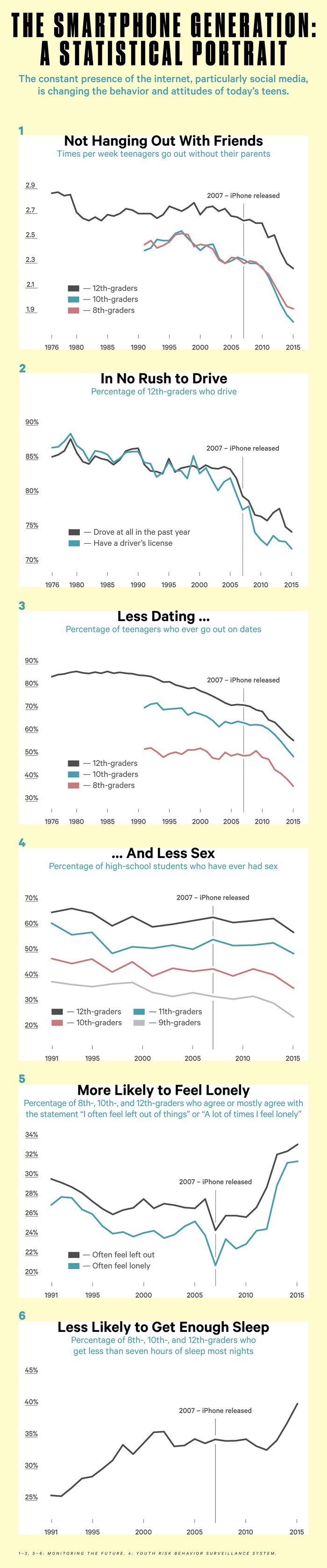
I’ve been researching generational differences for 25 years, starting when I was a 22-year-old doctoral student in psychology. Typically, the characteristics that come to define a generation appear gradually, and along a continuum. Beliefs and behaviors that were already rising simply continue to do so. Millennials, for instance, are a highly individualistic generation, but individualism had been increasing since the Baby Boomers turned on, tuned in, and dropped out. I had grown accustomed to line graphs of trends that looked like modest hills and valleys. Then I began studying Athena’s generation.Click to see full-size image
Around 2012, I noticed abrupt shifts in teen behaviors and emotional states. The gentle slopes of the line graphs became steep mountains and sheer cliffs, and many of the distinctive characteristics of the Millennial generation began to disappear. In all my analyses of generational data — some reaching back to the 1930s — I had never seen anything like it.
At first I presumed these might be blips, but the trends persisted, across several years and a series of national surveys. The changes weren’t just in degree, but in kind. The biggest difference between the Millennials and their predecessors was in how they viewed the world; teens today differ from the Millennials not just in their views but in how they spend their time. The experiences they have every day are radically different from those of the generation that came of age just a few years before them.
What happened in 2012 to cause such dramatic shifts in behavior? It was after the Great Recession, which officially lasted from 2007 to 2009 and had a starker effect on Millennials trying to find a place in a sputtering economy. But it was exactly the moment when the proportion of Americans who owned a smartphone surpassed 50 percent.
The more I pored over yearly surveys of teen attitudes and behaviors, and the more I talked with young people like Athena, the clearer it became that theirs is a generation shaped by the smartphone and by the concomitant rise of social media. I call them iGen. Born between 1995 and 2012, members of this generation are growing up with smartphones, have an Instagram account before they start high school, and do not remember a time before the internet. The Millennials grew up with the web as well, but it wasn’t ever-present in their lives, at hand at all times, day and night. iGen’s oldest members were early adolescents when the iPhone was introduced, in 2007, and high-school students when the iPad entered the scene, in 2010. A 2017 survey of more than 5,000 American teens found that three out of four owned an iPhone.
The advent of the smartphone and its cousin the tablet was followed quickly by hand-wringing about the deleterious effects of “screen time.” But the impact of these devices has not been fully appreciated, and goes far beyond the usual concerns about curtailed attention spans. The arrival of the smartphone has radically changed every aspect of teenagers’ lives, from the nature of their social interactions to their mental health. These changes have affected young people in every corner of the nation and in every type of household. The trends appear among teens poor and rich; of every ethnic background; in cities, suburbs, and small towns. Where there are cell towers, there are teens living their lives on their smartphone.
It could be that the widespread use of available technology to “virtualize” adolescence is at least to a degree a reaction to helicopter parenting.
H/T to Kate at Small Dead Animals for the link.
July 28, 2017
QotD: Soviet agitprop still echoes today
Stalinist agitprop created Western suicidalism by successfully building on the Christian idea that self-sacrifice (and even self-loathing) are the primary indicators of virtue. In this way of thinking, when we surrender our well-being to others we store up grace in Heaven that is far more important than the momentary discomfort of submitting to criminals, predatory governments, and terrorists.
The Communist atheists of Department V understood that Christian self-abnegation tends to inculcate a cult of self-sacrifice even among Westerners who are themselves agnostics or atheists. All the propagandists had to do was make the case that the value of self-abnegation applies to culture as well as individuals. By doing so, they were able to entrench the idea that suicidalists are morally superior to non-suicidalists.
They did this so successfully that at least one major form of Western self-abnegation seems to have developed as a secondary phenomenon: “deep environmentalism”. I can’t find any sign that this traces back to the usual Stalinist suspects, but it is rather obviously a result of generalizing suicidalism not just to culture but to species.
I think it’s important to understand that, although suicidalism builds on some pre-existing pathologies of Western culture, it is not a native or natural development. It is an infection that evildoers and their dupes created and then spread as part of a war against the West; their goal was totalitarian control, and part of their method was to talk the West into slitting its own throat.
Eric S. Raymond, “Suicidalism”, Armed and Dangerous, 2005-09-13.
July 17, 2017
The Bronze Age Collapse – IV: Systems Collapse – Extra History
Published on 15 Jul 2017
It started with famine… and ended with four great civilizations’ utter destruction. The Bronze Age Collapse is still a matter of scholarly debate, but our favorite theory rests on an understanding of Systems Collapse and how societies build themselves to survive disaster.
July 12, 2017
The Bronze Age Collapse – II: The Wheel and the Rod – Extra History
Published on Jul 1, 2017
Bronze Age societies built intricate networks of trade, advanced military infrastructure, and hugely organized central governments. But when crucial parts of those systems began to disappear, the societies built on them began to crumble.
QotD: Modern myth-making
… evidence of myth making is everywhere, and not just in the far past, when it’s easier to swallow just-so stories.
There seems to be this strange idea that we must tell stories of the world as we wish it to be and then it will automagically become so. And because no part of the world, and no time in History can compare to Western society in the current times (and very few can compare to the United States of America) the way to bring their stories into existence is to tell us how bad we are in comparison to everyone else.
The fact that this is a blatant lie doesn’t matter. They still do it.
They are convinced, if they can shame us with these imaginary superior cultures that we will somehow adopt the ways they want us to.
One egregious demonstration of this is the claim that other times and places were more tolerant of different sexual personas. This one makes me want to SCREAM because… well… define “more tolerant.”
Traditional societies often had niches for sexually different people, including but not limited to those who lived as the opposite sex. BUT when the ignorant parrots of the western world go on about this stuff, they usually know just enough about the other culture to project all sorts of happy thoughts upon it. The thing is that assuming the persona and lifestyle of the opposite sex was often not a choice, and not because the person “felt” one way or another. Certain social circumstances dictated a certain change. Like, in Romania (I think) a woman whose brothers have been killed was almost required to assume a male persona in order to support the family. Whether she wanted to or not. And I have a vague idea that in certain parts of India, a woman who cannot find a husband is allowed to “marry” another woman. Note there is no mention made of sexual desire for her own gender. It’s more a matter of fitting neatly into society.
Sarah A. Hoyt, “Inventing the Past — The Great Divorce”, According to Hoyt, 2015-09-23.
July 10, 2017
The Bronze Age Collapse – I: Before the Storm – Extra History
Published on Jun 24, 2017
Egyptians. Hittites. Assyrians. Myceneans. Long ago, these four Bronze Age civilizations lived together in a healthy system of trade, agriculture, and sometimes warfare. But then, everything changed when the Sea People attacked.
July 8, 2017
The past was not just like today in fancy dress
My QotD entry yesterday (The Marxist influence on modern “Regency” romances) gets an interesting echo in this article by Megan McArdle:
Open a historical novel, and you’ll find characters who would, sexually speaking, not have much difficulty fitting into the 21st century dating scene. Authors usually pay lip service to the era’s taboos, and sometimes use them as plot devices. But even there, the assumption is that what is being suppressed, or happening on the sly, is pretty much the same as what 21st century Americans enjoy, or wish they were enjoying. Humans have been having sex for millions of years. How different could it have been?
Quite, argues sociologist Gabriel Rossman. (The link is frank, but not prurient.) Ask an anthropologist, or a classicist, just how different it can be. Even things that look superficially similar — Greek tolerance toward homosexuality, for example — turn out upon closer examination to have been quite different. It wasn’t what we call “homosexuality”; neither the social nor the physical activity resemble a modern gay couple all that closely.
Since this is a family column, I will leave the frank discussion to Professor Rossman. But a couple of less … er … colorful examples may suffice to illustrate just how culturally and time specific sex actually is.
Take kissing. Pretty basic, yes? We might imagine that the cultural rules for when people kiss would vary, as indeed they do in our own culture, where very orthodox religious groups proscribe it before marriage, and libertines kiss strangers on national television. But it’s hard to imagine that the activity itself really varies all that much.
Except it does. For starters, a whole lot of cultures don’t kiss, at least romantically. It isn’t necessarily proscribed; they just don’t do it. The idea that kissing is a foundation for further sexual activity is to us so natural that it rarely occurs to any of us to question it, and yet, this is apparently a learned behavior, not an instinctive one, because in large cultural areas it is seen as weird and doesn’t happen.
(And so it is, if you think about it. If you enjoy kissing, I recommend not thinking about it very hard.)
Is sex the same, without the kiss? In some aspects, obviously. And yet try to imagine the West’s romantic literature, its poetry, its art and film, without the kiss. The result feels different not just in degree, but in kind.
July 3, 2017
Meet the Romans with Mary Beard 3/3 – HD
Published on 16 May 2013
1. All Roads Lead to Rome
2. Street life
3. Behind Closed Doors


