Quotulatiousness

June 18, 2012

Legal pratfalls ensue

Filed under: Law, Liberty, Media, USA — Tags: , , , , , — Nicholas @ 09:33

Scott H. Greenfield at the Simple Justice blog on how the legal equivalent of “two 12-year-olds rolling in the mud” morphed into a lawyer beclowning himself in an epic fashion:

But Matthew Inman, who does the Oatmeal, put the lawyer Charles Carreon’s letter demanding $20k on the web, with his own special touches, in a masterful response, one aspect of which was that rather than succumb to Carreon’s demand, he would raise some money for charity.

[. . .]

Three things to note: First, Carreon started suit in his own name, not that of his client, which suggest that this is for the wrong done him by the mean children of the internet. Second, he’s sued not only Inman, apparently for “incitement to cyber-vandalism,” but the Indiegogo, which handles charitable collections, as well as the two charities to whom Inman’s collection goes.

This is nuts. For a fellow who foolishly stepped in shit, he’s doubled quadrupled down. My guess is that he’s included the charities as stakeholders or beneficiaries of Inman’s actions, and wants the money collected to go to him rather than to fighting cancer or saving bears. He wants money collected to fight cancer to go to him instead. It’s unthinkable [that] anyone could do such a thing.

April 28, 2012

Charles Stross analyzes the economic and technical arguments for removing DRM on ebooks

Filed under: Books, Business, Economics, Media — Tags: , , , — Nicholas @ 00:08

A post at Charles Stross’s blog from earlier this week, when Macmillan announced that they were removing DRM from their ebook lines:

After I recommended that the major publishers drop mandatory DRM from their ebook products, I realized that my essay had elided a bunch of steps in my thinking, and needed to reconsider some points. Then I realized that it’s not a simple, straightforward argument to make. Consequently, I ended up writing another essay, although I’ve tried to summarize my conclusions below.

First, my conclusions:

1. The rapid current pace of change in the electronic publishing sector is driven by the consumer electronics and internet industry. It’s impossible to make long term publishing plans (3-10 years) without understanding these other industries and the priorities of their players. It is important to note that the CE industry relies on selling consumers new gadgets every 1-3 years. And it is through their gadgets that readers experience the books we sell them. Where is the CE industry taking us?

2. Dropping DRM across all of Macmillans products will not have immediate, global, positive effects on revenue in the same way that introducing the agency model did …

3. However, relaxing the requirement for DRM across some of Macmillans brands will have very positive public relations consequences among certain customer demographics, notably genre readers who buy large numbers of books (and who, while a minority in absolute numbers, are a disproportionate source of support for the midlist).

4. Longer term, removing the requirement for DRM will lower the barrier to entry in ebook retail, allowing smaller retailers (such as Powells) to compete effectively with the current major incumbents. This will encourage diversity in the retail sector, force the current incumbents to interoperate with other supply sources (or face an exodus of consumers), and undermine the tendency towards oligopoly. This will, in the long term, undermine the leverage the large vendors currently have in negotiating discount terms with publishers while improving the state of midlist sales.

Now the details:

April 20, 2012

Reason.tv: Too Much Copyright

Filed under: Law, Liberty, Media — Tags: , , , , , , , — Nicholas @ 07:45

“This disconnect between the public’s view of copyright and fair use and what should and should not be prosecuted, versus the ‘copyright maximist’ view of the law, is our generation’s Prohibition,” says Ben Huh, CEO and founder of Cheezburger and a loud voice in the recent backlash to SOPA and PIPA, two congressional bills aimed at curbing internet piracy.

Copyright exists to “promote the useful arts” according to the Constitution. But is it still doing that? And should the government protect so-called “intellectual property” in the same way it protects other forms of property? Reason.tv posed these questions to Ben Huh, as well as a professor and a movie studio representative.

Tom Bell, a law professor specializing in property law, has serious reservations about attempts by groups like the Motion Picture Association of America (MPAA) to equate property and copyright through ad campaigns admonishing viewers with messages like, “You wouldn’t steal a car. Downloading pirated movies is stealing.”

“As soon as we start using [the word] ‘copyright’ for ‘property,’ we start taking less seriously our property rights for things like cars and houses,” says Bell. “When you steal a candy bar or a car, you’ve left somebody without something to eat or something to drive.”

April 14, 2012

Colombia tries to butter up Obama with “quickie” SOPA rules

Colombia buckles under intense US lobbying to introduce SOPA-like copyright rules in time for President Obama’s visit:

President Obama is heading to Colombia this weekend for a summit, and we’d been hearing stories that US officials had been putting tremendous pressure on Colombian officials to pass new, ridiculously draconian copyright laws ahead of that visit. So that’s exactly what the Colombian government did — using an “emergency procedure” to rush through a bad bill that is quite extreme.

Earlier this year, Colombia tried to pass basically the same bill, which was called LesLleras, after Interior Minister German Vargas Lleras (who proposed it). That bill was so extreme that it resulted in SOPA-like protests, following significant concerns raised by the public as well as copyright and free speech experts. So, this time around, the government just claimed it was an emergency and rushed the bill through, despite all of its problems. They seemed to think that the public wouldn’t notice — but they’re wrong.

As is typical of idiotic trade agreements pushed via the USTR — who only seems to listen to Hollywood on these issues — the copyright bill includes all sorts of draconian enforcement techniques and expansions of existing copyright law, and removal of free speech rights. But what it does not include are any exceptions to copyright law — the very important tools that even the US Supreme Court admits are the “safety valves” that stop copyright law from being abusive, oppressive and contrary to freedom of speech

March 16, 2012

Copyright MathTM

Filed under: Economics, Media, Technology — Tags: , , , — Nicholas @ 13:38

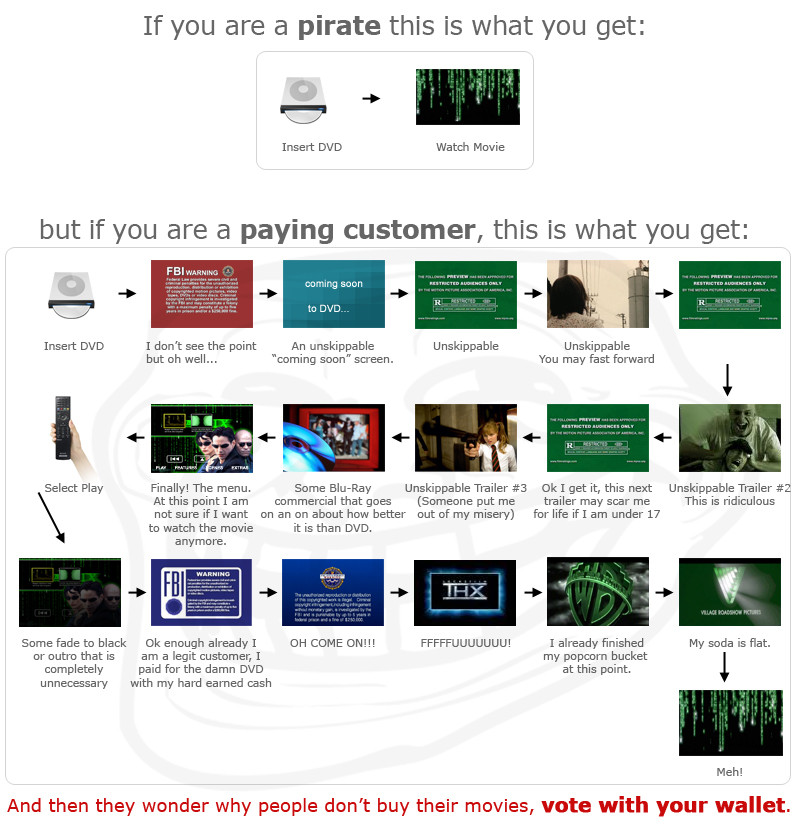
Now remember kids: always buy your movies and other entertainment items legally. You’ll get this kind of experience:

And here’s the reason you pay for a legal copy, rather than being one of those evil pirates:

Update, 21 March: The actual numbers — “by an actual Copyright Mathematician” — behind the Copyright MathTM video.

March 14, 2012

Michael Geist rounds up the changes to Bill C-11

Filed under: Cancon, Law, Liberty, Media, Technology — Tags: , , , , , , — Nicholas @ 11:58

It’s not wonderful, but as he points out, it could have been much worse:

In the days leading up to the clause-by-clause review, many focused on three key issues: no SOPA-style amendments such as website blocking or warrantless disclosure of information, maintaining the fair dealing balance found in the bill, and amending the digital lock provisions. By that standard, the changes could have been a lot worse. The government expanded the enabler provision, though not as broadly as CIMA requested. Virtually all other copyright lobby demands – website blocking, notice-and-takedown, iPod tax, copyright term extension, disclosure of subscriber information – were rejected. Moreover, the provisions supported by consumer and education groups including user generated content protection, time shifting, format shifting, backup copies, Internet provider liability, and statutory damages reform were left untouched. This represents a major victory for the many Canadians and groups such as Open Media that spoke out on these issues.

The fair dealing provision was similarly left unchanged despite a full court press from publishers and copyright collectives who sought elimination of the education category within fair dealing (didn’t happen), inclusion of the Berne three step test in the law (didn’t happen) or a new fair dealing test that overrules the Supreme Court of Canada CCH test (didn’t happen). The expanded fair dealing provision will not cause the horrors claimed by those groups and it is heartening that the government dismissed the misinformation campaign.

The only loss was the least surprising — digital locks. Despite widespread support for compromise legislation and sensible amendments from both the NDP and Liberals, the government rejected any changes. Given the government’s consistent support for digital locks, the ongoing pressure from the U.S., and Prime Minister Harper’s direct intervention on the issue in 2010, amending the digital lock rules presented a major challenge. Government MPs yesterday emphasized the possibility of future new exceptions via regulation but that will be cold comfort in the short term to those with perceptual disabilities, researchers, documentary film makers, consumers, and the many others adversely affected by the restrictive approach. In fact, one NDP MP raised the possibility of constitutional challenges to the bill.

EFF reports on most recent legal setback for former owners of Righthaven

Filed under: Law, Liberty, Media, Technology — Tags: , , , , — Nicholas @ 11:26

It’s pretty much good news all the way through for bloggers and anyone else who quotes and links to material on the web:

Late Friday, the federal district court in Nevada issued a declaratory judgment that makes is harder for copyright holders to file lawsuits over excerpts of material and burden online forums and their users with nuisance lawsuits.

The judgment — part of the nuisance lawsuit avalanche started by copyright troll Righthaven — found that Democratic Underground did not infringe the copyright in a Las Vegas Review-Journal newspaper article when a user of the online political forum posted a five-sentence excerpt, with a link back to the newspaper’s website.

March 2, 2012

The ugly twins: censorship and surveillance

Filed under: Government, Liberty, Media, Technology — Tags: , , , , , — Nicholas @ 10:27

Cory Doctorow in the Guardian:

There was a time when you could censor without spying. When Britain banned the publication of James Joyce’s Ulysses in the 1920s and 1930s, the ban took the form on a prohibition on the sale of copies of the books. Theoretically, this entailed opening some imported parcels, and it certainly imposed a constraint on publishers and booksellers. It was undoubtedly awful. But we’ve got it worse today.

Jump forward 80 years. Imagine that you want to ban www.jamesjoycesulysses.com due to a copyright claim from the Joyce estate. Thanks to the Digital Economy Act and the provision it makes for a national British copyright firewall, we’re headed for a system where entertainment companies can specify URLs that have “infringing” websites, and a national censorwall will block everyone in the country from visiting those sites.

In order to stop you from visiting www.jamesjoycesulysses.com, the national censorwall must intercept all your outgoing internet requests and examine them to determine whether they are for the banned website. That’s the difference between the old days of censorship and our new digital censorship world. Today, censorship is inseparable from surveillance.

February 29, 2012

“Taken together, the [Canadian] music industry demands make SOPA look like some minor tinkering with the law”

Filed under: Cancon, Law, Liberty, Media, Technology — Tags: , , , , , — Nicholas @ 11:51

Michael Geist on the representatives of the Canadian music industry and their breathtaking demands for modifications to Bill C-11:

The steady procession of Canadian music industry representatives to the Bill C-11 committee continues today with the Canadian Independent Music Association (CIMA) ready to add to an already long list of industry demands to completely overhaul the bill. The music industry demands keep growing, but CIMA’s list is the most radical to date as it would create liability risk for social networking sites, search engines, blogging platforms, video sites, aggregators, and many other websites featuring third party contributions. If that were not enough, the industry is also calling for a new iPod tax, an extension in the term of copyright, a removal of protections for user generated content, parody, and satire, as well as an increase in statutory damage awards. Taken together, the music industry demands make SOPA look like some minor tinkering with the law.

Note that industry had already called for SOPA-style reforms such as website blocking and expanded liability that could extend to sites such as YouTube before the hearings began. This week has seen an industry lawyer inaccurately portray global approaches to digital lock rules and a musician association demand full statutory damages of up to $20,000 per infringement for non-commercial infringements by individuals.

Those demands are nothing compared to what CIMA has in mind, however. Topping the list is a massive expansion of the enabler provision. The music industry wants to remove a requirement that the so-called pirate sites be “designed primarily” to enable copyright infringement.

[. . .]

There is virtually no limit to prima facie liability under this provision as most sites can be said to enable some infringement, particularly if they allow for users to post or interact with the site. This includes sites like Google, Facebook, Reddit, and Youtube. All of these sites — indeed virtually any blogging platform, social network, search engine, or website that offers third party contributions — would face the risk of a prima facie claim under the music industry’s vision of the enabler provision.

February 23, 2012

Michael Geist on why Canada should not appear in the US piracy watchlist

Filed under: Cancon, Law, Liberty, Media, Technology, USA — Tags: , , , , — Nicholas @ 13:16

You’d think, as Canada ranks 13th in the world for strength of intellectual property protection (much higher than the US at 24th spot), there’d be no question that Canada should not be considered as a “piracy haven”. But you’d be wrong:

In what has become an annual rite of spring, each April the U.S. government releases its Special 301 report — often referred to as the Piracy Watch List — which claims to identify countries with sub-standard intellectual property laws. Canada has appeared on this list for many years alongside dozens of countries. In fact, over 70% of the world’s population is placed on the list and most African countries are not even considered for inclusion.

While the Canadian government has consistently rejected the U.S. list because it “basically lacks reliable and objective analysis”, this year I teamed up with Public Knowledge to try to provide the U.S. Trade Representative Office with something a bit more reliable and objective. Public Knowledge will appear at a USTR hearing on Special 301 today. In addition, last week we participated in meetings at the U.S. Department of Commerce and USTR to defend current Canadian copyright law and the proposed reforms.

The full submission on Canadian copyright is available here. It focuses on four main issues: how Canadian law provides adequate and effective protection, how enforcement is stronger than often claimed, why Canada is not a piracy haven, and why Bill C-11 does not harm the interests of rights holders (critics of Bill C-11 digital lock rules will likely think this is self-evident).

January 24, 2012

SOPA Wars II: The Internet Strikes Back

Filed under: Law, Liberty, Media, Technology — Tags: , , , , , — Nicholas @ 13:14

Michael Geist on the remarkable results of the anti-SOPA protests:

Last week’s Wikipedia-led blackout in protest of U.S. copyright legislation called the Stop Online Piracy Act (SOPA) is being hailed by some as the Internet Spring, the day that millions fought back against restrictive legislative proposals that posed a serious threat to an open Internet. Derided by critics as a gimmick, my weekly technology law column [. . .] notes it is hard to see how the SOPA protest can be fairly characterized as anything other than a stunning success. Wikipedia reports that 162 million people viewed its blackout page during the 24-hour protest period. By comparison, the most-watched television program of 2011, the Super Bowl, attracted 111 million viewers.

More impressive were the number of people who took action. Eight million Wikipedia visitors looked up contact information for their elected representatives, seven million people signed a Google petition, and Engine Advocacy reported that it was completing 2,000 phone calls per second to local members of Congress.

The protest launched a political earthquake as previously supportive politicians raced for the exits. According to ProPublica, the day before the protest, 80 members of Congress supported the legislation and 31 opposed. Two days later, there were only 63 supporters and 122 opposed.

[. . .]

It may be tempting for SOPA protesters to declare victory, but history teaches that political wins are rarely absolute. The current Canadian legislation, Bill C-11, is much more balanced than the 2007 proposal, but the digital lock provisions that sparked the initial protest remain largely unchanged. In New Zealand, the government later introduced a more balanced bill with greater safeguards, but the prospect of terminating Internet access was not completely eliminated.

SOPA appears to be headed for the dustbin, but successor U.S. legislation is sure to follow. A political consensus on anti-piracy legislation will eventually emerge, but the day the Internet fought back will remain the elephant in the room for years to come.

January 23, 2012

Could OPEN address the real problems that SOPA/PIPA were supposed to fix?

Filed under: Law, Liberty, Media, USA — Tags: , , , — Nicholas @ 08:57

Christina DesMarais has a summary of the bill introduced by Congressman Darrell Issa to replace SOPA:

Rep. Darrell Issa (R-California) introduced H.R. 3782, the Online Protection and Enforcement of Digital Trade Act in the U.S. House of Representatives on Wednesday, the same day as an Internet protest when a number of high-profile websites such as Wikipedia went dark. Issa says the new bill delivers stronger intellectual property rights for American artists and innovators while protecting the openness of the Internet. Senator Ron Wyden (D-Oregon) has introduced the OPEN Act in the U.S. Senate.

OPEN would give oversight to the International Trade Commission (ITC) instead of the Justice Department, focuses on foreign-based websites, includes an appeals process, and would apply only to websites that “willfully” promote copyright violation. SOPA and PIPA, in contrast, would enable content owners to take down an entire website, even if just one page on it carried infringing content, and imposed sanctions after accusations — not requiring a conviction.

January 22, 2012

Paulo Coelho: Pirate my work!

Filed under: Books, Law, Liberty, Media, Technology — Tags: , , , — Nicholas @ 11:48

Paulo Coelho finds himself on the opposite side of an issue from where he “should be”:

As an author, I should be defending ‘intellectual property’, but I’m not.

Pirates of the world, unite and pirate everything I’ve ever written!

The good old days, when each idea had an owner, are gone forever. First, because all anyone ever does is recycle the same four themes: a love story between two people, a love triangle, the struggle for power, and the story of a journey. Second, because all writers want what they write to be read, whether in a newspaper, blog, pamphlet, or on a wall.

The more often we hear a song on the radio, the keener we are to buy the CD. It’s the same with literature.

The more people ‘pirate’ a book, the better. If they like the beginning, they’ll buy the whole book the next day, because there’s nothing more tiring than reading long screeds of text on a computer screen.

H/T to Cory Doctorow for the link.

January 20, 2012

Julian Sanchez on SOPA/PIPA: “No matter how bad last season’s crops were, witch burnings are a poor policy response”

Filed under: Economics, Law, Liberty, Media, USA — Tags: , , , , — Nicholas @ 00:08

In a posting at the Cato@Liberty blog, Julian Sanchez discusses the claims of SOPA/PIPA supporters that new legislation is necessary to fight piracy:

Earlier this month, I detailed at some length why claims about the purported economic harms of piracy, offered by supporters of the Stop Online Piracy Act (SOPA) and PROTECT-IP Act (PIPA), ought to be treated with much more skepticism than they generally get from journalists and policymakers. My own view is that this ought to be rather secondary to the policy discussion: SOPA and PIPA would be ineffective mechanisms for addressing the problem, and a terrible idea for many other reasons, even if the numbers were exactly right. No matter how bad last season’s crops were, witch burnings are a poor policy response. Fortunately, legislators finally seem to be cottoning on to this: SOPA now appears to be on ice for the time being, and PIPA’s own sponsors are having second thoughts about mucking with the Internet’s Domain Name System.

That said, I remain a bit amazed that it’s become an indisputable premise in Washington that there’s an enormous piracy problem, that it’s having a devastating impact on U.S. content industries, and that some kind of aggressive new legislation is needed tout suite to stanch the bleeding. Despite the fact that the Government Accountability Office recently concluded that it is “difficult, if not impossible, to quantify the net effect of counterfeiting and piracy on the economy as a whole,” our legislative class has somehow determined that — among all the dire challenges now facing the United States — this is an urgent priority. Obviously, there’s quite a lot of copyrighted material circulating on the Internet without authorization, and other things equal, one would like to see less of it. But does the best available evidence show that this is inflicting such catastrophic economic harm — that it is depressing so much output, and destroying so many jobs — that Congress has no option but to Do Something immediately? Bearing the GAO’s warning in mind, the data we do have doesn’t remotely seem to justify the DEFCON One rhetoric that now appears to be obligatory on the Hill.

The International Intellectual Property Alliance — a kind of meta-trade association for all the content industries, and a zealous prophet of the piracy apocalypse, released a report back in November meant to establish that copyright industries are so economically valuable that they merit more vigorous government protection. But it actually paints a picture of industries that, far from being “killed” by piracy, are already weathering a harsh economic climate better than most, and have far outperformed the overall U.S. economy through the current recession. The “core copyright industries” have, unsurprisingly, shed some jobs over the past few years, but again, compared with the rest of the economy, employment seems to have held relatively stable at a time when you might expect cash-strapped consumers to be turning to piracy to save money.

January 19, 2012

Chris Dodd would like to tell all you scummy pirates that your feeble protest is an abuse of power

Filed under: Law, Liberty, Media, Technology — Tags: , , , , — Nicholas @ 08:57

Cory Doctorow reminds us that former Senator, now head of the MPAA (one of the organizations pushing hardest for the adoption of SOPA and PIPA) has already added so much to your DVD-watching enjoyment:

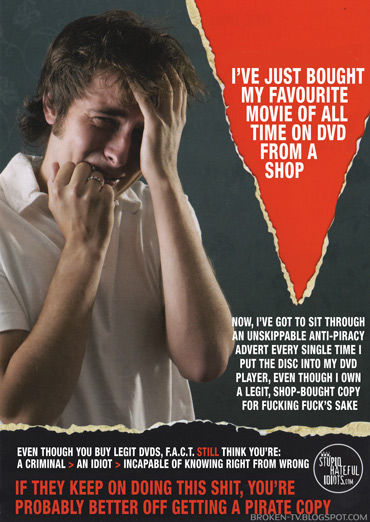
After all, he is the CEO of the organization responsible for inserting those unskippable FBI warnings (which are highly prejudiced and factually incorrect, advising, for example, that DVDs can’t be rented, even though the law says they can) before every commercial DVD. He’s the CEO of the organization that inserts those insulting PSAs in front of every movie chiding those of us who buy our DVDs because someone else decided to download the same movie for free.

And he’s the CEO of the organization responsible for the section of the DMCA that makes it illegal to build a DVD player that can skip these mandatory, partisan, commercially advantageous messages.

So he knows a thing or two about “abuse of power given the freedoms these companies enjoy in the marketplace today.”

You know, the kind of stuff that makes you feel like this guy:

And here’s the reason you pay for a legal copy, rather than being one of those evil pirates:

« Newer PostsOlder Posts »

Powered by WordPress