
Quotulatiousness

April 20, 2015

Canada’s first female Prime Minister makes a rare appearance

Filed under: Cancon — Tags: , , — Nicholas @ 23:33

Richard Anderson puts it a bit more pithily: “Kim Campbell says something sensible”:

When conservatives say things like this, no one really believes Kim Campbell was ever a conservative, they’re denounced as racists. So far I haven’t seen any ripples on the pond from Campbell’s comments. In part, I suspect, this is because of her lack of importance; no one cares what historical footnote thinks. The other part is that the Establishment Left would find it awkward attacking the First Female Prime Minister of Canada. I suppose she passes for a Canadian feminist icon. Admittedly not a giant threshold to leap.

Campbell’s musings are, of course, no more than common sense. Canada is one of the most advanced nations on earth. Most of our immigrant population comes from backward hellholes. When you import people from backward societies you import their primitive ideas as well. The refusal to acknowledge this is a dangerous act of wilful blindness. Campbell should be commended for speaking out.

Her solution, which fits with our traditional pattern of integrating new groups, is to focus on educating immigrants in our values and history. Making it abundantly clear that women possess legal and social equality with men should be utterly uncontroversial. Instead such calls for action are dismissed by the Left as racist dog whistles. No doubt for some they are. That does not change the nature of the threat or the need to act.
April 7, 2015

QotD: Top ten reasons not to be a rightist

Filed under: Politics, Quotations, USA — Tags: , , , , , , — Nicholas @ 01:00
  1. Pornography. The complete absence of evidence that exposure to sexually-explicit material is harmful to children or anyone else doesn’t stop conservatives from advocating massive censorship.
  2. Drugs. We found out that Prohibition was a bad idea back in the 1930s — all it did was create a huge and virulent criminal class, erode respect for the law, and corrupt our politics. Some people never learn.
  3. Creationism. I don’t know who I find more revolting, the drooling morons who actally believe creationism or the intelligent panderers who know better but provide them with political cover for their religious-fundamentalist agenda in return for votes.
  4. Abortion. The conservatives’ looney-toon religious need to believe that a fertilized gamete is morally equivalent to a human being has done the other half of making a reasoned debate on abortion nigh-impossible.
  5. Racism. I haven’t forgiven the Right for segregation, Jim Crow laws, and lynching blacks. And I never will.
  6. Sexism. Way too much conservative thought still reads like an apologia for keeping women barefoot, pregnant, and in the kitchen.
  7. Anti-science. Stem cells, therapeutic cloning — it doesn’t matter how many more diabetes, cancer and AIDS patients have to die to protect the anti-abortion movement’s ideological flanks. Knowledge — who needs it? Conservatives would try suppressing astronomy if the telescope had just been invented.
  8. Family values. Conservatives are so desperate to reassert the repressive `normalcy’ they think existed in Grand-dad’s time that they pretend we can undo the effects of the automobile, television, the Pill, and the Internet.
  9. Ronald Wilson Reagan. A B-movie actor who thought ketchup was a vegetable. His grip on reality was so dangerously weak that the Alzheimer’s made no perceptible difference. Conservatives worship him.
  10. Conservatives, by and large, are villains.

Eric S. Raymond, “Top Ten Reasons I’m Neither a Liberal Nor a Conservative”, Armed and Dangerous, 2004-09-19.

February 17, 2015

Ontario’s political future seems unusually feminine

Filed under: Cancon, Politics — Tags: , , , — Nicholas @ 03:00

After the last serious challenger dropped out of the race to be leader of the Progressive Conservatives, Christine Elliot (my local MPP) now appears to be the default choice to fill the leadership role. Richard Anderson has a characteristic take on the near future of Ontario politics:

So that leaves Christine Elliott and a bunch of other people. I could, of course, look up the names of the other people but that would be a waste of valuable electrons. No doubt they are all honourable and public spirit individuals whose contributions to the political process Ontarians eagerly acknowledge. I guess. One would assume given the circumstances.

Christine Elliott is now unofficially the leader of the official opposition. In 2019 she will have the honour of being defeated by Kathleen Wynne in another improbable landslide. To some this sounds like a daunting and terrifying prospect. Don’t worry. When 2019 comes around you won’t be worried about another Win for Wynne. No sir. You’ll be too busy fighting for food at the burnt-out Loblaws to give a damn about politics. Change that you can believe in.

[…]

Growing up in that dark epoch known as the 1980s I well recall feminists complaining about how the world was run by cranky old men stuck in the past. Ancient dinosaurs who monopolized power and prevented those with youth and innovative ideas from coming to the fore of public life. So much has changed since that time. The male gerontocracy of the Reagan Era has been swept away by the female gerontocracy of the Wynne-Elliott Era. You’ve come a long way baby.

Now that feminism has utterly triumphed, with all three of the major parties run by women, we can appreciate how right the early feminists were about, well, everything. Now that women rule Ontario the economy is humming along splendidly, the finances are managed like a prudent housewife of old and peace and love has spread through out the land. Ordinary voters look to the Ontario matriarchy with a degree of trust and understanding that no male politician has ever commanded.

Let us give a moment of thanks.

February 16, 2015

The rise of Scott Walker has Mother Jones all freaked out

Filed under: Politics, USA — Tags: , , , , — Nicholas @ 03:00

Perhaps not all the staff at Mother Jones are as worried about the conservative threat that is Scott Walker, but Kevin Drum appears more than a little concerned about his evident troglodyte ideological profile:

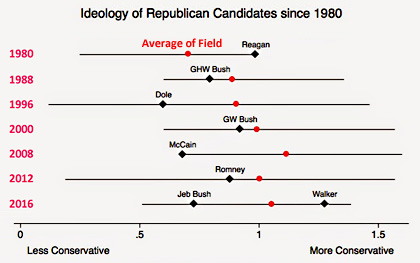
Republican presidential ideology rankingsFor those of us who are sort of fascinated by the rise of Scott Walker as a Republican presidential contender, here’s an interesting chart from Jason McDaniel, a political science professor at San Francisco State University. It shows the relative conservative-ness of GOP presidential nominees in the past six contested elections, and it demonstrates what an outlier Walker would be if he won next year’s primary: He’d be the first candidate since Ronald Reagan who’s more conservative than the average of the Republican field. And by McDaniel’s measure, he’d actually be the most conservative recent nominee, period — even more right-wing than Reagan:

    Walker is well to the right end of the conservative spectrum, residing in the ideological neighborhood of Ted Cruz and Rand Paul … It is not a stretch to argue that if nominated, Walker would be the most conservative Republican nominee since Barry Goldwater in 1964.

    … In contrast, Jeb Bush’s ideological position closely resembles previous Republican nominees. Bush most closely resembles John McCain in 2008 … In Scott Walker versus Jeb Bush, party elites and primary voters are presented with clearly contrasting visions of the future direction of the Republican party … If the recent history of Republican nomination contests is any guide, the party is likely to decide that Scott Walker is too ideologically extreme to be the Republican nominee in 2016.

January 27, 2015

QotD: Political parties and principles

Filed under: Cancon, Politics, Quotations — Tags: , , , — Nicholas @ 01:00

Normally, [the voters] are suckered. The political class — the class of politicians, senior bureaucrats, self-interested lobbyists, and all their paid flunkeys in media and elsewhere — are much cleverer than “the people,” on political questions. “The people,” for their part, may be individually cleverer than they, but not, as a rule, on political questions, which don’t much interest the great majority of them. The political class have, in addition to whatever native smarts, plenty of experience manipulating “the people,” and the contempt required to be ruthless about it. In a fully-fledged “democracy,” it takes little sophistry for the bad guys to win. But the term is relative, and should the good guys win, it will be another victory for the politicians.

A few days ago, I found myself trying to explain this to a well-intended, rightwing person. He complained that the Conservative Party had turned its back on “conservative principles.” This struck me as an unfair allegation, for the party had never once in the history of Canada, whether at the provincial or Dominion level, embraced “conservative principles,” nor shown the slightest curiosity over what they might be. The purpose of a political party has nought to do with such “principles.” (This goes for all parties including, within five years of their founding, those founded on “principles.”) Rather it is to tax as much as they dare, and distribute the takings among their friends, while “nation building” — i.e. adding to the machinery of State. A party unclear on this essential “principle” of democracy (the one that defeats every other principle) might get itself elected by some fluke, but will not long retain power.

David Warren, “Hapless Voters”, Essays in Idleness, 2014-05-26.

January 5, 2015

Morality in public, perversity in private?

Filed under: Media, Politics, Religion, USA — Tags: , , , — Nicholas @ 02:00

In the Washington Post, Nita Farahany looks at an interesting study published in the Archives of Sexual Behavior. The study gives away the game in the title — Do American States with More Religious or Conservative Populations Search More for Sexual Content on Google?

“In America, religiosity and conservatism are generally associated with opposition to non-traditional sexual behavior, but prominent political scandals and recent research suggest a paradoxical private attraction to sexual content on the political and religious right. We examined associations between state level religiosity/conservatism and anonymized interest in searching for sexual content online using Google Trends (which calculates within-state search volumes for search terms). Across two separate years, and controlling for demographic variables, we observed moderate-to-large positive associations between: (1) greater proportions of state-level religiosity and general web searching for sexual content and (2) greater proportions of state level conservatism and image-specific searching for sex. These findings were interpreted in terms of the paradoxical hypothesis that a greater preponderance of right-leaning ideologies is associated with greater preoccupation with sexual content in private Internet activity. Alternative explanations (e.g., that opposition to non-traditional sex in right-leaning states leads liberals to rely on private internet sexual activity) are discussed, as are limitations to inference posed by aggregate data more generally.”

The researchers found that the American states with the greatest proportion of individuals who self-identify as very religious, or consider religion to be an important part of their lives, engage in more active searches for sexual content online compared to states with fewer religious and conservative individuals. There was a direct correlation between the proportion of conservatives in a state and image-specific Internet sex searches documented in that state.

Their conclusion? More restrictive social norms drive behaviors underground. There are quite a few limitations of the study and alternative hypotheses that may drive the results, which the researchers acknowledge. But it’s still quite an interesting study.

December 25, 2014

QotD: Reactionary views on American Progressives

Filed under: Britain, History, Quotations, USA — Tags: , , , , — Nicholas @ 00:01

In America, progressivism focuses on pointing out how terrible American culture is and how much other people’s cultures are better than ours. If we celebrate Columbus Day, we have to spend the whole time hearing about what a jerk Columbus was (disclaimer: to be fair, Columbus was a huge jerk). If we celebrate Washington’s birthday, we have to spend the whole time hearing about how awful it was that Washington owned slaves. Goodness help us if someone tries to celebrate Christmas – there are now areas where if a city puts up Christmas decorations, it has to give equal space to atheist groups to put up displays about how Christmas is stupid and people who celebrate it suck. That’s … probably not the way to maximize cultural unity, exactly?

We are a culture engaged in the continuing project of subverting itself. Our heroes have been toppled, our rituals mocked, and one gains status by figuring out new and better ways to show how the things that should unite us are actually stupid and oppressive. Even the conservatives who wear American flag lapel pins and stuff spend most of their time talking about how they hate America today and the American government and everything else associated with America except for those stupid flag pins of theirs.

Compare this to olden cultures. If someone in Victorian Britain says “God save the Queen!”, then everyone else repeated “God save the Queen!”, and more important, they mean it. “England expects every man to do their duty” is actually perceived as a compelling reason why one’s duty should be done.

It would seem that the Victorian British are more on the Mormon side and modern Americans more like the Unitarians. And in fact, the Victorians managed to colonize half the planet while America can’t even get the Afghans to stop shooting each other. While one may not agree with Victorian Britain’s aims, one has to wonder what would happen if that kind of will, energy, and unity of purpose were directed towards a worthier goal (I wonder this about the Mormon Church too).

Reactionaries would go further and explore this idea in a depth I don’t have time for, besides to say that they believe many historical cultures were carefully optimized and time-tested for unifying potential, and that they really sunk deep into the bones of the populace until failing to identify with them would have been unthinkable. The three cultures they most often cite as virtuous examples here are Imperial China, medieval Catholicism, and Victorian Britain; although it would be foolish to try to re-establish one of those exactly in a population not thoroughly steeped in them, we could at least try to make our own culture a little more like they were.

Once again, the Reactionary claim is not necessarily that we have to brainwash people or drag the Jews kicking and screaming to Christmas parties. It’s just that maybe we should stop deliberately optimizing society for as little unity and shared culture as humanly possible.

Scott Alexander, “Reactionary Philosophy In An Enormous, Planet-Sized Nutshell”, Slate Star Codex, 2013-03-03.

December 21, 2014

QotD: The family as something to escape from

Filed under: Government, Quotations — Tags: , — Nicholas @ 00:01

What many movement conservatives can’t or won’t understand is that for some of us, the “family” should not be the base unit of society, because it can just as easily be a locus of evil as for good.

To many people, the “world” is a haven from a heartless family.

I am forever bowled over by my Jewish friends’ affection (or at least, infinite tolerance) for their families. When one of them suggested that I set up some kind of enterprise with “a trusted family member,” I reminded him that, being a gentile, I have no trusted family members.

The idea of wanted to increase one’s ties to one’s relatives rather than snip them as quickly and permanently as possible is utterly foreign to me.

Radical leftists are half-right in wanting to reduce each individual’s forced reliance upon their families for lifelong security and prosperity. They went wrong when they held up the State as a replacement. You can always, if you absolutely have to, kill your family. But the State is, at the end of the day, immortal and a million times more powerful.

Kathy Shaidle, “Christopher Lasch was one of those pseudo-conservative writers, like Chesterton, Buckley and Burke, who left me cold”, Five Feet of Fury, 2014-05-13

December 19, 2014

In Stephen Harper’s Canada, politics beats economics every time

Filed under: Cancon, Economics — Tags: , , — Nicholas @ 00:03

Stephen Harper gets a lot of criticism for being an ideological hard-liner, but he gets nearly as much flak from small-government conservatives for being no better — and in some cases, much worse — than Jean Chrétien and Paul Martin. Earlier this month in Maclean’s, Stephen Gordon explained some of the reasons for Harper’s political and economic actions:

Politics, not economics, has also determined [Harper’s] strategy for achieving this goal [a smaller government-spending-to-GDP ratio]. If you asked an economist for the best way of reducing revenues, she’d probably prepare a list with the taxes that are the most harmful to the economy at the top, and the taxes that are the least harmful at the bottom. The GST would rank at or near the bottom of that list. (Here is a representative reaction to the Conservatives’ 2005 campaign promise to reduce the GST; here is an explanation for why economists think the GST is a good idea.) In economic terms, reducing the GST was probably the worst possible option available to the Conservatives.

But as far as politics goes, it was an inspired choice. It helped win the election, and — perhaps even more importantly — reducing the GST has made it that much harder for any future government to reverse the trend to lower spending. If the Liberals and the NDP were to ask an economist to provide a list of ways of generating the most revenues at the least economic cost, increasing the GST would be at or near the top of the list. But those two GST points are not going to come back to fill federal coffers in the foreseeable future. Both the Liberals and the NDP have campaigned at some point on anti-GST platforms, and history has not been kind to provincial governments that have raised the HST without an electoral mandate to do so. (The NDP’s proposal to increase corporate tax rates is the doppelgänger of the Conservatives’ GST cut. In economic terms, an increase in corporate taxes is probably the worst possible choice for generating revenues, but it’s a potential vote-winner. Maybe it will work for them as well as it did for the CPC.)

[…]

This brings us to the “starve the beast strategy” described in detail here: the reduction in revenues is now a justification for reducing expenditures. But, once again, the strategy is driven by politics, not economics. The elements are as follows (see also here and, most recently, here):

  1. Let transfer payments to individuals grow at the rate of GDP.
  2. Let transfer payments to provinces grow at the rate of GDP.
  3. Hold nominal direct program spending constant.

These elements have been in place in every budget since 2010. The economics of this approach are very dodgy: the economically efficient way to approach the problem of reducing spending is to perform a cost-benefit analysis and eliminate the programs that don’t pass the test. But the politics are something else. Cuts in transfer payments directly affect peoples’ personal finances, and could be reversed at no political cost. The same is true for cuts in transfer payments to the provinces; much of the Jean Chrétien-era cuts to the provinces were rescinded a few year later. The path of least political resistance is through direct program spending: the cost of paying federal public servants’ wages.

December 18, 2014

“[C]onservatives are underrepresented in academia because they don’t want to be there, or they’re just not smart enough to cut it”

Filed under: Politics, USA — Tags: , , , , — Nicholas @ 06:55

The advantage of the quote in the headline is that it allows the person saying it to feel more positive about his or her own worldview, while side-stepping the real issue. Pascal-Emmanuel Gobry looks at a new report that addresses this issue:

I have had the following experience more than once: I am speaking with a professional academic who is a liberal. The subject of the under-representation of conservatives in academia comes up. My interlocutor admits that this is indeed a reality, but says the reason why conservatives are under-represented in academia is because they don’t want to be there, or they’re just not smart enough to cut it. I say: “That’s interesting. For which other under-represented groups do you think that’s true?” An uncomfortable silence follows.

I point this out not to score culture-war points, but because it’s actually a serious problem. Social sciences and humanities cannot be completely divorced from the philosophy of those who practice it. And groupthink causes some questions not to be asked, and some answers not to be overly scrutinized. It is making our science worse. Anyone who cares about the advancement of knowledge and science should care about this problem.

That’s why I was very gratified to read this very enlightening draft paper [PDF] written by a number of social psychologists on precisely this topic, attacking the lack of political diversity in their profession and calling for reform. For those who have the time and care about academia, the whole thing truly makes for enlightening reading. The main author of the paper is Jonathan Haidt, well known for his Moral Foundations Theory (and a self-described liberal, if you care to know).

Although the paper focuses on the field of social psychology, its introduction as well as its overall logic make many of its points applicable to disciplines beyond social psychology.

The authors first note the well-known problems of groupthink in any collection of people engaged in a quest for the truth: uncomfortable questions get suppressed, confirmation bias runs amok, and so on.

But it is when the authors move to specific examples that the paper is most enlightening.

November 6, 2014

QotD: Political iconoclasts in modern society

Filed under: History, Politics, Quotations — Tags: , , — Nicholas @ 00:01

People in ancient societies thought their societies were obviously great. The imperial Chinese thought nothing could beat imperial China, the medieval Spaniards thought medieval Spain was a singularly impressive example of perfection, and Communist Soviets were pretty big on Soviet Communism. Meanwhile, we think 21st-century Western civilization, with its democracy, secularism, and ethnic tolerance is pretty neat. Since the first three examples now seem laughably wrong, we should be suspicious of the hypothesis that we finally live in the one era whose claim to have gotten political philosophy right is totally justified.

But it seems like we have an advantage they don’t. Speak out against the Chinese Empire and you lose your head. Speak out against the King of Spain and you face the Inquisition. Speak out against Comrade Stalin and you get sent to Siberia. The great thing about western liberal democracy is that it has a free marketplace of ideas. Everybody criticizes some aspect of our society. Noam Chomsky made a career of criticizing our society and became rich and famous and got a cushy professorship. So our advantage is that we admit our society’s imperfections, reward those who point them out, and so keep inching closer and closer to this ideal of perfect government.

Okay, back up. Suppose you went back to Stalinist Russia and you said “You know, people just don’t respect Comrade Stalin enough. There isn’t enough Stalinism in this country! I say we need two Stalins! No, fifty Stalins!”

Congratulations. You have found a way to criticize the government in Stalinist Russia and totally get away with it. Who knows, you might even get that cushy professorship.

If you “criticize” society by telling it to keep doing exactly what it’s doing only much much more so, society recognizes you as an ally and rewards you for being a “bold iconoclast” or “having brave and revolutionary new ideas” or whatever. It’s only when you tell them something they actually don’t want to hear that you get in trouble.

Western society has been moving gradually further to the left for the past several hundred years at least. It went from divine right of kings to constutitional monarchy to libertarian democracy to federal democracy to New Deal democracy through the civil rights movement to social democracy to ???. If you catch up to society as it’s pushing leftward and say “Hey guys, I think we should go leftward even faster! Two times faster! No, fifty times faster!”, society will call you a bold revolutionary iconoclast and give you a professorship.

If you start suggesting maybe it should switch directions and move the direction opposite the one the engine is pointed, then you might have a bad time.

Scott Alexander, “Reactionary Philosophy In An Enormous, Planet-Sized Nutshell”, Slate Star Codex, 2013-03-03.

November 5, 2014

Ford Nation – retooling, reloading?

Filed under: Cancon, Politics — Tags: , , , , — Nicholas @ 00:03

As I’ve said in posts during the election campaign, I probably wouldn’t have voted for either of the Ford brothers were I still living in Toronto, but I understand why a lot of Toronto voters feel differently. That much being acknowledged … I don’t think a Doug Ford campaign for leader of the Ontario Progressive Conservative Party would be a good idea (and not just because the front-runner in the race is my MPP). Richard Anderson seems to feel the same way, but he bases his objections on reality rather than just inchoate feelings:

At the final tally Doug Ford captured 34% of the popular vote in the recent Toronto election. With more time he would likely have captured another 5% to 10% of the vote. It’s unlikely that any member of the Ford family would reach 50% in a three way race. In a two way race, against a half-way competent moderate, they’d almost certainly lose. But Toronto is not Ontario. Not even close.

While the Imperial Capital is certainly more Leftist than the rest of the province, it’s also more working class. That’s the Ford base, the low and semi-skilled workforce that can really only exist in a large dense city. In the vast sprawl lands of Mississauga and Markham the Fords are incredibly toxic.

[…]

A provincial premier is not a mayor. The Premier of Ontario is the second most powerful individual in the country. In a real and practical sense it is the ruler of Queen’s Park who acts as the Leader of the Official Opposition of Canada. The only thing Tom Mulcair can do is rant and rave at Stephen Harper. Kathleen Wynne can thwart a whole range of federal policy initiatives. That’s the power that comes from leading a province with 40% of the population and nearly half the national economic output.

Now imagine Doug Ford negotiating with Stephen Harper or Jim Prentice. You can’t really. Even if there is a bit of ideological overlap their styles are so radically different. For all his faults Harper is loaded to the rafters with gravitas and intelligence. Jim Prentice is a smooth old political operator. Either man can move with ease through the Petroleum Club or the Empire Club. They can deal with Obama, Cameron, Putin and whatever animatronic robot is currently ruling China.

October 30, 2014

QotD: Conservative versus Liberal views on jobs

Filed under: Economics, Media, Quotations, USA — Tags: , , — Nicholas @ 00:01

For the conservative, people are an asset — in the coldest economic terms, a potentially productive unit of labor. For the progressive, people are a liability — a mouth to be fed, a problem in need of a solution. Understanding that difference of perspective renders understandable the sometimes wildly different views that conservatives and progressives have about things like employment policy. For the conservative, the value of a job is what the worker produces; for the progressive, the value of a job is what the worker is paid. Politicians on both sides frequently talk about jobs as though they were economic products rather than contributors to economic output, as though they were ends rather than means. The phrase “there aren’t enough jobs” is almost completely meaningless, but it is a common refrain.

Kevin D. Williamson, “Welcome to the Paradise of the Real: How to refute progressive fantasies — or, a red-pill economics”, National Review, 2014-04-24

October 6, 2014

QotD: The political tribes of America

Filed under: Politics, Quotations, USA — Tags: , , , — Nicholas @ 00:01

The Red Tribe is most classically typified by conservative political beliefs, strong evangelical religious beliefs, creationism, opposing gay marriage, owning guns, eating steak, drinking Coca-Cola, driving SUVs, watching lots of TV, enjoying American football, getting conspicuously upset about terrorists and commies, marrying early, divorcing early, shouting “USA IS NUMBER ONE!!!”, and listening to country music.

The Blue Tribe is most classically typified by liberal political beliefs, vague agnosticism, supporting gay rights, thinking guns are barbaric, eating arugula, drinking fancy bottled water, driving Priuses, reading lots of books, being highly educated, mocking American football, feeling vaguely like they should like soccer but never really being able to get into it, getting conspicuously upset about sexists and bigots, marrying later, constantly pointing out how much more civilized European countries are than America, and listening to “everything except country”.

(There is a partly-formed attempt to spin off a Grey Tribe typified by libertarian political beliefs, Dawkins-style atheism, vague annoyance that the question of gay rights even comes up, eating paleo, drinking Soylent, calling in rides on Uber, reading lots of blogs, calling American football “sportsball”, getting conspicuously upset about the War on Drugs and the NSA, and listening to filk – but for our current purposes this is a distraction and they can safely be considered part of the Blue Tribe most of the time)

I think these “tribes” will turn out to be even stronger categories than politics. Harvard might skew 80-20 in terms of Democrats vs. Republicans, 90-10 in terms of liberals vs. conservatives, but maybe 99-1 in terms of Blues vs. Reds.

Scott Alexander, “I Can Tolerate Anything Except The Outgroup”, Slate Star Codex, 2014-09-30.

September 18, 2014

If Rush Limbaugh didn’t exist, the left would have to invent him

Filed under: Media, Politics, USA — Tags: , , , , — Nicholas @ 10:16

Hans Bader on how Rush Limbaugh is a constant gift to his enemies … almost a Rob Ford of US political commentary:

Rush Limbaugh can take a winning issue for conservatives and turn it into a loser just by shooting his mouth off. He gives advocates of extreme left-wing policies ammunition for their views by making stupid arguments when smarter arguments exist, and by lacing his arguments with sexism or scurrilous remarks. He did it recently in response to my commentary about Ohio State University’s ridiculously overbroad and intrusive “sexual assault” definition — which seemingly requires students to agree on “why” they are having sex or making out, which is none of the university’s business. And he did it in 2012, when his scurrilous remarks about contraceptive advocate Sandra Fluke being a “slut” and a “prostitute” drove even moderate liberals to support a contraceptive mandate on religious employers that they had earlier opposed (and which the Supreme Court later ruled 5-to-4 violated the Religious Freedom Restoration Act.)

[…]

But instead of focusing on that in his criticism of Ohio State’s policy, Limbaugh changed the subject to asking whether “no” really means “no,” saying “How many of you guys in your own experience with women have learned that no means yes, if you know how to spot it?” He then temporarily backed away from this remark by saying, “Let me tell you something, in this modern world, that’s simply…that’s not tolerated.” But then he returned to the inflammatory subject of “no” supposedly not meaning “no” by saying “It used to be that it was a cliché. It used to be part of the advice young boys were given.”

Liberal blogs like Think Progress, and newspaper blogs had a field day making fun of his comments questioning whether no means no, and using them to imply that the only reason anybody would ever oppose requiring “affirmative consent” is because they are a misogynistic troll like Limbaugh. In response, a columnist at a major midwestern newspaper endorsed the policy as supposedly being “smart” in light of the need to educate people like Limbaugh about consent. (Never mind that Limbaugh is not a college student, and it’s hard to imagine many college students sharing his ancient views.)

As a result, all of my efforts were undone, by a factor of ten. Overnight, a policy that seemed extreme even to liberals I discussed it with became embraced by many liberal commenters at these blogs, partly out of a desire to spite the hateful Limbaugh. It is being used to depict critics of the extreme policy as themselves being extreme.

« Newer PostsOlder Posts »

Powered by WordPress

