Quotulatiousness

November 15, 2012

The BBC’s 28 secret climate change advisors

Filed under: Britain, Environment, Law, Media — Tags: , , , , — Nicholas @ 10:49

The BBC has been prominent among media outlets for their relentless proclamations on the dangers of climate change. Despite the BBC’s charter requiring them to provide balanced coverage, in this particular area they have been cheerleaders for one particular message: that climate change is DOOM!

In 2006, the BBC convened a panel of climate change experts to advise them on the topic, and the corporation took the advice of that panel to heart and has been pushing the climate change = disaster meme ever since. Blogger Tony Newbery submitted a FOI request to find out who had been on the panel which had swung the BBC so far away from their charter, but his request was denied. Not just denied, but fought out in court at an estimated cost of £40,000 per day.

The BBC won in court, but the information was released by someone else:

Sadly for the BBC, another enterprising blogger called Maurizio Morabito unearthed the details anyway and published them on Monday via the website Watts Up With That?

So who were all these ‘best scientific experts’ who did so much to shape the BBC’s climate policy (and by extension, one fears, government policy too…)? Well, two were from Greenpeace; one was from Stop Climate Chaos; one was a CO2 reduction expert from BP; one was from Npower Renewables; one came from the left-leaning New Economics Foundation… Only five of those present could, in any way, be considered scientists with disciplines even vaguely relevant to ‘climate change’. And of these, every one had a track record of climate alarmism. No wonder the BBC tried so hard to keep the list of 28 a secret. Its claim that its policy change was based on the ‘best scientific’ expertise turns out to have been a massive lie.

November 10, 2012

“Carbon sequestration in peatland may be one of the main reasons why ice age conditions have occurred time after time”

Filed under: Environment, Science — Tags: , , — Nicholas @ 00:01

Overall, global cooling is far more to be feared than global warming … and we may be seeing the conditions that would create a new ice age in the near future:

A group of Swedish scientists at the University of Gothenburg have published a paper in which they argue that spreading peatlands are inexorably driving planet Earth into its next ice age, and the only thing holding back catastrophe is humanity’s hotly debated atmospheric carbon emissions.

“We are probably entering a new ice age right now. However, we’re not noticing it due to the effects of carbon dioxide,” says Professor of Physical Geography Lars Franzén, from the Department of Earth Sciences at Gothenburg uni.

[. . .]

The scientists have calculated that the potential is there for Swedish peatlands to triple in extent, enormously increasing their carbon sink effect. By extrapolating to include the rest of the world’s high-latitude temperate areas – the parts of the globe where peatland can expand as it does in Sweden – they project the creation of an extremely powerful carbon sink. They theorise that this is the mechanism which tends to force the Earth back into prolonged ice ages after each relatively brief “interglacial” warm period.

“Carbon sequestration in peatland may be one of the main reasons why ice age conditions have occurred time after time,” says Franzén.

With no other factors in play, the time is about right for the present interglacial to end and the next ice age to come on. Indeed, Franzén and his crew think it has barely been staved off by human activity

Caution should be exercised with this as with all climate-model-based predictions: our models are still not good enough to be dependable, so this is no more something to panic about than the “global warming” scare of the last decade. It is something to consider and to try to develop better models and collect more data to support or contradict the findings.

November 5, 2012

Matt Ridley on the real threat to our ecology

Filed under: Britain, Bureaucracy, Environment — Tags: , , , — Nicholas @ 00:01

It’s not global warming:

I’m pessimistic about the ash trees. It seems unlikely that a fungus that killed 90 per cent of Denmark’s trees and spreads by air will not be devastating here, too. There is a glimmer of hope in the fact that ash, unlike elms, reproduce sexually so they are not clones — uniformly vulnerable to the pathogen. But it’s only a glimmer: tree parasites, from chestnut blight to pine beauty moth, have a habit of sweeping through species pretty rampantly, because trees are so long-lived they cannot evolve resistance in time.

The Forestry Commission’s apologists are pleading ‘cuts’ as an excuse for its failure to do anything more timely to get ahead of the threat, but as a woodland owner I am not convinced. An organisation that has the time and the budget to pore over my every felling or planting application in triplicate and come back with fussy and bossy comments could surely spare a smidgen of interest in looming threats from continental fungi that have been spreading out from Poland for 20 years. The commission was warned four years ago of the problem.

Here’s what the commission was up to instead. Just last year, I received a letter from the Forestry Commission demanding access to survey one of my woods to answer the question ‘what are the forecasts for timber, biomass and carbon?’ in order to ‘help the United Kingdom meet international commitments, such as reporting for the Global Forest Resources Assessment and the Ministerial Conference on the Protection of Forests in Europe (MCPFE)’.

Notice the Sir Humphrey-esque circular argument: surveys must be done so that the results can be reported to assessment meetings. In other words, as far as I can tell, the Forestry Commission’s priority has been, as in so many government bodies, to supply talking points for the international carbon-obsessed bureaucracy. The implicit assumption here, of course, is that climate change is the greatest threat to Britain’s trees, when in reality far greater threats come from diseases carried around by foresters themselves.

This is happening throughout the world of nature conservation. A climate fetish has sucked all the oxygen from the real threats to species and habitats — indeed it has actually begun to make those threats worse.

August 20, 2012

The butterflies of doom

Filed under: Environment, Media, Science, USA — Tags: , , , — Nicholas @ 08:57

In The Register, Lewis Page tries to round up the varied results of some recent biodiversity/climate change reports:

A volley of studies into the likely effects of climate change on various animal species — and thus on biodiversity worldwide — have come out in the last few days. The headliner, examining butterflies in Massachusetts, seems to indicate that rising temperatures are having powerful ecological effects: but another pair of studies showed that other factors may be more powerful than warming, and yet another appears to indicate that dangers are being overblown.

[. . .]

“For most butterfly species, climate change seems to be a stronger change-agent than habitat loss. Protecting habitat remains a key management strategy, and that may help some butterfly species. However, for many others, habitat protection will not mitigate the impacts of warming,” comments study author and Harvard postdoc Greg Breed.

Open and shut, then — the warming seen from the 1980s to the turn of the century has already seriously affected butterflies, and projected future warming will surely mean more serious consequences. Many people, indeed, have not hesitated to link recent severe weather events in the States to global warming — despite a refutation of this idea from no less a body than the IPCC. But as it is well known to all followers of pop-science coverage that just one butterfly beating — or not beating — its wings can have major effects on the weather in the northeastern United States, it seems only reasonable to suggest that the invading Zabulon Skippers, apparently wafted into Massachusetts by global warming, are responsible for recent storms, floods, heatwaves etc.

[. . .]

Or, in summary, scientists don’t really know what will happen to any given species in future.

“Taken together, these two studies indicate that many species have been responding to recent climate change, yet the complexities of a species’ ecological needs and their responses to habitat modification by humans can result in unanticipated responses,” says Steven Beissinger, professor at UC Berkeley and senior boffin on both studies. “This makes it very challenging for scientists to project how species will respond to future climate change.”

Yet another recent study announced in the past week goes still further, suggesting that the danger to Earth’s biodiversity posed by rising temperatures has been exaggerated.

August 13, 2012

The problems of conducting science-by-press-release

Filed under: Environment, Media, Politics, Science — Tags: , , , — Nicholas @ 09:10

At sp!ked, Ben Pile explains why the first casualties in the climate change debate are usually the facts:

In plain sight of the fact that the melting was neither unexpected nor unprecedented, environmental journalists the world over picked up the story and ran with it. In the Guardian, Suzanne Goldenberg, wrote: ‘The Greenland ice sheet melted at a faster rate this month than at any other time in recorded history, with virtually the entire ice sheet showing signs of thaw.’

As I have noted elsewhere, Guardian journalists have a fetish for stories about melting ice. In September last year, following an unusually low measurement of Arctic sea-ice extent, Damian Carrington wrote: ‘Ice is the white flag being waved by our planet, under fire from the atmospheric attack being mounted by humanity.’ But the low measurement of sea ice that Carrington pointed to disagreed with at least five other continuous measurements of the Arctic, and was thus unreliable. This kind of over-reaction to scientific developments are facile attempts to turn science into stories of political intrigue. When images of the Arctic taken by US spy satellites were declassified in 2009, the headline of an article by Goldenberg and Carrington proclaimed that ‘the secret evidence of global warming Bush tried to hide’ had been ‘revealed’.

The rash of excited articles about the dying cryosphere caused some surprising corrective responses from voices within climate research. Malte Humpert from the Arctic Institute Centre wrote a stinging response to the headline histrionics. ‘The Greenland ice sheet, which is up to 3000+ metres thick, is not “melting away”, did not “melt in four days”, it is not “melting fast”, and Greenland did not “lose 97 per cent of its surface ice layer”.’ Humpert continued: ‘Most articles also exaggerated the importance of the melt event on global sea levels by explaining how sea levels would rise by up to 7.2 metres if the ice sheet were to melt.’

Similarly, Mark Brandon, a sea-ice scientist at the Open University, reproduced an interesting series of tweets and links to articles that showed the development of the current panic about ice, beginning with (alleged) comedian Marcus Brigstocke’s misconception of the story. To Brigstocke, an ‘unprecedented’ melt was the proverbial canary in the coal mine — a harbinger of doom. But as Brandon and his colleagues pointed out, it was a bit soon to be calling time on the human race. This was just weather.

August 11, 2012

Environmentalism versus ecology

Filed under: Environment, Politics — Tags: , , — Nicholas @ 10:09

An interesting interview with Dr. Patrick Moore:

Cotto: One of the gravest concerns you have cited with the modern environmentalist movement is its increasingly ideological nature. Some might say that this, in fact, is a positive development. How would you beg to differ?

Dr. Moore: Ideology is negative in so far as it tends to divide people into warring camps with no possible resolution. My late Greenpeace friend Bob Hunter suggested early on that in order for environmentalism to become a mass movement, it would have to be based on ideology, or as he called it “popular mythology,” because “not everybody can be a Ph.D. ecologist.” I have never accepted organized religion and note all the evils perpetuated in the name of “God is on our side” I do believe in just wars such as the armed struggle to end apartheid. But that was not based on religion but rather on human rights.

For example it has become part of environmental ideology, as stated by Bill McKibben in the current Rolling Stone, that the fossil fuel industries are “Public Enemy Number One.” Oil is particularly vilified as evidenced by high-profile campaigns to stop pipelines, drilling, tankers, oil sands, and anything else to do with producing or transporting oil. Oil is responsible for 36% of global energy and is therefore the most important source of energy to support our civilization. If it is the aim of “environmentalists” to stop fossil fuel production and use, end fracking, end coal mining, end the use of oil, then they are promoting a policy that would have disastrous consequences for human civilization and the environment. If we stopped using fossil fuel today, or by 2020 as Al Gore proposes, at least half the human population would perish and there wouldn’t be a tree left on the planet with a year, as people struggled to find enough energy to stay alive.

[. . .]

Cotto: In the past, you have said that human activity is not the only cause for climate change. What do you believe is the greatest contributing factor?

Dr. Moore: First, we don’t know precisely how the many factors affecting climate contribute and interact in producing the earth’s climate at any given time. The cause of the onset of Ice-Ages, one of which we are presently experiencing, is a puzzle we don’t fully understand. I explain in my presentations that as a scientist who is fully qualified to understand climate change, I seem dumber than the people who say they “know” the answers because I do not profess to know the future, especially of something so complicated as the global climate.

One thing is certain, there is no “scientific proof” as the term is generally understood, that human emissions are the main cause of climate change today. Even the IPCC only claims that it is “very likely” (a judgement, in their own words, not a proof) that human emissions are responsible for “most” of the warming “since the mid-20th century” (1950). Therefore they are not claiming that humans caused the 0.4C warming between 1910-1940, but they are claiming that we are the main cause of the 0.4C warming between 1970 and 2000. Yet they provide no opinion as to what did cause the warming between 1910-1940. There is a logical inconsistency here that has never been addressed. It is also important to note that the IPCC does not speak of “catastrophe”, that is left to the fanatics and perpetual doom-sayers.

August 1, 2012

Climate science as religion, complete with confession and absolution

Filed under: Environment, Media, Science — Tags: , , — Nicholas @ 08:41

In sp!ked, Rob Lyons explains why the “climate skeptic” credentials of Professor Richard A Muller don’t quite add up, and helpfully provides a guide to the larger skeptic community:

There has been much rejoicing among eco-commentators. Leo Hickman in the Guardian declared: ‘So, that’s it then. The climate wars are over. Climate sceptics have accepted the main tenets of climate science — that the world is warming and that humans are largely to blame — and we can all now get on to debating the real issue at hand: what, if anything, do we do about it?’ However, Hickman had to add ‘If only’. Apparently, while Muller is the right kind of sceptic, some pesky critics just won’t accept the ‘facts’. ‘The power of his findings lay in the journey he has undertaken to arrive at his conclusions’, suggests Hickman, but clearly some people don’t get it.

It sounds like a powerful argument: someone who has publicly taken a position for a few years, before putting up his hands and effectively saying: ‘You know what? I was wrong, and my fellow travellers were wrong, and we should just fall into line with the mainstream view.’ The conversion analogy is a good one. Here, instead of the unbeliever falling at the preacher’s feet and accepting Jesus into their lives, no longer able to resist the power of the Lord, we have the sceptic allowing the IPCC to drive out the devil of climate-change denial from within his soul.

Except, like many a modern faith healer’s performance, there’s something dodgy about this widespread interpretation. For starters, Muller was hardly what you would call a climate-change sceptic. By and large, he has been very accepting of the IPCC’s view of the problem of climate change. His claim to being a sceptic seems to relate to his acceptance that the famous ‘hockey stick’ graph, which was the centrepiece of the IPCC’s 2001 report and suggested that current temperatures are unprecedented, was simply the product of some sloppy science.

In spite of the media attempts to blacken the reputations of everyone who fails to fall into line with the IPCC’s orthodoxy, there are many different strains of disagreement with the official line:

But to a certain extent, this is all a false debate. There is no either/or. The leading climate sceptics all accept that humans have had some influence on the world’s climate. The argument is about how much human influence there is and what should be done about it.

Alarmists would argue that greenhouse-gas emissions are threatening to cook the planet and ultimately threaten humanity’s survival. At the very least, they see devastating destruction arising from global warming. For them, the only answer is the rapid decarbonisation of the world economy. Since the world is currently reliant on carbon-based fuels, this could mean an end to the drive for economic growth and the reorganisation of the economy and global politics. Anyone who disagrees is a ‘denier’. Some alarmists seriously suggest that debate should end now and anyone who continues to question the ‘consensus’ should be punished.

A few individuals aside, most climate sceptics think the world is moderately warmer than before, that humans have had some effect, but that most of the variation is natural and not particularly worrisome. Another band of sceptics — those who might be called ‘policy sceptics’, like Bjorn Lomborg and Roger Pielke Jr — broadly accept the IPCC’s view of temperature change and its causes. However, they think that the answer lies in devoting resources to technological development in the short term rather than a costly and probably futile attempt to decarbonise the world overnight. But even such policy disagreement is too much for the alarmists, who regularly pillory Lomborg in particular, yet it gets dressed up as ‘scientific fact’.

July 31, 2012

The BEST model: still science-by-press-release

Filed under: Environment, Media, Science — Tags: , , — Nicholas @ 09:02

Andrew Orlowski on the latest PR offensive by Dr Richard Muller of the Berkeley Earth Surface Temperature (BEST) project:

Richard Muller’s Berkeley Earth Surface Temperature (BEST) project, which began with goodwill from all corners of the climate debate, has made a series of bold announcements (without benefit of peer review) to the effect that global warming is definitely serious and definitely caused by humans. This has aroused derision among formerly supportive climate sceptics, caused an eminent climatologist to abandon the project, and even drawn criticism from generally alarmism-sympathetic media commentators.

Muller, professor of physics at UC Berkeley, is often regarded as a climate sceptic because he has frequently criticised the techniques used by climate scientists in the past and because he accepted funding for BEST from libertarian oil billionaire Charles Koch. When BEST launched in the wake of Climategate, it vowed to be “an independent, non-political, non-partisan group”, with Muller promising that “there will be no spin, whatever we find”. Critics of the existing temperature establishment, including well known sceptics Anthony Watts and Doug Keenan, welcomed it.

However each announcement has been aggressively trialled in the press not only before the peer review process had judged them ready for publication — which may not be a major issue — but also before anyone outside the BEST project could examine the papers at all. This requires the ordinary reader to take BEST’s accompanying press releases on blind faith — which is not a barrier for some journalists, but is far short of acceptable practice.

July 30, 2012

If your source data is flawed, your conclusions are useless

Filed under: Environment, Media, Science — Tags: , , , — Nicholas @ 10:30

James Delingpole on the recent paper from Anthony Watts and his co-authors:

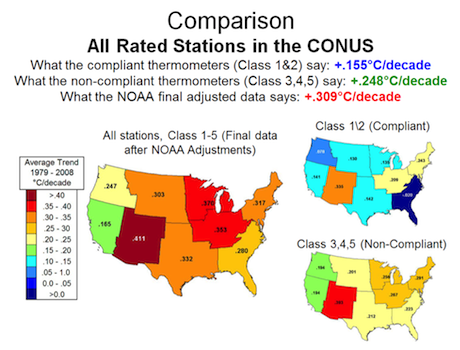
Have a look at this chart. It tells you pretty much all you need to know about the much-anticipated scoop by Anthony Watts of Watts Up With That?

What it means, in a nutshell, is that the National Oceanic and Atmospheric Administration (NOAA) — the US government body in charge of America’s temperature record, has systematically exaggerated the extent of late 20th century global warming. In fact, it has doubled it.

Is this a case of deliberate fraud by Warmist scientists hell bent on keeping their funding gravy train rolling? Well, after what we saw in Climategate anything is possible. (I mean it’s not like NOAA is run by hard-left eco activists, is it?) But I think more likely it is a case of confirmation bias. The Warmists who comprise the climate scientist establishment spend so much time communicating with other warmists and so little time paying attention to the views of dissenting scientists such as Henrik Svensmark — or Fred Singer or Richard Lindzen or indeed Anthony Watts — that it simply hasn’t occurred to them that their temperature records need adjusting downwards not upwards.

What Watts has conclusively demonstrated is that most of the weather stations in the US are so poorly sited that their temperature data is unreliable. Around 90 per cent have had their temperature readings skewed by the Urban Heat Island effect. While he has suspected this for some time what he has been unable to do until his latest, landmark paper (co-authored with Evan Jones of New York, Stephen McIntyre of Toronto, Canada, and Dr. John R. Christy from the Department of Atmospheric Science, University of Alabama, Huntsville) is to put precise figures on the degree of distortion involved.

July 16, 2012

If this forecast is accurate, we’ll all be nostalgic for global warming

Filed under: Britain, Environment — Tags: , , , , — Nicholas @ 08:05

In his Telegraph column on the current weather in Britain (and what it may or may not do to the Olympic schedule), Boris Johnson shares a long range weather forecast that is chilling — literally:

I have just been on the blower to my old chum, Piers Corbyn, the world’s foremost meteorological soothsayer, and he sounds like Jeremiah with an ingrown toenail. This is the same Corbyn, with a first-class degree in physics, who decisively beat the Met Office in 2010 and accurately forecast the cold and snowy winter — and I am afraid he has been bearish about this summer from sometime in February or March.

According to Piers and his team at Weather Action, we all underestimate the role of the sun. This is set to be just about the wettest July on record, he says, and that is mainly because of things taking place in the nuclear fireball millions of miles away from earth. “Sometime too bright the eye of heaven shines,” says the Poet, and often is his gold complexion dimmed. This is one of the dim moments. The old boy is suffering from some kind of solar acne, called “coronal holes”, and on July 12 he apparently emitted a colossal flare — a cosmic spurt of X-rays and other charged particles; and, by a process that we (or at least I) do not fully understand — perhaps because rain droplets form more easily when there are charged particles around — this distemper in the celestial orb is helping to cause the current inundations.

For the sake of completeness, and so that no one can later accuse me of concealing the bad news (what did he know about the weather, and when did he know it?), I should say that Piers has a general thesis that the current phase of grim weather — cold, snowy winters and wet summers — is just the prelude to something yet more bracing. We are heading, he says, for a mini Ice Age. These wet Julys and frosty Januaries are part of the opening drum roll of a cold period that will set in over the next decades.

Some say it will be upon us by 2045, some say by 2030. Looking at the pattern of the last few years, Piers Corbyn now thinks it could be sooner than that. He does not say that sabretooth tigers will roam the streets of Newcastle. He does not say that the Thames will freeze at London Bridge and that we will have fairs on the ice — unlikely, given how fast the river flows these days. But he does believe that it will get nippier, and that we will see the kind of cold period last experienced in the late 17th century and early 18th century.

July 15, 2012

Individual data points are less important than trends

Filed under: Environment, Media, USA — Tags: , , , , — Nicholas @ 00:06

Remember the summer of 2001? It was a media feeding frenzy on the highly appropriate topic of sharks: shark attacks in US coastal waters were the third-most reported news item. But the media was calling attention to a “trend” of increasing shark attacks that didn’t actually exist. 2001 was actually a lower than average year for shark attacks. Warren Mayer explains the similarities between 2001’s “Summer of the Shark” and 2012’s heat wave:

This summer we have been absolutely bombarded with stories about the summer heat wave in the United States. The constant drumbeat of this coverage is being jumped on by many as evidence of catastrophic man-made global warming.

[. . .]

Trend, you say? Doesn’t a 100-year high temperature in and of itself imply warming? Certainly not. I believe this will prove to be an exaggeration, but for a moment let’s assume that this heat wave has created the hottest June in 100 years for half the Continental US. That seems pretty extreme, right? But the Continental US is about 2.5% of the world’s land mass. Just by math, in a stochastic system with a stable mean, a land area of this size somewhere should have a 100-year high month about five times a year! One data point about one small patch of the Earth having a hot month tells us nothing about trends.

[. . .]

What the Summer of the Shark needed, and what this summer’s US heatwave needs, is a little context. Specifically, if we are going to talk about supposed “trends”, then we should look at the data series in question over time. So let’s do so.

July 14, 2012

Flood policy and personal responsibility

Filed under: Britain, Environment, Government — Tags: , , , , , — Nicholas @ 00:03

James Delingpole on the British government’s latest announcements on flood policy:

Yesterday it was reported that the Coalition had decided we should all be liable for the cost of flood damage, regardless of where we live. This puzzled me, as the Coalition’s decisions so often do. The only way it would make any kind of sense would be if you believed a) flooding is a new and unnatural phenomenon resulting directly from late 20th century Man Made Climate Change or b) that everyone is now so stupid they cannot be trusted to act in their own best interests and that it is therefore government’s job to hold their hands and wipe their bottoms for them from cradle to grave.

To discount a) you only have to go somewhere like the River Severn, just below Worcester Cathedral, and look at the flood marks on the wall. Many of the most dramatic inundations happened in years long before “man made global warming” was even a sinister glint in Al Gore’s eye. This isn’t to say that the cost of flood damage hasn’t risen to unprecedented levels these last few decades. But that has more to do with our insane practice of allowing property developments to be built on flood plains, together with our unfortunate habit of paving and tarmacking everything (such as the front gardens we would once have kept as front gardens) which means that in times of high rainfall floodwater is likely to accumulate in drains more rapidly. Plus, of course, we’re all richer — so there’s more expensive property for flooding to damage.

But it’s the b) aspect I find more worrying because of the way it rides roughshod over the most basic principles of free market economics. Can we really assume that when anybody buys a house by a river — or near a floodplain — they don’t do so in the full knowledge that flood-risk is one of the prices they pay for their pleasing waterside ambience? The very idea is a nonsense. Buyers, being rational, will factor this into their calculations: “OK, so it will be great for fishing and swimming and boating. But getting insurance will be a bugger and we’d better not keep anything too precious on the ground floor.” These complexities will be reflected by the market. While the value of the property may be enhanced by its attractive location, it will simultaneously be decreased by its flood-damage potential.

July 3, 2012

Bad news (for panicmongers, anyway)

Filed under: Economics, Environment — Tags: , , , , — Nicholas @ 08:32

In the Guardian, George Monbiot (known to his detractors as “The Great Moonbat”) admits the terrible truth. He was wrong, again:

The facts have changed, now we must change too. For the past 10 years an unlikely coalition of geologists, oil drillers, bankers, military strategists and environmentalists has been warning that peak oil — the decline of global supplies — is just around the corner. We had some strong reasons for doing so: production had slowed, the price had risen sharply, depletion was widespread and appeared to be escalating. The first of the great resource crunches seemed about to strike.

Among environmentalists it was never clear, even to ourselves, whether or not we wanted it to happen. It had the potential both to shock the world into economic transformation, averting future catastrophes, and to generate catastrophes of its own, including a shift into even more damaging technologies, such as biofuels and petrol made from coal. Even so, peak oil was a powerful lever. Governments, businesses and voters who seemed impervious to the moral case for cutting the use of fossil fuels might, we hoped, respond to the economic case.

[. . .]

Peak oil hasn’t happened, and it’s unlikely to happen for a very long time.

A report by the oil executive Leonardo Maugeri, published by Harvard University, provides compelling evidence that a new oil boom has begun. The constraints on oil supply over the past 10 years appear to have had more to do with money than geology. The low prices before 2003 had discouraged investors from developing difficult fields. The high prices of the past few years have changed that.

June 17, 2012

Narrow specialization, but very wide assumed knowledge

Filed under: Economics, Environment, Politics — Tags: , , — Nicholas @ 09:11

Tim Worstall on the problem when specialists in one area pretend deep understanding of radically different areas:

Regular readers will know that I’m perfectly happy to take what the climate scientists tell me about climate science. Where I start to stray from the path of green orthodoxy is those same scientists then tell us the economics of what we ought to do about it all. Something they are not competent to comment upon as they really don’t understand the economics. I do accept the economics of climate change as laid out by the economists who have studied the economics of climate change. William Nordhaus, Nick Stern and so on, tell us that if the climate science is right then a simple revenue neutral carbon tax will be the solution.

That’s fine by me. But it does still puzzle me as to why the not economists feel competent to pronounce on the economics of climate change. Are they intellectual supermen who can master two widely different subjects? Simply succumbing to politics: something must be done, this is something, do this? [. . .]

Which leads us to our conclusion. The reason the scientists are so in conflict with what the economists of climate change are saying about the economics of climate change is simply that the scientists are entirely ignorant of what the economists are saying. And I’m afraid that, despite the popularity of the stance among politicians, ignorance is not a notably successful form of governance.

June 16, 2012

James Lovelock interviewed in the Guardian

James Lovelock, who is perhaps best known for his “Gaia” theory, gives a somewhat surprising interview to the Guardian:

“Adapt and survive,” he says, when asked why he has decided to move. After more than three decades living amid acres of trees he planted himself by hand, he and his wife Sandy have decided to downsize and move to an old lifeguard’s cottage by the beach in Dorset. “I’m not worried about sea-level rises,” he laughs. “At worst, I think it will be 2ft a century.”

Given that Lovelock predicted in 2006 that by this century’s end “billions of us will die and the few breeding pairs of people that survive will be in the Arctic where the climate remains tolerable”, this new laissez-faire attitude to our environmental fate smells and sounds like of a screeching handbrake turn.

Indeed, earlier this year he admitted to MSNBC in an interview reported around the world with somewhat mocking headlines along the lines of “Doom-monger recants”, that he had been “extrapolating too far” in reaching such a conclusion and had made a “mistake” in claiming to know with such certainty what will happen to the climate.

[. . .]

Having already upset many environmentalists — for whom he is something of a guru — with his long-time support for nuclear power and his hatred of wind power (he has a picture of a wind turbine on the wall of his study to remind him how “ugly and useless they are”), he is now coming out in favour of “fracking”, the controversial technique for extracting natural gas from the ground. He argues that, while not perfect, it produces far less CO2 than burning coal: “Gas is almost a give-away in the US at the moment. They’ve gone for fracking in a big way. Let’s be pragmatic and sensible and get Britain to switch everything to methane. We should be going mad on it.”

Lovelock says the political fallout from the Fukushima disaster in Japan last year means that the chances of a surge in nuclear power generation are dramatically reduced. “The fear of nuclear is too great after Fukushima and the cost of building plants is very expensive and impractical. And it takes a long time to get them running. It is very obvious in America that fracking took almost no time to get going. There’s only a finite amount of it [in the UK] so before it runs out, we should really be thinking sensibly about what to do next. We rushed into renewable energy without any thought. The schemes are largely hopelessly inefficient and unpleasant. Fracking buys us some time, and we can learn to adapt.”

The reaction in Germany to Fukushima — which announced within weeks of the disaster that it was to shut down all its nuclear power plants by 2022 — particularly infuriates Lovelock: “Germany is a great country and has always been a natural leader of Europe, and so many great ideas, music, art, etc, come out of it, but they have this fatal flaw that they always fall for an ideologue, and Europe has suffered intensely from the last two episodes of that. It looks to me as if the green ideas they have picked up now could be just as damaging. They are burning lignite now to try to make up for switching off nuclear. They call themselves green, but to me this is utter madness.”

Nestled deep into an armchair, Lovelock brushes a biscuit crumb from his lips, and lowers his cup of tea on to the table: “I’m neither strongly left nor right, but I detest the Liberal Democrats.”

[. . .]

Lovelock does not miss a chance to criticise the green movement that has long paid heed to his views. “It’s just the way the humans are that if there’s a cause of some sort, a religion starts forming around it. It just so happens that the green religion is now taking over from the Christian religion. I don’t think people have noticed that, but it’s got all the sort of terms that religions use. The greens use guilt. You can’t win people round by saying they are guilty for putting CO2 in the air.”

« Newer PostsOlder Posts »

Powered by WordPress


