Quotulatiousness

December 24, 2022

The abiding influence of A Christmas Carol by Charles Dickens

Filed under: Books, Britain, History — Tags: , , , , — Nicholas @ 05:00

So many of our fading-but-still-fondly remembered Christmas traditions seem to come back to Victorian times, and especially those featured in Charles Dickens’ most famous Christmas story (certainly helped by the popularity of the Alistair Sim film adaptation):
Even in our supposedly rationalist secular era, we find one of these thin places or times in the unlikely guise of Christmas and its rich repository of ghost stories. The supernatural was not banished by the developments of modernity but rather it evolved and adapted, moving from enchanted woods to gothic houses to the streets and rooms of Victorian cities. Just as in earlier times, they found their place where it is dark, in the dead of winter, when the nights close in and fireside stories cause the mind to play tricks and shadows to seemingly change their forms.

Among the many writers who have tried their hand at yuletide ghost stories, none loom larger than Charles Dickens who, with A Christmas Carol (subtitled Being a Ghost Story of Christmas), fundamentally influenced the way we perceive and celebrate the festivity. To fully understand how and why Christmas became a thin place and remains so, we have to delve into a scourge at the very heart of Dickens’s story and our society still — loneliness.

Christmas is one of those times when, as a much earlier writer, Dante, put it: “There is no greater sorrow than to recall in misery the time when we were happy.” And what time is happier, or more melancholic when irretrievable, than a childhood Christmas? Victorian writers knew that when we are alone at Christmas, a time that seems intrinsically meant for loved ones congregating (the perpetual renewal of the Nativity scene), our ghosts, borne by memory, absence and regret, would instead arrive.

Dickens knew the power of myth, and how the beautiful lie might reveal the hidden truth. Determined to speak out about the horrors of child labour and poverty he had directly experienced and witnessed, Dickens first toyed with writing a strident but fairly unwieldly political jeremiad until he realised, correctly, that there was a much more seductive approach available, through the Trojan Horse of storytelling. It was all too easy to turn away from a lecture or respond with platitudes and fallacies, but a heart-stirring tale had the ability to get under one’s skin. His characters and settings were constructed not just from satirical observations of the powerful but from encounters Dickens had had with the powerless, during his lengthy night walks around London. He was also deeply inspired, and haunted, by macabre tales that his cockney nursemaid Mary Weller used to delight in telling him as a child — full of Faustian pacts, treacherous innkeepers, poisons “distilled from toads’ eyes and spiders’ knees”, the Black Cat and Captain Murderer. To add to the unease, Weller would claim the horrors were true and she had witnessed them herself or had heard them from relatives who were eyewitnesses. As Dickens later recounted, in The Uncommercial Traveller, she “took a fiendish enjoyment of my terrors, and used to begin, I remember — as a sort of introductory overture — by clawing the air with both hands, and uttering a long low hollow groan”.

A Christmas Carol has this oral tradition feel, albeit delivered in a short, and affordable, novella form. It also rebalances Dickens’s heavy lean towards sentimentality (the pitiable figure of Tiny Tim, for instance) with the resolutely unsentimental tactic of terrifying child readers. This was necessary for reasons of veracity — existence was unsentimental in those days — but also as a myth-making technique. There are few lessons that stay with us longer and deeper than those which strike mortal fear in us and then propose a way out.

At the heart of the story and its extraordinary legacy is loneliness. Rereading A Christmas Carol, its power initially comes from its status as a social tract and a fable. What is crucial, however, is its existential quality. It shows that the system then in place, and perhaps still, not only oppresses and squanders but it also alienates. Dickens takes the traditional Christmas theme of visitation (the announcing angel, the wandering star leading to the Christ child, the shepherds, the Magi) and makes it sinister. Salvation can come only through the painful process of facing the truth (“Without their visits,” said the Ghost, “you cannot hope to shun the path I tread”). It can only emerge from Scrooge seeing that he has betrayed and marginalised not only his fellow human beings but himself, acknowledging that he belongs to the Malthusian “surplus population” he castigates, that he is alone and bereft (“Will you not speak to me?” he begs the final phantom), and the only precious hope he has left is to be found through gratitude and selfless communion with others.

History-Makers: Saint Nicholas to Santa Claus

Overly Sarcastic Productions
Published 23 Dec 2022

Merry Sinterklaasfeest to all, and to all a good night.

Our content is intended for teenage audiences and up.
(more…)

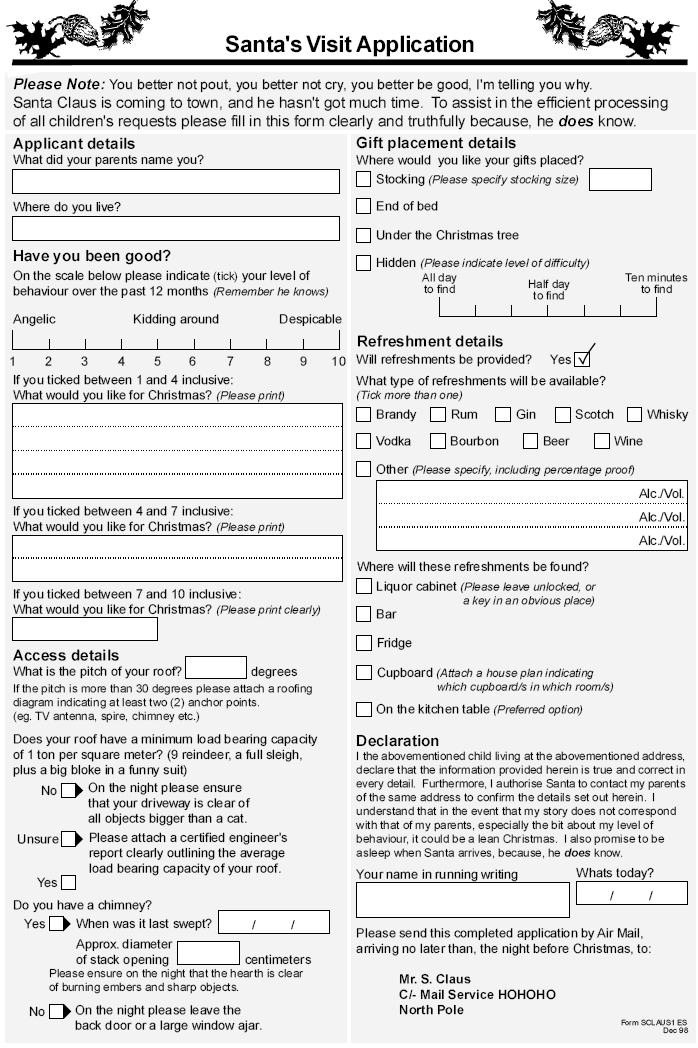
Repost – Hey Kids! Did you get your paperwork in on time?

Filed under: Bureaucracy, Humour — Tags: , — Nicholas @ 03:00

If you hurry, you can just get your Santa’s Visit Application in before the deadline tonight!

Repost – The Monkees – “Riu Chiu”

Filed under: Media, USA — Tags: , , , — Nicholas @ 02:00

Uploaded on 15 Dec 2015

The Monkees perform “Riu Chiu” from Episode 47, “The Monkees’ Christmas Show”.

H/T to the late Kathy Shaidle for the link.

(more…)

QotD: Auberon Waugh on Christmas shopping

Filed under: Britain, Humour, Quotations — Tags: , — Nicholas @ 01:00

For Christmas shopping in London I go by force of habit to Harrods. The toy department is full of loud-voiced Englishwomen, but I do not see a fellow Englishman anywhere until I chance upon the Women’s Underwear Department. As I pass, I hear a Major of the Household Brigade ask for some knickers with pussy fur. Another man, almost certainly from the Treasury, asks in a hoarse whisper for some crotchless briefs.

Auberon Waugh, Diary, 1975-12-18.

December 23, 2022

Hot Buttered Rum – Food Wishes

Filed under: Food — Tags: , , , — Nicholas @ 02:00

Food Wishes
Published 8 Dec 2020

You can do a lot of great things with rum. Make rum balls, soak a chocolate cake, pour it into a glass of cola, and of course, entertain pirates, but maybe my favorite thing to do with rum, especially around the holidays, would be to butter it. Enjoy!
(more…)

December 22, 2022

The Emulsified High-Fat Offal Tube | Yes, Minister: 1984 Christmas Special | BBC Comedy Greats

Filed under: Britain, Bureaucracy, Humour, Media, Politics — Tags: , , , — Nicholas @ 02:00

BBC Comedy Greats
Published 26 Jul 2021

Bernard (Derek Fowlds) walks Jim Hacker (Paul Eddington) through the red-tape of signing his Christmas cards, but Jim Hacker is more concerned with worrying plans from Brussels to rename the British sausage.
(more…)

December 21, 2022

Is Regifting a Crime?

Filed under: Humour, USA — Tags: — Nicholas @ 02:00

It’s a Southern Thing
Published 10 Dec 2019

To regift or not to regift? The Southern People’s Court brings their unique brand of justice to this tough issue.
(more…)

December 20, 2022

Eggnog: A Christmas History

Filed under: Food, History, USA — Tags: , , , , , — Nicholas @ 02:00

Tasting History with Max Miller
Published 22 Dec 2020
(more…)

December 19, 2022

Christmas Crack – You Suck at Cooking (episode 54)

Filed under: Food, Humour — Tags: , , , — Nicholas @ 02:00

You Suck At Cooking
Published 22 Dec 2016

To make the Christmas crack:

1. Combine equal parts of butter and brown sugar (1 cup of each works) and heat in a sauce pan until it turns into sauce in the pan.
2. Line a baking sheet with foil then with graham crackers. Break them up to make them fit along the edges.
3. Once the butter and sugar become a thickish sauce, pour it all over.
4. Bake in in the oven for a couple minutes until it starts to bubble but not for too long.
5. Cover with chocolate chips … you can put that back in the oven for a minute or just wait a minute and start spreading them around as they melt until it’s a full layer. Use just over 1 cup.
6. Throw on whatever toppings you want; almonds, pepperoni, whatever.
7. Wait a few hours for it to harden or throw it in the fridge or the freezer.

I personally like keeping it frozen and eating it that way. But I am not you and you may have different temperature preferences. It’s hard for me to tell at this point, but if you message me on snapchat perhaps we can discuss this more thoroughly. Or perhaps not. I’m sorta moody that way.
(more…)

December 15, 2022

Christmas in the WWI Trenches – Xmas Rations

Filed under: Britain, Food, History, Military, WW1 — Tags: , , , , — Nicholas @ 04:00

Tasting History with Max Miller
Published 13 Dec 2022

(more…)

December 11, 2022

How to Make A Christmas Cake – The Victorian Way

Filed under: Britain, Food, History — Tags: , , — Nicholas @ 02:00

English Heritage
Published 30 Nov 2017

Christmas is approaching so Mrs Crocombe is making a cake for Lord and Lady Braybrooke at Audley End House.

This traditional plum cake is based on a recipe by Charles Francatelli, who was Queen Victoria’s chief cook from 1840 to 1841.
(more…)

December 26, 2021

Repost – The market failure of Christmas

Filed under: Economics — Tags: , , — Nicholas @ 03:00

Not to encourage miserliness and general miserability at Christmastime, but here’s a realistic take on the deadweight loss of Christmas gift-giving:

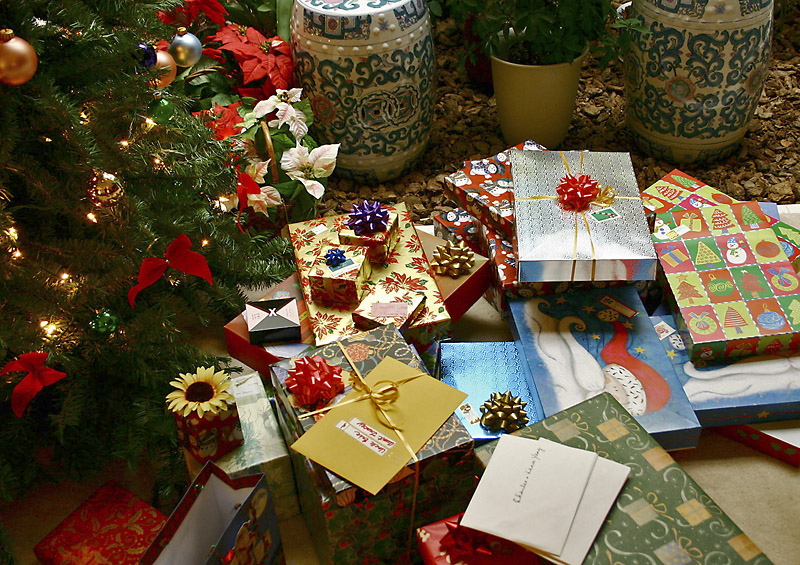
Christmas gifts under the tree.
Photo by Kelvin Kay via Wikimedia Commons.

In strict economic terms, the most efficient gift is cold, hard cash, but exchanging equivalent sums of money lacks festive spirit and so people take their chance on the high street. This is where the market fails. Buyers have sub-optimal information about your wants and less incentive than you to maximise utility. They cannot always be sure that you do not already have the gift they have in mind, nor do they know if someone else is planning to give you the same thing. And since the joy is in the giving, they might be more interested in eliciting a fleeting sense of amusement when the present is opened than in providing lasting satisfaction. This is where Billy Bass comes in.

But note the reason for this inefficient spending. Resources are misallocated because one person has to decide what someone else wants without having the knowledge or incentive to spend as carefully as they would if buying for themselves. The market failure of Christmas is therefore an example of what happens when other people spend money on our behalf. The best person to buy things for you is you. Your friends and family might make a decent stab at it. Distant bureaucrats who have never met us — and who are spending other people’s money — perhaps can’t.

So when you open your presents next week and find yourself with another garish tie or an awful bottle of perfume, consider this: If your loved ones don’t know you well enough to make spending choices for you, what chance does the government have?

You Suck at Christmas – You Suck at Cooking (episode 28)

Filed under: Food, Humour — Tags: , — Nicholas @ 02:00

You Suck At Cooking
Published 23 Dec 2015

A 100 percent full throttle high adrenaline speed chase through the history of christmas.

Wishing you all a great close to your year!

QotD: Boxing Week Sales

Filed under: Business, Humour, Quotations — Tags: , — Nicholas @ 01:00

I’ve done a few tours of duty behind a cash register. The job takes your soul, twists it like a wet chamois and runs it through the shredders they use to turn car hoods into tinfoil strips. […] When I lived out east, the relationship between cashier and customer was the same as that between a German gunner and the troops disembarking at Normandy.

James Lileks, “Backfence: Beyond new store’s hype, genuine smiles”, Minneapolis Star Tribune, 2004-08-03.

« Newer PostsOlder Posts »

Powered by WordPress