
Quotulatiousness

December 13, 2011

Canada’s withdrawal from Kyoto was inevitable from the beginning

I was against the Kyoto agreement from the start, but the government of the day had to be seen to be more “green” than the Americans. John Ibbitson explains:

The Harper government’s decision to withdraw from the Kyoto Protocol tarnishes Canada before the world. Liberal and Conservative incompetence and mendacity are to blame. You and I are to blame. And Lehman Brothers had something to do with it as well.

It isn’t easy for a country to descend, in the space of a single decade, from crusader to pariah, as Canada has done on the environment. But our political leaders were up to the task.

The first, worst mistake occurred at Kyoto itself in 1997, when then prime minister Jean Chrétien told Canadian negotiators to meet or beat the American commitment, whatever it took. The problem was that while the American commitment was ambitious, Bill Clinton never expected the Senate to ratify that commitment, and he was right.

The Liberals found themselves stuck with Draconian targets that, if met, would hobble oil sands production, hammer big industry in Ontario, and send home-heating bills through the roof. Their solution was to study the issue. And study. I remember sitting through an interminable briefing in 2003, in which officials patiently explained how Canada would meet its Kyoto targets. The only problem was that there was this enormous gap, which was to be closed through “future reductions.” It was like having a household budget in which Miscellaneous was bigger than Mortgage.

Given the hammering that British PM David Cameron has been taking in the British press, he should send a bouquet of flowers to Stephen Harper for giving the media a different villain to abuse.

Update: Stephen Gordon says the same thing: inevitable from the beginning.

Notwithstanding economically illiterate attempts to pretend otherwise, higher consumer prices for GHG-emitting goods and services are an essential component of any serious attempt to reduce emissions. Counting on people to reduce GGE emissions out of the goodness of their hearts was the strategy of the Chrétien-Martin Liberal governments, and adopting this policy made Canada’s Kyoto failure inevitable long before Stephen Harper’s Conservatives came to power.

Political parties rarely win when they campaign on a platform that promises to increase the price of fossil fuels — the Progressive Conservative government of Joe Clark lost power in large part because of its proposal to increase the gasoline excise tax by 18 cents a gallon (4 cents a litre).

Update, the second: Oh, it’s okay, apparently we’re not allowed to abandon the “voluntary” agreement:

Remember how this was phrased? “sign it, it’s just voluntary!”

Recall Rio 1992 “Earth Summit” where the meme was “hey, it’s voluntary! … with a negotiating schedule attached”. Apparently, like a Roach Motel, “countries check in but they can’t check out”. This email is from UNFCCC’s list server and note my bolded section below. The arrogance, it burns.

[. . .]

    “I regret that Canada has announced it will withdraw and am surprised over its timing. Whether or not Canada is a Party to the Kyoto Protocol, it has a legal obligation under the Convention to reduce its emissions, and a moral obligation to itself and future generations to lead in the global effort. Industrialized countries whose emissions have risen significantly since 1990, as is the case for Canada, remain in a weaker position to call on developing countries to limit their emissions.”

November 14, 2011

Beating up on the Boomer generation

Filed under: Economics, History, Media, USA — Tags: , , , — Nicholas @ 12:03

Walter Russell Mead has a bit of vitriol to spit at the Baby Boomers:

But at the level of public policy and moral leadership, as a generation we have largely failed. The Boomer Progressive Establishment in particular has been a huge disappointment to itself and to the country. The political class slumbered as the entitlement and pension crisis grew to ominous dimensions. Boomer financial leadership was selfish and shortsighted, by and large. Boomer CEOs accelerated the trend toward unlimited greed among corporate elites, and Boomer members of corporate boards sit by and let it happen. Boomer academics created a profoundly dysfunctional system that systemically shovels resources upward from students and adjuncts to overpaid administrators and professors who by and large have not, to say the least, done an outstanding job of transmitting the cultural heritage of the past to future generations. Boomer Hollywood execs created an amoral morass of sludge — and maybe I’m missing something, but nobody spends a lot of time talking about the towering cultural accomplishments of the world historical art geniuses of the Boomer years. Boomer greens enthusiastically bet their movement on the truly idiotic drive for a global carbon treaty; they are now grieving over their failure to make any measurable progress after decades spent and hundreds of millions of dollars thrown away. On the Boomer watch the American family and the American middle class entered major crises; by the time the Boomers have finished with it the health system will be an unaffordable and dysfunctional tangle — perhaps the most complicated, expensive and poorly designed such system in the history of the world.

All of this was done by a generation that never lost its confidence that it was smarter, better educated and more idealistic than its Depression-surviving, World War-winning, segregation-ending, prosperity-building parents. We didn’t need their stinking faith, their stinking morals, or their pathetically conformist codes of moral behavior. We were better than that; after all, we grokked Jefferson Airplane, achieved nirvana on LSD and had a spiritual wealth and sensitivity that our boorish bourgeois forbears could not grasp. They might be doers, builders and achievers — but we Boomers grooved, man, we had sex in the park, we grew our hair long, and we listened to sexy musical lyrics about drugs that those pathetic old losers could not even understand.

What the Boomers as a generation missed (there were, of course and thankfully, many honorable individual exceptions) was the core set of values that every generation must discover to make a successful transition to real adulthood: maturity. Collectively the Boomers continued to follow ideals they associated with youth and individualism: fulfillment and “creativity” rather than endurance and commitment. Boomer spouses dropped families because relationships with spouses or children or mortgage payments no longer “fulfilled” them; Boomer society tolerated the most selfish and immature behavior in its public and cultural leaders out of the classically youthful and immature belief that intolerance and hypocrisy are greater sins than the dereliction of duty. That the greatest and most effective political leader the Baby Boom produced was William Jefferson Clinton tells you all you need to know.

October 12, 2011

So, if it wasn’t Wall Street, then who inflated the US housing bubble anyway?

Filed under: Economics, Government, USA — Tags: , , , , , — Nicholas @ 12:03

Peter Wallison has the answer:

Beginning in 1992, the government required Fannie Mae and Freddie Mac to direct a substantial portion of their mortgage financing to borrowers who were at or below the median income in their communities. The original legislative quota was 30%. But the Department of Housing and Urban Development was given authority to adjust it, and through the Bill Clinton and George W. Bush administrations HUD raised the quota to 50% by 2000 and 55% by 2007.

It is certainly possible to find prime borrowers among people with incomes below the median. But when more than half of the mortgages Fannie and Freddie were required to buy were required to have that characteristic, these two government-sponsored enterprises had to significantly reduce their underwriting standards.

Fannie and Freddie were not the only government-backed or government-controlled organizations that were enlisted in this process. The Federal Housing Administration was competing with Fannie and Freddie for the same mortgages. And thanks to rules adopted in 1995 under the Community Reinvestment Act, regulated banks as well as savings and loan associations had to make a certain number of loans to borrowers who were at or below 80% of the median income in the areas they served.

August 12, 2011

Why Obama is being attacked from the left

Filed under: Economics, Media, Politics, USA — Tags: , , , , , — Nicholas @ 12:12

Victor Davis Hanson outlines the reasons for increasing attacks on President Obama and his administration from his erstwhile allies on the left:

Politics, of course. The combination of sinking polls to the near 40% range, the stock market nosedive, the Standard and Poor’s downgrade, the tragedy in Afghanistan, the confusion over Libya, the embarrassing golf outings and First Family insensitive preferences for the aristocratic Martha’s Vineyard, Vail, and Costa del Sol have contributed to a general unease on the Left about Obama’s judgment, perhaps to the extent that he might well take the Left down in 2012, both in the House and Senate, whether he wins reelection or not.

But the argument remains incoherent: Obama is being blamed for not being liberal enough — after federalizing much of the health care delivery system, expanding government faster than at any time since 1933, borrowing more money in two and a half years than any president in history, absorbing companies, jawboning the wealthy, going after Boeing, reversing the order of the Chrysler creditors, adding vast new financial and environmental regulations, appointing progressives like a Van Jones or Cass Sunstein, and institutionalizing liberal protocols across the cabinet and bureaucracy, from the EPA to the Attorney General’s Office.

In other words, there is now an elite liberal effort to disentangle Obama from liberalism itself, and to suggest that his sagging polls are not a reflection of Obama’s breakneck efforts to take the country leftward — but either his inability or unwillingness to do so!

Partly, the disappointment is understandably emotional. Just three years ago Obama was acclaimed as a once-in-a-lifetime prophet of liberalism, whose own personal history, charisma, teleprompted eloquence and iconic identity might move a clearly center-right country hard leftward where it otherwise rarely wished to go.

Partly, the anger is quite savvy: if one suddenly blames Obama the man, rather than Obama the ideologue, then his unpopularity is his own, not liberalism’s. There is a clever effort to raise the dichotomy of the inept Carter and the politically savvy Clinton, but in the most improbable fashion: Clinton supposedly was a success not because he was personable, sometimes compromising, and often centrist, and Carter was a failure not because he was sanctimoniously and stubbornly ideological, but just the opposite: Clinton is now reinvented as the true liberal who succeeded because of his principled leftwing politics; Carter like Obama was a bumbling compromiser and waffler.

April 8, 2011

QotD: the international double standard

Filed under: Europe, Humour, Italy, Quotations, USA — Tags: , — Nicholas @ 13:39

A long time ago we had a president who was doing a chubby intern.

And some Americans got uptight about it.

And we were told by Europeans everywhere ‘Relax, it’s just sex. He’s the leader of the country, they have mistresses, it happens get over it you uptight prudes.’

So now with Silvio Berlusconi having sex with underage prostitutes and orgies and I don’t know what-all I guess that makes Europe — and Italy in particular — about eighteen times more sophisticated [1] than us hicks in the United States and so-on and so-forth.

Y’all must be so proud.

[1] Sarcasm.

Brian Dunbar, “Sophisticated Europe”, Space for Commerce, by Brian Dunbar, 2011-04-07

February 3, 2011

Bipartisan big government

Filed under: Economics, Government, Politics, USA — Tags: , , , , — Nicholas @ 12:47

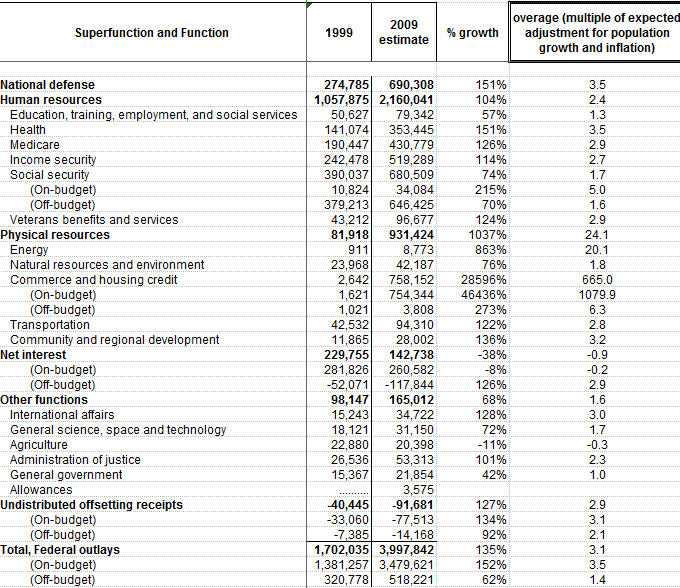
Bruce F. Webster addresses the “Clinton Budget Fallacy” by downloading some publicly accessible numbers and doing a bit of simple math:

Put simply, from 1999 to 2010, the US population grew by 10% and inflation reduced the value of the dollar by about 30%. Combine those two, and Federal spending should have gone up roughly 43% over that period. Instead, it went up 135%, or three times what it should have. Setting aside some of the bailouts, etc., that are in the budget, it’s still clear that almost every Federal line item went up at least twice what it should have during that period. Almost nothing (other than “general government”) grew a “mere” 43%.

I fully blame Bush and the 2002-2006 Republicans as much as I blame Obama and the 2006-2010 Democrats. The real question is whether the 2010 Republicans have the brains and the will to turn back the tide.

The smart money, I’m afraid, is betting against that outcome.

September 21, 2009

Hate the president: it’s a hallowed tradition

Filed under: Politics, USA — Tags: , , , — Nicholas @ 07:27

Steve Chapman looks at the long, long, long history of President Derangement Syndrome:

A new president, pursuing policies well within the political mainstream, evokes weirdly angry and intense denunciations from opponents—a reaction hard to explain in terms of anything he has actually done. Does that suggest, as Jimmy Carter insists, that their true motivation lies in racism?

No, it doesn’t, because I’m not talking about Barack Obama. I’m talking about George W. Bush and Bill Clinton — both of whom, from the day they took office, managed to convince a minority of Americans that they were not just wrong but illegitimate, dangerous, and thoroughly evil. Obama’s troubles are not exactly unprecedented.

[. . .]

So you don’t need to turn to race to explain the virulent animosity against Obama. What all the presidents who previously endured irresponsible slander had in common, after all, is that they were white.

Clinton’s experience suggests that merely being a Democrat is enough to evoke hysteria in some quarters. In matters of policy, he was about as congenial as any conservative could have hoped — cooperating with Republicans to balance the budget, advancing free trade, rejecting an international treaty banning land mines, signing welfare reform, and threatening to bomb North Korea over its nuclear program. Yet even today, many on the right regard him as an extreme liberal.

I don’t remember President Ford rousing the standard levels of derangement among his opponents, but that could be because it was before I started paying much attention to U.S. politics. Other than Ford, all the other occupants of that office seem to have generated deep animosity (Nixon? Hell yeah. Carter? Yep. Reagan? A subgenre of musical animosity. Bush I? Yep.)

« Newer Posts

Powered by WordPress

