Quotulatiousness

June 9, 2020

Hiding your Army | Military Camouflage | The Tank Museum

Filed under: Britain, France, Germany, History, Military, Russia, USA, WW1, WW2 — Tags: , , , , , , — Nicholas @ 04:00

The Tank Museum
Published 10 May 2020

Curator David Willey talks to you about military camouflage, from home! He takes a look at military uniform and vehicles.

https://tankmuseumshop.org/

Support the work of The Tank Museum on Patreon: ► https://www.patreon.com/tankmuseum
Visit The Tank Museum SHOP & become a Friend: ► https://tankmuseumshop.org/

Twitter: ► https://twitter.com/TankMuseum
Instagram: ► https://www.instagram.com/tankmuseum/
Tiger Tank Blog: ► http://blog.tiger-tank.com/
Tank 100 First World War Centenary Blog: ► http://tank100.com/

June 8, 2020

D-Day – The Last German Holdouts

Filed under: Britain, Cancon, Germany, History, Military, WW2 — Tags: , , , , — Nicholas @ 04:00

Mark Felton Productions
Published 6 Jun 2020

Some German coast defences managed to survive on D-Day and fought on behind Allied lines. One was the massive Douvres Radar Station bunker complex between Juno and Sword Beaches. It held out for 12 days after D-Day, and required a special operation to knock it out.

Visit my audio book channel ‘War Stories with Mark Felton’: https://youtu.be/xszsAzbHcPE

Help support my channel:
https://www.paypal.me/markfeltonprodu…
https://www.patreon.com/markfeltonpro…

Disclaimer: All opinions and comments expressed in the ‘Comments’ section do not reflect the opinions of Mark Felton Productions. All opinions and comments should contribute to the dialogue. Mark Felton Productions does not condone written attacks, insults, racism, sexism, extremism, violence or otherwise questionable comments or material in the ‘Comments’ section, and reserves the right to delete any comment violating this rule or to block any poster from the channel.

Credits: YouTube Creative Commons; WikiCommons; Google Commons; Google Maps; Mark Felton Productions; Sartorlelg

June 7, 2020

Why determining the Impact of Lend-Lease is so complicated

Filed under: Britain, Cancon, Economics, History, Military, Russia, USA, WW2 — Tags: , , , , , — Nicholas @ 02:00

Military History Visualized
Published 14 Aug 2018

Determining the impact of the Western Aid that was provided to the Soviet Union in the Second World War is quite controversial. This aid was provided under the Lend-Lease act, as such it is usually just called Lend-Lease. The majority of the support was provided by the United States, yet other countries like the United Kingdom and Canada aided the Soviet Union as well.

Thank you to VonKickass for the Thumbnail Design!

»» SUPPORT MHV ««
» patreon – https://www.patreon.com/join/mhv
» paypal donation – https://www.paypal.com/cgi-bin/webscr…

»» MERCHANDISE – SPOILS OF WAR ««
» shop – https://www.redbubble.com/people/mhvi…

»» SOCIAL MEDIA ««
» twitter – https://twitter.com/MilHiVisualized
» twitch – https://www.twitch.tv/militaryhistory…

» SOURCES «

Boris V. Sokolov: “The role of lend‐lease in Soviet military efforts, 1941–1945”, The Journal of Slavic Military Studies, 7:3 (1994) p. 567-586

Hill, Alexander: The Red Army and the Second World War. Armies of the Second World War. Cambridge University Press: Cambridge, UK, 2017.

Glantz, David M.; House, Jonathan M.: When Titans Clashed. How the Red Army stopped Hitler. Revised and Expanded Edition. University Press of Kansas: USA, 2015

Harrison, Mark: THE SOVIET ECONOMY AND RELATIONS WITH THE UNITED STATES AND BRITAIN, 1941-1945, Draft 25 August, 1993

Hill, Alexander: “British Lend Lease Aid and the Soviet War Effort, June 1941 June 1942”, in: The Journal of Military History, Vol. 71, No. 3 (Jul., 2007), pp. 773-808

Cambridge History of the Second World War. Volume 1: Fighting the War. Cambridge University Press: UK (2015)

Broadberry, Stephen; Howlett, Peter: “The United Kingdom: ‘Victory at all costs'”, in: Harrison, Mark (ed.): The Economics of World War II. Cambridge University Press: UK (1998), p. 43-80

Strydwolf: Lend-Lease to Soviet Union, significance, impact and myths

Protocol and Area Information Staff of the U.S.S.R. Branch and the Division of Research and Reports: REPORT ON WAR AID FURNISHED BY THE UNITED STATES TO THE U.S.S.R, November 28, 1945

Harrison, Mark: “The USSR and Total War: Why Didn’t the Soviet Economy Collapse in 1942?” In: Chickering, Roger (ed.); Förster, Stig (ed.); Greiner, Bernd (ed.): A World at Total War: Global Conflict and the Politics of Destruction, 1939-1945, Cambridge: Cambridge University Press (2005), p. 137-156.

Tooze, Adam: The Wages of Destruction. The Making and Breaking of the Nazi Economy. Penguin Books: United Kingdom (2006).

Overy, Richard: Why the Allies Won. Pimlico: London, UK (2006).

Higham, Robin (ed.); Kagan, Frederick W. (ed.): The Military History of the Soviet Union. Palgrave: New York, 2002

Havlat, Denis: Western aid for the Soviet Union during World War II, Wien, 2015 (Master Thesis)

» DATA CHAIN «
Made with Natural Earth. Free vector and raster map data @ naturalearthdata.com.

» CREDITS & SPECIAL THX «
Song: Ethan Meixsell – “Demilitarized Zone”

June 4, 2020

Tank Chats #71 M3 Stuart Hybrid | The Tank Museum

Filed under: Britain, History, Military, USA, Weapons, WW2 — Tags: , , , — Nicholas @ 02:00

The Tank Museum
Published 29 Mar 2019

David Fletcher talks about the Second World War M3 Stuart and why this particular version is a hybrid.

The M3 Stuart was built by the USA for WW2 and went into service in 1941. The tank in this video was gifted to The Tank Museum by the Brazilian Army.

Support the work of The Tank Museum on Patreon: ► https://www.patreon.com/tankmuseum

Visit The Tank Museum SHOP: ► https://tankmuseumshop.org/
Twitter: ► https://twitter.com/TankMuseum
Tiger Tank Blog: ► http://blog.tiger-tank.com/
Tank 100 First World War Centenary Blog: ► http://tank100.com/ #tankmuseum #tanks #tankchats

May 28, 2020

Why Halftracks? Why limited to WW2 only? (Featuring Tank Fest 2018)

Filed under: Germany, History, Military, USA, Weapons, WW2 — Tags: , , , , — Nicholas @ 02:00

Military History not Visualized
Published 6 Jul 2018

Disclaimer: I was invited to Tank Fest by the Tank Museum.

Why were half-tracks used in the first place? Why not trucks, fully-tracked vehicles or something else? Also, why after the Second World War did the half-track disappear? Why were there no new types produced by major powers?

Big thank you to green_goblin_z for sending me 2 books from my amazon wishlist!

»» SUPPORT MHV ««
» patreon – https://www.patreon.com/mhv
» paypal donation – https://www.paypal.com/cgi-bin/webscr…

»» MERCHANDISE – SPOILS OF WAR ««
» shop – https://www.redbubble.com/people/mhvi…

Military History not Visualized is a support channel to Military History Visualized with a focus personal accounts, answering questions that arose on the main channel and showcasing events like visiting museums, using equipment or military hardware.

» SOURCES «

Spielberger, Walter; Doyle, Hilary Lous, Jentz, Thomas L.: Halbkettenfahrzeuge des deutschen Heeres
Spielberger: Halftracked Vehicles of the German Army 1909-1945
(Spielberger German Armor and Military Vehicle)

Zaloga, Steven J.: M3 Infantry Half-Track. 1940-73. Osprey Publishing: Oxford, UK (1992 / 2002).

Citino, Robert M.: The German Way of War. From the Thirty Years’ War to the Third Reich. University Press of Kansas: USA, 2005.

Krapke, Paul-Werner: Armor, in: Margiotta, Franklin D. (Executive Editor): Brassey’s Encyclopedia of Land Forces and Warfare. Brassey’s: Washington, USA (1996), p. 42-53

Pöhlmann, Markus: Der Panzer und die Mechanisierung des Krieges: Eine deutsche Geschichte 1890 bis 1945 (Zeitalter der Weltkriege)

Munzel, Oskar: Die deutschen gepanzerten Truppen bis 1945

Fleischer, Wolfgang: Die motorisierten Schützen und Panzergrenadiere des deutschen Heeres: 1935-1945 – Waffen, Fahrzeuge, Gliederung, Einsätze

Felberbauer, Franz: Waffentechnik I – Band 2: Geschütze, Waffen in Entwicklung, Nichttödliche Waffensysteme, Ballistik, Physikalische Grundlagen (Truppendienst)
https://www.truppendienst.com/td-buec…

May 21, 2020

Tank Chats #70 Sherman M4A4 | The Tank Museum

Filed under: Britain, History, Military, USA, Weapons, WW2 — Tags: , — Nicholas @ 02:00

The Tank Museum
Published 23 Mar 2019

In Tank Chat #70, David Fletcher talks through the Sherman M4A4. The M4A4 is a relatively new addition to The Tank Museum, which is on long term loan.

Used and loved by the British, find out what makes this tank different from other types of Sherman in The Tank Museum.

Support the work of The Tank Museum on Patreon: ► https://www.patreon.com/tankmuseum

Visit The Tank Museum SHOP: ► https://tankmuseumshop.org/
Twitter: ► https://twitter.com/TankMuseum
Tiger Tank Blog: ► http://blog.tiger-tank.com/
Tank 100 First World War Centenary Blog: ► http://tank100.com/ #tankmuseum #tanks #tankchats

May 18, 2020

The British Tank Meme

Filed under: Britain, History, Military, Weapons, WW2 — Tags: , — Nicholas @ 02:00

Potential History
Published 1 Dec 2018

A look at British tanks and why they are what they are.

Music Used: https://www.youtube.com/watch?v=WSo_d…
https://www.youtube.com/watch?v=PGrxH…

End Song: https://www.youtube.com/watch?v=99LRv…

P.O.Box:
Potential History
P.O. Box
524 Beech Grove, IN,
46107

Patreon: https://www.patreon.com/potentialhistory
Twitter: https://twitter.com/Tank_Memes

May 13, 2020

Tank Chats #69 Ram Mark II | The Tank Museum

Filed under: Cancon, History, Military, USA, Weapons, WW2 — Tags: , — Nicholas @ 02:00

The Tank Museum
Published 15 Mar 2019

David Fletcher talks about the WW2 Ram Mark II tank, built by Canada during the Second World War.

It was based upon the American Medium M3 (Lee) and many components were supplied by the United States.

Support the work of The Tank Museum on Patreon: ► https://www.patreon.com/tankmuseum

Visit The Tank Museum SHOP: ► https://tankmuseumshop.org/
Twitter: ► https://twitter.com/TankMuseum
Tiger Tank Blog: ► http://blog.tiger-tank.com/
Tank 100 First World War Centenary Blog: ► http://tank100.com/ #tankmuseum #tanks #tankchats

May 10, 2020

“Blitzkrieg”: Stuka & Panzer – DEBUNKED

Filed under: Europe, France, Germany, History, Military, Russia, Weapons, WW2 — Tags: , , , , , , — Nicholas @ 02:00

Military History Visualized
Published 21 Aug 2018

Join me in War Thunder for free using this link http://v2.xyz/WarThunderMilitaryHistory and get a premium tank or aircraft and three days of premium time as a bonus.

The popular view is that the Wehrmacht used a combination of Panzers and Stukas to roll over Poland, Denmark, the Netherlands, Belgium, France and later the Soviet Union. Whereas the Panzers were heavily supported by Stukas overwhelming enemy ground forces.

The problem is that the details on how this was actually done are rather scarce. As such, there are various assumptions and misconceptions around, at least I had plenty of them myself before I took a closer look. So, in this video we will take a deeper dive on how Panzers and Stukas actually coordinated their efforts in Poland 1939, France 1940 and the Soviet Union 1941 (Operation Barbarossa).

Kommandeure der Luftwaffe” (Commanders of the Air Force) – usually called Koluft.

Flieger Verbindungsoffiziere” (Pilot Liason Officers) – usually called Flivo.

»» SUPPORT MHV ««
» patreon – https://www.patreon.com/join/mhv
» paypal donation – https://www.paypal.com/cgi-bin/webscr…
» Book Wishlist https://www.amazon.de/gp/registry/wis…

»» MERCHANDISE – SPOILS OF WAR ««
» shop – https://www.redbubble.com/people/mhvi…

»» SOCIAL MEDIA ««
» twitter – https://twitter.com/MilHiVisualized
» twitch – https://www.twitch.tv/militaryhistory…
» minds.com – https://www.minds.com/militaryhistory...

» SOURCES «

Corum, James S.: “The Luftwaffe’s Army Support Doctrine, 1918-1941”. In: The Journal of Military History, Vol. 59, No. 1 (Jan., 1995), p. 53-76

Murray, Williamson: “The Luftwaffe Experience, 1939-1941”. In: Cooling, Benjamin Franklin (ed.): Case Studies in the Development of Close Air Support. Office of Air Force History: Washington DC, United States (1990), p. 71-113

Citino, Robert M.: Blitzkrieg to Desert Storm. The Evolution of Operational Warfare. Kansas University Press: US (2004).

Pöhlmann, Markus: Der Panzer und die Mechanisierung des Krieges: Eine deutsche Geschichte 1890 bis 1945 (Zeitalter der Weltkriege), Paderborn 2016.

Creveld, Martin van; Canby, Steven L.; Brower, Kenneth S.: Air Power and Maneuver Warfare, Air University Press: 1994.

Brütting, Georg: Das waren die deutschen Stuka-Asse. 1939-1945. Motorbuch Verlag: Stuttgart, Germany (1984)

Stahel, David: Operation Barbarossa and Germany’s Defeat in the East. Cambridge University Press: UK (2009)

Das Deutsche Reich und der Zweite Weltkrieg, Band 2: Die Errichtung der Hegemonie auf dem europäischen Kontinent

Das Deutsche Reich und der Zweite Weltkrieg, Band 4: Der Angriff auf die Sowjetunion

Munzel, Oskar: Die deutschen gepanzerten Truppen bis 1945

Corum, James S.: The Roots of Blitzkrieg. Hans von Seeckt and German Military Reform

» DATA CHAIN «
Made with Natural Earth. Free vector and raster map data @ naturalearthdata.com.

May 5, 2020

Killer Tanks – The Cromwell

Filed under: Britain, History, Military, Weapons, WW2 — Tags: , , , , — Nicholas @ 04:00

gusty9053
Published 12 Jul 2014

Confusingly, the tank shown in the thumbnail isn’t a Cromwell, and many later tanks are shown in footage that is supposed to be from the Dunkirk evacuation during the Battle of France in 1940 (including wrecked Churchill tanks on the beach at Dieppe in August 1942). The video covers the genesis of the tank in WW1 and the British interwar neglect of tanks, but almost completely ignores light tanks and infantry tanks to concentrate on “cruiser” tank development. Wikipedia has a useful summary of the Cromwell family of tanks:

The Cromwell tank, officially Tank, Cruiser, Mk VIII, Cromwell (A27M), was one of the series of cruiser tanks fielded by Britain in the Second World War. Named after the English Civil War leader Oliver Cromwell, the Cromwell was the first tank put into service by the British to combine high speed from a powerful and reliable engine (the Rolls-Royce Meteor), and reasonable armour. The intended dual-purpose high velocity gun could not be fitted in the turret and the medium velocity dual purpose gun fitted proved inadequate. An improved version with a high velocity gun became the Comet tank.

The name “Cromwell” was initially applied to three vehicles during development. Early Cromwell development led to the creation of the A24 Cavalier. Later Cromwell development led to the creation of the competing Tank, Cruiser, Mk VIII, Centaur (A27L) design. The Centaur tank was closely related to the Cromwell, both vehicles being externally similar. The Cromwell and Centaur tanks differed in the engine used; the Centaur had the 410 hp Liberty engine, the Cromwell had the significantly more powerful 600 hp Meteor.

The Cromwell first saw action in the Battle of Normandy in June 1944. The tank equipped the armoured reconnaissance regiments of the Royal Armoured Corps, in the 7th Armoured Division, 11th Armoured Division and the Guards Armoured Division. While the armoured regiments of the latter two divisions were equipped with M4 Shermans, the armoured regiments of the 7th Armoured Division were equipped with Cromwells. The Centaurs were not used in combat except for those fitted with a 95 mm howitzer, which were used in support of the Royal Marines during the amphibious invasion of Normandy.

[…]

Post war

After the war, the Cromwell remained in British service, and saw service in the Korean War with the 8th King’s Royal Irish Hussars.

Cromwell Tanks were used by Czechoslovakia and Israel.

Fifty-two Centaur I tanks were donated in early 1946 to the Greek Army, during the opening stages of the Greek Civil War but they were kept in storage due to the lack of trained personnel. In 1947, the first Greek officers returned from training courses in the United Kingdom and training of tank crews began. In April 1948, the Centaurs were organised in three Centaur tank companies initially numbered II, IX and XI, but a year later were renumbered 381, 382, 383 and temporarily attached to Reconnaissance Regiments 391, 392, and 393. The Centaurs saw limited service in the war because battles were fought mainly on mountainous areas, but proved useful in supporting infantry units and in defence of inhabited areas. After the end of the war, in October 1949, the three Centaur companies were organised into the 391 Tank Regiment. The Centaurs were replaced by US built M47s and in 1962 were sold and scrapped. One Centaur is preserved in the Greek Army Tank Museum.

The British army, Austria and Jordan used the upgraded Charioteer version of the Cromwell post-war. Jordanian vehicles saw action in conflicts in the Middle-East.

May 3, 2020

How To… Drink Tea in a Tank | The Tank Museum

Filed under: Britain, Food, History, Military, Weapons, WW1, WW2 — Tags: , , — Nicholas @ 06:00

The Tank Museum
Published 30 Apr 2020

In the 1st episode of The Tank Museum’s brand new “How To” series, Wargaming’s Richard Cutland and historian James Holland explore how British tank crews managed to drink tea, while in a tank!

Download World of Tanks for free and claim your exclusive £15 starter kit: https://tanks.ly/2SiJPje
You can also share the invite code 1TANKIE with your friends.
Starter kit: Matilda Black Prince Tier V tank, 7 days of World of Tanks premium account & T-34-85M rental. Valid for new players only.

Using a WW1, WW2 and modern tank from The Tank Museum’s collection, the duo will discover how tea was made while soldiers were at war.

Support the work of The Tank Museum on Patreon: ► https://www.patreon.com/tankmuseum
Visit The Tank Museum SHOP & become a Friend: ► https://tankmuseumshop.org/

Twitter: ► https://twitter.com/TankMuseum
Instagram: ► https://www.instagram.com/tankmuseum/
Tiger Tank Blog: ► http://blog.tiger-tank.com/
Tank 100 First World War Centenary Blog: ► http://tank100.com/

April 29, 2020

Curator’s Tour of The Tank Museum | Blitzkrieg | WW2: Part 1

Filed under: Britain, Europe, France, Germany, History, Military, Weapons, WW2 — Tags: , , , , — Nicholas @ 04:00

The Tank Museum
Published 25 Apr 2020

Join Curator David Willey as he takes you on a tour of The Tank Museum’s Tank Story Hall, which houses over 30 key vehicles from Little Willie to Challenger 2. In this section he looks at early Second World War vehicles and gives you a potted history of the Blitzkrieg.

Support the work of The Tank Museum on Patreon: ► https://www.patreon.com/tankmuseum
Visit The Tank Museum SHOP & become a Friend: ► https://tankmuseumshop.org/

Twitter: ► https://twitter.com/TankMuseum
Instagram: ► https://www.instagram.com/tankmuseum/
Tiger Tank Blog: ► http://blog.tiger-tank.com/
Tank 100 First World War Centenary Blog: ► http://tank100.com/
#tankmuseum #tanks #MuseumFromHome

April 28, 2020

Tank Chats #68 T-34 | The Tank Museum

Filed under: History, Military, Russia, Weapons, WW2 — Tags: , , , , , — Nicholas @ 02:00

The Tank Museum
Published 9 Mar 2019

The T-34 is an iconic Soviet Second World War tank. It was the most produced tank of WW2 and remains a symbol of Russian sacrifice in the Great Patriotic War.

David Willey talks about both the T-34/76 and T-34/85 variants, used in World War Two.

Many thanks to RecoMonkey for providing many of the modern images of the T-34 https://www.recomonkey.com/

Support the work of The Tank Museum on Patreon: ► https://www.patreon.com/tankmuseum

Visit The Tank Museum SHOP: ► https://tankmuseumshop.org/
Twitter: ► https://twitter.com/TankMuseum
Tiger Tank Blog: ► http://blog.tiger-tank.com/
Tank 100 First World War Centenary Blog: ► http://tank100.com/ #tankmuseum #tanks #tankchats

April 22, 2020

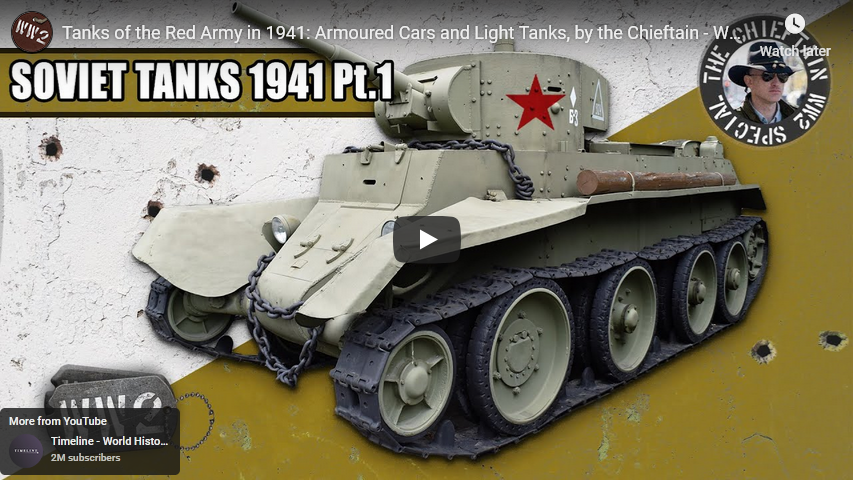
Tanks of the Early North Africa Campaigns, by The Chieftain – WW2 Special

Filed under: Africa, Britain, Germany, History, Italy, Military, Weapons, WW2 — Tags: , , — Nicholas @ 06:00

World War Two
Published 21 Apr 2020

The Chieftain takes us to North Africa, where he talks us through the tanks that were used during the first months of the Battles in North Africa between the Italians and Germans on the one side and British and Commonwealth forces on the other.

Check out The Chieftains channel: https://www.youtube.com/channel/UCp4j…

Join us on Patreon: https://www.patreon.com/TimeGhostHistory
Or join The TimeGhost Army directly at: https://timeghost.tv

Follow WW2 day by day on Instagram @World_war_two_realtime https://www.instagram.com/world_war_t…
Between 2 Wars: https://www.youtube.com/playlist?list…
Source list: http://bit.ly/WW2sources

Written and Hosted by: The Chieftain
Director: Astrid Deinhard
Producers: Astrid Deinhard and Spartacus Olsson
Executive Producers: Astrid Deinhard, Indy Neidell, Spartacus Olsson, Bodo Rittenauer
Creative Producer: Joram Appel
Post-Production Director: Wieke Kapteijns
Research by: The Chieftain
Edited by: Mikołaj Cackowski
Sound design: Marek Kamiński
Map animations: Eastory (https://www.youtube.com/c/eastory)

Colorizations by:
Carlos Ortega Pereira,
BlauColorizations, https://www.instagram.com/blaucoloriz…
Adrien Fillon – https://www.instagram.com/adrien.colo…

Sources:
Bundesarchiv
IWM KID 502, H 20697, E 443, H 1148, E380, KID346, E 1002, E 5366, E676, F 4594, E 1416, E 6605, E 15182, O 747, E 5559, E 142, F 2919, E 5036, F 2441, E 1772, E 9562, NA 2304, E 7304, E 2138
Noun Project: company soldiers by Andrei Yushchenko, Radio by Pravin Unagar, gearbox by Baboons, Shield by Nikita Kozin, Weight by Vadim Solomakhin, Game by Ecem Afacan, Target by RITASYA

Soundtracks from the Epidemic Sound:
Reynard Seidel – “Deflection”
Johannes Bornlof – “Deviation In Time”
Johan Hynynen – “Dark Beginning”
Max Anson – “Ancient Saga”
Rannar Sillard – “Split Decision”
Fabien Tell – “Last Point of Safe Return”
Johannes Bornlof – “The Inspector 4”
Rannar Sillard – “Easy Target”
Philip Ayers – “Trapped in a Maze”
Phoenix Tails – “At the Front”

Archive by Screenocean/Reuters https://www.screenocean.com.

A TimeGhost chronological documentary produced by OnLion Entertainment GmbH.
April 21, 2020

The Curator at Home | Film Review: Kelly’s Heroes | The Tank Museum

Filed under: Europe, Germany, History, Italy, Media, Military, USA, WW2 — Tags: , , , — Nicholas @ 04:00

The Tank Museum
Published 19 Apr 2020

Join Curator David Willey at Home, as he reviews the classic film: Kelly’s Heroes.
https://tankmuseumshop.org/products/k…

Support the work of The Tank Museum on Patreon: ► https://www.patreon.com/tankmuseum
Visit The Tank Museum SHOP & become a Friend: ► https://tankmuseumshop.org/

Twitter: ► https://twitter.com/TankMuseum
Instagram: ► https://www.instagram.com/tankmuseum/
Tiger Tank Blog: ► http://blog.tiger-tank.com/
Tank 100 First World War Centenary Blog: ► http://tank100.com/

« Newer PostsOlder Posts »

Powered by WordPress