Military History not Visualized
Published 6 Jul 2018Disclaimer: I was invited to Tank Fest by the Tank Museum.
Why were half-tracks used in the first place? Why not trucks, fully-tracked vehicles or something else? Also, why after the Second World War did the half-track disappear? Why were there no new types produced by major powers?
Big thank you to green_goblin_z for sending me 2 books from my amazon wishlist!
»» SUPPORT MHV ««
» patreon – https://www.patreon.com/mhv
» paypal donation – https://www.paypal.com/cgi-bin/webscr…»» MERCHANDISE – SPOILS OF WAR ««
» shop – https://www.redbubble.com/people/mhvi…Military History not Visualized is a support channel to Military History Visualized with a focus personal accounts, answering questions that arose on the main channel and showcasing events like visiting museums, using equipment or military hardware.
» SOURCES «
Spielberger, Walter; Doyle, Hilary Lous, Jentz, Thomas L.: Halbkettenfahrzeuge des deutschen Heeres
Spielberger: Halftracked Vehicles of the German Army 1909-1945 (Spielberger German Armor and Military Vehicle)Zaloga, Steven J.: M3 Infantry Half-Track. 1940-73. Osprey Publishing: Oxford, UK (1992 / 2002).
Citino, Robert M.: The German Way of War. From the Thirty Years’ War to the Third Reich. University Press of Kansas: USA, 2005.
Krapke, Paul-Werner: Armor, in: Margiotta, Franklin D. (Executive Editor): Brassey’s Encyclopedia of Land Forces and Warfare. Brassey’s: Washington, USA (1996), p. 42-53
Pöhlmann, Markus: Der Panzer und die Mechanisierung des Krieges: Eine deutsche Geschichte 1890 bis 1945 (Zeitalter der Weltkriege)
Munzel, Oskar: Die deutschen gepanzerten Truppen bis 1945
Fleischer, Wolfgang: Die motorisierten Schützen und Panzergrenadiere des deutschen Heeres: 1935-1945 – Waffen, Fahrzeuge, Gliederung, Einsätze
Felberbauer, Franz: Waffentechnik I – Band 2: Geschütze, Waffen in Entwicklung, Nichttödliche Waffensysteme, Ballistik, Physikalische Grundlagen (Truppendienst)
https://www.truppendienst.com/td-buec…
May 28, 2020
Why Halftracks? Why limited to WW2 only? (Featuring Tank Fest 2018)
May 21, 2020
Tank Chats #70 Sherman M4A4 | The Tank Museum
The Tank Museum
Published 23 Mar 2019In Tank Chat #70, David Fletcher talks through the Sherman M4A4. The M4A4 is a relatively new addition to The Tank Museum, which is on long term loan.
Used and loved by the British, find out what makes this tank different from other types of Sherman in The Tank Museum.
Support the work of The Tank Museum on Patreon: ► https://www.patreon.com/tankmuseum
Visit The Tank Museum SHOP: ► https://tankmuseumshop.org/
Twitter: ► https://twitter.com/TankMuseum
Tiger Tank Blog: ► http://blog.tiger-tank.com/
Tank 100 First World War Centenary Blog: ► http://tank100.com/ #tankmuseum #tanks #tankchats
May 18, 2020
The British Tank Meme
Potential History
Published 1 Dec 2018A look at British tanks and why they are what they are.
Music Used: https://www.youtube.com/watch?v=WSo_d…
https://www.youtube.com/watch?v=PGrxH…End Song: https://www.youtube.com/watch?v=99LRv…
P.O.Box:
Potential History
P.O. Box
524 Beech Grove, IN,
46107Patreon: https://www.patreon.com/potentialhistory
Twitter: https://twitter.com/Tank_Memes
May 13, 2020
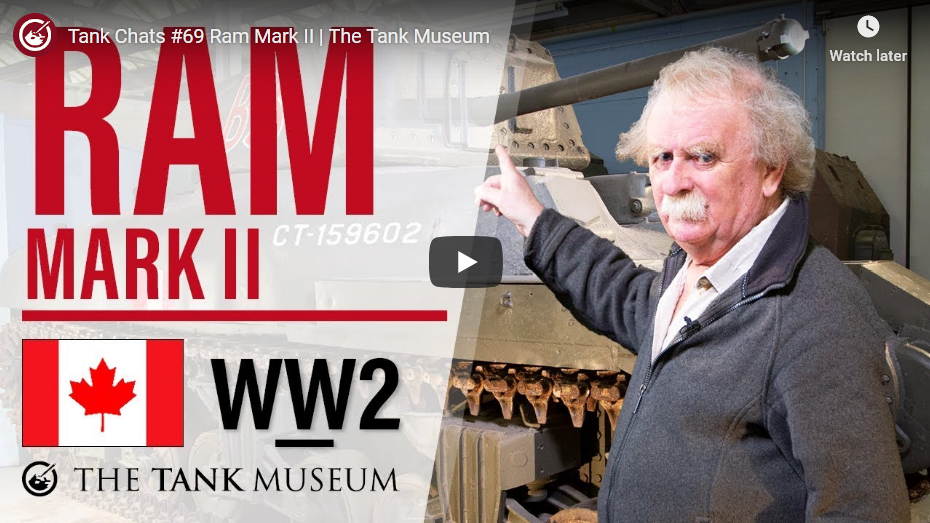
Tank Chats #69 Ram Mark II | The Tank Museum
The Tank Museum
Published 15 Mar 2019David Fletcher talks about the WW2 Ram Mark II tank, built by Canada during the Second World War.
It was based upon the American Medium M3 (Lee) and many components were supplied by the United States.
Support the work of The Tank Museum on Patreon: ► https://www.patreon.com/tankmuseum
Visit The Tank Museum SHOP: ► https://tankmuseumshop.org/
Twitter: ► https://twitter.com/TankMuseum
Tiger Tank Blog: ► http://blog.tiger-tank.com/
Tank 100 First World War Centenary Blog: ► http://tank100.com/ #tankmuseum #tanks #tankchats
May 10, 2020
May 5, 2020
Killer Tanks – The Cromwell
gusty9053
Published 12 Jul 2014
Confusingly, the tank shown in the thumbnail isn’t a Cromwell, and many later tanks are shown in footage that is supposed to be from the Dunkirk evacuation during the Battle of France in 1940 (including wrecked Churchill tanks on the beach at Dieppe in August 1942). The video covers the genesis of the tank in WW1 and the British interwar neglect of tanks, but almost completely ignores light tanks and infantry tanks to concentrate on “cruiser” tank development. Wikipedia has a useful summary of the Cromwell family of tanks:
The Cromwell tank, officially Tank, Cruiser, Mk VIII, Cromwell (A27M), was one of the series of cruiser tanks fielded by Britain in the Second World War. Named after the English Civil War leader Oliver Cromwell, the Cromwell was the first tank put into service by the British to combine high speed from a powerful and reliable engine (the Rolls-Royce Meteor), and reasonable armour. The intended dual-purpose high velocity gun could not be fitted in the turret and the medium velocity dual purpose gun fitted proved inadequate. An improved version with a high velocity gun became the Comet tank.
The name “Cromwell” was initially applied to three vehicles during development. Early Cromwell development led to the creation of the A24 Cavalier. Later Cromwell development led to the creation of the competing Tank, Cruiser, Mk VIII, Centaur (A27L) design. The Centaur tank was closely related to the Cromwell, both vehicles being externally similar. The Cromwell and Centaur tanks differed in the engine used; the Centaur had the 410 hp Liberty engine, the Cromwell had the significantly more powerful 600 hp Meteor.
The Cromwell first saw action in the Battle of Normandy in June 1944. The tank equipped the armoured reconnaissance regiments of the Royal Armoured Corps, in the 7th Armoured Division, 11th Armoured Division and the Guards Armoured Division. While the armoured regiments of the latter two divisions were equipped with M4 Shermans, the armoured regiments of the 7th Armoured Division were equipped with Cromwells. The Centaurs were not used in combat except for those fitted with a 95 mm howitzer, which were used in support of the Royal Marines during the amphibious invasion of Normandy.
[…]
Post war
After the war, the Cromwell remained in British service, and saw service in the Korean War with the 8th King’s Royal Irish Hussars.
Cromwell Tanks were used by Czechoslovakia and Israel.
Fifty-two Centaur I tanks were donated in early 1946 to the Greek Army, during the opening stages of the Greek Civil War but they were kept in storage due to the lack of trained personnel. In 1947, the first Greek officers returned from training courses in the United Kingdom and training of tank crews began. In April 1948, the Centaurs were organised in three Centaur tank companies initially numbered II, IX and XI, but a year later were renumbered 381, 382, 383 and temporarily attached to Reconnaissance Regiments 391, 392, and 393. The Centaurs saw limited service in the war because battles were fought mainly on mountainous areas, but proved useful in supporting infantry units and in defence of inhabited areas. After the end of the war, in October 1949, the three Centaur companies were organised into the 391 Tank Regiment. The Centaurs were replaced by US built M47s and in 1962 were sold and scrapped. One Centaur is preserved in the Greek Army Tank Museum.
The British army, Austria and Jordan used the upgraded Charioteer version of the Cromwell post-war. Jordanian vehicles saw action in conflicts in the Middle-East.
May 3, 2020
How To… Drink Tea in a Tank | The Tank Museum
The Tank Museum
Published 30 Apr 2020In the 1st episode of The Tank Museum’s brand new “How To” series, Wargaming’s Richard Cutland and historian James Holland explore how British tank crews managed to drink tea, while in a tank!
Download World of Tanks for free and claim your exclusive £15 starter kit: https://tanks.ly/2SiJPje
You can also share the invite code1TANKIEwith your friends.
Starter kit: Matilda Black Prince Tier V tank, 7 days of World of Tanks premium account & T-34-85M rental. Valid for new players only.Using a WW1, WW2 and modern tank from The Tank Museum’s collection, the duo will discover how tea was made while soldiers were at war.
Support the work of The Tank Museum on Patreon: ► https://www.patreon.com/tankmuseum
Visit The Tank Museum SHOP & become a Friend: ► https://tankmuseumshop.org/Twitter: ► https://twitter.com/TankMuseum
Instagram: ► https://www.instagram.com/tankmuseum/
Tiger Tank Blog: ► http://blog.tiger-tank.com/
Tank 100 First World War Centenary Blog: ► http://tank100.com/
April 29, 2020
Curator’s Tour of The Tank Museum | Blitzkrieg | WW2: Part 1
The Tank Museum
Published 25 Apr 2020Join Curator David Willey as he takes you on a tour of The Tank Museum’s Tank Story Hall, which houses over 30 key vehicles from Little Willie to Challenger 2. In this section he looks at early Second World War vehicles and gives you a potted history of the Blitzkrieg.
Support the work of The Tank Museum on Patreon: ► https://www.patreon.com/tankmuseum
Visit The Tank Museum SHOP & become a Friend: ► https://tankmuseumshop.org/Twitter: ► https://twitter.com/TankMuseum
Instagram: ► https://www.instagram.com/tankmuseum/
Tiger Tank Blog: ► http://blog.tiger-tank.com/
Tank 100 First World War Centenary Blog: ► http://tank100.com/
#tankmuseum #tanks #MuseumFromHome
April 28, 2020
Tank Chats #68 T-34 | The Tank Museum
The Tank Museum
Published 9 Mar 2019The T-34 is an iconic Soviet Second World War tank. It was the most produced tank of WW2 and remains a symbol of Russian sacrifice in the Great Patriotic War.
David Willey talks about both the T-34/76 and T-34/85 variants, used in World War Two.
Many thanks to RecoMonkey for providing many of the modern images of the T-34 https://www.recomonkey.com/
Support the work of The Tank Museum on Patreon: ► https://www.patreon.com/tankmuseum
Visit The Tank Museum SHOP: ► https://tankmuseumshop.org/
Twitter: ► https://twitter.com/TankMuseum
Tiger Tank Blog: ► http://blog.tiger-tank.com/
Tank 100 First World War Centenary Blog: ► http://tank100.com/ #tankmuseum #tanks #tankchats
April 22, 2020
Tanks of the Early North Africa Campaigns, by The Chieftain – WW2 Special
World War Two
Published 21 Apr 2020The Chieftain takes us to North Africa, where he talks us through the tanks that were used during the first months of the Battles in North Africa between the Italians and Germans on the one side and British and Commonwealth forces on the other.
Check out The Chieftains channel: https://www.youtube.com/channel/UCp4j…
Join us on Patreon: https://www.patreon.com/TimeGhostHistory
Or join The TimeGhost Army directly at: https://timeghost.tvFollow WW2 day by day on Instagram @World_war_two_realtime https://www.instagram.com/world_war_t…
Between 2 Wars: https://www.youtube.com/playlist?list…
Source list: http://bit.ly/WW2sourcesWritten and Hosted by: The Chieftain
Director: Astrid Deinhard
Producers: Astrid Deinhard and Spartacus Olsson
Executive Producers: Astrid Deinhard, Indy Neidell, Spartacus Olsson, Bodo Rittenauer
Creative Producer: Joram Appel
Post-Production Director: Wieke Kapteijns
Research by: The Chieftain
Edited by: Mikołaj Cackowski
Sound design: Marek Kamiński
Map animations: Eastory (https://www.youtube.com/c/eastory)Colorizations by:
Carlos Ortega Pereira,
BlauColorizations, https://www.instagram.com/blaucoloriz…
Adrien Fillon – https://www.instagram.com/adrien.colo…Sources:
Bundesarchiv
IWM KID 502, H 20697, E 443, H 1148, E380, KID346, E 1002, E 5366, E676, F 4594, E 1416, E 6605, E 15182, O 747, E 5559, E 142, F 2919, E 5036, F 2441, E 1772, E 9562, NA 2304, E 7304, E 2138
Noun Project: company soldiers by Andrei Yushchenko, Radio by Pravin Unagar, gearbox by Baboons, Shield by Nikita Kozin, Weight by Vadim Solomakhin, Game by Ecem Afacan, Target by RITASYASoundtracks from the Epidemic Sound:
Reynard Seidel – “Deflection”
Johannes Bornlof – “Deviation In Time”
Johan Hynynen – “Dark Beginning”
Max Anson – “Ancient Saga”
Rannar Sillard – “Split Decision”
Fabien Tell – “Last Point of Safe Return”
Johannes Bornlof – “The Inspector 4”
Rannar Sillard – “Easy Target”
Philip Ayers – “Trapped in a Maze”
Phoenix Tails – “At the Front”Archive by Screenocean/Reuters https://www.screenocean.com.
A TimeGhost chronological documentary produced by OnLion Entertainment GmbH.
April 21, 2020
The Curator at Home | Film Review: Kelly’s Heroes | The Tank Museum
The Tank Museum
Published 19 Apr 2020Join Curator David Willey at Home, as he reviews the classic film: Kelly’s Heroes.
https://tankmuseumshop.org/products/k…Support the work of The Tank Museum on Patreon: ► https://www.patreon.com/tankmuseum
Visit The Tank Museum SHOP & become a Friend: ► https://tankmuseumshop.org/Twitter: ► https://twitter.com/TankMuseum
Instagram: ► https://www.instagram.com/tankmuseum/
Tiger Tank Blog: ► http://blog.tiger-tank.com/
Tank 100 First World War Centenary Blog: ► http://tank100.com/
April 14, 2020
Curator at Home | Tanks: 100 Years of Evolution | The Tank Museum
The Tank Museum
Published 12 Apr 2020Join The Tank Museum’s Curator, David Willey, at home, as he reviews the book: Tanks – 100 Years of Evolution by Richard Ogorkiewicz.
Support the work of The Tank Museum on Patreon: ► https://www.patreon.com/tankmuseum
Visit The Tank Museum SHOP & become a Friend: ► https://tankmuseumshop.org/Twitter: ► https://twitter.com/TankMuseum
Instagram: ► https://www.instagram.com/tankmuseum/
Tiger Tank Blog: ► http://blog.tiger-tank.com/
Tank 100 First World War Centenary Blog: ► http://tank100.com/
April 13, 2020
Curator’s Tank Museum Tour: Tank Story Hall – Inter-War | The Tank Museum
The Tank Museum
Published 11 Apr 2020Join Curator David Willey as he takes you on a tour of The Tank Museum’s Tank Story Hall, which houses over 30 key vehicles from Little Willie to Challenger 2. In this section he looks at the inter-war vehicles and gives you a potted history of the time period between the two World Wars.
Support the work of The Tank Museum on Patreon: ► https://www.patreon.com/tankmuseum
Visit The Tank Museum SHOP & become a Friend: ► https://tankmuseumshop.org/Twitter: ► https://twitter.com/TankMuseum
Instagram: ► https://www.instagram.com/tankmuseum/
Tiger Tank Blog: ► http://blog.tiger-tank.com/
Tank 100 First World War Centenary Blog: ► http://tank100.com/
April 12, 2020
Tank Chats #67 Covenanter | The Tank Museum
The Tank Museum
Published 22 Feb 2019Historian David Fletcher MBE talks through the Second World War British Cruiser tank, the Covenanter. Otherwise known as Tank Cruiser Mark V** A13.
Support the work of The Tank Museum on Patreon: ► https://www.patreon.com/tankmuseum
Visit The Tank Museum SHOP: ► https://tankmuseumshop.org/
Twitter: ► https://twitter.com/TankMuseum
Tiger Tank Blog: ► http://blog.tiger-tank.com/
Tank 100 First World War Centenary Blog: ► http://tank100.com/ #tankmuseum #tanks #tankchats
April 11, 2020
3.7cm PAK – Germany’s Basic WWII Antitank Gun
Forgotten Weapons
Published 10 Dec 2019http://www.patreon.com/ForgottenWeapons
Cool Forgotten Weapons merch! http://shop.bbtv.com/collections/forg…
Germany developed its first 37mm (or as German designations put it, 3.7cm) antitank gun in the last months of World War One; a very simple design built using barrels from obsolete Hotchkiss revolving cannons. In the mid 1920s, the concept was reinvigorated by Rheinmetall, which developed a much more modern 37mm gun using a much larger and higher-pressure case (37 x 249mm). In its initial pattern, the Tak as it was called (Tankabwerhkanone) has wooden spoke wheels and no suspension, intended for transport by horse. A small number were made for the German military (to avoid aggravating the conditions of the Treaty of Versailles), and the gun was sold commercially by Rheinmetall. The Soviet Union in particular was interested, and used the 3.7cm Tak as the basis for its later 45mm antitank gun.
Between 1934 and 1936, a number of changes were made to the design. The wooden wheels were replaced with steel wheels and pneumatic rubber tires, and spring suspension was added to allow the gun to be towed at higher speed by motor vehicles. The designation also changed at the time from Tank-abwehrKanone to Panzer-abwehrKanone, as the new term “panzer” entered German military parlance. Under Germany’s 1930s rearmament program, the Versailles limitations were ignored, and Pak production took off. By September of 1939, the German military has some 11,200 of the guns in service. They were solid dependable guns at the beginning of World War Two, but became obsolete by 1941 as tank armor began to rapidly increase. A new tungsten-core AP round was introduced in 1940, and a rifle-grenade-like hollow charge munition (the Stielgranate 41) added in 1941, but there was stopgaps at best. The last few 3.7mm Paks were built in early 1942, as both it and the 50mm Pak 38 were phased out in favor of the 75mm Pak 40 antitank gun.
There is an excellent article on the development and use of the 3.7cm Pak at Tank Archives: http://tankarchives.blogspot.com/2016…
I’d like to thank DriveTanks.com for giving me the opportunity to bring you their 3.7mm Pak! They have a very cool collection of armored vehicles, artillery, and machine guns available for rental in Texas; check them out: http://www.drivetanks.com
Contact:
Forgotten Weapons
6281 N. Oracle #36270
Tucson, AZ 85704