
The RINOs you complain about are RINOs now but they weren’t always. I don’t know how many of you remember the seventies. The right here was kind of like the right in Europe. It assumed that in the end communism would not only win, but DESERVED to win, and what the right disagreed with was the way to get there. It is useful to remember this was a time when William Buckley’s dictum that conservatism was “Standing astride History yelling stop” found deep resonance. Unpack that phrase. It assumes history comes with an arrow, that it’s not going our way, and that at best we can get it to pause.
Those RINOs who, by the way, took immense flack back then were as conservative as anyone dared to be. Because everyone knew in the end the reds won.
Then the wall fell down and we knew what true horrors lurked on the other side.
Individuals process these things fast enough. Well, my generation, at any rate, awakened by Reagan and shown that the win of the dark side was not inevitable, was more pro-freedom than people ten years older than us.
But when we saw the wall fall down, it pushed many of us further into the liberty side of the isle. Not only wasn’t a communist win inevitable, but their vaunted “strengths” like superior planning and better minority integration didn’t exist unless you really wanted to plan for three million size thirty boots for the left foot only, and integration meant grinding the minorities very fine and spreading them in the soil.
However cultures aren’t individuals. Cultures re-orient and process startling events very slowly.
Yeah, those older Republicans are still with us, and they were over 45 when the wall fell, which means they couldn’t reorient anymore. (Studies have been done.)
Sarah Hoyt, “The Long March”, According to Hoyt, 2015-12-20.
January 8, 2019
QotD: RINOs and other soft conservatives
December 23, 2018
Repost – Kate Bush – Christmas Special 1979 (Private Remaster)
Published on 5 Oct 2013
I know there’s a good few copies of this out on YouTube, but here it is, again! The other copies were either split up into individual tracks, the best complete one (from BBC Four’s rebroadcast in 2009) had the wrong aspect ratio, which annoyed the hell out of me! So, here this is…
Video and audio have been tidied up very slightly, not much was needed!
Kate Bush – Christmas Special
Tracklist:
(Intro) 00:00
Violin 00:29
(Gymnopédie No.1 – composed by Erik Satie) 03:44
Symphony In Blue 04:44
Them Heavy People 08:20
(Intro for Peter Gabriel) 12:52
Here Comes The Flood (Peter Gabriel) 13:22
Ran Tan Waltz 17:02
December Will Be Magic Again 19:43
The Wedding List 23:35
Another Day (with Peter Gabriel) 28:05
Egypt 31:41
The Man With The Child In His Eyes 36:21
Don’t Push Your Foot On The Heartbreak 39:24“I was recently asked about this BBC TV special and I thought I’d share my comments here. Kate: Kate Bush Christmas Special is a stage performance by Kate Bush with her special guest Peter Gabriel. Though most of the songs are not holiday ones, they come from Bush’s first three albums (Never for Ever her third album would be released in 1980 after this 1979 TV special was taped). The performances include costumes, choreographed dances and a wind machine, creating an eclectic music TV special to say the least.
This is one of the programs that makes my research quite difficult — because it calls itself a Christmas Special yet it contains only one performance of a Christmas song “December Will Be Magic Again” (a song that wouldn’t be released as a single by Bush until the following year, in 1980). TV programming that calls itself a Christmas Special and yet contains little to no Christmas entertainment is actually quite common — especially on the BBC.
Between the end of November and the end of December each year, there is quite a bit of special programming on television. Remember Elvis’ 1968 Comeback Special — it aired in December that year and includes only one holiday song, a performance of “Blue Christmas.” Is it considered a Christmas special? No, not really. And so, despite its title, the lack of holiday programming in Kate Bush’s 1979 TV special means it shouldn’t be considered a Christmas special either. But the Kate Bush Christmas Special is certainly worth watching!”
H/T to Ghost of a Flea for the link.
December 14, 2018
“Bohemian Rhapsody”
Colby Cosh on the media phenomenon of “Bohemian Rhapsody” … which, in his opinion, isn’t all that good as a song:
… Queen wasn’t really a four-piece; it was a pansexual mutant alien athlete-hero plus three ugly, highly talented Englishmen. And “Bohemian Rhapsody” almost isn’t a song so much as a captured moment. Considered as a song, there isn’t much to it except as a showcase for virtuosity: it’s not among Queen’s 20 best. And ordinary people can’t take a crack at “Bohemian Rhapsody” expecting to do it nicely and competently, in the way they might do “Blackbird” or “Wonderwall.” To be used for performance by the general public, “Bohemian Rhapsody” basically requires a roomful of drunks united in the ironic, non-judgmental spirit of karaoke.
Perhaps there is not much more to be said of “Bohemian Rhapsody” by way of explanation. Queen enjoyed trying on American hats from time to time (ah, if only Elvis had stayed around to receive the gift of “Crazy Little Thing Called Love”). But an American group could never have made anything that was weird in this particular way — wallowing in the pathos of a French gangster movie, then diving into a cryptic Dantean nightmare, piling up gestures and word-sounds into a unabashedly hokey panorama. There is no content at all to the thing, per se, except what the band members put into it as performers. In no way, I promise, will knowledge of Scaramouche’s place in the commedia dell’arte or the life of Galileo Galilei unlock some hidden layer of understanding.
“Bohemian Rhapsody” is an exquisitely made thing whose intricacy and beauty everybody can appreciate on more or less the same level. That is the special formula for mass popularity in all of the arts. They will tell you the Mona Lisa has a zillion layers of biographical or political meaning, but the painting really is what it is for everybody, and in roughly the same way. Every ordinary grownup can participate in the intimacy and the mystery of it, and it is not really a superior experience, as many great paintings might be, for somebody with a bundle of university degrees. As often happens I am reminded of Andy Warhol’s praise for Coca-Cola. “A Coke is a Coke and no amount of money can get you a better Coke than the one the bum on the corner is drinking. All the Cokes are the same and all the Cokes are good.”
December 13, 2018
When Democrats Loved Deregulation
ReasonTV
Published on 12 Dec 2018Left-leaning politicians of the 1970s understood that red tape punishes consumers and protects big business. The leading deregulator of that era was none other than Jimmy Carter.
————————
Follow us on Twitter: https://twitter.com/reasonReason is the planet’s leading source of news, politics, and culture from a libertarian perspective. Go to reason.com for a point of view you won’t get from legacy media and old left-right opinion magazines.
————————
When President Donald Trump bragged in his first State of the Union address about cutting red tape, the Democratic response was no surprise. “Deregulation,” warned Center for American Progress Senior Advisor Sam Berger in Fortune, “is simply a code word for letting big businesses cut corners at everyone else’s expense.”But many leading Democrats had the opposite view in the 1970s. Then, at the dawn of the deregulation era, left-leaning politicians and economists understood that excessive government management of industry let the big-business incumbents get away with lousy performance at the expense of competitors, taxpayers, and consumers. The leading figure in that fight to cut red tape and shut down entire federal agencies was none other than Jimmy Carter.
It was Sen. Ted Kennedy who held extensive Senate hearings in the early ’70s, with testimony from the likes of Ralph Nader and liberal economist Alfred Kahn, about the benefits of lifting state controls on the airline industry. The resulting Airline Deregulation Act of 1978, signed by Carter, killed the Civil Aeronautics Board — a federal agency that decided which airlines could fly where, and even what they could charge. The new competition to the old airline cartel reduced fares, expanded destinations, increased safety, and made air travel an option for those of us who aren’t rich.
Carter also lifted stifling government oversight of the rail and trucking industries under a Democrat-controlled House and Senate. The result? Competition intensified, prices dropped, and consumers saved more money on everyday products.
In 1978, President Carter signed a bill that lifted Prohibition-era criminal restrictions on home brewing. The legalization of do-it-yourself beer production unleashed a boom of experimentation, paving the way for the craft beer revolution that is ongoing to this day. The year that Carter loosened the rules, the U.S. was home to a mere 50 breweries. Today there are well over 5,000. In two generations of beermaking, America went from global laughingstock to world leader.
The governor of California during Carter’s presidency was none other than Jerry Brown, then known as “Governor Moonbeam” for his far-out musings, glittery social life, and lefty politics. Yet Brown, too, could be a fiery skeptic of government. In his terrific second inaugural address in 1979, Brown stated that “many regulations primarily protect the past, prop up privilege or prevent sensible economic choices.”
But even while some sectors were unleashed four decades ago by far-seeing Democrats and Republicans alike, too many governments at the local, state, and federal levels have forgotten those lessons, and instead imposed entirely new categories of regulations. Occupational licensing, which applied to about one in 10 jobs 40 years ago, now impacts one in three.
So how did the party of Jimmy Carter and sideburns-era Jerry Brown become the ideological home of Elizabeth Warren and Alexandria Ocasio-Cortez? One explanation may be that Democratic support for deregulation back then was born out of a sense of nearly hopeless desperation in the face of stagflation. Cutting red tape to foster dynamism was about the last move politicians had left.
Our long economic expansion and stock-market boom will soon come to an end, imposing limits on government precisely at the moment when it’s asked to do more. When that day of reckoning comes, the best questions for lawmakers of both parties to ask may just be: What would Jimmy Carter do?
Photo credits: Jimmy Carter Library, Arthur Grace/ZUMA Press/Newscom, Dennis Brack/Newscom, Everett Collection/Newscom, Ron Sachs/CNP/MEGA/Newscom, Brian F. Alpert/ZUMA Press/Newscom, Paul Harris/Pacific Coast Nes/Newscom, Bee Staff Photo/ZUMA Press/Newscom, Dennis Brack/bb51/Newscom, Jonathan Bachman/REUTERS/Newscom, Rick Friedman/Polaris/Newscom
November 14, 2018
Ronnie Barker – British Rail
T.V Allsorts
Published on 13 Apr 2016
October 31, 2018
Store-bought Halloween costumes of old
Richard Lorenc explains why the Halloween costumes your parents bought for you as a kid … sucked:
While my husband and I were recently struggling to figure out our costumes for this Halloween (and we still don’t have any idea), he pulled up some old commercials on YouTube. The off-the-shelf options that trick or treaters had were, in a word, pitiful.
Basically, costume makers thought it was ok to make a front-only plastic mask (in any color, really) of a character and top it off with a plastic smock featuring an illustration of said character with either its name or the name of the show or movie it comes from. There was no attempt to dress in the character’s actual attire. If you wanted that, you’d either have to know a professional costumer or cobble together something from your closet.
Take a look for yourself at just how costume-poor we used to be:
Obviously, every costume is an opportunity to generate interest in a brand or franchise, and slapping on a logo is an easy way to get a name out there, but these costumes truly heralded a dark time for Halloween. Some may even argue that it demonstrated crass consumerism at its worst, with cynical companies taking the easiest route to grabbing a couple of bucks from desperate parents.

September 20, 2018
The Last Lee Enfield: the L42A1 Sniper
Forgotten Weapons
Published on 31 Aug 2018More info: https://www.forgottenweapons.com/the-…
http://www.patreon.com/ForgottenWeapons
When the British military adopted the FAL (L1A1 SLR) in 1960, they adopted the 7.62x51mm NATO cartridge along with it. While the Bren guns were converted to the new cartridge, efforts at converting the Lee Enfield into a precision rifle were not successful at the time. However, civilian target shooters and the British NRA would work on perfecting that conversion for use in competition, and would ultimately produce very accurate 7.62mm rifles built on Lee Enfield actions – accurate enough that the military took notice. Copying the competition rifles, the British military would adopt the L42A1 in 1970, an Enfield action converted to 7.62mm NATO with a shortened and free-floated stock and hand guard and a heavy profile barrel. A total of 1,080 L42A1 rifles would be converted from existing No4 MkI(T) sniper rifles, and they would serve in the front lines of the British military until 1992, when they were replaced by the Accuracy International L96A1.
If you enjoy Forgotten Weapons, check out its sister channel, InRangeTV! http://www.youtube.com/InRangeTVShow
September 9, 2018
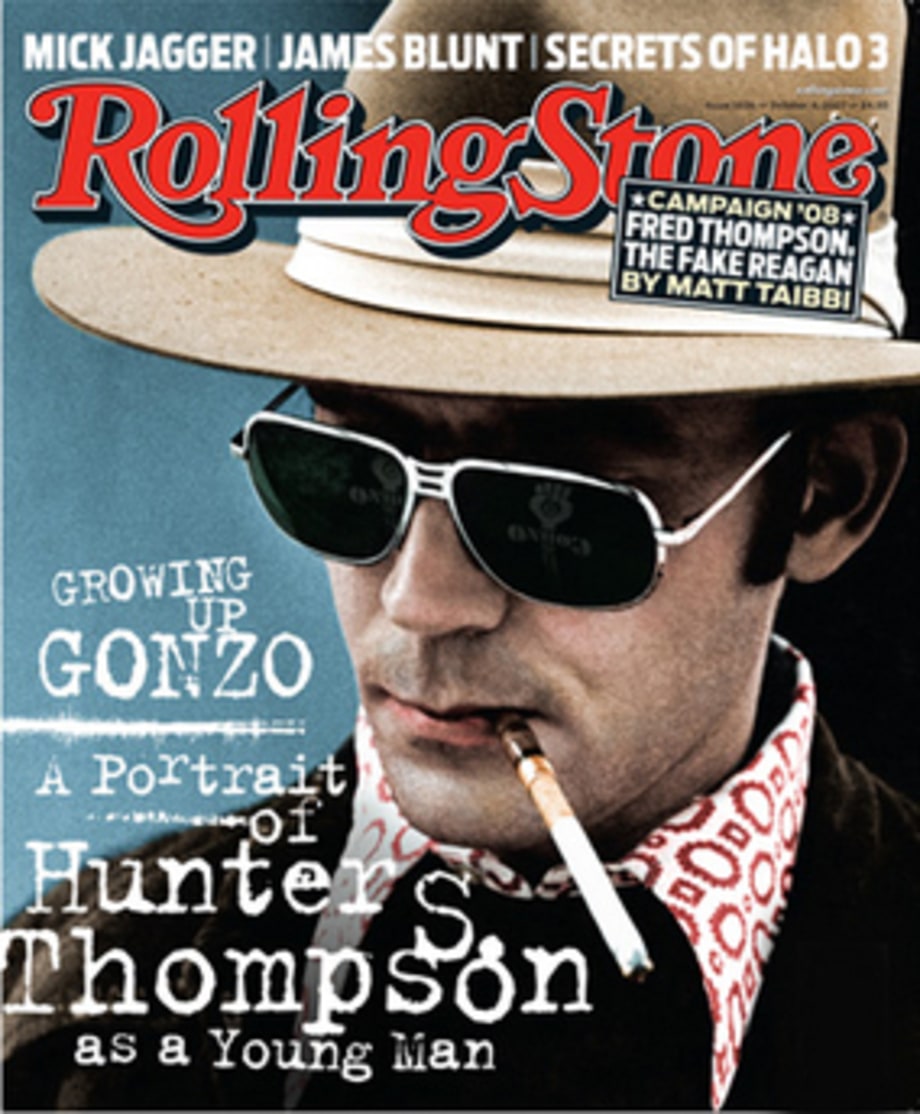
Hunter S. Thompson, Jann Wenner and Rolling Stone
Darcy Gerow on the sudden rise and long, long decline of Rolling Stone:
The suffocating media bias of the 1960s was difficult to escape. A lethargic gray specter of middle-class America was distributed with cunning sterility through the generic, bogus smiles of cable news networks and traditional print. Despite the election and assassination of Kennedy and the signing of the Civil Rights Act, if you had turned on a T.V. this was still Eisenhower’s America: regimented, religious, conservative. And the cultural vacuum created by the Eisenhower years had began to suck even harder with Lyndon Baines Johnson at the helm.
American media was out of touch with this new generation. Elitist authoritarians were preaching their moral superiority stamped with stars and stripes to a generation of cynics. These kids didn’t have a fucking clue what they wanted, but they wanted no part of what they were being given. So rose Rolling Stone, a counterculture bible for babyboomers, co-founded by Jann Wenner.[…]
Things were different in the 1960s. The anti-war movement and the civil rights movement were a just cause. The catalyst for a just movement of equal rights for women and gays and minorities was free speech, of which Jann Wenner was a huge proponent. When students at U.C. Berkley marched in the streets in the 1960s, it was an attack on the elitist, authoritarians and an establishment hellbent on keeping opposing viewpoints and the ideas of personal liberty stifled. The gang of “cruel faggots” kept the official narrative running but no one under 30 was listening.
The whole goddamn world had had enough of the travesty of war in Southeast Asia. There was no ignoring the ineptitude of American politics. The only reasonable thing to do in 1969 was to drive out to Altamont for the weekend, load up on heinous chemicals, hunker down and rethink your approach to the political process.
Thompson, the then-young, liberal anti-hero, could often be found gobbling LSD and firing his guns (he was a lifetime member of the NRA) at propane bottles for a crowd of jeering burnouts or Bay area bikers at his fortified compound, Owl Farm, in Woody Creek Colorado.
It was Jann Wenner’s idea to put Hunter, with all of his fear and loathing, on to the campaign trail in 1972. Why not get the guy who wrote Hell’s Angels? Hunter was someone with a penchant for dealing with vicious thugs and sick freaks gone crazy on power, someone who could draw a parallel between Richard Nixon and Sonny Barger.
Thompson’s openly-biased, subjective and wild account of the 1972 presidential election was the red Chevy convertible of campaign coverage. ‘Sympathy for the Devil’ on repeat and at full volume, barrelling across the country at 110 miles an hour or so and in search of an honest politician. In Hunter’s eyes, the only one that even came close was George McGovern, the senator from South Dakota.
McGovern’s non-interventionist platform focused on a complete withdrawal from Vietnam, amnesty for draft evaders and a Milton Freidman-inspired, negative income tax meant to replace the bureaucratic burden of social welfare programs and a complicated tax code. Thompson’s version of events is the story of an idealistic underdog fighting against the odds only to be crushed by postmodern Americanism and the establishment incumbent, “Tricky Dick Nixon.” McGovern might have owed a White House win, in part, to Thompson’s and Rolling Stone’s relentless support had he not owed his White House loss to the mental distress of his vice-presidential pick, Thomas Eagleton.
There’s no way to properly explain how great Rolling Stone was in those early years. How well the magazine represented the anti-establishment culture, individual liberty and equality for everyone. It can’t be compared to anything else because there was nothing else, only the traditional mainstream garbage and Rolling Stone.
August 5, 2018
On The Far Side
Today I Found Out
Published on 9 Jul 2018Check out my other channel TopTenz! https://www.youtube.com/user/toptenznet
Never run out of things to say at the water cooler with TodayIFoundOut! Brand new videos 7 days a week!
More from TodayIFoundOut
What Ever Happened to the Creator of Calvin and Hobbes?
In this video:
For 15 years, Gary Larson took millions of readers over to the Far Side. Using anamorphic animals, chubby teenagers, universal emotions, a simple drawing style and a really bizarre, morbid sense of humor, The Far Side became one of the most successful – and praised – comic strips of all time.
Want the text version?: http://www.todayifoundout.com/index.p…
July 29, 2018
QotD: The third Great Awakening
We are now — in the Me Decade — seeing the upward roll (and not yet the crest, by any means) of the third great religious wave in American history, one that historians will very likely term the Third Great Awakening. Like the others it has begun in a flood of ecstasy, achieved through LSD and other psychedelics, orgy, dancing (the New Sufi and the Hare Krishna), meditation, and psychic frenzy (the marathon encounter). This third wave has built up from more diverse and exotic sources than the first two, from therapeutic movements as well as overtly religious movements, from hippies and students of “psi phenomena” and Flying Saucerites as well as charismatic Christians. But other than that, what will historians say about it?
The historian Perry Miller credited the First Great Awakening with helping to pave the way for the American Revolution through its assault on the colonies’ religious establishment and, thereby, on British colonial authority generally. The sociologist Thomas O’Dea credited the Second Great Awakening with creating the atmosphere of Christian asceticism (known as “bleak” on the East Coast) that swept through the Midwest and the West during the nineteenth century and helped make it possible to build communities in the face of great hardship. And the Third Great Awakening? Journalists (historians have not yet tackled the subject) have shown a morbid tendency to regard the various movements in this wave as “fascist.” The hippie movement was often attacked as “fascist” in the late 1960s. Over the past several years a barrage of articles has attacked Scientology, the est movement, and “the Moonies” (followers of the Reverend Sun Myung Moon) along the same lines.
Frankly, this tells us nothing except that journalists bring the same conventional Grim Slide concepts to every subject. The word fascism derives from the old Roman symbol of power and authority, the fasces, a bundle of sticks bound together by thongs (with an ax head protruding from one end). One by one the sticks would be easy to break. Bound together they are invincible Fascist ideology called for binding all classes, all levels, all elements of an entire nation together into a single organization with a single will.
The various movements of the current religious wave attempt very nearly the opposite. They begin with … “Let’s talk about Me.” They begin with the most delicious look inward; with considerable narcissism, in short. When the believers bind together into religions, it is always with a sense of splitting off from the rest of society. We, the enlightened (lit by the sparks at the apexes of our souls), hereby separate ourselves from the lost souls around us. Like all religions before them, they proselytize — but always on promising the opposite of nationalism: a City of Light that is above it all. There is no ecumenical spirit within this Third Great Awakening. If anything, there is a spirit of schism. The contempt the various seers have for one another is breathtaking. One has only to ask, say, Oscar Ichazo of Arica about Carlos Castaneda or Werner Erhard of est to learn that Castaneda is a fake and Erhard is a shallow sloganeer. It’s exhilarating! — to watch the faithful split off from one another to seek ever more perfect and refined crucibles in which to fan the Divine spark … and to talk about Me.
Whatever the Third Great Awakening amounts to, for better or for worse, will have to do with this unprecedented post-World War II American development: the luxury, enjoyed by so many millions of middling folk, of dwelling upon the self. At first glance, Shirley Polykoff’s slogan — “If I’ve only one life, let me live it as a blonde!” — seems like merely another example of a superficial and irritating rhetorical trope (antanaclasis) that now happens to be fashionable among advertising copywriters. But in fact the notion of “If I’ve only one life” challenges one of those assumptions of society that are so deep-rooted and ancient, they have no name — they are simply lived by. In this case: man’s age-old belief in serial immortality.
Tom Wolfe, “The ‘Me’ Decade and the Third Great Awakening”, New York Magazine, 1976-08-23.
June 3, 2018
Brand X – Nuclear Burn (1976)
aquarianrealm
Published on Nov 7, 2010AMG: Brand X were a British jazz-rock fusion outfit formed by Genesis drummer Phil Collins and Atomic Rooster guitarist John Goodsall as a side project from their regular groups. Their initial lineup also included keyboardist Robin Lumley and bassist Percy Jones (the Liverpool Scene, the Scaffold). Brand X’s debut album, Unorthodox Behaviour, was released in 1976; a live album, Livestock, and the studio effort Moroccan Roll followed in 1977. Collins left the group to concentrate on Genesis, and for 1978’s Masques, he was replaced by Al Di Meola drummer Chuck Burgi, as well as additional keyboardist Peter Robinson, who had played with Stanley Clarke. Three further albums — 1979’s Product, 1980’s Do They Hurt?, and 1982’s Is There Anything About? — followed before the group disbanded. In the mid-’90s, Lumley, Goodsall, and Jones reunited, issuing several live collections in the years to follow.
H/T to ESR for the link.
June 1, 2018
QotD: Travelling with a political campaign
One of the constant nightmares of traveling with politicians is the need to keep them in sight at all times. Every presidential campaign has its own fearful litany of horror stories about reporters – and, occasionally, even a key staff member – who thought they had plenty of time to “run across the street for a quick beer” instead of hanging around in the rear of some grim auditorium half-listening to the drone of a long-familiar speech, only to come back in 20 minutes to find the auditorium empty and no sign of the press bus, the candidate or anybody who can tell him where they went. These stories are invariably set in places like Butte, Buffalo or Icepick, Minnesota, on a night in the middle of March. The temperature is always below zero, there is usually a raging blizzard to keep cabs off the street, and just as the victim remembers that he has left his wallet in his overcoat on the press bus, his stomach erupts with a sudden attack of ptomaine poisoning. And then, while crawling around on his knees in some ice-covered alley and racked with fits of projectile vomiting, he is grabbed by vicious cops and whipped on the shins with a night stick, then locked in the drunk tank of the local jail and buggered all night by winos.
These stories abound, and there is just enough truth in them to make most campaign journalists so fearful of a sudden change in the schedule that they will not even go looking for a bathroom until the pain becomes unendurable and at least three reliable people have promised to fetch them back to the fold at the first sign of any movement that could signal an early departure. The closest I ever came to getting left behind was during the California primary in 1972, when I emerged from a bathroom in the Salinas railroad depot and realized that the caboose car of McGovern’s “victory train” was about 100 yards further down the tracks than it had been only three minutes earlier. George was still standing outside on the platform, waving to the crowd, but the train was moving – and as I started my sprint through the crowd, running over women, children, cripples and anything else that couldn’t get out of my way, I thought I saw a big grin on McGovern’s face as the train began picking up speed….… I am still amazed that I caught up with the goddamn thing without blowing every valve in my heart, or even missing the iron ladder when I made my last-second leap and being swept under the train and chopped in half by the wheels.
Ever since then I have not been inclined to take many risks while traveling in strange territory with politicians. Even the very few who might feel a bit guilty about leaving me behind would have to do it anyway, because they are all enslaved by their schedules, and when it comes to a choice between getting to the airport on time or waiting for a journalist who has wandered off to seek booze, they will shrug and race off to the airport.
Hunter S. Thompson, “Fear and Loathing on the Campaign Trail ’76: Third-rate romance, low-rent rendezvous — hanging with Ted Kennedy, Jimmy Carter, and a bottle of Wild Turkey”, Rolling Stone, 1976-06-03.
May 16, 2018
QotD: The presidency and the Supreme Court
… I also like Jerry Jeff Walker, the Scofflaw King of New Orleans and a lot of other people I don’t necessarily believe should be president of the United States. The immense concentration of power in that office is just too goddamn heavy for anybody with good sense to turn his back on. Or her back. Or its back…. At least not as long as whatever lives in the White House has the power to fill vacancies on the U.S. Supreme Court; because anybody with that kind of power can use it – like Nixon did – to pack-crowd the Court of Final Appeal in this country with the same kind of lame, vindictive yo-yos who recently voted to sustain the commonwealth of Virginia’s antisodomy statutes……. And anybody who thinks that 6-3 vote against “sodomy” is some kind of abstract legal gibberish that doesn’t really affect them had better hope they never get busted for anything the Bible or any local vice-squad cop calls an “unnatural sex act.” Because “unnatural” is defined by the laws of almost every state in the Union as anything but a quick and dutiful hump in the classic missionary position, for purposes of procreation only. Anything else is a felony crime, and people who commit felony crimes go to prison.
Hunter S. Thompson, “Fear and Loathing on the Campaign Trail ’76: Third-rate romance, low-rent rendezvous — hanging with Ted Kennedy, Jimmy Carter, and a bottle of Wild Turkey”, Rolling Stone, 1976-06-03.
May 7, 2018
QotD: Running for the presidency
One of the most difficult problems for a journalist covering a presidential campaign is getting to know the candidates well enough to make confident judgments about them, because it is just about impossible for a journalist to establish a personal relationship with any candidate who has already made the big leap from “long shot” to “serious contender.” The problem becomes more and more serious as the stakes get higher, and by the time a candidate has survived enough primaries to convince himself and his staff that they will all be eating their lunches in the White House Mess for the next four years, he is long past the point of having either the time or the inclination to treat any journalist who doesn’t already know him personally as anything but just another face in the campaign “press corps.”
There are many complex theories about the progressive stages of a presidential campaign, but for the moment let’s say there are three: Stage One is the period between the decision to run for president and the morning after the New Hampshire primary when the field is still crowded, the staff organizations are still loose and relaxed, and most candidates are still hungry for all the help they can get – especially media exposure, so they can get their names in the Gallup Poll; Stage Two is the “winnowing out,” the separating of the sheep from the goats, when the two or three survivors of the early primaries begin looking like long-distance runners with a realistic shot at the party nomination; and Stage Three begins whenever the national media, the public opinion polls and Mayor Daley of Chicago decide that a candidate has picked up enough irreversible momentum to begin looking like at least a probable nominee, and a possible next president.
This three-stage breakdown is not rooted in any special wisdom or scientific analysis, but it fits both the 1972 and 1976 Democratic campaigns well enough to make the point that any journalist who doesn’t get a pretty firm personal fix on a candidate while he’s still in Stage One might just as well go with his or her instincts all the way to Election Day in November, because once a candidate gets to Stage Two his whole lifestyle changes drastically.
At that point he becomes a public figure, a serious contender, and the demands on his time and energy begin escalating to the level of madness. He wakes up every morning to face a split-second, 18-hour-a-day schedule of meetings, airports, speeches, press conferences, motorcades and handshaking. Instead of rambling, off-the-cuff talks over a drink or two with reporters from small-town newspapers, he is suddenly flying all over the country in his own chartered jet full of syndicated columnists and network TV stars……. Cameras and microphones follow him everywhere he goes, and instead of pleading long and earnestly for the support of 15 amateur political activists gathered in some English professor’s living room in Keene, New Hampshire, he is reading the same cliché-riddled speech – often three or four times in a single day – to vast auditoriums full of people who either laugh or applaud at all the wrong times and who may or may not be supporters……. And all the fat cats, labor leaders and big-time pols who couldn’t find the time to return his phone calls when he was desperately looking for help a few months ago are now ringing his phone off the hook within minutes after his arrival in whatever Boston, Miami or Milwaukee hotel his managers have booked him into that night. But they are not calling to offer their help and support, they just want to make sure he understands that they don’t plan to help or support anybody else, until they get to know him a little better.
It is a very mean game that these high-rolling, coldhearted hustlers play. The president of the United States may no longer be “the most powerful man in the world,” but he is still close enough to be sure that nobody else in the world is going to cross him by accident. And anybody who starts looking like he might get his hands on that kind of power had better get comfortable, right from the start, with the certain knowledge that he is going to have to lean on some very mean and merciless people just to get himself elected.
Hunter S. Thompson, “Fear and Loathing on the Campaign Trail ’76: Third-rate romance, low-rent rendezvous — hanging with Ted Kennedy, Jimmy Carter, and a bottle of Wild Turkey”, Rolling Stone, 1976-06-03.
April 29, 2018
Pipe Dreams: What Happened To Hovertrains?
Mustard
Published on 8 Apr 2018In 1974, a French train sets a speed record, exceeding 250 miles per hour. But this train is unlike any other before it. Instead of rolling on wheels, it hovers on a cushion of air. In the 1970’s hovertrains were seriously being considered the solution to slow, antiquated railways, which increasingly had to compete with new superhighways and even intercity air travel.
Without the rolling resistance of train wheels, hovertrains promised greater efficiency and much higher speeds. By feeding high pressure air through lifting pads, hovertrains float on a cushion of air much like a hovercraft.
One of the most widely known hovertrain prototypes was called the Aerotrain. Lead engineer Jean Bertin and his team in France, designed several versions, including one that could carry 80 passengers. The i80HV was powered by a turbofan sourced from an airliner, producing over twelve thousand pounds of thrust. At the front, a 400 horse power gas-turbine supplied high-pressure air to hover the twenty loaded train a quarter of an inch off its guideway. The British and Americans also experimented with hovertrain technology, incorporating the linear induction motor for improved efficiency. British research led to the development of the RTV-31 Tracked Hovercraft, and the American’s developed several prototypes, culminating in the development of the Urban Tracked Air Cushion Vehicle (UTACV).
But like their counterpart the Maglev, Hovertrains failed to revolutionize rail. Hovertrains, Maglevs, or any other innovative alternative to rail has to compete with nearly a million miles of rail line already in existence. With stations and infrastructure built-out in nearly every city in the world. The limitations of conventional railways were overcome not a single innovative leap forward, but by incremental improvements. Existing rail networks were modernized with sections of track that could handle higher speeds. New signaling technologies were developed along with more advanced wheelsets.


