
Forgotten Weapons
Published on 31 Aug 2018More info: https://www.forgottenweapons.com/the-…
http://www.patreon.com/ForgottenWeapons
When the British military adopted the FAL (L1A1 SLR) in 1960, they adopted the 7.62x51mm NATO cartridge along with it. While the Bren guns were converted to the new cartridge, efforts at converting the Lee Enfield into a precision rifle were not successful at the time. However, civilian target shooters and the British NRA would work on perfecting that conversion for use in competition, and would ultimately produce very accurate 7.62mm rifles built on Lee Enfield actions – accurate enough that the military took notice. Copying the competition rifles, the British military would adopt the L42A1 in 1970, an Enfield action converted to 7.62mm NATO with a shortened and free-floated stock and hand guard and a heavy profile barrel. A total of 1,080 L42A1 rifles would be converted from existing No4 MkI(T) sniper rifles, and they would serve in the front lines of the British military until 1992, when they were replaced by the Accuracy International L96A1.
If you enjoy Forgotten Weapons, check out its sister channel, InRangeTV! http://www.youtube.com/InRangeTVShow
September 20, 2018
The Last Lee Enfield: the L42A1 Sniper
September 9, 2018
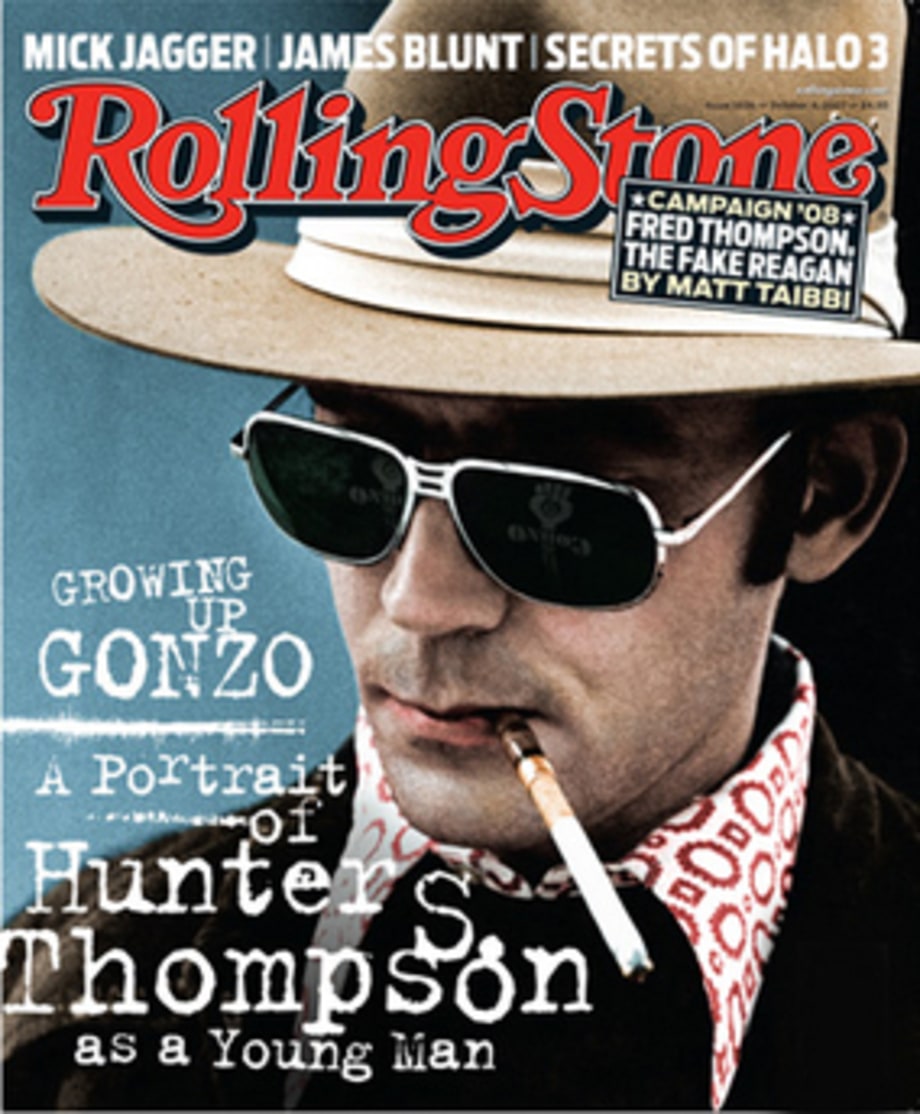
Hunter S. Thompson, Jann Wenner and Rolling Stone
Darcy Gerow on the sudden rise and long, long decline of Rolling Stone:
The suffocating media bias of the 1960s was difficult to escape. A lethargic gray specter of middle-class America was distributed with cunning sterility through the generic, bogus smiles of cable news networks and traditional print. Despite the election and assassination of Kennedy and the signing of the Civil Rights Act, if you had turned on a T.V. this was still Eisenhower’s America: regimented, religious, conservative. And the cultural vacuum created by the Eisenhower years had began to suck even harder with Lyndon Baines Johnson at the helm.
American media was out of touch with this new generation. Elitist authoritarians were preaching their moral superiority stamped with stars and stripes to a generation of cynics. These kids didn’t have a fucking clue what they wanted, but they wanted no part of what they were being given. So rose Rolling Stone, a counterculture bible for babyboomers, co-founded by Jann Wenner.[…]
Things were different in the 1960s. The anti-war movement and the civil rights movement were a just cause. The catalyst for a just movement of equal rights for women and gays and minorities was free speech, of which Jann Wenner was a huge proponent. When students at U.C. Berkley marched in the streets in the 1960s, it was an attack on the elitist, authoritarians and an establishment hellbent on keeping opposing viewpoints and the ideas of personal liberty stifled. The gang of “cruel faggots” kept the official narrative running but no one under 30 was listening.
The whole goddamn world had had enough of the travesty of war in Southeast Asia. There was no ignoring the ineptitude of American politics. The only reasonable thing to do in 1969 was to drive out to Altamont for the weekend, load up on heinous chemicals, hunker down and rethink your approach to the political process.
Thompson, the then-young, liberal anti-hero, could often be found gobbling LSD and firing his guns (he was a lifetime member of the NRA) at propane bottles for a crowd of jeering burnouts or Bay area bikers at his fortified compound, Owl Farm, in Woody Creek Colorado.
It was Jann Wenner’s idea to put Hunter, with all of his fear and loathing, on to the campaign trail in 1972. Why not get the guy who wrote Hell’s Angels? Hunter was someone with a penchant for dealing with vicious thugs and sick freaks gone crazy on power, someone who could draw a parallel between Richard Nixon and Sonny Barger.
Thompson’s openly-biased, subjective and wild account of the 1972 presidential election was the red Chevy convertible of campaign coverage. ‘Sympathy for the Devil’ on repeat and at full volume, barrelling across the country at 110 miles an hour or so and in search of an honest politician. In Hunter’s eyes, the only one that even came close was George McGovern, the senator from South Dakota.
McGovern’s non-interventionist platform focused on a complete withdrawal from Vietnam, amnesty for draft evaders and a Milton Freidman-inspired, negative income tax meant to replace the bureaucratic burden of social welfare programs and a complicated tax code. Thompson’s version of events is the story of an idealistic underdog fighting against the odds only to be crushed by postmodern Americanism and the establishment incumbent, “Tricky Dick Nixon.” McGovern might have owed a White House win, in part, to Thompson’s and Rolling Stone’s relentless support had he not owed his White House loss to the mental distress of his vice-presidential pick, Thomas Eagleton.
There’s no way to properly explain how great Rolling Stone was in those early years. How well the magazine represented the anti-establishment culture, individual liberty and equality for everyone. It can’t be compared to anything else because there was nothing else, only the traditional mainstream garbage and Rolling Stone.
August 5, 2018
On The Far Side
Today I Found Out
Published on 9 Jul 2018Check out my other channel TopTenz! https://www.youtube.com/user/toptenznet
Never run out of things to say at the water cooler with TodayIFoundOut! Brand new videos 7 days a week!
More from TodayIFoundOut
What Ever Happened to the Creator of Calvin and Hobbes?
In this video:
For 15 years, Gary Larson took millions of readers over to the Far Side. Using anamorphic animals, chubby teenagers, universal emotions, a simple drawing style and a really bizarre, morbid sense of humor, The Far Side became one of the most successful – and praised – comic strips of all time.
Want the text version?: http://www.todayifoundout.com/index.p…
July 29, 2018
QotD: The third Great Awakening
We are now — in the Me Decade — seeing the upward roll (and not yet the crest, by any means) of the third great religious wave in American history, one that historians will very likely term the Third Great Awakening. Like the others it has begun in a flood of ecstasy, achieved through LSD and other psychedelics, orgy, dancing (the New Sufi and the Hare Krishna), meditation, and psychic frenzy (the marathon encounter). This third wave has built up from more diverse and exotic sources than the first two, from therapeutic movements as well as overtly religious movements, from hippies and students of “psi phenomena” and Flying Saucerites as well as charismatic Christians. But other than that, what will historians say about it?
The historian Perry Miller credited the First Great Awakening with helping to pave the way for the American Revolution through its assault on the colonies’ religious establishment and, thereby, on British colonial authority generally. The sociologist Thomas O’Dea credited the Second Great Awakening with creating the atmosphere of Christian asceticism (known as “bleak” on the East Coast) that swept through the Midwest and the West during the nineteenth century and helped make it possible to build communities in the face of great hardship. And the Third Great Awakening? Journalists (historians have not yet tackled the subject) have shown a morbid tendency to regard the various movements in this wave as “fascist.” The hippie movement was often attacked as “fascist” in the late 1960s. Over the past several years a barrage of articles has attacked Scientology, the est movement, and “the Moonies” (followers of the Reverend Sun Myung Moon) along the same lines.
Frankly, this tells us nothing except that journalists bring the same conventional Grim Slide concepts to every subject. The word fascism derives from the old Roman symbol of power and authority, the fasces, a bundle of sticks bound together by thongs (with an ax head protruding from one end). One by one the sticks would be easy to break. Bound together they are invincible Fascist ideology called for binding all classes, all levels, all elements of an entire nation together into a single organization with a single will.
The various movements of the current religious wave attempt very nearly the opposite. They begin with … “Let’s talk about Me.” They begin with the most delicious look inward; with considerable narcissism, in short. When the believers bind together into religions, it is always with a sense of splitting off from the rest of society. We, the enlightened (lit by the sparks at the apexes of our souls), hereby separate ourselves from the lost souls around us. Like all religions before them, they proselytize — but always on promising the opposite of nationalism: a City of Light that is above it all. There is no ecumenical spirit within this Third Great Awakening. If anything, there is a spirit of schism. The contempt the various seers have for one another is breathtaking. One has only to ask, say, Oscar Ichazo of Arica about Carlos Castaneda or Werner Erhard of est to learn that Castaneda is a fake and Erhard is a shallow sloganeer. It’s exhilarating! — to watch the faithful split off from one another to seek ever more perfect and refined crucibles in which to fan the Divine spark … and to talk about Me.
Whatever the Third Great Awakening amounts to, for better or for worse, will have to do with this unprecedented post-World War II American development: the luxury, enjoyed by so many millions of middling folk, of dwelling upon the self. At first glance, Shirley Polykoff’s slogan — “If I’ve only one life, let me live it as a blonde!” — seems like merely another example of a superficial and irritating rhetorical trope (antanaclasis) that now happens to be fashionable among advertising copywriters. But in fact the notion of “If I’ve only one life” challenges one of those assumptions of society that are so deep-rooted and ancient, they have no name — they are simply lived by. In this case: man’s age-old belief in serial immortality.
Tom Wolfe, “The ‘Me’ Decade and the Third Great Awakening”, New York Magazine, 1976-08-23.
June 3, 2018
Brand X – Nuclear Burn (1976)
aquarianrealm
Published on Nov 7, 2010AMG: Brand X were a British jazz-rock fusion outfit formed by Genesis drummer Phil Collins and Atomic Rooster guitarist John Goodsall as a side project from their regular groups. Their initial lineup also included keyboardist Robin Lumley and bassist Percy Jones (the Liverpool Scene, the Scaffold). Brand X’s debut album, Unorthodox Behaviour, was released in 1976; a live album, Livestock, and the studio effort Moroccan Roll followed in 1977. Collins left the group to concentrate on Genesis, and for 1978’s Masques, he was replaced by Al Di Meola drummer Chuck Burgi, as well as additional keyboardist Peter Robinson, who had played with Stanley Clarke. Three further albums — 1979’s Product, 1980’s Do They Hurt?, and 1982’s Is There Anything About? — followed before the group disbanded. In the mid-’90s, Lumley, Goodsall, and Jones reunited, issuing several live collections in the years to follow.
H/T to ESR for the link.
June 1, 2018
QotD: Travelling with a political campaign
One of the constant nightmares of traveling with politicians is the need to keep them in sight at all times. Every presidential campaign has its own fearful litany of horror stories about reporters – and, occasionally, even a key staff member – who thought they had plenty of time to “run across the street for a quick beer” instead of hanging around in the rear of some grim auditorium half-listening to the drone of a long-familiar speech, only to come back in 20 minutes to find the auditorium empty and no sign of the press bus, the candidate or anybody who can tell him where they went. These stories are invariably set in places like Butte, Buffalo or Icepick, Minnesota, on a night in the middle of March. The temperature is always below zero, there is usually a raging blizzard to keep cabs off the street, and just as the victim remembers that he has left his wallet in his overcoat on the press bus, his stomach erupts with a sudden attack of ptomaine poisoning. And then, while crawling around on his knees in some ice-covered alley and racked with fits of projectile vomiting, he is grabbed by vicious cops and whipped on the shins with a night stick, then locked in the drunk tank of the local jail and buggered all night by winos.
These stories abound, and there is just enough truth in them to make most campaign journalists so fearful of a sudden change in the schedule that they will not even go looking for a bathroom until the pain becomes unendurable and at least three reliable people have promised to fetch them back to the fold at the first sign of any movement that could signal an early departure. The closest I ever came to getting left behind was during the California primary in 1972, when I emerged from a bathroom in the Salinas railroad depot and realized that the caboose car of McGovern’s “victory train” was about 100 yards further down the tracks than it had been only three minutes earlier. George was still standing outside on the platform, waving to the crowd, but the train was moving – and as I started my sprint through the crowd, running over women, children, cripples and anything else that couldn’t get out of my way, I thought I saw a big grin on McGovern’s face as the train began picking up speed….… I am still amazed that I caught up with the goddamn thing without blowing every valve in my heart, or even missing the iron ladder when I made my last-second leap and being swept under the train and chopped in half by the wheels.
Ever since then I have not been inclined to take many risks while traveling in strange territory with politicians. Even the very few who might feel a bit guilty about leaving me behind would have to do it anyway, because they are all enslaved by their schedules, and when it comes to a choice between getting to the airport on time or waiting for a journalist who has wandered off to seek booze, they will shrug and race off to the airport.
Hunter S. Thompson, “Fear and Loathing on the Campaign Trail ’76: Third-rate romance, low-rent rendezvous — hanging with Ted Kennedy, Jimmy Carter, and a bottle of Wild Turkey”, Rolling Stone, 1976-06-03.
May 16, 2018
QotD: The presidency and the Supreme Court
… I also like Jerry Jeff Walker, the Scofflaw King of New Orleans and a lot of other people I don’t necessarily believe should be president of the United States. The immense concentration of power in that office is just too goddamn heavy for anybody with good sense to turn his back on. Or her back. Or its back…. At least not as long as whatever lives in the White House has the power to fill vacancies on the U.S. Supreme Court; because anybody with that kind of power can use it – like Nixon did – to pack-crowd the Court of Final Appeal in this country with the same kind of lame, vindictive yo-yos who recently voted to sustain the commonwealth of Virginia’s antisodomy statutes……. And anybody who thinks that 6-3 vote against “sodomy” is some kind of abstract legal gibberish that doesn’t really affect them had better hope they never get busted for anything the Bible or any local vice-squad cop calls an “unnatural sex act.” Because “unnatural” is defined by the laws of almost every state in the Union as anything but a quick and dutiful hump in the classic missionary position, for purposes of procreation only. Anything else is a felony crime, and people who commit felony crimes go to prison.
Hunter S. Thompson, “Fear and Loathing on the Campaign Trail ’76: Third-rate romance, low-rent rendezvous — hanging with Ted Kennedy, Jimmy Carter, and a bottle of Wild Turkey”, Rolling Stone, 1976-06-03.
May 7, 2018
QotD: Running for the presidency
One of the most difficult problems for a journalist covering a presidential campaign is getting to know the candidates well enough to make confident judgments about them, because it is just about impossible for a journalist to establish a personal relationship with any candidate who has already made the big leap from “long shot” to “serious contender.” The problem becomes more and more serious as the stakes get higher, and by the time a candidate has survived enough primaries to convince himself and his staff that they will all be eating their lunches in the White House Mess for the next four years, he is long past the point of having either the time or the inclination to treat any journalist who doesn’t already know him personally as anything but just another face in the campaign “press corps.”
There are many complex theories about the progressive stages of a presidential campaign, but for the moment let’s say there are three: Stage One is the period between the decision to run for president and the morning after the New Hampshire primary when the field is still crowded, the staff organizations are still loose and relaxed, and most candidates are still hungry for all the help they can get – especially media exposure, so they can get their names in the Gallup Poll; Stage Two is the “winnowing out,” the separating of the sheep from the goats, when the two or three survivors of the early primaries begin looking like long-distance runners with a realistic shot at the party nomination; and Stage Three begins whenever the national media, the public opinion polls and Mayor Daley of Chicago decide that a candidate has picked up enough irreversible momentum to begin looking like at least a probable nominee, and a possible next president.
This three-stage breakdown is not rooted in any special wisdom or scientific analysis, but it fits both the 1972 and 1976 Democratic campaigns well enough to make the point that any journalist who doesn’t get a pretty firm personal fix on a candidate while he’s still in Stage One might just as well go with his or her instincts all the way to Election Day in November, because once a candidate gets to Stage Two his whole lifestyle changes drastically.
At that point he becomes a public figure, a serious contender, and the demands on his time and energy begin escalating to the level of madness. He wakes up every morning to face a split-second, 18-hour-a-day schedule of meetings, airports, speeches, press conferences, motorcades and handshaking. Instead of rambling, off-the-cuff talks over a drink or two with reporters from small-town newspapers, he is suddenly flying all over the country in his own chartered jet full of syndicated columnists and network TV stars……. Cameras and microphones follow him everywhere he goes, and instead of pleading long and earnestly for the support of 15 amateur political activists gathered in some English professor’s living room in Keene, New Hampshire, he is reading the same cliché-riddled speech – often three or four times in a single day – to vast auditoriums full of people who either laugh or applaud at all the wrong times and who may or may not be supporters……. And all the fat cats, labor leaders and big-time pols who couldn’t find the time to return his phone calls when he was desperately looking for help a few months ago are now ringing his phone off the hook within minutes after his arrival in whatever Boston, Miami or Milwaukee hotel his managers have booked him into that night. But they are not calling to offer their help and support, they just want to make sure he understands that they don’t plan to help or support anybody else, until they get to know him a little better.
It is a very mean game that these high-rolling, coldhearted hustlers play. The president of the United States may no longer be “the most powerful man in the world,” but he is still close enough to be sure that nobody else in the world is going to cross him by accident. And anybody who starts looking like he might get his hands on that kind of power had better get comfortable, right from the start, with the certain knowledge that he is going to have to lean on some very mean and merciless people just to get himself elected.
Hunter S. Thompson, “Fear and Loathing on the Campaign Trail ’76: Third-rate romance, low-rent rendezvous — hanging with Ted Kennedy, Jimmy Carter, and a bottle of Wild Turkey”, Rolling Stone, 1976-06-03.
April 29, 2018
Pipe Dreams: What Happened To Hovertrains?
Mustard
Published on 8 Apr 2018In 1974, a French train sets a speed record, exceeding 250 miles per hour. But this train is unlike any other before it. Instead of rolling on wheels, it hovers on a cushion of air. In the 1970’s hovertrains were seriously being considered the solution to slow, antiquated railways, which increasingly had to compete with new superhighways and even intercity air travel.
Without the rolling resistance of train wheels, hovertrains promised greater efficiency and much higher speeds. By feeding high pressure air through lifting pads, hovertrains float on a cushion of air much like a hovercraft.
One of the most widely known hovertrain prototypes was called the Aerotrain. Lead engineer Jean Bertin and his team in France, designed several versions, including one that could carry 80 passengers. The i80HV was powered by a turbofan sourced from an airliner, producing over twelve thousand pounds of thrust. At the front, a 400 horse power gas-turbine supplied high-pressure air to hover the twenty loaded train a quarter of an inch off its guideway. The British and Americans also experimented with hovertrain technology, incorporating the linear induction motor for improved efficiency. British research led to the development of the RTV-31 Tracked Hovercraft, and the American’s developed several prototypes, culminating in the development of the Urban Tracked Air Cushion Vehicle (UTACV).
But like their counterpart the Maglev, Hovertrains failed to revolutionize rail. Hovertrains, Maglevs, or any other innovative alternative to rail has to compete with nearly a million miles of rail line already in existence. With stations and infrastructure built-out in nearly every city in the world. The limitations of conventional railways were overcome not a single innovative leap forward, but by incremental improvements. Existing rail networks were modernized with sections of track that could handle higher speeds. New signaling technologies were developed along with more advanced wheelsets.
April 28, 2018
QotD: Nixon’s final days in the White House
The sudden, hellish reality of a nuclear war with either Russia or China or both was probably the only thing that could have salvaged Nixon’s presidency after the Supreme Court ruled that he had to yield up the incriminating tapes that he knew would finish him off. Would the action-starved generals at the Strategic Air Command Headquarters have ignored an emergency order from their commander-in-chief? And how long would it have taken Pat Buchanan or General Haig to realize that “The Boss” had finally flipped? Nixon spent so much time alone that nobody else in the White House would have given his absence a second thought until he failed to show up for dinner, and by that time he could have made enough phone calls to start wars all over the world.
A four-star general commandant of the U.S. Marine Corps with three wars and 35 years of fanatical devotion to duty, honor and country in his system would hack off his own feet and eat them rather than refuse to obey a direct order from the president of the United States – even if he thought the president was crazy.
The key to all military thinking is a concept that nobody who ever wore a uniform with even one stripe on it will ever forget: “You don’t salute the man, you salute the uniform.” Once you’ve learned that, you’re a soldier – and soldiers don’t disobey orders from people they have to salute. If Nixon’s tortured mind had bent far enough to let him think he could save himself by ordering a full-bore Marine/Airborne invasion of Cuba, he would not have given the Boom-Boom order to some closet-pacifist general who might be inclined to delay the invasion long enough to call Henry Kissinger for official reassurance that the president was not insane.
No West Pointer with four stars on his hat would take that kind of risk anyway. By the time word got back to the White House, or to Kissinger, that Nixon had given the order to invade Cuba, the whole Caribbean would be a sea of fire; Fidel Castro would be in a submarine on his way to Russia, and the sky above the Atlantic would be streaked from one horizon to the other with the vapor trails of a hundred panic-launched missiles.
***
Right. But it was mainly a matter of luck that Nixon’s mental disintegration was so obvious and so crippling that by the time he came face to face with his final option, he was no longer able to even recognize it. When the going got tough, the politician who worshiped toughness above all else turned into a whimpering, gin-soaked vegetable……. But it is still worth wondering how long it would have taken Haig and Kissinger to convince all those SAC generals out in Omaha to disregard a Doomsday phone call from the president of the United States because a handful of civilians in the White House said he was crazy.
Hunter S. Thompson, “Fear and Loathing on the Campaign Trail ’76: Third-rate romance, low-rent rendezvous — hanging with Ted Kennedy, Jimmy Carter, and a bottle of Wild Turkey”, Rolling Stone, 1976-06-03.
February 26, 2018
A few jotted notes on woodworking plane companies
I’ve been dabbling more in the woodworking hand tool market recently, and found myself getting confused about the various manufacturers and their products. Mostly to try to sort out the history for myself, I started taking notes as I trawled from website to forum to auction site, looking for answers. In a very abbreviated and assuredly incomplete and inaccurate thumbnail sketch, here’s how I think the woodworking hand tool market has changed over the last hundred and fifty years or so:
- Until the mid-19th century, most woodworkers made their own tools whenever they could, as the ability of manufacturers to produce economical, dependable tools was limited, and woodworkers (like other skilled craftsman of the early industrial era) were capable of producing most of the necessary tools with only minimal outlay to other trades.
- By the mid-19th century, innovators and inventors were prolific in their proposed solutions to all kinds of problems (some real and many probably imaginary). Among those many, many febrile innovators was a gentleman named Leonard Bailey. Bailey managed to almost single-handedly revolutionize the woodworking market by coming up with a line of hand planes that could out-compete most of the hand-made competitors while taking advantage of the economies of scale offered by mass production. It became more economical for a woodworker to buy a ready-made tool rather than take time away from productive work to fabricate it for himself.
- The Stanley Works of Massachusetts bought Bailey’s company — probably more for the value of Leonard’s patents than for the company’s sake itself — and parlayed that patent protection into becoming the acknowledged standard for woodworking planes.
- Even after the Bailey patents expired, other manufacturers paid backhanded tribute to Bailey by straight-out cloning his designs with very minor changes and putting their own functional copies on sale in direct competition with the original Stanley products … often even using the same or barely concealed names/numbers for their clones (for example, the British company Record generally just prepended a zero in front of the “standard” Stanley model numbers, where a #4 plane from Stanley was a #04 from Record).
- In the British market following the financial crisis of 1929, the government’s imposition of tariffs against inter alia American hand tool manufacturers encouraged many British companies to introduce Stanley clones for both domestic and Imperial markets. To their credit, not all of the opportunistic entrants went for the low-hanging fruit, and some of the British clones were at least as good and in some cases superior to the original products.
- After the Second World War, the market for woodworking hand tools in North America began a rapid decline, although it remained strong enough in Britain to keep many of the clone manufacturers going for another 20 years or so. In response to the softening market, Stanley began to cheapen their manufacturing processes and the product quality began a precipitous decline.
- By the early 1970s, Stanley had almost completely given up the hand tool market in woodworking, and their products were a sad mockery of what they’d been producing just a decade before, but North American woodworkers were inundated with innovative power tools from, among others, Black & Decker and the Sears Craftsman line that promised better/faster/more productive output from amateur woodworking shops than could be done with hand tools alone. That, coupled with the decreased emphasis on “shop” subjects in North American high school curricula meant that youngsters didn’t automatically become familiar with the use of hand tools unless they were already interested and had access to a workshop to indulge that interest.
- The same process of shrinking market requiring “rationalization” and “economization” hit the British manufacturers fifteen to twenty years after Stanley and their surviving American competitors, and the order of the day was ever-shrinking profit margins, smaller markets, and mergers/bankruptcies/take-overs among the tool manufacturers.
- After the financial bloodbath of the 70s through the 90s, it became clear that there was still a small-but-affluent market for quality woodworking hand tools, and a few new entrants made their mark by first copying the best designs of the past and then, hesitatingly, innovating with modern technology beyond what was possible a generation or two earlier.
Here are some notes I jotted down about a few of the key woodworking hand tool manufacturers and their respective rise and decline, based on a very cursory survey of what information is available online at the moment:
STANLEY (USA, UK, CANADA and AUSTRALIA)
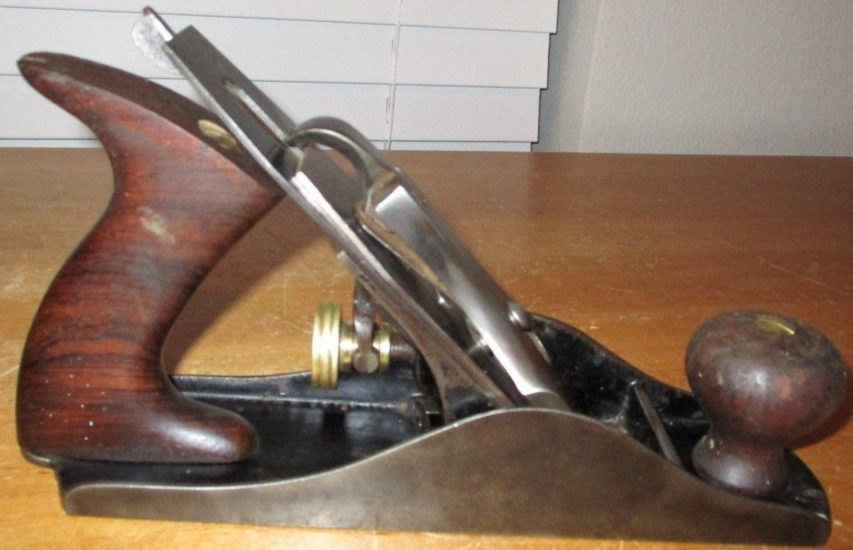
A vintage Stanley No. 4 smoothing plane from a recent eBay listing. Even though this is the single most common woodworking plane ever, the example I own is a late-70s piece of crap, so I went looking for a more representative image.
The Stanley Works was founded in 1843 by Frederick Stanley in New Britain, Connecticut.
In 1857, the Stanley Rule & Level Company was founded by Frederick Stanley’s cousin Henry. I imagine most people of the time assumed there was only the single Stanley company, as they produced products in related-but-not-competitive fields.
Stanley purchased Bailey, Chaney and Company in 1869 along with the Bailey plane patents. The Bailey patents were the key to Stanley’s future dominance of the hand plane market.
Stanley Rule & Level Co. purchased the Roxton Tool and Mill Company in Roxton Pond, Quebec (founded 1873). Manufacturing continued here from 1907 until about 1984. From the timing, I assume this was seen as a good way to get Stanley hand tools into the Canadian market without paying tariffs.
In 1920, The Stanley Works merged with the Stanley Rule & Level Company. The initials “S.W.” within a heart outline was introduced at that time. Later references to tools with this mark invariably refer to them as “Sweetheart”, but it’s not clear that the newly unified Stanley used that term in their own marketing until a few years later. The logo and name have been revived in the last decade or so, probably to cash in on the nostalgia factor.
In 1937, Stanley acquired J.A. Chapman (of Sheffield, England). I’m assuming this was a shortcut to getting non-tariff access to the British (and Imperial) hand tool market.
Stanley manufactured planes in Australia from 1965 to the early 1990s in Moonah, Tasmania.
In 2010, The Stanley Works merged with Black & Decker to become Stanley Black & Decker (Stanley Hand Tools is a division of the much larger company).
MILLERS FALLS (USA)
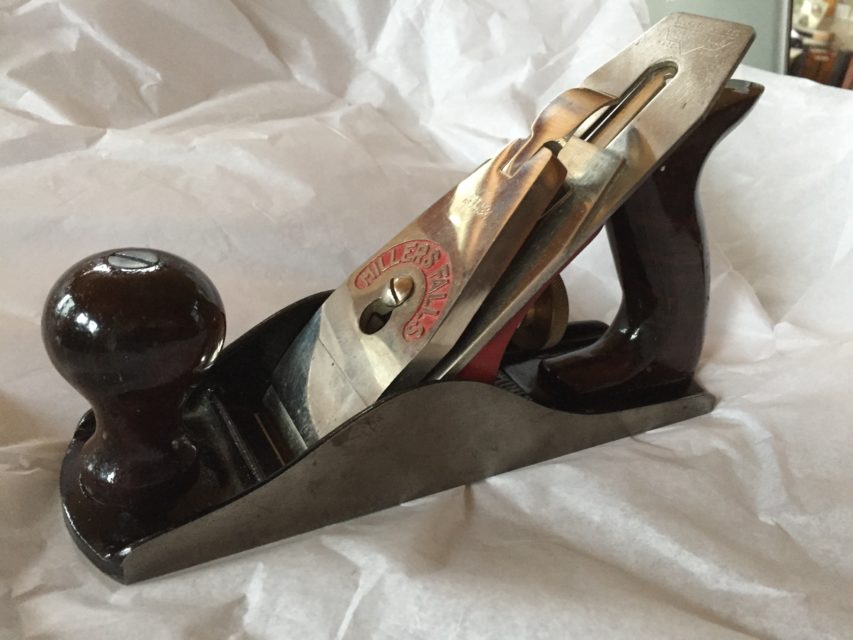
I happen to actually own a Millers Falls #9 smoothing plane (as of Friday). Look similar to the Stanley #4 above? It should, as it’s a near-clone.
Incorporated in 1868 as the Millers Falls Manufacturing Company, renamed as the Millers Falls Company in 1872. Introduced hand planes into its line of tools in 1928/29. Millers Falls chose to compete for the high-end of the hand tool market and managed to carve out a profitable niche for themselves, especially in the hand plane segment. Their futuristic plastic-and-chrome “Buck Rogers” planes of the late 1950s were visually distinctive enough that they kept the company in the black for longer than almost all of their US competitors.
In 1957, Millers Falls acquired the Union Tool Company of Orange, Massachusetts. The Union brand was kept active until 1975 when the Union plant was closed down.
Millers Falls became a subsidiary of Ingersoll Rand in 1962, and closed down their Massachusetts operation in 1982 with a corporate relocation to New Jersey after a buyout.
RECORD (UK)
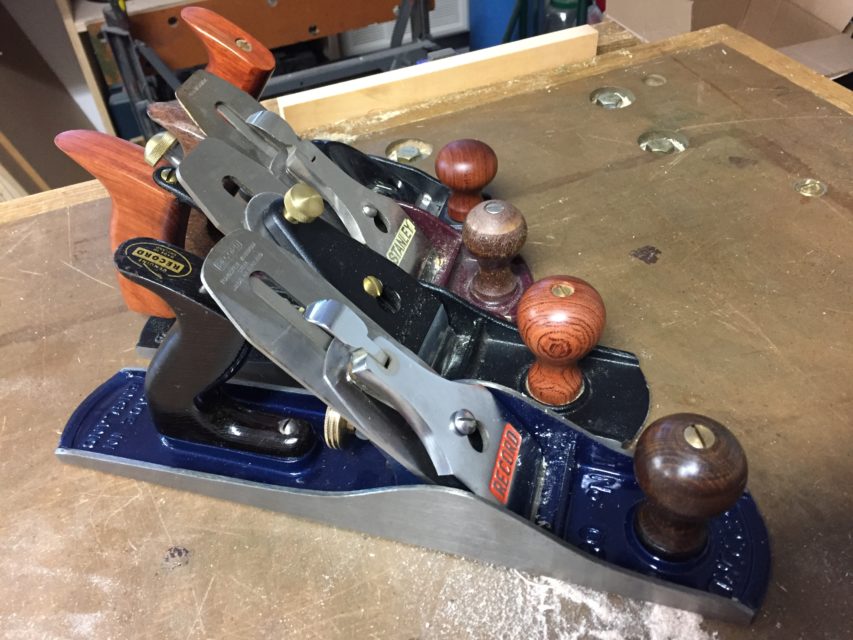
(front) A Record No. 05 jack plane, a close copy of the Stanley #5
Record was a brand name used by C & J Hampton from 1909. The company was founded in 1898 and incorporated a decade later. The founders, Charles and Joseph Hampton, had left the family business (The Steel Nut & Joseph Hampton Ltd in Wednesbury, Staffordshire) to set up shop in Sheffield. Joseph eventually returned to the family firm, but the sons of Charles succeeded to leadership roles in the younger company.
The first Record planes were offered for sale in 1931 (No. 03 through 08 and three block planes: No. 0110, 0120 and 0220). Record got into the plane business partly due to the preferential tariffs the British government levied on foreign (mainly American) hand tools and the fact that the Stanley Works’ Bailey patents had expired, so there was no legal issue with flat-out cloning Stanley’s plane line.
In 1934, Record took over production of some Edward Preston and Sons Ltd. products (mainly bullnose and rabbet planes). Preston had been acquired by John Rabone and Sons Ltd. (Birmingham) in 1932, but they decided to stick with the rule and level business and offload the plane manufacturing to Record.
Woden Tools Ltd was purchased from The Steel Nut & Joseph Hampton Ltd in 1961 and Record continued to use the Woden trademark for another 10 years (some sources say only five years: take your pick).
Record acquired 50% of William Marples and Sons Limited in 1963, the other 50% being held by William Ridgway & Sons, Ltd. (Parkway Works), also of Sheffield.
In 1972, Record merged with Ridgway to form Record Ridgway Tools Ltd.
In 1982, Record Ridgeway was acquired by AB Bahco of Sweden, but a management buyout in 1985 took it back to British ownership as Record Holdings plc.
In 1988 the company became Record Marples (Woodworking Tools) Ltd.
In 1998, Record Marples accepted an offer from American Tool Corporation and became part of the Record Irwin Group as Record Tools Ltd. Irwin was acquired by Stanley Black & Decker in 2017.
WODEN TOOLS (UK)

A pair of Woden planes as shown on the wodentools.com website.
Woden Tools was a wholly owned subsidiary of The Steel Nut & Joseph Hampton Ltd, producing planes from 1953/54 in Wednesbury, Staffordshire. (The planes were originally manufactured by W.S Manufacturing (Birmingham), which was acquired by The Steel Nut & Joseph Hampton around 1952.)
C & J. Hampton (Record) purchased Woden Tools Ltd from SNJH in 1961 and continued to use the Woden trademark for another 10 years (some sources say only until 1965).
LEE VALLEY/VERITAS (CANADA and USA)

A current Veritas 5 1/4 junior jack plane from Lee Valley Tools
Founded in 1978 by Leonard Lee in Ottawa, Ontario. The first out-of-town store was opened in 1982 (Toronto West). I think I visited that store in its original location in 1984. The company launched their website in 1997 and added e-commerce features in 2000.
In the early-to-mid 1980s, Lee Valley contracted with Footprint (UK) to produce a line of bench planes to their specifications. The “Paragon” line were sold in Canada by Lee Valley and by Garret Wade in the United States for a few years, but quality issues apparently doomed the venture. In a thread on the Sawmillcreek.org forums, Robin Lee said “Actually – we ‘remanufactured’ many of them here [in Ottawa]… We set out the specs, made some tooling changes, and had Footprint make them for us (and GW). All planes were received and inspected … – and in many cases, fettled and reground… We abandoned the brand shortly after – and formed Veritas tools as our manufacturing company…”
In 1999, the first Lee Valley manufactured plane, the Low-Angle Block Plane, was introduced. The Veritas line of bench planes was launched in 2001. The first shoulder plane was introduced in 2003. In 2014, the Veritas Custom Bench Plane line was introduced, which the company characterizes as the first user-customizable line of planes in the industry.
In 1982, the company began manufacturing its own tools under the Veritas label. In 1985, Lee Valley Manufacturing Ltd. was incorporated and later renamed as Veritas Tools, Inc. Manufacturing is primarily in Ottawa and (possibly) in Ogdensburg, New York.
February 15, 2018
The Volkswagen Thing Is Slow, Old, Unsafe… and Amazing
Doug DeMuro
Published on Oct 13, 2016GO READ MY COLUMN! http://autotradr.co/Oversteer
Thank you to Morrie’s Heritage Car Connection for letting me borrow your Thing!!
http://morriesheritage.com/
December 23, 2017
Repost – Kate Bush – Christmas Special 1979 (Private Remaster)
Published on 5 Oct 2013
I know there’s a good few copies of this out on YouTube, but here it is, again! The other copies were either split up into individual tracks, the best complete one (from BBC Four’s rebroadcast in 2009) had the wrong aspect ratio, which annoyed the hell out of me! So, here this is…
Video and audio have been tidied up very slightly, not much was needed!
Kate Bush – Christmas Special
Tracklist:
(Intro) 00:00
Violin 00:29
(Gymnopédie No.1 – composed by Erik Satie) 03:44
Symphony In Blue 04:44
Them Heavy People 08:20
(Intro for Peter Gabriel) 12:52
Here Comes The Flood (Peter Gabriel) 13:22
Ran Tan Waltz 17:02
December Will Be Magic Again 19:43
The Wedding List 23:35
Another Day (with Peter Gabriel) 28:05
Egypt 31:41
The Man With The Child In His Eyes 36:21
Don’t Push Your Foot On The Heartbreak 39:24“I was recently asked about this BBC TV special and I thought I’d share my comments here. Kate: Kate Bush Christmas Special is a stage performance by Kate Bush with her special guest Peter Gabriel. Though most of the songs are not holiday ones, they come from Bush’s first three albums (Never for Ever her third album would be released in 1980 after this 1979 TV special was taped). The performances include costumes, choreographed dances and a wind machine, creating an eclectic music TV special to say the least.
This is one of the programs that makes my research quite difficult — because it calls itself a Christmas Special yet it contains only one performance of a Christmas song “December Will Be Magic Again” (a song that wouldn’t be released as a single by Bush until the following year, in 1980). TV programming that calls itself a Christmas Special and yet contains little to no Christmas entertainment is actually quite common — especially on the BBC.
Between the end of November and the end of December each year, there is quite a bit of special programming on television. Remember Elvis’ 1968 Comeback Special — it aired in December that year and includes only one holiday song, a performance of “Blue Christmas.” Is it considered a Christmas special? No, not really. And so, despite its title, the lack of holiday programming in Kate Bush’s 1979 TV special means it shouldn’t be considered a Christmas special either. But the Kate Bush Christmas Special is certainly worth watching!”
H/T to Ghost of a Flea for the link.
December 21, 2017
UFOs? Again?
I must admit I share Colby Cosh’s just disproven belief that we were done with the UFO craze:

Yeah, I know: wrong UFO
There can no longer be any doubt: every fashion phenomenon does come back. I, for one, really thought we had seen the last of UFO-mania. When I was a boy, the idea of stealthy extraterrestrial visitors zooming around in miraculous aircraft was everywhere in the nerdier corners of popular culture. If you liked comic books or paperback science fiction or Omni magazine — and especially if those things were among the staples of your imaginative diet — there was no getting away from it.
Anyone remember the NBC series Project U.F.O. (1978-79), inspired by the USAF’s real Project Blue Book program? As the anthology show’s Wikipedia page observes, most episodes had the plot of a Scooby-Doo cartoon, only backwards: they would end with the investigating protagonists discovering that UFOs remained impenetrably Unidentifiable, but must be “real” craft capable of physically improbable manoeuvres. (I know citing Wikipedia will savour of pumpkin-spice holiday laziness on my part, but the Scooby thing is a truly perceptive point by some anonymous Wiki-genius.)
Then, at the end of the show, a disclaimer would appear on-screen: “The U.S. Air Force stopped investigating UFOs in 1969. After 22 years, they found no evidence of extra-terrestrial landings and no threat to national security.”
[…]
There are very good reasons for a superpower’s military apparatus to devote a little money to following up UFO sightings. “Threat Identification”? Sure, whatever. Plenty of U.S. military flyers have seen UFOs, and these people ought to be comfortable reporting odd occurrences without ridicule. But if I were American, I would definitely want most of that budget to go to Scully rather than Mulder. Don’t throw cash at someone who really, really wants to believe.
What I find vexing is that most of the response to the Times story has been in the spirit of “Whoa, aliens!” rather than “Taxpayers got robbed.” Young people may know on some level that ubiquitous good-quality cameras have all but eliminated civilian UFO sightings. But they lack the personal memory of a live, thriving UFO fad, one that bred quasi-scholarly international UFO-study associations along with a whole publishing industry devoted to UFO tales. I wonder if the Times’ piece on UFO research, by the very virtue of its flat-voiced Grey Lady objectivity, is having the same weird effect as that disclaimer they showed at the end of Project U.F.O.
November 30, 2017
QotD: Nuclear winter
In 1975, the National Academy of Sciences reported on “Long-Term Worldwide Effects of Multiple Nuclear Weapons Detonations” but the report estimated the effect of dust from nuclear blasts to be relatively minor. In 1979, the Office of Technology Assessment issued a report on “The Effects of Nuclear War” and stated that nuclear war could perhaps produce irreversible adverse consequences on the environment. However, because the scientific processes involved were poorly understood, the report stated it was not possible to estimate the probable magnitude of such damage.
Three years later, in 1982, the Swedish Academy of Sciences commissioned a report entitled “The Atmosphere after a Nuclear War: Twilight at Noon,” which attempted to quantify the effect of smoke from burning forests and cities. The authors speculated that there would be so much smoke that a large cloud over the northern hemisphere would reduce incoming sunlight below the level required for photosynthesis, and that this would last for weeks or even longer.
The following year, five scientists including Richard Turco and Carl Sagan published a paper in Science called “Nuclear Winter: Global Consequences of Multiple Nuclear Explosions.” This was the so-called TTAPS report, which attempted to quantify more rigorously the atmospheric effects, with the added credibility to be gained from an actual computer model of climate. At the heart of the TTAPS undertaking was another equation, never specifically expressed, but one that could be paraphrased as follows:
Ds = Wn Ws Wh Tf Tb Pt Pr Pe etc(The amount of tropospheric dust = # warheads × size warheads × warhead detonation height × flammability of targets × Target burn duration × Particles entering the Troposphere × Particle reflectivity × Particle endurance, and so on.)
The similarity to the Drake equation is striking. As with the Drake equation, none of the variables can be determined. None at all. The TTAPS study addressed this problem in part by mapping out different wartime scenarios and assigning numbers to some of the variables, but even so, the remaining variables were — and are — simply unknowable. Nobody knows how much smoke will be generated when cities burn, creating particles of what kind, and for how long. No one knows the effect of local weather conditions on the amount of particles that will be injected into the troposphere. No one knows how long the particles will remain in the troposphere. And so on.
And remember, this is only four years after the OTA study concluded that the underlying scientific processes were so poorly known that no estimates could be reliably made. Nevertheless, the TTAPS study not only made those estimates, but concluded they were catastrophic.
According to Sagan and his coworkers, even a limited 5,000 megaton nuclear exchange would cause a global temperature drop of more than 35 degrees Centigrade, and this change would last for three months. The greatest volcanic eruptions that we know of changed world temperatures somewhere between 0.5 and 2 degrees Centigrade. Ice ages changed global temperatures by 10 degrees. Here we have an estimated change three times greater than any ice age. One might expect it to be the subject of some dispute.
But Sagan and his coworkers were prepared, for nuclear winter was from the outset the subject of a well-orchestrated media campaign. The first announcement of nuclear winter appeared in an article by Sagan in the Sunday supplement, Parade. The very next day, a highly-publicized, high-profile conference on the long-term consequences of nuclear war was held in Washington, chaired by Carl Sagan and Paul Ehrlich, the most famous and media-savvy scientists of their generation. Sagan appeared on the Johnny Carson show 40 times. Ehrlich was on 25 times. Following the conference, there were press conferences, meetings with congressmen, and so on. The formal papers in Science came months later.
This is not the way science is done, it is the way products are sold.
Michael Crichton, “Aliens Cause Global Warming”: the Caltech Michelin Lecture, 2003-01-17.


