Quotulatiousness

June 2, 2019

A rare word in favour of free speech from the PM

Filed under: Cancon, Government, Liberty, Technology — Tags: , , , — Nicholas @ 03:00

Chris Selley on an unusually free-speech oriented comment from Justin Trudeau, who is more commonly heard making threats to shut down speech he doesn’t like:

Prime Minister Justin Trudeau said something interesting this past week, in a conversation with Vox journalist Liz Plank at the Open Government Partnership Summit in Ottawa. When it comes to regulating social media giants like Facebook, he suggested, governments like Canada’s have to be very, very careful.

“We recognize that the solution doesn’t lie in government’s heavy hand over our internet (and) public spaces,” he said. “Freedom of expression, freedom of speech, is so fundamental to our democracies that … as soon as we say we have to limit hate speech, we have to protect citizens, there are some really tricky decisions we have to (make).”

It’s interesting primarily because Trudeau and various of his ministers have been threatening for what seems like forever to bring the hammer down. “The platforms are failing their users and they’re failing our citizens,” a full-thesp Trudeau intoned in unveiling the government’s buzzword-laden Digital Charter. “They have to step up in a major way to counter disinformation. And if they don’t, we will hold them to account, and there will be meaningful financial consequences.”

Indeed, Trudeau warned Plank that if “partnership” with social media companies doesn’t yield the desired results — whatever those might be; the government has been studiously vague — “we will take measures that we will regret having to take.”

Still it’s nice to see freedom of speech get a shout out from the top. The sabre-rattling act is wearisome, but it’s vastly preferable to the government speech-regulation power trip that a remarkable number of mainstream Canadian voices have been demanding. Perhaps Trudeau realizes that while the government can and should encourage and work with social media companies to weed out national security threats and illegal material, it has no legal grounds to compel those companies to prohibit “disinformation” or “hate speech” as loosely defined by many people calling for serious regulations — which is to say nasty stuff they don’t like.


Butcherblock table made from scrap hardwood

Filed under: Tools, Woodworking — Tags: — Nicholas @ 02:00

TG Woodworking
Published on 16 Feb 2018

I had started collecting and cutting all the scrapwood almost a year ago, and finally had time to film and build this table. It turned out more beautiful than I could have imagined. I originally just set out to build a new cheap work table out of scraps, but now after making this table, I think I’d like to try this method with some fine furniture!

Another experiment in generating thumbnail images for social media links (just using a literal thumbnail image as in yesterday’s posts didn’t work):

QotD: Explaining modern female sexuality

Filed under: Health, Law, Quotations — Tags: , , , — Nicholas @ 01:00

I have a theory that for many women, sex, or rather agreeing to have sex is difficult, and especially so for the first time with a new partner. How else to explain the fact that so many women admitted that their first time with a new man was generally experienced in an alcoholic haze? (For those who haven’t been keeping up, the source data is here.) So if confronting herself about her “slutty” behavior (even if the sluttiness is only in her own mind), a woman would like to have an excuse like “Oh, but I was drunk…” and thus can excuse away or justify the indiscretion. Or else, as the original study showed, women can even explain away the drunkenness as just a regular part of the dating process, so therefore it’s okay.

I also believe that this is why so many women have rape fantasies, because “Oh, he forced me to do it…” is likewise an expression that denies the woman’s [shameful] complicity in the act. (Of course, now that it’s become okay to accuse a previous partner with actual rape as part of the excuse, the whole thing has become considerably more sinister, especially as such accusations can take place months or years afterwards and still be considered valid by law enforcement. But for the sake of argument, let’s treat this scenario as but a blip on societal consciousness which will disappear at some point when women regain their sanity. We can only hope.) Certainly, this explains female submissiveness (outside a natural submissive personality anyway), which can be regarded (by women) as a kind of watered-down rape fantasy.

The only time, I think, when self-delusion disappears is when a woman encounters a universal object of female desire, such as a hunky actor or popular musician. Even then, there is a “safety in numbers” excuse — “OMG everybody is crazy about him!” — which makes it okay, or at least, provides a figleaf of an excuse for irresponsibility and sexual licentiousness. You only need a sliver of an excuse, and it will be acceptable, in other words.

Kim du Toit, “Seeking Excuses”, Splendid Isolation, 2017-04-24.

June 1, 2019

2020 Presidential Candidate Blowout!

Filed under: Humour, Politics, USA — Tags: , , , — Nicholas @ 06:00

ReasonTV
Published on 31 May 2019

Election season is heating up, which means Republicans and Democrats are ready to sell you the candidate of your dreams. Whether it’s government intrusion into your private life or government intrusion into your economic life, they’ve got you covered.

——————
Subscribe to our YouTube channel: http://youtube.com/reasontv
Follow us on Twitter: https://twitter.com/reason
Subscribe to our podcast at Apple Podcasts: https://goo.gl/az3a7a

Reason is the planet’s leading source of news, politics, and culture from a libertarian perspective. Go to reason.com for a point of view you won’t get from legacy media and old left-right opinion magazines.
—————-

Written by Austin Bragg. Starring Andrew Heaton and Austin Bragg. Video produced by Bragg.

Happy Happy Game Show Kevin MacLeod (http://incompetech.com)
Licensed under Creative Commons: By Attribution 3.0 License
http://creativecommons.org/licenses/b…

Photo credit: Richard B. Levine/Newscom

Experimental social media link thumbnail thingy:

Tour of the Maginot Line Ouvrage Schoenenbourg – WW2 on Location – France 1940 – 02

Filed under: France, History, Military, WW2 — Tags: , — Nicholas @ 04:00

World War Two
Published on 30 May 2019

Marc Halter takes Indy and all of us on a tour through the fort at Schoenenbourg on the Maginot Line.

The website of the fort: http://www.lignemaginot.com

Join us on Patreon: https://www.patreon.com/TimeGhostHistory
Or join The TimeGhost Army directly at: https://timeghost.tv

Follow WW2 day by day on Instagram @World_war_two_realtime https://www.instagram.com/world_war_t…
Join our Discord Server: https://discord.gg/D6D2aYN.
Between 2 Wars: https://www.youtube.com/playlist?list…
Source list: http://bit.ly/WW2sources

Written and Hosted by: Indy Neidell
Produced and Directed by: Spartacus Olsson and Astrid Deinhard
Executive Producers: Bodo Rittenauer, Astrid Deinhard, Indy Neidell, Spartacus Olsson
Creative Producer: Joram Appel
Research by: Indy Neidell
Edited by: Iryna Dulka
Map animations: Eastory

Archive by Screenocean/Reuters https://www.screenocean.com.

A TimeGhost chronological documentary produced by OnLion Entertainment GmbH.

From the comments:

World War Two
36 minutes ago
You will have seen some of this material in our previous videos about the Maginot Line, but here is the full walk-though that Indy made with Marc, the President of the volunteer organisation that maintains the fort and keeps it in memory for all of us.

Experimental screen shot for social media thumbnail:

Paying taxes is only for the little people like you and me…

Filed under: Bureaucracy, Business, Cancon — Tags: , , , , — Nicholas @ 03:00

Canada’s tax-gathering bureaucracy is eager to crack down on scams that attempt to hide taxable funds from scrutiny, although they seem to be rather more vigilant when it’s some poor slob who forgets to declare a grand or two from part-time work than multi-national organizations running decades-long scams to benefit deep-pocketed clients:

The Canada Revenue Agency has once again made a secret out-of-court settlement with wealthy KPMG clients caught using what the CRA itself had alleged was a “grossly negligent” offshore “sham” set up to avoid detection by tax authorities, CBC’s The Fifth Estate and Radio-Canada’s Enquête have learned.

This, despite the Liberal government’s vow to crack down on high-net-worth taxpayers who used the now-infamous Isle of Man scheme. The scheme orchestrated by accounting giant KPMG enabled clients to dodge tens of millions of dollars in taxes in Canada by making it look as if multimillionaires had given away their fortunes to anonymous overseas shell companies and get their investment income back as tax-free gifts.

KPMG is a global network of accounting and auditing firms headquartered out of the Netherlands and is one of the top firms in Canada.

“Tax cheats can no longer hide,” National Revenue Minister Diane Lebouthillier promised in 2017.

Now, Tax Court documents obtained by CBC News/Radio-Canada show two members of the Cooper family in Victoria, as well as the estate of the late patriarch Peter Cooper, reached an out-of-court settlement on May 24 over their involvement in the scheme.

Details of the settlement and even minutes of the meetings discussing it are under wraps. A CBC News/Radio-Canada reporter who showed up to one such meeting this spring left after realizing it was closed to the public.

Journalists discovered references to the final settlement agreement in Tax Court documents only by chance.

Viper MkI: A Simplified Steampunk Sten

Forgotten Weapons
Published on 26 Apr 2019

http://www.patreon.com/ForgottenWeapons

Cool Forgotten Weapons merch! http://shop.bbtv.com/collections/forg…

The Viper Mk I was an experimental submachine gun developed in the UK for use by military policemen in post-WW2 occupation West Germany. It was a simplified Sten gun (full-auto only, without the semiauto option normally included in the Sten trigger mechanism) put into a wooden housing. It was intended to be carried slung over one shouldered [and] fired under the arm with just one hand. To this end, it had neither sights nor trigger guard. The whole concept seems pretty questionable, and while multiple different Viper submachine guns were designed to fill this role, none were ever adopted.

Many thanks to the Royal Armouries for allowing me to film and disassemble this very rare weapon! The NFC collection there – perhaps the best military small arms collection in Western Europe – is available by appointment to researchers:

https://royalarmouries.org/research/n…

You can browse the various Armouries collections online here:

https://royalarmouries.org/collection/

Contact:
Forgotten Weapons
PO Box 87647
Tucson, AZ 85754

Experimental screen capture for social media thumbnailing purposes:

QotD: Orwell’s fear of private monopolies

Filed under: Britain, Economics, Government, Quotations — Tags: , , — Nicholas @ 01:00

Professor Hayek is also probably right in saying that in this country the intellectuals are more totalitarian-minded than the common people. But he does not see, or will not admit, that a return to “free” competition means for the great mass of people a tyranny probably worse, because more irresponsible, than that of the State. The trouble with competitions is that somebody wins them. Professor Hayek denies that free capitalism necessarily leads to monopoly, but in practice that is where it has led, and since the vast majority of people would far rather have State regimentation than slumps and unemployment, the drift towards collectivism is bound to continue if popular opinion has any say in the matter.

George Orwell, “The Road to Serfdom by F.A. Hayek / The Mirror of the Past by K. Zilliacus”, Observer, 1944-04-09.

May 31, 2019

Making a DRILL PRESS TABLE (Part 2)

Filed under: Tools, Woodworking — Tags: , — Nicholas @ 06:00

Matt Estlea
Published on 30 May 2019

The second part of the Drill Press Table interlude project! Can’t wait to get using it!
_

Support what I do by becoming a Patron! This will help fund new tools, equipment and cover my overheads. Meaning I can continue to bring you regular, high quality, free content. Thank you so much for your support! https://www.patreon.com/mattestlea
_

See what tools I use here: https://kit.com/MattEstlea
My Website: www.mattestlea.com
_

My name is Matt Estlea, I’m a 23 year old Woodworker from Basingstoke in England and my aim is to make your woodworking less s***.

I come from 5 years tuition at Rycotewood Furniture Centre with a further 1 year working as an Artist in Residence at the Sylva Foundation. I now teach City and Guilds Furniture Making at Rycotewood as of September 2018.

I also had 5 years of experience working at Axminster Tools and Machinery where I helped customers with purchasing tools, demonstrated in stores and events, and gained extensive knowledge about a variety of tools and brands.

During the week, I film woodworking projects, tutorials, reviews and a viewer favourite ‘Tool Duel’ where I compare two competitive manufacturers tools against one another to find out which is best.

I like to have a laugh and my videos are quite fast paced BUT you will learn a lot, I assure you.

Lets go make a mess.

Update: Looks like the original video got replaced, so I’ve updated the embed code. Hopefully this now works for everyone.

Addressing the Canadian Forces’ shortfall in recruiting

Filed under: Cancon, Military — Tags: , , , — Nicholas @ 05:00

The Canadian Armed Forces have an authorized strength of more than 60,000, but have not been close to that level for several years: as of 2016 there were barely more than 56,000. Recruiting has not kept pace with the demand:

Canada’s armed forces have struggled for years to attract and retain talent. The latest reports only highlight the growing gulf between the number of members required for a fully staffed service, and the lack of actual personnel.

On May 7, Procurement Canada published an expression of interest notice asking the film and television industry to help boost the military’s brand among millennials and young Canadians.

The document ascribes young people’s apparent lack of interest in joining the military to a shift in generational attitudes.

“Millennials rank inward-focused values – happiness, discovery, etc. – higher than collective-focused values – justice, duty, etc.,” the report says.

“Characteristically, they want to contribute to society in a way that is meaningful as viewed in their own standards.”

Membership in the Canadian Armed Forces (CAF) fell from 58,000 to 56,300 between 2011 and 2016, while the forces’ staffing requirements actually grew.

The shortfall in personnel by the end of 2016 measured 4,200 jobs – nearly twice the vacancy gap of four years prior – with no evidence of a reversal of fortunes since.

A fascinating statistic popped up in the coverage that I hadn’t seen before:

The callout also targets celebrity personalities, influencers, podcasts and video games as potential vehicles for pro-military narratives, and stresses the importance of attracting visible minorities “as they account for 51 per cent of all science, technology, engineering and math (STEM) degrees and account for 50 per cent of the doctorate holders in Canada.”

According to the 2016 Census (summarized by Wikipedia), the national average of visible minorities is 22%, so that 22% is disproportionally represented in the graduating classes in STEM programs.

H/T to my friend William for the link.

“Hearts of Iron” – The Battle of Berlin – Sabaton History 017 [Official]

Filed under: Germany, History, Media, Military, WW2 — Tags: , , , , — Nicholas @ 04:00

Sabaton History
Published on 30 May 2019

The Sabaton song “Hearts of Iron” (on the Heroes album) tells the story of a German commander who is ordered to relieve Berlin in face of an overwhelming attack from the east and the west. Berlin is almost fully surrounded, but instead of following orders from his superiors who have clearly lost touch with reality, he decides to use his men to get as many civilians as possible out of Berlin.

Support Sabaton History on Patreon: https://www.patreon.com/sabatonhistory

Check out the trailer for Sabaton’s new album The Great War right here: https://www.youtube.com/watch?v=HCZP1…

Listen to Sabaton on Spotify: http://smarturl.it/SabatonSpotify
Official Sabaton Merchandise Shop: http://bit.ly/SabatonOfficialShop

Hosted by: Indy Neidell
Written by: Markus Linke and Indy Neidell
Directed by: Astrid Deinhard and Wieke Kapteijns
Produced by: Pär Sundström, Astrid Deinhard and Spartacus Olsson
Creative Producer: Joram Appel
Executive Producers: Pär Sundström, Joakim Broden, Tomas Sunmo, Indy Neidell, Astrid Deinhard, and Spartacus Olsson
Maps by: Eastory
Edited by: Iryna Dulka
Sound Editing by: Marek Kaminski

Eastory YouTube Channel: https://www.youtube.com/channel/UCEly…
Archive by: Reuters/Screenocean https://www.screenocean.com
Music by Sabaton.

Source:
– Colorization by Ruffneck88, Phot-colorization

An OnLion Entertainment GmbH and Raging Beaver Publishing AB co-Production.

© Raging Beaver Publishing AB, 2019 – all rights reserved.

From the comments:

Sabaton History
1 day ago
This episode is one of the few which shows the humanity in the German army. As with all conflicts, this was not a binary where it was the “good guys” versus “the bad guys”. And before anyone else says it – some people will probably complain how we frame the Soviets as the bad guys. We chose to tell this story from a neutral perspective, but fact is that many German civilians feared what the Soviets would do to them, and preferred to live under American occupation. This might be considered anti-Soviet, but it simply is how many Germans viewed the Soviet army and one of the reasons why Wenck and his 12th created a corridor for the civilian refugees to escape into American occupied territories. We’re happy to have a reasonable and research-based discussion in the comments, but we won’t tolerate any extremism or revisionism.

Another note: while this episode is about a moment where the German army thought for humanity instead of against it, it nowhere near proves any sort of clean-Wehrmacht myth – and we won’t tolerate any comments of that sort either.

And with that, I will leave you. Enjoy the video!
Cheers!

Basil Fawlty’s “John Cleese” moment

Filed under: Britain, Politics — Tags: , , , , — Nicholas @ 03:00

Renowned English comedian Basil Fawlty had a thinko the other day when he (accidentally?) tweeted in the character of noted racist, sexist, white supremacist, homophobe, transphobe, neo-Nazi, etc., etc., “John Cleese”:

Arthur Chrenkoff somehow mistakes the actor for his character (because no real life person like “John Cleese” could possibly exist in post-Cool Brittania, could they?).

As you can imagine, this sentiment didn’t go down very well. The mayor of London, Saddiq Khan, tweeted back “These comments make John Cleese sound like he’s in character as Basil Fawlty. Londoners know that our diversity is our greatest strength. We are proudly the English capital, a European city and a global hub.” Don’t mention the culture war, I guess. Needless to say, various other worthies have joined in to chide Cleese, including questioning what is Englishness anyway?

That’s a good question. Cleese no doubt had in mind the ethnic English, or people who come from the Anglo-Saxon or at least the Anglo-Celtic stock and heritage, who for the great majority of the past millennium and more have constituted the great, if not the overwhelming, majority of the inhabitants of England, and who, again over the course of centuries, have created what we know and understand as the English culture, tradition and institutions. Yes, there have always been migrants arriving and contributing to the mix – Normans, French Huguenots, Jews – but they have been relatively small in number and by and large ethnically and culturally similar. But Cleese’s definition is increasingly at odds with the post-nation state view of belonging. As TV presenter Anila Chowdhry replied to the Monty Python alumnus, “John Cleese, your comment is not only ironic as you live in the Caribbean, but it fails to recognise the benefits of multiculturalism AND that people of different colour in London may actually be English too! I was born & bred in England. I’m brown, English & proud. #ThisIsMyHome”, which of course can be true too, if anything as a legal and cultural matter. This is also coincidentally while it is easier to “become” an American or an Australian or another -an of one of the historically migrant countries where the “-anness” is built on shared civic ideas rather than ethnicity.

(For the record, over 40 per cent of London residents have been born overseas, which is one of the highest proportions in the world, and if you consider major cities, over one million in population, only Toronto, Sydney and Melbourne have more first-generation migrants. Whatever you think, and whatever you think of it, the London of today is certainly not the London of Cleese’s childhood or even his middle age.)

History Buffs: Master and Commander

Filed under: Britain, France, History, Media, Military — Tags: , , , — Nicholas @ 02:00

History Buffs
Published on 18 Sep 2016

History Buffs is back! To thank you all for your patience while I’ve been away on holiday, I’m starting off with Master and Commander!

SUPPORT HISTORY BUFFS ON PATREON
https://www.patreon.com/HistoryBuffs

● Follow us on Twitter: https://twitter.com/HistoryBuffsNH

________________________________________­­_________________________________

Master and Commander: The Far Side of the World is a 2003 American epic historical drama film written, produced and directed by Peter Weir. The film stars Russell Crowe as Captain Jack Aubrey and Paul Bettany as Dr. Stephen Maturin. The film, which cost $150 million to make, was a co-production of 20th Century Fox, Miramax Films, Universal Pictures, and Samuel Goldwyn Films, and released on November 14, 2003 to critical acclaim. The film’s plot and characters are adapted from three novels in author Patrick O’Brian’s Aubrey–Maturin series, which includes 20 completed novels of Jack Aubrey’s naval career.

At the 76th Academy Awards, the film was nominated for 10 Oscars, including Best Picture. It won in two categories, Best Cinematography and Best Sound Editing and lost in all other categories to The Lord of the Rings: The Return of the King.

QotD: How we gain weight

Filed under: Books, Food, Health, Quotations, Science — Tags: , , — Nicholas @ 01:00

I first learned about [Stephan] Guyenet’s work from his various debates with Gary Taubes and his supporters, where he usually represents the “establishment” side. He is very careful to emphasize that the establishment doesn’t look anything like Taubes’ caricature of it. The establishment doesn’t believe that obesity is just about weak-willed people voluntarily choosing to eat too much, or that obese people would get thin if they just tried diet and exercise, or that all calories are the same. He writes

    The [calories in, calories out or CICO] model is the idea that our body weight is determined by voluntary decisions about how much we eat and move, and in order to control our body weight, all we need is a little advice about how many calories to eat and burn, and a little willpower. The primary defining feature of this model is that it assumes that food intake and body fatness are not regulated. This model seems to exist mostly to make lean people feel smug, since it attributes their leanness entirely to wise voluntary decisions and a strong character. I think at this point, few people in the research world believe the CICO model.

    [Debate opponent Dr. David] Ludwig and I both agree that it provides a poor fit for the evidence. As an alternative, Ludwig proposes the insulin model, which states that the primary cause of obesity is excessive insulin action on fat cells, which in turn is caused principally by rapidly-digesting carbohydrate. According to this model, too much insulin reduces blood levels of glucose and fatty acids (the two primary circulating metabolic fuels), simultaneously leading to hunger, fatigue, and fat gain. Overeating is caused by a kind of “internal starvation”. There are other versions of the insulin model, but this is the one advocated by Ludwig (and Taubes), so it will be my focus.

    But there’s a third model, not mentioned by Ludwig or Taubes, which is the one that predominates in my field. It acknowledges the fact that body weight is regulated, but the regulation happens in the brain, in response to signals from the body that indicate its energy status. Chief among these signals is the hormone leptin, but many others play a role (insulin, ghrelin, glucagon, CCK, GLP-1, glucose, amino acids, etc.)

The Hungry Brain is part of Guyenet’s attempt to explain this third model, and it basically succeeds. But like many “third way” style proposals, it leaves a lot of ambiguity. With CICO, at least you know where you stand – confident that everything is based on willpower and that you can ignore biology completely. And again, with Taubes, you know where you stand – confident that willpower is useless and that low-carb diets will solve everything. The Hungry Brain is a little more complicated, a little harder to get a read on, and at times pretty wishy-washy.

But listening to people’s confidently-asserted simple and elegant ideas was how we got into this mess, so whatever, let’s keep reading.

Scott Alexander, “Book Review: The Hungry Brain“, Slate Star Codex, 2017-04-27.

May 30, 2019

Moving the Overton window, illustrated

Filed under: Media, Politics, USA — Tags: , , — Nicholas @ 05:00

The Wikipedia entry for Overton window reads:

The Overton window is a term for the range of ideas tolerated in public discourse, also known as the window of discourse. The term is named after Joseph P. Overton, who stated that an idea’s political viability depends mainly on whether it falls within this range, rather than on politicians’ individual preferences. According to Overton, the window contains the range of policies that a politician can recommend without appearing too extreme to gain or keep public office in the current climate of public opinion.

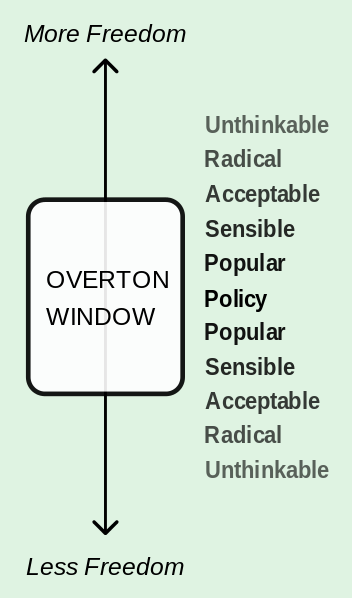
Overton described a spectrum from “more free” to “less free” with regard to government intervention, oriented vertically on an axis, to avoid comparison with the left-right political spectrum. As the spectrum moves or expands, an idea at a given location may become more or less politically acceptable. Political commentator Joshua Treviño postulated that the degrees of acceptance of public ideas are roughly:

  • Unthinkable
  • Radical
  • Acceptable
  • Sensible
  • Popular
  • Policy

The Overton window is an approach to identifying which ideas define the domain of acceptability within a democracy’s possible governmental policies. Proponents of policies outside the window seek to convince or persuade the public in order to move and/or expand the window. Proponents of current policies, or similar ones, within the window seek to convince people that policies outside it should be deemed unacceptable.

There’s also a helpful illustration of the concept:

Diagram of the “Overton Window”, based on a concept promoted by Joseph P. Overton (1960–2003), former director of the Mackinac Center for Public Policy. The term “Overton Window” was coined by colleagues of Joe Overton after his death. In the political theory of the Overton Window, new ideas fall into a range of acceptability to the public, at the edges of which an elected official risks being voted out of office.
Illustration by Hydrargyrum via Wikimedia Commons

To move the Overton window is to shift how the public considers certain ideas, making once unthinkable things merely radical, then acceptable, and so on. Shifting the window is usually something that takes time and media preparation, as a series of tweets from Zach Goldberg handily illustrates:


The full thread can be viewed at this Thread Reader link.

« Newer PostsOlder Posts »

Powered by WordPress