
Published on 20 Apr 2017
French Commander Robert Nivelle was sure that his offensive would bring the final victory against Germany. He scaled up his successful plan from Verdun which had worked so well and even when other generals questioned the very idea of the offensive, he would refuse to alter it or call it off. The Germans knew that the French were coming and were well prepared. And so the disaster at the Chemin Des Dames unfolded.
April 21, 2017
The Nivelle Offensive – Carnage At The Chemin Des Dames I THE GREAT WAR Week 143
Comments Off on The Nivelle Offensive – Carnage At The Chemin Des Dames I THE GREAT WAR Week 143
April 19, 2017
QotD: Hubris and Nemesis, or pride goeth before the fall
Few things are more likely to precede defeat than the conviction that you are on the verge of victory. One hundred years ago, in the spring of 1917, Germany had every reason to believe that it would triumph over its enemies in the First World War. France had been bled white in repeated attacks on the German army’s fortified lines, England was suffering from shortages of both munitions and military manpower, and Russia was descending into a revolution that would, within a year, enable Germany and its Austro-Hungarian allies to shift enormous numbers of troops and guns to the Western Front. Yet the entry of the United States into the war on April 6, 1917, proved to be the counterweight that shifted the balance. By the autumn of 1918, the fond hope of Germany victory had been exposed as a delusion. The ultimate result of the Kaiser’s war was the destruction of the Kaiser’s empire, and of much else besides.
What is true in war is true also in politics. Hubris is nearly always the precedent to unexpected defeat. In 1964, Lyndon Johnson won a landslide victory; less than four years later, LBJ could not even win his own party’s nomination for re-election. In 1972, Richard Nixon was re-elected in a landslide; less than two years later, he was forced to resign from office. More recently, after George W. Bush’s 2004 re-election, some imagined that this victory was the harbinger of a “permanent Republican majority” — a GOP electoral hegemony based on a so-called “center-right” realignment — but two years later, Democrats captured control of Congress and in 2008 Barack Obama was elected president. Obama’s success in turn led Democrats to become overconfident, and Hillary Clinton’s supporters believed they were “on the right side of history,” as rock singer Bruce Springsteen told a rally in Philadelphia on the eve of the 2016 election. Unfortunately for Democrats, history disagreed.
Robert Stacy McCain, “Why Is the ‘Right Side of History’ Losing?”, The American Spectator, 2017-04-05.
Comments Off on QotD: Hubris and Nemesis, or pride goeth before the fall
April 18, 2017
Western Front Artillery At The Outbreak of World War 1 I THE GREAT WAR Special
Published on 17 Apr 2017
World War 1 was a war of artillery, 75% of casualties are attributed to artillery fire. And since the late 19th century the development of field canons, howitzers and mortars had made rapid progress. We are taking a look at the standard artillery pieces of the German, French and British Army at the outbreak of the war in this first part of a new series.
Comments Off on Western Front Artillery At The Outbreak of World War 1 I THE GREAT WAR Special
In WW1, the United States “was not fighting for survival. It was fighting for an ideal.”
Reason‘s Glenn Garvin reviews two new documentaries, including one called American Experience: The Great War (no relation to the YouTube channel I regularly reblog).
World War I, as American Experience: The Great War paraphrases a conclusion already reached by the cast of Friends many years ago, is probably the biggest event in U.S. history of which Americans know next to nothing. In some ways, that will still be true even if they watch The Great War, which views the events strictly through the lens of how Americans were affected. The welter of royal bloodlines and backdoor treaties that turned a seemingly isolated event — the assassination of an Austrian nobleman by a Serbian teenager — into a worldwide conflagration involving Russia, France, England, Italy, Germany, the Austro-Hungarian Empire, the Ottoman Empire, Bulgaria, Japan, and the United States is barely explored [*]. Nor are many of the war’s geopolitical shockwaves. Even the implosion of Russia’s czarist government, which would eventually result in a Cold War that for nearly five decades threatened to turn apocalyptically hot, only gets a minute or two.
What The Great War does do, in truly spectacular fashion, is limn the voracious expansion of the American government midwifed by World War I. When Woodrow Wilson’s uncertain attempts at neutrality floundered and he called for a declaration of war in 1917 because “the world must be made safe for democracy,” it made the United States unique among the combatants, notes a historian in The Great War: “It was not fighting for survival. It was fighting for an ideal.”
But as The Great War documents in horrifying detail, that ideal was the creation of a Leviathan state with unprecedented power: to draft young men and send them to a foreign war. To set price controls on food and impose dietary restrictions. To arrest and even deport political dissidents. To create a powerful government propaganda organ aimed not at enemy nations but the American people. (It expanded from one employee to about 100,000 in a couple of months.) To send goon squads known as Liberty Loan Committees roaming neighborhoods offering deals on war bonds that couldn’t be refused.
Wilson’s actions did not go without dissent (signs at a protest march in New York City: MR. PRESIDENT, WHY NOT MAKE AMERICA SAFE FOR DEMOCRACY?) and dissent did not go without punishment. Wilson demanded, and got, a new Espionage Act that made it a crime to collect, record and disseminate information “harmful to the war effort,” and he wielded it like an axe against the anti-war movement. By the fall of 1917, the federal government opened prison camps in Utah, Georgia, and North Carolina to house all the “security threats” Wilson’s Justice Department had detected.
Wilson’s security mania spread out into the population, too, where it unleashed what The Great War calls the “wholesale destruction of German culture in the United States. There were moves to ban German music, plays, and even the spoken language. Some of the xenophobic spasms, like beer-stein-smashing contests, were loony enough to be funny; others, like the slaughter of German dog breeds in Ohio, were almost too ugly for words. Though Wilson’s supporters managed to utter some. When an Illinois coal miner of German heritage was lynched by coworkers who thought he might be a spy, the Washington Post labeled it a nothing more than a slightly over-exuberant sign of “a healthful and wholesome awakening in the interior part of the country.”
* Should you want to know more about the non-American aspects of how World War 1 began, you could read my Origins of WW1 series of posts, starting here (there are 12 posts in the series, and even so, I could be accused of omitting a lot of detail).
Comments Off on In WW1, the United States “was not fighting for survival. It was fighting for an ideal.”
April 16, 2017
Smoke Screens – Fortress Location – Recruitment Age I OUT OF THE TRENCHES
Published on 15 Apr 2017
Start your free Great Courses Plus trial today: http://ow.ly/z4VI30acl50
It’s time for Out Of The Trenches again where Indy answers your questions about World War 1, this week we talk about the recruitment age, smoke grenades and fortress locations.
Comments Off on Smoke Screens – Fortress Location – Recruitment Age I OUT OF THE TRENCHES
April 14, 2017
The Canadian Corps Takes Vimy Ridge – The Battle of Arras I THE GREAT WAR Week 142
Published on 13 Apr 2017
This week 100 years ago, the Western Front comes to live with a big British offensive at Arras. The Canadian Corps and the British 51st Infantry Division take Vimy Ridge which had been contested for 3 years by now. The rest of the battles goes well in the beginning too but due to a snowstorm and the German defences it soon slows down.
Comments Off on The Canadian Corps Takes Vimy Ridge – The Battle of Arras I THE GREAT WAR Week 142
April 13, 2017
“The First World War is the moment when America says, ‘We’re the big dog on the planet'”
In Maclean’s, Allen Abel looks at the US entry into World War 1 a hundred years ago this month, and wonders why it’s so little remembered by Americans today:
Precisely 100 years after U.S. president Woodrow Wilson — “with a profound sense of the solemn and even tragical character of the step I am taking” and with millions of young men of other nations already lying in the graves of Flanders — asked the United States Congress to mobilize a neutral, jazz-happy nation to save Britain, France and little Belgium from obliteration by the German kaiser, there is little in the American capital to remind a visitor of the war to end all wars. There is no sky-piercing obelisk, no haunting roster of the fallen, no sacred shrine to Wilson himself.
As Canada ritually, dutifully, predictably embraces the grimness and glory of Vimy Ridge, the American republic and its new president gird for the inevitable next conflagration — Syria; North Korea — in place of looking backward, weeping, learning.
“The First World War is the moment when America says, ‘We’re the big dog on the planet,'” notes Mark Facknitz of James Madison University, a descendant of three men who fought in the Great War for the U.S., for Germany and, fatally, for Canada, respectively. “Donald Trump keeps saying the same thing,” he goes on, “but it’s no longer true.”
Physically, and allegorically as well, small residue of Wilson’s tragical gambit endures here. Across the Potomac in Arlington, Va., rests the Tomb of the Unknown Soldier. In the city itself, a little Doric temple, 12 columns around, was erected by the District of Columbia in the 1920s to commemorate its fallen sons. There is a soaring “national” monument to the courage of the killed, but it is in Kansas City. To many Americans, the most famous battle of the First World War was Snoopy versus the Red Baron.
[…]
“At the level of the purely mythic Great War battles, nothing in the American experience rivals the Canadians at Vimy, the French at Verdun or the British at the Somme,” Facknitz says. “Our deaths from influenza [60,000] outnumbered our combat dead [50,000] in France in 1918. There was nothing compared to other nations’ Golgothas, nor, for that matter, to the enduring symbolism of Civil War battles like Gettysburg and Antietam, or to the Second World War battles that followed a short generation later—Normandy, the Bulge, Iwo Jima.”
I suspect the biggest lasting influence of American participation in WW1 was actually the political and economic ramifications of both anti-German hysteria (a lot of Schmidts became Smiths and Müllers became Millers to avoid the witch hunt) and the first major nationalizations of industry in the US (which set the stage for FDR’s New Deal during the Great Depression).
Comments Off on “The First World War is the moment when America says, ‘We’re the big dog on the planet'”
April 11, 2017
Evolution of the British Infantry during World War 1 I THE GREAT WAR Special
Published on 10 Apr 2017
The professional British soldier of 1914 had little to do with the British conscript of 1918. So, even though World War 1 is often perceived as something static, the British infantry underwent a considerable evolution during the war.
Comments Off on Evolution of the British Infantry during World War 1 I THE GREAT WAR Special
April 10, 2017
100 years later, the second day at Vimy
David Warren recalls the then-ongoing battle at Vimy Ridge, along with a ghostly visit from his grandfather, who fought in WW1:
Today is the hundredth anniversary of the day after the four divisions of the Canadian Corps launched their assault up Vimy Ridge, and stormed to the top, as part of the Battle of Arras in the Great War. This was a task the British and French armies had failed to accomplish. In the national mythology, it was the day we truly became a nation, at the cost of more than ten thousand casualties, including three thousand five hundred and ninety-eight dead; and rather more, I should say, among the Sixth German Army. The engagement was essentially settled in the first light hours of April 9th, which was Easter Monday. The mop-up continued until the 12th, when we took “The Pimple,” silencing the enemy’s last artillery.
One cannot argue with mythology, and I was not arguing with my grandfather, Harry Roy Warren, when he appeared to me in a dream last night. This helped me recall what he had had to say about the whole affair, when he still lived. He said that the gods were with us, in the form of the magnificent British artillery and logistics that lay behind us; the remarkable generalship of the very British “Bungo” Byng, and of our beloved Canadian, Arthur Currie; and most importantly, the sky. After an unusually cold and prolonged winter, it was hurling snow and sleet into the faces of the defenders, who were often shooting blind. But to our farm boys, from across the fair Dominion, it was, if one could overlook the shell-bursts, just like home.
Grandpa was more impressed with the casualties. It was the first in a long string of engagements in which the Canadians were used as shock troops — Hill 70! Amiens! Cambrai! — as the allies broke the German lines, setting stage for the rest of the twentieth century.
Comments Off on 100 years later, the second day at Vimy
Small Arms of WWI Primer 022: German T-Gewehr Anti-Tank Rifle
Published on Mar 29, 2016
Othais and Mae delve into the story of this WWI classic. Complete with history, function, and live fire demonstration.
C&Rsenal presents its WWI Primer series; covering the firearms of this historic conflict one at a time in honor of the centennial anniversary. Join us every other Tuesday!
Cartridge: 13.2x92mmR
Capacity: 1 rnd
Length: 5.5′
weight: 37.7 lbsAdditional reading:
Das Tankgewehr Mauser M 1918
Wolfgang KernDWJ – 1972 – Volume 4
Die Panzerbuchse 18
K. D. Meyer
Comments Off on Small Arms of WWI Primer 022: German T-Gewehr Anti-Tank Rifle
April 9, 2017
Vimy Ridge: The Canadian National Memorial
Published on 11 Nov 2014
A visit to the Canadian National Vimy Memorial in northern France. The memorial commemorates the lives lost in the April 1917 battle of Vimy Ridge.
Comments Off on Vimy Ridge: The Canadian National Memorial
April 8, 2017
The “Three Stooges of the Apocalypse”
David Warren takes a well-deserved kick at Lloyd George, Clemenceau, and (especially) Woodrow Wilson:
A century has now passed since President Wilson disowned President Washington’s advice to his successors — to stay out of European conflicts — and war was declared by the United States on Germany. A moral preener, Wilson justified himself by declaring an even more extravagant mission to go with it:
“The world must be made safe for democracy.”
However large, a war is just a war. It should have a beginning and an end. As my old Indian girlfriend explained, “Too much war only leads to peace. Too much peace only leads to war.” As most people prefer peace, most of the time, it is well that war is not a permanent condition. But a war to some idealistic purpose can get very large, and go on for a long time, and morph into conditions which resemble peace, but are not peace. We’ve been making the world safe for democracy for at least a century. By now we have far too much.
[…]
In my view, that Great War, that Totaler Krieg, hasn’t ended yet. The old etiquette, that war was for soldiers — that non-combatants should be non-involved — became a thing of nostalgia. Vast conscript armies had been summoned, and would never be fully demobilized. The men I call the “Three Stooges of the Apocalypse” — Wilson, Lloyd George, Clemenceau — clinched at Versailles this new normal. It was not simply the punitive terms that were imposed on the war’s losers, but a more fundamental reorganization of all national and international affairs: “statecraft” became “policy.”
For Wilson was also the pioneer of progressive schemes to change the American way of life. He was, in some sense, a second Washington, consolidating a second American Revolution that had begun more modestly with Lincoln and the Union victory in the Civil War. America would be recreated, along bureaucratic lines, in a tireless campaign for full secularization, under centralized government control. The general mobilization of the First World War, now in America as well as Europe, created a new opportunity, by accustoming men to following orders; by the propaganda that made them identify with huge abstractions.
This is of course an inexhaustible topic, at which I pick away, in my attempts to explain if only to myself what makes our world so different from all preceding. It embraces more than any single force or event. We must also go back to the Prussian invention of the welfare state, and for that matter to the Gatling gun. Post-modernity is an invention of modernity, as modernity was an invention of the Middle Ages. The contemporary revolution has antecedents that may be found in the Enlightenment and in the Reformation. (What will post-modernity beget?)
Comments Off on The “Three Stooges of the Apocalypse”
April 7, 2017
The First American Shots Of WW1 – Guam And The Cormoran I THE GREAT WAR Special
Published on 6 Apr 2017
Learn more about Guam in WW1: www.visitguam.com/smscormoranguam/
The Island of Guam was on the other end of the world when the US declared war on Germany in 1917. However, they had been involved in the global conflict for years already. When the Germans lost their colonies in the Pacific, the German merchant raider SMS Cormoran II had no other choice but to seek refuge in the then neutral Arpor Harbour, Guam. For months the German crew around Adalbert Zuckschwerdt stayed on the island and became a kind of sensation. But that all changed on April 6, 1917.
Comments Off on The First American Shots Of WW1 – Guam And The Cormoran I THE GREAT WAR Special
Some people build boats as a hobby … this guy built a Fokker Dreidecker I
At The Register, the story of Dr Peter Brueggemann’s quest to build a close replica of the kind of WW1 aircraft made famous by the Red Baron:
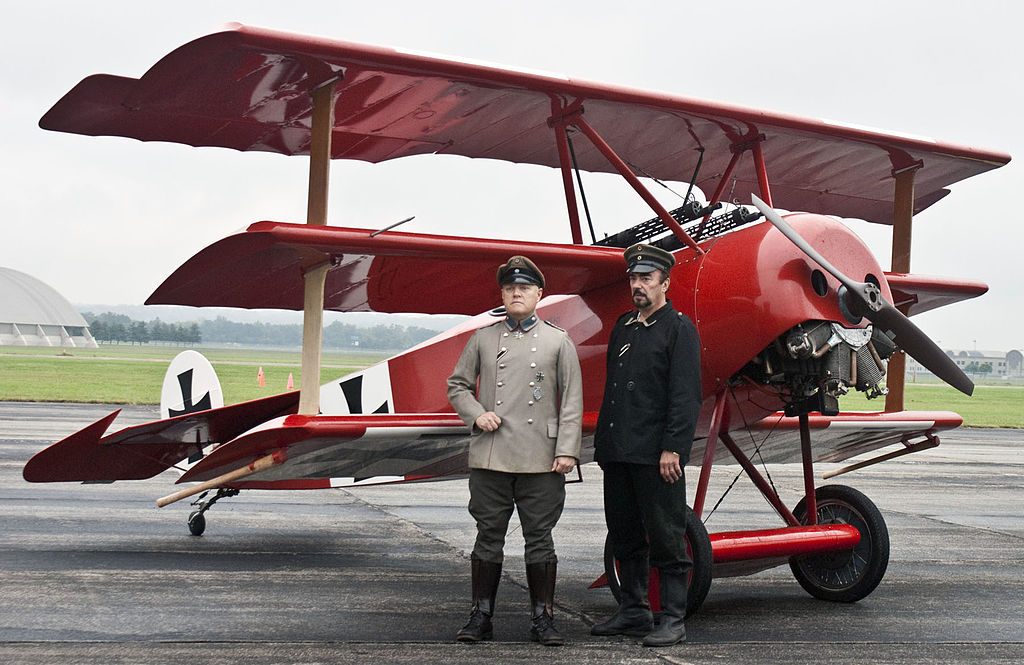
World War I Dawn Patrol Rendezvous DAYTON, Ohio — Reenactors stand in front of a Fokker Dr. I during the World War I Dawn Patrol Rendezvous at the National Museum of the U.S. Air Force, 8 August 2009. (U.S. Air Force photo, via Wikimedia)
A German orthopaedic surgeon in Norfolk has spent £70,000 building himself a flyable full-size replica of the Red Baron’s Fokker Triplane.
Dr Peter Brueggemann built the First World War-era aircraft by hand – even though when he started he couldn’t fly, as ITV News reported.
The bright red Fokker Dreidecker I (German for “three-decker”, or triplane) was built to a set of technical drawings prepared by an American aviation fanatic in the 1970s. No original Dr.Is exist, though a number of replicas have been put together during the 20th century.
Dr Brueggemann even acquired the title of baron from the Principality of Sealand, ready for when his Fokker makes its planned first flight this summer.
He told the telly station: “Being a surgeon has certainly helped and I have used surgical equipment like needles and forceps when stitching materials to the ribs of the plane.”
[…]
Fokker copied the original Dr.I design from British company Sopwith. During the early stages of air fighting in WWI, rate of climb was deemed vitally important. As aeronautical science was still in its infancy – aircraft were built from plywood and canvas, while the relatively primitive rotary engines of the day were only capable of around 110hp – the easiest way of increasing the amount of lift available was to add more wings.
First seeing action in early 1917, the Sopwith Triplane was an instant success. However, a captured example shown to Anthony Fokker, prompting German development of their own version. The first pre-production Dr.I was issued to a frontline unit in August 1917 and proved an instant hit. German fighter squadron commander Manfred von Richthofen recommended the Dr.1 be issued to as many frontline units as possible.
Comments Off on Some people build boats as a hobby … this guy built a Fokker Dreidecker I
April 6, 2017
The United States Declares War on Germany I THE GREAT WAR Week 141
Published on 5 Apr 2017
Diplomatic tensions after the return of German unrestricted submarine warfare and the aftermath of the Zimmermann telegram lead to the United States declaration of war on Germany this week 100 years ago. Meanwhile the British and French high command are still debating the upcoming offensive, namely the Battle of Arras which includes taking the contested Vimy Ridge and the Nivelle Offensive at the Chemin Des Dames.
Comments Off on The United States Declares War on Germany I THE GREAT WAR Week 141


