
Published on 6 May 2017
It’s time to shine a light on some of the great comments we received and in the past days you guys had a lot to say about Nivelle and the French High Command in general.
May 7, 2017
Joffre The Imbecile – Nivelle’s Catastrophe I OUT OF THE ETHER
Comments Off on Joffre The Imbecile – Nivelle’s Catastrophe I OUT OF THE ETHER
May 6, 2017
History of the Royal Navy – Steam, steel and Dreadnoughts (1806-1918)
Published on 1 Mar 2013
Here’s also an older post covering the technological challenges faced by the Royal Navy in the post-Napoleonic era, and some of the reasons for all those “weird” ship designs in the Victorian era.
Comments Off on History of the Royal Navy – Steam, steel and Dreadnoughts (1806-1918)
May 5, 2017
The Battle of Arleux – Robert Nivelle Gets Fired I THE GREAT WAR Week 145
Published on 4 May 2017
The Battle of Arras continued in smaller scale attacks this week 100 years ago. Fighting focused on Arleux and the Scarpe river. Neither of these battles was able to repeat the success of the early Arras offensive. The casualties of the Nivelle Offensive were now costing Robert Nivelle his job as he was still blaming everyone but himself.
Comments Off on The Battle of Arleux – Robert Nivelle Gets Fired I THE GREAT WAR Week 145
May 2, 2017
Reinventing Cavalry in WW1 – Bulgarian General Ivan Kolev I WHO DID WHAT IN WW1?
Published on 1 May 2017
Cavalry was seen as leftover from the past in the dawn of modern warfare during World War 1. But Bulgarian General Ivan Kolev was one of the few who still saw a place for them on the modern battlefield. He reinvented the cavalry role and used them together with early motorised infantry – with great success during the Romanian campaign. He died before the war was over but people like August von Mackensen or Heinz Guderian were still impressed with his legacy.
Comments Off on Reinventing Cavalry in WW1 – Bulgarian General Ivan Kolev I WHO DID WHAT IN WW1?
Tank Chats #8 Renault FT-17
Published on 4 Aug 2015
The eight in a series of short films about some of the vehicles in our collection presented by The Tank Museum’s historian David Fletcher MBE.
Conceived by General Jean-Baptiste Estienne and manufactured under the control of the Renault Company this was the world’s first mass-produced tank, 3800 being built in all.
They went into action for the first time on 31 May 1918 near Ploissy-Chazelle and proved very successful when they were used in numbers. British forces used a few Renaults as liaison vehicles while the United States Army used them in combat and copied the design.
Comments Off on Tank Chats #8 Renault FT-17
April 30, 2017
Fight For Air Supremacy – Bloody April 1917 I THE GREAT WAR Special feat. Real Engineering
Published on 29 Apr 2017
Check out Real Engineering and their video about WW1 airplanes: https://www.youtube.com/watch?v=MI08NGCgISE
Meet us and see original WW1 airplanes: http://bit.ly/TGWStowMaries
“Bloody April” was the result of two competing aviation strategies: The more defence oriented German Luftstreitkräfte and the more offensive oriented British Royal Flying Corps. The RFC needed air reconnaissance for the Battle of Arras and the Germans needed to deny them them. With the superior German Albatross D.III fighters, the German Jagdstaffeln inflicted heavy losses on the RFC.
Comments Off on Fight For Air Supremacy – Bloody April 1917 I THE GREAT WAR Special feat. Real Engineering
April 28, 2017
The Battle of Doiran – Turmoil In The French Army I THE GREAT WAR Week 144
Published on 27 Apr 2017
The Salonica Front had been quiet over the winter, but much like the recent battles on the Western Front, it erupted this week. The British Army tried to take the Bulgarian positions at Doiran – these positions might have been some of the best defences of the entire war. After the failed Nivelle Offensive, some French soldiers start to question the whole war.
Comments Off on The Battle of Doiran – Turmoil In The French Army I THE GREAT WAR Week 144
April 25, 2017
German Trade Submarines – Beutepanzer Upgrades – Dan Carlin I OUT OF THE TRENCHES
Published on 24 Apr 2017
Check out Dan Carlin’s Podcast about WW1: http://bit.ly/DanCarlinArmageddon
It’s Chair of Wisdom Time again and this week we talk about German Trade Submarines (Deutschland class), Beutepanzer upgrades and Dan Carlin’s Blueprint for Armageddon series.
Comments Off on German Trade Submarines – Beutepanzer Upgrades – Dan Carlin I OUT OF THE TRENCHES
April 22, 2017
Flamethrower Units – Handling of Prisoners – Artillery Fuses I OUT OF THE TRENCHES
Published on 22 Apr 2017
In this week’s episode, Indy talks about flamethrower units, the handling of war prisoners and different types of artillery fuses.
Comments Off on Flamethrower Units – Handling of Prisoners – Artillery Fuses I OUT OF THE TRENCHES
Movie on the Armenian Genocide attracts massive number of Turkish trolls
One of the worst aspects of the First World War was the attempt by Ottoman forces to eliminate the Armenian “threat” by launching an organized campaign of murder and deportation that killed an estimated 1.5 million Armenians. A new movie which is set in this time has been drawing trollish attention from Turkish detractors:
The Promise, the grandest big-screen portrayal ever made about the mass killings of Armenians during World War I, has been rated by more than 111,300 people on IMDb — a remarkable total considering it doesn’t open in theaters until Friday and has thus far been screened only a handful of times publicly.
The passionate reaction is because The Promise, a $100-million movie starring Oscar Isaac and Christian Bale, has provoked those who deny that 1.5 million Armenians were massacred between 1915 and 1923 by the Ottoman Empire or that the deaths of Armenians were the result of a policy of genocide. Thousands, many of them in Turkey, have flocked to IMDb to rate the film poorly, sight unseen. Though many countries and most historians call the mass killings genocide, Turkey has aggressively refused that label.
Yet that wasn’t the most audacious sabotage of The Promise, a passion project of the late billionaire investor and former MGM owner Kirk Kerkorian.
In March, just a few weeks before The Promise was to open, a curiously similar-looking film called The Ottoman Lieutenant appeared. Another sweeping romance set during the same era and with a few stars of its own, including Ben Kingsley and Josh Hartnett, The Ottoman Lieutenant seemed designed to be confused with The Promise. But it was made by Turkish producers and instead broadcast Turkey’s version of the events — that the Armenians were merely collateral damage in World War I. It was the Turkish knockoff version of The Promise, minus the genocide.
“It was like a reverse mirror image of us,” said Terry George, director and co-writer of The Promise. George, the Irish filmmaker, has some experience in navigating the sensitivities around genocide having previously written and directed 2004’s Hotel Rwanda, about the early ’90s Rwandan genocide.
George bought a ticket to see it. “Basically the argument is the Turkish government’s argument, that there was an uprising and it was bad and we had to move these people out of the war zone — which, if applied to the Nazis in Poland would be: ‘Oh, there was an uprising in the Warsaw Ghetto and we need to move these Jews out of the war zone,’” says George. “The film is remarkably similar in terms of structure and look, even.”
The movie itself, however, didn’t win over A.V. Club critic Ignatiy Vishnevetsky:
Among the many virtues of James Gray’s The Lost City Of Z is its sense of proportion, which turns a decades-spanning historical epic into a pas de deux between vision and madness. Unfortunately, most recent historical epics have been more on the order of Terry George’s The Promise: messes of soap and cheese. Here at last is a film that tackles the Armenian genocide by way of a flimsy love triangle and an international cast (it really captures the diversity of the Armenian people), straining so hard to show its good intentions that it doesn’t bother to be directed. What does a movie that can’t even mount a competent horse chase — despite repeated attempts — have to say about the murder of 1.5 million people? At least George can rest easy knowing that his film is less bungled than Bitter Harvest, the February release that turned the Holodomor into the stuff of schmaltz. Up next, presumably, is Nicholas Sparks’ Auschwitz.
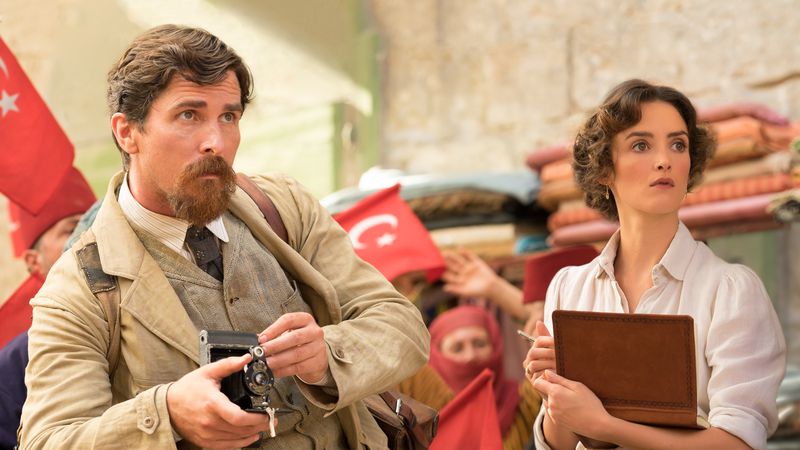
Doing his best impression of Omar Sharif, Oscar Isaac stars as Mikael Boghosian, a village apothecary who agrees to marry doe-eyed local girl Maral (Angela Sarafyan) in order to use her dowry to finance his dream of becoming a doctor. (Pity poor Maral, as no two members of the cast seem to agree on how to pronounce her name.) Arriving in Constantinople, the capital of the Ottoman Empire, Mikael moves in with his wealthy uncle and enrolls in medical school, but soon develops a crush on Ana (Charlotte Le Bon), the modern young woman who tutors his uncle’s children. But it’s 1914, and the Ottoman Empire is about to enter World War I as an ally of Germany and Austria-Hungary and within months will begin a strategic elimination of its large Armenian minority. As if to make matters worse, Ana has an American boyfriend, Chris Myers (Christian Bale), the Associated Press’ bureau chief of Armenian genocide exposition.
Still from The Promise, by Open Road Films.
Comments Off on Movie on the Armenian Genocide attracts massive number of Turkish trolls
Tank Chats #7 British Mark II
Published on 2 Jul 2015
The seventh in a series of short films about some of the vehicles in our collection presented by The Tank Museum’s historian David Fletcher MBE.
Only fifty tanks each of Marks II and III were produced. They were unarmoured, in the sense that the steel from which they were built was not heat treated to make it bullet proof. The reason being that these tanks were only intended for use as training machines.
The chief external differences from Mark I lay in the tail wheels, which were not used on Marks II and III and later heavy tanks, the narrower driver’s cab and the ‘trapezoid’ hatch cover on the roof.
Comments Off on Tank Chats #7 British Mark II
April 21, 2017
The Nivelle Offensive – Carnage At The Chemin Des Dames I THE GREAT WAR Week 143
Published on 20 Apr 2017
French Commander Robert Nivelle was sure that his offensive would bring the final victory against Germany. He scaled up his successful plan from Verdun which had worked so well and even when other generals questioned the very idea of the offensive, he would refuse to alter it or call it off. The Germans knew that the French were coming and were well prepared. And so the disaster at the Chemin Des Dames unfolded.
Comments Off on The Nivelle Offensive – Carnage At The Chemin Des Dames I THE GREAT WAR Week 143
April 19, 2017
QotD: Hubris and Nemesis, or pride goeth before the fall
Few things are more likely to precede defeat than the conviction that you are on the verge of victory. One hundred years ago, in the spring of 1917, Germany had every reason to believe that it would triumph over its enemies in the First World War. France had been bled white in repeated attacks on the German army’s fortified lines, England was suffering from shortages of both munitions and military manpower, and Russia was descending into a revolution that would, within a year, enable Germany and its Austro-Hungarian allies to shift enormous numbers of troops and guns to the Western Front. Yet the entry of the United States into the war on April 6, 1917, proved to be the counterweight that shifted the balance. By the autumn of 1918, the fond hope of Germany victory had been exposed as a delusion. The ultimate result of the Kaiser’s war was the destruction of the Kaiser’s empire, and of much else besides.
What is true in war is true also in politics. Hubris is nearly always the precedent to unexpected defeat. In 1964, Lyndon Johnson won a landslide victory; less than four years later, LBJ could not even win his own party’s nomination for re-election. In 1972, Richard Nixon was re-elected in a landslide; less than two years later, he was forced to resign from office. More recently, after George W. Bush’s 2004 re-election, some imagined that this victory was the harbinger of a “permanent Republican majority” — a GOP electoral hegemony based on a so-called “center-right” realignment — but two years later, Democrats captured control of Congress and in 2008 Barack Obama was elected president. Obama’s success in turn led Democrats to become overconfident, and Hillary Clinton’s supporters believed they were “on the right side of history,” as rock singer Bruce Springsteen told a rally in Philadelphia on the eve of the 2016 election. Unfortunately for Democrats, history disagreed.
Robert Stacy McCain, “Why Is the ‘Right Side of History’ Losing?”, The American Spectator, 2017-04-05.
Comments Off on QotD: Hubris and Nemesis, or pride goeth before the fall
April 18, 2017
Western Front Artillery At The Outbreak of World War 1 I THE GREAT WAR Special
Published on 17 Apr 2017
World War 1 was a war of artillery, 75% of casualties are attributed to artillery fire. And since the late 19th century the development of field canons, howitzers and mortars had made rapid progress. We are taking a look at the standard artillery pieces of the German, French and British Army at the outbreak of the war in this first part of a new series.
Comments Off on Western Front Artillery At The Outbreak of World War 1 I THE GREAT WAR Special
In WW1, the United States “was not fighting for survival. It was fighting for an ideal.”
Reason‘s Glenn Garvin reviews two new documentaries, including one called American Experience: The Great War (no relation to the YouTube channel I regularly reblog).
World War I, as American Experience: The Great War paraphrases a conclusion already reached by the cast of Friends many years ago, is probably the biggest event in U.S. history of which Americans know next to nothing. In some ways, that will still be true even if they watch The Great War, which views the events strictly through the lens of how Americans were affected. The welter of royal bloodlines and backdoor treaties that turned a seemingly isolated event — the assassination of an Austrian nobleman by a Serbian teenager — into a worldwide conflagration involving Russia, France, England, Italy, Germany, the Austro-Hungarian Empire, the Ottoman Empire, Bulgaria, Japan, and the United States is barely explored [*]. Nor are many of the war’s geopolitical shockwaves. Even the implosion of Russia’s czarist government, which would eventually result in a Cold War that for nearly five decades threatened to turn apocalyptically hot, only gets a minute or two.
What The Great War does do, in truly spectacular fashion, is limn the voracious expansion of the American government midwifed by World War I. When Woodrow Wilson’s uncertain attempts at neutrality floundered and he called for a declaration of war in 1917 because “the world must be made safe for democracy,” it made the United States unique among the combatants, notes a historian in The Great War: “It was not fighting for survival. It was fighting for an ideal.”
But as The Great War documents in horrifying detail, that ideal was the creation of a Leviathan state with unprecedented power: to draft young men and send them to a foreign war. To set price controls on food and impose dietary restrictions. To arrest and even deport political dissidents. To create a powerful government propaganda organ aimed not at enemy nations but the American people. (It expanded from one employee to about 100,000 in a couple of months.) To send goon squads known as Liberty Loan Committees roaming neighborhoods offering deals on war bonds that couldn’t be refused.
Wilson’s actions did not go without dissent (signs at a protest march in New York City: MR. PRESIDENT, WHY NOT MAKE AMERICA SAFE FOR DEMOCRACY?) and dissent did not go without punishment. Wilson demanded, and got, a new Espionage Act that made it a crime to collect, record and disseminate information “harmful to the war effort,” and he wielded it like an axe against the anti-war movement. By the fall of 1917, the federal government opened prison camps in Utah, Georgia, and North Carolina to house all the “security threats” Wilson’s Justice Department had detected.
Wilson’s security mania spread out into the population, too, where it unleashed what The Great War calls the “wholesale destruction of German culture in the United States. There were moves to ban German music, plays, and even the spoken language. Some of the xenophobic spasms, like beer-stein-smashing contests, were loony enough to be funny; others, like the slaughter of German dog breeds in Ohio, were almost too ugly for words. Though Wilson’s supporters managed to utter some. When an Illinois coal miner of German heritage was lynched by coworkers who thought he might be a spy, the Washington Post labeled it a nothing more than a slightly over-exuberant sign of “a healthful and wholesome awakening in the interior part of the country.”
* Should you want to know more about the non-American aspects of how World War 1 began, you could read my Origins of WW1 series of posts, starting here (there are 12 posts in the series, and even so, I could be accused of omitting a lot of detail).
Comments Off on In WW1, the United States “was not fighting for survival. It was fighting for an ideal.”


