
Foundation for Economic Education
Published on 25 Sep 2018Forget about slot machines, the future of gaming is virtual reality! In this episode of Mind Your Business, Andrew Heaton is teaming up with entrepreneur Rahul Sood to learn all about esports, safe and legal online betting, and the global community that is surging behind organized competitive video gaming.
September 27, 2018
Mind Your Business #4: Free the Unikrn
Comments Off on Mind Your Business #4: Free the Unikrn
September 24, 2018
Verity Stob on early GUI experiences
“Verity Stob” began writing about technology issues three decades back. She reminisces about some things that have changed and others that are still irritatingly the same:
It’s 30 years since .EXE Magazine carried the first Stob column; this is its
pearlPerl anniversary. Rereading article #1, a spoof self-tester in the Cosmo style, I was struck by how distant the world it invoked seemed. For example:
Your program requires a disk to have been put in the floppy drive, but it hasn’t. What happens next?
The original answers, such as:
e) the program crashes out into DOS, leaving dozens of files open
would now need to be supplemented by
f) what’s ‘the floppy drive’ already, Grandma? And while you’re at it, what is DOS? Part of some sort of DOS and DON’TS list?
I say: sufficient excuse to present some Then and Now comparisons with those primordial days of programming, to show how much things have changed – or not.
1988: Drag-and-drop was a showy-offy but not-quite-satisfactory technology.
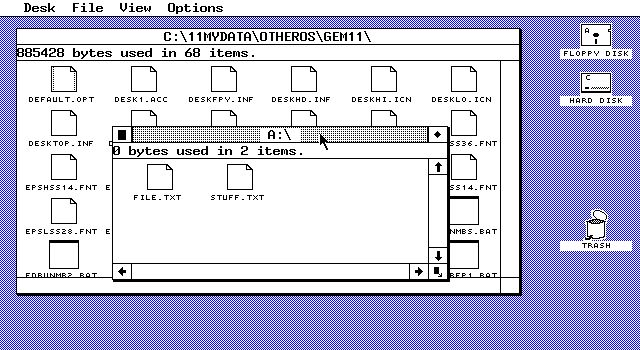
My first DnD encounter was by proxy. In about 1985 my then boss, a wise and cynical old Brummie engineer, attended a promotional demo, free wine and nibbles, of an exciting new WIMP technology called GEM. Part of the demo was to demonstrate the use of the on-screen trash icon for deleting files.
According to Graham’s gleeful report, he stuck up his hand at this point. “What happens if you drag the clock into the wastepaper basket?’
The answer turned out to be: the machine crashed hard on its arse, and it needed about 10 minutes embarrassed fiddling to coax it back onto its feet. At which point Graham’s arm went up again. “What happens if you drop the wastepaper basket into the clock?’
Drag-ons ‘n’ drag-offs
GEM may have been primitive, but it was at least consistent.
The point became moot a few months later, when Apple won a look-and-feel lawsuit and banned the GEM trashcan outright.
2018: Not that much has changed. Windows Explorer users: how often has your mouse finger proved insufficiently strong to grasp the file? And you have accidentally dropped the document you wanted into a deep thicket of nested server directories?
Or how about touch interface DnD on a phone, where your skimming pinkie exactly masks from view the dragged thing?
Well then.
However, I do confess admiration for this JavaScript library that aims to make a dragging and dropping accessible to the blind. Can’t fault its ambition.
Comments Off on Verity Stob on early GUI experiences
September 23, 2018
The Nimrod MRA4 – the world’s most expensive bad aircraft
Back in 2011, I posted an article about the retirement of the Hawker Siddeley Nimrod from the Royal Air Force inventory. I referred to the Nimrod as
… expensive to buy, eye-wateringly expensive to upgrade, but it must be cheap to operate, right? No:
[…] our new fleet of refurbished De Havilland Comet subhunters (sorry, “Nimrod MRA4s”) will cost at least £700m a year to operate. If we put the whole Nimrod force on the scrapheap for which they are so long overdue right now, by the year 2019 we will have saved […] £7bn
The Register certainly got in the right ballpark with this helpful graphic:

Earlier this month, the Nimrod saga was detailed at Naval Gazing, if only as a way to show that someone can have worse procurement experiences than the United States military. Despite being a military development of a passenger jet famous for crashes, the initial marks of the Nimrod were able to meet the RAF’s needs. The problems began when a requirement was generated for a British AWACS aircraft and the Nimrod was deemed to be the best candidate for conversion (“best” probably meaning “only British competitor”):
Things began to go wrong in the mid-70s, when the British decided to introduce an AWACS aircraft to support their air defense efforts. They had several options. The E-2 Hawkeye and E-3 Sentry were both about to enter service, and were rapidly proving themselves to have excellent radar systems during trials. The British could have had either aircraft, or bought their radar systems to integrate into an aircraft of their own. Or they could have only bought a few subcomponents, like the antenna or the radar transmitter itself, and built the rest domestically.
They decided to take none of these options. Instead, they would produce an entirely new radar system. Instead of an American-style radome, separate antennas would be installed in the nose and tail, and the system would sweep through one, and then the other. This was far more expensive and much riskier than buying from the Americans, but it did produce a lot more jobs in the British defense industry, which was apparently the government’s prime concern. In 1977, a contract was placed, making BAE and GEC-Marconi co-leads on the project to convert 11 surplus Nimrod MR1 airframes to the new configuration.
As might be expected based on that kind of decision-making, the resulting airplane had problems. The computer system chosen wasn’t powerful enough to integrate all of the data, particularly the area where the nose and tail radars overlapped. It was also horribly unreliable, with a mean time between failures of only two hours, in a system which took 2.5 hours to load the mission data from the tape. The Nimrod, considerably smaller than the American Sentry, was unable to carry more equipment to solve this problem. Different electronics racks were earthed to different points in the airframe, and the resulting potential differences caused false tracks to appear, overloading the computer even more. To make matters worse, most of the electronics units weren’t interchangeable for reasons that were never entirely clear. If one unit failed, several spares had to be tried before one that worked was found. The only system that functioned reliably was the IFF system, which could only track friendly aircraft and airliners. This was a major handicap in an aircraft intended to detect incoming Soviet bombers.
It probably isn’t a surprise to hear that the planes were delayed. A lot. And delaying military projects tends to drive the overall price higher. What was anticipated to be a £200-300 million project was over £1 billion before the government of the day came to their fiscal senses and pulled the plug (they ended up buying Boeing E-3 Sentry aircraft instead).
A few years later, the RAF ran a competition to replace the Nimrod MR2 maritime patrol aircraft. Lockheed, Dassault and Airbus entered the competition, but somehow, the RAF ended up selecting BAE’s bid which involved rebuilding 30-year-old Nimrod frames with new electronics and all the modern conveniences.
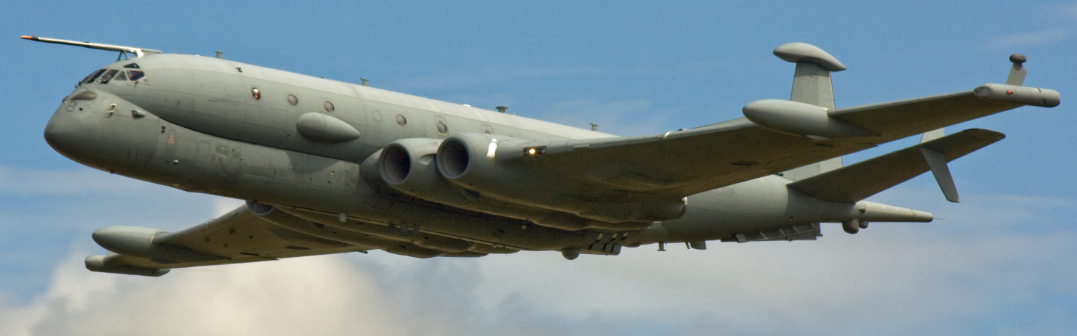
RAF Nimrod MRA4 on 18 July 2009.
Detail of original photo by Ronnie Macdonald, via Wikimedia Commons.
In 1996, a contract was issued for the new aircraft, designated Nimrod MRA4. 21 aircraft were to be produced at a cost of £2.8 billion, and they would be essentially new airplanes, with only the fuselage structure being retained. The antique Spey engines would be replaced with modern BR700s. These engines were significantly larger, and required much more air, forcing BAE to design a new, larger wing. The combined effect of these two changes was to double the Nimrod’s range and improve performance. Inside, the flight deck was replaced with one derived from the A340 airliner, and the mission systems were to be all-new.
A fuselage was sent to be reverse-engineered for the design of the new wing, and BAE designed and built it, then pulled in another aircraft to make the modification. And discovered that the wing didn’t fit. Apparently, the problem dated back to the initial construction of the aircraft. When positioning the frames, Hawker Siddeley had not done what all sensible manufacturers did, and measured from a common baseline. Instead, they had positioned each frame with a tolerance relative to the previous one, which meant that the position of the wings varied by as much as a foot across the fleet. Worse, the aircraft they had designed the wings for was one of the most extreme in wing position, so the new wings didn’t fit most of the other aircraft. This forced a redesign of the wings, further delaying the program.
Spoiler: they missed their delivery deadline. By nearly a decade. And the original plan to build 21 aircraft shrank to only 4 … but the budget continued to grow, from the original £2.8 billion to over £4.1 billion at cancellation. Each of the surviving airframes had literally cost more than £1 billion. That’s why Bean gave the Nimrod his “Naval Gazing Worst Procurement Ever” trophy, and I think it was very well-deserved.
Comments Off on The Nimrod MRA4 – the world’s most expensive bad aircraft
September 22, 2018
The Distant Early Warning Line
The History Guy: History Deserves to Be Remembered
Published on 23 Apr 2018The History Guy examines how the Cold War transformed Canada with the establishment of the U.S. Air Force’s distant early warning or dew line.
The History Guy uses images that are in the Public Domain. As photographs of actual events are often not available, I will sometimes use photographs of similar events or objects for illustration.
Patreon: https://www.patreon.com/TheHistoryGuy
The History Guy: Five Minutes of History is the place to find short snippets of forgotten history from five to fifteen minutes long. If you like history too, this is the channel for you.
Comments Off on The Distant Early Warning Line
September 19, 2018
QotD: The “generations” of jet fighters
American warplanes like the F-22 and F-35 are often called “5th generation” fighters. This leaves many wondering what the other generations were and what the next one will be. The generation reference is all because of jet fighters, and the first generation was developed during and right after World War II (German Me-262, British Meteor, U.S. F-80, and Russian MiG-15). These aircraft were, even by the standards of the time, difficult to fly and unreliable (especially the engines). The 2nd generation (1950s) included more reliable but still dangerous to operate aircraft like the F-104 and MiG-21. The 3rd generation (1960s) included F-4 and MiG-23. The 4th generation (1970s) included F-16 and MiG-29. Each generation has been about twice as expensive (on average, in constant dollars) as the previous one. But each generation is also about twice as safe to fly and cheaper to operate. Naturally, each generation is more than twice as effective as the previous one. Increasingly it looks like the 6th generation will come without pilots. That’s because producing fifth generation fighters has proved difficult as well as very expensive. So far only the United States has managed to get 5th gen fighters (F-22 and F-35) into service. The Russians are still trying as are the Chinese, even though one of their stealth fighter designs (J-20) is technically in service (even though production has been suspended after less than a dozen were produced).
The Russians have said they will keep working on their 5th generation Su-57, although some of the derivatives of their Su-27 are at least generation 4.5. One of the reasons the Soviet Union collapsed was the realization that they could not afford to develop 5th generation warplanes to stay competitive with America. The Russians had a lot of interesting stuff on the drawing board and in development but the bankruptcy of most of their military aviation industry during the 1990s left them scrambling to put it back together ever since. At the moment the Russians are thinking of making a run for the 6th generation warplanes, which will likely be unmanned and largely robotic. As of 2018 they don’t have much choice because their answer to the F-22, work on the Su-57 was canceled (“indefinitely paused”.)
“Murphy’s Law: The Impossible 5th Generation”, Strategy Page, 2018-08-20.
Comments Off on QotD: The “generations” of jet fighters
September 13, 2018
Mind Your Business Ep. 2: Aceable in the Hole
Foundation for Economic Education
Published on 11 Sep 2018Believe it or not, parallel parking is not an impossible task. Meet Blake Garrett, the entrepreneur who is using VR to teach people how to drive, without actually getting behind the wheel.
____________
Produced & Directed by Michael Angelo Zervos
Executive Produced by Sean W. Malone
Hosted by Andrew Heaton
Original Music by Ben B. Goss
Featuring Blake Garrett
Comments Off on Mind Your Business Ep. 2: Aceable in the Hole
September 12, 2018
How Do Light Bulbs Work? | Earth Lab
BBC Earth Lab
Published on 1 Nov 2013James May explains one of the most important inventions to modern life: the lightbulb.
“Subscribe to Earth Lab for more fascinating science videos – http://bit.ly/SubscribeToEarthLab
All the best Earth Lab videos http://bit.ly/EarthLabOriginals
Best of BBC Earth videos http://bit.ly/TheBestOfBBCEarthVideosHere at BBC Earth Lab we answer all your curious questions about science in the world around you. If there’s a question you have that we haven’t yet answered or an experiment you’d like us to try let us know in the comments on any of our videos and it could be answered by one of our Earth Lab experts.
Comments Off on How Do Light Bulbs Work? | Earth Lab
September 11, 2018
Fear the Internet-of-Things
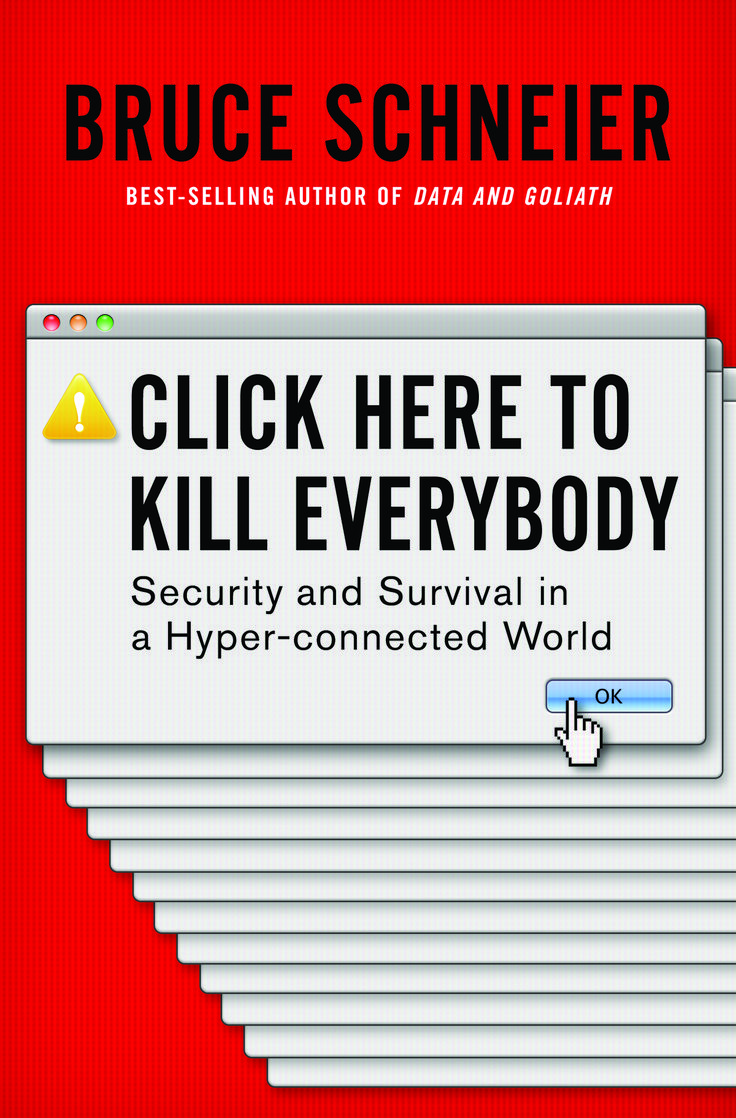
Martin Giles talks to Bruce Schneier about his new book, Click Here to Kill Everybody:
The title of your book seems deliberately alarmist. Is that just an attempt to juice sales?
It may sound like publishing clickbait, but I’m trying to make the point that the internet now affects the world in a direct physical manner, and that changes everything. It’s no longer about risks to data, but about risks to life and property. And the title really points out that there’s physical danger here, and that things are different than they were just five years ago.
How’s this shift changing our notion of cybersecurity?Our cars, our medical devices, our household appliances are all now computers with things attached to them. Your refrigerator is a computer that keeps things cold, and a microwave oven is a computer that makes things hot. And your car is a computer with four wheels and an engine. Computers are no longer just a screen we turn on and look at, and that’s the big change. What was computer security, its own separate realm, is now everything security.
You’ve come up with a new term, “Internet+,” to encapsulate this shift. But we already have the phrase “internet of things” to describe it, don’t we?
I hated having to create another buzzword, because there are already too many of them. But the internet of things is too narrow. It refers to the connected appliances, thermostats, and other gadgets. That’s just a part of what we’re talking about here. It’s really the internet of things plus the computers plus the services plus the large databases being built plus the internet companies plus us. I just shortened all this to “Internet+.”
Let’s focus on the “us” part of that equation. You say in the book that we’re becoming “virtual cyborgs.” What do you mean by that?
We’re already intimately tied to devices like our phones, which we look at many times a day, and search engines, which are kind of like our online brains. Our power system, our transportation network, our communications systems, are all on the internet. If it goes down, to a very real extent society grinds to a halt, because we’re so dependent on it at every level. Computers aren’t yet widely embedded in our bodies, but they’re deeply embedded in our lives.
Can’t we just unplug ourselves somewhat to limit the risks?
That’s getting harder and harder to do. I tried to buy a car that wasn’t connected to the internet, and I failed. It’s not that there were no cars available like this, but the ones in the range I wanted all came with an internet connection. Even if it could be turned off, there was no guarantee hackers couldn’t turn it back on remotely.
Hackers can also exploit security vulnerabilities in one kind of device to attack others, right?
There are lots of examples of this. The Mirai botnet exploited vulnerabilities in home devices like DVRs and webcams. These things were taken over by hackers and used to launch an attack on a domain-name server, which then knocked a bunch of popular websites offline. The hackers who attacked Target got into the retailer’s payment network through a vulnerability in the IT systems of a contractor working on some of its stores.
Comments Off on Fear the Internet-of-Things
Unleashing The Tank’s Full Potential – 1918/1919 Tank Tactics I THE GREAT WAR On The Road
The Great War
Published on 10 Sep 2018Support The Tank Museum: https://www.patreon.com/tankmuseum
Indy and David Willy from the Tank Museum sit inside a Mark V tank to talk about the evolution of tank tactics and how the Allies started to properly use tanks during and after the battle of Amiens.
Comments Off on Unleashing The Tank’s Full Potential – 1918/1919 Tank Tactics I THE GREAT WAR On The Road
September 7, 2018
Suomi m/31 – Finland’s Excellent Submachine Gun
Forgotten Weapons
Published on 17 Aug 2018More info: https://www.forgottenweapons.com/suomi-m-31-finlands-excellent-submachine-gun/
http://www.patreon.com/ForgottenWeapons
Designed by Aimo Lahti, the Suomi m/31 submachine gun is in my opinion one of the standout submachine guns of the World War Two era. Despite its hefty weight (10.4lb / 4.7kg) and lack of a good pistol grip stock, it still manages to be tremendously controllable and accurate, with a very high rate of fire (about 900 rpm).
For a detailed written description of the history and development of the weapon, I would refer you to the excellent article by Jaeger Platoon: http://www.jaegerplatoon.net/MACHINEP…
If you enjoy Forgotten Weapons, check out its sister channel, InRangeTV! http://www.youtube.com/InRangeTVShow
Comments Off on Suomi m/31 – Finland’s Excellent Submachine Gun
September 5, 2018
Germany’s New Light Howitzer: the 7.5cm le.IG 18
Forgotten Weapons
Published on 15 Aug 2018More info: https://www.forgottenweapons.com/germ…
http://www.patreon.com/ForgottenWeapons
In the aftermath of World War One, every military force immediately began to assess what they thought was most important to improve in their arsenals for the next war. For Germany, one thing they felt lacking was a light howitzer that could be organic to infantry units, mobile enough to remain with the front lines in an advance to provide easy and immediate supporting fire. The Rheinmetall company would develop just such a gun and the German military adopted it in 1932 under the designation 7.5cm leichtes Infanteriegeschutz 18.
The 7.5cm le.IG 18 fired a roughly 12 pound (5.5-6 kg) 75mm high explosive shell out to 4,000 meters, and was capable of both direct and indirect fire (elevation maxed out at 90 degrees). These guns would see service on all fronts with the German military in World War Two, remaining inservice throughout the entire war.
The mechanical operation of the gun is rather unusual for an artillery piece, with a fixed breech and a barrel which tips up from the muzzle for loading and ejection. This did not really convey any particular advantage, but it also did not have any particular weakness and was quite satisfactory in action.
If you enjoy Forgotten Weapons, check out its sister channel, InRangeTV! http://www.youtube.com/InRangeTVShow
Comments Off on Germany’s New Light Howitzer: the 7.5cm le.IG 18
September 4, 2018
How do plasma TVs work? I James May Q&A I Head Squeeze
BBC Earth Lab
Published on 18 Oct 2013So how do plasma TV’s work? Believe it or not the concept of plasma displays had been invented as long ago as the 1930’s, Not quite 21st cutting edge technology! The idea is that instead of using electrons to create lines, the plasma screen uses three fluorescent light cells, one in each primary colour.
Plasma displays are considerably shallower than older TVs, you can mount them on a wall and conveniently hide them behind a well-placed curtain. They can also be scaled up by adding more pixels and enough power to run them. The biggest plasma TV we found was a 152 inch! That’s pretty much 3 meters long and will set you back a measly £380,000.
I bet your TV is not as big as 152 inches! If you enjoyed this vid then why not give us a thumbs up or share it with your friends.
Comments Off on How do plasma TVs work? I James May Q&A I Head Squeeze
September 1, 2018
August 29, 2018
The History of Virtual Reality – Cyberpunk, Anime, and the Movies – Extra Sci Fi – #2
Extra Credits
Published on 28 Aug 2018From William Gibson’s Burning Chrome which introduced the word “cyberpunk” into pop culture, to modern-day anime like Sword Art Online that explore if technology really isn’t in our control, our anticipation for VR has only accelerated in the last 30 years. Many thanks to Oculus Rift for sponsoring the next two episodes of Extra Sci Fi and giving us a chance to explore our collective definition of virtual reality.
Comments Off on The History of Virtual Reality – Cyberpunk, Anime, and the Movies – Extra Sci Fi – #2
August 28, 2018
Inside the Medium Mark A “Whippet” Tank I THE GREAT WAR On The Road
The Great War
Published on 27 Aug 2018Check out the Tank Museum’s YouTube Channel: http://youtube.com/thetankmuseum
The Medium Mark A “Whippet” Tank was a new kind of tank design for exploiting breakthroughs and wrecking havoc in the rear of enemy positions. It could could reach a, for the time pretty fast, top speed of 8 miles per hour. When looking at the tanks of the First World War it is often overlooked.
Comments Off on Inside the Medium Mark A “Whippet” Tank I THE GREAT WAR On The Road


