Quotulatiousness

February 16, 2025

Canada – parliamentary democracy or elected dictatorship?

Filed under: Cancon, Government, Law, Liberty, Politics — Tags: , , , — Nicholas @ 05:00

During the entire dramatic confrontation with Donald Trump, Canada’s parliament has been prorogued … effectively meaning that the opposition can’t hold the government to task for how it is handling Trump’s aggression. In any other western country, parliament would have been in session all the way through this, but because Justin Trudeau was aware that his government might be defeated in the house, he chose to ask the Governor General to prorogue until late March.

Not everyone has been meekly accepting Trudeau’s position, and the Justice Centre for Constitutional Freedoms is challenging the prorogation in Federal Court. Dan Knight updates us on the progress of the hearing:
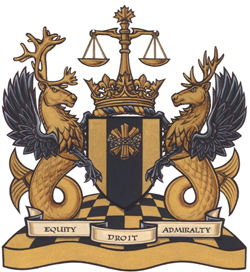
Arms of the Federal Court of Canada

We are now in Day 2 of the Federal Court hearing, where Justin Trudeau’s government is trying to convince a judge that shutting down Parliament to avoid Well, folks, here we are. Day two of the Federal Court showdown, where the Trudeau government is desperately trying to convince Canadians that shutting down Parliament to protect their own hide was a completely reasonable thing to do. They want you to believe that this is all perfectly normal, that it’s routine, that it’s just a quirk of the system. Nothing to see here, folks!

But the problem with lying is that eventually, you get caught. And on Day 2 of this hearing, Justin Trudeau’s legal team got caught. Over and over again.

If you watched what unfolded in court, you saw the Trudeau government’s lawyers flailing like fish on dry land, fumbling through weak excuses as Chief Justice Paul S. Crampton shredded their arguments one by one. At one point, they actually misrepresented a legal precedent in court, only for the Chief Justice to read the case aloud and reveal that it actually contradicted their argument. Humiliating.

And that was just the start.

This case isn’t just about whether Trudeau technically had the ability to prorogue Parliament. It’s about why he did it — and more importantly, whether Canada is now a country where the Prime Minister can shut down democracy whenever it gets inconvenient for him. Because if the courts let this stand, what’s stopping the next Prime Minister from proroguing indefinitely? What’s stopping the government from suspending Parliament every time there’s a corruption scandal, every time they fear a non-confidence vote, every time they need to cover up a mess of their own making?

And that’s exactly what Trudeau did. His government was facing multiple crises all at once — a massive financial scandal, a looming non-confidence vote, and an economic firestorm caused by Trump’s tariff threats. So rather than actually dealing with it, he shut Parliament down. The question is: Did he have the right to do that?

[…]

The Chief Justice has promised to issue a ruling before Parliament resumes on March 24. That means this case will be decided before Trudeau can walk away and pretend none of this ever happened.

If the court rules against the government, it will mean that future Prime Ministers cannot abuse prorogation to avoid scrutiny. It will send a clear message that shutting down Parliament to protect yourself is unconstitutional and illegal.

But if the government wins, it will mean that the Prime Minister can shut down democracy anytime he wants. It will mean that Canada is no longer a functioning parliamentary system but a country where the executive can do whatever it pleases.

And if that happens, ask yourself this: What’s stopping the next Prime Minister from just shutting down Parliament indefinitely?

Trudeau might be stepping down soon, but his legacy of corruption, incompetence, and political cowardice will haunt this country for years. The question now is whether the courts will allow him to rewrite the rules of democracy on his way out the door.

We’ll find out soon.

Update: Fixed broken link.

Free-market economist grapples with a new kind of tariff

Filed under: Business, Economics, Government, Politics, USA — Tags: , , , , — Nicholas @ 03:00

With US President Donald Trump seemingly utterly entranced by the possibilities of killing off as much world trade as he can using tariffs, I did not expect to read that renowned libertarian economist David Friedman is not sure about the latest kind of tariffs being proposed:

I have finally encountered a kind of tariff that I am not sure I am against. The idea is to impose the same tariff on another country’s exports that they impose on your exports. A tariff makes the country that imposes it worse off, a fact that neither Trump or most of the media appear to understand — Vance may — but it makes the country it is imposed against worse off as well. Imposing a tariff can be in the interest of the politicians who impose it for public choice reasons, as a way of buying support from a concentrated and well organized interest group such as the auto industry at the expense of a dispersed interest group such as their customers. That is one of the two reasons tariffs exist, the other being that the false theory of trade economics is simpler and easier to understand than the true theory.1

But another country’s tariff barriers against your exports make both your country and its politicians worse off. So if imposing tariffs on their imports results in tariffs being imposed on their exports, it might be in the interest of the politicians as well as the country they rule to lower, even abolish, their tariffs — and free trade, zero tariffs, is my first best tariff policy.

Reciprocal reduction of tariffs is, of course, a routine objective of trade negotiations. What Trump appears to be proposing is to automate the process. That might have some advantages. It would reduce the amount of time and effort spent on trade negotiations. More important, it would make it harder for a government that wanted to keep its tariffs to pretend to its citizens that negotiations for mutual reductions had broken down over details.

It is not obvious what “reciprocal tariffs” means in practice, because tariffs, typically, are on particular goods. China imports oil and exports textiles. If they impose a tariff on American oil there would be no point to the US retaliating by imposing a tariff on Chinese oil — we don’t import Chinese oil.

    Under the Plan, my Administration will work strenuously to counter non-reciprocal trading arrangements with trading partners by determining the equivalent of a reciprocal tariff with respect to each foreign trading partner. (Reciprocal Trade and Tariffs Memo)

It isn’t clear what “the equivalent” means. One possible approach would be to figure how much revenue a country collects from tariffs on American exports and set a uniform tariff on that country’s exports set to bring in the same amount of revenue. That would be simple and would reduce the political support for tariffs, since they could not be targeted to protect specific industries.

For which reason I don’t expect it to happen. The closest version that seems politically plausible is a nonuniform tariff schedule that brings in the equivalent revenue. Unfortunately that would let the administration protect favored industries with tariffs high enough to reduce imports, and revenue, to near zero.

Of course, the target country could, in a true system of reciprocal tariffs, solve the problem by reducing their tariffs to zero.


February 15, 2025

“Trump marks the overdue end of the Long Twentieth Century”

Filed under: History, Media, Politics, USA — Tags: , , — Nicholas @ 05:00

At The Upheaval, N.S. Lyons suggests that the arrival of Donald Trump, version 2.0, may finally end the era we’ve been living in since immediately after the end of WW2:

The 125 years between the French Revolution in 1789 and the outbreak of WWI in 1914 was later described as the “Long Nineteenth Century”. The phrase recognized that to speak of “the nineteenth century” was to describe far more than a specific hundred-year span on the calendar; it was to capture the whole spirit of an age: a rapturous epoch of expansion, empire, and Enlightenment, characterized by a triumphalist faith in human reason and progress. That lingering historical spirit, distinct from any before or after, was extinguished in the trenches of the Great War. After the cataclysm, an interregnum that ended only with the conclusion of WWII, everything about how the people of Western civilization perceived and engaged with the world – politically, psychologically, artistically, spiritually – had changed.

R.R. Reno opens his 2019 book Return of the Strong Gods by quoting a young man who laments that “I am twenty-seven years old and hope to live to see the end of the twentieth century”. His paradoxical statement captures how the twentieth century has also extended well past its official sell-by date in the year 2000. Our Long Twentieth Century had a late start, fully solidifying only in 1945, but in the 80 years since its spirit has dominated our civilization’s whole understanding of how the world is and should be. It has set all of our society’s fears, values, and moral orthodoxies. And, through the globe-spanning power of the United States, it has shaped the political and cultural order of the rest of the world as well.

The spirit of the Long Twentieth could not be more different from that which preceded it. In the wake of the horrors inflicted by WWII, the leadership classes of America and Europe understandably made “never again” the core of their ideational universe. They collectively resolved that fascism, war, and genocide must never again be allowed to threaten humanity. But this resolution, as reasonable and well-meaning as it seemed at the time, soon became an all-consuming obsession with negation.

Hugely influential liberal thinkers like Karl Popper and Theodor Adorno helped convince an ideologically amenable post-war establishment that the fundamental source of authoritarianism and conflict in the world was the “closed society”. Such a society is marked by what Reno dubs “strong gods”: strong beliefs and strong truth claims, strong moral codes, strong relational bonds, strong communal identities and connections to place and past – ultimately, all those “objects of men’s love and devotion, the sources of the passions and loyalties that unite societies”.

Now the unifying power of the strong gods came to be seen as dangerous, an infernal wellspring of fanaticism, oppression, hatred, and violence. Meaningful bonds of faith, family, and above all the nation were now seen as suspect, as alarmingly retrograde temptations to fascism. Adorno, who set the direction of post-war American psychology and education policy for decades, classified natural loyalties to family and nation as the hallmarks of a latent “authoritarian personality” that drove the common man to xenophobia and führer worship. Popper, in his sweepingly influential 1945 book The Open Society and Its Enemies, denounced the idea of national community entirely, labeling it as disastrous “anti-humanitarian propaganda” and smearing anyone who dared cherish as special his own homeland and history as a dangerous “racialist”. For such intellectuals, any definitive claim to authority or hierarchy, whether between men, morals, or metaphysical truths, seemed to stand as a mortal threat to peace on earth.

The great project of post-war establishment liberalism became to tear down the walls of the closed society and banish its gods forever. To be erected on its salted ground was an idyllic but exceptionally vague vision of an “open society” animated by peaceable weak gods of tolerance, doubt, dialogue, equality, and consumer comfort. This politically and culturally dominant “open society consensus” drew on theorists like Adorno and Popper to advance a program of social reforms intended to open minds, disenchant ideals, relativize truths, and weaken bonds.

As Reno catalogues in detail, new approaches to education, psychology, and management sought to relativize truths, elevate “critical thinking” over character, vilify collective loyalties, cast doubt on hierarchies, break down all boundaries and borders, and free individuals from the “repression” of all moral and relational duties. Aspiration to a vague universal humanitarianism soon became the only higher good that it was socially acceptable to aim for other than pure economic growth.

[…]

The Long Twentieth Century has been characterized by these three interlinked post-war projects: the progressive opening of societies through the deconstruction of norms and borders, the consolidation of the managerial state, and the hegemony of the liberal international order. The hope was that together they could form the foundation for a world that would finally achieve peace on earth and goodwill between all mankind. That this would be a weak, passionless, undemocratic, intricately micromanaged world of technocratic rationalism was a sacrifice the post-war consensus was willing to make.

That dream didn’t work out though, because the strong gods refused to die.

Update, 17 February: Welcome Instapundit readers! Thanks for dropping by. Please do look around at some of my other posts! I think the last time I got linked by Instapundit was back in 2008/9 just before I moved to the current location. Please do read the entire N.S. Lyons post, as this is just a taster of the full essay!

Nannies on the right are just as bad as nannies on the left

Filed under: Business, Government, Health, Politics, USA — Tags: , , , — Nicholas @ 03:00

Jim Treacher briefly gets slightly serious about RFK Jr.’s new role as America’s chief health nanny:

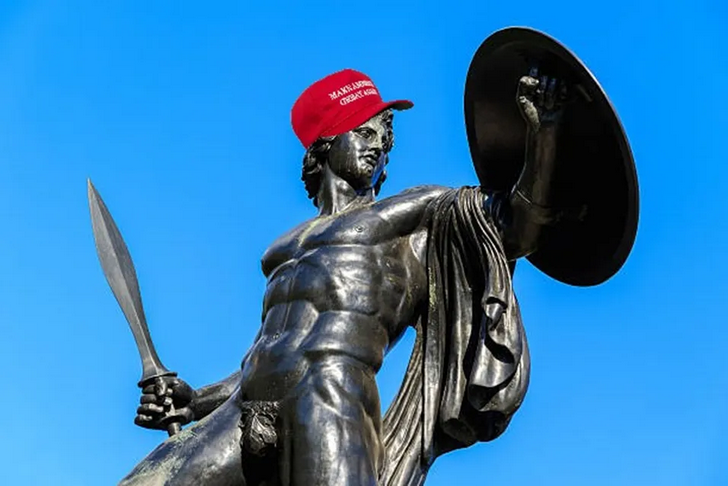
Fake image generated by Grok

First things first: I’m fine with a United States president picking his own cabinet. Donald Trump won, so he gets to choose the people he wants. It’s not fascism, it’s not unconstitutional, and it’s not going to destroy the country. This is the system we have, and so far the Trump administration has been operating within precedent. (Yes, even with Elon Musk and DOGE.) Fair enough.

And, also, in addition to that: I don’t like RFK Jr., and I won’t pretend I do just so you don’t yell at me.

RFK is still the same guy he was before he suddenly started being nice to Trump. He’s the guy who thinks COVID-19 was “ethnically targeted” to attack Caucasians and blacks, while sparing the Jews and Chinese. He’s the guy who bragged about having a worm in his brain. He’s the guy who, just seven months ago, said “Trump was a terrible president“.

Now I’m supposed to pretend none of that happened, just because Trump likes him for the moment? Nah.

And, of course, RFK is the guy who thinks the role of government is to slap your hand at the dinner table. So I’m supposed to pretend nanny-statism is good now.

Yay, let’s embrace lib policies to own the libs!

If you didn’t want Michelle Obama telling you what to eat, why do you want RFK telling you what to eat? If you didn’t want the government telling you which vaccines to put in your body, why do you want the government telling you which food to put in your body?

“But seed oils and high-fructose corn syrup and Red Dye Number Whatever are bad for you!” Okay. So don’t eat that stuff. You can read labels, can’t you? Why do you need the feds to hold your hand?

It’s amazing: At the very same time MAGA is cheering on Trump for reducing the size of government — and buddy, I’m right there with them — they’re begging the government to “clean up the food supply”.

Which is it, friends?

Get mad at me all you want, but at least I’m consistent. I don’t want the government telling me what to do, no matter who’s in charge for the time being.

February 14, 2025

“Over half of all Germans now find themselves on ‘the right’ and urgently require democratic reeducation”

Filed under: Germany, Government, Media, Politics — Tags: , , , , — Nicholas @ 05:00

Ah, poor German democracy … you guessed it, once again it’s hanging by a thread as protests against the extremely extreme extreme right (the AfD) have now grown to include protests against the merely extreme extreme right (the CDU and CSU):

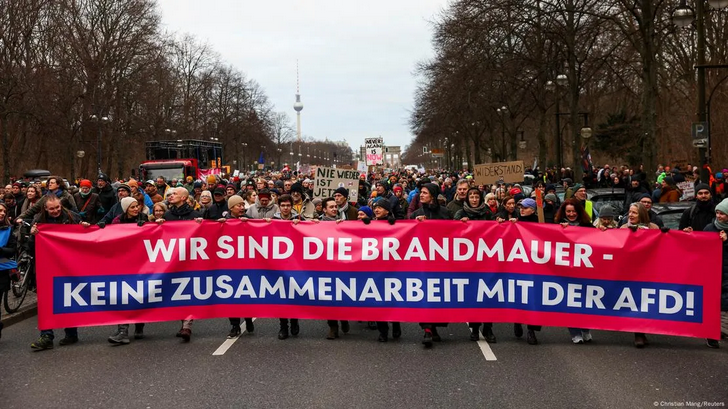
“We are the cordon sanitaire – no cooperation with the AfD”: the banner leading the Berlin protest against AfD and CDU on 2 February, which was financed in part by the German taxpayer and arranged by semi-affiliated apron organisations of the governing Green and Social Democrat parties of Germany.

All the activists are out in force.

Every day there are new protests “against the right”, and by “the right” they do not merely mean Alternative für Deutschland and the one-in-five Germans who vote for them, as was the case last year at this time. Since Friedrich Merz stepped over the cordon sanitaire at the beginning of this month, “the right” now also includes the centre-right CDU and CSU parties. Over half of all Germans now find themselves on “the right” and urgently require democratic reeducation. What is worse, it is not just crazy pink-haired activists and septum-pierced Antifa who want to do the reeducating, oh no. It is the government itself; the activists are merely their agents.

According to taz, 500,000 right-thinking Germans took to the streets this past weekend to combat the out-of-bounds radical views held by 52% of everybody. Perhaps 200,000 or 250,000 or 320,000 turned out for the massive “Democracy Needs You” protest in Munich on Saturday. A further 35,000 people “warned against a shift to the right” in Bremen, the absurd “Grannies against the Right” brought 24,000 people to the streets of Hannover, and another 14,000 denounced “right-wing extremism” in Marburg. There were also protests throughout Nordrhein-Westfalen, in Wuppertal, Aachen, Duisburg, Gütersloh, Gummersbach and Euskirchen. Yesterday 15,000 showed up to protest an AfD event in Freiburg; they were less than peaceful. And that is just what I found by scanning a few headlines. I could easily expand this paragraph into an entire post because they are protesting everywhere and all the time “against the right” these days.

I must emphasise again the extremely expansive notion of “the right” that is in play at these protests. Basically everyone who is not on the left – and particularly everyone who does not vote for the Greens or the Social Democrats (SPD) – presently attracts the activists’ ire. That is very interesting, because we are in the final stages of an election campaign and the Greens and the SPD are the only parties in government. Could it be that the Greens and the SPD are using the substantial resources of the German state to call forth massive street protests against all the Germans who are not planning to vote for them?

Yes, in fact that is exactly how it could be:

    When 160,000 demonstrators turned out to protest on behalf of the cordon sanitaire on the first weekend in February, and organisers projected the words “All Berlin hates the CDU” onto the Victory Column, the red-green federal government provided financial support. The rally was co-sponsored from the coffers of the federal budget … indirectly and in two ways. As in many German cities, the organiser was the association Campact. Campact itself does not receive government funds. Yet they are the primary stakeholder of the nonprofit HateAid, which receives funds from the Ministry for Family Affairs. Since 2020, HateAid has received a total of almost 2.5 million Euros from the “Live Democracy” project, and their funding has just been extended. According to the Ministry for Family Affairs, HateAid can expect 424,823 Euros this year for its work against online hate speech.

    Thousands also took to the streets in Dresden and Leipzig to protest CDU plans for migration policy. In both cities, the SPD and the Greens indirectly sponsored the rallies with taxpayer money, this time through the Workers’ Welfare Association (AWO). This association enjoys the favour of the Ministry of the Interior and the Ministry of Family Affairs. The AWO received tens of thousands of Euros … in 2024. In Saxony-Anhalt, the AWO state association received 90,043 Euros from the Ministry of Family Affairs in 2025, among other things from the ‘Live Democracy’ project …

    Paus’s ministry also provides financial support to many of the organisers of demonstrations in Schleswig-Holstein. This year, a total of 1.525 million Euros will flow … The municipalities divide the money equally among themselves, with each receiving 140,000 Euros to form local “partnerships for democracy”. Many of the sponsored organisations have sponsored demonstrations on behalf of the cordon sanitaire. In Kiel, the Green-financed “Central Education and Advice Centre for Migrants” … called for a protest in front of the CDU headquarters, in Lübeck the “Lübeck Refugee Forum” did the same …

All of this is to varying degrees illegal. Non-profit organisations, which receive tax-deductible contributions from supporters, are bound to political neutrality. Nor can the government finance (directly or otherwise) campaign events against the political opposition. Since 2021, however, in the name of defending democracy, the traffic light coalition have called into being an absolute jungle of NGOs to intimidate voters, censor the internet and riot on the streets against parliamentary votes. Their semi-affiliated activist cadres police German politics and redefine as right-wing and forbidden whatever it is our rulers happen to disagree with at the moment.

Trump may start paying attention to Canadian cultural protectionist polices next

Michael Geist points out just how many Canadian federal policies and programs will likely come under scrutiny by the Trump administration for their blatant protectionism against US cultural products:

My Globe and Mail op-ed argues the need for change is particularly true for Canadian digital and cultural policy. Parliamentary prorogation ended efforts at privacy, cybersecurity and AI reforms and U.S. pressure has thrown the future of a series of mandated payments – digital service taxes, streaming payments and news media contributions – into doubt. But the Trump tariff escalation, which now extends to steel and aluminum as well as the prospect of reviving the original tariff plan in a matter of weeks, signals something far bigger that may ultimately render current Canadian digital and cultural policy unrecognizable.

Our cultural frameworks are largely based on decades-old policies premised on marketplace protections and mandated support payments. This included foreign ownership restrictions in the cultural sector and requirements that broadcasters contribute a portion of their revenues to support Canadian content production.

As we moved from an analog to digital world, the government simply extended those policies to the digital realm. But with Mr. Trump appearing to call out what he views to be Canadian protectionist policies in sensitive sectors such as banking ownership, the cultural and digital sectors may be next.

If so, there are no shortage of long-standing policies that tilt the playing field in favour of Canadians that could spark some uncomfortable conversations.

Why do U.S. companies face ownership restrictions in the telecom and broadcast sectors? Why are Canadian broadcasters permitted to block U.S. television signals in order to capture increased advertising revenue? Why do Canadian content rules exclude U.S. companies from owning productions featuring predominantly Canadian talent?

The Canadian response that this is how it has always been is unlikely to persuade Mr. Trump.

Canadian policies premised on “making web giants pay” may also be non-starters under Mr. Trump. For the past five years, the Canadian government seemingly welcomed the opportunity to sabre rattle with U.S. internet companies. This led to mandated payments for streaming services to support Canadian film, television and music production; link taxes that targeted Meta and Google to help Canadian news outlets; and the multibillion-dollar retroactive digital services tax that is primarily aimed at U.S. tech giants.

Not only have those policies raised consumer affordability and marketplace competition concerns, they have also emerged as increasingly contentious trade issues. If the trade battles with the U.S. continue, the pressure to scale back the policies will mount.

Beyond rethinking established cultural and digital policies both new and old, the bigger changes may come from re-evaluating the competitive impact of policies that rely heavily on regulation just as the U.S. prioritizes economic growth through deregulation. Proposed Canadian privacy, online harms and AI rules have all relied heavily on increased regulation, looking to Europe as the model.

For example, consider the Canadian approach to AI regulation in the now-defunct Artificial Intelligence and Data Act. It specifically referenced the European Union’s regulatory system, which establishes extensive regulatory requirements for high-risk AI systems and bans some AI systems altogether.

However, the European approach is not the only game in town. Mr. Trump moved swiftly to cancel the former Biden administration’s executive order on AI regulation, signalling that the U.S. will prioritize deregulation in pursuit of global AI leadership. Further, the arrival of DeepSeek, the Chinese answer to ChatGPT, took the world by storm and served notice that U.S. AI dominance is by no means guaranteed.

The competing approaches – U.S.-style lightweight regulation that favours economic growth against a more robust European regulatory model that emphasizes AI guardrails and public protections – will force difficult policy choices that Canada has thus far avoided.

February 13, 2025

Australia’s most toxic export (so far) – “Settler-colonial ideology”

Filed under: Australia, Books, Cancon, Education, History, Media, Politics, USA — Tags: , , , , — Nicholas @ 05:00

Helen Dale explains how a lunatic fringe Australian notion has grown to be a major ideology in most of the Anglosphere and even as far afield as Israel:

Despite a great efflorescence of literature and especially film about the mafia, it’s a truism to say that it isn’t very good for Sicily. It also hasn’t been very good when exported to other countries, either, spreading violence, corruption, and lawlessness. Well, Australia is to settler-colonial ideology as Sicily is to mafia, and our poisonous gift to the world is, like Sicily’s mafia, one of those things about us that really isn’t for export.

“Settler-colonial ideology” seems a mouthful, but if I describe bits of it to you, you’ll recognise it. Heard Australia Day called “Invasion Day”? You’ve encountered settler-colonial ideology. Been called racist for voting NO in the 2023 Voice Referendum? You’ve encountered settler-colonial ideology. Noticed Aboriginal academics get hired with obviously inadequate qualifications? You’ve encountered settler-colonial ideology.

Many Australians — including me — first encountered settler-colonial ideology at university. Back then, it was a theoretical and foreign concern, and largely in languages other than English (mainly French and Arabic). I do remember one of the “post-colonial literatures” (note the s, the s is important) obsessives trying to convince me that Alan Paton’s Cry the Beloved Country wasn’t a “legitimate book” because its author was white, but back then, this was still a niche view.

Like other Australians confronted with daft academic ideas, I blamed the US or France and ignored my own country’s contribution. Australians aren’t noted for their theoretical acumen, which made this easier. Critical race theory and affirmative action are all-American, while US academics have often executed hostile takeovers of French nonsense like postmodernism or queer theory early on in proceedings. It gets easy to blame America and France.

Easy, but unfair.

I realised how mistaken I’d been when, in October last year, I returned to Australia for a stint. While I was there, I read Adam Kirsch’s On Settler Colonialism: Ideology, Violence and Justice. I did so in part because October 2024 was the one-year anniversary of two important events. Both concerned what Kirsch calls “the ideology of settler-colonialism”.

Kirsch documents a process whereby the French- and Arabic-speaking theorists of post WWII decolonial conflicts — particularly Frantz Fanon — had their ideas grafted (very, very awkwardly) onto dissimilar Australian history and conditions by Australian intellectuals. These were then exported throughout the English-speaking world, likely through academic conferences. This explains how cringeworthy Australian nonsense like land acknowledgments managed to spread first to Canada and then the US in a reversal of the usual process whereby America sneezes and so gives its Hat a cold.

Fanon was a Marxist and a Freudian. His writing seethes with angry bloodthirstiness and pseudoscientific psychodrama, but he was responding to a vicious war of independence and incipient civil conflict. Kirsch notices a pattern where Australian scholars borrow bits of Fanon to give a sanguinary rhetorical garnish to their writing. “Fanon’s praise of violence is a large part of his appeal for Western intellectuals,” he notes. “Many of the sentiments expressed in The Wretched of the Earth, coming from a European or American writer, would immediately be identified as fascistic.”

Australia’s intervention changed the ideology, in some ways making it more destructive. Fanon is shorn of most of his Marxism, for example (can’t have that, won’t be able to recruit rich minorities to the boss class otherwise). The key Australian shift coalesces around an oft-quoted aphorism from historian Patrick Wolfe: “invasion is a structure, not an event”. That is, colonisation trauma is constantly renewed because “settler” is a heritable identity. “Every inhabitant of a settler colonial society who is not descended from the original indigenous population,” Kirsch points out, “is, and always will be, a settler”.

“Settler” here includes people transported to both America and Australia in chains — slaves and convicts. Once it became acceptable to construe one group of people conveyed against their will across thousands of miles of ocean in dreadful conditions as providentially lucky (and genocidal) settlers, it became possible to extend the reasoning to other, similar groups. After all, the only difference between a convict and a slave is the presence or absence of a criminal conviction.

Kirsch’s attempt to explain how Australia was analogised with Fanon’s Algeria and then how Israel was analogised with Wolfe’s Australia is heroic, in part because the casuistry he seeks to unpick is so convoluted. Filtering Fanon through Australian academia and its claim that “settler” is a heritable identity did have the effect of making Jewish Israelis look more like non-indigenous Australians or Americans, however, especially when attention was focussed on European Jewish immigrants to Israel.

The downfall of the “theatre kid occupied government”

Filed under: Bureaucracy, Government, Media, Politics, USA — Tags: , , , , — Nicholas @ 03:00

Theophilus Chilton says that one of the biggest weaknesses of the Biden administration was their addiction to the idea that appearances mattered far more than reality:

For the previous four years, one of the constant refrains from the Left that we kept hearing over and over was “the adults are back in charge”. Trump is “childish” while Biden was “the adult in the room,” or so the media-driven narrative kept telling us. Trump just hung out on social media and made fun of people during his first term while Democrats did the serious business of guiding the ship of state through the rocky shoals of the modern world when Biden was in office, and all that. The whole point was to mask the serious deficiencies in the previous administration and its underlying ideational premises, deficiencies that existed at both the structural and personnel levels because of the fundamental ideological puerility of the Left.

It’s become common for observers to (only partially jokingly) note that until very recently we had a “theatre kid occupied government”. What’s that mean? Well, everything we saw from the past four years (and really, a lot longer than that) was performative — it was about giving appearances rather than getting anything useful done. All the way back to the terminally midwit show The West Wing, the belief among up-and-coming leftie PMCers was that government could essentially be conducted by stagecraft. All you have to do is write the script, teach the actors their lines, and create whatever you want out of the production. More generally, the theatre kids in government thought that they could rule the world merely by wishcasting things into reality, which explains a lot of the “questionable” spending to and through USAID and various NGO organisations. They have the very juvenile tendency to think that wanting something to be a certain way can make it so, regardless of intervening realities.

Fundamentally, that is the whole character of modern Western and American progressivism. Modern leftists display a whole suite of childlike behavioural patterns that, as it turns out, are not conducive to good government. Really, progressivism is essentially based on wishful thinking and daddy issues. Once you understand this, you understand about 90% of where the Left’s thought process comes from.

One good example of this is the whole transgender push. While there is obviously an element of grooming/recruiting involved with it all, the main point to it is that it’s a means of social conditioning and control. They pretend — and demand that others pretend — that boys can become girls and that girls can become boys. Until recently, they were able to punish normal people who didn’t at least pay lip service to this. Even without this power, there is still a good deal of attempting to emotionally manipulate people about the matter (you don’t want to commit TRANS GENOCIDE do you???), which is itself a means of trying to exercise power, though in a juvenile manner.

Of course, the fact that the whole trans agenda rests of wishful thinking, on the attempt to stage manage reality into accepting something blatantly at odds with it, should go without saying. There has been a concerted effort to build a Baudrillardian hyperreality around this issue, to create a “consensus reality” that muddies the distinction between fact and fiction. Baudrillard himself defined hyperreality as “… the generation by models of a real without origin or reality”. The entire process is essentially semiotic, which explains the obsession of the modern Left (not just now, they tried this in Weimar Germany in the 1920s as well) with transgenderism — it’s a spearhead which, once successfully pierced through the veil of classical reality in this one area, can justify the same exact process being carried out in any other so that any symbolic-yet-unreal consensus can be built, even if by fraud or force.

There are real world consequences to this sort of theatre kid performativism. It leads to them impeding traffic on busy highways to protest whatever their idiotic cause du jour happens to be (physics isn’t real bro!). It’s also why (ostensibly adult) Democratic elected officials think they can impede federal immigration enforcement efforts. For so long, progressives in our TKOG were able to force everyone else to go along with their delusions or face punishment. Even though they’re now not able to do this (at least here in the USA, other places in the West aren’t so lucky), they still think they can obstruct and counteract the implementation of policy simply because they don’t want these things to happen. Like little kids who can’t accept that they lost at a game, these folks believe they can roll back the results of the latest election by throwing tantrums and trying to get in the way. Hopefully, a few arrests will clear up this misconception.

QotD: Social Darwinism

Filed under: Economics, History, Politics, Quotations, Science, WW2 — Tags: , , , , — Nicholas @ 01:00

Social Darwinism fails both on its own terms, and in the implementation. On its own terms, because we simply can’t account for all the variables. I use the example of billiards: The math is simple enough behind any given billiard shot, but once you introduce obvious real world variables like imperceptible imperfections in the felt of the table, the balls themselves, the cue … plus the inability of human muscles to consistently apply the necessary force in just the right way … your average PhD physicist should be a much better pool player than, say, your average barfly, but the reality is far different. How much more complex is an entire living system, than a pool table?

Social Darwinism fails in practice for the most obvious reason: You can’t practice it with the necessary consistency without massive State intervention, and what kind of fool would give a State, any State, that power? It has been tried, 1933-45 being the most prominent example, and it didn’t go well.

Severian, “The Experiment”, Founding Questions, 2021-09-25.

February 12, 2025

Poilievre’s outlined plan for the Canadian Arctic gets the CDR Salamander seal of approval

Filed under: Cancon, Military, Politics — Tags: , , , — Nicholas @ 05:00

Although most of the attention is on the still ongoing Trump tariff tantrum, there is still the required battle-space preparations going on for the next federal election. Conservative leader Pierre Poilievre discussed his proposals for improving national security in the Arctic, and CDR Salamander is enthusiastic:

Pierre and Ana Poilievre at a Conservative leadership rally, 21 April, 2022.
Photo by Wikipageedittor099 via Wikimedia Commons.

… here are the highlights as I see them.

  • Canada’s Arctic is under threat. 75% of Canada’s coastline is in the far north, and 40% of her landmass. Canada needs to become self-sufficient.
  • In the fall of 2022, the Canadian military found Chinese monitoring buoys in the Arctic.
  • A Royal Canadian Navy frigate shadowed a Chinese research vessel in the Bering Strait off Alaska last year (thank you RCN friends, we don’t have any frigates nor naval bases in Alaska because … our leaders don’t understand much outside Norfolk, San Diego, or the Potomac).
  • Russia is building new bases and infrastructure in the Arctic.
  • Canada will take back control of Canadian waters, sky, and land.
  • The Canadian military today is weakened and her allies no longer respects her.
  • Canada does not have a permanent military presence in the Arctic.
  • When Prime Minister, he will increase Canadian forces by:
  • – Doubling the size of the Canadian Rangers from 2,000 to 4,000 Rangers.

    – Acquire two additional polar heavy icebreakers for the Royal Canadian Navy by 2029 on top of the two current icebreakers being built for the Canadian Coast Guard.

    – Will build Canada’s first permanent Arctic military base since the Cold War. It will be CFB Iqaluit. 100% of the cost of the base will come out of the Canadian foreign aid budget and will be up and running within two years of Poilievre becoming Prime Minister.

    – New submarines.

  • Bringing wasted foreign aid back to Canada.
  • If Canada wants to be a sovereign, self-reliant nation, it must take control of their north, secure its borders, and stand on its own two feet.
  • Canada cannot count on the Americans to do it for them.

Further on in this speech, Poilievre speaks out strongly against some of the statements of President Trump and his administration, and that is fine for me. Were I Canadian, I would say very similar things. This is OK. Friends can have disagreements now and then, but for every one item that causes friction, we will always have nine items that bring us together.

It’s all good.

QotD: Jacob Zuma – South Africa’s answer to Donald Trump

Filed under: Africa, Media, Politics, Quotations — Tags: , , , , — Nicholas @ 01:00

[Thabo] Mbeki’s presidency ended in disaster and humiliation, but it paved the way for one of the most colorful politicians alive today: Jacob Zuma. The most important thing for Americans to understand is that Zuma is basically a left-wing and South African version of Donald Trump. He is colorful, bombastic, and over-the-top. He has a tendency to break into song at political rallies and church services. He says outrageous and inappropriate things. He is beloved by the far left and grudgingly admired by the far right and fanatically hated by all the bien-pensants in the center. He was viciously persecuted by the South African deep state, and his accession to the presidency caused a bitter #NeverZuma faction to break off the ANC and start another party (incredibly this party is called “COPE”). Finally, he is an out and proud polygamist and brags openly about his corruption, and people love this because they know every politician is doing it, he’s just honest about it.

The ANC bosses did not like Zuma. For decades the ANC had been dominated by elite, western-educated, communist Xhosas, but Zuma was none of those things. Zuma came from nothing — his mother was a janitor and his father died when he was 3. Zuma was so illiterate and uncultured that Mbeki tapped him to be deputy president on the theory that it would keep his own position secure, since nobody would ever let Zuma be president (yeah this backfired spectacularly). Most shocking of all, Zuma was a Zulu. He danced in a loincloth and leopard skin with the Zulu king at the Shaka festival. The idea of this savage wildman becoming president was just beyond the pale. Something had to be done to stop him.

The last chance to stop Zuma was a credible-seeming rape accusation from a family friend. The ANC pounced on this, and initiated a high-profile criminal trial. This incensed Zuma’s supporters, who insisted that the prosecution was politically motivated (given that over the past decade the ANC had all but stopped prosecuting rape cases in society more broadly, they may have had a point). The trial was a total debacle. Countless thousands of young activists showed up outside the courtroom wearing t-shirts with slogans like “One hundred percent Zuluboy”, “Burn the bitch”, and “Zuma was raped”. When summoned to the witness stand, the president-to-be performed war dances and led the crowds in song. The prosecution collapsed after the accuser’s story was found to be inconsistent on numerous points, and a triumphant Zuma rode the backlash all the way to the presidency.

There’s another way Jacob Zuma is like Donald Trump: the corrupt and failed ruling classes of both South Africa and the United States find it convenient to blame these men for everything that has gone wrong in their countries ever since. In fact in Zuma’s case, history has begun to be rewritten so that he can be blamed for things that happened before he became president. Many of the South Africans I’ve spoken to will confidently assert that some problem (say, the power outages) is all due to Zuma. When I gently point out that those outages began in 1998 and innocently ask who was president then, they shut down entirely. Zuma is the scapegoat for the failings of an entire country, and making him the sole source of all evil plays the important social role of allowing everybody to pretend that things were great until he showed up (things were not great). In a similar vein, I will not be shocked if decades from now, Donald Trump is blamed for starting the fentanyl epidemic.

John Psmith, “REVIEW: South Africa’s Brave New World, by R.W. Johnson”, Mr. and Mrs. Psmith’s Bookshelf, 2023-03-20.

February 11, 2025

Many young white men are choosing to “own the insult” when accused of being a fascist

Filed under: Media, Politics, USA — Tags: , , , , , — Nicholas @ 05:00

Lorenzo Warby points out that some — even many — young white men are reacting to repeatedly being called “Nazi” or “fascist” by embracing the slur:

Still from Pink Floyd: The Wall

For the fuel of the contemporary networked authoritarians are angry young men. Angry young men who have a great deal to be angry about.

In so many modern schools, universities, and much of social media, if you are a low melanin count, heterosexual male you are absolutely at the bottom of the “woke” oppression-bingo hierarchy. You will be implicitly, or explicitly, held to be somehow tarred with every bad thing any person “like” you has done in history, no matter how long — even how many generations — before you were born that it happened, nor how dubious an historical characterisation it might be. There is no identity open to you that you can celebrate, or feel positively attached to, without potential or actual denigration.

If you do any reading, you can quickly work out that this is a ludicrously one-sided — and deeply unfair — way to look at history. Even in its own terms, it is nonsense, as “folk like you” — i.e., low melanin count heterosexual males — voted for every single legal advance any of the celebrated-as-oppressed groups made. “Folk like you” built the Scientific Revolution, Parliamentary Government, mass prosperity.

Of course, this was a matter of culture, institutions, the happenstance of history, not melanin content. The trouble with the racialisation of history and identity is that it is, indeed, the racialisation of history and identity. As Jews are currently (re)discovering.

Nor can many of these angry young men take much refuge in the good life, work or entertainment. Online dating has turned into a hypergamous nightmare that excludes most guys, in-person connections are fraying and migration-plus-restrictive-land-regulation has shot rents up and made home-owning unattainable.

In entertainment, masculine heroes are being replaced and degraded. Online games are being systematically “wokified”. There are systematic attacks on their heritage. Sport and advertising is also being wokified, is “bending the knee”. Where to go?

If folk systematically tar or denigrate someone’s identity, a natural response is to say “no, my identity is great, it is wonderful”. There will be certainly a market for such a response. The natural response to systematic denigration is some form of “fuck you!” and the politics of “fuck you!“.

In the contemporary world, what is the most dramatic way of saying “fuck you!“? To take the racist!, fascist! abuse and go “right on!“. Even more so if you take the ideas they invoke and turn them back against them.

Of course, if you just reverse what left-progressivism — in its “woke” iteration — stands for, you are still dancing to their tune. But rage can easily work like that.

So, these angry young men look at the folk who treat them with such continual, institutionalised, contempt — who stack everything they can against them — and decide “we hate you”. If you are going to abuse us anyway no matter what we do — the seductive logic goes — then why not simply embrace the identity you impose on us if we put our heads up? There is, after all, no more in-your-face way to shriek their anger and rejection back at those who are abusing, denigrating and excluding them than to embrace racism and fascism.

They look at ordinary conservatives, at ordinary liberals, they look at Boomers, and think “you did not stop it, you did nothing to protect people like me”, so they — and their politics — get no respect.

Instead, they go to the politics of using the operational tactics used against them — the operational politics of “wokery” — in support of politics that most completely expresses their rage. This is the updated version of what happened with 1920s Fascism in Italy and 1930s Nazism in Germany. Like the original versions, they are using — and so helping to legitimate — the operational methods of the left-progressivism.

Not that left-progressives, the “woke”, will see it. They are way too full of the stupidity of arrogance, of the blindness of moral narcissism, to pick what is happening, still less take any responsibility for it. They utterly fail to see themselves; to understand how much they come across as smug, arrogant, condescending, self-righteous, shits whose politics again and again ends up favouring people like them and whose recurrent response to disagreement is to de-legitimise, denounce and censor. Their entire view of themselves is they are the oh-so-clever, oh-so-moral people. Nothing they do is ever seriously counter-productive or fundamentally mistaken.

Faced with the rise of actual racism and actual fascism, they will shriek racist! and fascist! even harder. But they are in the situation of the boy who cried wolf! Except worse, as the boy in the story neither created, nor trained, the wolf.

They have so debased that currency, so debased historical analogy, that fascism has lost its rhetorical, or even its warning, power.

Besides, how many people will say: these folk against whom you are shrieking the same terms of abuse you have shrieked at people for decades. Are they making excuses for the mass sexual predation on young girls by migrants we did not want? Are they supporting the hormonal and surgical mutilation and sterilisation of minors? Are they teaching folk to despise their own countries and heritage? Are they pushing the narrative lies of the moment? Have they proved to be incompetent at elementary things, such as fighting crime and managing fire risk?

No? Then they sound good to me.

Left-progressives: so good at finding new ways to make the same mistakes. It is almost as if they have a pathological relationship with information. Oh, wait, they do.

“As it turns out, you can just cut things”

Filed under: Bureaucracy, Government, Media, Politics, USA — Tags: , , , , — Nicholas @ 03:00

John Carter outlines the left’s long march through the institutions and explains why a conservative counter-operation of the same kind would utterly fail. Instead, Donald Trump (of all people) launched a political blitzkrieg that used none of the strategies of the long march — because the establishment knew intimately how those worked, as they’d used them for generations to become the establishment:

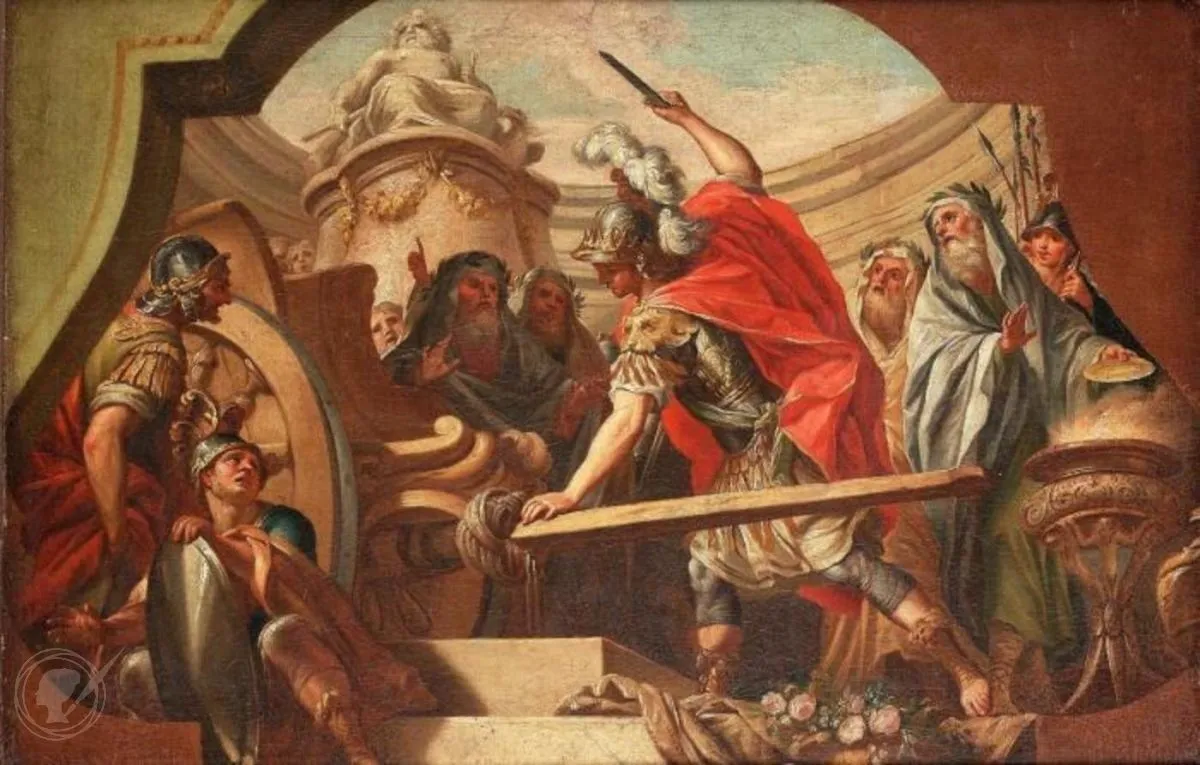
Alexander Cutting the Gordian Knot
Fedele Fischetti, 18th century.

But a counter-revolutionary long march through the institutions was always a doomed project.

The left understands the method quite well, having perfected it themselves, and its defences against counter-infiltration were well advanced. It was never enough merely to say the right things, and not say the wrong things – the left knows how easily such signals are faked, as these are mere words, and words have no meaning to an egregore which sees in discourse nothing but the currents and tokens of power. Much of the seeming insanity of the Cancelled Years is best understood as the imposition of elaborate, difficult to fake displays of loyalty: offering your child’s genitals to the hungry gender gorgon, opening your veins for the gene therapy injection. Then of course there is DEI, whose explicit intent was to simply deny opportunity to those most likely, on a demographic basis, to oppose the left. There is very little point, as a young white man, in keeping your mouth shut if you will be locked out simply because you are white, no matter what you say.

The psychological demands of stealthy infiltration are spiritually toxic. Anyone attempting this path finds himself embedded in a social context in which all of his friends and colleagues adhere to values which he privately despises, and moreover, he knows that the instant they discover his true beliefs he will be not only fired, but ostracized and isolated. Worse, he’s constantly placed in the position of betraying his own convictions, of going along with and even actively supporting things he knows are wrong, because failing to do so would be immediately suspicious. Since the left is a hive mind, he must “pretend” to give up his agency … and insofar as you are what you do, there is very little difference between pretending to give up your agency, and actually doing giving it up. Living like this is miserable. It requires iron discipline, and there is very little reward. Some of you doubtless have direct experience of this.

The most important reason that a long march was never viable, however, was that there was not enough time.

The West is in crisis. Public debt has broken up through the exosphere, its rise ever more vertical as the deficits fuelling it continue to expand, and we can all see in its meteoric rise that its inevitable descent will hit the land like rods from God. Third world invaders pour into our countries by their millions at the open invitation of seditious governments whose open aim is to reduce native white populations to second-class minorities in their own homelands within the space of a generation. These two crises of the Great Inflation and the Great Replacement could never be solved by the tactics the left used to bring them about. Even if such a long march could have succeeded in the face of the barriers the left so astutely erected, by the time it came to fruition the victors would preside over wreckage.

The left’s tactics were those of a chronic disease, gradually wasting the patient, leaching the strength from his limbs. You cannot cure a patient by becoming an opportunistic infection in your own right.

So what to do? Many, despairing, looked to civil war. A coup d’état, likely followed by blue states separating from the Union. Battle lines would be drawn, brother would be set against brother, cities would be ruined, vast pits would be excavated and filled with the stinking dead. Such a war would never have been limited to continental United States. It would have dissolved the Pax Americana, with brushfire wars springing up across the globe as great powers sought to expand their territories by grabbing resources or strategic trade corridors. Those powers would have gotten involved in the Civil War themselves, backing one side or another, prolonging the conflict in order to ensure the Union remained shattered forever.

On J6, the American government teetered on a precipice. Had Trump applied so much as the gentlest pressure with his baby finger, it would have toppled over. The other side would then have screamed that he was a tyrant who had seized power by force; his own supporters would have rallied to the cause that the election had been stolen; America, and the world, would have been bathed in blood. So Trump pulled back, allowed the heroes of J6 to be imprisoned, and permitted the sclerocracy to impose four years of malevolent mismanagement on the American people.

Many were furious with Trump. He’d lost his nerve; he was a coward.

As it turned out, they were all wrong. It was a strategic withdrawal.

And now, instead of a Long March, we are getting a blitzkrieg.

I’ve been silent for the last month partly for personal reasons that deprived me of the time and energy to write, which I won’t elaborate upon here save to note that it’s nothing anyone has to worry about. But I’ve also been silent because I haven’t been sure what to say. The last weeks have been one of those ‘weeks when decades happen’ periods, and that pace of change doesn’t appear to be letting up. Executive Orders flying off of the big man’s desk, birthright citizenship being struck down, entire government departments getting defunded, the J6 heroes being pardoned, trade wars starting and then stopping before they start, the military heading to the border, DOGE siccing broccoli-headed zoomers armed with large language models to rip through the sprawling financial records of acronym agencies like a cyclone of destruction.

As it turns out, you can just cut things.

These are all great, wonderful things. We are winning, and the pace of winning is dizzying. It’s like we’ve spent the last several years slamming again and again against a seemingly immovable wall, bashing our brains out upon it like an enraged tiger, only for that wall to suddenly turn to sand upon our final desperate push, leaving us sprawled and disoriented on the ground.

That is at least what it has felt like to me. The people on the inside of the Trump administration are not disoriented. Far from it. They are executing a detailed, thorough plan. They’ve identified the enemy nerve centres and are neutralizing them precisely, rapidly, and ruthlessly. Handpicked squads of very competent young men have been turned loose inside the Beltway. It is clear that they are not being micromanaged, but are being left to develop their own action plans on the fly as the tactical situation evolves. This is manoeuvre warfare, with small, nimble, lethal teams dropped into the heart of enemy territory and being given maximum latitude to pursue the campaign’s strategic objectives.

February 10, 2025

Trump’s EO against central bank digital currencies

Filed under: Economics, Government, Politics — Tags: , , , , — Nicholas @ 03:00

The Trudeau government’s illegal move to freeze the bank accounts of Canadians who supported the Freedom Convoy should have clearly illustrated the dangers of allowing a government to exercise that level of control over individuals’ financial affairs. (It’s hard to express just how inhumane that move was to deprive thousands of Canadians their ability to conduct any financial business at all … in the middle of the winter just because they’d chipped in small donations to a cause Trudeau didn’t like.) I don’t know if Donald Trump took note, but another of his long list of executive orders directly addresses crypto and CBDCs:

“Bitcoin – from WSJ” by MarkGregory007 is licensed under CC BY-NC-SA 2.0

While the order has upsides and downsides concerning current crypto policies, the parts of the order I’m most excited about are the portions on Central Bank Digital Currencies, or CBDCs. A CBDC is essentially a government-created centrally controlled version of cryptocurrency. As FEE has discussed in the past, CBDCs are a very dangerous idea, and it was troubling that they were being pursued by the Biden administration.

So what does the Trump executive order say about them? Take a look:

    [The Trump administration is] taking measures to protect Americans from the risks of Central Bank Digital Currencies (CBDCs), which threaten the stability of the financial system, individual privacy, and the sovereignty of the United States, including by prohibiting the establishment, issuance, circulation, and use of a CBDC within the jurisdiction of the United States.

Section 5 of the order covers how this will be done. By the order, it’s now illegal for bureaucrats within government agencies to pursue any plans to establish a CBDC unless it is required by law. In other words, barring the possibility that some bureaucrats could break the law, CBDC initiatives must immediately end unless the legislature passes bills requiring them.

This is a big step because the establishment of a CBDC would require significant political, bureaucratic, and technological infrastructure to be implemented. Trump’s order puts a pause on the building of that infrastructure which began under Biden.

On net, Trump’s order seems to have been taken well by crypto markets, with Bitcoin seeing a small price surge after the announcement of the order. So while the future of government crypto regulation remains unclear, the new administration’s commitment to stopping CBDCs and protecting the rights of those engaging in crypto mining and transactions seems to be a good sign.

February 9, 2025

A “certain niche Canadian’s” prophetic look at Western demography

Filed under: Books, Government, Politics, USA — Tags: , , , , , — Nicholas @ 03:00

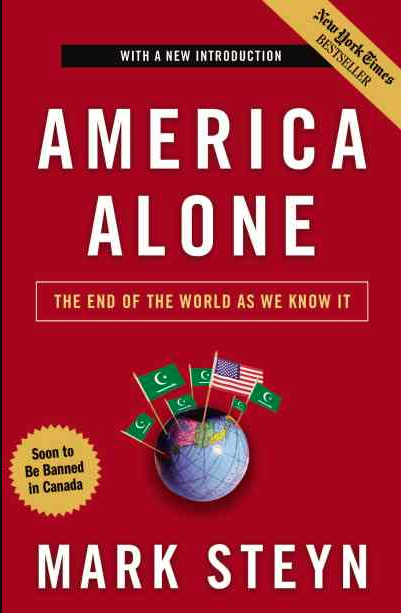
Mark Steyn reminds us that it’s twenty years since he published America Alone: The End of the World as We Know It, which has become more and more accurate every year:

~As some readers may be aware, next year marks the twentieth anniversary of a certain “niche Canadian”‘s boffo international bestseller on demography. So the other day I was musing on whether it was too soon to mark the occasion — only to find I’d been beaten to the punch by the Nigerian media bigfoot Azu Ishiekwene:

    It’s nearly 20 years since Mark Steyn wrote a non-fiction book, America Alone: The End of the World as We Know It.

    Steyn, a Canadian newspaper columnist, could not have known that the kicker of this book title, which extolled America as the last bastion of civilisation as we know it, would become the metaphor for a wrecking ball.

    Steyn thought demographic shifts, cultural decline, and Islam would ruin Western civilisation. The only redeeming grace was American exceptionalism. Nineteen years after his book, America Alone is remembered not for the threats Steyn feared or the grace of American exceptionalism but for an erratic president almost alone in his insanity.

    The joke is on Steyn.

Oh, well. It was good while it lasted — which wasn’t as long as it should have, thanks to the dirty stinkin’ rotten corrupt American “justice” system (see below).

~But I thank Mr Ishiekwene for reminding me of the twin theses of my book: on the one hand, “demographic shifts, cultural decline, and Islam” and, on the other, “American exceptionalism”. The first half is undeniable: At one point last year, there were no Anglo-Celtic heads of government anywhere in the British Isles except for Northern Ireland. Nobody even talks about “demographic shifts”, with even “conservative” politicians preferring to focus on “British values” or “French values” or “[Your Country Here] values”, even as those “values”, not least freedom of speech, are remorselessly surrendered. The UK’s “Deputy Prime Minister”, Angela Rayner, is proposing as the state’s reaction to the Southport stabbings, about which the most intemperate Tweeters were less inaccurate than the state propaganda, to restrict free expression even further. Islam? In Britain, Germany, France, the Netherlands, we would rather our children be stabbed and gang-raped than do anything about it, especially if it risks being damned as “Islamophobic”. The delightful Ms Rayner, who once boasted about flashing her soi-disant “ginger growler” across the Commons to Boris Johnson at Question Time, will be keeping it under wraps in the years ahead.

~As for the second part of my book’s arguments — “American exceptionalism” — well, it’s been a rough twenty years. But, to cast Azu Mr Ishiekwene’s contempt for an “an erratic president almost alone in his insanity” in a more generous light, the last three weeks have been a useful reminder that America is still different — or, at any rate, retains the capacity to be different. In his first days in office Trump 47 yanked the US from the World “Health” Organisation and the Paris “climate” accord and the UN “Human Rights” Council. If I have been insufficient in my praise for this energy, it is only because I held out hopes that a man “alone in his insanity” might have simply nuked the WHO. But, such disappointments aside, in Britain (and in the EU it has yet to leave in any meaningful sense), no such decisive acts in the here-and-now can even be contemplated.

And just because I’ve been including a fair bit of USAID-related stuff this week, he comments on Elon Musk’s epic sidequests investigations into US government waste and corruption:

~That’s the good news — and it’s very heartening. The bad news is that almost everything the national government (it is no longer really “federal”) of the United States touches is a racket.

The United States Agency for International Development is so-called in order that gullible rubes who listen to NPR think that it’s something to do with helping starving children in Africa. The cynical rubes who follow Conservative Inc think it’s something to do with helping African dictators’ Swiss bank accounts and endlessly regurgitate the old line about “international aid” taking money from poor people in rich countries to give to rich people in poor countries. But this is the cynicism of the terminally naïve and does a great injustice to the average blood-drenched Somali warlord. As Elon Musk has pointed out, ninety per cent of USAid funds are disbursed in the Washington, DC area. Opponents of that line say, ah, yes, but that’s misleading because some of it then gets passed on outside the Beltway eventually to reach some emaciated Congolese laddie.

Well, I would doubt it. There is no legitimate reason for Bill Kristol and Mona Charen to be receiving any funds from an agency for “international development” — and they surely know it. The least we should expect from them is that they come by their Never Trumpery honestly.

But I wouldn’t be surprised to learn that that 90-10 ratio is pretty standard. The US armed forces account for forty per cent of the planet’s total military spending. Does ninety per cent of that also get disbursed in the District of Columbia? On Thoroughly Modern Milley’s ribbon budget? It’s as good an explanation as any for the failure to win anything since VJ Day. The rube right’s antipathy to foreigners shouldn’t blind us to the fact that the overwhelming majority of the corruption is domestic — and it’s a very bipartisan sewer.

So I wish Trump, Musk et al the best of luck. But, notwithstanding that every rinky-dink District Court judge seems to be labouring under the misapprehension that he’s head of the executive branch of government, Trump has spent the last three weeks doing things. There is no sign that that is even possible in the rest of the west, where the Dutch model seems to prevail: Geert Wilders wins the election, but then gets neutered.

So, in a sense, Azu Ishiekwene is right. There is a yawning chasm between Trump and the poseur attitude-flaunting rest of the west. And yet Mr Ishiekwene is wrong on this: an erratic president is not almost alone in his insanity. In case you haven’t noticed, Panama won’t be renewing its Chinese deal on the Belt & Road Initiative, and El Salvador is happy to gaol anybody Trump sends them. It turns out that the quickest way to solve any international dispute is to threaten the recalcitrant with twenty-five per cent tariffs starting at midnight. If the forty-seventh president doesn’t seem interested in “winning hearts and minds”, it’s because he’s found something more effective.

« Newer PostsOlder Posts »

Powered by WordPress