Quotulatiousness

October 21, 2009

Southgate out at Middlesbrough

Filed under: Britain, Soccer — Tags: — Nicholas @ 09:29

It’s an unusual situation to dismiss a manager when you’re just a few points out of first place, even more so right after a home win, but that’s what’s happened to Gareth Southgate:

Middlesbrough boss Gareth Southgate has been sacked – despite the Championship club being fourth in the table and bidding for promotion.

His dismissal came in the early hours of Wednesday, shortly after a 2-0 home win over Derby.

The 39-year-old was appointed in June 2006 but last season Boro were relegated from the Premier League.

Chairman Steve Gibson said: “This has been the most difficult decision I’ve ever had to make in football.”

BBC Sport understands Gordon Strachan and Nigel Pearson are among the front-runners to take over at the Riverside, and an appointment could be made as soon as Thursday.

I’d expected Gibson to sack Southgate at the end of last season, where Middlesbrough dropped from the Premier League, but when he retained Southgate after that, I figured he was safe for the year . . . and if they went right back up to the Premier Leage in that year, he’d be safe for a few years yet.

QotD: England of bye-gone days

Filed under: Britain, History, Quotations — Tags: , , , — Nicholas @ 00:11

[I]t is worth noting a minor English trait which is extremely well marked though not often commented on, and that is a love of flowers. This is one of the first things that one notices when one reaches England from abroad, especially if one is coming from southern Europe. Does it not contradict the English indifference to the arts? Not really, because it is found in people who have no aesthetic feelings whatever. What it does link up with, however, is another English characteristic which is so much a part of us that we barely notice it, and that is the addiction to hobbies and spare-time occupations, the privateness of English life. We are a nation of flower-lovers, but also a nation of stamp-collectors, pigeon-fanciers, amateur carpenters, coupon-snippers, darts-players, crossword-puzzle fans. All the culture that is most truly native centres round things which even when they are communal are not official — the pub, the football match, the back garden, the fireside and the ‘nice cup of tea’. The liberty of the individual is still believed in, almost as in the nineteenth century. But this has nothing to do with economic liberty, the right to exploit others for profit. It is the liberty to have a home of your own, to do what you like in your spare time, to choose your own amusements instead of having them chosen for you from above. The most hateful of all names in an English ear is Nosey Parker. It is obvious, of course, that even this purely private liberty is a lost cause. Like all other modern people, the English are in process of being numbered, labelled, conscripted, ‘co-ordinated’. But the pull of their impulses is in the other direction, and the kind of regimentation that can be imposed on them will be modified in consequence. No party rallies, no Youth Movements, no coloured shirts, no Jew-baiting or ‘spontaneous’ demonstrations. No Gestapo either, in all probability.

George Orwell, “England, Your England”, The Lion and the Unicorn: Socialism and the English Genius, 1941-02-19.

October 16, 2009

Friday links of possible interest

Filed under: Britain, Football, Health, Humour, Religion, Technology — Tags: , , , , , , — Nicholas @ 12:25

October 15, 2009

Nobel committee had reservations, was not unanimous

Filed under: Europe, Politics, USA — Tags: , , — Nicholas @ 09:14

Apparently, it’s not just the cranky centrists, paranoid rightists and lunatic libertarians who thought the Nobel Peace Prize award to Barack Obama was incorrect: so did a majority of the committee itself:

Three of the five members of the Norwegian Nobel Committee had objections to the Nobel Peace Prize being awarded to US President Barack Obama, the Norwegian tabloid Verdens Gang (VG) reported Thursday.

“VG has spoken to a number of sources who confirmed the impression that a majority of the Nobel committee, at first, had not decided to give the peace prize to Barack Obama,” the newspaper said.

The Billionaire’s vinegar-scented legal decision

Filed under: Britain, Law, Wine — Tags: , — Nicholas @ 00:06

Following up on an item posted a couple of months ago (“The Billionaire’s Vinegar-scented lawsuit“), Michael Broadbent wins his lawsuit against the publisher of The Billionaire’s Vinegar:

This week, the man who authenticated the Lafite and presided over its auction won an apology and damages from the publisher Random House over a bestselling book, which, he argued, had suggested he had sold the wine knowing its provenance to be suspect. Michael Broadbent has retired as the senior director of Christie’s wine department but remains, according to Adam Lechmere, editor of decanter.com, “among the top three most respected wine critics in the world”.

Broadbent described the ruling as a “great relief”, adding that he planned to celebrate with a magnum of Mouton 1990 over dinner at his club.

The settlement relates to a book called The Billionaire’s Vinegar by American journalist Benjamin Wallace, which outlines the now notorious case of “the Jefferson bottles” – and which Random House, according to Broadbent’s lawyer, Sarah Webb, must now remove from bookshop shelves in Britain.

October 14, 2009

Military false economies

Filed under: Britain, Military — Tags: — Nicholas @ 07:33

Strategy Page reports on the British Territorial Army:

Recently, Britain decided to suspend training for its Territorial Army, for six months, as a way to save money so that more resources could be devoted to the effort in Afghanistan. This has caused an uproar in Britain, where there is much popular support for the Territorial Army, even though it is a relatively small force, with only 34,000 troops.

Cutting training was widely seen as false economy, since the average Territorial only gets 4-5 weeks of training a year. The government saw it differently, noting that many non-combat jobs in the Territorial Army are held by people who do the same kind of work in their civilian job. This is particularly true of people with communications, maintenance or medical jobs in the Territorial Army. But Territorials only get two weeks of additional training before being sent off to a combat zone, and the feeling is that they need all the training they can get if they want to survive overseas.

I’m astonished not only at the bone-headed decision to suspend training, but the relatively tiny size of the current Territorial forces . . . bureaucratic war results, I suspect, as the part-timers don’t have a strong voice in either the military or civilian hierarchy to defend their interests.

October 12, 2009

Protip: a police station parking lot is not a “private place”

Filed under: Britain, Law — Tags: , , , — Nicholas @ 12:59

BBC News reports that a couple of Edinburgh pub-goers chose a particularly unsuitable place to go have sex after meeting in the pub:

An amorous couple have been fined for having sex in broad daylight — in a police station car park.

Leanne Richardson, 26, and Ross Welsh, 30, had to be physically stopped mid sex act by officers from Portobello police station in Edinburgh.

They both pleaded guilty to committing a breach of the peace in the car park on 21 April and were fined £200.

October 11, 2009

QotD: Silvio Berlusconi

Filed under: Europe, Italy, Politics, Quotations — Nicholas @ 11:29

As Silvio Berlusconi yesterday tried to shore up his position by declaring himself irreplaceable as Italy’s head of government, a court in Milan was told it had been “amply demonstrated” that he was guilty of bribery.

“I am, and not only in my own opinion, the best prime minister who could be found today,” he told a press conference. “I believe there is no one in history to whom I should feel inferior. Quite the opposite.”

The problem, he explained, was that “In absolute terms, I am the most legally persecuted man of all times, in the whole history of mankind, worldwide, because I have been subjected to more than 2,500 court hearings and I have the good luck — having worked well in the past and having accumulated an important wealth — to have been able to spend more than €200m in consultants and judges . . . I mean in consultants and lawyers.

John Hooper, “Silvio Berlusconi: I am inferior to no one in history”, The Guardian, 2009-10-10

Will Cameron be the last PM of the United Kingdom?

Filed under: Britain, Europe, Politics — Tags: , , , , — Nicholas @ 11:05

Jackie Ashley (almost alone among British commentators, according to Charles Stross) examines the likely consequences of both the next British election and the promised-by-Tory-leader referendum on the European Union:

So the question facing the Tory leadership is quite clear: if, by next May, the Lisbon treaty has come into force and Europe has a new president, quite possibly Tony Blair, will Cameron keep his promise to hold a referendum? Yes or no? It’s a straightforward question. He knows that to do so would risk a huge row with the rest of Europe, and a fully operational treaty would be harder to unpick than one not yet signed. That’s why until now he has used the weaselly words that, if the treaty is signed, he would “not let matters rest there”.

Cameron also knows that many in his party, not least his would-be successor Boris Johnson, will push for a referendum and have the support of much of the media too. If Cameron appears to want to renege on his promise, he will provoke fury and rebellion on his own side. For now, his “wait and see” gambit is beginning to look indecisive. If he were Gordon Brown, he would undoubtedly be accused of dithering.

At the same time, Cameron is worrying about another referendum, one which may prove no less momentous for the future shape of Britain. He faces a two-sided constitutional struggle, looking south towards Europe — but also north towards the Scots.

The nightmare for Cameron is that, once George Osborne has revealed details of the cuts imposed by Tory Westminster on Scottish budgets, the SNP start to gain momentum for their proposed independence referendum. Alex Salmond, Scotland’s first minister and nobody’s fool, has been watching the Conservative agendas on cuts and on Europe with fascination.

The Scots will be having their own referendum on independence in 2011, and the Tories barely poll north of the River Tweed. Up in Scotland, it’s Labour and the Scottish Nationalist Party as the top two. Scotland is in an odd situation of having its own parliament, but also sending MPs to Westminster, where they can vote on issues affecting the rest of Britain, but non-Scottish MPs do not get to vote on Scottish issues.

Charles provides the odds:

The current government is a minority one (yes, we’ve got a hung parliament): the Scottish National Party are in charge, although they rely on other parties to get legislation passed. The SNP are formally in favour of outright independence for Scotland, as an EU member nation; and they’re committed to holding a referendum on independence in 2011, before the next election. (Labour and the Lib Dems oppose this. The Tories do too, but they’re so marginal that nobody pays any attention to them.)

Here’s the rub. As things stand, the SNP would lose a vote on independence at this point. But under a conservative government in Westminster — especially one that’s wielding the axe of public service cuts, which is going to happen whoever wins the election and which will disproportionately hit the less well off, which includes a lot of Scots — well, I’d handicap things by giving the pro-independence vote an automatic bonus of 10%.

A sensitive, caring, next-generation Conservative government will therefore be at pains to tread lightly north of the border, and to attempt to defuse nationalist sentiment. Or will it?

On the one hand, to give them their full title, they’re the Conservative and Unionist Party, dedicated to preserving the union. But if they cut Scotland loose, then, in a 650 seat parliamentary system, they lose 80 seats, 78 of which belong to their rivals. Leave aside the fact that Cameron is committed to reducing the number of constituency seats in the UK: the 10% of them elected by Scotland are overwhelmingly not conservative. Ditching them will give the Conservatives an electoral lift that will last for a generation.

That’s got to be a temptation, even to a leader who “loathes the idea of being the last ever prime minister of the United Kingdom”.

October 10, 2009

Where High Speed Trains can beat short-haul flight

Filed under: Economics, Europe, Railways, Technology — Tags: , , — Nicholas @ 11:46

Spain has a new high speed railway (HSR) network that appears to be a huge success, according to the Guardian:

Last year’s drop in air travel, which was also helped by new high-speed lines from Madrid to Valladolid, Segovia and Malaga, marks the beginning of what experts say is a revolution in Spanish travel habits.

In a country where big cities are often more than 500km (300 miles) apart, air travel has ruled supreme for more than 10 years. A year ago aircraft carried 72% of the 4.8 million long-distance passengers who travelled by air or rail. The figure is now down to 60%.

“The numbers will be equal within two years,” said Josep Valls, a professor at the ESADE business school in Barcelona.

Two routes, from Barcelona to Malaga and Seville, opened last week. Lines are also being built to link Madrid with Valencia, Alicante, the Basque country and Galicia. The government has promised to lay 10,000km of high-speed track by 2020 to ensure that 90% of Spaniards live within 30 miles of a station. The prime minister, José Luis Rodríguez Zapatero, boasts it will be Europe’s most extensive high-speed network.

While I’m always skeptical of HSR advocates’ larger-than-life claims, the Spanish system may be in a good position to permanently claim a big share of the short-haul air passenger market. The situation works to the strengths of HSR: relatively dense population corridors, short-to-medium length journeys, and government subsidy of construction costs.

HSR cannot be run on the same tracks as regular freight trains and commuter passenger trains: the signalling, degree of curvature of track, and speed differential between the HSR and ordinary trains creates too many risks. HSR must have its own right of way, which pretty much always means that governments must get involved to condemn existing properties and expropriate them for the benefit of the railway.

That HSR is, or may become, a success in densely populated European countries does not make the case for North American HSR efforts, as I’ve posted a few times before.

October 9, 2009

Army beats Navy and Airforce

Filed under: Britain, Military — Tags: , , , — Nicholas @ 12:11

Following up on yesterday’s post about the British Ministry of Defence directive to find savings to support the ongoing (primarily army) efforts in Afghanistan, Strategy Page calls the winner:

British Army Sinks The Navy And Grounds The Air Force

After several months of debate, the British Royal Navy and Royal Air Force have been ordered to cut back on spending, so that money and resources may be used to support army operations in Afghanistan. Among other things, the army has been pointing out that only ten percent of spending on new equipment goes to the army (based on actual and planned spending between 2003-18). This, despite the fact that it’s the army that is doing most of the fighting during this period. Although the army recently pulled out of Iraq (where it had been since 2003), it is still in Afghanistan, and more troops are headed there. The Royal Navy and Royal Air Force have not been fully involved in a major operation since the Falklands in 1982, although they have been involved in several more limited efforts. The point is that they face nothing like what the army is dealing with in Afghanistan.

The British armed forces have 191,000 troops on active service. Of those, 38,000 are in the Royal Navy, 109,000 in the Army, 41,000 in the Royal Air Force, and the rest in joint staffs and operations. The annual defense budget is about $58 billion.

Those aircraft carriers are looking less and less likely to be ever in service . . .

What was the Nobel Peace Prize jury thinking?

Filed under: Europe, Politics, USA — Tags: , , , , — Nicholas @ 09:01

They award it to Barack Obama? For what tangible results over a period of time? He’s been in office less than a year, but has almost nothing to show for it (and, to be fair, a year isn’t a long time in American politics). But I’m not the only doubter, as Benedict Brogan is equally flabbergasted at the decision:

Nobel prize for President Obama is a shocker. He should turn it down.

They could have awarded it to Kylie Minogue and I wouldn’t have been half as surprised as I am watching the television screens around me proclaiming that Barack Obama has been awarded the 2009 Nobel peace prize. The whole business of a bunch of Scandinavian worthies doling out the profits of a long-gone dynamite maker’s fortune has always smacked of the worst sort of self-satisfied plutocratic worthiness. But this takes the biscuit. President Obama remains the barely man of world politics, barely a senator now barely a president, yet in the land of the Euro-weenies (copyright PJ O’Rourke) the great and the good remain in his thrall. To reward him for a blank results sheet, to inflate him when he has no achievements to his name, makes a mockery of what, let’s face it, is an already fairly discredited process (remember Rigoberta Menchu in 1992? Ha!). That’s not the point. What this does is accelerate the elevation of President Obama to a comedy confection, which he does not deserve, and gives his critics yet another bat to whack him with.

Update: Radley Balko sent this twitter post:

Nobel committee also gives Obama Physics prize, citing shirtless beach photo as example that he’s “quite the physical specimen.”

Update, the second: The Whited Sepulchre points out that

it was just a few weeks ago that The Teleprompter Jesus ordered a dozen Bunker-Busting Bombs for a potential attack on Iran. (Bunker-Busters are the most devastating weapons available without going nuclear.) [. . .]

I heard the folks on NPR fumbling around this morning, trying to explain the Nobel committee’s decision. Even that gang of White House Sock Puppets were bewildered. They decided that it was probably awarded for Obama’s desire for “Multilateral Approaches” to world conflicts. [. . .] I wonder if Iran is worried about France building up Bunker-Buster stockpiles…..

Everyone knew Obama would get this award, but I figured they would have the decency to wait until he was out of office, the way they did it with Jimmy Carter or The Goracle Of Music City and any other Democrats that I may have overlooked.

Update, the third: Crikey, even the Guardian thinks it was a premature award.

The citation describes his “his extraordinary efforts to strengthen international diplomacy and co-operation between peoples” in his outreach to the Muslim world and efforts to end nuclear proliferation.

Which is all very well, except that Obama is fighting wars in two Islamic states — Iraq and Afghanistan — and his efforts at international diplomacy, notwithstanding his powerful desire to achieve quick results, has thus far shown almost no progress in pushing forward peace talks in the Middle East and only very partial progress on Iran. It is true that he has made real advances in “resetting” US-Russian relations, not least over his decision to cancel an anti-missile shield that was to be based in eastern Europe, but the consequences of that engagement are too early to judge.

The reality is that the prize appears to have been awarded to Barack Obama for what he is not. For not being George W Bush.

October 8, 2009

British military establishment facing cuts under next government?

Filed under: Britain, Bureaucracy, Military — Tags: , , — Nicholas @ 07:36

It would be too glib of me to suggest that the Ministry’s preferred way to respond to the Conservative opposition’s call “to cut MoD costs by 25%” would be to abandon the Royal Navy (or ground the Royal Air Force), but it’s hard to imagine them voluntarily cutting their own numbers:

Shadow defence secretary Liam Fox is expected to tell the party’s conference: “Some things will have to change and believe me, they will.”

The BBC’s Laura Kuenssberg said Mr Fox had asked for savings in bureaucracy – the MoD has 85,000 civil servants.

The Tories have pledged to cut overall Whitehall budgets by a third.

In his speech to party members in Manchester, Dr Fox will accuse Labour of having creating “a black hole” in defence budgets, which are affecting the war in Afghanistan and threatening to create an “on-going defence crisis for years to come”.

Of course, there’s nothing new about the administrative “tail” of the armed forces growing . . . C. Northcote Parkinson documented the phenomenon (PDF) back in 1955:

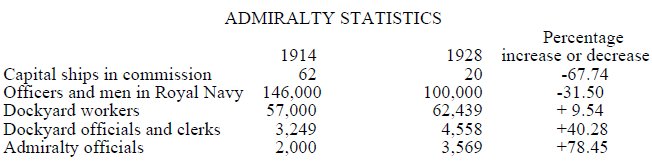
The accompanying table is derived from Admiralty statistics for 1914 and 1928. The criticism voiced at the time centered on the comparison between the sharp fall in numbers of those available for fighting and the sharp rise in those available only for administration, the creation, it was said, of “a magnificent Navy on land.” But that
comparison is not to the present purpose. What we have to note is that the 2,000 Admiralty officials of 1914 had become the 3,569 of 1928; and that this growth was unrelated to any possible increase in their work. The Navy during that period had diminished, in point of fact, by a third in men and two-thirds in ships. Nor, from 1922 onwards, was its strength even expected to increase, for its total of ships (unlike its total of officials) was limited by the Washington Naval Agreement of that year. Yet in these circumstances we had a 78.45 percent increase in Admiralty officials over a period of fourteen years; an average increase of 5.6 percent a year on the earlier total. In fact, as we shall see, the rate of increase was not as regular as that. All we have to consider, at this stage, is the percentage rise over a given period.

Parkinson_Admiralty_Statistics

October 6, 2009

If you can’t believe Xinhua, who can you believe?

Filed under: China, Europe, Media — Tags: , , — Nicholas @ 16:25

Lester Haines had a lot of fun composing this, um, fascinating report from the Chinese news agency, Xinhua:

Chinese media finger Swedish lesbian enclave
Mythical city of Sapphic luuuurv

Chinese media have confirmed what we in the West suspected all along: that concealed in the northern Swedish woods is a city of 25,000 women, many of whom have turned to Sapphic love to satiate their natural Scandinavian sexual desires.

According to news agancy Xinhua, the all-female enclave is called “Chako Paul City”, and was founded in 1820 by a “wealthy widow”. The city is guarded by two blonde sentries who prevent men from entering. Those chaps who do unwisely attempt to force the issue risk being “beaten half to death” by Nordic gender police.

Women, though, are welcome to visit Chako Paul City, which boasts a burgeoning tourist industry with hotels and restaurants catering for international guests. Locals, however, are discouraged from leaving their female paradise, and those who do “are only allowed to re-enter Chako Paul City if they agree to bathe and undertake several other measures designed to ensure that their out-of-town trysts don’t negatively affect the mental state of other women in the town”.

Sounds like an old post in alt.sex.stories.swedish to me . . .

September 26, 2009

British libraries now afraid to lend scissors to patrons

Filed under: Britain, Bureaucracy — Tags: , , — Nicholas @ 16:13

The staff at the Holborn Library in London are apparently very worried about the risk of being attacked by library patrons, so they won’t even lend scissors:

Lorna Watts, 26, a self-employed dressmaker, was turned down at Holborn Library in central London.

She said: “It’s ridiculous — public libraries are supposed to be supportive of small businesses.”

A spokeswoman for Camden Council, which runs the library, has apologised and said it would investigate the incident.

Ms Watts, from Islington, north London, said: “I asked why I couldn’t borrow a pair of scissors and she said, ‘they are sharp, you might stab me’.

“I then asked to borrow a guillotine to cut up my leaflets but she refused again — because she said I could hit her over the head with it!”

The way Britain has been going, I’m surprised they didn’t hit Ms. Watts with an ASBO for the implied threat here: “It’s absurd — there are plenty of heavy books I could have hit her with if I wanted to.”

« Newer PostsOlder Posts »

Powered by WordPress


