Quotulatiousness

March 16, 2010

This is taking nostalgia too far

Filed under: Britain, Food, History, WW2 — Nicholas @ 07:18

Britain survived the second world war partly through the early introduction of rationing — there were too many people to be directly supported from British farms, so food importation was critical. My mother told me that rationing was actually an improvement in basic nutrition for a lot of working class families: they got a wider variety of foods, even if it wasn’t of high quality. George Orwell’s pre-war writing solidly confirms this for miners and their families (probably the best known example is The Road to Wigan Pier).

All this being said, I still think that this is taking nostalgia too far:

I’m intrigued by this Time Out review of Kitchen Front, a restaurant at London’s Imperial War museum that serves accurate re-creations of the (mostly horrible) food eaten in Britain during WWII’s rationing period. Time Out gave it two star for food quality and full marks for accuracy (in the print edition, at least — they haven’t recreated this online). It sounds like a uniquely wonderful and horrible dining experience, especially as the food is prepared by a well-loved firm of caterers who’ve really gotten into the spirit of things.

March 9, 2010

QotD: Early America

Early America enjoyed, perhaps, a little more participatory local democracy than Britain, and had a slightly broader electorate and already the highest standard of living in the world. But the revolution so rapturously mythologized by Jefferson, Thomas Paine, Patrick Henry and others, was really, as Washington, Franklin, Hamilton, Madison and Adams did not forget, a somewhat grubby contest over taxes.

In one of the greatest feats of statesmanship of all history, the Americans, and especially Benjamin Franklin, persuaded the British to expel the French from North America, and then persuaded the French to provide the margin of victory in evicting the British themselves. This precocious manipulation of the world’s two greatest powers by a group of colonists showed astounding finesse and precocity, made more piquant and ironic by the fact that their rebellion was against paying the colonies’ share of the cost of removing the French, and the French were recruited to save the Americans their proportionate share of the cost of their own eviction.

All countries swaddle themselves in myths, and the Americans aren’t more self-indulgent than others; only more successful and operating on the grand scale of a country that in two long lifetimes grew to possess completely unprecedented power and influence in the world.

Even without the great pre-eminence of America, the founders of the country possessed a presentational skill that vastly exceeded the procession of demagogues and lunatics that sent and followed each other to the guillotine in the French Revolution. And they were certainly more persuasive and sophisticated than the British spokesmen for constitutional monarchy.

But their unintended legacy of this gift for theatricality is the endless hyperbole and hucksterism of American materialism and individuality.

Conrad Black, “Send in the clowns”, National Post, 2010-03-09

Opening the door to arbitrary punishment

Cory Doctorow talks about why the proposed “three strikes” internet ban is such a stupid idea:

March 8, 2010

This sounds familiar

Filed under: Bureaucracy, Cancon, Economics, Europe, Government, Greece — Tags: , , — Nicholas @ 17:39

The other day, I wrote:

Once upon a time (and this is becoming long enough in the past to qualify as legend), government work was less well-paid than equivalent work in the private sector. The advantage of taking the lower-paid government job was job security: government workers had a “job for life” and a nice pension at the end of it. Private sector workers got more in the weekly pay, but generally had worse pensions and more uncertainty for long-term employment.

During the last generation or so, this basic trade-off has been lost. Government workers now get better paid than their private sector counterparts, still get practically guaranteed lifetime employment, and not-just-nice-but-very-nice pensions. No wonder governments have become the employer of choice.

Clearly I’m not the only one thinking this way, as Kelly McParland makes a similar pitch:

I like they way they put “bail out” in quotations, as if devoting billions of dollars to the rescue of Greece isn’t really a bail-out. Because in union-land, it isn’t. By definition, everything a unionized worker earns is deserved, because someone, somewhere agreed to pay it — especially workers employed by the government, who make up the bulk of the protesting Greeks. And since they earned it, there’s no reason they should make any sacrifices to help the country avoid economic disaster. No, that’s for little people, who don’t have government jobs.

Canada isn’t Greece, but it’s no healthier here to have a country divided into two classes. Class One: Public sector workers with safe, secure, well-paid jobs it is almost impossible for them to lose, with generous holidays, guaranteed pensions and protection against the economic cycles that prevail in the private sector. Class Two: Everyone else.

It used to be that the people in Class Two had an incentive for risking exposure to economic ups and downs. The pay was generally better, and it was possible to spend an entire career with a successful company and enjoy a pension at the end. Not any more. If events of the past few years have proved anything, it’s that no company is too big to fail, and there’s no guarantee benefits promised when you were hired are likely to be there when you leave. If the pension goes splat, like so many have, you’re on your own.

While the incentive to face the risks of the private sector have diminished, life on the government payroll has never been better. After all those nasty cutbacks imposed by Finance Minister Paul Martin, the Conservatives were elected in 2006, and have been spending wildly ever since. All the staff reductions have been reversed and the public payroll is bigger than ever. Salaries have largely caught up with private sector levels, and the pensions are just as rock solid as they’ve ever been. And you can’t be fired, short of indictment for murder.

At some point (and that point may be sooner than anyone believes), growth in civil service has to stop: there won’t be enough non-civil service jobs to pay for all the rest. Especially as government jobs become more and more attractive over their private sector counterparts. Why not take a job paying more money, with longer vacations, guaranteed pensions, and no risk of losing the job? You’d be crazy to take a job anywhere else, wouldn’t you?

March 5, 2010

The winds of change: UK’s Met Office to abandon seasonal forecasts

Filed under: Britain, Environment, Media — Tags: , — Nicholas @ 09:01

You’d almost think someone was paying attention. Britain’s Met Office has given up providing seasonal forecasts:

The Met Office is to stop publishing seasonal forecasts, after it came in for criticism for failing to predict extreme weather.

It was berated for not foreseeing that the UK would suffer this cold winter or the last three wet summers in its seasonal forecasts.

The forecasts, four times a year, will be replaced by monthly predictions.

The Met Office said it decided to change its forecasting approach after carrying out customer research.

Explaining its decision, the Met Office released a statement which said: “By their nature, forecasts become less accurate the further out we look.

That last point is why, in years gone by, newspapers used to have much amusement contrasting official weather forecasts with non-scientific publications like the Old Farmer’s Almanac, where just often enough to be newsworthy, the annual’s predictions were more accurate than those provided by “real weathermen”.

March 4, 2010

How to tell when the bureaucracy has won

Filed under: Britain, Bureaucracy — Tags: , , , — Nicholas @ 12:52

It’s when you have 18 firefighters standing around for six hours debating about whether the rules allow them to rescue a dying woman:

An injured woman lay for six hours at the foot of a disused mine shaft because safety rules banned firefighters from rescuing her, an inquiry heard yesterday. As Alison Hume was brought to the surface by mountain rescuers she died of a heart attack.

A senior fire officer at the scene admitted that crews could only listen to her cries for help, after she fell down the 60ft shaft, because regulations said their lifting equipment could not be used on the public. A memo had been circulated in Strathclyde Fire and Rescue stations months previously stating that it was for use by firefighters only.

The Scotsman has more:

During the hearing, solicitor Gregor Forbes asked Mr Rooney: “On the basis of the manpower and equipment that you had available, is it your view it would it would have been possible for the firefighters to have brought the person to the surface before the mountain rescue team?”

He replied: “Yes, I believe so.”

The now-retired fire officer said the memo had been circulated around Strathclyde Fire and Rescue stations in March 2008.

Mr Forbes said: “Your position is that, while you were supplied with safe working-at-height equipment, while this could be used to bring up firefighters, it could not be used to bring up a member of the public.”

Mr Rooney, 51, told the inquiry at Kilmarnock Sheriff Court: “Yes, that’s correct.”

All 18 firefighters at the scene were trained and capable of using the equipment, he added.

Of the memo four months before the incident, he was then asked: “If Mrs Hume had fallen down the shaft on 13 March, instead of 26 July, you could have used a lowering line?”

Mr Rooney replied: “We could have.”

I lack words to express my outrage and disgust with the “men” who allowed themselves to be restrained by a memo in this situation.

H/T to Natalie Solent for the link.

March 1, 2010

UK Photographers . . . act now, or lose your rights

Filed under: Britain, Law, Liberty — Tags: , , , , — Nicholas @ 15:52

Philip Dunn has all the bad news, photography-wise:

Photographers to lose copyright protection of their work

This startling and outrageous proposal will become UK law if The Digital Economy Bill currently being pushed through Parliament is passed. This Bill is sponsored by the unelected Government Minister, Lord Mandelson.

Let’s look at the way this law will affect your copyright:

The idea that the author of a photograph has total rights over his or her own work — as laid out in International Law and The Copyright Act of 1988 — will be utterly ignored. If future, if you wish to retain any control over your work, you will have to register that work (and each version of it) with a new agency yet to be set up.

I had wondered where Lord Mandelson had picked up his “of Mordor” sobriquet. Now I know. Oh, and it gets even worse:

Photographers are to lose all effective rights to take photographs in public places.

Not content with taking away photographer’s copyright, another section of this Government is proposing sweeping changes to your freedom to take pictures in public places.

The Information Commissioner’s Office (ICO) has deemed that a photograph taken in a public place may now be considered to contain ‘private data’.

This means that if you take a picture in the street and there is a member of the public in the shot, that person has the right to demand either payment — if you wish to publish the image — or that you do not publish it. In fact, according to the ICO. There does not actually have to be an objection, it is up to the photographer to ‘judge’ whether the subject might object. Now work that one out if you can.

You may think this won’t affect you . . . but if you’ve got a camera in your cell phone or MP3 player, it’s going to have an impact. Contact your MP now and explain that you don’t approve of this drastic change in the law and try to get it tossed out before it becomes law.

Russia expects . . . the coaches to fall on their swords now

Filed under: Politics, Russia, Sports — Tags: , — Nicholas @ 12:51

Apparently, the Russian government is taking the relatively poor showing by the country’s Olympic team very seriously. The “fat cats” who were responsible for training the athletes have been ordered to resign or “we will help them”:

President Medvedev said those who trained the Russian team before the Vancouver games should “have the courage to step down” as a result of Russia’s woeful medals tally. If they refused to resign “we will help them”, he said bluntly.

Over the weekend Medvedev abruptly cancelled a scheduled visit to last night’s closing ceremony, apparently in disgust. “We must drastically change the training of our athletes . . . We have been living on Soviet resources for a long time. But that is over now,” Medvedev told the ruling United Russia Party.

He added: “Unprecedented investments are being made in sports in Russia. But money is not everything. We should think about changing the training methods. The new training system must focus on athletes rather than on fat cats.”

Opposition politicians demanded the sacking of the sports minister, Vitaly Mutko, and Russian Olympic committee president Leonid Tyagachyev, both close allies of Putin. The pair were antiheroes, the Moskovsky Komsomolets newspaper said, ridiculing Tyagachyev’s Panglossian prediction Russia would finish in the top three.

It would probably be wise for the so-called “fat cats” to get out while they can. An embarassed Russian government will probably not be acting with grace or tact.

February 26, 2010

US Navy SEAL teams to use British mini-sub

Filed under: Britain, Military, Technology, USA — Tags: , , — Nicholas @ 12:53

Lewis Page discovers that the latest minisub for the US Navy’s SEAL teams is actually made in Britain:

A groundbreaking new miniature submarine in use by the US Navy’s secretive, elite frogman-commando special operations force was actually designed and built in old Blighty, the Reg can reveal.

We reported first on the S301 mini-sub two weeks ago, noting from federal documents that the famous US Navy SEALs had leased a demonstration model for “doctrinal, operational, and organizational purposes”. This was followed up last week by the Honolulu Advertiser, which had spoken to Submergence Group, the American firm listed by the US government as provider of the S301.

It emerged that the S301 — now in trials with the SEALs in Hawaii — had cost just $10m to develop, which contrasted especially well with the $885m+ spent on the ill-fated Advanced SEAL Delivery System (ASDS).

The ASDS, from US defence behemoth Northrop Grumman, had been intended to supersede the SEALs’ current Mark 8 Mod 1 minisubs, which are carried in a “Dry Deck Shelter” (DDS) airlock docking bay fitted to a full-sized US Navy nuclear submarine — either a normal attack boat or an Ohio-class dedicated Stingray-style special-ops mothership. The Ohios, nuclear missile subs retired from their old job under arms-reduction treaties, have space aboard for a large force of SEALs and pack a powerful armament of conventional-warhead cruise missiles for precision shore bombardment.

February 24, 2010

Make up your minds!

Filed under: Germany, History, Military, USA — Tags: , , , — Nicholas @ 07:17

American soldiers have been accused of being too “egg-headed” in their approach to war, with much being made about the constant upgrading of equipment with newer electronic and computerized gizmos. But it’s not what it seems — now a New York Times Idea of the Day blogger says the US military has a “fetish” for Wilhelmine and Hitlerian Germany:

“Why do people have a fixation with the German military when they haven’t won a war since 1871?”

That’s the Tom Clancy quote William J. Astore uses to begin this essay on TomDispatch (picked up by Mother Jones), renewing a critique of what some see as a Clausewitz cult among American military strategists.

Mr. Astore, a former Air Force Academy history instructor (and Wehrmacht buff as a boy), says “the American military’s fascination with German military methods and modes of thinking” is reflected outwardly in busts of Clausewitz on display American military academies, and more tangibly in echoes of the Blitzkrieg in the first and second Iraq wars:

In retrospect, what disturbs me most is that the military swallowed the Clausewitzian/German notion of war as a dialectical or creative art, one in which well-trained and highly motivated leaders can impose their will on events. In this notional construct, war became not destructive, but constructive. It became not the last resort of kings, but the preferred recourse of “creative” warlords who demonstrated their mastery of it by cultivating such qualities as flexibility, adaptability and quickness. One aimed to get inside the enemy’s “decision cycle” . . . while at the same time cultivating a “warrior ethos” within a tight-knit professional army that was to stand above, and also separate from, ordinary citizens.

There were lots of things that western armies could profitably learn after 1945 from German tactical and operational models. There was no intrinsic reason why small German units fought better and more effectively than their allied opponents, in spite of Nazi propaganda, there was no “racial” strength that made German soldiers better at their trade than other nations. Remember that a lot of “German” soldiers were Austrians, Poles, Czechs, Slovaks, and other allied or conquered peoples.

German soldiers were better trained, and had much greater tactical autonomy, which gave them more flexibility and encouraged improvisation at all levels. Western armies were much more hierarchical and didn’t delegate decision-making to lower ranks. That alone made German battalions, companies, and platoons far more dangerous: when things didn’t go according to the detailed plan, they adapted and still tried to accomplish their assigned mission. British, French, and (especially) Soviet units were not rewarded for departing from their (inevitably) more detailed orders.

Non-military critics may easily assume that trying to learn anything from the Kaiser’s army or Hitler’s army carries a moral taint, but paradoxically, those soldiers — fighting for an authoritarian or dictatorial government — had more tactical freedom than Allied soldiers who could vote (and whose votes actually mattered).

February 23, 2010

BBC accused of bias in euthanasia debate

Filed under: Britain, Health, Liberty, Media — Tags: , , , , , — Nicholas @ 13:00

The BBC’s decision to broadcast Terry Pratchett’s speech on euthanasia tribunals is cited as evidence that the corporation is acting as an advocate on this highly emotional issue:

The Care Not Killing Alliance accused the BBC of flouting impartiality rules and adopting a “campaigning stance” in an attempt to step up pressure on the Government to legalise assisted suicide.

The decision to broadcast Sir Terry Pratchett’s speech advocating “euthanasia tribunals” in full earlier this month was an example of unbalanced reporting, the alliance claimed.

Lord Carlile, chairman of the alliance and the Government’s independent reviewer of terror legislation, has demanded a meeting with BBC bosses to seek answers over the “biased” coverage.

In a letter to Sir Michael Lyons, the chairman of the BBC trust, the Liberal Democrat peer also raised questions over the corporation’s failure to inform police that a veteran presenter had confessed to killing his lover on one of its programmes.

H/T to Elizabeth for the link.

Statistics can tell a lot . . . but not always truthfully

Filed under: Cancon, Economics, Europe — Tags: , , , , — Nicholas @ 12:46

Brian Lilley looks at a recent report which critiques the federal government’s claim that women earn only 84% of the wages that men earn. The report uses a different set of statistics to show that women only earn 70 cents for every dollar a man earns in Canada:

Were this true it would be a shocking and appalling state of affairs, the type of thing that government regulations must be called upon to rectify. I truly do not know anyone who would advocate that a man earn 42% more than a woman for working the same job, for the same number of hours. Of course this is not the case.

The report, dubbed a reality check by its authors, looks at the government’s claim that women earn 84 cents for every dollar a man makes and they dismiss it. Their reason for doing so? The government does not use the correct data. In the government report, the 84 cents on the dollar claim is arrived at by looking at wages on a dollar per hour basis using Statistics Canada’s July 2008 Labour Force Survey. In July of 2008 women earned an average of $19.14 per hour while men earned an average of $22.80 per hour, thus the 84 cents on the dollar figure.

In any argument over statistics, the chosen measurement is always the one that best supports your argument. This is fair play, when the statistics are comparable. It isn’t when your choice of stat measures something quite different:

The collective report by the labour and activist groups does not use dollar per hour compensation to show that women earn less than men, they use total year compensation. It is easy to understand why the group uses this formula, it will always show that women are being discriminated against while the other formula is showing improvements. A quick look at Stats Canada’s monthly Labour Force Survey shows one reason why men make more money than women; they work more hours. While this may not justify a difference in hourly wages, it would justify a difference in year end compensation. In the report cited by the government, men worked an average of 38.7 hours per week, a full five hours more than women who clocked in for 33.7 hours. For full-time workers, rather than all workers combined, there was still a difference, men working 40.7 hours per week to 38 hours for women. In reviewing several months of these reports over the past two years a consistent pattern emerges, men in full-time jobs work two to three hours more per week than women.

There may still be parts of the economy where male bosses or business owners irrationally discriminate against women (equally, there may be other forms of prejudice in play). Where laws exist to prohibit this, they should be enforced. However, trying to paint the numbers to show discrimination where it does not exist does not help anyone, and it makes it harder to achieve truly equal rights.

Update, 21 October: Ilkka at The Fourth Checkraise mentioned a related story from Finland:

Speaking of the male-female wage gap, I don’t know how I could forget the recent study by the Finnish emeritus researcher (who is thus free to speak his mind) Pauli Sumanen about this very issue. It concluded that Finnish men earn more on average (again, not the median) than Finnish women simply because they work more: if you control for actual hours worked, women get paid more than men so that a woman’s euro is not 80 cents but closer to 104. And if you look at the net salaries after the heavily progressive taxation, and include the fact that women live and receive pensions seven years longer on average (Finnish women pay 45% of total health care costs yet use 59% of health care), these numbers become vastly more dramatic for women.

More market-rigging to favour Government Motors

Filed under: Economics, Germany, Law, USA — Tags: , , , — Nicholas @ 07:09

If you’re a fan of German sports cars, this might be a swan song for your preferred makes and models:

In a few years, by 2016 to be exact, P.J. O’Rourke’s “ass-engined Nazi slot car” may be history in the U.S.A. Gone. By that time, Porsche needs to have a Corporate Average Fuel Economy (CAFE) of 41.4 mpg — if President Obama gets his wish. Mission impossible, says Porsche. Jack Baruth, stock up. Porsches will be extinct.

On May 19, 2009 President Barack Obama proposed a new national fuel economy program. If signed into law in May this year, as currently planned, the law will throw a nasty punch, beginning in the model year 2012.

Porsche-Lobbyist Stefan Schläfli talked to the German Edition of the Financial Times, before taking off for Washington for a last ditch effort to save the endangered species. Says the FTD: “Hardest hit will be German producers of premium brands which sell big-engined large cars. Critics in the German camp don’t think this is a coincidence. The formulas used to calculate the maximum permissible values are tailor-made for U.S. manufacturers. Basis for the calculation will be wheel base and track width — highly unusual criteria.”

A short and compact Porsche is faced with much stricter limits than a Corvette. Not to mention a pick-up. Large manufacturers turn into a CAFE-society, and can offset their thirsty oinkers with smaller cars. Porsche doesn’t have that option. Neither does Aston Martin, Jaguar, Land Rover and other eclectic brands.

Now that the government has a major financial stake in GM and Chrysler, they don’t even need to pretend to be even-handed in their regulatory fixes.

February 19, 2010

Bosworth Field, real location now made public

Filed under: Britain, History — Tags: , , — Nicholas @ 12:12

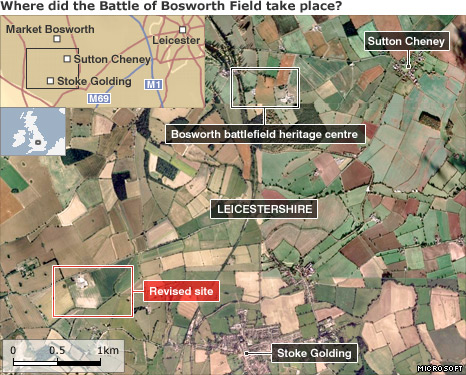
As I mentioned back in October, archaeologists have located the actual site of the Battle of Bosworth Field in 1485. Now that they’ve had time to do more research and examination, they’ve gone public with the location:

The true site of one of the most decisive battles in English history has been revealed.

Bosworth, fought in 1485, which saw the death of Richard III, was believed to have taken place on Ambion Hill, near Sutton Cheney in Leicestershire.

But a study of original documents and archaeological survey of the area has now pinpointed a site in fields more than a mile to the south west.

A new trail will lead from the current visitor centre to the new location.

[. . .]

The original announcement was made in October but the exact location was kept a secret until now to protect it from treasure hunters.

Researchers also believe they have identified the medieval marsh where Richard III was dragged from his horse and killed.

February 18, 2010

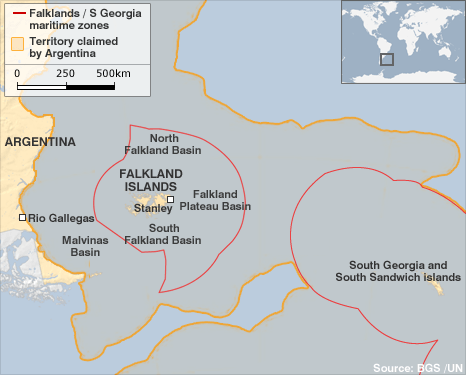
MoD denies reports that Falklands naval presence to be reinforced

Filed under: Americas, Britain, Military — Tags: , , — Nicholas @ 07:21

The BBC reports on British military preparations in the Falklands, after Argentina imposed tighter controls on the seas around the islands:

The UK has made “all the preparations that are necessary” to protect the Falkland Islands, Prime Minister Gordon Brown has said.

Argentina has brought in controls on ships passing through its waters to the islands over UK plans to drill for oil.

Shadow foreign secretary William Hague told the BBC the Royal Navy’s presence in the region should be increased.

The Ministry of Defence has denied reports a naval taskforce is on its way to the Falklands.

While it’s unlikely that we’ll see a re-run of the 1982 Falkland war, recall that it was a reduction in British force in the region that gave Argentina’s military junta the opportunity to invade. Britain appears to have learned from that mistake.

« Newer PostsOlder Posts »

Powered by WordPress