By way of Tim Harford’s Twitter feed, a blog devoted to what the current street fashion is in Helsinki:



By way of Tim Harford’s Twitter feed, a blog devoted to what the current street fashion is in Helsinki:
By way of A Blog About History, a story about a valuable set of over 400 photographs of the Sutton Hoo excavations:
Like the original ship burial, this remarkable find has laid unseen and forgotten for a long time. Tucked away in a dusty storeroom were a couple of fairly nondescript cardboard boxes.
Inside these unprepossessing packages were a photographic treasure trove which sheds new light on the discovery and the excavation of the Sutton Hoo ship burial.
Inside the boxes were more than 400 photographs taken during the summer of 1939 by two visiting school teachers Barbara Wagstaff and Mercie Lack.
It is believed that they had contacts with The British Museum which is why they were given access to the site but very little is known about them.
They took more than 400, highly detailed photographs of the dig — far more than the 29 official shots taken by the British Museum photographer.
The pictures have laid forgotten until now; as a selection of them are forming the centrepiece of a new exhibition at Sutton Hoo.
It’s hard to believe that the British Museum didn’t have a more comprehensive formal photographic record of the excavations.
The last Harrier takes off from HMS Ark Royal earlier today:
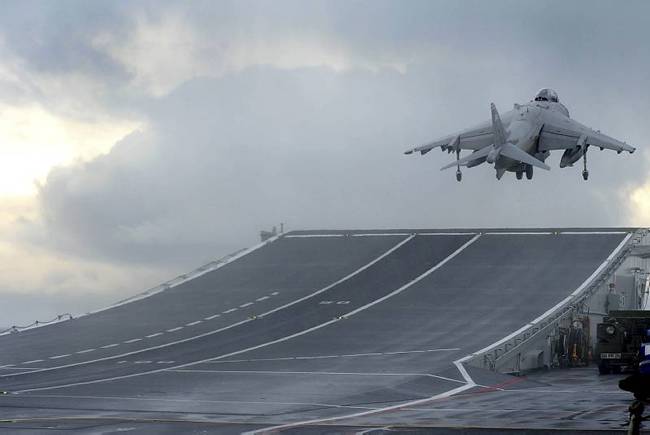
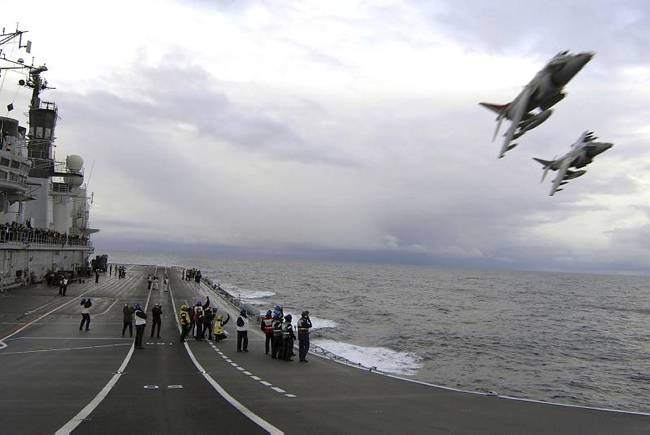
Lt. Cdr. James Blackmore was the last Harrier pilot to launch from HMS Ark Royal, noting that “this is truly a memorable day.” But as it is never a good idea to tell your bosses they are a bunch of idiots, he also adds that “we accept the decision to decommission both the Harrier and HMS Ark Royal; however, of course the final launch will be emotional.”
More information at Aviation Week.
Remember the Royal Navy’s latest destroyer, the Type 45? It’s the one without effective main armament. As if that wasn’t bad enough, the lead ship of the class, HMS Daring, broke down at sea recently:
The Royal Navy’s new Type 45 destroyers continue to suffer from technical mishaps, with first ship of the class HMS Daring arriving a week late in Portsmouth on Saturday following emergency propulsion repairs in Canada. The £1.1bn+ ship had previously broken down in mid-Atlantic.
The News of Portsmouth reported on the breakdown and the destroyer’s delayed return to its home port, noting that a similar propulsion problem had occurred just four months previously during an outing in the Solent for families of the ship’s company.
[. . .]
The Type 45s’ hulls and some of their kit — for instance the fire-control radar — are made in Britain but much of the colossal expense of the ships has gone on equipment from the US, Italy and France. Particularly well-known are their French-made Aster air-defence missiles, which have been delayed for several years following repeated failures in test-firings caused by a manufacturing fault.
The UK Public Accounts Committee went so far to describe the missile-system, named “Sea Viper” in British service, as “disgraceful” in 2009 … and that was before the most recent test failure. However the flaws in the Aster missiles are now reportedly rectified and successful firings have since taken place. The UK Ministry of Defence expects to declare its first Sea Viper system operational next year: until then, the Type 45 destroyers will continue to be almost unarmed, able to employ only basic guns and cannon.*
[. . .]
*Apart from Sea Viper, the only armament possessed by a Type 45 is a single 4.5-inch “Kryten” gun turret, primarily useful for bombarding targets ashore (within a few miles of deep water) and two light 30mm cannon for close-in work against pirate dhows or the like.
Sea Viper will not enhance the destroyers’ abilities against other ships or land targets when it becomes operational as it has no surface-to-surface mode. It is said to be superior to any other system against missiles and aircraft, perhaps even offering an effective defence against widely-feared shipkiller missiles of Russian manufacture which approach their target at supersonic speeds. However Aster/Sea Viper has never been tested against a supersonic target and there are no plans to do so, which means that any battle plan based on such a capability would be a gutsy call indeed.
As you can tell, Lewis Page isn’t a fan of the Type 45 destroyers . . .
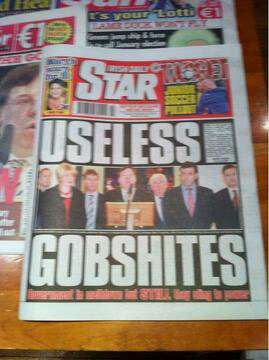
From Andrew Bloch’s Twitpic page and brought to my attention by Damian Penny.
If there was one trade show in Britain you’d be certain that The Register would cover, it would have to be Erotica 2010:
Whether it was the cold or the recession, Erotica 2010 – the 15th year of the international sex exposition – appears to have ever so slightly wilted.
It is not exactly shrivelled, but is a little smaller; not the proud, thrusting standard-bearer of the UK’s adult erotic industry it once was.
A quick totting up through the programme suggests around 20 fewer exhibitors than two years ago.
[. . .]
Yet again, a glittering procession of acts — from pole dancers to zentai dolls — took to the stage at the heart of the show, with pride of place for the inimitable Dita von Teese. Sadly, we are unable to bring you any pictures of her act, under pain of a penalty fee of $1m, which all journalists were required to agree to before entering the hall!
Ed West responds to reader complaints about a recent column:
The conventional definition of racism is the belief that “race” (however one defines that) is a primary or significant cause of differences between men; that some of these races are superior to others; and that it is acceptable to discriminate on grounds of race, or to behave unpleasantly to someone because of their race. The term dates to the 1930s, although “racialist” and “racialism” go back to the Edwardian period.
“Anti-racism” means something altogether different, and is best explained by the Civitas book Racist Murder and Pressure Group Politics, an account of the Salem-like events that gripped Britain in the 1990s. The authors cite the example of the Central Council for Education and Training in Social Work (CCETSW), which in 1991 set out the implementation of its new Diploma in Social Work.
The first tenet was “the self-evident truth” that “racism is endemic in the values, attitudes and structures of British society”.
The training manual then stated “steps need to be taken to promote permeation of all aspects of the curriculum by an anti-racist analysis”. All “racist materials” had to be withdrawn from the syllabus and CCETSW would decide what was racist.
In the rules there would be no freedom of speech for opinions that can be constructed as “racist” or favourable to “racism”, and “anti-racist practice requires the adoption of explicit values”. The first value is that individual problems have roots in “political structures” and “not in individual or cultural pathology”. (In other words, if different groups have different outcomes in terms of education or crime levels, it is all the fault of British racism, not of individuals).
A second value is that racial oppression and discrimination are everywhere to be found in British society, even when invisible. In other words, impossible to disprove!
Gotta love those unbridled opinions in British politics:
A peer and former defence minister has described the A400M military transport plane — which is being bought by the cash-strapped UK armed forces for a secret but outrageous amount of money — as a “Euro-wanking make-work project” in the written Parliamentary record.
The straight talk came from Lord Gilbert, who held various ministerial portfolios in the 1970s – including a defence one – and did another spell in the MoD as a peer in the first years of the Blair government. Last week he made the following remarks in the House of Lords:
I regard the decision on the A400M as the most bone-stupid in the 40 years that I have been at one end or other of this building. It is an absolutely idiotic decision. We have a military airlift fleet of C-17s and C-130s. We have total interoperability with the United States… six or seven countries altogether will be flying the A400M. Flying the C130, which it is intended to replace, are 60 countries, with 2,600 or so C130Js currently being used. That is the interoperability that we are losing…
Tabloid headline is in this case completely justified:
Organs of nuclear workers secretly harvested for 40 years, report finds
The families of scores of nuclear power station workers whose hearts, lungs and other organs were secretly stored and tested over a period of almost 40 years were let down by the authorities, a report said yesterday.Relatives were seldom told that their loved ones’ organs were to be removed, and as a result families buried or cremated incomplete bodies.
In many cases the truth that their organs had been illegally removed and then destroyed in the testing process emerged only many years later.
The three-and-a-half year investigation conducted by Michael Redfern, QC, covered events spread over almost four decades.
This is the sort of thing that retroactively justifies some of the weird paranoias of the last fifty years. It becomes more difficult to dismiss worries that “they” are doing shady and unethical stuff when it turns out that that’s exactly what they’ve been doing.
A good round-up of the “Twitter bomber” case:
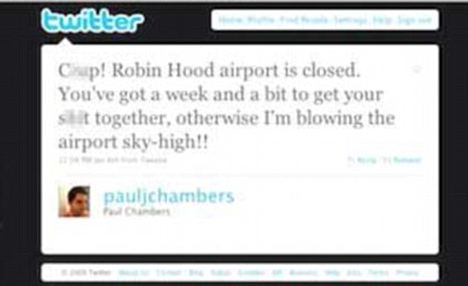
It all started with a moment of grumpy sarcasm on Twitter. Frustrated that his planned trip to Northern Ireland was put in jeopardy by heavy snow at Robin Hood Airport in Doncaster, Mr Chambers whipped out his iPhone and posted the following message on the social networking site: ‘C***! Robin Hood Airport closed. You have got a week to get your s*** together, otherwise I’m blowing the airport sky high!’
A week later, he was in a police station being quizzed as a potential terrorist. He was eventually prosecuted under a law aimed at nuisance calls rather than under legislation for bomb hoaxes, which requires stronger evidence of intent.
After all, it was plain as a pikestaff that Mr Chambers didn’t have any intent to bomb anything at all. Even so, he was hauled before magistrates, found guilty of sending a menacing electronic communication and fined £385. A few days ago, Mr Chambers lost his appeal against his conviction and sentence.
He will now have to pay £2,600 legal costs as well. Judge Jacqueline Davies, who was sitting with two magistrates, ruled the tweet was ‘menacing in its content and obviously so’, claiming ‘any ordinary person’ would ‘be alarmed’ by it.
Christopher Booker says that Britain’s bureaucracy to look out for the interests of children is badly off-mission:
For parents who fall foul of this system, often on no more evidence than malicious hearsay, the first shock is to find themselves treated like dangerous criminals. To seize children, social workers seem able to enlist the unquestioning support of the police, who arrive mob-handed, six or eight at a time, beating down doors, tearing babies from their mothers’ arms, holding parents in custody for up to 36 hours while their children are removed into foster care.
The parents must then wrestle with a Kafka-esque system rigged against them in every way. They find themselves in courts where every normal principle of British justice has been stood on its head. Social workers may give written evidence to a judge which the parents aren’t allowed to see. The most outrageous hearsay evidence may be accepted by the court without the parents even being allowed to cross-examine on it.
A key part is played by evidence from supposed “experts”, psychiatrists or paediatricians who may be paid up to £35,000 for their reports, and who receive regular work from the social workers involved. Parents are forbidden to call their own independent experts to challenge a case made against them. They are, all too often, pressured into being represented by lawyers who, again, work regularly for the council, who fail to put their case and who turn out to be just part of the same system.
Parents may be forbidden to testify on their own behalf, but must listen for hours, even days, to everyone else involved — including their own lawyers — putting what amounts to a case for the prosecution. The guardian appointed to represent the interests of the child may never have met the child and merely endorses whatever the social workers say.
Not surprisingly, these bizarre practices are so geared to the interests of a corrupted system that, in the latest year for which we have figures (2008), of 7,340 applications for care orders made by social workers, only 20 were refused.
Meanwhile, the children themselves are handed over to foster homes, which receive £400 a week or £20,000 a year for each child, and where many are intensely unhappy and not infrequently abused. Foster carers and social workers routinely conspire to tell bewildered children that their parents neither love them nor want them back. Children and parents meet at rigorously supervised “contact sessions”, where any expression of affection or attempt to discuss why the children have been taken from home may be punished by termination of the session or denial of further contact.
If you remember the foofaraw about the ten Russian sleeper agents who were in the news earlier this year, Strategy Page says they were actually unmasked long before it became public knowledge:
According to Russian officials, the ten Russian spies arrested in the United States last June were betrayed by a Russian espionage official (identified only as “colonel Shcherbakov”) in the SVR (Russian CIA). The U.S. claimed they had been watching the ten sleepers for several years, which may indicate that Shcherbakov has revealed a lot more if he was on the American payroll all that time. Shcherbakov was in charge of the SVR sleeper cell operation. The Russians use military ranks in the police and intelligence services, and colonels are middle-management. There is political pressure to on the head of SVR to resign, indicating that the damage was greater than anyone wants to admit.
Last July, after Shcherbakov was safely in the U.S., American and Russian officials conducted a spy swap in Vienna, Austria. This was the largest such swap since the Cold War. Russia pardoned and freed four Russians, including two former intel officers who had revealed the identities of numerous Russian agents in the West. These two are believed to have more information and insights of value. The U.S. released the ten Russians who had, for the last decade, been trying to pass themselves off as Americans, and operate as “illegals” (spies without diplomatic cover and protection). As part of the deal, the ten Russians had to admit their guilt. The FBI said that they caught on to this bunch early on, and have been watching them for years, trying to obtain more information on how Russian espionage operate in the United States. The FBI finally arrested these ten when it became apparent that the Russians had detected that they were being watched. Or because colonel Shcherbakov believed his SVR bosses were on to him, or because the colonel believed it was time to retire to that secret condo in the United States. Russian government officials are indicating that SVR assassins have been sent to kill Shcherbakov.
Some have speculated that these agents were actually just a cover for “real” sleeper agents who were doing actual espionage work — it’s as viable an explanation as the SVR deliberately placing ineffective agents.
The Economist sums up the arguments in favour of retaining the Harrier over the RAF’s preferred Tornado:
Francis Tusa of Defence Analysis, a newsletter, reckons that retiring the much more maintenance-heavy Tornados instead of the Harriers would have saved £4 billion-5 billion, while keeping Ark Royal going would cost only about £120m a year. He adds that getting out of the strike-carrier business for ten years means that critical skills will be lost. Others, including the letter’s authors, fear that the “carrier gap” will mean Britain loses the ability to carry out autonomous expeditionary missions. Among other things, that would, they say, leave the Falkland Islands (and their valuable oilfields) vulnerable to attack.
What appears to have changed the new (and inexperienced) National Security Council’s mind at the last moment was the air force’s claim that the Tornado was more effective than the Harrier in Afghanistan. It is odd that this was regarded as a clinching argument, as there are more than enough jets in Afghanistan. It is true that in terms of range, payload, speed and its ability to hit moving targets, the Tornado wins. On the other hand, the Harrier can operate from makeshift landing sites, is more flexible and reliable and could easily be equipped with the advanced Brimstone anti-tank missiles carried by the Tornado. And for five months of the year in Afghanistan, when the weather is hot, the Tornado can only take off with a similar weapons load to the Harrier.
The RAF’s enthusiasm for the Tornado is understandable. It does not have to share it with the navy (the Harrier is operated by a Joint Strike Wing) and it needs a lot more people to operate it (saving air-force jobs). Mr Tusa suggests a sensible compromise that would still save billions of pounds: get rid of half the Tornados, keeping 60 until they are not needed in Afghanistan; retain 20 Harriers for carrier duty until their replacements arrive in 2020; and accelerate the deployment of the strike version of the Typhoon. Time for a rethink.



Powered by WordPress