
There was in the man a certain instinctive antipathy to the concrete aristocrat and in particular to the aristocrat’s private code — the product, no doubt, of his essentially bourgeois origin and training. But if he could not go with the Junkers all the way, he could at least go the whole length of their distrust of the third order — the undifferentiated masses of men below. Here, I daresay, he owed a lot to Nietzsche. He was always reading German books, and among them, no doubt, were Also sprach Zarathustra and Jenseits von Gut und Bose. In fact, the echoes were constantly sounding in his own harangues. Years ago, as an intellectual exercise while confined to hospital, I devised and printed a give-away of the Rooseveltian philosophy in parallel columns — in one column, extracts from The Strenuous Life; in the other, extracts from Nietzsche. The borrowings were numerous and unescapable. Theodore had swallowed Friedrich as a peasant swallows Peruna — bottle, cork, label and testimonials. Worse, the draft whetted his appetite, and soon he was swallowing the Kaiser of the Garde-Kavallerie-mess and battleship-launching speeches — another somewhat defective Junker. In his palmy days it was often impossible to distinguish his politico-theological bulls from those of Wilhelm; during the war, indeed, I suspect that some of them were boldly lifted by the British press bureau, and palmed off as felonious imprudences out of Potsdam. Wilhelm was his model in Weltpolitik, and in sociology, exegetics, administration, law, sport and connubial polity no less. Both roared for doughty armies, eternally prepared — for the theory that the way to prevent war is to make all conceivable enemies think twice, thrice, ten times. Both dreamed of gigantic navies, with battleships as long as Brooklyn Bridge. Both preached incessantly the duty of the citizen to the state, with the soft pedal upon the duty of the state to the citizen. Both praised the habitually gravid wife. Both delighted in the armed pursuit of the lower fauna. Both heavily patronized the fine arts. Both were intimates of God, and announced His desires with authority. Both believed that all men who stood opposed to them were prompted by the devil and would suffer for it in hell.
If, in fact, there was any difference between them, it was all in favor of Wilhelm. For one thing, he made very much fewer speeches; it took some colossal event, such as the launching of a dreadnaught or the birthday of a colonel-general, to get him upon his legs; the Reichstag was not constantly deluged with his advice and upbraiding. For another thing, he was a milder and more modest man — one more accustomed, let us say, to circumstance and authority, and hence less intoxicated by the greatness of his state. Finally, he had been trained to think, not only of his own immediate fortunes, but also of the remote interests of a family that, in his most expansive days, promised to hold the throne for many years, and so he cultivated a certain prudence, and even a certain ingratiating suavity. He could, on occasion, be extremely polite to an opponent. But Roosevelt was never polite to an opponent; perhaps a gentleman, by American standards, he was surely never a gentle man. In a political career of nearly forty years he was never even fair to an opponent. All of his gabble about the square deal was merely so much protective coloration, easily explicable on elementary Freudian grounds. No man, facing Roosevelt in the heat of controversy, ever actually got a square deal. He took extravagant advantages; he played to the worst idiocies of the mob; he hit below the belt almost habitually. One never thinks of him as a duelist, say of the school of Disraeli, Palmerston and, to drop a bit, Blaine. One always thinks of him as a glorified longshoreman engaged eternally in cleaning out bar-rooms — and not too proud to gouge when the inspiration came to him, or to bite in the clinches, or to oppose the relatively fragile brass knuckles of the code with chair-legs, bung-starters, cuspidors, demijohns, and ice-picks.
Abbott and Thayer, in their books, make elaborate efforts to depict their hero as one born with a deep loathing of the whole Prussian scheme of things, and particularly of the Prussian technique in combat. Abbott even goes so far as to hint that the attentions of the Kaiser, during Roosevelt’s historic tour of Europe on his return from Africa, were subtly revolting to him. Nothing could be more absurd. Prof. Dr. Sherman, in the article I have mentioned, blows up that nonsense by quoting from a speech made by the tourist in Berlin — a speech arguing for the most extreme sort of militarism in a manner that must have made even some of the Junkers blow their noses dubiously. The disproof need not be piled up; the America that Roosevelt dreamed of was always a sort of swollen Prussia, truculent without and regimented within. There was always a clank of the saber in his discourse; he could not discuss the tamest matter without swaggering in the best dragoon fashion.
H.L. Mencken, “Roosevelt: An Autopsy”, Prejudices, part 2, 1920.
February 16, 2014
QotD: Theodore Roosevelt’s admiration for Imperial Germany
January 20, 2014
Addressing commonly held beliefs about the First World War
BBC News Magazine has an article by Dan Snow discussing some commonly held beliefs about the First World War:
3. Men lived in the trenches for years on end
Front-line trenches could be a terribly hostile place to live. Often wet, cold and exposed to the enemy, units would quickly lose their morale if they spent too much time in them.
As a result, the British army rotated men in and out continuously. Between battles, a unit spent perhaps 10 days a month in the trench system, and of those, rarely more than three days right up on the front line. It was not unusual to be out of the line for a month.
During moments of crisis, such as big offensives, the British could occasionally spend up to seven days on the front line but were far more often rotated out after just a day or two.
4. The upper class got off lightly
Although the great majority of casualties in WW1 were from the working class, the social and political elite was hit disproportionately hard by WW1. Their sons provided the junior officers whose job it was to lead the way over the top and expose themselves to the greatest danger as an example to their men.
Some 12% of the British army’s ordinary soldiers were killed during the war, compared with 17% of its officers. Eton alone lost more than 1,000 former pupils – 20% of those who served. UK wartime Prime Minister Herbert Asquith lost a son, while future Prime Minister Andrew Bonar Law lost two. Anthony Eden lost two brothers, another brother of his was terribly wounded and an uncle was captured.
[…]
7. Tactics on the Western Front remained unchanged despite repeated failure
Never have tactics and technology changed so radically in four years of fighting. It was a time of extraordinary innovation. In 1914 generals on horseback galloped across battlefields as men in cloth caps charged the enemy without the necessary covering fire. Both sides were overwhelmingly armed with rifles. Four years later, steel-helmeted combat teams dashed forward protected by a curtain of artillery shells.
They were now armed with flame throwers, portable machine-guns and grenades fired from rifles. Above, planes, that in 1914 would have appeared unimaginably sophisticated, duelled in the skies, some carrying experimental wireless radio sets, reporting real-time reconnaissance.
Huge artillery pieces fired with pinpoint accuracy — using only aerial photos and maths they could score a hit on the first shot. Tanks had gone from the drawing board to the battlefield in just two years, also changing war forever.
January 12, 2014
Obscure old German book from 1925 becomes surprise e-book hit
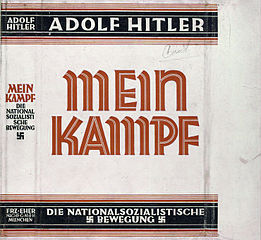
Dust jacket of 1926–1927 edition
Adolf Hitler’s Mein Kampf has quietly become an e-book bestseller, climbing high on the charts of political books on Apple’s iTunes and Amazon’s Kindle, even as print sales of the 1925 anti-Semitic screed continue to languish.
“Mein Kampf hasn’t made the New York Times‘ nonfiction chart since its U.S. release in 1939, the same year Germany invaded Poland, and its print sales have fallen steadily ever since,” Chris Faraone wrote for the website Vocativ. “But with a flood of new e-book editions, Hitler’s notorious memoir just clocked a banner digital year.”
Two different digital versions of Mein Kampf currently rank third and fourth on the Politics & Current Events on iBooks, outpacing books by modern-day conservative pundits and celebrities such as Sarah Palin, Charles Krauthammer and Glenn Beck. The books sell for 99 cents and $2.99 respectively.
On Amazon, the Kindle version of Mein Kampf ranks No. 1 in the category of Propaganda and Political Philosophy.
Odd how the LA Times‘ instinct is to compare the sales of Mein Kampf with books by American conservatives, rather than works by, say, Marx, Mao, or Mussolini. You know, comparable theorists of totalitarian power (oh, wait…that is how the Times views Palin, Krauthammer, and Beck).
In a post from 2010, Reason TV looks at the power of Nazi Propaganda:
From radio and film to newspapers and publishing, the Nazi regime controlled every aspect of German culture from 1933-1945. Through Josef Goebbels’ Ministry of Public Enlightenment and Propaganda, the German state tightly controlled political messaging, promoting deification of the leader—the Führerprinzip—and the demonization of the ubiquitous and duplicitious “racial enemy.” A new exhibit at the United States Holocaust Memorial Museum in Washington, D.C., examines “how the Nazi Party used modern techniques as well as new technologies and carefully crafted messages to sway millions with its vision for a new Germany.” Reason.tv’s Michael C. Moynihan visited with museum historian and curator Steve Luckert to discuss the role and effectiveness of propaganda in the rise of fascism and what lessons can be drawn from the Nazi experiment in mass manipulation.
January 10, 2014
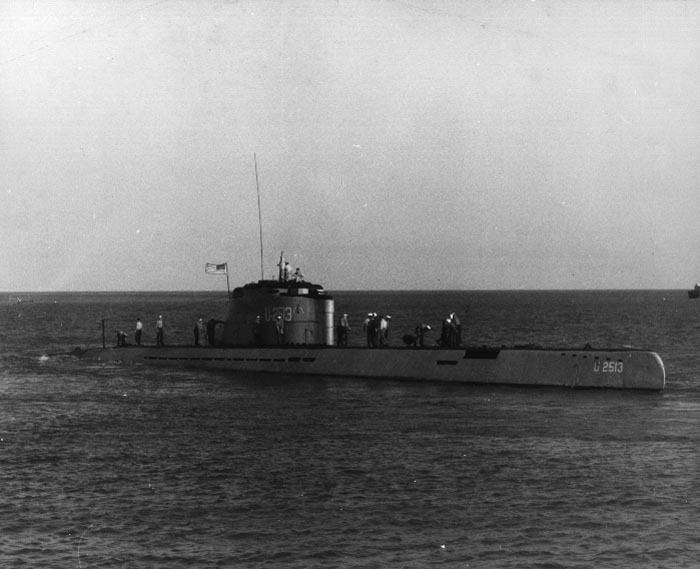
US analysis of captured German U-boats after WW2
Tony Zbaraschuk posted an interesting link to the Lois McMaster Bujold Mailing list (http://lists.herald.co.uk/cgi-bin/mailman/listinfo/lois-bujold):
Design Studies of German Submarines by the US Navy
The Design Study of Type IXC U-boats was made available by Scott Sorenson. The Design Study of Type XXI U-boats was made available by the Portsmouth Naval Shipyard Public Affairs Office and the Navy Yard Museum — in particular Debora White, Gary Hildreth, Jim Dolf and Bill Tebo (a member of the US Navy crew of U-2513).
Photographs and documents of surrendered German submarines and their crews were made available by John Cunningham (a member of the US Navy crew of U-2513).
U-2513 off Key West, Florida — 30 October 1946
January 6, 2014
Boris Johnson – Germany started the war
In the Telegraph Boris Johnson is exasperated by recent comments that try to obscure or minimize the German role in starting the First World War:
It is a sad but undeniable fact that the First World War — in all its murderous horror — was overwhelmingly the result of German expansionism and aggression. That is a truism that has recently been restated by Max Hastings, in an excellent book, and that has been echoed by Michael Gove, the Education Secretary. I believe that analysis to be basically correct, and that it is all the more important, in this centenary year, that we remember it.
That fact is, alas, not one that the modern Labour Party believes it is polite to mention. According to the party’s education spokesman, Tristram Hunt, it is “crass” and “ugly” to say any such thing. It was “shocking”, he said in an article in yesterday’s Observer, that we continued to have this unacceptable focus on a “militaristic Germany bent on warmongering and imperial aggression”.
He went on — in a piece that deserves a Nobel prize for Tripe — to mount what appeared to be a kind of cock-eyed exculpation of the Kaiser and his generals. He pointed the finger, mystifyingly, at the Serbs. He blamed the Russians. He blamed the Turks for failing to keep the Ottoman empire together, and at one stage he suggested that we were too hard on the bellicose Junker class. He claimed that “modern scholarship” now believes that we have “underplayed the internal opposition to the Kaiser’s ideas within the German establishment” — as if that made things any better.
[…]
Hunt is guilty of talking total twaddle, but beneath his mushy-minded blether about “multiple histories” there is what he imagines is a kindly instinct. These wars were utterly horrific for the Germans as well as for everyone else, and the Germans today are very much our friends. He doesn’t want the 1914 commemorations to pander to xenophobia, or nationalism, or Kraut-bashing; and I am totally with him on that.
We all want to think of the Germans as they are today — a wonderful, peaceful, democratic country; one of our most important global friends and partners; a country with stunning technological attainments; a place of incomparable cultural richness and civilisation. What Hunt fails to understand — in his fastidious Lefty obfuscation of the truth — is that he is insulting the immense spiritual achievement of modern Germany.
The Germans are as they are today because they have been frank with themselves, and because over the past 60 years they have been agonisingly thorough in acknowledging the horror of what they did. They don’t try to brush it aside. They don’t blame the Serbs for the 1914-18 war. They don’t blame the Russians or the Turks. They know the price they paid for the militarism of the 20th century.
November 30, 2013
November 11, 2013
“The Canadian Corps … had beaten 47 German divisions since Aug. 8”
In the Globe and Mail, J.L. Granatstein wants us to remember the greatest military achievement of the Canadian Corps in World War One (and it isn’t the battle of Vimy Ridge):
On Aug. 8, 1918, the Canadian Corps had secretly moved into position in front of the French city of Amiens. The German army had been on the offensive since March, and the Amiens sector was rather lightly defended. The Canadians, British and Australians struck this sector a surprise hammer blow in the early morning, a hurricane of artillery fire clearing the way for the tanks and infantry that blasted through the defences. Thousands of Germans surrendered, more were killed and within a few hours, the Canadian advance was almost 15 kilometres. This, wrote the German army’s great strategist, General Erich Ludendorff, was “the black day” of the German Army.
Lt.-Gen. Currie’s troops then moved north to the Arras area, where, at the end of the month, they struck toward and then through the Drocourt-Quéant Line, an immensely strong extension of the Hindenburg Line defended by crack troops. In heavy fighting at high cost, the Corps broke the line, forcing the Germans back behind the Canal du Nord, their last position protecting the key supply point of Cambrai.
[…]
The Germans now were in full retreat, moving eastward as fast as they could go. The Canadians took Valenciennes, smashing the enemy defences with a massive artillery barrage, and then moved into Belgium. By Nov. 11, they were in Mons, the same small town where the men of the British Expeditionary Force had first faced the invading Germans in August, 1914.
The Canadian Corps, more than a hundred thousand strong, had fought its last battles. As Lt.-Gen. Currie noted proudly, it had beaten 47 German divisions since Aug. 8, a quarter of the German forces in the West. The Corps had accomplished this because of its great fighting spirit, its fine leadership at all levels and its effective reinforcement and logistics systems. The cost in lives and in wounded was terrible — 45,000 casualties, 20 per cent of the total of Canadian losses in the entire war — but for once, the campaign had achieved measurable gains on the ground. More than that, the Canadian shock troops had battered the enemy, forced them eastward and obliged them to seek an armistice that was a de facto capitulation. It had scored its greatest victory, the greatest battlefield triumph ever by Canadian troops.
October 30, 2013
QotD: The career of Karl Marx
[Karl Marx] was also an unemployed professor, a scholar in the German tradition with a first-rate brain, a vast depth of learning and considerable obscurity of thought. Of his intellect and scholarship there can be no doubt at all. He knew many languages and had read widely in many subjects. A very learned man indeed, he was admirably fitted for the life of a German university. Marx’s complete absorption in his philosophy, history and economics was quite typical of the sort of professor he should by right have become. That mixture of scholarship, vagueness, poverty and practical inexperience would have graced a chair at Heidelberg or Bonn. But for the death in 1840 of Frederick William IV, a man of strictly orthodox views on religion, Marx might have had an academic career. Barred from this, however, as an atheist, he had no class to teach, no pupils from whom he might have learned. There is a sense, of course, in which a professor lives apart from the world. But his duties, even in the mid-nineteenth century, involved some contact with other people. The most professorial of German professors would have examinations to set and appointments to keep. Sessions of Senate and Faculty might give him scope for eloquence or intrigue, and he would find for himself the need to compromise, concede and persuade. Howbeit painfully and slowly, the professor comes to know something of administration and finance. But this was the practical knowledge which Marx was denied. All the experience he had was in his own home, where his failure was catastrophic for his wife and family. Of his children some died of slow starvation and two committed suicide. Retaining and increasing all his professional learning, he became more purely theoretical than even professors are allowed to be. Of the difficulties of organizing human society he knew practically nothing. There was in fact no human society — no province or city, no school or club — of which he could be said to have been a member. His whole life was bounded by the printed page.
C. Northcote Parkinson, “Internal Contradiction”, Left Luggage, 1967.
October 3, 2013
Postwar horror – the misery didn’t stop with VE day or VJ day
In the last couple of years, I’ve read several books about the aftermath of World War Two, including Tony Judt’s Postwar: A History of Europe Since 1945, Ronald Spector’s In the Ruins of Empire: The Japanese Surrender and the Battle for Postwar Asia, and David Stafford’s Endgame, 1945: The Missing Final Chapter of World War II. When you concentrate on the combat side of war, you can easily miss the destructive side-effects of that combat and it’s hard to imagine how long it can take for a city or a region to recover from being a battlefield. What is even more interesting is the complex interplay of humanitarian, political and social pressures on the winning side, too often leading to actions that we would have called war crimes if they’d happened just days or weeks earlier. In the New York Times, Adam Hochschild looks at an interesting new book covering the immediate postwar period:
Ian Buruma’s lively new history, Year Zero, is about the various ways in which the aftermath of the Good War turned out badly for many people, and splendidly for some who didn’t deserve it. It is enriched by his knowledge of six languages, a sense of personal connection to the era (his Dutch father was a forced laborer in Berlin) and his understanding of this period from a book he wrote two decades ago that is still worth reading, The Wages of Guilt: Memories of War in Germany and Japan. His survey rambles over a wide expanse of ground, from sexual behavior (imagine millions of Allied occupation troops in a Germany where women outnumbered men by eight to five), to British and American soldiers unintentionally killing thousands of liberated concentration camp inmates by feeding them more than their shriveled intestinal tracts could handle, to the Allies’ blindness to how much of their cornucopia of food and supplies found its way into the hands of Italian, French and Japanese gangsters, restoring some of their prewar power.
Despite the lofty democratic aura of World War II, Buruma points out that the Allies spent much of the latter half of 1945 reviving colonialism. After Algerian Arabs began an uprising on V-E Day, demanding equal rights, some of the troops the French governor general called in to suppress them included an elite infantry regiment that had just taken part in the final assault on Germany. Rebellious towns and villages were bombed, or shelled by naval vessels; in two months of fighting as many as 30,000 Algerians may have been killed. Thousands were made to kneel before the French flag and beg forgiveness.
On the other side of the world, inhabitants of the Dutch East Indies demanded freedom just after the Japanese surrender. But the Dutch government answered with troops, aided by soldiers from Britain’s large Indian Army, British battleships and abundant American military supplies. Fighting continued for four years. And in Vietnam, where a crowd of more than 300,000 gathered to hear Ho Chi Minh declare independence from France, the story would of course eventually become even bloodier. In 1945 British troops were crucial to restoring the colonial order in Vietnam, with help from French Foreign Legion detachments. These included many German volunteers, recruited from P.O.W. camps, who had recently been fighting the Allies in Europe or North Africa.
Meanwhile, the victorious Allies were uprooting some 10 million ethnic Germans from parts of Eastern Europe, where they had lived for generations, and forcing them to move to a shrunken Germany, with perhaps a half-million or more dying in the process from hunger, exposure or attacks by vengeful neighbors. Buruma, like others before him, notes the paradox of the Allied armies carrying out something that echoed “Hitler’s project . . . of ethnic purity.”
September 30, 2013
Re-evaluating Neville Chamberlain
BBC News Magazine on the reputation of British PM Neville Chamberlain:
…this derogatory reference reflects the continuing potency of a well-established conventional wisdom assiduously propagated by Chamberlain’s detractors after his fall from the premiership in May 1940. As Churchill is once supposed to have quipped, “Poor Neville will come badly out of history. I know, I will write that history”.
In his influential account The Gathering Storm, published in 1948, Churchill characterised Chamberlain as “an upright, competent, well meaning man” fatally handicapped by a deluded self-confidence which compounded an already debilitating lack of both vision and diplomatic experience. For many years, this seductive version of events remained unchallenged and unchallengeable.
[…]
The Munich agreement, which later came to symbolise the evils of appeasement, was signed 75 years ago, in the early hours of 30 September. At Munich, Britain and France acquiesced in the dismemberment of Czechoslovakia and the transfer of its Sudeten region to Germany in face of Hitler’s increasingly bellicose threats of military action. Chamberlain’s hopes that this humiliating sacrifice would satisfy Hitler’s last major territorial demand and thus avert another catastrophic war were dashed within four months.
After this monumental failure of policy Chamberlain’s name became an abusive synonym for vacillation, weakness, immoral great-power diplomacy and, above all, the craven appeasement of bullies — whatever the price in national honour. Despite his many achievements in domestic policy, therefore, ultimately Chamberlain’s reputation remains indelibly stained by Munich and the failure of his very personal brand of diplomacy.
As he confessed in the Commons at the outbreak of war, “Everything I have worked for, everything that I have hoped for, everything that I have believed in during my public life, has crashed into ruins.”
September 23, 2013
Merkel’s victory
German Chancellor Angela Merkel’s conservatives won re-election yesterday, but their Free Democrat coalition partners did not earn enough votes to retain their seats in the Bundestag, so a new coalition will may have to be formed. The Economist has more:
Angela Merkel, chancellor of Germany for eight years, seems likely to stay in office for a few more. She has won for her party, the Christian Democratic Union (CDU), a sparkling election result, with about 42% of the vote when including its Bavarian sister party, the CSU, according to exit polls and estimates. Depending on how the smaller parties fare, that may even suffice for an absolute majority of seats in parliament, allowing Mrs Merkel to govern without a coalition partner as only Konrad Adenauer, also of the CDU, did in the 1950s.
But as of the evening of this election day, September 22nd, other outcomes were still possible. For one, voters delivered a stinging rebuke to Mrs Merkel’s current coalition partner, the liberal Free Democrats (FDP). Having been thrown out of the Bavarian state parliament a week ago, and the state parliament of Hesse today, the FDP seemed likely to be ejected from the federal parliament as well. Its leadership will have to go, its message will have to be renewed, if it is to have any future in German politics.
The greatest unknown on this Sunday evening is the fate of the newest party in German politics, the euro-sceptic (as in: sceptic about the euro, not necessarily the European Union) Alternative for Germany. At 4.9% in the exit polls, it teeters on the edge of the 5% threshold necessary to get into parliament.
Earlier this year, I linked to a Zero Hedge piece which predicted if not the end of the world, the end of stability in Europe following this particular electoral outcome:
There will be nothing but lying until September 22, 2013 which is the date of the German elections. This is the drop dead date that I have been asked about for so long. Then, as soon as the celebration is over that Ms. Merkel is to remain in power, the world will turn on its axis. The status quo will disappear and there will be a “shock and horror” campaign as the Southern nations of Europe demand more help and Germany squirms and then refuses to provide it because it does not have the assets to do so.
Spain, France, Portugal, Greece, Cyprus, and even Italy are all going to line up at the trough only to discover that the promise of water was just that, a promise, and does not exist. A Biblical drought will be upon the Continent and from the political battles will emerge new alliances and new screams calling the traitors by name. The twin towers upon which the markets rest, money from nothing and fairy tale financials, will decompose in the light of this new sun and our old friend, Fear, will return to haunt us.
Let us cast our eyes toward Berlin and see whether this is prophecy or mere doom-mongering.
September 22, 2013
QotD: The personal alienation of Karl Marx
Almost any Jew can be stateless, but Marx was particularly so — born of alien parents in a frontier region between Germany and France, educated in the Rhineland and in Prussia, a student at Berlin but a graduate of Jena, exiled by the age of thirty-two. Nor was this domicile chosen from any love of England or of anything but safety. He knew next to nothing of the English when he died, preferring to live among German exiles, talking German, thinking in German, and for preference writing in German. He knew of the toiling masses only from blue books and parliamentary reports. We hear nothing of his travels among the Lancashire cotton mills and as little of his talks with the London poor. There is no record of his visiting the coal mines, the docks, or even a public house. He was essentially homeless, offering no loyalty and expecting no aid. And with his scorn went hatred. He despised and loathed his rivals, quarreled with this allies and condemned all sympathizers who deviated even by a little from the doctrine he held to be sacred. Karl Marx had no country.
C. Northcote Parkinson, “Internal Contradiction”, Left Luggage, 1967.
August 2, 2013
The self-inflicted wounds of Britain’s post-war auto industry
Dominic Sandbrook contrasts the rise of the German auto industry from the literal rubble of the post-war world with the slow decline of Britain’s once-mighty car makers:
If you want to know why Angela Merkel calls the shots in Europe, Germany’s car factories are a pretty good place to start.
By contrast, Britain’s car industry is a shadow of its former self. We do still make almost one and a half million cars a year, which is good news for thousands of British engineers. But these days, we make them for other people.
The iconic Mini plant at Cowley, for example, is celebrating its centenary this year. It was founded in 1913 by the entrepreneur William Morris as the home for his legendary Morris Oxford.
Today it still makes thousands of cars — but it makes them for BMW.
It’s a similar story at Crewe, the home of another great British icon, Bentley – which actually belongs to Volkswagen.
Half a century ago, let alone when Morris was at his peak, this would have seemed unimaginable. But the sad truth is that Britain’s car firms only have themselves to blame.
Seventy years ago, at the end of World War II, Germany was on its knees. After the fall of Hitler’s empire, its car industry lay in ruins.
In August 1945 the British Army sent a major called Ivan Hirst to take control of the giant Volkswagen plant in Wolfsburg, which had been built under the Nazis to produce ‘people’s cars’ for the German masses.
Ignoring his sceptical superiors, Hirst could see the potential amid the shattered debris of the Wolfsburg factory.
Rebuilding Volkswagen, he thought, would be a step towards rehabilitating Germany as a prosperous, peaceful European ally. And of course he was right.
In the next few years, Hirst restarted production of a car we know today as the Beetle. And from then on, VW was flying.
July 29, 2013
Why Germany is the venue for the loudest denunciations of NSA surveillance
Alex Harrowell explains the deep suspicions among Germans which long predate the NSA surveillance revelations:
Obviously, privacy and data protection are especially sensitive in Germany. After the Stasi, the centrality of big databases to the West German state’s response to the left-wing terrorists of the 1970s, and the extensive Nazi use of telephone intercepts during the seizure of power, it couldn’t really be otherwise. Privacy and digital activism is older and better established in Germany than anywhere else — in the US, for example, I consider the founding text of the movement to be the FBI vs. Steve Jackson Games case from 1990 or thereabouts, while the key text in Germany is the court judgment on the national census from ten years earlier. But the UK has a (strong) data protection act and no-one seems anywhere near as exercised, although they probably should be.
So here’s an important German word, which we could well import into English: Deutungshoheit. This translates literally as “interpretative superiority” and is analogous to “air superiority”. Deutungshoheit is what politicians and their spin doctors attempt to win by putting forward their interpretations and framings of the semirandom events that constitute the “news”. In this case, the key event was Snowden’s disclosure of the BOUNDLESS INFORMANT slides, which show that the NSA’s Internet surveillance operations collect large amounts of information from sources in Germany.
The slides don’t say anything about how, whether this was information on German customers handed over by US cloud companies under PRISM orders, tapped from cables elsewhere, somehow collected inside Germany, or perhaps shared with the NSA by German intelligence. This last option is by far the most controversial and the most illegal in Germany. The battle for Deutungshoheit, therefore, consisted in denying any German involvement and projecting the German government, like the people in question, as passive victims of US intrusion.
On the other hand, Snowden’s support-network in the Berlin digital activist world, centred around Jacob “ioerror” Applebaum, strove to imply that in fact German agencies had been active participants, and Snowden’s own choice of further disclosures seems to have been guided by an intent to influence German politicians. Der Spiegel, rather than the Guardian, has been getting documents first and their content is mostly about Germany.
In this second phase, the German political elite has shifted its feet; rather than trying to deny any involvement whatsoever, they have instead tried to interpret the possibility of something really outrageous as being necessary for your security, and part of fundamental alliance commitments which cannot be questioned within the limits of respectable discourse. The ur-text here is Die Zeit‘s interview with Angela Merkel, in which Merkel argues that she knew nothing, further that there was a balance to strike between freedom and security, that although some kinds of spying were unacceptable, the alliance came first. The effectiveness of this, at least in the context of the interview, can be measured by astonishingly uncritical questions like the one in which she was asked “what additional efforts were necessary from the Germans to maintain their competitiveness”.
H/T to Tyler Cowen for the link.


