
Published on 26 Jan 2015
Paul von Lettow-Vorbeck, also known as the Lion of Africa, was commander of the German colonial troops in German East Africa during World War 1. His guerilla tactics used againd several world powers of the time are considered to be one of the most successful military missions of the whole war. In Germany, he was celebrated as a hero until recently. But recent historical research show a picture much more controversial than the one of a glorious hero.
January 28, 2015
Paul von Lettow-Vorbeck I WHO DID WHAT IN WW1?
Comments Off on Paul von Lettow-Vorbeck I WHO DID WHAT IN WW1?
January 23, 2015
Zeppelins Over England – New Inventions For The Modern War I THE GREAT WAR Week 26
Published on 22 Jan 2015
For a decisive advantage on the Western Front, the military commanders of both sides are trying to use technological advances. And so this week, German Zeppelins are flying their first air raids on English towns. Winston Churchill is outlining his ideas for what would later become the tank. Meanwhile at the Western Front, the soldier Adolf Hitler is thinking about how this war is going to continue.
Comments Off on Zeppelins Over England – New Inventions For The Modern War I THE GREAT WAR Week 26
January 20, 2015
Recap: The First Six Months I THE GREAT WAR
Published on 19 Jan 2015
World War 1 broke out in summer 1914, a little over 100 years ago. Our channel is following the historic events week by week. For everyone who recently joined this channel: this recap is specially for you! Catch up with the last six months, hence the first six months of the war. Between the assassination of Franz Ferdinand, the Battle of the Marne and the Christmas Truce, hundreds of thousands of soldiers had to die. This is modern war.
Comments Off on Recap: The First Six Months I THE GREAT WAR
January 16, 2015
Onwards! – The Western Front Of Early 1915 – THE GREAT WAR Week 25
Published on 15 Jan 2015
French general Joseph Joffre is stuck in a dilemma: the Champagne offensive has been going on for weeks now — without any expected results. Should he dig in and tolerate the enemy on French soil? Or should his soldiers continue to run up against the impenetrable German defences? Meanwhile, South African troops attack German South West Africa and in London, Winston Churchill’s plan for an invasion of the Dardanelles has been approved.
Comments Off on Onwards! – The Western Front Of Early 1915 – THE GREAT WAR Week 25
Germany and Canada are neck-and-neck … in the helicopter fail zone
Every now and again, I’ve reminded you about the sad, sad state of the Canadian Armed Forces’ long quest to get new helicopters. If any other western country has had a worse time trying to re-equip their military with capable helicopters, Germany must come close to the top of the list:
As early as the mid-1980s, German army aviation needed new helicopters. Its Vietnam-era Bell UH-1s and Sikorsky CH-53s had seen better days.
France, West Germany, Italy, The Netherlands and the United Kingdom got together in 1985 and drafted a scheme to develop a new fly-by-wire, multipurpose helicopter—the NH90. The U.K. soon left the project.
[…]
The NH90 itself struggled through its long years of development—and ultimately proved less than perfectly reliable. The Dutch have struggled to prevent corrosion in their naval NH90s that deploy aboard warships. The Germans have had problems of their own.
In Germany, the NH90 was originally supposed to open a new era of air-assault operations, wherein different variants of the NH90 would haul troops, vehicles and equipment in lightning-fast attacks behind enemy lines. There would also be a naval version.
But when the Cold War ended, funding became scarce. The German military had wanted more than 200 HN90s but ultimately ordered just 122, making large-scale air assaults unlikely. The first few machines arrived in December 2006.
Another seven years passed before Germany deployed the NH90. In April 2013, several of the copters began flying medical-evacuation missions in Afghanistan.
On June 19, 2014, an engine on one of the deployed NH90s exploded during a training mission over Uzbekistan. On Nov. 17, the German aviation security advisory board grounded the whole fleet.
Comments Off on Germany and Canada are neck-and-neck … in the helicopter fail zone
January 14, 2015
What Was The Bloodiest Battle Of World War 1? – OUT OF THE TRENCHES #6
Published on 12 Jan 2015
“Indy is answering your questions again. In this episode of OUT OF THE TRENCHES he is explaining how airplanes got armed with machine guns and what was the bloodiest battle of WW1.
Comments Off on What Was The Bloodiest Battle Of World War 1? – OUT OF THE TRENCHES #6
December 26, 2014
The First Battle of Champagne – Dying In Caucasus Snow I THE GREAT WAR Week 22
Published on 25 Dec 2014
Right before Christmas the allied powers begin the Champagne offensive, which will last several months. In the snow and the mud, and under horrible living conditions not only the soldiers suffer. The images of a war fought with honour and glory are finally over as even the white flag is used for ambushes. Far away in the mountains of the Caucasian, Russia and the Ottoman Empire are fighting a grim battle, too, in which many soldiers die during interminable marches in the snow wearing summer uniforms.
Comments Off on The First Battle of Champagne – Dying In Caucasus Snow I THE GREAT WAR Week 22
December 25, 2014
A Sign Of Friendship In The Midst Of War I THE CHRISTMAS TRUCE 1914
Published on 24 Dec 2014
Initially, everyone believed that this war would be over by Christmas, but on Christmas Eve 1914, soldiers were still facing each other in France, Belgium, throughout Eastern Europe, and all of the other theatres of war. But instead of shooting at each other, quite a few soldiers decided to sing and celebrate this night with their enemies. This happened in many places on the Western Front, and the commanding officers were not happy about it. In future, they would see to it that it did not happen again.
Comments Off on A Sign Of Friendship In The Midst Of War I THE CHRISTMAS TRUCE 1914
December 19, 2014
The Raid On Scarborough – A Failed Attempt at Intimidation I THE GREAT WAR Week 21
Published on 18 Dec 2014
German admiral Franz von Hipper reluctantly carries out his orders to bomb British coastal towns. And indeed, this attempt to intimidate British civilians only makes them more united. British propaganda gets another opportunity to portray Germans as bloodthirsty and brutal. Meanwhile, the French start a new offensive near Vimy on the Western Front.
Comments Off on The Raid On Scarborough – A Failed Attempt at Intimidation I THE GREAT WAR Week 21
December 12, 2014
The Naval Battle At The Falkland Islands – The Death of Maximilian von Spee I THE GREAT WAR Week 20
Published on 11 Dec 2014
Near the far away Falkland Islands the story of the German East Asia Squadron is coming to an end: in a naval battle nearly the entire squadron sunk and Maximilian von Spee dies together with over 2000 German seamen. Meanwhile, the war of attrition is still going on in Europe and Austria-Hungary has to learn that their conquest of Belgrade is not putting a lid on the Serbian resistance.
Comments Off on The Naval Battle At The Falkland Islands – The Death of Maximilian von Spee I THE GREAT WAR Week 20
December 8, 2014
The Luftwaffe attack at Bari in 1943
Patrick K. O’Donnell discusses one of the Luftwaffe‘s most deadly attacks and why most people have never heard of it:
Americans remember December 7 as Pearl Harbor Day, but most Americans have never even heard of the “Little Pearl Harbor,” which occurred in Bari Harbor, Italy, on December 2, 1943. More than 100 Luftwaffe bombers mounted a surprise attack on Allied ships moored in the harbor. Their bombs sank or rendered inoperable 28 of these ships. Nearly a thousand Allied troops were killed or wounded. along with hundreds of civilians.
Unbeknownst to those in the port, one of the ships carried liquid death in its belly. The American freighter John Harvey was secretly carrying mustard agent, in violation of international agreements that banned its use. President Franklin Roosevelt had covertly ordered the shipment of 100 tons of mustard agent to Italy for retaliation in the event that the Germans used chemical warfare against the Allied troops. The incident was covered up and remained a secret for decades.
When the German bombs hit the John Harvey, the ship’s hold immediately exploded with devastating violence, killing all those who knew about the mustard [gas]. Deadly liquid and gas flew high into the air and then slowly settled back down into the harbor, coating everything and everyone in the vicinity. Casualties would mount over the coming days and weeks as the agent slowly and painfully claimed the lives of many who had survived the initial attack.
Mustard gas was one of the nastiest relics of the attempts to break the trench lines during the First World War. Wikipedia says:
The sulfur mustards, or sulphur mustards, commonly known as mustard gas, are a class of related cytotoxic and vesicant chemical warfare agents with the ability to form large blisters on the exposed skin and in the lungs. Pure sulfur mustards are colorless, viscous liquids at room temperature. When used in impure form, such as warfare agents, they are usually yellow-brown in color and have an odor resembling mustard plants, garlic, or horseradish, hence the name. Mustard gas was originally assigned the name LOST, after the scientists Wilhelm Lommel and Wilhelm Steinkopf, who developed a method for the large-scale production of mustard gas for the Imperial German Army in 1916.
Mustard agents are regulated under the 1993 Chemical Weapons Convention (CWC). Three classes of chemicals are monitored under this Convention, with sulfur and nitrogen mustard grouped in Schedule 1, as substances with no use other than in chemical warfare. Mustard agents could be deployed on the battlefield by means of artillery shells, aerial bombs, rockets, or by spraying from warplanes.
Comments Off on The Luftwaffe attack at Bari in 1943
December 3, 2014
Wilhelm II German Emperor I WHO DID WHAT IN WW1? – Portrait
Published on 1 Dec 2014
Kaiser Wilhelm II (1859-1941), Germany’s last Kaiser, was born in Potsdam in 1859, the son of Frederick III and Victoria, daughter of Queen Victoria. Wilhelm became emperor of Germany in 1888 following the death of Frederick II. During his rule, Germany’s relations with Britain, France and Russia became strained. William was forced to abdicate on 9th November, 1918. He fled the country with the rest of his family and lived in Holland for the rest of his life. Who was Wilhelm II the last emperor of Germany and what was his political and military influence on the Germans decisions during World War I?
Comments Off on Wilhelm II German Emperor I WHO DID WHAT IN WW1? – Portrait
December 1, 2014
The Soviet tank that won the war in the East
Paul Richard Huard looks at the tank that took away the Panzer’s reputation for invincibility, the T-34:

T-34/85 at musée des blindés de Saumur (via Wikipedia)
The T-34 had its problems — something we often forgotten when discussing a tank with a legendary reputation. The shortfalls included bad visibility for the crew and shoddy Soviet workmanship.
“They were good, but they were not miracle weapons and they had their faults,” writes Philip Kaplan in Rolling Thunder: A Century of Tank Warfare. “But the T-34, for all its faults, is now often referred to by tank experts and historians as possibly the best tank of the war.”
World War II German Field Marshall Ewald Von Kleist was more succinct. “The finest tank in the world,” is how he described the T-34.
The origins of the T-34 are simple enough. The Red Army sought a replacement for the BT-7 cavalry tank, which was fast-moving and lightly armored for use in maneuver warfare. It also had Christie suspension, one reason for the tank’s increased speed.
But during a 1938-to-1939 border war with Japan, the BT-7 fared poorly. Even with a low-powered gun, Japanese Type 95 tanks easily destroyed the BT-7s. Tank attack crews also assaulted the BT-7s with Molotov cocktails, reducing the Soviet tank to a flaming wreck when ignited gasoline dripped through chinks between poorly welded armor into the tank’s engine compartment.
[…]
By the end of the war, the Soviet Union had produced nearly 60,000 T-34 tanks — proving the point that quantity does have a quality all of its own.
At first, the Germans were at a loss when it came to countering the threat the T-34 posed. The Germans’ standard anti-tank guns, the 37-millimeter Kwk36 and the 50-millimeter Kwk 38, couldn’t put a dent in the Soviet tank with a shot to its front.
That left the Germans with a limited set of tactics. German tankers could attempt flank shots with their guns. The Wehrmacht could lay mines. Soldiers risked their lives in close assaults employing satchel charges and Molotov cocktails.
In what could be called an act of desperation, the Germans even used modified 88-millimeter anti-aircraft guns to stop attacking T-34s with direct fire.
Comments Off on The Soviet tank that won the war in the East
November 30, 2014
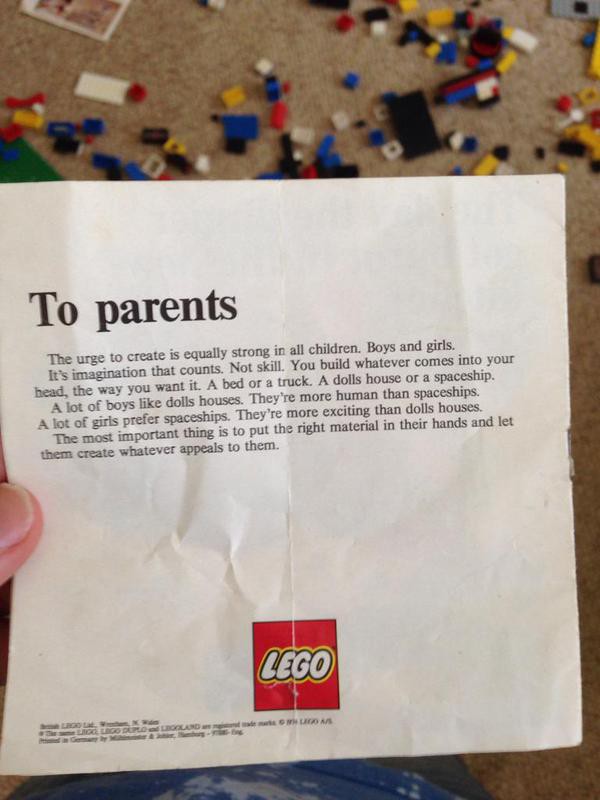
Medium.com goes all “Rathergate” on a 1970s LEGO letter
I managed to miss the initial controversy about a typographical hoax that might not have been so hoax-y:
According to the website of the Independent newspaper, LEGO UK has verified the 1970s ‘letter to parents’ that was widely tweeted last weekend and almost as widely dismissed as fake. Business as usual in the Twittersphere — but there are some lessons here about dating type.
‘The urge to create is equally strong in all children. Boys and girls.’ It’s a sentiment from the 1970s that’s never been more relevant. Or was it?
Those of us who produce or handle documents for a living will often glance at an example and have an immediate opinion on whether it’s real or fake. That first instinct is worth holding on to, because it comes from the brain’s evolved ability to reach a quick conclusion from a whole bunch of subtle clues before your conscious awareness catches up. It’s OK to be inside the nearest cave getting your breath back when you start asking yourself what kind of snake.
But sometimes you will flinch at shadows. Why did this document strike us as wrong when it wasn’t?
First, because the type is badly set in exactly the way early consumer DTP apps, and word processor apps to this day (notably Microsoft Word), set type badly — at least without the intervention of skilled users. I started typesetting on an Atari ST, the poor man’s Mac, in 1987. The first desktop publishing program for that platform was newly released, running under Digital Research’s GEM operating system. It came with a version of Times New Roman, and almost nothing else. Me and badly set Times have history.
In the LEGO document, the kerning of the headline is lumpy and the word spacing excessive. The ‘T’ seems out of alignment with the left margin, even after allowing for a lack of optical adjustment. The paragraph indent on the body text has been applied from the start, contrary to modern British typesetting practice; the first line should be full-out. The leading (vertical space between lines of text) is not quite enough for comfort, more appropriate to a dense newspaper column than this short blurb.
There’s also an error in the copy: ‘dolls houses’ needs an apostrophe. Either before or after the last letter of ‘dolls’ would be fine, depending on whether you think you mean a house for a doll or a house for dolls. But it definitely needs to be possessive.
It wasn’t just that the type looked careless. It was that it stank of the careless use of tools that shouldn’t have been available to its creators.
Comments Off on Medium.com goes all “Rathergate” on a 1970s LEGO letter
QotD: A German “comic” song
We were a fashionable and highly cultured party. We had on our best clothes, and we talked pretty, and were very happy — all except two young fellows, students, just returned from Germany, commonplace young men, who seemed restless and uncomfortable, as if they found the proceedings slow. The truth was, we were too clever for them. Our brilliant but polished conversation, and our high-class tastes, were beyond them. They were out of place, among us. They never ought to have been there at all. Everybody agreed upon that, later on.
We played morceaux from the old German masters. We discussed philosophy and ethics. We flirted with graceful dignity. We were even humorous — in a high-class way.
Somebody recited a French poem after supper, and we said it was beautiful; and then a lady sang a sentimental ballad in Spanish, and it made one or two of us weep — it was so pathetic.
And then those two young men got up, and asked us if we had ever heard Herr Slossenn Boschen (who had just arrived, and was then down in the supper-room) sing his great German comic song.
None of us had heard it, that we could remember.
The young men said it was the funniest song that had ever been written, and that, if we liked, they would get Herr Slossenn Boschen, whom they knew very well, to sing it. They said it was so funny that, when Herr Slossenn Boschen had sung it once before the German Emperor, he (the German Emperor) had had to be carried off to bed.
They said nobody could sing it like Herr Slossenn Boschen; he was so intensely serious all through it that you might fancy he was reciting a tragedy, and that, of course, made it all the funnier. They said he never once suggested by his tone or manner that he was singing anything funny — that would spoil it. It was his air of seriousness, almost of pathos, that made it so irresistibly amusing.
We said we yearned to hear it, that we wanted a good laugh; and they went downstairs, and fetched Herr Slossenn Boschen.
He appeared to be quite pleased to sing it, for he came up at once, and sat down to the piano without another word.
“Oh, it will amuse you. You will laugh,” whispered the two young men, as they passed through the room, and took up an unobtrusive position behind the Professor’s back.
Herr Slossenn Boschen accompanied himself. The prelude did not suggest a comic song exactly. It was a weird, soulful air. It quite made one’s flesh creep; but we murmured to one another that it was the German method, and prepared to enjoy it.
I don’t understand German myself. I learned it at school, but forgot every word of it two years after I had left, and have felt much better ever since. Still, I did not want the people there to guess my ignorance; so I hit upon what I thought to be rather a good idea. I kept my eye on the two young students, and followed them. When they tittered, I tittered; when they roared, I roared; and I also threw in a little snigger all by myself now and then, as if I had seen a bit of humour that had escaped the others. I considered this particularly artful on my part.
I noticed, as the song progressed, that a good many other people seemed to have their eye fixed on the two young men, as well as myself. These other people also tittered when the young men tittered, and roared when the young men roared; and, as the two young men tittered and roared and exploded with laughter pretty continuously all through the song, it went exceedingly well.
And yet that German Professor did not seem happy. At first, when we began to laugh, the expression of his face was one of intense surprise, as if laughter were the very last thing he had expected to be greeted with. We thought this very funny: we said his earnest manner was half the humour. The slightest hint on his part that he knew how funny he was would have completely ruined it all. As we continued to laugh, his surprise gave way to an air of annoyance and indignation, and he scowled fiercely round upon us all (except upon the two young men who, being behind him, he could not see). That sent us into convulsions. We told each other that it would be the death of us, this thing. The words alone, we said, were enough to send us into fits, but added to his mock seriousness — oh, it was too much!
In the last verse, he surpassed himself. He glowered round upon us with a look of such concentrated ferocity that, but for our being forewarned as to the German method of comic singing, we should have been nervous; and he threw such a wailing note of agony into the weird music that, if we had not known it was a funny song, we might have wept.
He finished amid a perfect shriek of laughter. We said it was the funniest thing we had ever heard in all our lives. We said how strange it was that, in the face of things like these, there should be a popular notion that the Germans hadn’t any sense of humour. And we asked the Professor why he didn’t translate the song into English, so that the common people could understand it, and hear what a real comic song was like.
Then Herr Slossenn Boschen got up, and went on awful. He swore at us in German (which I should judge to be a singularly effective language for that purpose), and he danced, and shook his fists, and called us all the English he knew. He said he had never been so insulted in all his life.
It appeared that the song was not a comic song at all. It was about a young girl who lived in the Hartz Mountains, and who had given up her life to save her lover’s soul; and he died, and met her spirit in the air; and then, in the last verse, he jilted her spirit, and went on with another spirit — I’m not quite sure of the details, but it was something very sad, I know. Herr Boschen said he had sung it once before the German Emperor, and he (the German Emperor) had sobbed like a little child. He (Herr Boschen) said it was generally acknowledged to be one of the most tragic and pathetic songs in the German language.
It was a trying situation for us — very trying. There seemed to be no answer. We looked around for the two young men who had done this thing, but they had left the house in an unostentatious manner immediately after the end of the song.
That was the end of that party. I never saw a party break up so quietly, and with so little fuss. We never said good-night even to one another. We came downstairs one at a time, walking softly, and keeping the shady side. We asked the servant for our hats and coats in whispers, and opened the door for ourselves, and slipped out, and got round the corner quickly, avoiding each other as much as possible.
I have never taken much interest in German songs since then.
Jerome K. Jerome, Three Men in a Boat (to say nothing of the dog), 1889.
Comments Off on QotD: A German “comic” song


