Quotulatiousness

September 27, 2010

Europe according to . . .

Filed under: Europe, France, Humour — Tags: , — Nicholas @ 14:09

Amusing infographic source including “Europe according to France”:

H/T to Cory Doctorow for the link.

September 1, 2010

British and French navies consider going “sharesies” on aircraft carriers

Filed under: Britain, Economics, France, Military — Tags: , — Nicholas @ 13:06

Matt Gurney reports on a bizarre scheme for Britain and France to share their carriers:

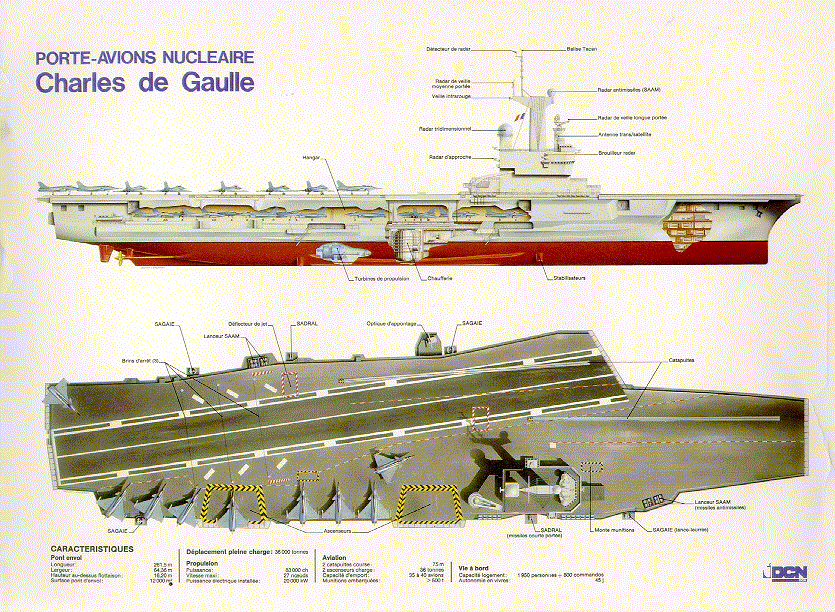
The rumoured plan to share the vessels would have certain advantages, to be sure. But it would also have certain ironies. Until the very recent past, the French and the British hated one another for approximately a thousand years, give or take a century. They battled each other endlessly, usually on the high seas. Progress is great and peace is nifty, but could anyone ever again look upon Lord Nelson’s monument in Trafalgar Square without chuckling if they knew the British Isles were protected by a glitchy French carrier named after a colossal thorn in the revered Churchill’s side?

The British have been quick to stamp out these rumours, calling them unwarranted speculation. But it’s interesting to even consider. Set aside the issue of the French and Royal navies co-operating, because stranger things have happened. Not many, but some. Every major Western military power, including Canada, is facing the same crunch. Sure, Prime Minister Harper made a big splash when his government announced plans to spend $16-billion on F-35 fighters, but lots of other things aren’t getting done. New destroyers? New search and rescue aircraft? An armoured vehicle refit? Frigate modernization? Show me the money! Or don’t. There is no money. If they are indeed discussing sharing their carriers, the French and the Brits at least deserve some credit for original thinking.

Original yes, but flawed. The rumoured plan doesn’t involve jointly constructing or manning vessels, but coordinating the patrol schedules of their respective carriers so that at least one would be at sea at all times. This would give both countries the capability to respond swiftly to threats in their shared North Atlantic area, or to react immediately to crises and disasters around the world (Whether for battle or rescue, few military assets can equal the utility of an aircraft carrier). Whichever carrier was deployed at any given time would remain under the command of its own national government, but there would apparently be contingencies to deal with a purely national military situation.

I doubt that the plan, even as scaled-down as indicated, would be workable, but it does show that the Royal Navy is seriously concerned that the new government will deprive them of the funds needed to complete the two new aircraft carriers already underway. Any extra leverage to persuade the government to avoid killing the program (like getting the French involved) may be seen as a good tactical tool.

Update, 3 September: The Guardian reports on the prospect of French/British military co-operation:

Fox stressed the coalition government’s “willingness to engage in stronger bilateral co-operation with France”.

He added: “And why France? Because there are two things that matter most when it comes to defence co-operation: the willingness to deploy and the willingness to spend on the research and development required to maintain modern military capabilities. That makes France the natural European partner for the United Kingdom.”

Fox said it was not simply a response to budgetary pressures. “It has to be driven by wider security interests.”

Morin said the two countries would come up with precise proposals by the end of October, after Britain’s strategic defence and security review.

August 7, 2010

QotD: De Gaulle

Filed under: Cancon, Europe, France, History, Quotations, WW2 — Tags: , , , — Nicholas @ 00:01

De Gaulle was great because he knew how to act the part. Actually doing great things was someone’s else problem. The heavy lifting of the Second World War was done by the Russian foot soldier and the English speaking powers. Objectively, Canada did more to defeat Hitler than France. Being a nation of citizen soldiers, who desperately wanted to get home, we did our bit and went home. This allowed a prima donna like De Gaulle to take the credit for liberating France. In gratitude, the Liberator then travelled to Montreal, some twenty years later, and thanked Canada by trying to destroy it.

Publius, “The Saviour of the Nation”, Gods of the Copybook Headings, 2010-08-04

June 30, 2010

Here’s an example of a home that’s really a castle

Filed under: Architecture, Europe, France, History — Tags: , , — Nicholas @ 12:03

Chateau de Guedelon is a real 13th century castle, or at least, it will be when they finish building it:

The ­Chateau de Guedelon was started in 1998, after local landowner Michel Guyot wondered whether it would be possible to build a castle from scratch, using only contemporary tools and materials.

Today, the walls are rising gradually from the red Burgundy clay. The great hall is almost finished, with only part of the roof remaining, while the main tower edges past the 15m (50ft) mark.

Builders use sandstone quarried from the very ground from which the castle is emerging.

[. . .]

The Guedelon site was chosen because it contained all the necessary materials: plentiful oak from the forests, as well as clay and water. Stone from the quarry had actually been used in the building of real-life medieval chateaux.

June 22, 2010

QotD: He bestrides the G8 like a Colossus

Filed under: Cancon, France, Germany, Italy, Politics, Quotations — Tags: , , , — Nicholas @ 00:07

. . . things are pretty bad in the mother country when a self-described “Whig” calls Stephen Harper “a magnificent fiscal conservative.” It’s like calling Gordon Brown “a brilliant and charismatic leader,” or Jean Chretien “a visionary and articulate statesman.” In politics, at least practical politics, all truth is relative.

Compared to most G8 leaders Stephen Harper does look like a genius. This is, as you’ve guessed, damning by the faintest of praise. Barack Obama is an avowed socialist, who described his one real job in the private sector as working “behind enemy lines.” Japan has been governed by a series of interchangeable non-entities for the better part of the last decade. In most of Europe, and certainly the English speaking world, Silvio Berlusconi would be awaiting sentencing. Angela Merkel rivals Helmut Schmidt in the visionary department. Sarko is a living embodiment of every mistake the French have made since Diem Bien Phu: A domestic policy summed up by the quintessentially French term “dirigiste,” and a foreign policy consisting of German guilty tripping and sophomore anti-Americanism. If Stephen Harper looks taller than others, it is because he is standing on the shoulders of midgets.

Publius, “Well, at least someone likes him…”, Gods of the Copybook Headings, 2010-06-21

June 16, 2010

Monty explains it all for you

Filed under: Economics, Europe, France, Humour — Tags: , , , , — Nicholas @ 12:02

Financial worries? Fiscal imbalance? Debt woes? No problem! Monty has the answers (well, answers to some questions, even if they’re not the ones you’re interested in):

And the good news just keeps coming! Slumping cattle and lean-hogs futures may have bottomed out. Screw gold, man; I’m buying swine! (Monty, The Wasteland Bacon Baron. It has a nice ring to it. The potentate of pork! The sultan of swine! The High Lord of ham! The chitlin Chieftain!)

I’m not sure whether this is good news or not: Cramer calls yesterday’s big gain a sucker’s rally and advises people to get out. My rule of thumb is to treat anything Cramer says as the ravings of a lunatic. I consider him a shill and a buffoon. And yet . . . is this a Strange New Respect I’m feeling? Or just the dying embers of that burrito I ate for lunch yesterday?

French financial group AXA experiences a blinding glimpse of the obvious and exclaims, “Ze Euro eez doomed!”. Zut alors! (And no, I don’t know why French guys would be speaking English with a French accent instead of French.)

Spain and Portugal submit their austerity plans to the ECB and IMF. Plans include selling shoelaces at the airport, dancing for nickels, graft, corruption, and murder-for-hire. The ECB and IMF remain skeptical, and suggest that Portugal and Spain might want to look into selling the family silver or something.

And if all of that isn’t enough to get you assembling your Financial Apocalypse Survival kit, how about this?

More bond issues are being denominated in Canadian Loonies and Swiss Francs as investor skittishness regarding the Euro spreads. When investors choose something called the “Loonie” over your currency because it just sounds more stable somehow, dude, you got problems.

June 10, 2010

Enough with the camel jokes!

Filed under: Europe, France, Military — Tags: , , — Nicholas @ 10:05

The French Foreign Legion has a storied history of bravery, endurance, and inappropriate relations with camels extraordinary fighting skills. They do, however, also have some less-savoury attributes:

The Legion has a lot of dirty laundry that almost never gets exposed due to the unit’s notoriously secretive nature. For one thing, desertion is, and always has been, rampant in the Foreign Legion. As far as modern, 21st century armies are concerned, the Legion has some of the worst desertion rates in the world. This is the reason why small arms and light weapons are ALWAYS kept under lock and key under the watch of armed guards 24/7 when they are not being used at the range, training, or combat. French Army authorities know that, given the high rates of desertion, it’s too much to risk having renegade soldiers running around the French countryside with loaded assault rifles.

Furthermore, substance abuse, particularly alcoholism, is even more of a problem in the Legion than in other armies. It is not hard to see why, considering that the Legion has often sent its men to isolated duty stations in some of the most inhospitable and violent regions on earth. Finally, unlike the U.S. Marine Corps, U.S. Army, or British Army, corporal punishment (e.g., punching) is still very much alive and in practice in the Legion, and often comes in the form of sometimes savage beatings administered by NCOs as a means of instilling “discipline”. The Legion’s notorious military police section possesses an even more sinister reputation for brutality and mistreatment. Much of this abuse is directed towards captured deserters and the grim reputation of Legion stockades is well-deserved indeed.

June 9, 2010

Confused by international finance? Monty can help

Filed under: Economics, Europe, France, Germany, Government, USA — Tags: , , — Nicholas @ 11:35

If you’re finding the up-then-down-then-under-the-table performance of your investments unfathomable, you’re probably wondering who can explain it all in a way that makes perfect sense and allows you to figure out the best way to handle your personal finances. If you find such a savant, let me know.

For the “real” story about why the markets are doing an imitation of an unstable personality on conflicting medication, here’s Monty’s “Wednesday Financial Briefing”:

Nicholas Sarkozy and Angela Merkel are still waging war against “the speculators” who had the temerity to point out that Euorpean finances were a God Damn mess. A spokesmen for the holders of European sovereign bonds warned the leaders that they were “teasing the gorilla in the monkey-house”. Sarkozy was heard to say that he farted in their general direction and that their fathers smelt of elderberries. Chancellor Merkel only muttered darkly, “I will break you!”

Interbank loans at Spanish banks are drying up. This tightens credit and leads to busted bond auctions. “Fitch can kiss my ass!”, said an unnamed source at Banco Santander who blames the problems on Fitch’s recent downgrade of Spanish debt. Just to show how not-broke they are, Santander bought back their stake in their Mexican unit from Bank of America for $2.5 billion. When asked if this was a wise move given their weak balance-sheet, a Santander representative lowered his trousers and mooned the press-pool.

US debt will climb to 19.6 trillion by 2015, according to a Treasury report to Congress. Tim Geithner assured everyone that, in true Keynesian fashion, every dollar of debt translates directly into GDP growth. Somehow. When pressed on the issue, Mr. Geithner began to cry and had to be excused to the lavatory to pull himself together.

May 26, 2010

French and German troops play catch-up

Filed under: Europe, France, Germany, Military — Tags: , — Nicholas @ 07:47

Strategy Page looks at recent changes in the role of French and German troops in Afghanistan:

Since France and Germany loosened up their ROE (Rules of Engagement) in the last year, and allowed their troops to more readily engage Taliban gunmen, there has been a lot more combat for them. Before the ROE change, the Taliban generally ignored the German and French troops, knowing that these foreigners would not interfere with Taliban terrorism operations, and would not even fire unless the Taliban fired on the foreign troops first. But now that the French and Germans can go after any Taliban they spot (or suspect they’ve spotted), the Taliban have become much more aggressive against the French and Germans.

This led to the Germans and French discovering that they were not really equipped or trained to deal with the Taliban. The Americans, British, Canadians, Dutch and Australians made it all look so easy. But it isn’t, so now the French and Germans are hustling new equipment (especially armored vehicles, UAVs and sensors like night sights and thermals) to their troops in Afghanistan. But another shortcoming was training, and that was solved by borrowing training manuals (and some trainers) from their combat experienced allies, and starting to train troops back home, before sending them to Afghanistan. This meant having MRAPs back home, as well as realistic training exercises to get the troops ready.

May 19, 2010

Remembering Dunkirk, 70 years on

Filed under: Britain, France, Germany, History, Military, WW2 — Tags: , — Nicholas @ 08:53

This is the 70th anniversary of the Dunkirk evacuation, where 338,000 British and French troops were carried out of the German encirclement by just about everything that could float.

“Without Dunkirk, Britain wouldn’t have had an Army and it’s extremely questionable whether Britain could have fought the war,” he explains.

Mr Hewitt gives the credit to the Royal Navy and Admiral Sir Bertram Ramsay, who led the operation, but also to all the civilians who helped.

“They thought they would bring back 30-40,000. In the end they rescued 338,000 British and French troops. It’s an extraordinary achievement.”

And this pulling together of civilians and the military meant an event that could have been seen as a failure became, in fact, a key turning point in World War II.

“Dunkirk was a military defeat, but it was a symbolic victory,” he adds.

May 14, 2010

Remembering Henri le Grande

Filed under: Europe, France, History, Religion — Tags: , , — Nicholas @ 09:18

France is still fond of King Henri IV, who was assassinated 400 years ago:

“If we were to measure his approval ratings now, what result would we get?” wondered Nouvel Observateur magazine in a special report this week. “100% happy? 200%? At any rate a figure to make the late greats turn pale — even more so the not-so-greats who are still alive.” Nicolas Sarkozy, the subtext implied, would do well to watch and learn.

During his reign from 1589 to 1610, Henri le Grand was credited with turning a country torn apart by the wars of religion into a newly confident land where Catholics and Protestants were forced to tolerate, if not like, each other.

He converted from Calvinism to the faith of the vast majority of his subjects, but did not neglect the country’s long-persecuted Hugenot minority. In 1598, 26 years after thousands of people who had gathered for his wedding day died in the St Bartholomew’s Day massacre, he declared the Edict of Nantes, which guaranteed Protestants freedom of worship.

[. . .]

Aside from his political achievements, it is the amorous escapades of the “Green Gallant” which continue to titillate modern-day fans. Married twice but unimpeded by vows of fidelity, Henri had numerous affairs and flings. This week Francois Caviglioli, a journalist, summed him up by referring to a contemporary Italian bon vivant: “Henri seemed to be the Rocco Siffredi of the 16th century. A porn star who was said to never wash.”

Judging by the tributes being paid to him now, Henri IV seems to be working his magic from beyond the grave. Such was the impact of his reign — and the shock of his untimely death — that he has become a martyr who is viewed almost as the personification of good leadership.

A few years ago, I tried to find a good biography of Henri, but there didn’t appear to be anything currently in print (in English). For such an iconic leader, he is not well known outside France . . .

March 9, 2010

QotD: Early America

Early America enjoyed, perhaps, a little more participatory local democracy than Britain, and had a slightly broader electorate and already the highest standard of living in the world. But the revolution so rapturously mythologized by Jefferson, Thomas Paine, Patrick Henry and others, was really, as Washington, Franklin, Hamilton, Madison and Adams did not forget, a somewhat grubby contest over taxes.

In one of the greatest feats of statesmanship of all history, the Americans, and especially Benjamin Franklin, persuaded the British to expel the French from North America, and then persuaded the French to provide the margin of victory in evicting the British themselves. This precocious manipulation of the world’s two greatest powers by a group of colonists showed astounding finesse and precocity, made more piquant and ironic by the fact that their rebellion was against paying the colonies’ share of the cost of removing the French, and the French were recruited to save the Americans their proportionate share of the cost of their own eviction.

All countries swaddle themselves in myths, and the Americans aren’t more self-indulgent than others; only more successful and operating on the grand scale of a country that in two long lifetimes grew to possess completely unprecedented power and influence in the world.

Even without the great pre-eminence of America, the founders of the country possessed a presentational skill that vastly exceeded the procession of demagogues and lunatics that sent and followed each other to the guillotine in the French Revolution. And they were certainly more persuasive and sophisticated than the British spokesmen for constitutional monarchy.

But their unintended legacy of this gift for theatricality is the endless hyperbole and hucksterism of American materialism and individuality.

Conrad Black, “Send in the clowns”, National Post, 2010-03-09

February 17, 2010

“Not a single American consumer complained”

Filed under: Europe, France, USA, Wine — Tags: , — Nicholas @ 17:26

French wine merchants scam US wine importer:

A dozen French winemakers and traders have been found guilty of a massive scam to sell 18 million bottles of fake Pinot Noir to a leading US buyer.

The judge in Carcassonne, south-west France, said the producers and traders had severely damaged the reputation of the Langedoc region.

The 12 more than doubled profits passing off the wine to E and J Gallo under its Red Bicyclette brand.

The case came to light when French Customs noticed that the winemakers were selling more Pinot Noir to Gallo than was grown within the Langedoc region. Don’t feel sorry for the fraudsters: along with suspended sentences ranging from 1-6 months and fines from $2,000 to $156,000. The swindle netted over $10 million. It’s not clear whether they had to repay those profits.

January 8, 2010

Second career for Jeanne d’Arc?

Filed under: Europe, France, Military — Tags: , — Nicholas @ 12:06

Due for retirement from the French fleet later this year, the helicopter carrier Jeanne d’Arc may have a civilian career ahead of her:

For the past 50 years, the venerable Jeanne d’Arc has had a career worthy of her name. She has toured the world, sailed to the rescue of populations in need and become a symbol of French military might.

But, if a bellicose group of activists get their way, the distinguished helicopter carrier could face a very different future when it is retired in May. Driven to distraction by private helicopters whirring above their homes, St Tropez residents are pushing for the icon of seafaring glory to become a landing strip for the international jet set.

The pressure group Halte Hélico sees the ageing 180m-long hulk of the carrier as a potential solution to the problems they have been fighting for years. Jean-Claude Molho, its president, said: “We thought it could be a good solution as there are already many landing strips for helicopters and we could also transform it into a hotel and restaurant to combine tourism with the practical issues.”

December 15, 2009

The rise of California wine

Filed under: Bureaucracy, Europe, France, USA, Wine — Tags: , — Nicholas @ 07:18

H/T to Jon, my former virtual landlord.

« Newer PostsOlder Posts »

Powered by WordPress