
The_Chieftain
Published on 5 Jan 2019Supporting the World War Two channel, https://www.youtube.com/channel/UCP1A…
The second in the series of videos discussing how various nations spent the time in between the two wars analyzing what did or did not work for their tank doctrines, how they were developed, and what they came up with. This video (obviously) looks at the British, where budgets and votes were far more important than tank capability.
References:
Mechanised Force, David Fletcher
The Challenge of Change, Harold Winton
Military Innovation in the Interwar Period, Williamson Murray
The Business of Tanks, G. Mcleod Ross
Men, Ideas and Tanks, J.P. Harris
March 1, 2019
Development of the British Tank Arm, 1918-1939
Comments Off on Development of the British Tank Arm, 1918-1939
February 28, 2019
QotD: Lawrence of the Arabian Nights
The everlasting battle stripped from us care of our own lives or of others’. We had ropes about our necks, and on our heads prices which showed that the enemy intended hideous tortures for us if we were caught. Each day some of us passed; and the living knew themselves just sentient puppets on God’s stage: indeed, our taskmaster was merciless, merciless, so long as our bruised feet could stagger forward on the road. The weak envied those tired enough to die; for success looked so remote, and failure a near and certain, if sharp, release from toil. We lived always in the stretch or sag of nerves, either on the crest or in the trough of waves of feeling. This impotency was bitter to us, and made us live only for the seen horizon, reckless what spite we inflicted or endured, since physical sensation showed itself meanly transient. Gusts of cruelty, perversions, lusts ran lightly over the surface without troubling us; for the moral laws which had seemed to hedge about these silly accidents must be yet fainter words. We had learned that there were pangs too sharp, griefs too deep, ecstasies too high for our finite selves to register. When emotion reached this pitch the mind choked; and memory went white till the circumstances were humdrum once more.
Such exaltation of thought, while it let adrift the spirit, and gave it licence in strange airs, lost it the old patient rule over the body. The body was too coarse to feel the utmost of our sorrows and of our joys. Therefore, we abandoned it as rubbish: we left it below us to march forward, a breathing simulacrum, on its own unaided level, subject to influences from which in normal times our instincts would have shrunk. The men were young and sturdy; and hot flesh and blood unconsciously claimed a right in them and tormented their bellies with strange longings. Our privations and dangers fanned this virile heat, in a climate as racking as can be conceived. We had no shut places to be alone in, no thick clothes to hide our nature. Man in all things lived candidly with man.
The Arab was by nature continent; and the use of universal marriage had nearly abolished irregular courses in his tribes. The public women of the rare settlements we encountered in our months of wandering would have been nothing to our numbers, even had their raddled meat been palatable to a man of healthy parts. In horror of such sordid commerce our youths began indifferently to slake one another’s few needs in their own clean bodies — a cold convenience that, by comparison, seemed sexless and even pure. Later, some began to justify this sterile process, and swore that friends quivering together in the yielding sand with intimate hot limbs in supreme embrace, found there hidden in the darkness a sensual co-efficient of the mental passion which was welding our souls and spirits in one flaming effort. Several, thirsting to punish appetites they could not wholly prevent, took a savage pride in degrading the body, and offered themselves fiercely in any habit which promised physical pain or filth.
T.E. Lawrence, Seven Pillars of Wisdom, 1926.
Comments Off on QotD: Lawrence of the Arabian Nights
February 26, 2019
Laissez-faire versus “Fairtrade”
In the Guardian, a sad tale of the fading bright hopes of the (relatively small number of) affluent westerners who passionately supported the “Fairtrade” movement:
When, in 2017, Sainsbury’s announced that it was planning to develop its own “fairly traded” mark, more than 100,000 people signed a petition condemning the move. Today, on the eve of Fairtrade Fortnight, the fact that most supermarkets have moved away from the standards developed by the Fairtrade Foundation is worrying.
While some grocery chains have sought the foundation’s stamp of approval, many have gone their own way. This means most consumers have little sense of which organisation is doing what to protect the wages and rights of developing world workers. Over the next two weeks, the foundation plans to focus its publicity efforts on cocoa farmers in west Africa and the way the Fairtrade mark can improve their lives.[…]
That is a sad situation. After the great financial crash of 2008, a commodity boom that lasted from 2013 to 2017 turned into a slump that has robbed farmers and developing world governments of vital cash. Just as they were managing to stabilise their finances and set aside money to invest, the world price tumbled and wiped out their profit. Fairtrade practices protect farmers from this sort of setback and allow them to plan for the future.
Of course they have their critics. These are most mostly from the US – people who favour unfettered markets and seek to undermine the Fairtrade ideal, saying it is a form of protectionism that dampens innovation and ultimately ruins farms.
Theirs is an almost religious adherence to the free market that discounts the gains in stability and security that Fairtrade provides, and the scope of the community premium to promote universal education and the rights of women.
But without large employers making strides to adopt the standardised and transparent Fairtrade practices put forward by the foundation, it will be left to consumers to drive the project forward.

At the Continental Telegraph, Tim Worstall responds:
The Guardian tells us that the Great White Hope of global trade, Fairtrade, isn’t in fact working. On the basis that no one seems to be doing very much of it. To which the answer is great – for the only fair trade is laissez faire.
This does not mean that Fairtrade should not have been tried – to insist upon that would be to breach our basic insistence upon the value of peeps just getting on with doing what they want, laissez faire itself. But the very value of that last is that we go try things out, see whether they work and if they don’t we stop doing them. If they do then great, we do more of them.
[…]
So, trying out Fairtrade, why not? Let’s go see how many other people feel the same way? In exactly the same way we find out whether people like Pet Rocks, skunk or Simon Cowell. Product gets put on the market we see whether it adds to human welfare or not. If people value it – and revealed preferences please, by actually buying it – at more than the use of those scarce resources in other uses then that’s adding to human welfare and long may it thrive. If it doesn’t, if it’s subtracting value from the human experience, then we’ll stop doing it as those trying go bust.
This is not an aberration of the system it is the system and it’s why laissez faire works. Peeps get to do whatever and we keep doing more of what works, less of what doesn’t.
Fairtrade? No, I never thought it was going to work as anything other than virtue signalling for Tarquin and Jocasta but that’s fine. Why shouldn’t Tarquin and Jocasta gain their jollies by virtue signalling? As it turns out, now that we’ve tried it, no one else gives a faeces*. So, we can stop. Except, obviously enough, for those specialist outlets like the Co Op where the odd can still gain their jollies. It being that very mark of a laissez faire, liberal, society that the jollies of the odd are still catered to in due proportion to the desire for them.
*From Gibbon, all the fun stuff’s in Latin.
Comments Off on Laissez-faire versus “Fairtrade”
Irish Potato Famine – The Corn Laws – Extra History – #2
Extra Credits
Published on 23 Feb 2019Prime Minister Robert Peel was caught between the political pressures of the Whigs and the Tories. He repealed the corn laws in Britain to keep food prices low in Britain, with the secondary goal of famine relief for Ireland, but that bureaucratic multi-tasking would not help the Irish very much…
Join us on Patreon! http://bit.ly/EHPatreon
Comments Off on Irish Potato Famine – The Corn Laws – Extra History – #2
February 25, 2019
Modern parenting – too many helicopters yield lots of snowflakes
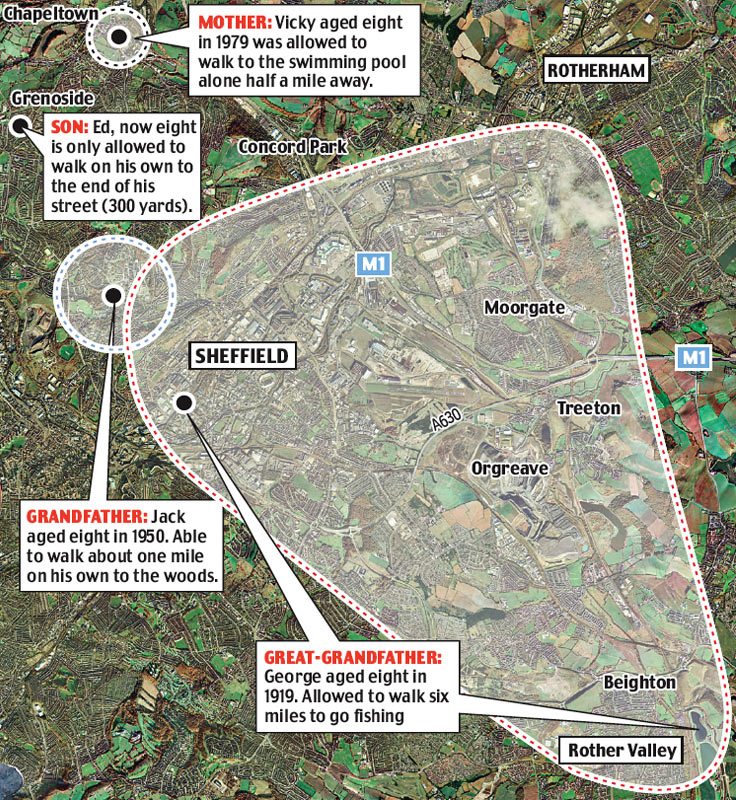
It’s a commonplace assertion that children today have less unscheduled, unsupervised opportunities for play and exploration, and parents have been indoctrinated into the belief that the world has become a much more dangerous place and their kids need 24/7 protection from those myriad dangers. “Helicopter” parenting is a rational response to this indoctrination, but it comes with costs to the growth and maturity of the next generation. More than a decade ago, I posted this graphic showing how each generation has been more protective of their own children than their parents had been for them:
The problem has been getting worse over time, as Rob Creasy and Fiona Corby describe:
Children growing up in the UK are said to be some of the unhappiest in the industrialised world. The UK now has the highest rates of self harm in Europe. And the NSPCC’s ChildLine Annual Review lists it as one of the top reasons why children contact the charity.
Children’s mental health has becomes one of British society’s most pressing issues. A recent report from the Prince’s Trust highlights how increasing numbers of children and young people are unhappy with their lives, sometimes with tragic consequences.
This is a generation of young people that has been labelled as “snowflakes” – unable to handle stress and more prone to taking offence. They are also said to have less psychological resilience than previous generations. And are thought to be too emotionally vulnerable to cope with views that challenge their own.
[…]
Children’s lives are being stifled. No longer are children able to spend time with friends unsupervised, explore their community or hang around in groups without being viewed with suspicion. Very little unsupervised play and activity occurs for children in public spaces or even in homes – and a children’s spare time is often eaten up by homework or organised activity.
This is further impacted by the way children are taught in schools and how pressure to succeed has led to a taming of education. But if children are never challenged, if they don’t ever experience adversity, or face risks then it is not surprising they will lack resilience.
Comments Off on Modern parenting – too many helicopters yield lots of snowflakes
HMCS Bonaventure of the Royal Canadian Navy
Sneaky Loon
Published on 9 Apr 2017The Bonaventure was purchased from the Royal Navy to replace HMCS Magnificent because the Bonaventure could operate fighter jets to conduct anti-submarine activities.
Comments Off on HMCS Bonaventure of the Royal Canadian Navy
February 19, 2019
Irish Potato Famine – Isle of Blight – Extra History – #1
Extra Credits
Published on 16 Feb 2019The potato blight hit the United States first before it came to Ireland (and other countries). But what made it particularly devastating in Ireland was the factor of human influence — behind-the-scenes bureaucracy that prioritized economics over human lives.
The Irish Potato Famine ranks as one of Europe’s worst agricultural disasters — scattering a people to the winds.
Join us on Patreon! http://bit.ly/EHPatreon
Comments Off on Irish Potato Famine – Isle of Blight – Extra History – #1
February 18, 2019
Mis-measuring inequality
Tim Worstall explains why any protest in a western country about “inequality” is probably bogus from the get-go:
Their opening line, their justification:
We live in an age of astonishing inequality.
No, we don’t. We live in an age of astonishing and increasing equality. Thus any set of policies, any series of analysis, that flows from this misunderstanding of reality is going to be wrong.
And that’s all we really need to know about it all.
The problem is that their measurements – the ones they’re paying attention to – of inequality just aren’t the useful ones, the ones we’re interested in. They’re usually pre-tax, pre-benefits. They’re always pre-government supplied services. And they never, ever, look at the thing we’re actually interested in, inequality of living standards.
To give an example, the Trades Union Congress did a calculation a few years back looking at top 10% households in the UK and bottom 10%. They took the average of each decile – so, the average of the top 10% households, the average of the bottom. Then they looked at the ratio between them.
The top 10% gain some 12 times the market income of the bottom 10%. Now take account of taxes and benefits. Then add in the effects of the NHS, free education for all children and so on. Government services. We end up with a ratio of 4 to 1. Life as it’s actually lived gives the top 10% four times the final income – income being defined by consumption of course – of the bottom 10%.
That’s not a high level of inequality.
Comments Off on Mis-measuring inequality
Forgotten history of India’s Thermopylae
The History Guy: History Deserves to Be Remembered
Published on 20 Jun 2017The History Guy tells the forgotten history of the World War II battle of Imphal also known as India’s Thermopylae.
The History Guy uses images that are in the Public Domain. As photographs of actual events are often not available, I will sometimes use photographs of similar events or objects for illustration.
Patreon: https://www.patreon.com/TheHistoryGuy
The History Guy: Five Minutes of History is the place to find short snippets of forgotten history from five to fifteen minutes long. If you like history too, this is the channel for you.
The episode is intended for educational purposes. All events are presented in historical context.
Comments Off on Forgotten history of India’s Thermopylae
February 15, 2019
“Blood of Bannockburn” – Sabaton History 002
Sabaton History
Published on 14 Feb 2019Sabaton’s song “Blood of Bannockburn” is about the First War of Scottish Independence and one of its key figures, Robert the Bruce. He fought the English King Edward who invaded Scotland when Bruce’s revolutionary force forced all Scottish nobles to join his cause or lose their lands. Edward moved on Bruce’s army while they were besieging Stirling Castle, but his plans to overwhelm the Scottish was opposed by Bruce.
Support Sabaton History on Patreon: https://www.patreon.com/sabatonhistory
Watch the official lyric video for Blood of Bannockburn here: https://www.youtube.com/watch?v=Xp-Rk…
Hosted by: Indy Neidell
Written by: Markus Linke and Indy Neidell
Directed by: Astrid Deinhard and Wieke Kapteijns
Produced by: Pär Sundström, Astrid Deinhard and Spartacus Olsson
Creative Producer: Joram Appel
Executive Producers: Pär Sundström, Joakim Broden, Tomas Sunmo, Indy Neidell, Astrid Deinhard, and Spartacus Olsson
Maps by: Eastory
Edited by: Wieke Kapteijns
Sound Editing by: Marek KaminskiEastory YouTube Channel: https://www.youtube.com/channel/UCEly…
Archive by: Reuters/Screenocean https://www.screenocean.com
Music by Sabaton‘Photo young Sabaton’ ©Dalarnas museum, foto: Susanne Nyhlén – The National Portrait Gallery https://www.npg.org.uk
An OnLion Entertainment GmbH and Raging Beaver Publishing AB co-Production.
© Raging Beaver Publishing AB, 2019 – all rights reserved.
From the comments:
Sabaton History
1 day ago (edited)Hey!! We’re leaving the modern times (which instantly that answers a frequently asked question about if we’re just sticking to WW2) and will enter the Medieval Era. The 3d animated maps are made and researched by Eastory (check his channel here: https://www.youtube.com/channel/UCElybFZ60Hk1NSjgCf7I2sg). As the battle took place long ago, there is little documentation about it and there are several possible reconstructions of the events of the battle available. We had to prefer one version and proponents of others may criticise it. The most risky decision was to add the effects of land rise and make the Forth river larger as a result. This is absent from most of reconstructions, but Eastory studied some old maps and according to them the sea level in 15th and 16th centuries was far higher in the region.
Enjoy and STAY AWESOME! 🤘🤘
Comments Off on “Blood of Bannockburn” – Sabaton History 002
February 13, 2019
The origins of the word “loot”
William Dalrymple wrote about the Honourable East India Company for the Guardian a few years back, including the way the word “loot” entered common English usage:
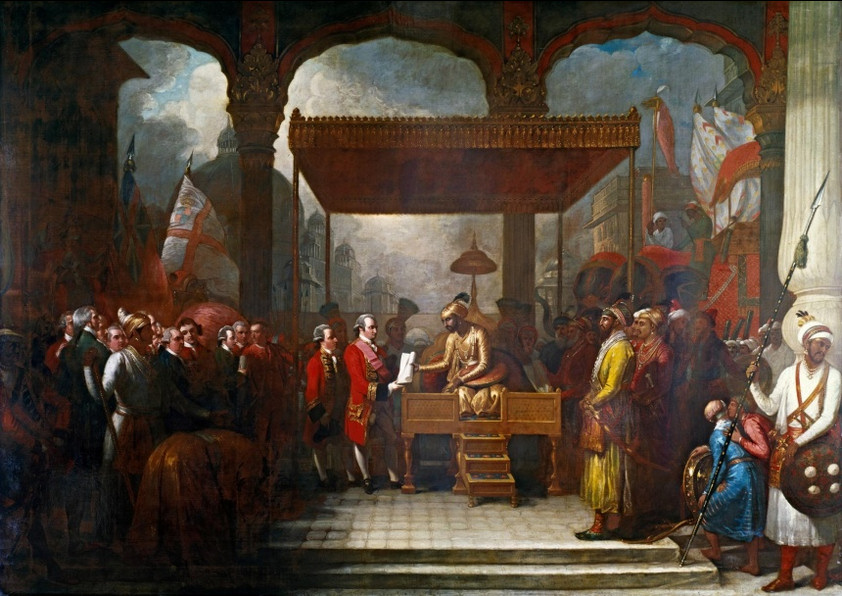
The Mughal emperor Shah Alam hands a scroll to Robert Clive, the governor of Bengal, which transferred tax collecting rights in Bengal, Bihar and Orissa to the East India Company, August 1765.
Oil painting by Benjamin West (1738-1820) via Wikimedia Commons.
One of the very first Indian words to enter the English language was the Hindustani slang for plunder: “loot”. According to the Oxford English Dictionary, this word was rarely heard outside the plains of north India until the late 18th century, when it suddenly became a common term across Britain. To understand how and why it took root and flourished in so distant a landscape, one need only visit Powis Castle.
The last hereditary Welsh prince, Owain Gruffydd ap Gwenwynwyn, built Powis castle as a craggy fort in the 13th century; the estate was his reward for abandoning Wales to the rule of the English monarchy. But its most spectacular treasures date from a much later period of English conquest and appropriation: Powis is simply awash with loot from India, room after room of imperial plunder, extracted by the East India Company in the 18th century.
There are more Mughal artefacts stacked in this private house in the Welsh countryside than are on display at any one place in India – even the National Museum in Delhi. The riches include hookahs of burnished gold inlaid with empurpled ebony; superbly inscribed spinels and jewelled daggers; gleaming rubies the colour of pigeon’s blood and scatterings of lizard-green emeralds. There are talwars set with yellow topaz, ornaments of jade and ivory; silken hangings, statues of Hindu gods and coats of elephant armour.
Such is the dazzle of these treasures that, as a visitor last summer, I nearly missed the huge framed canvas that explains how they came to be here. The picture hangs in the shadows at the top of a dark, oak-panelled staircase. It is not a masterpiece, but it does repay close study. An effete Indian prince, wearing cloth of gold, sits high on his throne under a silken canopy. On his left stand scimitar and spear carrying officers from his own army; to his right, a group of powdered and periwigged Georgian gentlemen. The prince is eagerly thrusting a scroll into the hands of a statesmanlike, slightly overweight Englishman in a red frock coat.
The painting shows a scene from August 1765, when the young Mughal emperor Shah Alam, exiled from Delhi and defeated by East India Company troops, was forced into what we would now call an act of involuntary privatisation. The scroll is an order to dismiss his own Mughal revenue officials in Bengal, Bihar and Orissa, and replace them with a set of English traders appointed by Robert Clive – the new governor of Bengal – and the directors of the EIC, who the document describes as “the high and mighty, the noblest of exalted nobles, the chief of illustrious warriors, our faithful servants and sincere well-wishers, worthy of our royal favours, the English Company”. The collecting of Mughal taxes was henceforth subcontracted to a powerful multinational corporation – whose revenue-collecting operations were protected by its own private army.
It was at this moment that the East India Company (EIC) ceased to be a conventional corporation, trading and silks and spices, and became something much more unusual. Within a few years, 250 company clerks backed by the military force of 20,000 locally recruited Indian soldiers had become the effective rulers of Bengal. An international corporation was transforming itself into an aggressive colonial power.
Using its rapidly growing security force – its army had grown to 260,000 men by 1803 – it swiftly subdued and seized an entire subcontinent. Astonishingly, this took less than half a century. The first serious territorial conquests began in Bengal in 1756; 47 years later, the company’s reach extended as far north as the Mughal capital of Delhi, and almost all of India south of that city was by then effectively ruled from a boardroom in the City of London. “What honour is left to us?” asked a Mughal official named Narayan Singh, shortly after 1765, “when we have to take orders from a handful of traders who have not yet learned to wash their bottoms?”
Comments Off on The origins of the word “loot”
QotD: The goose-step
One rapid but fairly sure guide to the social atmosphere of a country is the parade-step of its army. A military parade is really a kind of ritual dance, something like a ballet, expressing a certain philosophy of life. The goose-step, for instance, is one of the most horrible sights in the world, far more terrifying than a dive-bomber. It is simply an affirmation of naked power; contained in it, quite consciously and intentionally, is the vision of a boot crashing down on a face. Its ugliness is part of its essence, for what it is saying is “Yes, I am ugly, and you daren’t laugh at me”, like the bully who makes faces at his victim. Why is the goose-step not used in England? There are, heaven knows, plenty of army officers who would be only too glad to introduce some such thing. It is not used because the people in the street would laugh. Beyond a certain point, military display is only possible in countries where the common people dare not laugh at the army. The Italians adopted the goose-step at about the time when Italy passed definitely under German control, and, as one would expect, they do it less well than the Germans. The Vichy government, if it survives, is bound to introduce a stiffer parade-ground discipline into what is left of the French army. In the British army the drill is rigid and complicated, full of memories of the eighteenth century, but without definite swagger; the march is merely a formalized walk. It belongs to a society which is ruled by the sword, no doubt, but a sword which must never be taken out of the scabbard.
George Orwell, “The Lion And The Unicorn: Socialism and the English Genius”, 1941-02-19.
Comments Off on QotD: The goose-step
February 12, 2019
History Summarized: Iroquois Native Americans
Overly Sarcastic Productions
Published on 7 Aug 2017There’s a fascinating history from just northwest of American history that is too often ignored. But that’s a damn shame, because it’s a damn cool history, and I’m going to talk about it dammit!
No, I didn’t accidentally misspell the title of this video when I sleepily uploaded this after I woke up. That’s absurd.
EXTRA CREDITS: HIAWATHA: https://youtu.be/79RApCgwZFw
This video was produced with assistance from the Boston University Undergraduate Research Opportunities Program.
PATREON: http://www.patreon.com/OSP
Comments Off on History Summarized: Iroquois Native Americans
February 10, 2019
A debate on the impact of Brutalism on British cities
In Prospect magazine, James Stevens Curl and Barnabas Calder disagree on how Brutalist architecture has influenced destroyed urban areas in so many British cities. This is Curl’s opening salvo:
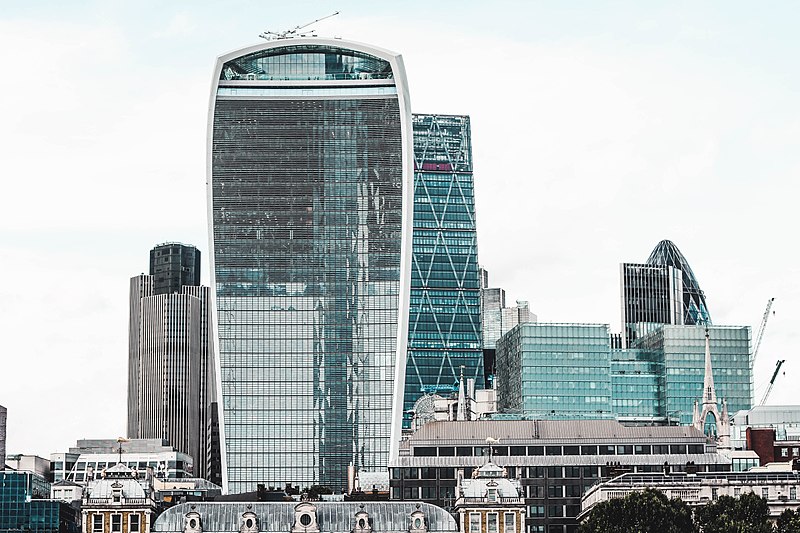
20 Fenchurch Street in London has been nicknamed the “Walkie-Talkie” due to its distinctive design.
Image by Toa Heftiba via Wikimedia Commons.
Visitors to these islands who have eyes to see will observe that there is hardly a town or city that has not had its streets — and skyline — wrecked by insensitive, crude, post-1945 additions which ignore established geometries, urban grain, scale, materials, and emphases.
Such structures were designed by persons indoctrinated in schools of architecture in ways that made them incapable of creating designs that did not cause immense damage and offend the eye, the sensibilities, and the spirit. Harmony with what already exists has never been a consideration for them, as it was not for their teacher: following the lead of “Le Corbusier” (as Swiss-French architect Charles-Édouard Jeanneret called himself), they have, on the contrary, done everything possible to create buildings incompatible with anything that came before. It seems that the ability to destroy a townscape or a skyline was the only way they have been able to make their marks. Can anyone point to a town in Britain that has been improved aesthetically by modern buildings?
Look at the more recent damage done to the City of London, with such crass interventions as the so-called “Walkie-Talkie” (which, through its reflectivity, has caused damage on the street below), or the repellent stuff inflicted on several cities by the infamous John Poulson and some of his bent cronies (from the 1950s until they were jailed in 1974). Quod erat demonstrandum.
How has this catastrophe been allowed to happen? A series of totalitarian doctrinaires reduced the infinitely adaptable languages of real architecture to an impoverished vocabulary of monosyllabic grunts. Those individuals rejected the past so that everyone had to start from scratch, reinventing the wheel and confining their design clichés to a few banalities. Today, form follows finance, when modern architecture is dominated by so-called “stars,” and becomes more bizarre, egotistical, unsettling, and expensive, ignoring contexts and proving stratospherically remote from the aspirations and needs of ordinary humanity. Their alienating works, inducing unease, are, without exception, inherently dehumanising and visually repulsive.
Comments Off on A debate on the impact of Brutalism on British cities
February 9, 2019
HMS Dreadnought – Guide 001
Drachinifel
Published on 12 Dec 2018HMS Dreadnought, the first dreadnought battleship and game changer for the British Royal Navy, is today’s subject.
Want to support the channel? – https://www.patreon.com/Drachinifel
Want to talk about ships? https://discord.gg/TYu88mt
Comments Off on HMS Dreadnought – Guide 001


