Quotulatiousness

March 15, 2026

Using US gun statistics to argue against Canadian gun owners

Filed under: Cancon, Law, USA, Weapons — Tags: , , , , — Nicholas @ 03:00

On the social media site formerly known as Twitter, Gun Owners of Canada respond to a troll post trying to confuse the legal situation for Canadian gun owners by using statistics from the US, where the laws are significantly different:

Typical. He blocked without further discussion.

But, he’s wrong.

There is a fundamental flaw in using that 1998 [US] DOJ literature review to argue the Stand on Guard Act will lead to more gun deaths. The claim relies on a completely broken comparison between U.S. and Canadian law.

Here is why applying that specific American data to this Canadian bill proposed by the CPC simply does not work.

The DOJ report relies heavily on American statistics where firearms kept for self defense are typically stored loaded and unlocked. That specific environment, meaning immediate and unrestricted access to a loaded weapon, is the primary driver for the increased rates of accidental shootings and suicides highlighted in those U.S. studies.

The Stand on Guard Act does not create that environment in Canada. Saying it does such is just fear-mongering.

This proposed legislation is strictly an amendment to Section 34(2) of the Criminal Code. It establishes a presumption that force used against a violent home invader is reasonable. The goal is to spare Canadians from years of legal limbo for defending their families.

Crucially, this bill does not amend the Firearms Act and it does not repeal Canada’s strict safe storage regulations.

A legally compliant Canadian firearm owner must still store their firearms unloaded and secured with a locking device, or locked inside a sturdy cabinet or safe. Ammunition must also be stored separately or locked up securely in the same safe.

The specific risks identified in the U.S. data, like a child finding a loaded gun or someone in crisis having instant access to a weapon, are mitigated by our existing storage framework.

Debating the merits of self defense thresholds is perfectly fair. However, importing U.S. data based on a completely different regulatory baseline to predict Canadian outcomes is a clear misapplication of the evidence. We need to ground this conversation in actual Canadian law rather than American statistics.

So, as a reminder — welcome to Canada — let’s buy Canadian, support Canadian and recognize Canadian facts.

March 14, 2026

Quid pro quo – something that is given in return for something else

Filed under: Cancon, China, Media, Politics — Tags: , , , , , — Nicholas @ 03:00

In the National Post, Tristin Hopper considers what the Parliamentary floor-crossers got in exchange for their loyalty:

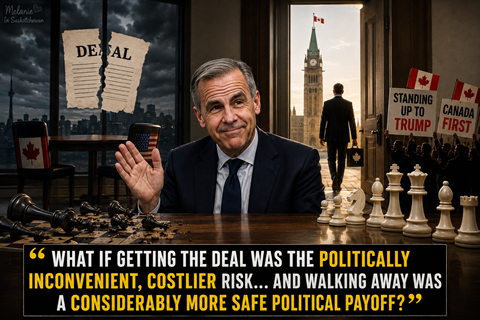
Image from Melanie in Saskatchewan

Nunavut MP Lori Idlout has now become the fourth opposition member to join the Liberals in just the last five months, joining three Conservative MPs.

While there have been more than 100 MP floor-crossings since Canada’s 1867 founding, the circumstances have never looked quite like this. In any prior instance where multiple MPs shifted party loyalties in a short period of time, it was almost always because of a seismic political issue such as First World War conscription or Quebec separatism.

But in this case, all four floor-crossers gave vague reasons for the move, if they even tried to explain it at all. Idlout’s statement, issued by the Liberal Party, explained her switch as endorsing “strong and ambitious government that makes decisions with Nunavut — not only about Nunavut”.

Unmentioned is that the four also saw personal benefits for their defection to the government benches. A cursory summary is below.

Thus far, there are no tangible goodies to d’Entremont’s surprise November floor-crossing. He hasn’t received a position in cabinet, a pay raise or any special titles. What he did seem to secure, however, was his job.

When rumours first began to leak out that the Liberals were actively seeking floor-crossers among the Conservatives, one commonality emerged among the MPs being solicited: They all represented tightly contested ridings that were now polling for the Liberals.

This was particularly true of d’Entremont’s Acadie-Annapolis riding in Nova Scotia. He won it for the Conservatives by just 536 votes in 2025. And given a surge in Liberal popularity across the Maritimes in interim months, it now seemed likely to swap back to the Liberals; which it had done as recently as 2015.

D’Entremont’s former Conservative colleagues would allege quite directly that the defection had been done purely to remain as the MP for Acadie-Annapolis.

After the floor-crossing, Conservative MP Rick Perkins would allege that d’Entremont had told him the weekend prior, “If an election is held now, I will lose my seat. I might as well not run.”

“There is nothing in his floor crossing about principles. It was about keeping his job,” Perkins wrote in a Facebook post.

Ma also represents a tightly contested riding. Markham-Unionville had gone Liberal as recently as 2021, and he won in 2025 with just 50.65 per cent of the vote as compared to 47.05 per cent for his Liberal opponent.

But it only took a few days after the floor-crossing before Ma was conspicuously added to Prime Minister Mark Carney’s delegation headed to the People’s Republic of China and Qatar.

As noted by National Post‘s Chris Nardi at the time, Ma was the only member of the delegation who wasn’t a minister or a parliamentary secretary. His highest applicable rank was that he was vice-chair of the Canada-China Legislative Committee, a group comprising 11 other MPs and senators who didn’t similarly receive a seat on the plane.

March 12, 2026

Carney’s Liberals buy gain another seat in Parliament

Filed under: Cancon, Government, Media, Politics — Tags: , , , — Nicholas @ 04:00

What couldn’t be obtained at the ballot box can apparently be constructed through non-electoral methods. After the Liberals fell short of a majority in the 2025 federal election, they’ve now gained four more seats through attracting opposition MPs to join their caucus:

Image from Melanie in Saskatchewan

Consider several ridings from the last election where Conservatives defeated Liberals by extremely small margins. Terra Nova–The Peninsulas was decided by only a handful of votes. Milton East–Halton Hills South by just a few dozen. Windsor–Tecumseh–Lakeshore by fewer than a hundred. In Markham–Unionville and Edmonton Riverbend the margins were still narrow by federal election standards, measured in the low hundreds.

In ridings with tens of thousands of ballots cast, those margins are not ideological fortresses.
They are statistical coin flips.

Now imagine you are a strategist trying to change the parliamentary math without calling another election. Would you target MPs who defeated your party by twenty thousand votes? Or would you look at ridings where the electorate was already split nearly fifty fifty? Where persuading one individual changes everything!?

That is where the Moneyball logic appears.

Instead of persuading fifty thousand voters, you persuade one MP. The scoreboard shifts instantly. No campaign. No election. No voters trudging through snow to mark an X. Just a quiet change of jersey on the House of Commons floor.

Now consider the MPs who have crossed the floor or whose ridings are currently the focus of speculation. Seats like Edmonton Riverbend held by Matt Jeneroux and Markham–Unionville represented by Michael Ma sit squarely in that category of competitive swing ridings. Even Nunavut, represented by Lori Idlout, illustrates how single seats in geographically unique ridings can dramatically affect parliamentary arithmetic.

Notice the pattern.
Not massive strongholds.
Swing ridings.
Seats where the Liberal candidate already came within striking distance.

Which raises an uncomfortable question.

Is this coincidence?
Or strategy?

Because if a riding was decided by one hundred votes, persuading the MP to change parties is dramatically easier than persuading fifty thousand voters to change their minds. The parliamentary math changes instantly.

The voters never get another say.

    Just like Canadians did not get a say when 131,674 votes from Liberal Party members at Mark Carney’s leadership race installed Mark Carney as defacto Prime Minister. He effectively became the Prime Minister of Canada through installation, not election.
    That is 0.33 percent of Canadians.
    Or, put another way, roughly one third of one percent of the country’s population participated in choosing the Liberal leader who then became Prime Minister through the parliamentary system without being elected by the people of the country.
    • 131,674 people chose the leader
    • out of about 41 million Canadians

Of course nobody in Ottawa will describe it this way. Politics prefers softer language. You will hear phrases like cooperation, evolving priorities, responsible leadership, and national unity.

Politics prefers poetry.
Arithmetic prefers patterns.

Individually every floor crossing can be explained. Each one comes with its own “so-called” story, its own “so-called” reasoning, its own “so-called” justification.

But collectively something else begins to emerge.
A seat here.
Another seat there.
Nothing dramatic.
Until one day the standings look different.

Exactly the way Moneyball worked. No blockbuster moves. Just quiet arithmetic accumulating advantage until the outcome changed.

In the past I’ve been comfortable with the Parliamentary tradition that voters elect individuals as their representatives so if that MP leaves the party they were elected for, it doesn’t change the representation of the constituents. Historically, when most MPs were free to vote their conscience except for a minority of “whipped” votes, where they were obligated to vote on party lines, this made sense. I’m becoming less comfortable as this pattern of “recently elected opposition MPs suddenly discovering they’d run for the wrong party” repeats, indicating that it’s not just ordinary politics, but a deliberate strategy on the part of the Liberals.

Some have speculated that a major factor in the latest defection was a recent federal financial benefit to the territory, but it might perhaps have been something more concrete:

Homelessness can’t be solved by just throwing more money at the problem

Filed under: Cancon, Government, Health, Media, Politics, USA — Tags: , , , — Nicholas @ 03:00

On the social media site formerly known as Twitter, L. Wayne Mathison responds to someone explaining their family’s tragic problem of a homeless relative:

The post hits a nerve because it exposes the part of the homelessness debate people prefer not to talk about.

A lot of the public story says homelessness is mainly about housing and compassion. If we build more units and remove stigma, the problem fades. That sounds humane. The trouble is that it ignores what families dealing with severe addiction and psychosis actually face.

Emily Baroz describes the reality many relatives know too well. The person on the street is often not just poor. They are deeply mentally ill, addicted, paranoid, sometimes violent, and frequently refusing help. Families try everything. Housing. Money. Treatment. Support. The illness itself destroys the ability to cooperate. Meanwhile the legal system often blocks intervention until someone gets hurt.

So the public debate becomes strange theatre. Compassion is defined as leaving the person alone. Authority is treated as cruelty.

That brings us closer to home. Manitoba’s NDP government is now moving toward supervised consumption sites. The argument is harm reduction. The idea is that if people are going to use drugs anyway, the state should at least make it safer.

The problem is that the evidence across Canada is far from comforting. Vancouver, Toronto, and other cities expanded harm-reduction sites over the last decade. Yet overdoses, street disorder, and visible addiction kept rising. Recovery rates did not suddenly surge. In many neighbourhoods the result was more normalization of drug use without a clear path back to stability.

If a policy is supposed to reduce harm, the basic question is simple: are fewer people addicted, dying, or trapped in the street?

If the answer is no, the policy deserves scrutiny.

Safe consumption sites may prevent some immediate overdoses. But they also risk locking people into a long-term cycle where the system manages addiction instead of helping people escape it. Families who are begging for treatment beds, detox spaces, psychiatric care, and recovery programs often watch governments invest more energy in enabling use than in ending it.

That’s the tension people feel but rarely say out loud.

A compassionate society does not abandon people to addiction while calling it care. Compassion sometimes means structured treatment, involuntary intervention when someone is clearly incapable of making rational choices, and serious investment in recovery infrastructure.

Otherwise we are simply managing decline.

And families like the one in that post already know it.

Update, 14 March: Welcome, Instapundit readers! Have a look around at some of my other posts you may find of interest. I send out a daily summary of posts here through my Substackhttps://substack.com/@nicholasrusson that you can subscribe to if you’d like to be informed of new posts in the future.

Update, the second: Devon Eriksen had a relevant-to-this-topic aside on a longer post –

One of the most common sources of confusion is “using the wrong word”.

For example, if you have a drug zombie problem, and you call it a “homeless” problem, then you spend a lot of tax money giving houses to drug zombies, who turn them into rat-infested drug dens.

The wrong word implies the wrong understanding.

March 11, 2026

The Supreme Court of Canada in Santa Claus mode (even if they no longer use those robes)

Filed under: Cancon, Government, Politics — Tags: , , , , , , , — Nicholas @ 05:00

In a pretty conclusive 8-1 decision, the Supreme Court of Canada seems to have overturned not only the Quebec childcare entitlement at issue in this case, but the notion of citizenship in a much wider sense:

The SCC recently abandoned their traditional red robes for black robes more similar to those of the US Supreme Court. This is a case where the older robes would be more appropriate for other reasons.

On Friday, the Supreme Court of Canada delivered its latest stupefying ruling. According to an 8–1 majority in the case of Quebec (Attorney General) v. Kanyinda, the Charter requires the Quebec government to extend subsidized daycare benefits to refugee claimants — asylum seekers who have not yet proven the legitimacy of their claim to refugee status. Founded on a prevalent but contentious reading of constitutional equality rights, the court’s reasoning has far-reaching potential to destabilize parts of the nation’s immigration and social welfare systems.

Until last week, Quebec law granted daycare subsidies to certain categories of parents, including Canadian citizens, permanent residents, and those with approved refugee status. When Bijou Cibuabua Kanyinda, the plaintiff in this case, arrived in the province and sought asylum in 2018, she fell into none of those categories. Aided by cause lawyers, and a coterie of social justice interveners (third party interest groups who submit arguments to the court), Kanyinda argued that the exclusion of refugee claimants from this welfare scheme amounted to unconstitutional discrimination.

Remarkably, the majority of the Supreme Court not only agreed with Kanyinda that the Quebec daycare scheme violated Section 15(1) of the Charter — which provides for “the right to the equal protection and benefit of the law without discrimination” — but bypassed the Quebec legislature by “reading in” a remedy directly into the law. In other words, the court rewrote the statute to immediately grant subsidies to “all parents residing in Quebec who are refugee claimants”.

More troubling than the outcome itself, however, will be the judicial reasoning that rationalized it. Writing for the majority, Justice Andromache Karakatsanis held that the Quebec scheme created a distinction “on the basis of sex”, a proscribed ground of discrimination under Section 15. But rather than fostering a distinction between men and women, Justice Karakatsanis asserted that the scheme discriminated between “men and women refugee claimants” — even though neither group was eligible for benefits at all. Because Quebec’s exclusion of refugee claimants worsened the economic disadvantage of the female claimants, she concluded, it constituted discrimination that violated Section 15.

The court’s reasoning is convoluted, to be sure. Readers may be forgiven for struggling to understand how a ruling that extends benefits to “refugee claimants” can follow from a supposed distinction on the basis of “sex”. In fact, the judgment exposes the incoherence into which the Supreme Court’s equality rights jurisprudence has fallen.

March 10, 2026

Rolling toward disaster – North America’s trucking industry

Filed under: Australia, Books, Cancon, USA — Tags: , , , , , — Nicholas @ 05:00

Donna Laframboise reviews a new memoir by Gord Magill, recounting his career in trucking in Canada, the United States, Australia and New Zealand:

… Gord has written a splendid book that belongs on Economics 101 reading lists everywhere. End of the Road: Inside the War on Truckers is chock-a-block with firsthand anecdotes. He tells us, for example, about traveling north into Canada from New York state during the 2022 Freedom Convoy protest, and feeling “drunk with patriotism, in love with every person I met, and they were in love with me”. After returning to his wife and daughters south of the border, he says he’d “never seen so many Canadian flags flying in the United States. It was unbelievable.” For a short time, “I was a minor celebrity simply for being from Canada”.

But this book is more than a collection of quirky tales about life behind the wheel. It’s a deep dive into shark-infested waters. For decades, but especially in recent years, experienced truckers have been treated like disposable widgets rather than skilled professionals. An industry upon which much of the North American economy depends has been undermined and hollowed out by perverse economic incentives, widespread fraud, and foolish policy. All of this makes our highways dangerous.

Gord explains that members of the public are three times more likely to be killed in a truck crash in America than down under partly because Australia has a graduated, quasi-apprentice licensing system. After driving smaller trucks for a year, people apply for the next level of trucking license, and then the next level, and then the next.

In North America these days, licenses seem to be given out like breath mints. The driver who blew through a stop sign in rural Saskatchewan in 2018, killing sixteen people associated with the Humboldt Broncos junior hockey team and injuring 13 others had less than one month of trucking experience. Yet he was behind the wheel of one of the largest configurations on the road (two interconnected trailers, known in the industry as a Super B-train). In Australia, that same driver would have needed a minimum of four years of experience and would have completed multiple courses and passed multiple tests before being entrusted with such a load.

Gord reminds us about the Ethiopian driver (on a work visa) who plowed into traffic that had slowed to a halt in a Texas construction zone last March. Five people — including a family of two parents and two young children — were killed, eleven others were sent to hospital, and seventeen vehicles were damaged. In that case, the driver reportedly had only four months of trucking experience.

Shortly afterward, in August 2025, three people died in Florida when, as Gord writes, “a tractor trailer attempted to pull an illegal U-turn through a small access point in the median … As the driver of the truck executed the turn, he pulled in front of a minivan, which ran into his trailer at high speed.”

The trucker in that case, an illegal immigrant from India, had somehow acquired commercial driver’s licenses in two US states. But when an English proficiency test was administered a few days after the accident, he answered only 2 of 12 verbal questions correctly and could identify only 1 of 4 traffic signs. It was later reported he’d failed his commercial trucking exam ten times during a two-month period.

Then there’s the trucker who drove an 18-wheeler weighing forty tons across a bridge with a clearly posted weight limit of six tons in rural Arkansas in 2018. The bridge collapsed and the truck sank into the river. It took seven months to extract it, while the bridge remained out-of-service for years.

March 8, 2026

The comfortable illusions Canadians tell themselves about the criminal justice system

Filed under: Cancon, Government, Law, Media, Politics — Tags: , , — Nicholas @ 05:00

L. Wayne Mathison describes how far too many Canadians see crime in Canada and how their pleasant imaginings depart from reality:

Let’s talk about the fairy tale we keep telling ourselves about crime in this country.

If you listen to a certain very loud and very sheltered crowd, you would think our justice system is basically a giant vacuum cleaner wandering the streets accidentally sucking up innocent people who somehow tripped and fell into a robbery charge. Apparently every person behind bars is just a tragic first-timer who made one bad decision on a difficult Tuesday afternoon.

That story collapses the moment you look at the numbers.

Statistics Canada shows something much less romantic. Our prisons are not packed with unlucky amateurs. They are filled largely with repeat performers. If someone is standing in court for a property crime, there is about an 80 percent chance they have already been convicted of doing the exact same thing before. For a lot of these offenders, theft is not a moment of desperation. It is a routine. Court is not a moral reckoning. It is paperwork.

Breaking into garages, lifting bikes, stripping catalytic converters. That is not chaos. It is a job description. Getting caught is just an occupational hazard.

Meanwhile the public is told to take a deep breath, retreat into their “inner Stoic,” and accept that having your property stolen is just part of modern urban weather. File the police report. Replace the lock. Pretend the system is working. It takes real mental gymnastics to watch the same small group of chronic offenders rack up dozens of charges while experts patiently explain that we simply need more empathy.

Look at what happens when these people are actually caught. Most walk out with bail conditions that amount to a polite note asking them to please behave. Unsurprisingly, a huge chunk of new convictions in Canada are administration-of-justice offences. That means breaching bail, skipping court, ignoring probation. They break the rules almost immediately. The revolving door barely slows down.

We do not need some grand philosophical rewrite of the social contract to fix this. We just need to stop pretending the public cannot see what is happening. A very small group of highly active repeat offenders causes a huge share of the damage in our communities.

Until the justice system stops treating career criminals like lost lambs who simply wandered off the path, the rest of us will keep paying the bill.

March 7, 2026

“Canadians were told there were 215 graves”

Filed under: Cancon, Government, History, Media, Politics — Tags: , — Nicholas @ 04:00

On the social media site formerly known as Twitter, John Rustad expresses his anger at the federal government’s apparent connivance in concealing information from Canadians in the not-really-an-investigation into the alleged mass graves at a former Residential School in British Columbia:

Canadians were told there were 215 graves.

The country lowered the national flag for months. Churches were burned. International headlines declared the discovery of mass graves at a former residential school. The federal government responded by allocating $12.1 million in taxpayer funding specifically to support investigation and exhumation work to verify those claims.

Now we learn that no remains have been exhumed.

At the same time, the Department of Crown-Indigenous Relations has released the activity reports tied to that funding, but every meaningful detail has been redacted. The reports describing what work was carried out, what investigations were conducted, and how public money was spent have been blacked out and labelled confidential.

That is unacceptable.

When the federal government spends millions of your taxpayer dollars to investigate a claim that shook the entire country, Canadians have a right to transparency. They have a right to know what work was performed, what evidence was found, and how their money was used.

This is not about denying history. It is not about attacking Indigenous communities. It is about basic public accountability.

If the government funded an investigation, the public deserves to see the results of that investigation.

Let me be clear: The records should be released in full. The spending should be explained clearly.

Canadians deserve the truth about what was done with their money. And if that money was not spent for the purpose it was granted for, then the public deserves accountability, including repayment of those funds.

March 6, 2026

The “security clearance issue” demonstrated by, of all people, Mark Carney

Filed under: Cancon, Government, Media, Politics — Tags: , , , , — Nicholas @ 05:00

Melanie in Saskatchewan explains why the constant Liberal talking point that refusing to get a particular security clearance “proved” that Pierre Poilievre was next-door to a traitor will probably not be raised any more:

Image from Melanie in Saskatchewan

Open Letter to Canada’s Security Clearance Scolds: Carney Just Proved Pierre Right!

To every Liberal and NDP partisan who has spent the last year yelling “security clearance” like it is a magic spell that turns criticism into treason, congratulations. Mark Carney just demonstrated Pierre Poilievre’s point for him, on camera, in real time.

The moment came on March 3, 2026, during Prime Minister Mark Carney’s Indo-Pacific trip. After meetings in India with Prime Minister Narendra Modi, Carney held a press availability with Canadian media while travelling through the region. The topic journalists wanted clarified was not subtle. They asked about foreign interference linked to India and the 2023 assassination of Sikh activist Hardeep Singh Nijjar in Surrey, British Columbia, the allegation that detonated Canada’s diplomatic crisis with India.

The question came from Dylan Robertson of The Canadian Press during the media scrum. He asked directly whether Carney believed India continued to engage in foreign interference or transnational repression targeting Canadians.

Carney swerved. He was asked again. And again.

Eventually, after the careful circling that seasoned politicians deploy when a straight answer would be inconvenient, he landed on the tell. Not the kind you need a polygraph for. The kind you publish in a civics textbook.

Here is what he said, exactly:

    There will not be consequences for those officials … There are aspects of those briefings that I can’t share in public, and I’m not going to betray them. I will tell you that there is progress on these issues.

Read that again, slowly, with a spoon handy in case you choke on the irony. Because this is the whole debate in one neat little ribbon.

Pierre Poilievre’s argument, from the start, has been that the particular classified briefings being pushed would place him inside a legal box. Once inside it, the rules governing those briefings restrict what he can say publicly and how he can use the information while doing his job as Leader of the Opposition. Global News reported Poilievre’s office saying officials told them the briefing structure could leave him legally prevented from speaking publicly about certain information except in narrow ways, which they argued would “render him unable to effectively use any relevant information he received”.

Now watch what just happened.

Carney, the man with the clearance and the briefings, is asked direct questions about one of the most explosive foreign-interference files in modern Canadian politics.

And his answer, translated into plain English, is simple: I cannot share what I know.

The latest CF-188 upgrade program, Hornet Extension Project, HEP

Filed under: Cancon, Military, Weapons — Tags: , , — Nicholas @ 02:00

Polyus
Published 10 Nov 2025

The CF-18s are getting old. Designed in the 70s, they were introduced into Canadian service in 1982, so they’re basically as old as me and yet they’re still flying on the front line. Of course they’re not the same planes today that they were back in 1982. They’ve gone through some changes along the way.

This video is intended to be an overview of the most recent upgrade program to the CF-188 Hornet, called the Hornet Extension Project. And yes that’s its official name but everyone calls it the CF-18, including me.

0:00 Introduction
1:37 Capability Gap
2:30 HEP-1
3:05 HEP-2
4:36 Conclusion
(more…)

March 4, 2026

Epic bad takes – “Justin Trudeau wasn’t a bad prime minister”

Filed under: Cancon, Government, Media, Politics — Tags: , , , — Nicholas @ 03:00

On the social media site formerly known as Twitter, L. Wayne Mathison responds to someone who we shouldn’t mock, because perhaps he was dropped on his head too many times as a child or perhaps he’s a card-carrying member of the Liberal Party:

There’s a reflex in Canadian politics that drives me nuts. If you criticize a prime minister hard enough, someone eventually says, “You’re just emotional. History will fix it.”

No. History doesn’t fix weak math.

Let’s stop pretending this is about vibes. Under Justin Trudeau, federal spending didn’t just rise during COVID. It exploded before it. Deficits were normalized in good years. Productivity flatlined. GDP per capita drifted backward relative to the U.S. Housing costs detached from incomes. Regulatory layers multiplied while investment quietly left for friendlier jurisdictions.

That isn’t hysteria. That’s structural decline.

The “he governed for the times” excuse is soft thinking. Leaders are supposed to anticipate trade-offs, not amplify them. When you stack carbon taxes, capital constraints, pipeline cancellations, and endless approval timelines onto a resource economy, you don’t get moral progress. You get stalled growth and capital flight. Then you blame grocers and global headwinds.

And let’s be blunt. The brand was performance politics. Identity theatre. International applause. But governance is boring. It’s about compounding effects. Interest payments. Productivity curves. Regulatory drag. Trudeau governed like narratives create wealth.

They don’t.

Even his defenders quietly admit course corrections were needed. If policies now require rollback or “revision”, that’s not vindication. That’s damage control.

Time won’t turn fiscal drift into foresight. It won’t convert stagnant productivity into hidden genius. Mulroney is respected because NAFTA and fiscal reforms strengthened the country long term. Results earned that.

If in twenty years Canada’s energy capacity, housing stock, productivity, and fiscal health look stronger because of Trudeau’s foundations, fine. I’ll concede it.

But if the next generation is still digging out from regulatory paralysis and debt overhang, nostalgia won’t rewrite the ledger.

Simple standard. Did living standards rise sustainably?

If not, no amount of mood reframing saves the record.

March 3, 2026

New name for Vancouver incoming in 3 … 2 … 1…

Filed under: Cancon, Government, Liberty, Politics — Tags: , , , — Nicholas @ 03:00

The Canadian federal government is not eager to share the details of a new agreement they’ve signed with the Musqueam First Nation that apparently cedes most of the city of Vancouver to the band, casting the property rights of two million people into legal limbo:

The Liberal government is refusing to publicly release an agreement with the Musqueam Indian Band that recognizes Aboriginal title over a vast area of British Columbia, including Metro Vancouver and surrounding areas, potentially affecting nearly two million people.

Buried in a seemingly mundane fisheries announcement put out on February 20th, the acknowledgement could radically undermine property rights in one of Canada’s largest and most populated metropolitan regions.

On February 20, Crown-Indigenous Relations and Northern Affairs Canada issued a news release with little fanfare titled “Musqueam and Canada Sign Historic Agreements Recognizing Rights, Stewardship and Fisheries”.

The news release reads: Canada “recognizes that Musqueam has Aboriginal rights including title within their traditional territory and establishes a framework for incremental implementation of rights and nation-to-nation relations with Canada”.

That phrase “including title” refers to Aboriginal title. Under Canadian constitutional law, Aboriginal title is a contentious but increasingly recognized property interest, affirmed by recent court rulings, including the controversial Cowichan decision. Courts have recognized Aboriginal title as a prior and senior right to land that critics say threatens fee simple title or traditional private property ownership in Canada.

The Musqueam Indian Band’s traditional territory encompasses virtually all of Metro Vancouver, including Vancouver, West Vancouver, North Vancouver, Burnaby, Richmond, New Westminster, parts of Delta and Surrey and other regions.

Based on 2021 census and other data, that territory is home to an estimated 1.8 million British Columbians.

The federal government has now formally recognized in writing Musqueam Indian Band’s Aboriginal title over that territory, yet Crown-Indigenous Relations and Northern Affairs Canada refuses to make the agreement public.

The February 20 announcement specifically refers to the “šxʷq̓ʷal̕təl̕tən Rights Recognition Agreement”, described as recognizing Musqueam’s Aboriginal rights, “including title” and establishing a framework for implementation.

Musqueam Chief Wayne Sparrow emphasized the Aboriginal title component directly in the release:

    Our Musqueam community celebrates these historic agreements as a step forward in our path to Reconciliation. In signing these agreements, the Government of Canada is acknowledging Musqueam’s Aboriginal title and rights to our traditional territory and recognizing our expertise in both marine management and fisheries management.

But when Juno News requested a copy of the agreement from Crown-Indigenous Relations, the department’s media relations spokesperson Eric Head confirmed receipt of the request and then cut communication altogether, even when pressed to ask if the agreement would be made public.

March 2, 2026

Remember this when they tell you grocery prices are high because of greedy corporations

Filed under: Business, Cancon, Food, Government, Media — Tags: , , — Nicholas @ 03:00

On the social media site formerly known as Twitter, L. Wayne Mathison explains why the headline profits of grocery stores bear almost no relation to the far smaller actual profits in the grocery retail market:

“Leader IGA” by daryl_mitchell is licensed under CC BY-SA 2.0 .

The 32% Illusion: A Grocer’s View from Behind the Till

I used to own the IGA in Hamiota. Small town. Thin margins. Real bills. So when I hear that Loblaw Companies Limited is raking in “31–32% profit”, I don’t get angry. I get tired.

Here’s the move. Take a gross margin number. Call it profit. Add a dash of politics. Serve hot.

Gross margin is revenue minus cost of goods sold. That’s it. It doesn’t include payroll, hydro, insurance, property tax, refrigeration repairs at 2 a.m., shrink, theft, advertising, transport, interest, or the banker breathing down your neck. Net profit is what’s left after all of that. In grocery, that number floats around 2 to 3 percent in a good year. Some years less. Some years negative.

When I ran my store, payroll alone could swallow most of the gross margin. Then add freight. Then add utilities. Manitoba winters are not kind to freezers. Then add spoilage. Bananas do not care about your ideology. They rot on schedule.

People think grocers “set prices”. That’s half true at best. Suppliers raise costs. Fuel goes up. Wages rise. Carbon costs ripple through trucking and farming. You pass it on or you close. It’s arithmetic, not greed.

Now here’s the uncomfortable part. Food inflation hurts. It hurts seniors. It hurts young families. It hurts the clerk stocking shelves. But blaming a 30% “profit margin” is a shortcut. It feels good. It’s wrong.

Big chains make money on scale, pharmacy, cosmetics, financial services. Those categories carry higher margins than milk and bread. That lifts the consolidated gross margin number. It does not mean grocery aisles are printing cash.

We should argue about competition. We should argue about supply management. We should argue about taxes embedded at every step of the chain. Good. Let’s do that. But at least use the right numbers.

I spent years watching pennies. Grocers survive on volume and efficiency. A few cents per dollar is the game. Always has been.

If you want lower food prices, focus on input costs, transport, energy, regulation, and competition. Start there.

And before sharing the next viral graphic, ask one question: gross or net?

That single distinction separates outrage from reality.

February 28, 2026

Just when you think Canada can’t get worse … it gets worse

Unlike most other Anglosphere countries, Canada does not have a resurgent right wing in domestic politics — we barely have a right wing at all — and the governing Liberal Party is constantly trying to steal sitting opposition MPs to achieve a majority of seats in Parliament. It’s no wonder that Alberta’s separatist movement has been active the last few years. In case you still have an optimistic view of Canada’s present and future, here’s a long “state of Canada” post from John Carter that will probably increase the numbers signing up for free euthanasia (“MAID” in Canadian):

The US is now leading Canada 3-0 in international hockey. If you count the Stanley Cup as an occasional international match, a Canadian team hasn’t won since 1993. For a country that has long practically defined itself as the Hockey Nation, this is especially humiliating. Given the continual year-round repetition of the Elbows Up mantra, this is the kind of thing a Roman augur would have interpreted as a portent of divine disfavour.

Months, you say? Oh dear.

Consistent with that interpretation, Canada’s recent humiliations have not been limited to sportspuck losses. What follows is a snapshot in time, headlines from a country beset by interlocking economic, demographic, spiritual, and political crises, a country which has not had good news in so long that it has forgotten what optimism even looks like.

Item: Canada recently watched the worst school shooting in Canadian history, and the second-worse mass shooting after the infamous 1989 Montreal Massacre in which “Mark Lepine”1 shot 14 female engineering students. The shooting took place in Tumbler Ridge, British Columbia, a small rural village in the country’s north, and claimed the lives of 10 people including the shooter, his mother, his brother, and several students. Dozens of others were injured. It soon turned out that the murderer was a trannie whose brain had been twisted into a psychotic pretzel by psychedelics, legal weed, SSRIs, and the gender woo he was force-fed at school, at home, and on Reddit. This has led to it being referred to as the Tumblr Shooting. Naturally, both the Royal Canadian Mounted Police and the Canadian media went out of their way to respect the shooter’s pronouns in all reporting and official communications. The media even made sure to give the shooter an AI filter glow-up, so that he could be remembered as the pretty girl we all know he really was deep down inside.

After a desultory and hilariously unsuccessful attempt at scolding the public that the problem wasn’t trannies, but guns or whiteness or something (blessedly, they couldn’t say “men” this time), the Canadian media just dropped it, though not before the government flew the flag at half mast.

Which is how this happened.

Item: A former school board trustee in Chilliwack, British Columbia, was fined $750,000 for failure to respect pronouns. Shooting up a school is bad, but misgendering is unforgivable.

[…]

Item: A xeet went viral in which a leaflib tried to fact check an American poster making fun of 18-month MRI wait times by pointing out that she’d only had to wait six months, prompting widespread mockery from incredulous Yanks.

Pennsylvania, which has about 1/3 of Canada’s population, has more MRIs than all of Canada put together. The Canadian mind cannot comprehend, etc.

Item: Euthanasia via Canada’s Medical Assistance in Dying (MAiD) program now accounts for 1 death in 20 in Canada. The overwhelming majority, around 96%, of MAiD recipients are white, despite white Canadians comprising 86% of Canadians in the elderly demographic that dominates assisted suicide participants.

Since 2016 over 76,000 Canadians have been killed by MAiD. Moreover, the program is accelerating: the death toll in 2024 was the highest on record at 16,499. Annual death tolls have risen by around a few thousand every year since the program started, with no sign of stopping. Canada is expected to hit 100,000 MAiD deaths by summer.

Item: While most MAiD victims are elderly and infirm, this is not true in every case. Recently it came out that a 26-year-old man was euthanized, simply because he was depressed over his diabetes-induced blindness. His family allege that he doctor-shopped until he found one who would kill him (she has apparently killed several hundred others).

MAiD was originally billed as an easy, painless out for people with terminal illnesses, a dignified death that would spare them a few months of pointless agony. It’s now being extended to people whose imminent death is not reasonably foreseeable. Several Canadian Armed Forces veterans have been offered MAiD in lieu of treatment for injuries sustained in the course of their service.

The primary goal of MAiD is almost certainly to reduce pressure on Canada’s overstretched public health care system whilst simultaneously reducing the fiscal burden of pensioners on the federal budget. Someone looked at the financials, and concluded that unfunded liabilities were going to bankrupt the country when the boomers reached their 80s. Therefore the government is talking them into killing themselves. However, while they’re at it, they might as well expand the program to hasten demographic replacement within the younger sectors of the population pyramid.


  1. Née Gamil Gharbi, a detail the Canadian media successfully kept from us for decades as it didn’t fit their narrative that “men” are the problem, rather than men from … certain places.

February 27, 2026

Brookfield, Carney, Freeland, and Ukraine – cui bono?

Melanie in Saskatchewan goes digging in the less-publicly-visible parts of Canada’s massive support of Ukraine to see who is gaining the benefit from all that money and all those political and economic manoeuvres … and you probably won’t be surprised to hear that it’s not ordinary Ukrainians or their soldiers fighting on the front line against Russia:

Image from Melanie in Saskatchewan

I need you to stop for a moment and really sit with this. Ask yourself a question that should make your stomach drop. What if the billions of your tax dollars being sent to Ukraine are not just about solidarity, democracy, or defending freedom? What if they also intersect with private financial interests connected to the very people making those decisions?

Because that is the bombshell.

And once you see the connections, you cannot unsee them.

Canada has now committed more than $25.5 billion to Ukraine. Just days ago, Prime Minister Mark Carney announced another $2 billion in military aid. Armoured vehicles. Equipment. Sanctions. More money flowing outward while Canadians juggle mortgage renewals, grocery bills, and heating costs that feel like ransom demands.

[…]

And to the Ethics Commissioner, Canadians deserve clarity. The Conflict of Interest Act is widely described as a disclosure regime. It relies heavily on what office holders report and on screening mechanisms that operate within defined boundaries. Committee testimony has acknowledged that screen administrators do not know the specific underlying assets within the Brookfield Global Transition Fund and that a significant portion of Brookfield’s broader portfolio is outside those screens. Mark Carney is the architect of Brookfield’s Global Transition Fund. He KNOWS what the assets in that fund are. He also has carried interest structures in that fund. If Konrad von Finckenstein does not take note and act, then I cannot validate the need for his position. We might as well install a potted Boston Fern in his chair, we’d still get the same results.

So the question becomes simple. If an issue of this magnitude does not justify proactive scrutiny and clear public documentation, then what does? Canadians are not asking for drama. They are asking for written determinations, documented recusals, and visible oversight that goes beyond procedural minimums.

Were Canadian Ukraine policy decisions structured, timed, or insulated in a way that ensures there is absolutely no benefit, direct or indirect, to any financial exposure connected to Brookfield-related structures? Have recusals been documented? Has the Ethics Commissioner issued written determinations? Has conflict screening been publicly disclosed?

Where is the paperwork?

If everything is clean, then showing the documentation should be effortless. If everything is arms-length, then release the recusal letters. If there is nothing to hide, then open the books.

Canadians are not children. We understand complexity. What we resent is opacity.

To Moose on the Loose, credit where it is due. Independent researchers willing to comb through filings, contracts, and timelines are the reason these overlaps are being discussed at all. Without that digging, most Canadians would never see the full picture.

Now it is on us.

Share this. Ask your MP. Demand written answers. Demand documentation. Demand transparency from Mark Carney.

« Newer PostsOlder Posts »

Powered by WordPress