
It’ll probably be no surprise to anyone who’s met me, but I was a terrible student in school. While I quite enjoyed learning (about some things, anyway), I hated the environment where that learning was supposed to be taking place. I did well enough in primary and middle school, but I dropped out of high school and finished my diploma through correspondence. I have a great deal of sympathy for those kids who don’t fit into the institutional framework, as I certainly didn’t feel I fit in during my sentence. (It’s often worse for boys, as it’s more difficult for boys to sit still and stay quiet, and teachers readily interpret distraction and fidgeting as something needing medical intervention rather than signs of normal human development for half the species.) At Without Diminishment, Sam Dagres considers the plight of the vast majority of children locked in to that minimum 12-year incarceration:
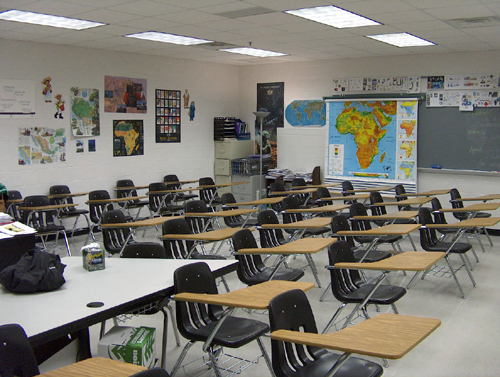
You’re sitting there, one eye on the clock, eagerly waiting for the bell to ring. How you crave the chime of that sweet-sounding bell, a ring marking the start of your allotted outdoor time. You rush outside, feel the sun on your skin, eat a snack reminding you of a world that exists on the other side of the fence. But for most of the day, you are sat, effectively immobile for 8 hours. Stillness is the highest virtue, and any violation leads to punishment and an ADHD diagnosis. Day in and day out, you wait for the last bell.
Most of us will have experienced this kind of imprisonment, befitting what crime, you may wonder? We are punished for the crime of being born into a society where all forms of care are by default institutional, a society whose “child care policy is adult policy, not early childhood policy”, as Katharine B. Stevens noted.
According to Statistics Canada, approximately 5.5 million students are enrolled in K–12 public schools, dwarfing the 67,000 who are home-schooled. Nearly 99 per cent of all school-aged children in Canada are currently institutionalised.
In 2025, 58 per cent of children aged 0 to 5 were in childcare facilities, representing approximately 1.4 million children. One-quarter of those were aged under 1.
As someone who attended public schools all my life, I never thought of it as anything but natural. But as I reach a point in my life where family formation is uppermost in my mind, I wonder whose interests are prioritised whenever I walk by a school and hear, not see, kids playing on the other side of a tall brick wall.
We do not leave it to children to decide very much for themselves, which means their interests are ours to safeguard. Luckily, the research exists: institutional, non-familial care is not what is best for most of our young.
The incomparable Institute for Family Studies recently enumerated the relevant studies, one of which is the NICHD Study of Early Child Care and Youth Development, which followed 1,000 children from infancy through adulthood and found that “children who had spent at least 30 hours per week in those settings beginning in infancy had three times the rate of social-emotional difficulties, including lower social competence, higher externalising behavior, and more conflict with teachers and peers. These effects persisted through elementary school, and by adolescence appeared as impulsivity, risk-taking, and substance use.”
Similarly, studies of Quebec’s universal childcare system have shown that the programme “has been associated with increased anxiety, aggression, hyperactivity, worse parent-child relationships, and lower self-reported life satisfaction in adolescence. By young adulthood, the negative effects extended to a 22% increase in criminal conviction rates.”
The foundations of our emotional and cognitive lives are formed early on while we bond with caregivers, and early institutionalisation disrupts that. The emotional downsides resulting from the systematic separation between the young children and their mothers are not broadly grasped, since the opposite is widely believed. When I share my musings about home-schooling with my friends, without fail, I receive the unanimous response: “Aren’t you worried they’ll turn out weird?” To that I respond, “Have you been paying attention?”
We are living through an era of weird, surrounded by friendless, non-eye-contact-making, socially anxious individuals. Nowadays, most schools encourage gender exploration and, through intense anti-bullying campaigns, demand a near-total embrace of any and all quirks. Not to mention that these tiny balls of anxiety, for some reason, require Vietnam-War-vet-levels of pharmacological intervention. I had someone tell me, “In my current role, I feel more like a pharmacist than a teacher”.
We can attribute the explosion of weirdness to a whole host of factors, notably digital devices and their role in mass social atrophy, but the forced dislocation of young children from their families is the foundation for a lifetime of alienation.


