
I think it’s fair to say that Enoch Powell is having a moment, nearly sixty years after he shocked the establishment with his 1968 “Rivers of Blood” speech. He became a pariah even in his own party, and his political career never recovered … but his warnings have more than been fulfilled over the intervening decades. In The Critic, Jeremy Black reviews the recently reprinted 1998 biography of Enoch Powell by Simon Heffer:
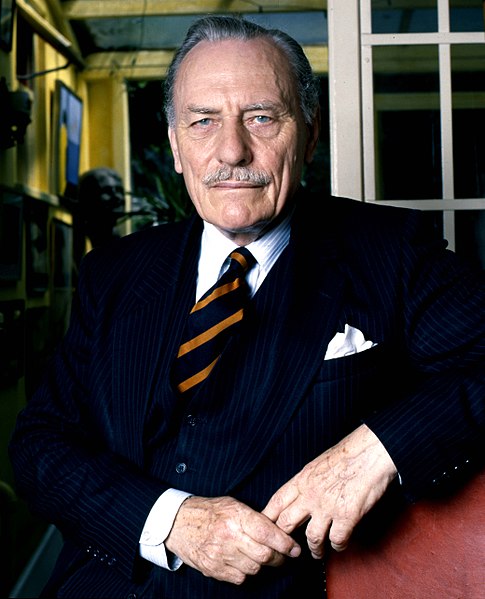
Enoch Powell in a 1987 portrait by Allan Warren.
Wikimedia Commons.
The new imprint of this important biography provides an opportunity to reread one of the most skilful works on British political history published over the last half century. As with Heffer’s other books, it is also very well written — although might I offer a plea for leaving aside sentences such as “He still saw no reason to lay off Heath”?
Before turning to the substance, it is worth considering the Foreword. Written this January, it underlines Powell’s significance to many issues, notably: “His deep scepticism about the confluence of America’s interest with those of Britain”. I am, however, dubious about the proposition that “Powell was, quite simply, one of the foremost Conservative thinkers in living memory, possibly the greatest since Burke”. Leaving aside the question of whether Burke can be described as Conservative or even, prior to the 1790s, as conservative, and, separately, the implicit dig at claims for Disraeli whom Heffer is on the record as describing as a Charlatan, I myself would make the case for Salisbury, while agreeing that Macmillan, Hailsham and MacLeod did not measure up to Powell. He returned the damage done him by Macmillan with “bilious” reviews of his Memoirs.
While I am sceptical of the claim that Powell was a great Conservative thinker in the cosmic sense, he was an impressive critic of many of the shibboleths of establishment Conservatism from the 1960s to the 1980s, including on immigration, the nuclear deterrent, the Common Market, the American alliance, Northern Ireland, and economic policy.
A significant aspect of the intellectual character of Powell was the return of this one-time atheist to the Church in the late 1940s, the subject of the “Interlude” “Powell and God” in the book. There is, as Salisbury and Cowling among others underlined, a significant link between Conservatism and the Church of England, and Powell, like Thatcher, can be profitably discussed in these terms, with Thatcher far less convincing.
The discussion of Powell’s elision from public debate is also interesting. Published by Weidenfeld and Nicolson in 1998, the biography was kept on print-on-demand until cancelled in the aftermath of the Black Lives Matter movement. Heffer compares the treatment of Powell to that of Orwell in facing difficulties in publishing Animal Farm and Nineteen Eighty-Four. For several years, Heffer found it impossible to persuade a publisher to republish the book and suggests that this was due to a craven fear of public opinion “real or perceived”, one about which Orwell had warned not least when referring to “intellectual cowardice”. The publisher he has found, it has to be said, is another instance of the very valuable work being done by non-metropolitan concerns.


