Quotulatiousness

February 15, 2026

The smartphone as a tool to create a real-life Idiocracy

Filed under: Britain, Media, Railways, Technology — Tags: , , , , , — Nicholas @ 05:00

Not being much of a film fan, I’d never seen the movie Idiocracy, but based on the description in Christopher Gage’s rant against the smartphone, I might not need to watch it as it’s happening all around us:

Transport for London, the mythical entity alleged to manage the city’s Tube, has revealed its campaign to tackle the smartphone scourge: sickly posters splashed in kindergarten colours.

The campaign targets the “disruptive behaviour” of passengers who were evidently raised by a pack of snarling hyenas. They blast reels, videos, music. They FaceTime their cackling friends. Not so long ago, a fellow passenger revealed to us — her captive audience — that someone named Sarah had caught the clap from someone named Travis. Syphilis? How literary.

Miraculously, researchers at Transport for London discovered a rare tribe thought to be long extinct: Londoners who communicate with their fellow human beings by making noises with their mouths — one thousand of them, in fact.

Researchers approached these strange beings with a mixture of wonder and trepidation. They prodded them with a stick. That didn’t work. After jabbing them with a cattle prod, they looked up from their phones. Several members landed in Accident and Emergency, complaining of neck strain injuries.

Seventy percent of those surveyed said the constant noise screaming out of smartphones drove them crazy. One responder suggested offenders receive forty lashings in public. That is a bit much. Ten should do the trick.

TFL wavered from such brutal and effective methods. Campaign posters politely ask passengers to wear headphones.


I’m afraid that TFL’s well-meaning campaign hasn’t quite restored sanity on the London Underground.

Last week, I sat next to a grown man grinning at his phone like a Hindu cow. On the screen was a captivating spectacle. Someone, somewhere, makes it their daily business to buy gigantic, waist-height glass bottles of soda. This clearly well-adjusted person then rolls the bottles down a flight of concrete steps. Our friend dissolved the journey between Hammersmith and Leicester Square in a trance. Bottle. Roll. Smash. Bottle. Roll. Smash.

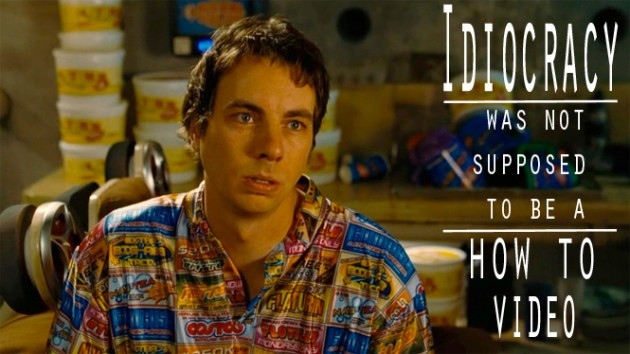
This reminded me of the satirical film, Idiocracy. The plot follows U.S. Army librarian Luke, and prostitute Rita.

After signing up for a hibernation experiment, the two awake in America, year 2500. Mountains of trash litter the landscape. Planes fall out of the sky. The citizens drag their gormless faces between Starbucks (which is now a coffee-serving brothel) and shopping malls even more dementing than those today. Over centuries, the dumb have biologically outgunned the smart.

The citizens of this moronic inferno drain their days glued to hyperactive screens. Their favourite content includes the Masturbation Channel and a reality TV show called “Ow! My Balls!” That show follows a hapless man as he gets whacked in the testicles.

They cultivate high culture, too. The profound film, Ass, zooms in on a pair of bare bum cheeks. The sophisticated audience fizzes with laughter as the bum, for two hours, passes wind.


Back in 2006, Idiocracy was a well-done satire which stretched logical extremes. Today, I’m not so sure it is as ridiculous as it once seemed. Just spend ten minutes on the Tube, inhaling the noxious TikTok fumes spewing from smartphones.

Transport for London has a point. But it is far too late. We are a nation of dopamine addicts. Those dopamine crack pipes stitched to our palms are quite literally designed to suck away as much of our time and attention as possible. An intervention, at this late hour, must be drastic.

How about a campaign outlining the terrifying effects of watching brain-rot content for hours and hours each day? A growing body of research suggests today’s smartphone is tomorrow’s lobotomy. Am I rioting in hyperbole? No.

One study found that watching short-form video is more harmful to our brains than soaking them in booze. At least, the latter indulgence might get you laid.

Several studies link smartphone culture with declines in comprehension, literacy, and the ability to reason. Others link smartphones with rising narcissism and collapsing social capital. And then there’s the nascent research suggesting that smartphone addiction may trigger ADHD and Autism-like symptoms in the addicted.
How to Make The Economy Look Better Than It Is – Death of Democracy 03 – Q3 1933

Filed under: Economics, Germany, History, Religion — Tags: , , , , , , — Nicholas @ 04:00

World War Two
Published 14 Feb 2026

Death of Democracy returns to Nazi Germany in Q3 1933. See Hitler enforce one‑party rule, sign the Reichskonkordat, tighten propaganda and press control, and expand work programs that feed rearmament. From July to September, follow the legal and cultural Gleichschaltung that normalizes terror and reshapes Europe’s future in this episode.
(more…)

Everything you see in the media is kayfabe

Filed under: Government, Law, Media, Politics, USA — Tags: , , , , — Nicholas @ 03:00

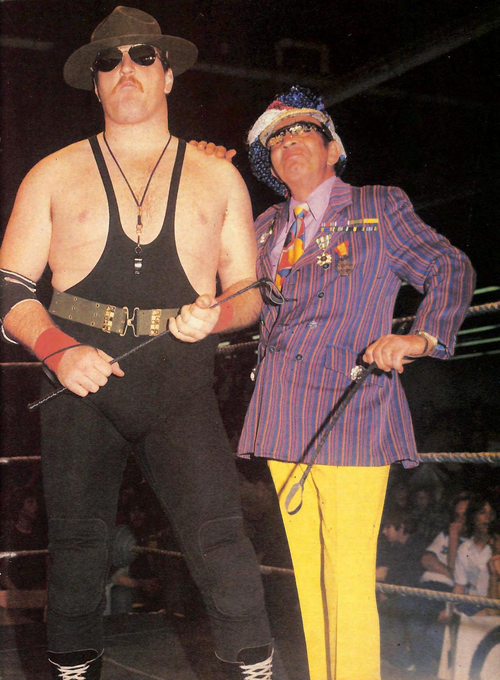
Wikipedia defines kayfabe as “the portrayal of staged elements within professional wrestling (such as characters, rivalries, and storylines) as legitimate or real. Although it remains primarily a wrestling term, it has evolved into a code word for maintaining the pretense of ‘reality’ in front of an audience.” It’s hard not to see modern political theatre in that light, as Damian Penny points out:

Sgt. Slaughter and The Grand Wizard, February 1984.
Photo from Wrestling’s MAIN EVENT magazine via Wikimedia Commons.

I know a guy who was obsessed with WWF wrestling (yes, I said WWF wrestling, because you kids better get off my lawn before Diagnosis Murder comes on) when he was younger and got to see it live when it came to his city. After the show, he was shocked to see several of the wrestlers — some of them good-guy “faces”, others bad-guy “heels” — being driven from the arena in the same minivan.

For someone who took the “sport” of professional wrestling seriously1 and was extremely emotionally invested in the performer rivalries, this was kind of like finding out that Santa Claus wasn’t real.2

That’s the first thing I thought about when I came across this piece by Christianity Today‘s Russell Moore, a rare evangelical leader who actually held on to his integrity in the age of Trump, about the Epstein Files:

    Reading through the names of those connected with Epstein, one can hardly believe the range listed there. Some were unsurprising: for instance, creepy filmmaker Woody Allen or the man formerly known as Prince Andrew. But even then, the scope is unsettling. Even the Dalai Lama had to put out a statement noting that he was never involved with Epstein. Just as incredible, many of the people listed were partying with those they spend a lot of time telling the rest of us to hate.

    Both Donald Trump and Bill Clinton were apparently friendly with Epstein. The New Age syncretist Deepak Chopra is in the documents many times — often with shady, enigmatic phrases — but so are those who accused the pope of New Age syncretism. With Middle Eastern tensions what they are, still the files include both sheikhs and Israelis. All over the files are connections with both left-wing populist provocateur Noam Chomsky and right-wing populist provocateur Steve Bannon. Epstein makes fun of evangelicals yet recommends a James Dobson article.

    How can this be?

    Maybe one reason is that Jeffrey Epstein figured out the deep, dark secret of this moment: The people who fight culture wars often believe what they say, but the people who lead culture wars often don’t.

[…] And if the Epstein revelations didn’t blackpill you hard enough, check this out:

To be fair, I’m not sure it’s an entirely bad thing that so many decision-makers and “thought leaders” who are sworn enemies in public get along just fine when the cameras are turned off. If they really hated each other, our political culture might be even more messed up.


  1. YouTuber Drew Allen says you should take wrestling seriously, and honestly he makes a darned good argument.
  2. I’ll never forget when I found out Santa Claus wasn’t real, and how I was so depressed and hopeless and wouldn’t leave my bed for days. Finally my mother came into my bedroom, sat down on the side my bed and said, “honey, I know you’re sad but you’re in your second year of law school and really we thought you’d have figured this out long ago“.

WW1: The Siege of Przemyśl: Austria-Hungary’s Horror Story | EP 6

Filed under: Europe, Germany, History, Military, Russia, WW1 — Tags: , , , , — Nicholas @ 02:00

The Rest Is History
Published 11 Sept 2025

After endeavouring to wreak their revenge on Serbia, what would be the greatest hammer blow to the Austro-Hungarian Empire during the First World War? With Leviv having fallen apocalyptically to the Russian hordes, what had gone so wrong? How might the war have been brought to an end before Christmas of 1914? And, with the darkness gathering around the Austrian defences, could the great fortress of Przemyśl hold out against the Russian barrage for a second time?

Join Dominic and Tom as they discuss the fall of the Austro-Hungarian Empire and the Russian advance, on the brutal Eastern front, as the first year of the First World War grinds bloodily on…

Alexander Watson’s The Fortress, the book heavily referenced in this episode, is available to purchase here: http://bit.ly/41NKRrq
______

00:00 – Cold open: “intricacies of war” reading
01:13 – Adobe
01:51 – Nick Lloyd & the Tyrolean Kaiserjäger
03:26 – Austria-Hungary’s coming unraveling: setting the stakes
06:50 – Why Przemyśl is a fortress; garrison & geography
08:31 – August 1914: Conrad’s plan and its unraveling
17:48 – Catastrophe for the Habsburg army
18:32 – The siege begins
24:50 – Pendulum swings back; Russians advance again
27:01 – Civilian exodus chaos; encircled again (8 Nov)
28:10 – Uber
28:50 – Folio Society
30:17 – Russian occupation & pogroms in Galicia (1914)
31:39 – War aims: Russification under Count Bobrinsky
33:00 – Russian antisemitism context; pogroms & deportations
37:05 – Second siege strategy: starve them out; General Kusman
38:04 – Early aerial bombing of civilians (Dec 1)
39:10 – Christmas Eve gestures; brief humanity, then darkness
41:04 – Conrad’s Carpathian rescue bid (23 Jan): campaign from hell
42:02 – Carpathian horrors; Tyrolean memoir; morale collapses
47:10 – POW fate: officers vs men; camps & Murmansk railway
49:01 – Austria-Hungary reels from the disaster
50:17 – Germany’s opinion of Austria Hungary
51:13 – Italy cuts a deal, joins war; the Italian Front beckons
53:38 – Tsar’s visit; enforced Russification in Przemyśl
55:14 – Mackensen’s offensive; Germans “liberate” Przemyśl; Austria eclipsed
56:10 – Foreshadowing WW2?
(more…)

QotD: The love of long-distance train travel

Filed under: Food, History, Quotations, Railways — Tags: , , — Nicholas @ 01:00

Why is it that I love, or used to love, trains so much? I thought about this often when I was effectively banned, by the virus, from my normal daily journey between Oxford and London, 63 miles each way. Even now, in bare modern trains systematically stripped of character and romance, there can be a glorious seclusion in a long-distance train that does not stop too much. The soft and distant landscape rolls by, and at any time I can look up and see a familiar hill, church, or stretch of woodland. I can name much of what I see, and have walked over a great deal of it, purposely seeking to know the land better. If I am traveling from the North of England to London, I always try to change at York, to the hourly nonstop train to the capital. The feeling of peace and irresponsibility that spreads through me as the train heaves itself out of the station is a special joy. For two hours nobody can bother me. For two hours I will not be disturbed. For two hours I will be enclosed in a warm and comfortable space, again passing through familiar towns and fields along the route so wonderfully described by Philip Larkin in “The Whitsun Weddings“, until the brakes tighten and I am in prosaic London. And it seems to me that everyone else on that train will be similarly calmed and soothed.

Of course, the accursed cell phone and the even more accursed smartphone have penetrated the seclusion. And alas, there are no more dining cars, a delight now almost completely abolished by spiteful managements, and available mainly on ridiculous super-luxury trains such as the pastiche Orient Express. Yet no restaurant meal I have ever had, including the pressed duck at the old Tour D’Argent in Paris (before it became a museum where you could eat the exhibits), has surpassed the breakfasts, lunches, teas, and dinners I have eaten in trains.

I think of the wonderful bacon and eggs, accompanied by soda bread, on the cross-border Belfast-to-Dublin flyer in Ireland; the vast plates of pork and dumplings accompanied by Pilsener beer on the somnolent Zapadny Express from Nuremberg to Prague; the fresh pancakes and maple syrup at breakfast on the California Limited, with antelopes fleeing from the train somewhere between Dodge City and Albuquerque; the first sip of tea from the samovar, served in a glass in an ornate silver holder, on the Red Star night sleeper from Moscow to Leningrad; the first glass of wine on a sunny September evening as the Rome Express, an hour out of Paris, clattered southward past the faintly minatory cathedral tower at Sens. Then there were the toasted teacakes near Grantham on the southbound Flying Scotsman, and the superb galley-cooked steak on the upper deck of the Chicago-bound Capitol Limited, as it climbed westward through the evening into the forests beyond Harper’s Ferry and up the Potomac valley.

Peter Hitchens, “Why I Love Trains”, First Things, 2020-07-16.

Powered by WordPress