
Quotulatiousness

October 9, 2025

Freedom Convoy 2022 – “… proving once again the Liberal mastery of combining high drama with low farce”

Filed under: Cancon, Government, Media, Politics — Tags: , , , , , — Nicholas @ 05:00

In the National Post, Michael Higgins states the obvious fact that Tamara Lich, Chris Barber, and the rest of the Freedom Convoy protesters were never insurrectionists. Trudeau had decided in advance that the convoy was a maple-flavoured January 6th attempt to overthrow the government — if not an attempt to re-stage the storming of the Winter Palace — and merely waited for the violence to break out and/or the Parliament buildings to be stormed. But nobody other than a few particularly glowy federal provocateurs was interested … because they were there to protest government policy not to start a revolution:
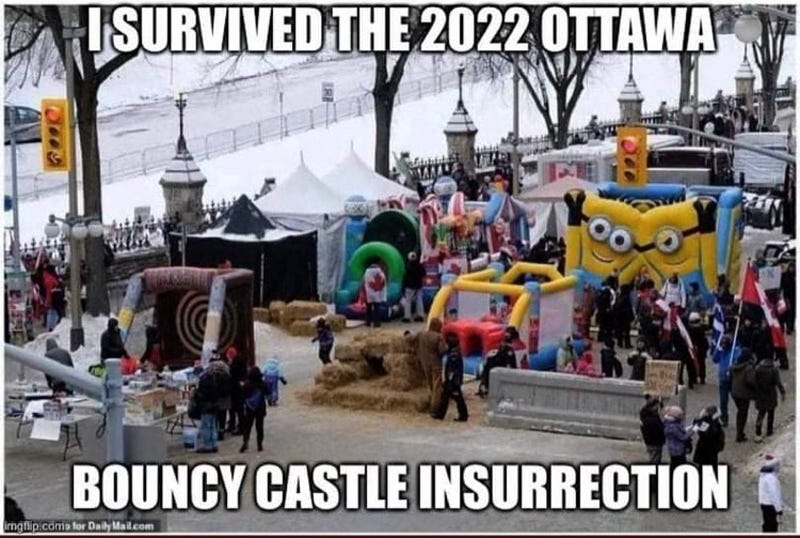
Marco Mendicino, the public safety minister of the day, portrayed them as extremists intent on overthrowing the government.

“This so-called ‘freedom convoy’ called for the overthrow of the government. They called for the Governor General to unilaterally remove the Prime Minister from office,” Mendicino told a Commons parliamentary committee.

Indeed, the Office of the Secretary to the Governor General was inundated with calls and emails by protesters demanding then prime minister Justin Trudeau be fired.

But since the Governor General can’t just decide to sack a prime minister, these email-writing anarchists were particularly inept as well as being constitutionally illiterate.

It was Shakespearean farce, but Liberals like Mendicino were happy to play politics and paint the convoy protesters as lawless subversives bent on destroying democracy.

Although, to be fair, Trudeau only said they were a “small fringe minority” with “unacceptable views” — more retrogrades than revolutionaries.

Meanwhile, Ottawa’s Keystone Kops had all the laws, rules and regulations needed to disband the convoy, they just lacked the leadership.

Days into the occupation, Ottawa Police Services chief, Peter Sloly, appeared to have thrown up his hands in resignation, stating, “There may not be a policing solution” to the crisis. Two weeks later, he quit.

In his report, the public inquiry commissioner Paul Rouleau would later criticize the “serious dysfunction within the OPS’s leadership”.

The government theatrics escalated with the imposition of the Emergencies Act, proving once again the Liberal mastery of combining high drama with low farce. Within days, police had cleared the convoy and several other blockades without incident.

This was less the power of the Emergencies Act and more to do with getting the police to just act.

Enoch Powell: The Father of Brexit?

Filed under: Britain, History, Politics — Tags: , , , , , , — Nicholas @ 04:00

The Rest Is History
Published 6 Oct 2025

Who was Enoch Powell, the deeply controversial British conservative politician? Why is he the father of Brexit, and possibly even Reform? And, how did he come to make his inflammatory “Rivers of Blood speech”, in 1968?

00:00 Intro
00:23 Hive
01:46 Introducing Enoch Powell
07:41 A very peculiar childhood
09:19 The least clubbable man in Cambridge
13:30 War years
14:48 An imperial dream thwarted
17:02 An eccentric MP
23:26 The anti-American
24:53 Immigration in post-war Britain
31:09 Smethwick 1964: campaign, slogan, shock result
33:34 Uber
34:14 Mid-60s Britain
35:59 Powell pivots to immigration
41:44 English identity in Powell’s mind (“united people in an island home”)
44:12 Politics & ambition: differentiating from Heath
45:03 The role of US race riots in Powell’s evolving opinions
46:24 Kenyan Asians crisis; Labour’s response
49:47 Race Relations Bill setup: Powell prepares the speech
50:59 The “Rivers of Blood” speech
56:07 Immediate fallout: sacking, friends’ reactions
57:42 Public opinion divides
1:00:04 His legacy
1:04:02 Was Powell racist?
1:08:12 Long-term legacy: why politicians avoided the topic

Join Dominic and Tom as they discuss Enoch Powell — one of the most incendiary and contentious figures in all of British political history — and his enduring shadow today.
(more…)

Britain is only a few steps further than Canada in the war on free speech

In The Line, Peter Menzies looks at the worsening situation for freedom of speech and freedom of expression in Britain, noting that what’s happening over in Blighty is our immediate future with current Liberal bills before Parliament to give government bureaucrats more power to silence us:

Everyone may know, for instance, that Kimmel got suspended by ABC for a week following statements made in the wake of the assassination of Charlie Kirk. But not a lot of people consuming Canadian media know that in the U.K., comedians weren’t just getting one-week suspensions. Nope. Last month they were getting arrested.

Right-wing icon Katie Hopkins, best known for her Batshit Bonkers Britain clips and Silly Cow tour, hadn’t been charged at the time of writing, but was arrested and, as they say in Blighty, “interviewed under caution”. Previously, Graham Linehan was arrested upon his return from the United States by five armed police officers at Heathrow Airport. At issue were posts he had made on X in April.

“If a trans-identified male is in a female-only space,” one Linehan post declared, “he is committing a violent, abusive act. Make a scene, call the cops and if all else fails, punch him in the balls.”

Currently on bail, Linehan returns to court on Oct. 29. The charges are harassment, criminal damage and suspicion of inciting hatred.

The merits of the cases can be debated, but my point today is that when it comes to digital policy and policing you, and the internet, Canadians and their media should be paying a lot more attention to the U.K.

Because it is there that the true illiberalism of modern Western so-called liberalism is most menacingly embraced. Even prior to the U.K.’s Online Safety Act coming into effect, pre-existing British legislation had been used to, for instance, convict six retired police officers for making comments “deemed to be offensive” within their private WhatsApp chat group. Following the Southport mass stabbing murders of little girls, at least two women with no prior history with police were given prison sentences — one for 15 months for a Facebook post calling for a mosque to be blown up, another 31 months for a tweet calling for hotels full of migrants to be burned. While their comments were certainly worthy of vigorous condemnation, the intervention of the state into private, closed conversations and the involvement of police, courts and the penal system has taken matters in the U.K. to a level inconsistent with liberal traditions.

Now that the Online Safety Act has supplemented those laws, hundreds of people have been arrested and dozens so far convicted for social media posts. The government calls the act a “new set of laws that protect children and adults online” in much the same way Justin Trudeau explained Canada’s own Online Harms Act. It’s all about “safety”.

Online Harms may have died when Parliament was prorogued last winter, but a successor is anticipated and, given Prime Minister Mark Carney’s obvious Anglophilia, it’s easy to speculate — fear is a better word — that he is taking inspiration from the Brits. After all, up until a few months ago, he was one of them.

Fighting back in the U.K. is, among others, Lord Toby Young, the Conservative peer, associate editor of The Spectator and founder of the Free Speech Union, which now has a Canadian branch featuring, among others, journalist Jonathan Kay. Young has protested that criminalizing disinformation hands governments the power to determine truth. Nevertheless, while Prime Minister Sir Keir Starmer has muttered that maybe the police have more important things to do, he shows — despite the meteoric rise in the polls of Nigel Farage’s Reform Party — no inclination to order a digital retreat.

In fact, Starmer just doubled down with the introduction of legislation imposing mandatory digital IDs. A petition opposing it and the potential to enable mass surveillance and state control has already gathered close to three million signatures.

There’s a good chance the Canadian Free Speech Union will be similarly engaged in the years ahead. The Trudeau government’s instincts when it came to digital legislation were not as extreme as Britain’s. And there are very real differences in the legal structure of free-speech rights in Canada and the U.K. — we have the Charter, and the British don’t. So our laws would be enacted and enforced differently here than they can be the the U.K.

Russia’s Great Retreat 1915

The Great War
Published 9 May 2025

In May 1915, the Central Powers launched one of the greatest offensive operations of the First World War. The armies of Germany and Austria-Hungary planned to smash their way through Russia lines and tip the strategic balance in their favor. The result was one of the biggest and bloodiest campaigns of the war, known today as the Great Russian Retreat.
(more…)

QotD: Ontario and the Loyalists

Filed under: Cancon, History, Quotations, USA — Tags: , , , , , , — Nicholas @ 01:00

The Province of Ontario is the most populous province in Canada, home to 38.5% of Canada’s national population as of the 2021 census. Located in Central Canada, it is the political, economic, and cultural heart of the country. Its capital, Toronto, is the nation’s largest city and financial centre, while Ottawa, the national capital, lies along Ontario’s eastern edge. Ontario is bordered by Quebec to the east and northeast, Manitoba to the west, Hudson Bay and James Bay to the north, and five U.S. states to the south — Minnesota, Michigan, Ohio, Pennsylvania, and New York — mostly along a 2,700 km (1,700 mi) boundary formed by rivers and lakes in the Great Lakes–St. Lawrence drainage system. Though Ontario is the second-largest province by total area after Quebec, the vast majority of its people and arable land are concentrated in the warmer, more developed south, where agriculture and manufacturing dominate. Northern Ontario, in contrast, is colder, heavily forested, and sparsely populated, with mining and forestry serving as the region’s primary industries. But Ontario is more than just a province; it is the crucible of English-speaking Canada.

In 1784, after the American Revolution, Loyalist settlers arrived with intention, bringing with them the legal traditions, religious institutions, and steadfast allegiance to the Crown that had shaped their former world. They sought to uphold a civilisational order rooted in monarchy, Church, and Law, and to establish a society founded on duty, hierarchy, and restraint. From these early Loyalist settlements, beginning at Kingston, a distinct political and cultural tradition emerged. It was neither British nor American. It became the foundation of a new people.

Today, the descendants of these settlers form the core of an ethnocultural identity known as Anglo-Canadian. Numbering over ten million across the country, and more than six million in Ontario, Anglo-Canadians are known for their enduring institutions: constitutional monarchy, common law, Protestant-rooted civic morality, and a national ethos shaped by loyalty and order. This cultural framework shaped Ontario’s development across every sphere of life.

Loyalists built the province’s schools, banks, and legal systems. They established its early industries, including agriculture, forestry, mining, and railroads, and later came to dominate the professional sectors of law, education, public administration, and finance. Their shining city, Toronto the Good, became the centre of Canadian banking and corporate life, while small towns across the province were anchored by courthouses, parish churches, and grain elevators.

Language and schooling played a central role in shaping the Anglo-Canadian character. Ontario’s education system, from common schools to universities, was built to transmit British values, civic order, and the English language. Protestant denominational schools and later public grammar schools taught the children of settlers to read scripture, study British history, and speak in the elite formal register of English Canada. Institutions such as Upper Canada College, Queen’s University, and the University of Toronto became pillars of elite formation, producing the clergy, lawyers, teachers, and administrators who carried the culture forward.

Culturally, Anglo-Canadians preserved a rhythm of domestic and seasonal life rooted in British tradition but adapted to the northern landscape. Autumn fairs, apple bobbing, and harvest suppers marked the calendar in rural communities. Roast beef, butter tarts, mincemeat pies, and tea with milk became the everyday fare of farmhouses and urban kitchens alike. Sunday observance, cenotaph ceremonies, school uniforms, and service clubs reflected a moral seriousness and civic sense inherited from the Loyalist project. It is this tradition that formed the structural spine of its political and cultural development.

Fortissax, “Loyal she Began, Loyal she Remains”, Fortissax is Typing, 2025-07-07.

Powered by WordPress


