You might think, from my headline, that I’m referring to former prime minister Justin Trudeau — who really, really did love him some gushing media coverage accompanied by advertising-agency-quality visual effects. But it’s actually our current prime minister who has somehow managed to show even more love for the photogenic backdrop and the appealing props in media coverage:
Twice in four days, Prime Minister Mark Carney scheduled official photo ops in front of environments that weren’t entirely real.
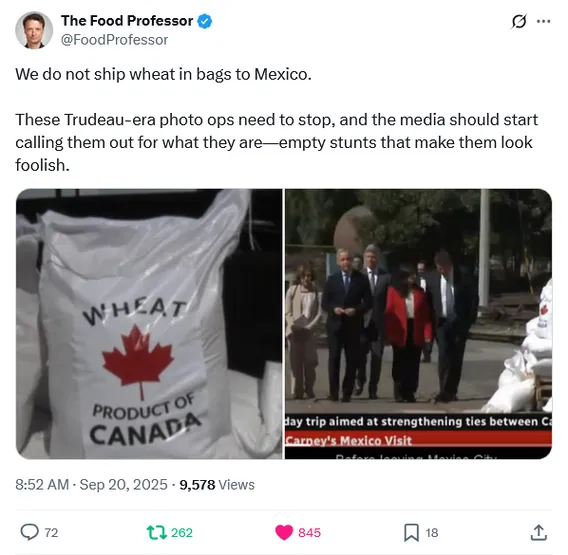
During a Sept. 19 visit to Mexico, Carney led cameras through a railyard stocked with pallets of artfully arranged sacks decorated with a maple leaf and the words “product of Canada”.
The site was the Canadian Pacific Kansas City Ferrovalle train yard, located outside Mexico City.
The yard is indeed equipped to process incoming railcars of Canadian wheat, but that’s all done in bulk. Hopper cars are positioned over large tanks to disgorge their loads, multiple tonnes at a time.
If any sacks ever enter into the equation, it’s long after Canadian producers have exited the process.
“Canadian grain farmers haven’t shipped wheat in sacks for over a century!” read a reaction by Chris Warkentin, Conservative MP for the heavily wheat-growing riding of Grande Prairie, Alta.
Sylvain Charlebois, a food scientist at Dalhousie University, wrote in a column this week that “bagged wheat is a relic of less mechanized economies”.
“We are among the most efficient bulk grain exporters in the world, shipping millions of tonnes through rail networks and ocean vessels designed for efficiency, safety, and traceability,” he wrote.
But it was a housing announcement just outside Ottawa where Carney would run into more direct accusations of being deliberately deceptive with his photo backdrop.
On Sept. 14, just before the opening of the fall session of Parliament, Carney stood in front of two under-construction homes in the Ottawa area and announced the official launch of Build Canada Homes, a new federal agency tasked with developing subdivisions of manufactured homes on federal land.
“The two sets of homes behind me were manufactured in two days, assembled on site in one,” Carney said to applause.
“We wanted to keep the townhouses open; we held back the workers from finishing it so you could see how things fit together,” he said, adding that one of the homes was being shipped “to Nunavut”.
Once the press conference was over, both homes were dismantled, and the site returned to what it had been before: A patch of fallow government land located near the Ottawa airport.
The land is a right-of-way for high-voltage power lines, which is why it currently doesn’t contain any development.
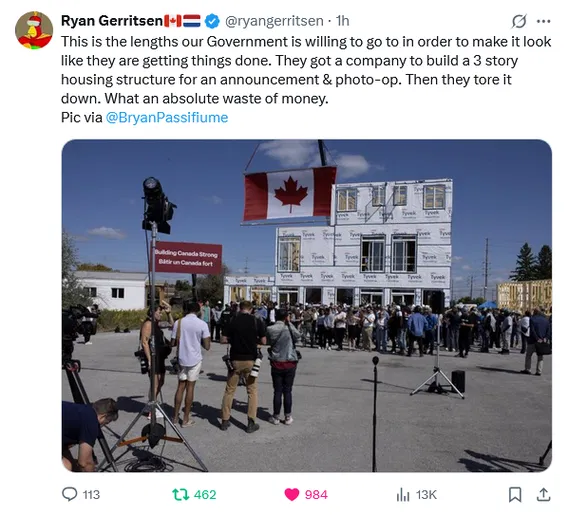
At The Rewrite, Peter Menzies congratulates Brian Passifume for being one of the only legacy media reporters to look past the literal Potemkin Village structure Carney had assembled for his photo op:
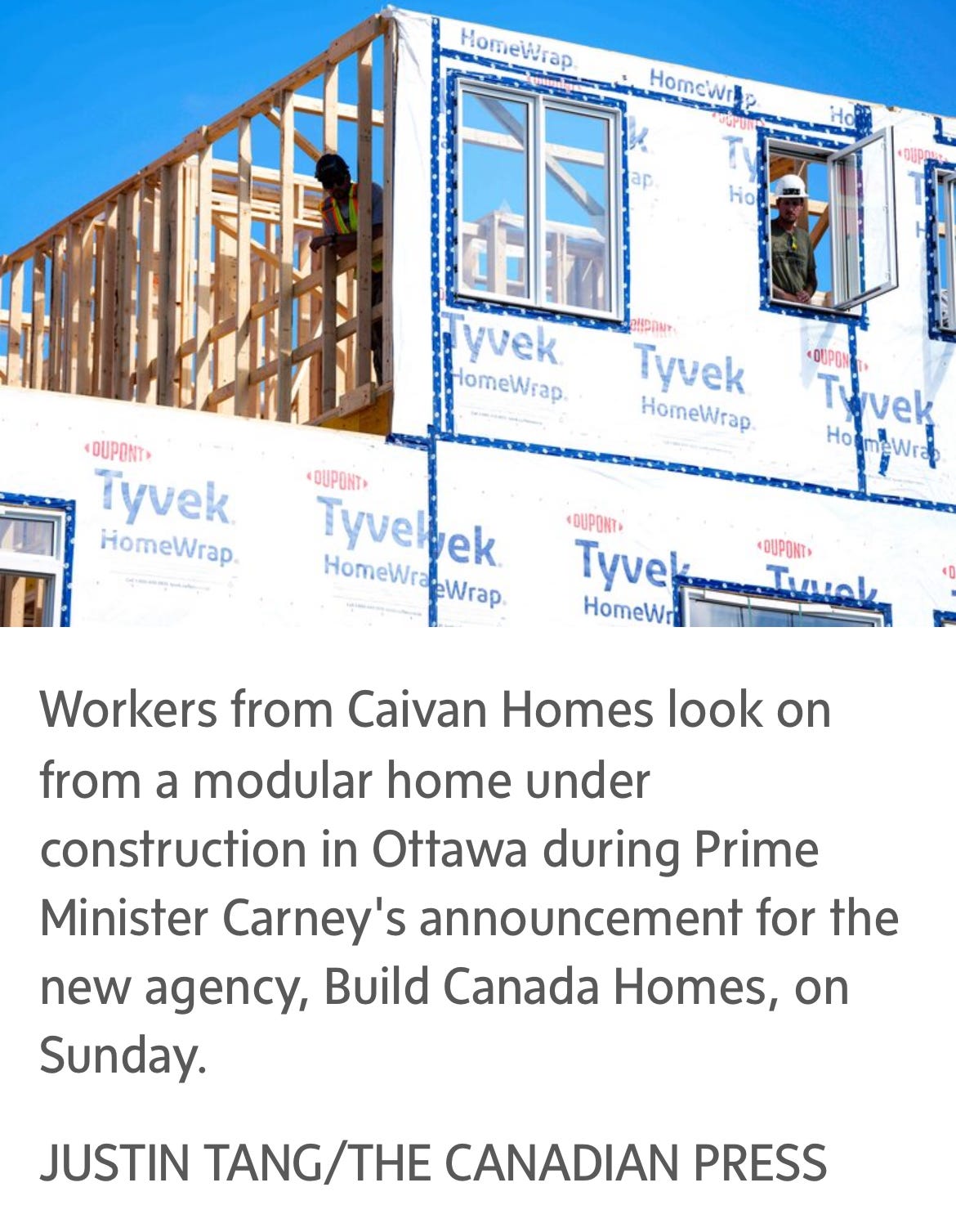
Our Orwellian theme continues but, this time, it’s to credit Brian Passifume of the Toronto Sun for his work digging into how our prime minister and his staff work to create fantasy settings for their announcements. Canadian Press and others were happy to play government propagandist by captioning a photo taken at Prime Minister Mark Carney’s Canada Builds launch by stating “Workers from Caivan Homes look on from a modular home under construction in Ottawa during Prime Minister Carney’s announcement for the new agency.”
Near as I can tell, most other media were happy to play along. Except Passifume who broke from the pack and pointed out the whole scene was, essentially, a movie set.
After one X user pointed out that the entire scene was fake, Passifume jumped in with “Dude I was there, that’s exactly what happened. It was a freshly-graded gravel lot with no utilities or services run. I was discussing this very topic with other reporters covering it — they didn’t even move the crane or remove the lifting apparatus, they just repurposed it to hold a gigantic Canadian flag.”
I expect some in the trade will say “hey, everyone does it” and no doubt that is true. But when people with power and those who crave it misrepresent reality, journalists are obliged to point that out. It doesn’t even have to be aggressive, just “Carney said in front of a set created for the announcement”.
Journalism isn’t actually that complicated. You just have to subscribe to its principles.