Quotulatiousness

September 21, 2025

From Eat Pray Love to plotting a murder

Filed under: Books, Health, Media, Religion — Tags: , , , , — Nicholas @ 05:00

On Substack, Elizabeth Nickson charts the career of Elizabeth Gilbert who wrote Eat Pray Love and more recently a memoir of her life up to the point where she planned to murder her “once in a million year” partner:

Gilbert, you certainly know, wrote Eat Pray Love which was a massive international bestseller made into a film with Julia Roberts, which was also very successful. During the Pray portion, Gilbert retreated to an ashram in India to worship a living sub-deity called The Mother. At the time I was still tangentially aware of life in the world of moderately successful upscale arty women from the mega-cities and I’d heard of the Mother and her clinging clanging worship sessions — Siddha Yoga — going round the Pilates and yoga studios and the upscale self-help programs. The Mother’s satsangs were guaranteed to put you into an ecstatic state where you fused with the divine. And then you’d heal. From the abuse of the Patriarchy.

During the Pray section, Gilbert had a series of intense moments, which &mddash; coupled with an earlier session on the bathroom floor where God told her to wash her face and go to bed — meant, to her, a great deal. Her “God” gave her direction and purpose, where before she was caught in an unhappy marriage, being apparently the breadwinner in that marriage with a husband who a) didn’t work, b) wanted her to buy more and more stuff and c) have a child.

This seems a poor choice for a husband, but never mind. Gilbert was successful in the New York world of publishing and magazines and much occupied with that pursuit, a business which I now suspect is financed by the drug trade and used to launder money. In that world where success is one in ten thousand, one hundred thousand, and where Gilbert experienced perhaps the biggest literary success of her generation. She became universally, ridiculously, excessively loved.

And embrace it she did. For the past 15 years, Gilbert has traveled the world, usually with a woman companion to keep her on the rails, dishing out nostrums and platitudes with relish meant to show you how to “find yourself” and “live your truth” to women searching for purpose. “Creativity” or “art” is now substituted for what women in the before times used to call service to their communities and families, which is now called slavery to the patriarchy.

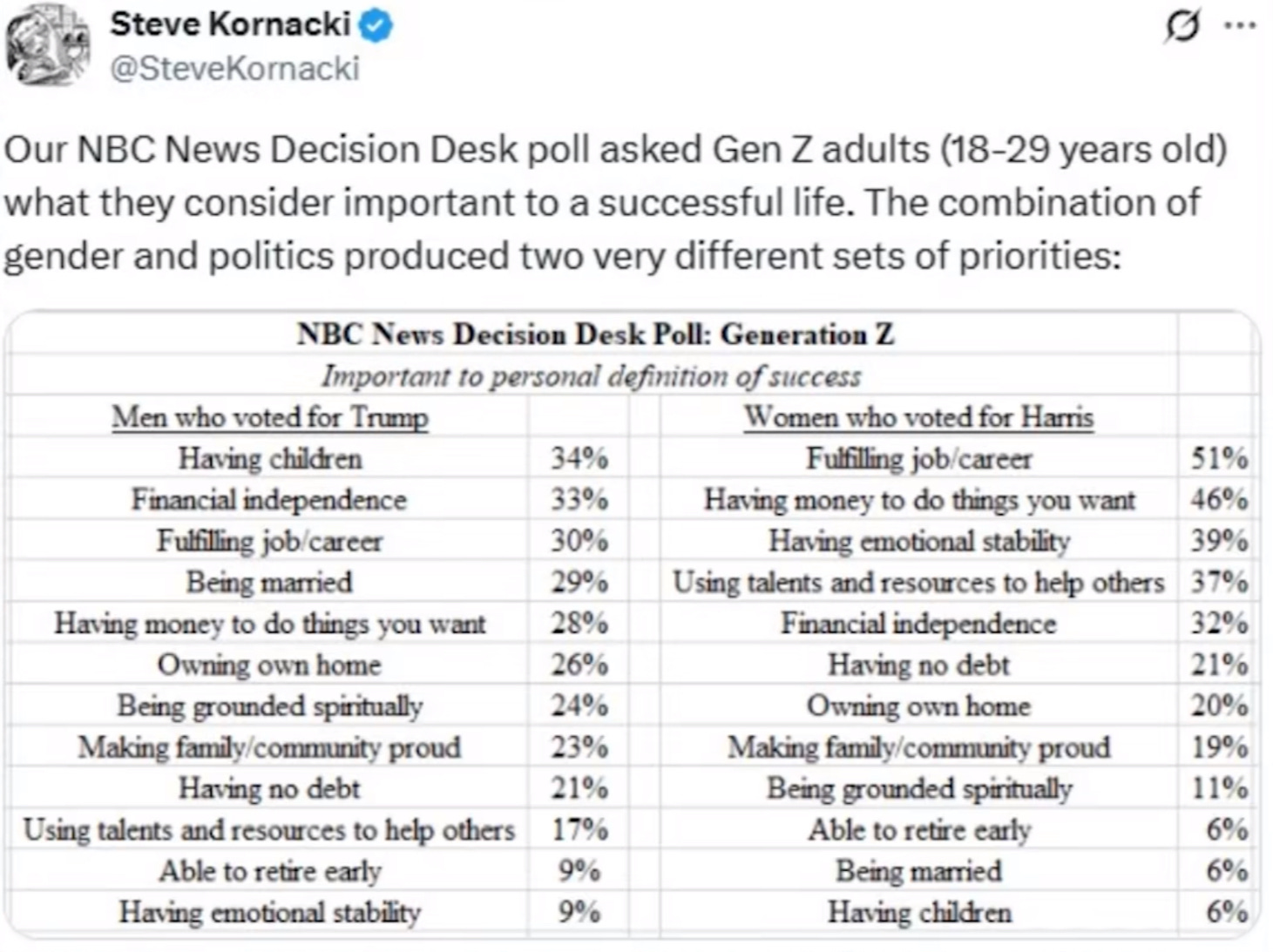
The following is the progression of “evolving” for modern left-of-center women, for whom finding a meaningful work is the number one priority, children being the last, as the below illustrates.

When the recognition of slim to no talent or at least un-sellable talent, is made and a future of grinding for multinationals is revealed, and spiritual enlightenment or Kundalini awakening seems out of reach, the desperation moves onto Democrat politics, and ends in middle-aged and elderly woman on the streets, face contorted in rage. Those women, a full 40% of whom are childless and family-less, spend their lives slogging away in some corporate or health or educational structure, becoming semi-insane. As an aside note, in my years-long investigation of voter fraud, many of the operators are women just like these below: middle-aged, put together, well dressed, polite, fully criminal.

In searching for your creativity — the highest good — you have to become fully aligned with your child self, your spiritual self, and that self becomes the most cherished part of you. Your intelligence, your executive function is demoted. Your creativity, your spirituality, then becomes fused to others whom you perceive being as weak as that child self you have elevated as spiritually superior. Women, it seems hardwired, must have people to care about. In the absence of family, it is the helpless to whom you assign your life.

Gilbert’s once-in-a-million-years love was a gay Syrian immigrant hairdresser with a history of heroin addiction and incarceration. No more victimish victim can be found.

For Gilbert’s millions of acolytes, spiritual worth, meaning,creative power is found in allyship with the weak, with whom they fully identify. And meaning is also found in hysterical advocacy and fury on behalf of the weak. There is no thinking attached to any of this, no analysis, no study. Just intense emotionality.

Why Didn’t Hitler Invade Switzerland? – OOTF Community Questions

Filed under: Europe, France, Germany, History, Military, WW2 — Tags: , , , — Nicholas @ 04:00

World War Two
Published 20 Sept 2025

In this Out of the Foxholes Q&A, Indy and Sparty dive into some of the most intriguing questions about World War Two. Why didn’t Hitler invade Switzerland, what was going through the minds of the German High Command as defeat loomed, and why didn’t the Germans use the Vichy French Army in Operation Barbarossa? Three questions that shed light on the strategies, choices, and mysteries of the war.
(more…)

“What do you remember of the summer when the English awoke?”

Filed under: Britain, History, Media, Politics — Tags: , , , , , , — Nicholas @ 03:00

In The Critic, David Shipley says that the rapid, visible rise in English nationalism is a new and positive thing in Britain:

“Union Jacks and crosses of St George” by Ben Sutherland is licensed under CC BY 2.0 .

What do you remember of the summer when the English awoke? The summer of arguments over what “English” means, hotel protests, and of “flagging”. Overnight the England flag was everywhere. On lampposts, on bridges over motorways, and even painted on roundabouts, the St George’s cross appeared, as a challenge to the old regime, and a threat, or promise, of something new.

For this is new, make no mistake. In my lifetime, England’s flag has only been seen in force during football tournaments and at the rugby. Political figures of the left have seized upon this novelty as they have tried to resist the challenge. The Green Party leadership candidate Ellie Chowns insisted that “it’s traditionally not part of British culture to hang flags”, while Zack Polanski, the party’s new leader, said he wouldn’t fly the flag outside of football tournaments because “of what it represents to people who worry about that problematic history”, before going on to say he’s “worried that we’re importing fascism”. Meanwhile John McTernan, former advisor to Tony Blair insisted that flag flying isn’t an expression of “national pride”, but rather “being used to other people” (my italics).

Notionally sensible centrists, The News Agents suggested that the flag should be redefined as representing “tolerance, liberalism, democracy and Shakespeare” and that would deter “right-wing thugs” from using it. The propagandists of the regime recognise that it is in danger, and seem to believe that “British Values” are enough to hold back the tide.

York Council went ever further, saying that flagging has “coincided with a rise in racist incidents” and have decided to remove hundreds of England and Union flags, to which York’s “Flag Force” responded by announcing they would promptly replace every flag which was removed.

England’s flag was everywhere at the hotel protests too — standing for resistance against a Westminster regime that continues to force migrants upon communities which do not want them.

At the end of the summer, as the Last Night of the Proms coincided with the “Unite the Kingdom” march, the flag divide could not have been wider. On the streets of London that Saturday a sea of Union and St George flags, while at the Albert Hall it seemed one could wave any nation’s flag but England’s.

A Times cartoon from July caught the year’s mood. It depicted a group of unthreatening families protesting, holding signs saying We’re not far right – we’re worried about our kids and Deport Foreign Criminals. Beneath them, buried in the earth lurks a bald, beefy man with H A T E tattooed on his knuckles, and Made in England alongside the red cross of St George tattooed on his shoulder. Here, in the favoured paper of the British establishment, we see their fear that a deeper, more dangerous Englishness threatens to rise up, and threaten, or even destroy their order.

Chatham Dockyard – Half a millennium of supporting the Royal Navy

Filed under: Britain, History, Military — Tags: , , , , — Nicholas @ 02:00

Drachinifel
Published 16 Feb 2022

Today we take an overview look at the history of Chatham Royal Dockyard and some of what you can find today at in its preserved premises!

Visit the dockyard – https://thedockyard.co.uk/
(more…)

QotD: Herbert Hoover, an epitaph

Filed under: History, Quotations, USA — Tags: , , , , , , — Nicholas @ 01:00

Hoover was a man who did everything wrong. He was the quintessential High Modernist. He was arrogant, he was authoritarian, he didn’t listen to anyone, he put no effort into pleasing people or making his ideas more palatable. He never solicited stakeholders’ opinions. He lied like a rug, constantly and egregiously. He lived his life like a caricature of exactly the sort of person who should fail at philanthropy and become a horror story to warn future generations.

But he won anyway. He started from a measly few million dollars and beat out Rockefellers and Carnegies to become the most successful philanthropist in early 20th century history. Whyte’s estimate of 100 million lives saved seems much too high; there were only 100 million people in Europe total during the relevant period. But even during his own time, people universally credited him with saving millions. And he did it again and again and again. I didn’t even have space to talk about the time he saved the Southern United States from a giant flood, or half a dozen other impressive accomplishments. Maybe the rules are wrong. Maybe all of this stuff about how authoritarian approaches never work, and you need to let the people you are helping lead the way, is all just modern prejudices, and putting a brilliant and very rich engineer in charge of a hypercentralized organization is just as good as any other way of doing things.

But even this I find less interesting than his psychology. He combined a personal callousness with a love for all humanity. When he was inspecting mines in Australia, he fired the worst-performing X% of workers. One worker begged him to reconsider – he had a family to support. Hoover raised $300 for the man’s family – a lot of money at the time! Probably more than Hoover made in a month! – but fired him anyway. In 1932, when the Bonus Army marched on Washington, Hoover was adamant that he would not give these men – poor, starving veterans – a single cent more than they were entitled to by their existing benefits. But he also instructed his staff to go around to their encampments and give them food and supplies in secret.

Sometimes his stubborness calls to mind the fictional Inspector Javert, who refuses to bend the law for any reason. In this model, Hoover sympathizes with everybody, but his honor forbids him to bend the rules in favor of underperforming employees or protesters who want more than their contracts entitle them to. But this picture of a hyper-honorable Hoover crashes into his constant willingness to lie, cheat, and bend the rules in his own favor. Sometimes his lies are for the greater good, like when he tells Britain that Germany is preparing to feed Belgium. Other times they seem entirely selfish, like his various Chinese mining scams. The best that can be said about Hoover is that if he decides a principle is involved, he sticks to it.

And this is actually really good! Again and again through the book, Hoover feels like the only person with a moral compass. When it is in everyone’s strategic interest to let Belgium starve, Hoover is the only one who is able to keep fixated on the potential human toll. When it is in everyone’s interest to let the USSR starve, only Hoover – despite his fanatical anti-communism – is able to stick to the frame where the Russians are human beings and politics is beside the point. When Americans are starving during the Great Depression …

… okay, Hoover totally dropped the ball on that one. In fact, one of his Democratic opponents wrote something about how maybe if unemployed American workers pretended to be Belgians, they could get Hoover’s sympathy. I don’t have a great explanation for this. But Hoover’s weak and inconsistent sympathies are often enough to let him outdo everyone else. Or at least, he is uncorrelated with everyone else and succeeds when they fail. Again and again Hoover is accused of treating people like numbers on a piece of paper. But if this is true, it seems to be linked to the reverse talent – the ability to remember that numbers on a piece of paper represent people, even when other people would rather forget.

I’m equally confused about Hoover’s politics, although it’s not really his fault. The whole era confuses me. The Progressives, Hoover’s own faction, seem clearly related to modern progressives. But they also give me more of a technophile, rationalist feel than their modern counterparts. Am I imagining things? If not, where did this go?

And how did Hoover so deftly merge authoritarian centralizing technocratic engineer side with his small-government individual-freedom pro-capitalism side? Maybe it wasn’t that deft? Maybe he started his life as a centralizing technocrat, then made a 180 after becoming a small-government individualist helped him dunk on FDR more effectively? But it didn’t feel that way. It felt like all of it was coming from some central set of core beliefs throughout his life.

[…]

I get the impression that Kenneth Whyte is a bit of a revisionist historian, too sympathetic to his subject to tell his story the way everyone else does. But at least in Whyte’s telling, the Hoover presidency was a great missed opportunity, or at least a fulcrum of history. If a few key economic events had been a few months off in one direction or the other, FDR might have been a footnote to history, and a four-term President Hoover might have left an indelible mark on America. Instead of a New Deal, we might have gotten a optimistic small-government technocratic meritocracy that was able to merge the best aspects of a dying frontier America with the best aspects of the industrial age.

In one of the most poignant passages in the book, Commerce Secretary Hoover fires back at his socialist critics. He points out that of the top dozen US officials – the President, VP, and ten Cabinet Secretaries – eight, including himself, had begun as manual laborers and worked their way up. That was the America Hoover was working to defend. He lost, and now we have this shitshow. But it’s hard to begrudge him the attempt.

Scott Alexander, “Book Review: Hoover”, Slate Star Codex, 2020-03-17.

Powered by WordPress