
Rex Krueger
Published 21 Aug 2025
August 22, 2025
You built a tool chest. Now, make it YOURS.
Comments Off on You built a tool chest. Now, make it YOURS.
Resolved – This country’s youth will not fight to defend this country
On Tuesday, John Robson discussed the results of a recent Angus Reid survey that, among other things, indicated that Canadians are at least as anti-military as they’ve been since the first Trudeau government:
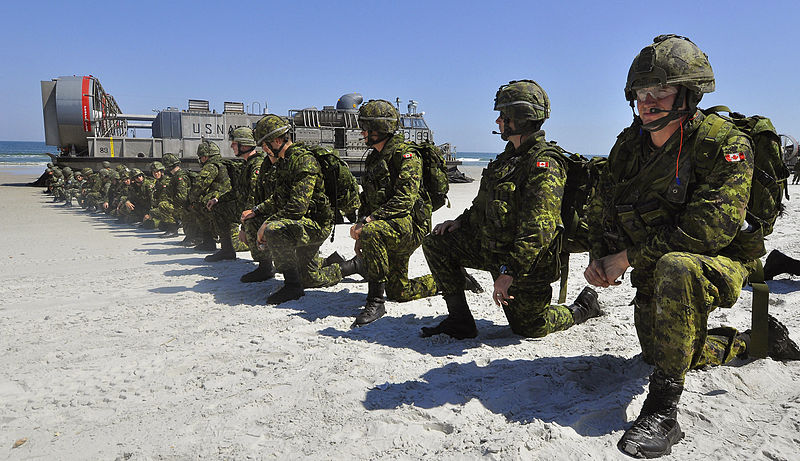
Canadian soldiers set a perimeter position after disembarking a U.S. Navy landing craft during a simulated amphibious landing, 24 April 2009.
U.S. Coast Guard photo by Petty Officer Seth Johnson via Wikimedia Commons.
The National Post reports an Angus Reid survey finding that a significant majority of us favour compulsory voluntary service by the youth of today. Which might sound like a bracingly traditional Jordan Peterson clean-your-room, stand-up-straight, shoulders-back attitude until you read the fine print, which would risk making Peterson ill if he weren’t already. Because it turns out we want to conscript them to work in health care so we get stuff we didn’t pay for, not to defend the country because if ye break faith and so on.
According to the survey, 74 per cent of respondents want young people to have to give a year of their lives to bolstering our failing, structurally unsound socialized medical system. Respondents were also in favour of mandatory service in support of the environment (73 per cent), “youth services” (72 per cent), whatever it might be, and “civil protection” (70 per cent). But when it comes to (ugh) national defence, just 43 per cent supported it, with 44 per cent opposed.
Spending on comfort while barbarians undermine the city walls lacks prudence as well as dignity. As I observed in a long-ago graduate-school debate about American national security, it didn’t matter how wonderfully progressive the Dutch social welfare system was in 1940 when the Nazis came calling. And we too seem to have our priorities backward.
If I might confuse the government by discussing principles of political economy, there are good reasons why national defence is considered a binding duty on those able to contribute to it. First is the “free rider” problem that everyone benefits from successful protection of the community, especially, at least in a narrow and hedonistic sense, if you send some other chump to die for your freedom while you recline comfortably at home.
Second is the moral consideration that, as John Stuart Mill famously if uncharacteristically put it, “War is an ugly thing, but not the ugliest of things: the decayed and degraded state of moral and patriotic feeling which thinks that nothing is worth a war, is much worse”. Which comes from, yes, his “Principles of Political Economy”.
Mill was no warmonger. As he immediately continued, “When a people are used as mere human instruments for firing cannon or thrusting bayonets, in the service and for the selfish purposes of a master, such war degrades a people”.
But not all wars are like Russian President Vladimir Putin’s invasion of Ukraine, let alone Hamas’s attack on Israel. As the anything-but-bellicose Mill added, “A war to protect other human beings against tyrannical injustice; a war to give victory to their own ideas of right and good, and which is their own war, carried on for an honest purpose by their free choice — is often the means of their regeneration”.
Comments Off on Resolved – This country’s youth will not fight to defend this country
History’s Oldest Dessert – 4,000 Year Old Mersu
Tasting History with Max Miller
Published 18 Mar 2025Short pastry filled with pistachios and dates
City/Region: Mari, Mesopotamia
Time Period: c. 1800 B.C.E.In the ancient ruined Mesopotamian city of Mari, a clay tablet receipt from 4,000 years ago was found that mentioned dates and pistachios for making mersu for the king. We don’t know exactly what mersu was or if there were other ingredients in it, but I think there was more to it than just dates and pistachios. The king employed eight specialists who made mersu, so my guess is that it was at least as complicated as this pastry, possibly much more so.
The flavor combination in this interpretation is wonderful. The pastry is a little crumbly, and the filling is chewy, rich, and quite sweet, with the added texture of the nuts.
I made my pastry dough unsweetened and I really liked the contrast between the unsweetened dough and the very sweet filling, but you can add some date syrup or honey to your dough if you’d like.
1 gur of dates
And 10 sila of pistachios
For making mersu
Meal of the king
— Receipt from Mari, c. 1800 BCE
Comments Off on History’s Oldest Dessert – 4,000 Year Old Mersu
QotD: “White fragility”
White fragility is the sort of powerful notion that, once articulated, becomes easily recognizable and widely applicable … But stare at it a little longer and one realizes how slippery it is, too. As defined by [White Fragility author Robin] DiAngelo, white fragility is irrefutable; any alternative perspective or counterargument is defeated by the concept itself. Either white people admit their inherent and unending racism and vow to work on their white fragility, in which case DiAngelo was correct in her assessment, or they resist such categorizations or question the interpretation of a particular incident, in which case they are only proving her point. Any dissent from “White Fragility” is itself white fragility. From such circular logic do thought leaders and bestsellers arise. This book exists for white readers. “I am white and am addressing a common white dynamic,” DiAngelo explains. “I am mainly writing to a white audience; when I use the terms us and we, I am referring to the white collective”. It is always a collective, because DiAngelo regards individualism as an insidious ideology. “White people do not exist outside the system of white supremacy,” DiAngelo writes, a system “we either are unaware of or can never admit to ourselves”. … Progressive whites, those who consider themselves attuned to racial justice, are not exempt from DiAngelo’s analysis. If anything, they are more susceptible to it. “I believe that white progressives cause the most daily damage to people of color,” she writes. “[T]o the degree that we think we have arrived, we will put our energy into making sure that others see us as having arrived …” … It is a bleak view, one in which all political and moral beliefs are reduced to posturing and hypocrisy.
Carlos Lozada, “White fragility is real. But ‘White Fragility’ is flawed,” Washington Post, quoted by Ann Althouse, 2020-06-19.
Comments Off on QotD: “White fragility”
August 21, 2025
Pure quill, 100% genuine Astroturf
You might almost think that Freddie deBoer isn’t a fan of pre-chewed, pre-digested “fandoms”:

brat summer was fake. That’s been my stance for a long while, and I’ve been encouraged recently to learn that I’m not alone in this belief — the belief that the whole Charli XCX “brat” phenomenon of 2024 was AstroTurf, a top-down media phenomenon driven fundamentally by marketing and the clicks-based media’s insatiable need for #content. There was clearly a carefully-coordinated rollout, with key pop culture websites and well-placed influencers shilling brat summer in suspiciously similar terms at the same exact time. And once the actual payola element was out there, once the PR apparatus had gotten the idea into the heads of early-middle-aged music and culture writers, those writers ran with it, in pursuit of the feeling of being out in front of a new craze and wanting to appear to be down with the kids. Someone told them brat was the new thing, they were filled with the FOMO anxiety that dictates their lives, and so they set about acting as though brat really was the new thing, faking it to make it.
This dynamic has been building for years now. The same basic Astroturf pattern was all over the “Barbiecore” moment. The movie itself was certainly popular and deserving of that popularity; it was fundamentally, existentially pretty good and frequently treated as much better than that, but it was still a fun and inventive story that was so much better than a movie based on a series of mass-produced plastic dolls had any right to be. But Barbiecore was fake. The Barbie discourse was fake. The idea that tweens were suddenly enraptured with the whole phenomenon, and particularly its confused brand of inoffensive feminism, was fake. There wasn’t some organic groundswell of pink-clad girl power erupting from the grassroots, but rather an omnipresent corporate campaign designed to manufacture the impression of inevitability. The movie itself was fine, sometimes clever, sometimes clumsy, good enough. But between the Mattel-driven branding blitz, the endless pink product tie-ins, and stunts like Ryan Gosling hamming it up at the Oscars, the film’s cultural footprint was artificially inflated. A popular movie was treated as a broader mass fandom movement that was in turn dressed up as a civilizational turning point, its supposed artistic influence dramatically overstated to serve commercial ends. In the end, Barbiecore didn’t demonstrate the power of art to shape culture so much as the ability of corporations to convince us that commerce is culture.
This is in fact the general condition of what’s now constantly sold as spontaneous collective vibes bubbling up out of TikTok comments and stan culture and the zeitgeist: prepackaged campaigns that combine paid marketing savvy with the cynical manipulation of our poptimism-obsessed cultural commentors, who are terrified of feeling left behind and always ready to buy into any new trend that’s sold as the obsession of the youth. There’s a press release behind every new trendspotting piece, a rollout schedule behind every claim of a new Gen Alpha aesthetic. There are people in glass towers in Manhattan and Los Angeles being paid six figures to decide what your summer will be, and then pretending that you, the amorphous online “fan,” actually decided it. It’s not the grassroots, it’s not organic, it’s not fun in the way subcultures used to be fun. It’s advertising.
Now, I’m a sad middle aged child of the 1990s who believes that selling out is real and bad and that authenticity is a fundamental and essential element of artistic creation and consumption; I believe in those widely-mocked old-school values, and I think my relationship to the art I create and consume is deepened because of that belief. But you don’t have to share my anachronistic artistic ethics to see why the death of organic pop culture appreciation matters. You just have to recognize that all of this ersatz fan enthusiasm creates a hollow kind of cultural participation. If every supposed craze is just a PR initiative with better branding, then what looks like bottom-up fandom is really just a slightly more insidious form of top-down messaging. You’re being asked to play along, to cosplay at authenticity, while the machine harvests your clicks and hashtags. Once again, the digital era’s ballyhooed capacity for citizen participation and “the long tail” has been crushed in favor of top-down control by giant corporations. The promise of the internet was that the gatekeepers would be dethroned, that cultural movements would erupt from the crowd. Instead, we’re living in a Potemkin village of virality where the audience is always the mark and the trick is always the same.
Comments Off on Pure quill, 100% genuine Astroturf
Most of us learned the “pull my finger” gag around grade 2, so why are so many of us still gullible about “scientists warn”?
At Watts Up With That?, Willis Eschenbach warns us yet again about believing headlines that say things like “Scientists Warn!”
Only a journalist truly committed to the ancient art of panic-clickbait could squeeze all the world’s existential dread into a headline like, “A Giant, Destructive Volcanic Eruption Is Set to Shake the World in the Coming Months, Bringing About the End of Mankind, Scientists Warn“. They’ve accompanied it with the following graphic, in case you weren’t adequately terrified.
The dead giveaway? “Scientists Warn“. Whenever you see those two words sandwiched together above the fold, you know you’re about to step into a wonderland of wild extrapolation, qualified maybes, and models run so far into the future they boomerang back with “robots take over” as the y-axis.
They start out as follows:
A detailed geophysical study published in Nature in by the U.S. Geological Survey (USGS) has refined our understanding of the Yellowstone supervolcano, uncovering new insights into its subsurface magma dynamics. Concurrently, climatological assessments by researchers such as Markus Stoffel (University of Geneva) have renewed discourse around the global systemic risks posed by a potential super-eruption — not only at Yellowstone, but at several other active volcanic complexes worldwide.
There’s an oddity here to start with. They’ve pushed together into one paragraph an actual scientific study of the Yellowstone caldera, and a paywalled puff piece by some random guy trying to frighten people about future eruptions. Unless you’re watching very closely to see which walnut the pea is under, it’s likely to be successful in making you think “Wow, a predicted super-eruption at Yellowstone, and the odds are high in other locations as well“.
Which does sound scary. So keep that thought in mind while we look at the first of the two parts they’ve pushed into one paragraph — the actual Yellowstone scientific study.
It’s the latest USGS study published in Nature under the very boring title “The progression of basaltic–rhyolitic melt storage at Yellowstone Caldera“. It gives us an upgraded, high-res CAT scan of Yellowstone’s magma plumbing. Instead of a giant pool of liquid doom sloshing under Wyoming, the new imaging shows a club sandwich: scattered blobs of partially molten rock, unevenly distributed, with most of the melt sitting in the northeast sector. The scale is impressive — 400–500 cubic kilometers of rhyolitic magma waiting for its cosmic moment. The heat just keeps bubbling up from below, slow and relentless, and with enough time, these melt zones might even hook up into a larger reservoir. But spoiler: no scientist anywhere is claiming that’s on tomorrow’s chore list.
Which brings us to the great, headline-grabbing “16% chance (one in six) of apocalypse by 2100” further down in the popular reports — a number that, if ever printed on a lottery ticket, would bankrupt Las Vegas. From the article:
Still, climatologist Markus Stoffel and affiliated risk researchers estimate a ~16% probability of a VEI 7 or higher eruption occurring globally before the year 2100.
Except that particular prediction is not referred to by the scientists of the actual Yellowstone study, and has nothing to do with the Yellowstone study.
It comes from a some gentleman yclept Markus Stoffel. And he’s not even talking about Yellowstone. He’s talking about the entire planet. Nothing to do with Yellowstone.
And who is Markus when he’s at home? Is he a member of the team of authors of the Yellowstone study?
Nope.
Well, is he a vulcanologist?
Nope again.
He’s a climate professor at the University of Geneva. He’s published a lot, almost entirely regarding the effects of “climate change” on glaciers, mountain landslides, and mountain lakes.


Comments Off on Most of us learned the “pull my finger” gag around grade 2, so why are so many of us still gullible about “scientists warn”?
Six Reasons Operation Market Garden FAILED
The Tank Museum
Published 3 April 2025Operation Market Garden failed because the tanks of XXX Corps did not reach the Paras in Arnhem in time. Many historians have argued that the British armoured column “let the side down”. But is this actually true?
We reckon there are six reasons why the operation was a total disaster. It was a poor plan from the get-go, relying on a rate of advance that would outmatch the German invasion of France in 1940. Bad weather prevented the deployment of badly-needed reinforcements, and the terrain Guards Armoured were expected to traverse – a single road with impassable conditions on either side – significantly hampered the efforts of the tank crews.
Poor intelligence also meant that the British column was not prepared for resistance from a retreating and desperate German Army. It was a combination of all these factors that caused Market Garden to unravel completely.
Despite the complications, many acts of valour were carried out by both the airborne and armoured divisions, including the legendary assault across the Waal by the US 82nd Airborne.
So, join us as we explore these six reasons why Operation Market Garden failed and decide for yourself whether XXX Corps could have done anymore.
00:00 | Introduction
02:23 | #1 – A Bad Plan
06:22 | #2 – Poor Intelligence
07:51 | #3 – Difficult Terrain
11:27 | #4 – Determined Resistance
13:45 | #5 – Bad Weather
14:38 | #6 – Loss of Surprise
19:45 | What Went Wrong?
(more…)
Comments Off on Six Reasons Operation Market Garden FAILED
QotD: Computer models
But note: for 100 dollars or negotiable, I will produce a minority report that will explain everything, infallibly. I will not preview the report in this Idlepost, however, because it might be worth money to me.
Aw, heck. Since I am rich beyond the dreams of avarice, let me just go ahead and blow all the beans. Let me recklessly tell gentle reader why computer models are always mistaken.
It is because their makers decide the result, before they design the model.
This does not mean they are self-interested phanatics, consciously preying on the gullibility of a drooling, ignorant public; although usually it does. For even if, by disposition, they are lofty, objective types, they will need, objectively, a lofty budget to perform a “credible” study. This means they must beg huge sums of money, and this will only be available from a source with an unhealthy interest in the result.
You see, the problem has nothing to do with computers. Even among humans, the phenomenon of “garbage in, garbage out” is well attested. The intention of following the evidence where it leads, is transient. I should think only a saint could sustain it, for longer than he could hold his breath under water.
David Warren, “A note on sternutation”, Essays in Idleness, 2020-06-19.
Comments Off on QotD: Computer models
August 20, 2025
“All politics is local” … except when it isn’t
Lorenzo Warby on a recent study of the vast chasm between what European voters want in areas like crime and immigration and what their elected representatives want:
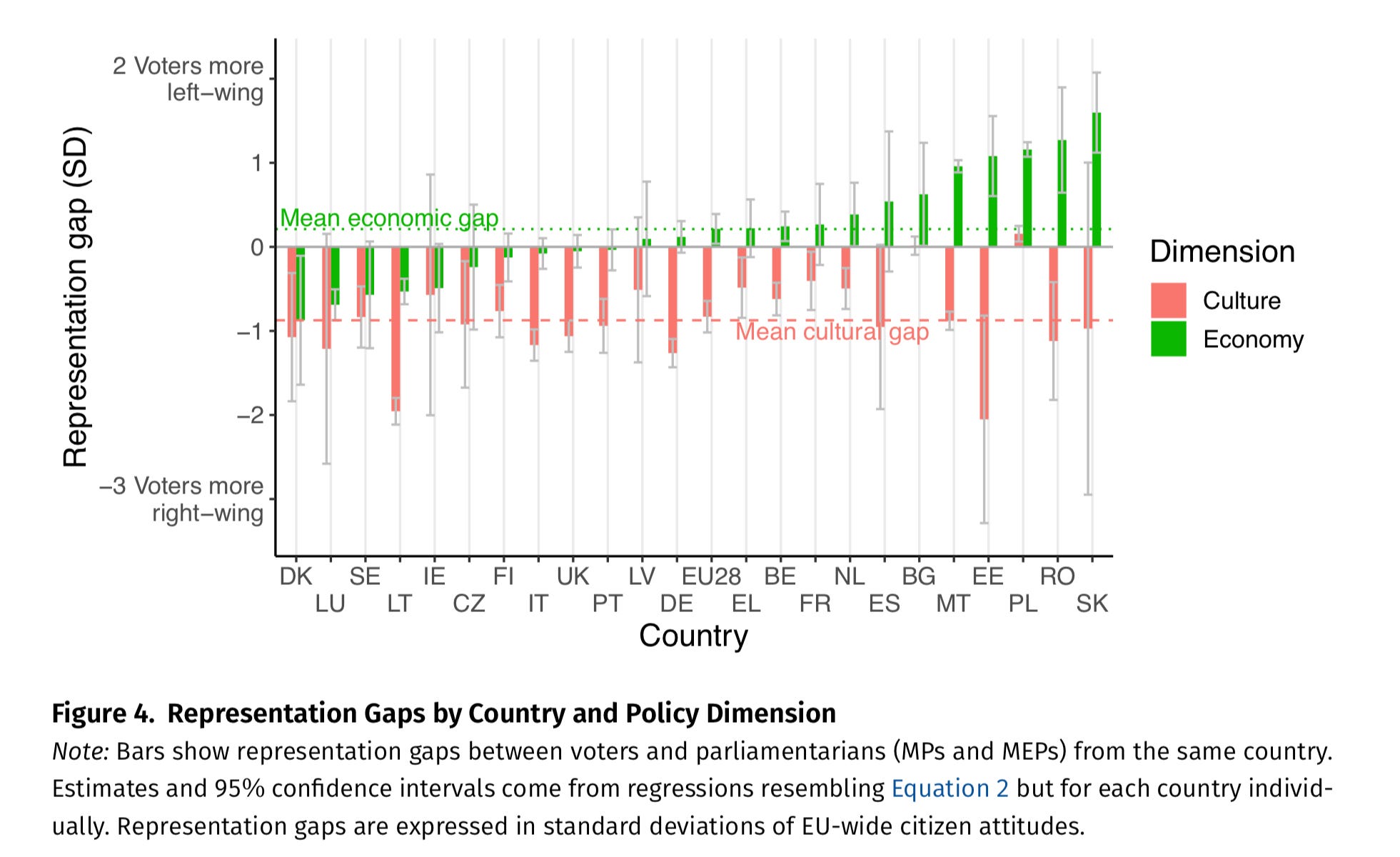
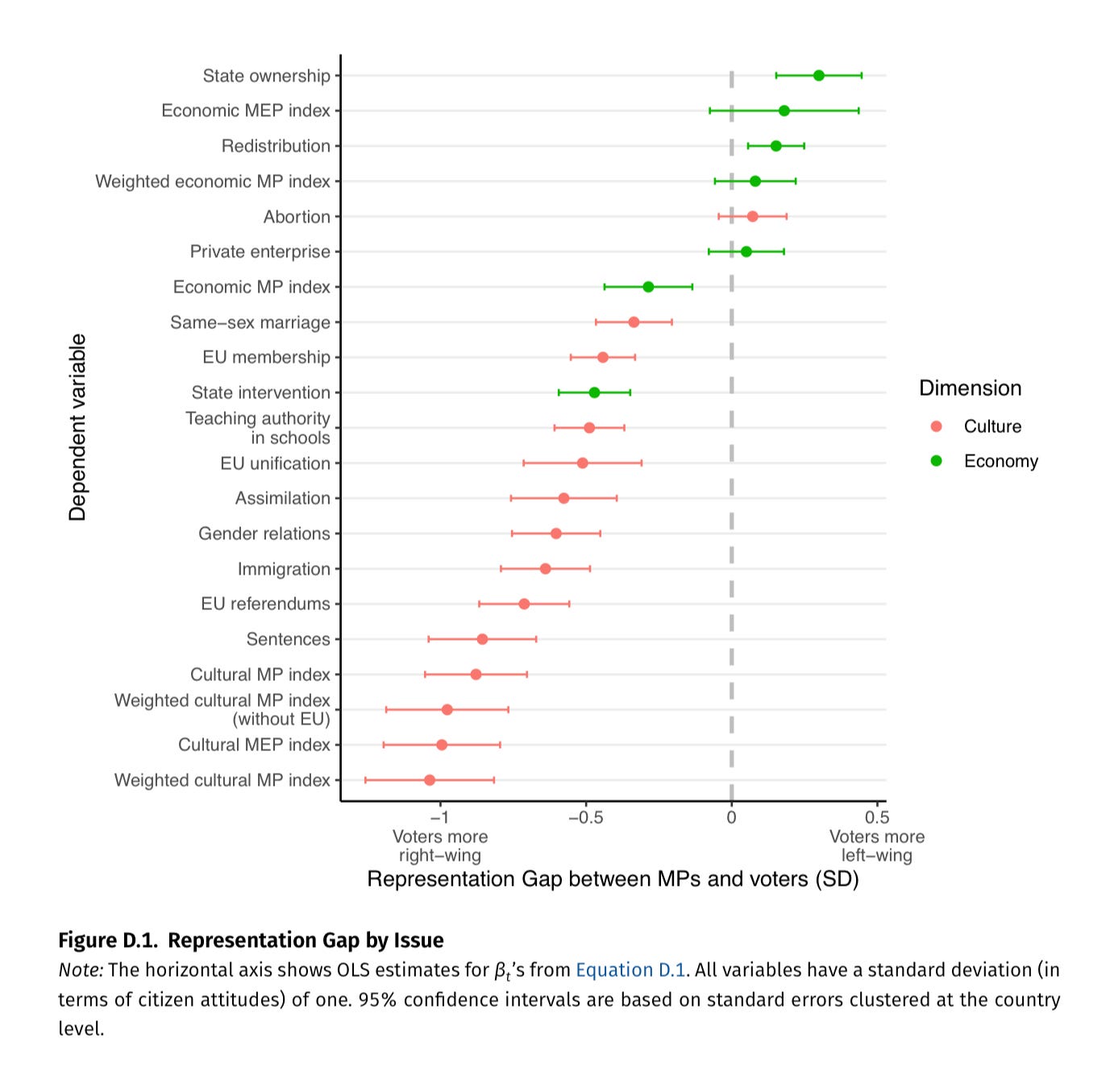
Economist Laurenz Guenther has performed the very useful exercise of quantifying how unrepresentative the views of European politicians are of their voters on cultural issues, such as crime and immigration. This is not true of economic issues, where the views of politicians tend to be quite representative of their voters.
In the case of economic issues, in some countries the politicians are more pro-market (“right”) then their voters, in others they are more dirigiste (“left”) than their voters, in others still they are very similar to their voters. There is simply no consistent pattern, and the average gap between voters and politicians across European countries on economic issues is fairly small.
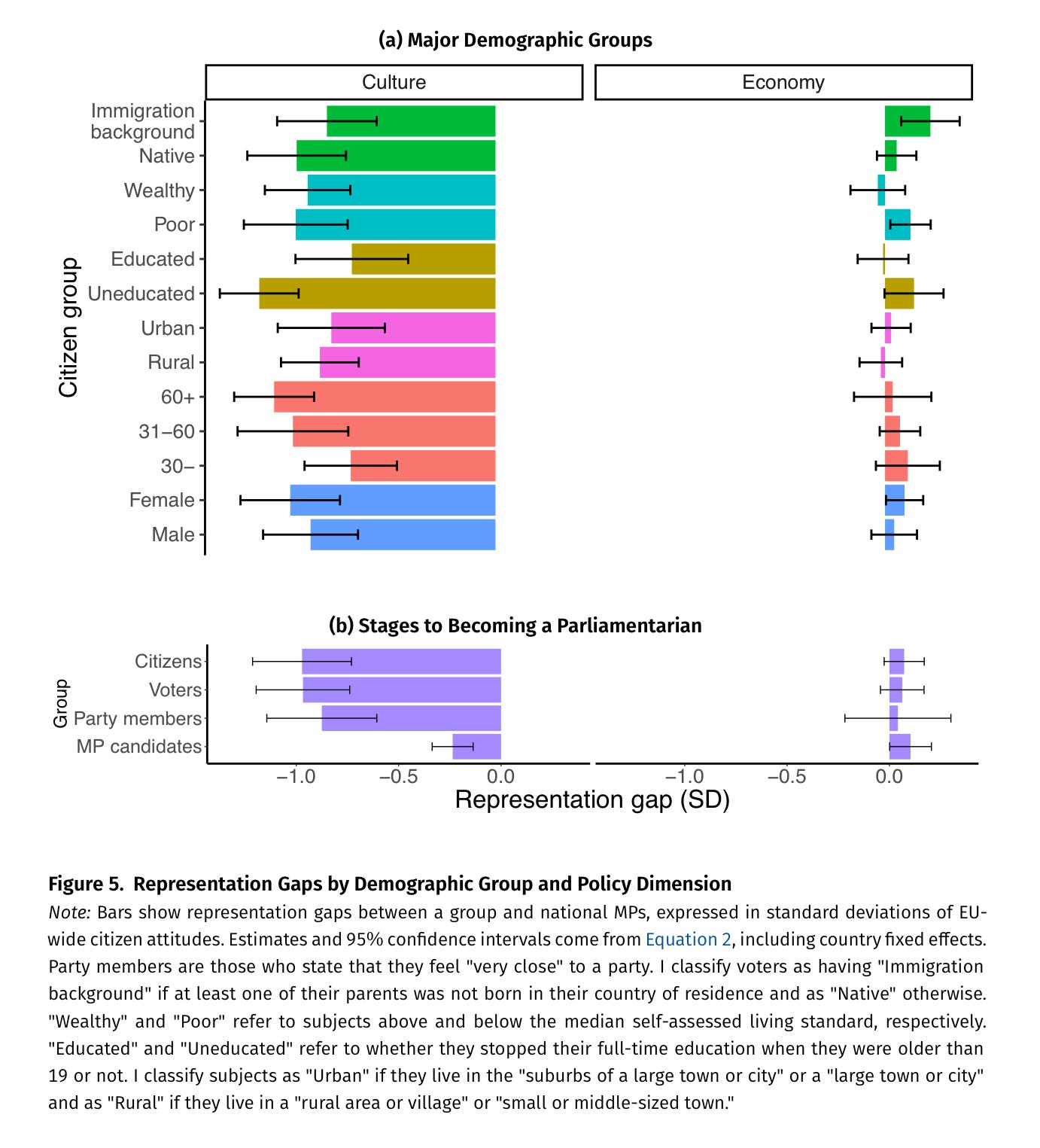
With cultural issues, such as crime and immigration, we get a very different pattern. There, politicians are consistently more socially liberal (“left”) than their voters and by a considerable margin. While education levels explain some of this difference, they do not explain very much, as politicians are significantly more socially liberal than even university-educated voters.
Moreover, politicians are unrepresentative even of their own Party members/base on cultural issues and, again, in being much more liberal than their core supporters. There is some factor or factors specific to being a contemporary politician that systematically separates them out from voters on cultural issues yet does not operate with economic issues.
Veteran politician Tip O’Neill famously said that all politics is local. This is particularly true of cultural issues such as crime and immigration, where the effects vary wildly by location. This is much less true of economic issues, which are much more economy-wide in their operation.
There are various features we can identify here. First, executive function(s) — including such features as patience (aka time horizon) — varies between people and is highly heritable. Localities that have lots of people with poor executive function operate very differently from those where it is very much normal for people to have strong executive function.
As the combination of physical robustness and weak executive function predicts criminal behaviour, this has a great deal to do with why crime varies so dramatically by locality. This is especially as crime is very much a power law phenomenon, where a small minority of (overwhelmingly) men commit the vast majority of violent crimes.
Source – Wikimedia Commons.
It also means that people who have spent their lives in social milieus full of people with high executive function can have little or no sense of what happens when one has to deal with weak executive function folk. This is the people unlike me problem that so bedevils contemporary politics and commentary.

Comments Off on “All politics is local” … except when it isn’t
The Korean War Week 61: The South Koreans Strike as Ceasefire Talks Stall – August 19, 1951
The Korean War by Indy Neidell
Published 19 Aug 2025After two months of inactivity, 8th Army begins new offensive operations this week, and it is the South Korean forces doing the fighting. Meanwhile, the Kaesong peace talks are ever more threatened by continuing neutral zone violations.
Chapters
00:00 Hook
00:48 Recap
01:13 Neutral Zone Violations
02:17 The UN Defense System
06:59 The ROK Attacks
10:38 Summer Diseases
12:48 Summary
13:33 Conclusion
15:20 Call to Action
(more…)
Comments Off on The Korean War Week 61: The South Koreans Strike as Ceasefire Talks Stall – August 19, 1951
California’s ever-receding High Speed Rail dream
Chris Bray provides an on-the-ground update of California’s ultra-expensive high speed rail project which still has yet to deliver a single passenger from one station to another after nearly 20 years of funding:

Start with a description: “In 2008, California voters approved $9.95 billion of state bond funding as seed money to build an 800-mile high-speed rail (HSR) network connecting Los Angeles and San Francisco, and the Central Valley to coastal cities, at speeds of up to 220 miles per hour, with an expected completion date of 2020.”
Construction started in 2015. Pause for a moment and really notice the date.
Ten years later, the project has consumed $18 billion, and an effort to connect Los Angeles and San Francisco has turned into a much more modest “Phase One” plan to connect the cities of the Central Valley, well east of the coast. The modest declared cost of the proposed LA-to-SF bullet train now looks like this for the much shorter line: “a cost range of $89 billion to $128 billion.” The Trump administration has declined to provide more federal funding for the project, but California is suing to try to keep the federal spigot open.
[…]
Famously, the California High-Speed Rail Authority has been posting pictures of its huge construction successes on social media:
See, that’s … almost a whole rail line for a bullet train. Obviously!
So!
If you ever find yourself in Fresno, and I sincerely hope you don’t, the structures that have been built for “high-speed rail” are surprisingly easy to access. There are several places where those structures aren’t fenced in or guarded. At all. […] So when you see this:
…it’s not that hard to just head up onto the thing. It’s also very dangerous, legally dubious, and something you definitely shouldn’t do. Since it’s an elevated construction site, there are a lot of places without guardrails where you can just fall off the thing, and it’s a long way down.
Everyone see this part: Don’t go up there. It’s dangerous. You can fall and die. […] But if you were to climb up onto the thing, which you absolutely should never do, you would see a whole bunch of this:
That’s a section at the northern end of Fresno, looking south.



Of course, California isn’t the only jurisdiction struggling to complete big infrastructure projects: Toronto’s long-awaited Crosstown LRT project got started in 2007 and still has no confirmed completion date, although a faint possibility exists that a portion of the line may open later in 2025.
Comments Off on California’s ever-receding High Speed Rail dream
UK vz.59 Czech Universal Machine Gun: History and Mechanics
Forgotten Weapons
Published 21 Mar 2018In 1952, Czechoslovakia adopted a whole new family of small arms, including the vz.52 pistol, vz.52 rifle, and vz.52 light machine gun. The rifle and LMG were both chambered in the Czech 7.62x45mm cartridge, and both would be adapted to the Soviet standard 7.62x39mm a few years later, in 1957. Very shortly thereafter, the Czechs would also introduce a heavier universal machine gun version in 7.62x54mmR under the designation UK vz.59 (universal machine gun model 59).
The UK 59 was basically a scaled up sibling of the vz.52 and vz.52/57 machine guns, although it fed from a belt only, where its smaller predecessors had allowed either belt or magazine feed. It used a pivoting locking block system much like the Walther P38 and Beretta pistols, in conjunction with a long stroke gas piston much like that of the vz.26 light machine gun.
The weapon did not see much interest outside of Czechoslovakia, although it does remain in service in that region in the modernized 7.62x51mm iteration.
Thanks to Marstar for letting me examine and shoot their UK vz.59!
Comments Off on UK vz.59 Czech Universal Machine Gun: History and Mechanics
QotD: Most “mass movements” really do need that “vanguard” to start moving
And yet, as Orwell knows better than anyone, the proles can’t do it on their own. You really do need a vanguard of the proletariat. As Orwell himself notes, Hitler was backed by the big industrialists, and if you really want to needle the eggheads in your life, point out how quickly and thoroughly the German professors knuckled under […] They couldn’t wait to lick his jackboots, any more than his British and American colleagues could wait to kiss Stalin’s ass. They called themselves a “workers’ party”, but in the early days [German fascists] were almost exclusively found among the dueling fraternities – and professors! — of the German university system.
In other words, maybe the proles don’t need nothin’ but a good time, like the old song says, but though the proles are the “mass” of “mass movement”, the “movement” part gets started considerably higher up the social ladder … that is, with guys like Orwell. Guys who know, deep in their bones, that there’s more to life than hygiene, short working hours, birth control, etc. Because he’s one of the great prose stylists, it’s not as apparent in Orwell, but in lesser hands than his you can smell the contempt dripping off every sentence an egghead writes about the proles …
It’s not that the proles want hygiene, birth control, etc. It’s what they need. What they deserve, when you come right down to it, because that’s what you do with livestock — keep ’em clean and well fed, and of course control their breeding. You could take the most purple passage of “animal rights” eco-lunacy and set it side by side with the Webbs’ Soviet Communism: A New Civilization, and see no difference at all. Sure, every aspect of our lives is managed for us by Our Betters, but at least we’re free range!
Severian, “Bonfire of the Vanities II”, Founding Questions, 2021-12-29.
Comments Off on QotD: Most “mass movements” really do need that “vanguard” to start moving
August 19, 2025
Bad laws in Canada must be challenged in court
At Rigid Thinking, Damian Penny says — and I wholeheartedly agree — that it’s a good thing for laws to be challenged in the courts, but especially when it’s called an “emergency”:

[Retired Canadian veteran Jeff] Evely, with the help of some conservative/libertarian-ish legal organizations, plans to challenge the woods ban in court as a violation of the Canadian Charter of Rights and Freedoms. This is not a popular position here in Nova Scotia (in online discussions, the phrases “Maple MAGA” and the venerable “American-style” come up a lot) and I am not sure he’ll be successful.
But, honestly, I give him credit for trying. In fact, I’d argue his Charter challenge is win-win for everyone in Nova Scotia, whether one supports, opposes or remains indifferent to the policy.
That’s not despite the pressing emergency posed by the forest fire threat, but because of it.
When we’re faced with a crisis, that’s precisely when governments are tempted to seize as much power and authority as possible – and, more importantly, when the public is more inclined to go along with it.
Hence, Trudeau I imposing War Measures Act provisions during the 1970 October crisis, the PATRIOT Act debate after 9/11, COVID-19 restrictions during the pandemic, Trudeau II using the Emergencies Act when the “Freedom Convoy” set up shop in downtown Ottawa, and now Premier Houston (whom I support, despite some misgivings about this issue) using sweeping measures to tramp down the forest fire risk.
And sometimes such powers are justified under the circumstances. Even self-professed libertarians will admit as such when the emergency is something they’re personally worried about, and when a leader from the “good” team is in power.1
But they aren’t always justified. And governments definitely can’t be trusted to handle such power responsibly the longer the “emergency” goes on.
- The rise of Trump has allowed many “libertarians” to reveal themselves as authoritarians, but that’s for another post.
Comments Off on Bad laws in Canada must be challenged in court
Dieppe 1942: The Failed Raid That Shaped D-Day
Battle Guide
Published 2 May 2025On 19th August 1942, as dawn was breaking along the coast of occupied France, a force of just over 6,000 men stormed the beaches around the port town of Dieppe in the first major allied strike against Hitler’s Atlantic Wall. Within a matter of minutes hundreds lay dead or wounded, washed up against seawalls, hung on wire entanglements or incinerated in the burning landing craft. Over 60% of the mainly Canadian assault force were killed, wounded or captured by the end of the day, and the Dieppe Raid has, for the allies, gone down as one of the most infamous days of the Second World War.
(more…)
Comments Off on Dieppe 1942: The Failed Raid That Shaped D-Day


