
World War Two
Published 23 Aug 2025Indy and Sparty dig into the Battle of Moscow. Was this the Soviet defence of the city the turning point of WW2? What if the Germans had taken Moscow in December 1941? How did the Holocaust transition from bullets to gas?
(more…)
August 24, 2025
The Supreme Court of British Columbia has detonated a legal mine under all of Canada’s established property titles
Conrad Black discusses just how much the Supreme Court of British Columbia’s decision on First Nations land claims in BC will undermine established property rights across the entire country:
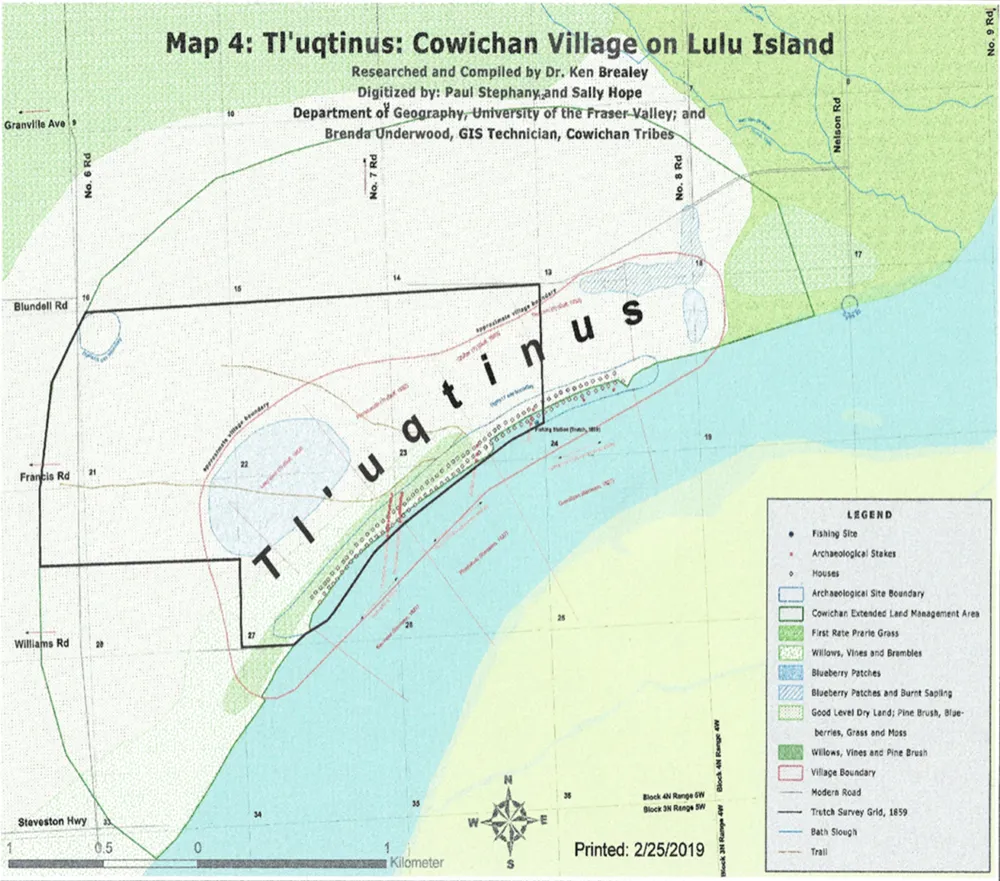
A map shows the Cowichan title lands outlined in black. (B.C. Supreme Court) Photo by B.C. Supreme Court
The decision earlier this month by the Supreme Court of British Columbia that the Cowichan tribes hold title over federal, city, and private land in Richmond B.C. that enjoys a higher legal status than the fee simple ownership of the current proprietors is outrageous but may have some positive consequences. The decades and $7 billion that have been spent or pledged for what is called the “reconciliation” process, has finally hit a stone wall. The almost universal desire to be fair to Indigenous people and where appropriate to compensate them for inequitable treatment, has finally collided with the entrenched economic rights and interests of every owner of real property in Canada, including those of Indigenous ancestry.
Inexplicable latitude has been granted to the thickening population of crusaders for indigenous rights. Even the NDP government of British Columbia, which has been pathologically addicted to prostrating itself at the feet of anyone or anything purporting to champion any definition of the Indigenous interest, was reduced to monosyllabic waffling by the court decision brought down by Justice Barbara Young. Premier David Eby’s office declared an ambition to continue seeking a negotiated resolution of the conflict between Aboriginal rights and common law rights of affected property owners, (including the municipal, provincial, and federal governments-of $100 billion of property in Richmond B.C. that is directly affected by the decision).
This is an understandable ambition, but in the circumstances, his government might have pressed the negotiations over the six years that this case has been litigated. Our judiciary has been addicted to truckling to almost any Indigenous claim, on the restricted occasions when the federal and provincial governments have even had the temerity to conduct a defense against them. Now the taxpayers’ negotiating position has been tanked by this ludicrous decision, which is being appealed.
If courts with authority for the whole country were to come to similar judgments, and we cannot doubt that activists will continue to push on an open door and quite rightly take all they can get, then every property title deed in the country is compromised, including the Houses of Parliament. There were only approximately 200,000 native people in all of what is now Canada when the French and British explorers and settlers came here starting at the end of the 15th century. Yet the implication of this ruling is that they legitimately owned all of Canada and that in the patchwork of numbered treaties and other agreements following absorption of the politically organized parts of Canada into the British Empire at the end of the Seven Years War in 1763, ancient and undocumented Aboriginal rights took precedence over any subsequent real estate law allocations of property rights under the common or civil law systems that gradually spread across Canada.
Given the activist preferences of courts across the country, we can expect to see similar cases pop up everywhere, as First Nations sensibly try to strike while the iron is hot and lay claim to as much of the real estate of Canada as the courts will let them … which might well be the entire land mass plus fishing rights.
Comments Off on The Supreme Court of British Columbia has detonated a legal mine under all of Canada’s established property titles
Much of our prosperity is based on trust, and we’re rapidly losing it
Ted Gioia foresees a precipitous fall in trust coming at us very soon, and I’m afraid he might be being too optimistic:
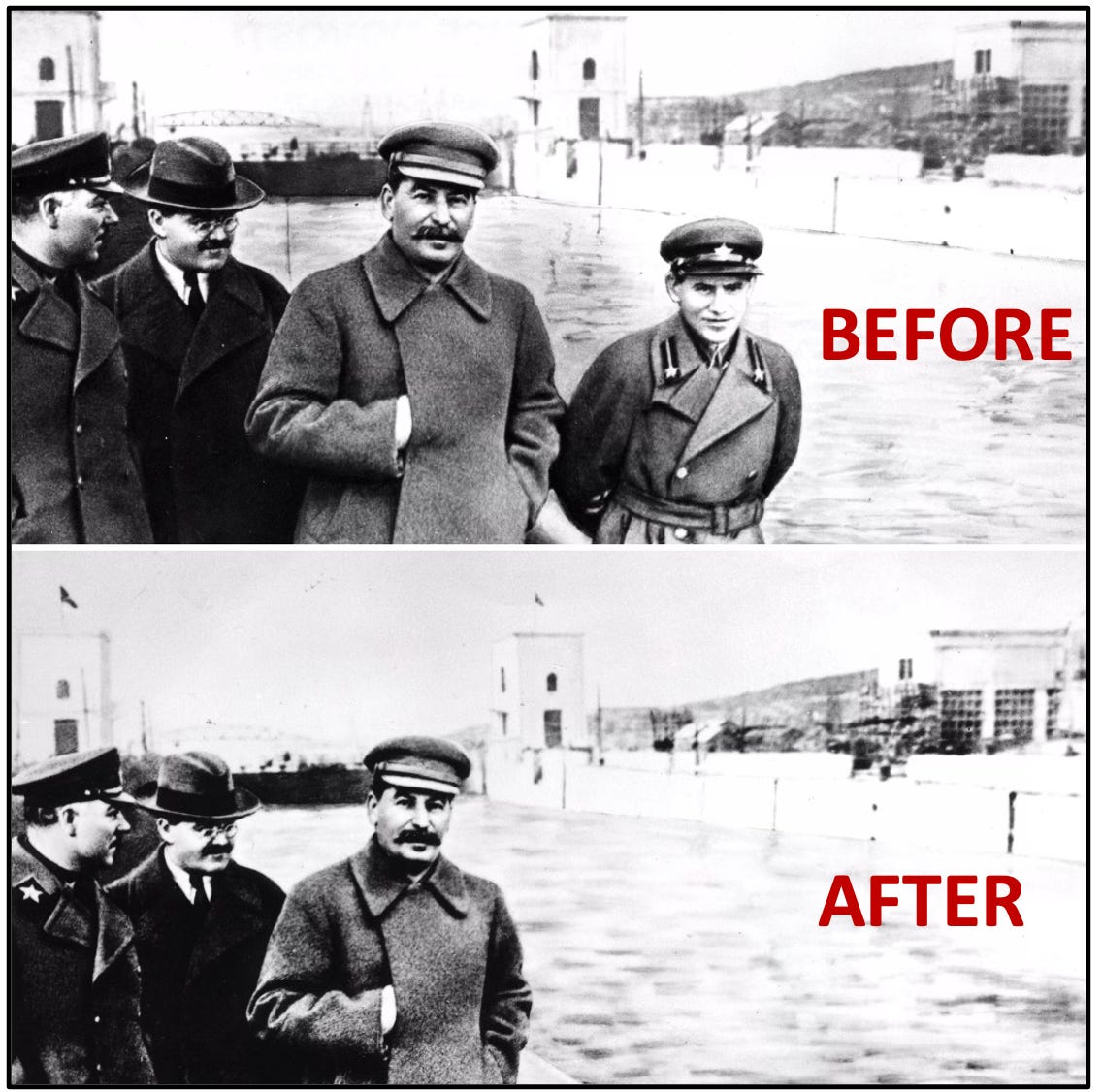
During the great purges of the 1930s, Stalin ordered the execution of a million people, including some of his closest associates. But it wasn’t enough to kill these victims — they also had to disappear from photographs.
In a famous case, Nikolai Yezhov got removed from his position next to Stalin in a photo taken by the Moscow Canal. This erasure alarmed many party elites because Yezhov, head of the secret police, had been one of the most feared men in the Soviet Union.
And now he got totally deleted.
Well, not totally. In those days of print media, original photos survived, and a paper trail made it difficult to erase history.
So this photo was later used to mock Stalin, and the pretensions of dictators. They can try to change reality, but that’s not possible.
Or is it? Maybe dictators now get the last laugh. Because in the last few months, reality has been defeated — totally, completely, unquestionably.
It is now possible to alter reality and every kind of historical record — and perhaps irrevocably. The technology for creating fake audio, video, and text has improved enormously in just the last few months. We will soon reach — or may have already reached — a tipping point where it’s impossible to tell the difference between truth and deception.
- Can I tell the difference between a fake AI video and a real video? A few months ago, I would have said yes. But now I’m not so sure.
- Can I tell the difference between fake AI music and human music? I still think I can discern a difference in complex genres, but this is a lot harder than it was just a few months ago.
- Can I tell the difference between a fake AI book and a real book by a human author? I’m fairly confident I can do this for a book on a subject I know well, but if I’m operating outside my core expertise, I might fail.
At the current rate of technological advance, all reliable ways of validating truth will soon be gone. My best guess is that we have another 12 months to enjoy some degree of confidence in our shared sense of reality.
But what happens when it’s gone?
Back in 2023, I asserted that trust is the most scarce thing in society. But that was before all these tech deceptions came online. Trust will soon get even more scarce — or perhaps disappear completely from the public sphere.
This is not a small matter.
Most discussions of this issue focus on the technology. I believe that’s a mistake. The real turmoil will take place in social cohesion and individual psychology. They will both fracture in a world where our shared benchmarks of truth and actuality disappear.
We will be — already are — in desperate need of Robert Heinlein’s Fair Witnesses:
A Fair Witness is an individual trained to observe events and report exactly what is seen and heard, making no extrapolations or assumptions. While wearing the Fair Witness uniform of a white robe, they are presumed to be observing and opining in their professional capacity. Works that refer to the Fair Witness emphasize the profession’s impartiality, integrity, objectivity, and reliability.
An example from the book [Stranger in a Strange Land] illustrates the role of Fair Witness when Anne is asked what color a house is. She answers, “It’s white on this side.” The character Jubal then explains, “You see? It doesn’t occur to Anne to infer that the other side is white, too. All the King’s horses couldn’t force her to commit herself … unless she went there and looked – and even then she wouldn’t assume that it stayed white after she left.”
Comments Off on Much of our prosperity is based on trust, and we’re rapidly losing it
This is Westland Helicopters (1960s)
British Helicopters History
Published 17 Jan 2020Major rationalisation of the UK aircraft industry occurred during the 1960s. With the acquisition of Bristol Helicopters, Fairey Aviation and Saunders-Roe, Westland Helicopters transformed itself into Britain’s only helicopter maker with plants at Yeovil, Weston-super-Mare, Eastleigh, and Hayes, producing helicopters for all roles.
Comments Off on This is Westland Helicopters (1960s)
QotD: Police culture
Cops live and operate within a strict hierarchy, usually with titles like “sergeant”, “lieutenant”, “captain”, and so forth. Most of them wear military-style uniforms, and an argument can be made that so-called “plainclothes” operations ought to be outlawed. Increasingly, they wear military battledress and carry military weapons.
Cops form a culture all to themselves, like professional soldiers, and usually have little to do with those who are not cops. They do call us “civilians”. […] They also call us “assholes” and say that the public just consists of criminals who haven’t been caught yet. I know because I was there at one time.
Yeah, I understand the theory that they’re civilians, too. I repeat that it’s bullshit. What they are, in fact, is an occupying military force, with strategic bases in every hamlet in the nation — which is why they and their hangers-on lie to us and possibly to themselves about being civilians, too.
They are the very standing army that the Founding Fathers were afraid of.
L. Neil Smith, “Letter from L. Neil Smith” Libertarian Enterprise, 2005-05-01.
Comments Off on QotD: Police culture


