
World War Two
Published 3 May, 20205Indy and Sparty tackle some more of your interesting questions in another live Out of the Foxholes. Today they look at loss rates of B-17 crews, the myth of the clean Wehrmacht, and ask why the West was apparently so unprepared for Japan’s attack.
(more…)
May 4, 2025
The Clean German Myth, Doomed B-17 Pilots, and Japan’s Rapid Victories – Out of the Foxholes Live
Comments Off on The Clean German Myth, Doomed B-17 Pilots, and Japan’s Rapid Victories – Out of the Foxholes Live
One Fine Day in the British Empire 100 years ago
Nigel Biggar discusses One Fine Day by Matthew Parker, which looks at the state of the British Empire in the mid-1920s with a moderately jaundiced eye (as you’d expect for a modern popular history about the empire):
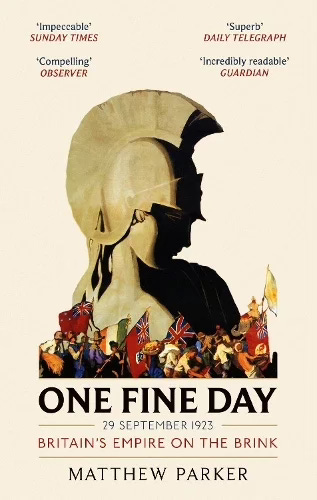
The approach is imaginative: to present a snapshot of the British Empire a century ago, five years after its victory in the First World War, when its territory was most extensive and at what must have seemed its zenith. The result is a display of the Empire in all its ad hoc variety, from the white-majority settler “dominion” of Australia to the non-settler “protectorate” of Uganda. The reader meets colonial officials who were sympathetic and conscientious in their dealings with those they ruled, as well as some who were brutally arrogant and dismissive. He also hears from native people who appreciated the benefits of imperial rule, as well as those who felt humiliated by Western dominance. And he learns that, if the British were late in introducing democracy to India, they were the very first to do so, for its like had never been seen before. To its great credit, no one can read this book and conclude that the British Empire was a morally simple thing.
However, it seems that our snap-shooter was fascinated mainly by the Empire in the east and grew tired as he travelled westward. Of the thirty-seven chapters, he devotes twenty-two to Australasia, the Pacific, South-East Asia, and India. There is very little mention of the Empire in South Africa, almost nothing on the Middle East (Egypt, Palestine, and Iraq) and hardly a reference to Canada. In addition, the publisher appears to have become alarmed at the length, since readers wanting to consult the notes or bibliography are directed to the author’s website.
What is more, the synchronic approach suffers from myopia, relegating major imperial achievements to walk-on parts. We do hear about the Empire’s humanitarian suppression of slavery, but only incidentally. The reader is not told that Britain (along with France and Denmark) was among the first states in the history of the world to repudiate slave-trading and slavery in the early 1800s and that it used its imperial power throughout the second half of its life to abolish slavery from Brazil across Africa to India and New Zealand. And in ending his book by reporting the 1923 cession of Rwanda to Belgium and Jubaland to Italy as tokens of imminent imperial dissolution — “Very soon, of course, the trickle became a flood” is the very last sentence — the author allows the reader to overlook the extraordinary, heroic contribution that the British Empire went on to make in the Second World War, when, between the Fall of France in May 1940 and the German invasion of Russia in June 1941, it offered the only military resistance to the massively murderous, racist regime in Nazi Berlin, with the sole exception of Greece.
While our imperial tourist is a generally an honest reporter, presenting the good as well as the bad elements of the Empire, his account is not innocent of unfairly negative bias.
The problem first manifests itself in the decision to open his account with the story of the mining ruination of a tiny Pacific territory by the British Phosphate Company. He then returns to this in the book’s closing pages, where describes it as a tale of “extractive colonialism at its most literal”. While an attentive reader of the pages in between will notice that the Empire sometimes brought native people economic opportunities and benefits, the lasting impression given by this bookending is that it was — as neo-Marxists have always claimed — basically exploitative. And yet Rudolf von Albertini, whose work was based “on exhaustive examination of the literature on most parts of the colonial world to 1940” (according to the eminent imperial economic historian, David Fieldhouse) judged “that colonial economics cannot be understood through concepts such as plunder economics and exploitation”.1
Parker’s negative bias appears most strongly in his crude, unreflective understanding of the racial attitudes of the imperial British. While he does bring onto the stage colonial Britons who express a range of views of other peoples, including sympathy and benevolence (albeit usually “paternalistic”), he nevertheless tells us that “ideas of white supremacy remained a guiding structural principle of the empire. This racist ideology was a coping stone of empire” (p. 8). What he has in mind is specifically the idea of a fixed “hierarchy of races”, with whites permanently established at the top — “what we would now call white supremacism” (p. 65). Such a view could claim the authority of natural science, since at the turn of the twentieth century “European scientists all still agreed that human beings were naturally unequal … and that there was a hierarchy of races” (p. 138).
1. D.K. Fieldhouse, The West and the Third World (Oxford: Blackwell, 1999), p. 168; R. von Albertini with Albert Wirz, European Colonial Rule, 1880–1940: The Impact of the West on India, Southeast Asia, and Africa, trans. John G. Williamson (Oxford: Clio, 1982), p. 507.
Comments Off on One Fine Day in the British Empire 100 years ago
Everyday Life in the Roman Empire – Culture and Literacy in the Roman Empire
seangabb
Published 28 Dec 2024This is the eighth video in my series on Everyday Life in the Roman Empire. In this, I wander about at the beginning, with talk of poetry and philosophy, before realising that the real theme is the extent of ancient literacy. The whole of the remainder is given over to this, and how it enabled a literary civilisation wholly different from our own.
Introduction – 00:00:00
Our perceptions of culture in the Ancient world – 00:01:40
Virgil – 00:03:45
Catullus – 00:05:17
Philosophy in Rome – 00:06:23
The Romans and Stoicism – 00:08:40
The Romans and Epicureanism – 00:10:27
Pretty silver things from Roman Britain – 00:16:25
Broad-based cultural participation in the Ancient World? – 00:19:26
The Ancient World: a largely illiterate civilisation (no spectacles) – 00:28:27
The Ancient World: a largely illiterate civilisation (expensive education, expensive books) – 00:35:40
The Ancient World: a largely illiterate civilisation (economic imperatives) – 00:42:35
The Ancient World: a largely illiterate civilisation (expensive writing materials) – 00:44:44
The Ancient World: a largely illiterate civilisation (difficulties of reading) – 00:49:16
The Ancient memory – 00:53:14
The primacy of oral communication – 00:55:23
The Ancient World: a largely illiterate civilisation (the Second Sophistic and linguistic change) – 00:59:53
Bibliography – 01:08:10
(more…)
Comments Off on Everyday Life in the Roman Empire – Culture and Literacy in the Roman Empire
QotD: Women and depression
Why wouldn’t powerlessness cause depression in women too?
Well, in a backwards sort of way it actually does.
The difference is this: women feel powerful when they are loved, and powerless when they are not, because their instinct wiring tells them that safety lies in being able to form social coalitions and attract a strong mate.
Women, in general (there are always outlier exceptions) don’t get major antidepressive help from just going outside and chopping up a cord of firewood, the way men do. Because the woman’s game is to give a man a good reason to chop firewood for her.
It’s when she can’t do *that* that she feels powerless.
ESR, Twitter, 2024-05-06.

Comments Off on QotD: Women and depression


