Quotulatiousness

May 3, 2025

Carney sets his agenda

Filed under: Cancon, Government — Tags: , , , — Nicholas @ 05:00

On his Substack, Paul Wells says that newly elected Prime Minister Mark Carney had a good opening press conference on Friday morning:
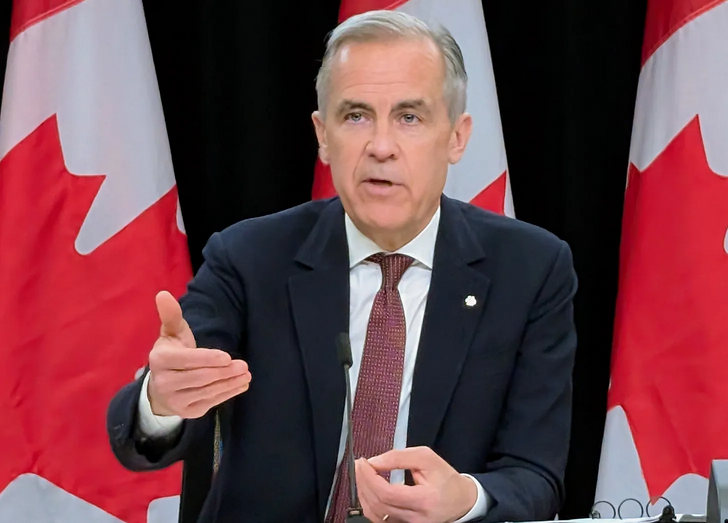
Mark Carney at the National Press Theatre, 2 May, 2025.
Photo By Paul Wells via his Substack

The first news conference is the easiest, because armies of public servants have been working on deliverables for weeks, and because little has had time to go wrong yet. Even by that congenial standard, Mark Carney had a good morning.

He began by noting something few of us had: that there was no serious organized attempt to reject Monday’s election result. “The leader of every party quickly and graciously accepted the results. At a time when democracies around the world are under threat, Canadians can be proud that ours remains strong.”

Canadians want “big changes quickly”. He promised to work “relentlessly” to deliver. He is “committed to working with others, governing as a team in cabinet and caucus … working in real partnership with provinces, territories, and Indigenous people and bringing together labour, business, and civil society”. Everyone always promises to work with the provinces, at first. He seemed to have something specific in mind. “In the coming weeks, I will unveil more of our plans to engage with Canadians as we embark on the biggest transformation of our economy since the end of the Second World War.”

There’ll be a new cabinet in 10 days. A return to Parliament on May 27. The King will read the Throne Speech. Before any of that, Carney will meet Donald Trump in Washington next Tuesday. He’ll remove “federal barriers to internal trade” by July 1. He’ll “identify projects that are in the national interest, projects that will connect Canada, deepen our ties with the world, and grow our economy for generations”. He’ll build a lot of houses. He’ll hire more border-services agents and muster “dog teams, drones and scanners to fight the traffic in guns and drugs”. He’ll “make bail harder to get for those charged with stealing cars, home invasion, human trafficking, and smuggling”.

There was more but you get the gist. Time for questions! What’s he expecting from his Washington trip? “Quite a comprehensive set of meetings,” mostly on tariffs. Does he expect a better reception than Volodomyr Zelensky got? “Look, I go there with the expectation of constructive — difficult but constructive — discussions.”

How’s he going to make Parliament work, with less than a majority? He offered no details at first, except to point out that the Liberals won more votes on Monday than any party ever has, and that it won seats in every province and a majority of the seats in seven provinces. He said he’s already spoken to Yves-François Blanchet and Pierre Poilievre. Speaking of Poilievre, there’ll be a by-election for the currently discomfited Conservative leader “as soon as possible … No games. Nothing. Straight.” Is the prime minister a subscriber? I don’t divulge such things.

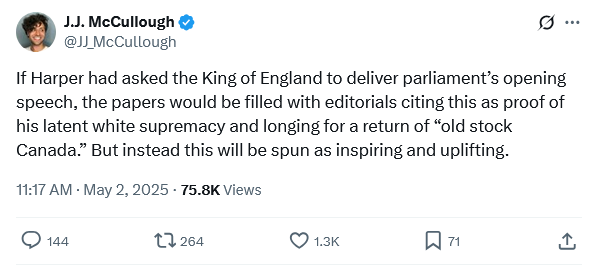
I was pleasantly surprised to find that the PM found a way to include the King in his agenda, but JJ is quite right here:

German democracy under threat from extremely extreme extreme right AfD

Filed under: Germany, Media, Politics — Tags: , , , , — Nicholas @ 04:00

That, at least is the judgement of the German domestic intelligence agency assigned responsibility for sniffing out threats to German democracy:

This morning, the Federal Office for the Protection of the Constitution (BfV) officially reclassified Alternative für Deutschland as a “confirmed right-wing extremist” organisation. The BfV is Germany’s primary domestic intelligence agency; it is subject to the Ministry of the Interior and tasked, among other things, with policing the democratic respectability of ordinary Germans and their political parties. The upgraded AfD classification is supported by an extensive and totally secret 1,100-page assessment of AfD activities and beliefs, which BfV analysts have been preparing since last year.

Everybody expected the BfV to do this. Leading Social Democrats in particular have been urging the BfV to release their new assessment for months. They see it as a political justification for initiating ban proceedings against the party. As I wrote last week, it is now likely that the new CDU/SPD government, or the new Bundestag, or both, will ask the Federal Constitutional Court in Karlsruhe to weigh an AfD prohibition. This new assessment matters mostly because it is the first concrete move in that direction.

The only thing that is really surprising about this news, is the timing: I and everybody else expected the BfV to wait until the CDU and the SPD form a new government and appoint a new Interior Minister. Instead, the sitting Interior Minister Nancy Faeser appears to have forced this assessment through in the final four days of her tenure. This, and not AfD poll numbers (as some have speculated), is the reason this is happening now.

[…]

Among other things, the assessment allegedly cites these extremely right-wing remarks from an 11 August 2024 speech by Hannes Gnauck, who sits on the AfD federal executive committee:

    We must also be allowed to decide once again who belongs to this nation and who does not. There is more to being German than simply holding citizenship papers. All of us here in this market square are connected by much more than just a common language. We are connected by an invisible and simply inexplicable bond. Each and every one of you has more in common with me than any Syrian or Afghan, and I don’t have to explain that – it’s simply a law of nature.

The assessment also includes this absolutely extremist 25 August 2024 statement by Dennis Hohloch, an AfD staffer in the Brandenburg state parliament:

    Diversity means multiculturalism. And what does multiculturalism mean? Multiculturalism means a loss of tradition, a loss of identity, a loss of homeland, murder, manslaughter, robbery and gang rape.

Finally, the BfV would like us to know that their assessment includes this insanely extreme (and since-deleted) tweet from Martin Reichardt, a Bundestag staffer:

    Failed migration policy and asylum abuse have led to the importation of 100,000 people from deeply backward and misogynistic cultures.

Obviously the BfV are leaking their choicest, least arguable, and juiciest bits of evidence – the stuff they think will really turn ordinary Germans against those evil AfD Nazis. I invite you re-read these three passages with that in mind, and then try to imagine for yourself what an absurd cultural and ideological bubble these people must inhabit, to find these remarks scandalous.

Poilievre to run in Alberta riding when the byelection is set

Filed under: Cancon, Media, Politics — Tags: , , , — Nicholas @ 03:00

After losing the seat he’d held for more than 20 years in this week’s federal election, Pierre Poilievre’s political future was clouded. An Alberta MP-elect, Damien Kurek has volunteered to resign so that Poilievre can run in his riding.

Seatless Conservative leader Pierre Poilievre will run in an Alberta byelection as Conservative MP Damien Kurek “temporarily” steps aside.

In a press release, Kurek, the Battle River—Crowfoot MP-elect, said he was relinquishing his seat for Poilievre because it’s “what’s best for Canada” and the riding. Kurek was first elected in the Alberta riding in 2019.

Poilievre lost his Ottawa-area seat to a Liberal challenger by more than 4,000 votes in Monday’s election.

“The people of Battle River—Crowfoot will be represented well by Pierre for the remainder of this Parliamentary session, and I will keep working with our incredible local team to do everything I can to remain the strong voice for you as I support him in the process, and then run again here in Battle River—Crowfoot in the next general election,” Kurek said in a statement.

At a press conference in Ottawa on Friday, Prime Minister Mark Carney said he would call a byelection as soon as possible and that the government would play “no games” with Poilievre’s quest to win a seat.

Apparently, Carney is going with the less-unfriendly path rather than delaying the call for a byelection for the full allowable period (as Justin Trudeau certainly would have done).

Development of the Uzi Family: Standard, Mini, and Micro

Forgotten Weapons
Published 4 Jan 2025

The Uzi was originally designed in the 1950s, and it was on the technological cutting edge at the time. The stamped receiver, telescoping bolt, and compact magazine-in-grip layout made it an inexpensive and effective weapon. Its sedate 600 round/minute rate of fire helped as well, making it easy to shoot effectively. Uziel Gal experimented with a compact version at that time, but dropped the idea when he proved unable to make a smaller version with the same low rate of fire as the standard pattern.

Fast forward to the late 1970s, and the designers at IMI revisited the idea of a compact Uzi. They were willing to accept the increased rate of fire of a shorter receiver and lighter bolt, and their first prototypes were ready in 1978. full export sales began in 1980. The gun was advertised as having a 900 rpm rate of fire, but the reality was much higher.

The final step of classic Uzi development was the Micro Uzi, introduced in 1986. This was actually developed form the semiautomatic, closed-bolt Uzi Pistol made for American commercial sales. That pistol was given a select-fire trigger group and a folding stock, and it became a micro-compact submachine gun for only the most tactical of operators. It was advertised as having a 1200 rpm rate of fire, but this was again underestimated to improve sales.

In reality, the standard Uzi does fire at about 600 rpm. The Mini (in closed-bolt form) ran at 1300+ in my testing at S&B, and the Micro was over 1400 rpm. Where the original Uzi is best kept in fully automatic mode and can easily fire single shots when desired, the Mini and Micro Uzis are definitely best suited to semiautomatic use. Firing them in fully automatic is a much more difficult proposition if one wants to maintain any level of accuracy and situational awareness.

Thanks to Sellier & Bellot for giving me access to this set of Uzis to film for you!
(more…)

QotD: When the Cursus Honorum failed, so did the Roman Republic

Public men in the Roman Republic had always been ambitious — it went with the territory; they built large parts of their culture around it — but by Caesar’s day the vetting process had been completely inverted.

The Old Republic was full of men like Caesar, because people are what they are; there are always potential Caesars running around. But the names of the Old Republic’s Caesars don’t appear in the history books, because back then they still maintained the distinction between process and outcome. If there’s a conflict between them, process must yield, and so even though a potential Caesar did a competent job as quaestor and was ready to stand for curule aedile, he’d be taken aside by an old man (“senate” comes from senex, “old man”) for a stern talking-to … or more than a stern talking-to, if it came to that.

By Julius Caesar‘s day, though, process had completely eclipsed outcome. Again, the “real” Caesar is much debated by historians, but what’s not in dispute is his naked ambition. Everybody knew what Caesar was about, right from the get-go. But since there was no way to stop his climb up the cursus honorum spelled out in the Policies and Procedures Manual, nobody did.

Indeed, by Caesar’s time, the rot was so deep that most (I’d argue all, but I’m not a Classicist) of the offices on the CH were eyewash, just lines on a CV. The curule aediles weren’t managing the grain supply; they had battalions of freedmen running that. They were still putting on games, of course, but they weren’t personally putting them on; again, battalions of clever freedmen did that. The only thing the aedile did for “his” games was pay for them … on credit, and only in order to take the next step up the ladder.

And the rot was, of course, recursive. Caesar at least had clarity: He wanted to be quaestor so he could be aedile; to be aedile so he could be praetor; to be praetor so he could be governor; to be governor so he could be general; to be general so he could be … well, whatever, that’s part of the great debate surrounding Caesar, but it doesn’t matter for our purposes. For us, what matters is that everyone else was doing the same thing, and because all the real work was being done by those battalions of clever freedmen, the quality of Republican leadership dropped off dramatically. How can a praetor-in-name-only accurately judge the competence of an aedile-in-name-only? Yeah, he technically held the office for a year, but he left it as ignorant of its duties as when he entered.

Severian, “Cursus Honorum”, Founding Questions, 2021-12-27.

[NR: Links to the Roman Glossary added.]

Powered by WordPress