
HardThrasher
Published 17 Apr 2025The speed with which a theory had to be put into practice, and the opening phase of the raid itself.
(more…)
April 19, 2025
Dambusters – Part 2 – The Countdown to the Raid
Comments Off on Dambusters – Part 2 – The Countdown to the Raid
Notes on the English debate
In the National Post, Chris Selley explains the apparent utility of having Bloc Québécois leader Yves-François Blanchet included in the English-language leaders’ debate:

Bloc Québécois leader Yves-François Blanchet, 8 November, 2023.
Screencapture from a TVA Nouvelles video via Wikimedia Commons.
Wednesday evening’s French-language leaders’ debate kicked off with a video montage that mentioned President Donald Trump roughly 175 times. (I exaggerate somewhat.) Thursday evening’s English-language leaders’ debate was much less focused specifically on Trump, to an almost bizarre extent. When moderator Steve Paikin offered each leader a chance to ask a question of an opponent, Liberal Leader Mark Carney chose to ask Conservative Leader Pierre Poilievre about the security-clearance drama.
Carney’s campaign clearly believes Poilievre’s Achilles’ heel is Trump. One has to wonder how many Canadians even know the basics of the security-clearance issue. It was a baffling decision.
Ultimately, though, leaving Trump aside was a benefit. One of Carney or Poilievre will be prime minister in a month, and they essentially agree that Trump is too unpredictable to strategize against with any confidence from our current position as a semi-deadbeat country. (Again, I paraphrase.)
The only thing we can really do is focus on our own affairs in ways that would make us more prosperous, safe, happy and independent in every sense. In the long term: diversify our trade partners in every sector, including natural resources; improve border security, not to satisfy Trump’s fentanyl obsession but to prevent the northbound flow of illegal firearms (and because borders are supposed to be secure by definition); rebuild the military, not because Trump demands it but out of respect to our existing commitment to NATO and our self-styled reputation as An Important Country; fix health care; make housing affordable; get a handle on our own opioid crisis; fix our broken justice system. All that jazz.
You might think in a debate on those big national issues Bloc Québécois Leader Yves-François Blanchet would be extraneous on the stage. I saw plenty of people reacting in real time in that vein: Why is this man here? But in fact Blanchet served a very useful purpose: He was the voice of comfy Canadian inertia; the voice of Quebec continuing to plod along in its own way under Canada’s protective umbrella (ludicrous sovereignty-referendum threats notwithstanding).
Blanchet embodied how Canada might very plausibly abandon the opportunity that Trump’s kick in our rear end, however unjustified, offered us to live up to the greatness Canadian politicians always ascribe — often dubiously — to this country.
“The building of (new) pipelines will take at least 10 to 14 years. Mr. Trump will be 90 years old, not president … and somebody of course less terrible will be there before you can even dream of having oil through (a new) pipeline,” Blanchet said, kiboshing (as ever) the notion of any new pipeline running through Quebec.
At Rigid Thinking, Damian Penny tries to explain Jagmeet Singh’s performance as the designated interrupter:
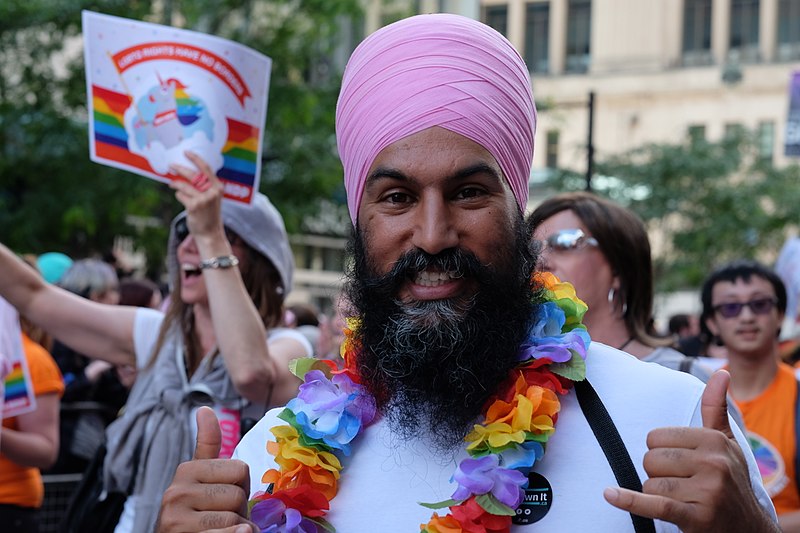
Federal NDP leader Jagmeet Singh taking part in a Pride Parade in June 2017 (during the leadership campaign).
Photo via Wikimedia.
I didn’t see the entire English-language, federal leaders debate on Thursday night, but from what I did see each of the leaders accomplished exactly what they set out to do:
- Pierre Poilievre went on offence against the liberals and tried to show that, despite their new leader, it’s the same bunch that have been running the country for the past decade.
- Mark Carney portrayed himself as much more measured and serious than either his main opponent or his predecessor.
- The Bloc guy showed that his only concern is Quebec and by the way everything comes down to immigration.
- And the NDP’s Jagmeet Singh did everything he had to do to lock down that cushy patronage appointment he’ll receive should Carney be elected Prime Minister on April 28.
There was far more cross talk and interruptions during Thursday’s English debate compared to the French parlay the night before. Singh in particular seemed prone to interrupt his opponents.
Poilievre was the main target of Singh’s interjections — so much so that at one point Carney told the NDP leader to let his Conservative rival finish his point.
When Poilievre criticized the industrial carbon tax, Singh jumped in and accused the Conservatives of wanting to let everyone pollute. Poilievre spoke about border issues and Singh accused the former Conservative government of cutting border officers.
Poilievre at one point tried to make an appeal to voters: “The question that Canadians have to ask…”
“Why vote for Conservatives?” Singh jumped in before Poilievre could finish.
As of this writing, the venerable NDP is polling about as well in Canada as Marjorie Taylor Greene, and their only real shot at even maintaining major party status is to peel off voters from the Liberals, since no one even considering voting Conservative will vote for Singh’s party.
The Line‘s election Bullshit Bulletin overflowed with bullshit from the debates, including some Mark Carney blarney about pipelines:

Mark Carney had quite a few howlers during Thursday’s debate, one of which was aptly called out by Blanchet (hey, we like the guy, we just don’t think he should be in the debate). Carney wants to portray himself as strongly pro-pipeline, while still respecting Quebec’s ability to effectively veto national projects. That’s bullshit — and Carney should stop pretending otherwise.
Carney has been out of the country in recent years, so he may be unaware of how things are actually working. To sum up the last 10 years of internecine battles on this point: Pipelines absolutely fall under federal jurisdiction to approve or disapprove. However, provinces can hold up or significantly delay certain aspects of the process, either through legal challenges, or through sandbagging local permitting processes. The big lesson of the last 10 years is that absolute jackshit can actually get built when provincial governments try to encroach on federal authority to stall projects that fall under the national interest. Duties for First Nations consultation add another complicating step. Lastly, this country couldn’t build a goddamn supermarket (and Singh might try to stop it, even if we could) if conditions veer into the quasi-spiritual realm of “social license” — because nobody really knows what that means, or how the bar for “social license” can be cleared when any project at all is even remotely contested or controversial.
Add Bill C-69 to the mix, and what we’re facing is a regulatory quagmire in which the Liberals have made the approvals process practically impossible, and pissed everybody off while doing it. It’s worse than that almost nothing is getting built; the situation is now such a disaster that major projects are no longer even being seriously proposed. Even CEOs of Canadian companies know that their best return on investment is energy projects outside of Canada (see The Line Podcast episode from a week ago and our dispatch last Sunday for discussion of this).
In short, Blanchet is correct, here. A pipeline filled with Alberta oil is not getting through Quebec if Quebec gets a veto. Either we’re in a Confederation in which a federal government has the final say over these things, or Quebec has already separated, and that’s the end of it.
There was also an excellent dissection of the Liberal Party’s endless games with Canadian firearm laws, but it was too long to sensibly excerpt, but if you have any interest or curiosity about why so many Canadian gun owners are pissed off with the feds, it’s worth reading in full.
Comments Off on Notes on the English debate
Downfall: The Battle of Berlin 1945
Real Time History
Published 6 Dec 2024April 1945. After nearly six years of war, the Red Army stands massed on the banks of the Oder River in eastern Germany. The Nazi capital and Hitler’s bunker are just 60km away, but the Nazi Party and the Wehrmacht are preparing to fight to the bitter end in the final struggle of WW2 in Europe – the Battle for Berlin.
(more…)
Comments Off on Downfall: The Battle of Berlin 1945
QotD: Allied air and sea operations won WWII
In [How the War Was Won author Phillips Payson] O’Brien’s methodology, we should look at what the Axis spent its productive effort making and consider what Allied actions slowed that productive effort. In both theaters, the answer is shocking. The Germans spent relatively little productive effort on tanks, focusing far more on aircraft, submarines, and vengeance weapons (i.e., proto-cruise missiles and rockets). The Japanese spent heavily on aircraft as well, but also a tremendous amount on freighters and oil tankers.
The Allies won the war by using air power to destroy the German and Japanese capacity both to produce military equipment and to transport it to the battlefield. By 1944-45, the Germans and Japanese could not use their economies to arm and supply their armies on the battlefield, leading to their inevitable defeat.
In the European war, American and British airpower: (a) directly destroyed a significant amount of productive capacity, (b) rendered remaining capacity far less efficient, (c) made it impossible for the Germans to defeat western ground forces, and (d) compelled the Germans to waste tremendous resources on air defense and exorbitant, ultimately ineffective vengeance weapons.
In the Pacific, the United States used carrier-based airpower, submarines, and bomber-deployed mines to isolate Japan from the resources of the empire it conquered in 1941-42. American bombers also directly destroyed factories and transportation systems, leading to similar levels of economic dysfunction as in Germany.
Anonymous, “Your Book Review: How the War Was Won“, Astral Codex Ten, 2024-08-09.
Comments Off on QotD: Allied air and sea operations won WWII


