Quotulatiousness

February 15, 2025

“Trump marks the overdue end of the Long Twentieth Century”

Filed under: History, Media, Politics, USA — Tags: , , — Nicholas @ 05:00

At The Upheaval, N.S. Lyons suggests that the arrival of Donald Trump, version 2.0, may finally end the era we’ve been living in since immediately after the end of WW2:

The 125 years between the French Revolution in 1789 and the outbreak of WWI in 1914 was later described as the “Long Nineteenth Century”. The phrase recognized that to speak of “the nineteenth century” was to describe far more than a specific hundred-year span on the calendar; it was to capture the whole spirit of an age: a rapturous epoch of expansion, empire, and Enlightenment, characterized by a triumphalist faith in human reason and progress. That lingering historical spirit, distinct from any before or after, was extinguished in the trenches of the Great War. After the cataclysm, an interregnum that ended only with the conclusion of WWII, everything about how the people of Western civilization perceived and engaged with the world – politically, psychologically, artistically, spiritually – had changed.

R.R. Reno opens his 2019 book Return of the Strong Gods by quoting a young man who laments that “I am twenty-seven years old and hope to live to see the end of the twentieth century”. His paradoxical statement captures how the twentieth century has also extended well past its official sell-by date in the year 2000. Our Long Twentieth Century had a late start, fully solidifying only in 1945, but in the 80 years since its spirit has dominated our civilization’s whole understanding of how the world is and should be. It has set all of our society’s fears, values, and moral orthodoxies. And, through the globe-spanning power of the United States, it has shaped the political and cultural order of the rest of the world as well.

The spirit of the Long Twentieth could not be more different from that which preceded it. In the wake of the horrors inflicted by WWII, the leadership classes of America and Europe understandably made “never again” the core of their ideational universe. They collectively resolved that fascism, war, and genocide must never again be allowed to threaten humanity. But this resolution, as reasonable and well-meaning as it seemed at the time, soon became an all-consuming obsession with negation.

Hugely influential liberal thinkers like Karl Popper and Theodor Adorno helped convince an ideologically amenable post-war establishment that the fundamental source of authoritarianism and conflict in the world was the “closed society”. Such a society is marked by what Reno dubs “strong gods”: strong beliefs and strong truth claims, strong moral codes, strong relational bonds, strong communal identities and connections to place and past – ultimately, all those “objects of men’s love and devotion, the sources of the passions and loyalties that unite societies”.

Now the unifying power of the strong gods came to be seen as dangerous, an infernal wellspring of fanaticism, oppression, hatred, and violence. Meaningful bonds of faith, family, and above all the nation were now seen as suspect, as alarmingly retrograde temptations to fascism. Adorno, who set the direction of post-war American psychology and education policy for decades, classified natural loyalties to family and nation as the hallmarks of a latent “authoritarian personality” that drove the common man to xenophobia and führer worship. Popper, in his sweepingly influential 1945 book The Open Society and Its Enemies, denounced the idea of national community entirely, labeling it as disastrous “anti-humanitarian propaganda” and smearing anyone who dared cherish as special his own homeland and history as a dangerous “racialist”. For such intellectuals, any definitive claim to authority or hierarchy, whether between men, morals, or metaphysical truths, seemed to stand as a mortal threat to peace on earth.

The great project of post-war establishment liberalism became to tear down the walls of the closed society and banish its gods forever. To be erected on its salted ground was an idyllic but exceptionally vague vision of an “open society” animated by peaceable weak gods of tolerance, doubt, dialogue, equality, and consumer comfort. This politically and culturally dominant “open society consensus” drew on theorists like Adorno and Popper to advance a program of social reforms intended to open minds, disenchant ideals, relativize truths, and weaken bonds.

As Reno catalogues in detail, new approaches to education, psychology, and management sought to relativize truths, elevate “critical thinking” over character, vilify collective loyalties, cast doubt on hierarchies, break down all boundaries and borders, and free individuals from the “repression” of all moral and relational duties. Aspiration to a vague universal humanitarianism soon became the only higher good that it was socially acceptable to aim for other than pure economic growth.

[…]

The Long Twentieth Century has been characterized by these three interlinked post-war projects: the progressive opening of societies through the deconstruction of norms and borders, the consolidation of the managerial state, and the hegemony of the liberal international order. The hope was that together they could form the foundation for a world that would finally achieve peace on earth and goodwill between all mankind. That this would be a weak, passionless, undemocratic, intricately micromanaged world of technocratic rationalism was a sacrifice the post-war consensus was willing to make.

That dream didn’t work out though, because the strong gods refused to die.

Update, 17 February: Welcome Instapundit readers! Thanks for dropping by. Please do look around at some of my other posts! I think the last time I got linked by Instapundit was back in 2008/9 just before I moved to the current location. Please do read the entire N.S. Lyons post, as this is just a taster of the full essay!


Vintage Workbenches: Quick, Dirty, and Awesome

Filed under: Tools, Woodworking — Tags: , , , — Nicholas @ 04:00

Rex Krueger
Published 13 Feb 2025
(more…)

Nannies on the right are just as bad as nannies on the left

Filed under: Business, Government, Health, Politics, USA — Tags: , , , — Nicholas @ 03:00

Jim Treacher briefly gets slightly serious about RFK Jr.’s new role as America’s chief health nanny:

Fake image generated by Grok

First things first: I’m fine with a United States president picking his own cabinet. Donald Trump won, so he gets to choose the people he wants. It’s not fascism, it’s not unconstitutional, and it’s not going to destroy the country. This is the system we have, and so far the Trump administration has been operating within precedent. (Yes, even with Elon Musk and DOGE.) Fair enough.

And, also, in addition to that: I don’t like RFK Jr., and I won’t pretend I do just so you don’t yell at me.

RFK is still the same guy he was before he suddenly started being nice to Trump. He’s the guy who thinks COVID-19 was “ethnically targeted” to attack Caucasians and blacks, while sparing the Jews and Chinese. He’s the guy who bragged about having a worm in his brain. He’s the guy who, just seven months ago, said “Trump was a terrible president“.

Now I’m supposed to pretend none of that happened, just because Trump likes him for the moment? Nah.

And, of course, RFK is the guy who thinks the role of government is to slap your hand at the dinner table. So I’m supposed to pretend nanny-statism is good now.

Yay, let’s embrace lib policies to own the libs!

If you didn’t want Michelle Obama telling you what to eat, why do you want RFK telling you what to eat? If you didn’t want the government telling you which vaccines to put in your body, why do you want the government telling you which food to put in your body?

“But seed oils and high-fructose corn syrup and Red Dye Number Whatever are bad for you!” Okay. So don’t eat that stuff. You can read labels, can’t you? Why do you need the feds to hold your hand?

It’s amazing: At the very same time MAGA is cheering on Trump for reducing the size of government — and buddy, I’m right there with them — they’re begging the government to “clean up the food supply”.

Which is it, friends?

Get mad at me all you want, but at least I’m consistent. I don’t want the government telling me what to do, no matter who’s in charge for the time being.

Halifax Donair (Canada) on Sandwiches of History⁣

Filed under: Cancon, Food, History — Tags: , , , — Nicholas @ 02:00

Sandwiches of History
Published 27 Oct 2024

Welcome back to another episode of You’re Doing it Wrong. Lol. Also known as International Sandwich Sunday. I’m joking, kinda. Today, we’re headed northeast to Halifax, Nova Scotia for the Halifax Donair. As I mention in the video, this was created by a Greek immigrant after his traditional lamb and beef gyros just weren’t selling. So it’s less cultural appropriation and more adaptation to the needs of the market. I think if you ask anyone in Halifax, they’d fully acknowledge the original inspiration for this. Also, if you’re tempted to comment on how it’s not a sandwich, just know that, while I understand where you’re coming from, I don’t keep strict purity tests in place for sandwiches as I don’t want to miss out on deliciousness because of them. Join me, won’t you?
(more…)

QotD: The absurdly high early expectations for genetic research

Filed under: Health, Media, Quotations, Science — Tags: , , , — Nicholas @ 01:00

For decades, people talked about “the gene for height”, “the gene for intelligence”, etc. Was the gene for intelligence on chromosome 6? Was it on the X chromosome? What happens if your baby doesn’t have the gene for intelligence? Can they still succeed?

Meanwhile, the responsible experts were saying traits might be determined by a two-digit number of genes. Human Genome Project leader Francis Collins estimated that there were “about twelve genes” for diabetes, and “all of them will be discovered in the next two years”. Quanta Magazine reminds us of a 1999 study which claimed that “perhaps more than fifteen genes” might contribute to autism. By the early 2000s, the American Psychological Association was a little more cautious, was saying intelligence might be linked to “dozens – if not hundreds” of genes.

The most recent estimate for how many genes are involved in complex traits like height or intelligence is approximately “all of them” – by the latest count, about twenty thousand. From this side of the veil, it all seems so obvious. It’s hard to remember back a mere twenty or thirty years ago, when people earnestly awaited “the gene for depression”. It’s hard to remember the studies powered to find genes that increased height by an inch or two. It’s hard to remember all the crappy p-hacked results that okay, we found the gene for extraversion, here it is! It’s hard to remember all the editorials in The Guardian about how since nobody had found the gene for IQ yet, genes don’t matter, science is fake, and Galileo was a witch.

And even remembering those times, they seem incomprehensible. Like, really? Only a few visionaries considered the hypothesis that the most complex and subtle of human traits might depend on more than one protein? Only the boldest revolutionaries dared to ask whether maybe cystic fibrosis was not the best model for the entirety of human experience?

Scott Alexander, “The Omnigenic Model As Metaphor For Life”, Slate Star Codex, 2018-09-13.

February 14, 2025

“Over half of all Germans now find themselves on ‘the right’ and urgently require democratic reeducation”

Filed under: Germany, Government, Media, Politics — Tags: , , , , — Nicholas @ 05:00

Ah, poor German democracy … you guessed it, once again it’s hanging by a thread as protests against the extremely extreme extreme right (the AfD) have now grown to include protests against the merely extreme extreme right (the CDU and CSU):

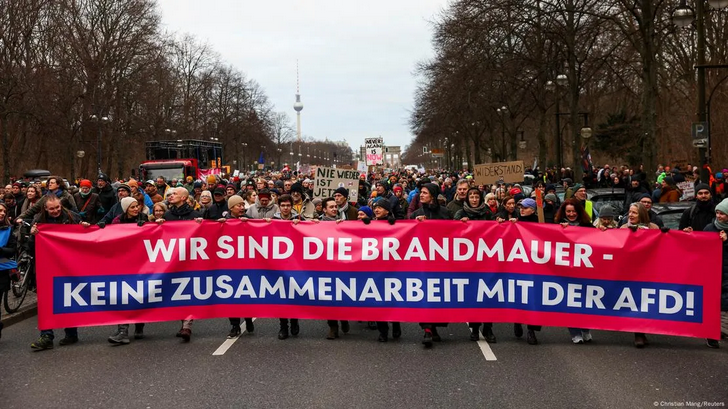
“We are the cordon sanitaire – no cooperation with the AfD”: the banner leading the Berlin protest against AfD and CDU on 2 February, which was financed in part by the German taxpayer and arranged by semi-affiliated apron organisations of the governing Green and Social Democrat parties of Germany.

All the activists are out in force.

Every day there are new protests “against the right”, and by “the right” they do not merely mean Alternative für Deutschland and the one-in-five Germans who vote for them, as was the case last year at this time. Since Friedrich Merz stepped over the cordon sanitaire at the beginning of this month, “the right” now also includes the centre-right CDU and CSU parties. Over half of all Germans now find themselves on “the right” and urgently require democratic reeducation. What is worse, it is not just crazy pink-haired activists and septum-pierced Antifa who want to do the reeducating, oh no. It is the government itself; the activists are merely their agents.

According to taz, 500,000 right-thinking Germans took to the streets this past weekend to combat the out-of-bounds radical views held by 52% of everybody. Perhaps 200,000 or 250,000 or 320,000 turned out for the massive “Democracy Needs You” protest in Munich on Saturday. A further 35,000 people “warned against a shift to the right” in Bremen, the absurd “Grannies against the Right” brought 24,000 people to the streets of Hannover, and another 14,000 denounced “right-wing extremism” in Marburg. There were also protests throughout Nordrhein-Westfalen, in Wuppertal, Aachen, Duisburg, Gütersloh, Gummersbach and Euskirchen. Yesterday 15,000 showed up to protest an AfD event in Freiburg; they were less than peaceful. And that is just what I found by scanning a few headlines. I could easily expand this paragraph into an entire post because they are protesting everywhere and all the time “against the right” these days.

I must emphasise again the extremely expansive notion of “the right” that is in play at these protests. Basically everyone who is not on the left – and particularly everyone who does not vote for the Greens or the Social Democrats (SPD) – presently attracts the activists’ ire. That is very interesting, because we are in the final stages of an election campaign and the Greens and the SPD are the only parties in government. Could it be that the Greens and the SPD are using the substantial resources of the German state to call forth massive street protests against all the Germans who are not planning to vote for them?

Yes, in fact that is exactly how it could be:

    When 160,000 demonstrators turned out to protest on behalf of the cordon sanitaire on the first weekend in February, and organisers projected the words “All Berlin hates the CDU” onto the Victory Column, the red-green federal government provided financial support. The rally was co-sponsored from the coffers of the federal budget … indirectly and in two ways. As in many German cities, the organiser was the association Campact. Campact itself does not receive government funds. Yet they are the primary stakeholder of the nonprofit HateAid, which receives funds from the Ministry for Family Affairs. Since 2020, HateAid has received a total of almost 2.5 million Euros from the “Live Democracy” project, and their funding has just been extended. According to the Ministry for Family Affairs, HateAid can expect 424,823 Euros this year for its work against online hate speech.

    Thousands also took to the streets in Dresden and Leipzig to protest CDU plans for migration policy. In both cities, the SPD and the Greens indirectly sponsored the rallies with taxpayer money, this time through the Workers’ Welfare Association (AWO). This association enjoys the favour of the Ministry of the Interior and the Ministry of Family Affairs. The AWO received tens of thousands of Euros … in 2024. In Saxony-Anhalt, the AWO state association received 90,043 Euros from the Ministry of Family Affairs in 2025, among other things from the ‘Live Democracy’ project …

    Paus’s ministry also provides financial support to many of the organisers of demonstrations in Schleswig-Holstein. This year, a total of 1.525 million Euros will flow … The municipalities divide the money equally among themselves, with each receiving 140,000 Euros to form local “partnerships for democracy”. Many of the sponsored organisations have sponsored demonstrations on behalf of the cordon sanitaire. In Kiel, the Green-financed “Central Education and Advice Centre for Migrants” … called for a protest in front of the CDU headquarters, in Lübeck the “Lübeck Refugee Forum” did the same …

All of this is to varying degrees illegal. Non-profit organisations, which receive tax-deductible contributions from supporters, are bound to political neutrality. Nor can the government finance (directly or otherwise) campaign events against the political opposition. Since 2021, however, in the name of defending democracy, the traffic light coalition have called into being an absolute jungle of NGOs to intimidate voters, censor the internet and riot on the streets against parliamentary votes. Their semi-affiliated activist cadres police German politics and redefine as right-wing and forbidden whatever it is our rulers happen to disagree with at the moment.

Disarmament Talks, Budget Battles, and Student Duels – Nov 1930

Filed under: Germany, History, Media — Tags: , , , , , , — Nicholas @ 04:00

World War Two
Published 13 February 2025

November 1930 sees Germany caught between political instability and international disputes. Brüning fights to pass his controversial budget while Germany’s push for global disarmament meets French resistance and Nazi outrage. Meanwhile, Hitler restructures the SA and SS, student duels make headlines, and Berlin’s police chief is attacked in court.
(more…)

Trump may start paying attention to Canadian cultural protectionist polices next

Michael Geist points out just how many Canadian federal policies and programs will likely come under scrutiny by the Trump administration for their blatant protectionism against US cultural products:

My Globe and Mail op-ed argues the need for change is particularly true for Canadian digital and cultural policy. Parliamentary prorogation ended efforts at privacy, cybersecurity and AI reforms and U.S. pressure has thrown the future of a series of mandated payments – digital service taxes, streaming payments and news media contributions – into doubt. But the Trump tariff escalation, which now extends to steel and aluminum as well as the prospect of reviving the original tariff plan in a matter of weeks, signals something far bigger that may ultimately render current Canadian digital and cultural policy unrecognizable.

Our cultural frameworks are largely based on decades-old policies premised on marketplace protections and mandated support payments. This included foreign ownership restrictions in the cultural sector and requirements that broadcasters contribute a portion of their revenues to support Canadian content production.

As we moved from an analog to digital world, the government simply extended those policies to the digital realm. But with Mr. Trump appearing to call out what he views to be Canadian protectionist policies in sensitive sectors such as banking ownership, the cultural and digital sectors may be next.

If so, there are no shortage of long-standing policies that tilt the playing field in favour of Canadians that could spark some uncomfortable conversations.

Why do U.S. companies face ownership restrictions in the telecom and broadcast sectors? Why are Canadian broadcasters permitted to block U.S. television signals in order to capture increased advertising revenue? Why do Canadian content rules exclude U.S. companies from owning productions featuring predominantly Canadian talent?

The Canadian response that this is how it has always been is unlikely to persuade Mr. Trump.

Canadian policies premised on “making web giants pay” may also be non-starters under Mr. Trump. For the past five years, the Canadian government seemingly welcomed the opportunity to sabre rattle with U.S. internet companies. This led to mandated payments for streaming services to support Canadian film, television and music production; link taxes that targeted Meta and Google to help Canadian news outlets; and the multibillion-dollar retroactive digital services tax that is primarily aimed at U.S. tech giants.

Not only have those policies raised consumer affordability and marketplace competition concerns, they have also emerged as increasingly contentious trade issues. If the trade battles with the U.S. continue, the pressure to scale back the policies will mount.

Beyond rethinking established cultural and digital policies both new and old, the bigger changes may come from re-evaluating the competitive impact of policies that rely heavily on regulation just as the U.S. prioritizes economic growth through deregulation. Proposed Canadian privacy, online harms and AI rules have all relied heavily on increased regulation, looking to Europe as the model.

For example, consider the Canadian approach to AI regulation in the now-defunct Artificial Intelligence and Data Act. It specifically referenced the European Union’s regulatory system, which establishes extensive regulatory requirements for high-risk AI systems and bans some AI systems altogether.

However, the European approach is not the only game in town. Mr. Trump moved swiftly to cancel the former Biden administration’s executive order on AI regulation, signalling that the U.S. will prioritize deregulation in pursuit of global AI leadership. Further, the arrival of DeepSeek, the Chinese answer to ChatGPT, took the world by storm and served notice that U.S. AI dominance is by no means guaranteed.

The competing approaches – U.S.-style lightweight regulation that favours economic growth against a more robust European regulatory model that emphasizes AI guardrails and public protections – will force difficult policy choices that Canada has thus far avoided.

Henry VIII, Lady Killer – History Hijinks

Filed under: Britain, History, Humour, Religion — Tags: , , , , — Nicholas @ 02:00

Overly Sarcastic Productions
Published 3 Feb 2023

brb I’m blaring “Haus of Holbein” from Six the Musical on the loudest speakers I own.

SOURCES & Further Reading:
Britannica “Henry VIII” (https://www.britannica.com/biography/…, History “Who Were The Six Wives of Henry VIII” (https://www.history.com/news/henry-vi…), The Great Courses lectures: “Young King Hal – 1509-27”, “The King’s Great Matter – 1527-30”, “The Break From Rome – 1529-36”, “A Tudor Revolution – 1536-47”, and “The Last Years of Henry VIII – 1540-47” from A History of England from the Tudors to the Stuarts by Robert Bucholz
(more…)

QotD: “Galentine’s Day”

Filed under: Media, Quotations, USA — Tags: , , , — Nicholas @ 01:00

My other moment of Argh was occasioned by younger son. No, that doesn’t mean younger son did something wrong. He didn’t. It’s more that younger son told me about something. (Oh, dear Lord, why does he do that?) and what he told me about was that some show introduced the concept of “Galentine’s” on the 13th. This is a day for “ladies to celebrate ladies”. What was driving younger son bananas (with a side of kiwi) is that he seeing all his female friends fall into this.

The idea is frankly loony. Valentine’s itself is highly commercialized, but most of the time, my husband I circumvent it by having walks together, or just watching a movie together. However, a day to celebrate being a couple is useful (and it wasn’t proclaimed by some government. In fact, I’m fairly sure what it is in the US grew organically, because it’s not the same anywhere else. In Portugal it’s considered “boyfriend/girlfriend day” but it mostly amounts to some kissing and maybe flowers. Or it did in my day.) Trust me, in the years of raising toddlers, any time to remember yes, you’re in love, and what brought you together is important.

But Galentine? What the actual heck? It’s not bonding, and it’s not building a relationship that is a cornerstone of society. No. It’s … putting up lists of your friends who are female and celebrating them BECAUSE THEY’RE FEMALE. This is something they were born, and can’t help being, and … what are we celebrating, precisely?

It’s not that I object to “ugly/awkward girls get a day too.” No. It’s the undertones of it. It’s the “It’s just as good to be a woman as a couple (you know, the future would beg to differ) and how being a woman is something you should celebrate because … because … because … I don’t know? Because we have vaginas?

Picture guys saying that being a man is something to celebrate, because … they have penises? Mind you, I’m a big fan of both men and their ah implement, but seriously? It would be laughable. And celebrating because you’re a woman is equally laughable.

Mind you, I’m probably the voice crying in the wilderness in the days of pussy hats and women marching around with signs painted with vulvas or proudly proclaiming they have a vulva, but it seems to me if what makes you special is the non-thinking thing between your legs, you’re doing life wrong, you’re doing equality wrong and MOST importantly, you’re doing SPECIAL wrong.

Sarah Hoyt, “Dance To The Music”, According to Hoyt, 2017-02-14.

February 13, 2025

Australia’s most toxic export (so far) – “Settler-colonial ideology”

Filed under: Australia, Books, Cancon, Education, History, Media, Politics, USA — Tags: , , , , — Nicholas @ 05:00

Helen Dale explains how a lunatic fringe Australian notion has grown to be a major ideology in most of the Anglosphere and even as far afield as Israel:

Despite a great efflorescence of literature and especially film about the mafia, it’s a truism to say that it isn’t very good for Sicily. It also hasn’t been very good when exported to other countries, either, spreading violence, corruption, and lawlessness. Well, Australia is to settler-colonial ideology as Sicily is to mafia, and our poisonous gift to the world is, like Sicily’s mafia, one of those things about us that really isn’t for export.

“Settler-colonial ideology” seems a mouthful, but if I describe bits of it to you, you’ll recognise it. Heard Australia Day called “Invasion Day”? You’ve encountered settler-colonial ideology. Been called racist for voting NO in the 2023 Voice Referendum? You’ve encountered settler-colonial ideology. Noticed Aboriginal academics get hired with obviously inadequate qualifications? You’ve encountered settler-colonial ideology.

Many Australians — including me — first encountered settler-colonial ideology at university. Back then, it was a theoretical and foreign concern, and largely in languages other than English (mainly French and Arabic). I do remember one of the “post-colonial literatures” (note the s, the s is important) obsessives trying to convince me that Alan Paton’s Cry the Beloved Country wasn’t a “legitimate book” because its author was white, but back then, this was still a niche view.

Like other Australians confronted with daft academic ideas, I blamed the US or France and ignored my own country’s contribution. Australians aren’t noted for their theoretical acumen, which made this easier. Critical race theory and affirmative action are all-American, while US academics have often executed hostile takeovers of French nonsense like postmodernism or queer theory early on in proceedings. It gets easy to blame America and France.

Easy, but unfair.

I realised how mistaken I’d been when, in October last year, I returned to Australia for a stint. While I was there, I read Adam Kirsch’s On Settler Colonialism: Ideology, Violence and Justice. I did so in part because October 2024 was the one-year anniversary of two important events. Both concerned what Kirsch calls “the ideology of settler-colonialism”.

Kirsch documents a process whereby the French- and Arabic-speaking theorists of post WWII decolonial conflicts — particularly Frantz Fanon — had their ideas grafted (very, very awkwardly) onto dissimilar Australian history and conditions by Australian intellectuals. These were then exported throughout the English-speaking world, likely through academic conferences. This explains how cringeworthy Australian nonsense like land acknowledgments managed to spread first to Canada and then the US in a reversal of the usual process whereby America sneezes and so gives its Hat a cold.

Fanon was a Marxist and a Freudian. His writing seethes with angry bloodthirstiness and pseudoscientific psychodrama, but he was responding to a vicious war of independence and incipient civil conflict. Kirsch notices a pattern where Australian scholars borrow bits of Fanon to give a sanguinary rhetorical garnish to their writing. “Fanon’s praise of violence is a large part of his appeal for Western intellectuals,” he notes. “Many of the sentiments expressed in The Wretched of the Earth, coming from a European or American writer, would immediately be identified as fascistic.”

Australia’s intervention changed the ideology, in some ways making it more destructive. Fanon is shorn of most of his Marxism, for example (can’t have that, won’t be able to recruit rich minorities to the boss class otherwise). The key Australian shift coalesces around an oft-quoted aphorism from historian Patrick Wolfe: “invasion is a structure, not an event”. That is, colonisation trauma is constantly renewed because “settler” is a heritable identity. “Every inhabitant of a settler colonial society who is not descended from the original indigenous population,” Kirsch points out, “is, and always will be, a settler”.

“Settler” here includes people transported to both America and Australia in chains — slaves and convicts. Once it became acceptable to construe one group of people conveyed against their will across thousands of miles of ocean in dreadful conditions as providentially lucky (and genocidal) settlers, it became possible to extend the reasoning to other, similar groups. After all, the only difference between a convict and a slave is the presence or absence of a criminal conviction.

Kirsch’s attempt to explain how Australia was analogised with Fanon’s Algeria and then how Israel was analogised with Wolfe’s Australia is heroic, in part because the casuistry he seeks to unpick is so convoluted. Filtering Fanon through Australian academia and its claim that “settler” is a heritable identity did have the effect of making Jewish Israelis look more like non-indigenous Australians or Americans, however, especially when attention was focussed on European Jewish immigrants to Israel.

From Ruins to Recovery: The Fight to Rebuild – W2W 004

Filed under: Britain, Economics, France, Germany, History, Japan, Military, USA — Tags: , , , , — Nicholas @ 04:00

TimeGhost History
Published 12 Feb 2025

In 1946, the world is struggling to rebuild from the devastation of WWII. Cities lie in ruins, economies are shattered, and millions are displaced. As the old powers of Britain and France weaken, the rising superpowers — the U.S. and USSR — compete to shape the new world order. Will reconstruction lead to stability, or is the world heading for another conflict?
(more…)

The downfall of the “theatre kid occupied government”

Filed under: Bureaucracy, Government, Media, Politics, USA — Tags: , , , , — Nicholas @ 03:00

Theophilus Chilton says that one of the biggest weaknesses of the Biden administration was their addiction to the idea that appearances mattered far more than reality:

For the previous four years, one of the constant refrains from the Left that we kept hearing over and over was “the adults are back in charge”. Trump is “childish” while Biden was “the adult in the room,” or so the media-driven narrative kept telling us. Trump just hung out on social media and made fun of people during his first term while Democrats did the serious business of guiding the ship of state through the rocky shoals of the modern world when Biden was in office, and all that. The whole point was to mask the serious deficiencies in the previous administration and its underlying ideational premises, deficiencies that existed at both the structural and personnel levels because of the fundamental ideological puerility of the Left.

It’s become common for observers to (only partially jokingly) note that until very recently we had a “theatre kid occupied government”. What’s that mean? Well, everything we saw from the past four years (and really, a lot longer than that) was performative — it was about giving appearances rather than getting anything useful done. All the way back to the terminally midwit show The West Wing, the belief among up-and-coming leftie PMCers was that government could essentially be conducted by stagecraft. All you have to do is write the script, teach the actors their lines, and create whatever you want out of the production. More generally, the theatre kids in government thought that they could rule the world merely by wishcasting things into reality, which explains a lot of the “questionable” spending to and through USAID and various NGO organisations. They have the very juvenile tendency to think that wanting something to be a certain way can make it so, regardless of intervening realities.

Fundamentally, that is the whole character of modern Western and American progressivism. Modern leftists display a whole suite of childlike behavioural patterns that, as it turns out, are not conducive to good government. Really, progressivism is essentially based on wishful thinking and daddy issues. Once you understand this, you understand about 90% of where the Left’s thought process comes from.

One good example of this is the whole transgender push. While there is obviously an element of grooming/recruiting involved with it all, the main point to it is that it’s a means of social conditioning and control. They pretend — and demand that others pretend — that boys can become girls and that girls can become boys. Until recently, they were able to punish normal people who didn’t at least pay lip service to this. Even without this power, there is still a good deal of attempting to emotionally manipulate people about the matter (you don’t want to commit TRANS GENOCIDE do you???), which is itself a means of trying to exercise power, though in a juvenile manner.

Of course, the fact that the whole trans agenda rests of wishful thinking, on the attempt to stage manage reality into accepting something blatantly at odds with it, should go without saying. There has been a concerted effort to build a Baudrillardian hyperreality around this issue, to create a “consensus reality” that muddies the distinction between fact and fiction. Baudrillard himself defined hyperreality as “… the generation by models of a real without origin or reality”. The entire process is essentially semiotic, which explains the obsession of the modern Left (not just now, they tried this in Weimar Germany in the 1920s as well) with transgenderism — it’s a spearhead which, once successfully pierced through the veil of classical reality in this one area, can justify the same exact process being carried out in any other so that any symbolic-yet-unreal consensus can be built, even if by fraud or force.

There are real world consequences to this sort of theatre kid performativism. It leads to them impeding traffic on busy highways to protest whatever their idiotic cause du jour happens to be (physics isn’t real bro!). It’s also why (ostensibly adult) Democratic elected officials think they can impede federal immigration enforcement efforts. For so long, progressives in our TKOG were able to force everyone else to go along with their delusions or face punishment. Even though they’re now not able to do this (at least here in the USA, other places in the West aren’t so lucky), they still think they can obstruct and counteract the implementation of policy simply because they don’t want these things to happen. Like little kids who can’t accept that they lost at a game, these folks believe they can roll back the results of the latest election by throwing tantrums and trying to get in the way. Hopefully, a few arrests will clear up this misconception.

Homemade Valentine’s Chocolates – Hot Chocolate Stones – Chocolate Truffles

Filed under: Food — Tags: , , — Nicholas @ 02:00

Food Wishes
Published 13 Feb 2010

Use this Valentine’s Day chocolate recipe to make a special gift. Find yourself a nice decorative box to put these best Valentine’s chocolates in. It doesn’t hurt to have the word “love” on the box. The flavor profile of these chocolates is perfect: dark chocolate with just a hint of warmth.
(more…)

QotD: Social Darwinism

Filed under: Economics, History, Politics, Quotations, Science, WW2 — Tags: , , , , — Nicholas @ 01:00

Social Darwinism fails both on its own terms, and in the implementation. On its own terms, because we simply can’t account for all the variables. I use the example of billiards: The math is simple enough behind any given billiard shot, but once you introduce obvious real world variables like imperceptible imperfections in the felt of the table, the balls themselves, the cue … plus the inability of human muscles to consistently apply the necessary force in just the right way … your average PhD physicist should be a much better pool player than, say, your average barfly, but the reality is far different. How much more complex is an entire living system, than a pool table?

Social Darwinism fails in practice for the most obvious reason: You can’t practice it with the necessary consistency without massive State intervention, and what kind of fool would give a State, any State, that power? It has been tried, 1933-45 being the most prominent example, and it didn’t go well.

Severian, “The Experiment”, Founding Questions, 2021-09-25.

« Newer PostsOlder Posts »

Powered by WordPress