Quotulatiousness

October 10, 2024

The malignant persistence of snotty Millennial slang into adult life

Filed under: Media, Politics, USA — Tags: , , , , — Nicholas @ 05:00

At The Upheaval, a guest post by Dudley Newright tries to decipher what the hell all of the permanently online Millennial snots are saying:

Back in May, a black studies professor – an academic of the type who writes dissertations about the semiotics of Beyonce – “clapped back” at one of her peers, a white man who had dared complain that all the jobs in his corner of academia had been given to minorities. Their grating exchange went viral, and the poor schmuck certainly won’t be finding work now.

Setting aside the content of the argument, I was struck by how these people spoke to one another:

    “I mean, I’m sorry –“

    “Let’s be *very* clear here”

    “So true 🙄”

    “You’re so right 🙄”

    “This is an *extremely* bad look for you”

    “Umm, frankly…”

These are middle-aged PhDs with prestigious careers, talking like snotty teenagers or sassy black drag queens. Note the overuse of sarcasm, emphasizing asterisks, exclamation points, and pregnant pause ellipses to denote how “over it” they are. They all speak in the dramatic tone of the mean girl.

    “History PhD here, and uh, this thread is…a lot!”

You see this language, and these people, everywhere today. You know them by the “fluent in sarcasm” in bio. The PhDs, the columnists, the policy wonks and Wonkettes, the assorted professional quippers and clappers back – public intellectuals did not talk this way twenty years ago. Lionel Trilling did not call things “brat”. This is new. Yet this bumptious patois is how our ascendant elites talk now.

I call it “Millennial Snot”.

It’s the defining feature of our degraded public discourse, and the apotheosis of secular enlightenment liberalism. The last 20 years of economic decline and consolidation of blue America into fake laptop work culminated in tweets like this:

What is Millennial Snot? Where did it come from? How did it become the prevailing liberal voice? What exactly is the matter with these people? And are we going to have to suffer this obnoxious style forever?
The nerds who never got over high school

Liberals who have time to goof around on social media all day are probably nerds with more-or-less fake laptop jobs. They aren’t working class, otherwise they’d be working all day, but they aren’t terribly successful either, otherwise they’d have better things to do. The Bluesky-American sits awkwardly in the middle, and this feeds his resentment. He got good grades. He’s credentialed, and believes he’s smarter than his boss. He should be running things. If only society weren’t so dumb. If only society were fair, like when he was in school, when a kind teacher rewarded his intelligence and punished ne’erdowells.

Pity the “front row kid”, the wordcel who grinds his youth away for straight A’s only to find that the spoils of the market go to the back row goober who inherits his dad’s used car lot. If only there was some way to turn society upside down, so the front row kid could be on top. If only society could be more like grade school …

That would be a start, but the nerd doesn’t just want to be recognized for his intelligence. He also desperately wants to be cool. He wants to prove to the world that he won’t be shoved into a locker any more. He’s with it now, he uses the latest teen slang, he “understands the assignment”. This is how you get balding hetero professors saying stuff like “she ate and left no crumbs”, and “big mad” and other phrases that will sound embarrassingly dated in a few weeks.
Trump’s tariff proposals will rival Smoot-Hawley for self-inflicted economic woes

Filed under: Economics, Government, History, USA — Tags: , , , , — Nicholas @ 04:00

J.D. Tuccille explains why Trump’s economic plans are very much a curate’s egg of good and bad ideas, but the proposed tariff plans would more than compensate for any good positive effects from the rest of his proposals:

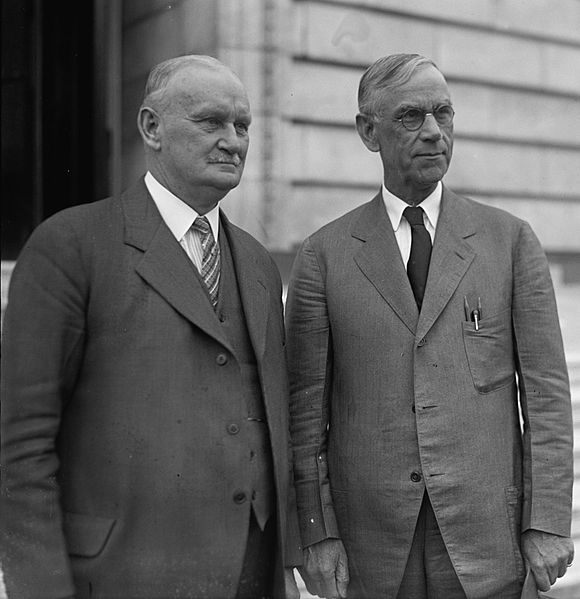
Willis C. Hawley (left) and Reed Smoot in April 1929, shortly before the Smoot–Hawley Tariff Act passed the House of Representatives.
Library of Congress photo via Wikipedia Commons.

Former president and current Republican presidential candidate Donald Trump wants to extend the tax cuts passed when he was in the White House, which are due to expire next year. That would not just be welcomed by the many Americans who would benefit, it could boost economic activity. But there’s a big problem: The protectionist tariffs favored by Trump would undo the good done by his tax cuts, reducing rather than increasing prosperity.

Tariffs Not Seen Since the Great Depression

“Former President Donald Trump’s proposals to impose a universal tariff of 20 percent and an additional tariff on Chinese imports of at least 60 percent would spike the average tariff rate on all imports to highs not seen since the Great Depression,” warns Erica York of the Tax Foundation.

Trump has actually been a little vague on the size of his universal tariff, first floating it at 10 percent while allowing “it may be more than that”, and then upping the ante to 20 percent. Either way, it’s a cost that ends up being largely paid by Americans in terms of higher retail prices and more expensive imported parts and materials for domestic manufacturing.

The Trump administration’s 2018 “tariffs resulted in higher prices for a wide variety of goods that U.S. consumers and businesses purchase,” the Tax Foundation’s Alex Durante and Alex Muresianu concluded.

Even when tariffs don’t directly affect the cost of imported goods purchased by consumers, they still drive up the prices of many things made in the U.S. The Cato Institute’s Pierre Lemieux points out that “a tariff on an input (say, steel) is paid by the American importer who will typically pass it down the supply chain to his customers and eventually to the consumers of the final good (say, a car)”. Instead of boosting domestic production, that can do harm, instead.

“For manufacturing employment, a small boost from the import protection effect of tariffs is more than offset by larger drags from the effects of rising input costs and retaliatory tariffs,” Federal Reserve Board economists found when they researched the 2018 tariffs.

That’s not to say Trump is alone in his protectionism. Last month, Bob Davis noted for Foreign Policy that “the Biden administration is the first since at least President John F. Kennedy’s time to fail to negotiate a major free trade deal, instead embracing tariffs” while Trump pursued both tariffs and trade deals.

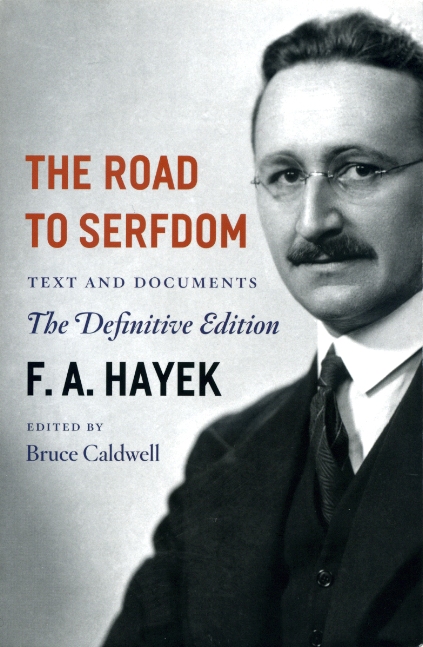
The Road to Serfdom by F.A. Hayek

Filed under: Books, Economics, History — Tags: , — Nicholas @ 03:00

David Warren recommends one of the first economics books I ever read and I fully concur with his appreciation of Friedrich Hayek’s most famous work:

For those who have an interest in politics, who also wish to have some knowledge of this subject, I can recommend a book published in 1944. It is by Friedrich Hayek, and is dedicated “To the socialists of all parties”. The title is, The Road to Serfdom.

It is extraordinarily well-written, for an academic whose native language wasn’t English, in less than two hundred exhilarating pages. The book predicts, correctly, that while they will lose the War, German ideological notions that began to prevail before the War in e.g. Germany, Russia, Italy, and throughout the West, would continue to do so, in Britain and America. They were plausible and were thought to have been proved in wartime. In the coming peacetime, all the intellectuals would be on board.

Yet they were wrong, and had always been wrong. The professor, Hayek, shows why neither a little nor a lot of socialism will ever work; why it invariably makes everyone poorer, except for an ideological elite; and why it traps whole societies in the condition of serfdom. Oddly enough, almost no one wants to be a serf, but some wish to have power over serfs. Hence the popularity of socialism among the power-hungry.

Too, ambiguous and poorly understood political terms fool people. (My father explained this as the Triple-B principle: “Bullshit Baffles Brains”.)

The idle reader should still be captivated by this book, which hasn’t dated, even slightly. Re-reading it, as I have been doing since high school, I find the arguments irresistible and compelling. Other members of the “Austrian School” out of which Hayek sprang (it was originally a Catholic movement, incidentally) are also informative, but none are so articulate.

The “Chicago School”, of Milton Friedman et alia, was the nearest American equivalent. But that was based on numbers, more than upon the ironical ideas, which old Austro-Hungaria had the leisure to mull.

HBO’s Rome – Ep. 2 “How Titus Pullo brought down the Republic” – History and Story

Filed under: Europe, History, Media — Tags: , , , , , , — Nicholas @ 02:00

Adrian Goldsworthy. Historian and Novelist
Published Jun 26, 2024

A look at episode 2 of the first series/season of HBO’s Rome drama. Once again we talk about the actual history and how the characters, events and institutions are presented in the series. This time this includes Antony becoming tribune of the plebs, as well as a meeting of the Senate and Julius Caesar crossing the Rubicon.

Vidcaps taken from the dvd edition, so copyright belongs to HBO.

QotD: Why did ancient China lose its early lead in science and technology?

Why, despite China’s prodigious lead in science, technology, population, and economic activity, did the scientific revolution and then the industrial revolution happen in Europe? Why did they fall so far behind after being so far ahead?

There are all kinds of answers given to this question, from ones based around the concept of “agricultural involution” (which I briefly surveyed in my review of Energy and Civilization), to ones that blame the complexity of the Chinese system of writing and other more outlandish theories. But would you know it, this question is commonly referred to within Sinology as the “Needham puzzle” or the “Needham question”, so what does the man himself think? Needham got the credit for posing the question, not for answering it, but in the final chapter of this book, “Attitudes Towards Time and Change”, he drops some fascinating hints.

A belief common to the great civilizations of the Axial Age was that time itself was somehow unreal. Greek philosophers from the pre-Socratics to the Neo-Platonists all expressed it in very different ways, but all agreed that in some sense the world of mutability and change was an illusion, and that outside of it stood an eternal, absolute reality sufficient in itself, unchanging in its perfection, αἰῶνας τῶν αἰώνων. The Buddhist civilizations include this under the doctrine of maya (illusion), and traditional Hinduism also exhibits time as a dreamlike and incidental quality of the world.

If time is somehow unreal and nothing can ever change, then it’s easy to see the attraction of a cyclic conception of history. And indeed, in the ancient world these cyclic theories predominate. The Babylonians had their Great Year, and Greek thinkers as diverse as Hesiod, Pythagoras, Plato, and Aristotle all speculated about the eternal repetition and recurrence of the ages of the world. In the Mahabharata the great yugas and kalpas, the Days of Brahma, follow one another in an inevitable fourfold cycle of world ages, the profusion of Hindu and Buddhist sects have promulgated a thousand interpretations and variations on this basic pattern. On the other side of the world, the Mayans had their own Great Year, and countless other peoples besides. This cosmology almost feels like a human universal (at least for civilizations at a particular stage of development), and why wouldn’t it be? We open our eyes and all we see are cycles within cycles — the cycle of the day, the cycle of the moon, the cycle of the seasons, the cycle of the generations. As sure as day follows night, why wouldn’t we expect that the universe too, a grand mechanism made by the gods, must eventually return to its starting point.

Various philosophers of science have asserted that this view of history makes scientific progress impossible, because of its fatalism and pessimism. If everything that happens has happened before and will happen again, then why bother trying to change anything? It’ll just get undone in the Kali Yuga anyway. But Needham points out another connection: if time is cyclic, or worse yet somehow unreal, then it makes no sense to stretch it out into an independent coordinate. In this way, the entire metaphysics of cyclical time resists the mathematization of physics. One can imagine the analytic geometry of Descartes being discovered in ancient Alexandria or Tikal or Harappa, but would it have been possible for one of the coordinate axes to represent time? A Descartes was possible, but a Newton or a Bernoulli was inconceivable.

All of this changes with the advent of Christianity, for which the most important fact about the world, the Incarnation, takes place at a particular moment in history, once and for all, κατὰ πάντα καὶ διὰ πάντα. The cosmos is fixed around this central point, and cannot curl back upon itself. Kairos transfigures chronos, and in so doing makes it real, gives it force and meaning. History is not a cycle, but a story of creation, separation, incarnation, and redemption, speeding towards its culmination as assuredly as a stone tracing a parabolic arc through the air. Or as Needham puts it:

    [In the Indo-Hellenic world] space predominates over time, for time is cyclical and eternal, so that the temporal world is much less real than the world of timeless forms, and indeed has no ultimate value … The world eras go down to destruction one after the other, and the most appropriate religion is therefore either polytheism, the deification of particular spaces, or pantheism, the deification of all space … For the Judaeo-Christian, on the other hand, time predominates over space, for its movement is directed and meaningful … True being is immanent in becoming, and salvation is for the community in and through history. The world era is fixed upon a central point which gives meaning to the entire process, overcoming any self-destructive trend and creating something new which cannot be frustrated by cycles of time.

Some historians of science have argued that without this linear conception of time introduced by Christianity, we lack the conceptual vocabulary for various things ranging from analytic methods in physics to the idea of causality itself. So is that the answer? Is the solution to the Needham Puzzle that China progressed as far as it could until, weighed down by the fatalism of cyclic history and the impoverished mathematical vocabulary of timeless metaphysics, it ground to a halt?

Unfortunately, the answer is no. This theory sounds great, but it’s totally wrong.

There’s a bad habit among Western historians and philosophers of engaging in a shallow sort of Orientalism that aggregates all of the exotic East into a single entity.1 But when it comes to attitudes towards time, change, and history; the traditional Chinese attitude is much closer to that of Christendom than it is to the Hindu or Buddhist view. Needham does a good job summarizing the basic Chinese outlook, but includes a lot of details I didn’t know, including that the view of civilizations as ascending through distinct historical stages (e.g. the Stone Age, Bronze Age, Iron Age, etc.) is of Chinese origin! Needham also discusses the veneration, sometimes deification, of great inventors that saturates Chinese folk religion. All in all, the picture is one of China as a progress-obsessed society almost from its earliest moments, and as a society that was steadily progressing right up until it was suddenly and dramatically eclipsed by European science.

John Psmith, “REVIEW: Science in Traditional China, by Joseph Needham”, Mr. and Mrs. Psmith’s Bookshelf, 2023-08-14.


    1. I am infuriated by restaurants that advertise “Asian food”. There’s more culinary diversity inside some regions of China than there is in most of Europe.

Powered by WordPress