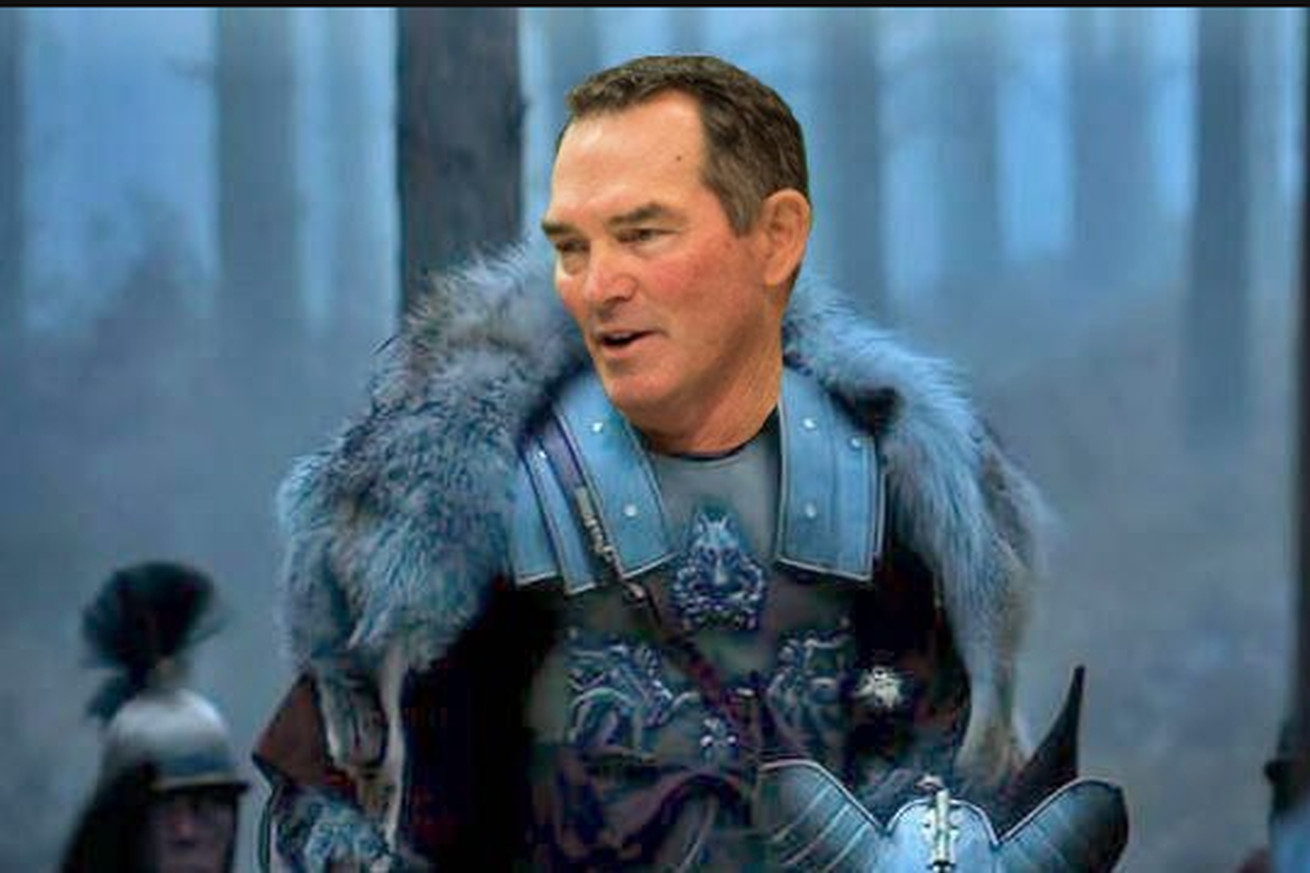
The National Football League has certain rules and requirements of the head coaches of all the teams, including a certain amount of mandatory contact with … ugh! … the media. Minnesota Vikings head coach Mike Zimmer follows these rules — probably unwillingly, and certainly without much enjoyment or enthusiasm — but generally guards his tongue very carefully, not giving out any more information than he absolutely has to and couching that information in ways that are obscure and often inscrutable to the uninitiated media schlub or everyday fan. Fortunately, the Daily Norseman has on their staff Ted Glover, the world’s leading Zimmerologist, who can unwrap the verbal enigmas and decrypt the encoded truth and share with true Vikings fans:
Zim Tzu, image by Eric Thompson, Daily Norseman.
The Vikings warrior poet coach dispenses his words of wisdom
ED NOTE: This has bad words. None of the other things we write on here do, but this one does. It seems to be a popular bit, so until the law catches up with me, I’m going to keep doing it. Thanks for understanding, and thanks for not reading and not letting your kids read it if bad language isn’t your thing. Hope you enjoy the rest of our articles—Ted
Warrior poets don’t have time for deep, philosophical conversations once they’re in the maelstrom of conflict. You need accurate information, the lay of the land, and then you must make a decision. Good or bad, decisions must be made, because indecision is certain death. Good decisions could still end up with a bad result, for a number of reasons. Poor execution, faulty equipment, any number of things. But at least you give yourself the best chance of success.
And bad decisions? Bad decisions are more than likely going to result in your demise, but fuck it, at least go out with your boots on. And sometimes, even a bad decision can turn out okay with a stroke of luck, or poor execution of your adversary. And when that happens you feel invincible. Glory or death, bay.
Glory or death. Pain is temporary, chicks dig scars, but glory is forever. Unless you really fuck things up and lose, then you’re just a loser looking for answers, and you vow to not fuck things up like that again.
Because you are Zim Tzu, Scalper of the Capital, True King Of The Jungle, Potentate Of Those Who Eat Feces, The Biggest Apple, Commodore Of Outlaw Sailors, Master Falconer, The Once And Future King In The North, High Septon Of Eagan, Lord Commander Of The Iron Range And Twin Cities, Master Of Fortress TCO, Honorary Elder Of Mankato and Protector Of The Realm.
And when you need to explain setbacks, you’ll need help discussing things, because the proletariat has no concept of the shit you’ve gone through, man. None. So you need someone* to take your words and turn them into language that folks understand.**
You’re welcome.***
*Look, you don’t need anyone to help you figure this out. You’re a Vikings fan. Just shut up, drink, and bury those goddamn feelings.
**This whole post is incomprehensible bullshit. All the answers are made up, by me, because I need an outlet to vent and meth, apparently, is frowned upon in my house.
***Seriously, enjoy. Glad you guys like these remarkably bad interpretations of Zimmer’s press conferences.
James May meets Harrison Schmitt, one of the last men to ride Saturn 5 and learns a bit about the science behind a rocket with six million components.
Taken From James May: On the Moon
Welcome to BBC Earth Lab! Here we answer all your curious questions about science in the world around you (and further afield too). If there’s a question you have that we haven’t yet answered let us know in the comments on any of our videos and it could be answered by one of our Earth Lab experts.
Comments Off on How Did The Saturn 5 Rocket Work? | James May: On The Moon | Earth Lab
… the basic ideas of “alternative facts” and “fake news” — our updated, revved-up forms of disinformation — were not foreign to Orwell. Working at the BBC as a news producer — a fancy term for war propagandist — he heard some of the Axis powers’ propaganda as well as that of his own side (even if he kept his own hands fairly clean). He justifiably feared that the very concept of objective truth was fading from the modern world. Winston Smith’s job at the Ministry of Truth is to rewrite or “rectify” history, so that it follows the current party line, whatever it may be at that moment.
Orwell himself saw all this happen when he read Catalan newspapers as well as British ones during the Spanish Civil War, several years before joining the BBC. Condemning press distortions, above all how several English newspapers reported the war, he wrote: “I saw great battles where there had been no fighting and complete silence where hundreds of men had been killed … I saw, in fact, history being written not in terms of what happened but what ought to have happened according to various ‘party lines.'” Given the gridlock in American politics, and the never-ending verbal warfare between news outlets on the Right such as Fox News and on the Left such as MSNBC, Orwell appears all too accurate in his “predictions.”
One of the features of the world of Oceania reflecting Orwell’s prescience is its official language, Newspeak, an argot resembling a kind of Morse code that satirizes advertising norms, political jargon, and government bureaucratese. The purpose of Newspeak is to limit thought, on the view that “you can’t think what you lack the words for.” Ultimately, this impoverished language seeks to narrow and control human thought. (Does Twitter represent a step in that direction?) Purged of all nuance and subtlety, denuded of variety, and reduced to a few hundred simple words, Newspeak ultimately promises to render all independent thought (or “thoughtcrime”) impossible. If it cannot be expressed in language, it cannot be thought. And anything can fill the vacuum, such as 2 + 2 = 5. That is the equation — a perfect example of “doublethink” — which O’Brien indoctrinates Winston to accept in Room 101 and which marks the final step of the latter’s brainwashing. As the Party defines it, “doublethink” consists in holding “two contradictory beliefs in one’s mind simultaneously, and accepting both of them.” In 2018, Trump’s lead lawyer, former New York mayor Rudy Giuliani, declared in a TV interview: “Truth isn’t truth.” A few months later, a talking head defended a critical news report on the grounds that, just because it is “not accurate doesn’t mean it’s not true.”
It testifies both to the brilliance of Orwell’s vision and to the bane of our times that Nineteen Eighty-Four retains so much relevance.
Dragons are one of the most popular creatures of myth and legend and for good reason! These guys are everywhere! Almost every culture has some form of dragon tale. From the wicked wyrms of western Europe, the benevolent Lung dragons of China, the feathered serpent Quetzalcoatl, to the Rainbow Serpent of Aboriginal myth, dragon like figures take on many different forms and roles. But how and why do these serpentine beasts and gods appear in so many different legends? Gather round the campfire and let’s chat!
In the latest Libertarian Enterprise, L. Neil Smith relates the time he took a week-long seminar with Robert LeFevre:
I already considered myself a libertarian — of the Randian variety — when I first met Bob in 1972, at a seminar he delivered in Wichita, Kansas, sponsored by the Love Box Company and the local 7-up bottlers. I spent five magical 8-hour days in a motel basement meeting room, with about forty other people, listening to Bob’s moral, historical, and economic observations. Nearly half a century later, I can still remember large swatches of them, virtually verbatim. Bob reminded me of Frank Morgan in The Wizard of Oz. I didn’t agree with everything the Wzard of Libz said and thought (most notably, Bob was a Gandhian pacifist, while anyone who knows me or my work will tell you that, I, decidedly am not.)
But it was Bob’s unique view of history that won me over and changed my life. There are only three ways, he said, for human beings to organize themselves: (A), one guy tells everybody what to do; (B), everybody tells everybody else what to do; and (C) nobody tells anybody what to do. The last, he insisted, is the very definition of libertarianism.
Inevitably, Bob was an advocate of (C), and so was I, once he had rid me of the cob-webs in my head and the myth of “limited government”, which, he pointed out, somehow never manages to stay limited. Option (A), he suggested, was the way that the world had turned for ten thousand years or longer.
(B) is supposed to be the be-all and end-all of sociopolitical arrangements. It encompasses various forms of collectivism, including socialism, fascism, and the most dangerous of all, democracy, under which you are encouraged to believe that you’re free, but your neighbors can vote to control your life and impoverish you any time they want. As Robert A, Heinlein (a friend of Bob’s) put it, “‘Vox populi, vox dei‘ usually means ‘How the hell did we get into this mess?'”
The violent transition to (B) in 1776 accomplished two important things. It may yet prove to be a pathway to real liberty (no, I’m not holding my breath). In terms of what I’ve written here, it also pissed off all the right people. It schmussed humble pie in the face of the insane King George III and the rest of his inbred, slithery, pampered ilk. And when British General Corwallis surrendered his sword to George Washington, the band (where the hell did that come from?) played a little ditty called “The World Turned Upside-down.”
Most of history since then, according to Bob, has been a series of attempts — the War Between the States, public schooling, World War I, the Federal Reserve banks and the income tax, World War II, the United Nations, communism’s rise in Europe and Asia, the overpopulation and Global Warming hoaxes, the Silicon Valley commisars, the socioeconomic war on the Productive Class — by the pre-Revolutionary elites (who all seem to be related to each other) to regain the power they once wielded over the rest of the human race.
Aside from what I’ve written in The Libertarian Enterprise about the political significance of gun ownership, if you want to see who’s really on what side, take a look at the war on cattle and red meat. For centuries, the aristocrat class have hunted, and they have dined lavishly on animal protein, while trying to forbid the peasantry — us deplorables — the same rights and forcing them to subsist on boiled turnips. There’s a good reason for this: meat is mind. If you remembver nothing else of what I’ve said here, remember that: meat is mind. It contains certain components that let you build a strong and efficient nervous system (look up myelin), creating uppity peons, the last thing any right-minded upper cruster wants.
For decades, these creepy, perverted parasites have been sneaking up on us, falsely calling themselves “Progressives”, hoping to reverse the American Revolution and everything it has meant to humanity. Since socialism was invented in the early 19th century by Pierre-Joseph Proudhon, they’ve made more and more of what they regard as “progress”. By the beginning of the 21st century, they thought their victory was inevitable — until it was rudely snatched out of their blood-soaked hands by those uppity meat-eating peasants, eventually led by Donald J. Trump. The patricians and their surrogates are the swamp Trump wants to drain.
Comments Off on The three ways human beings can organize themselves
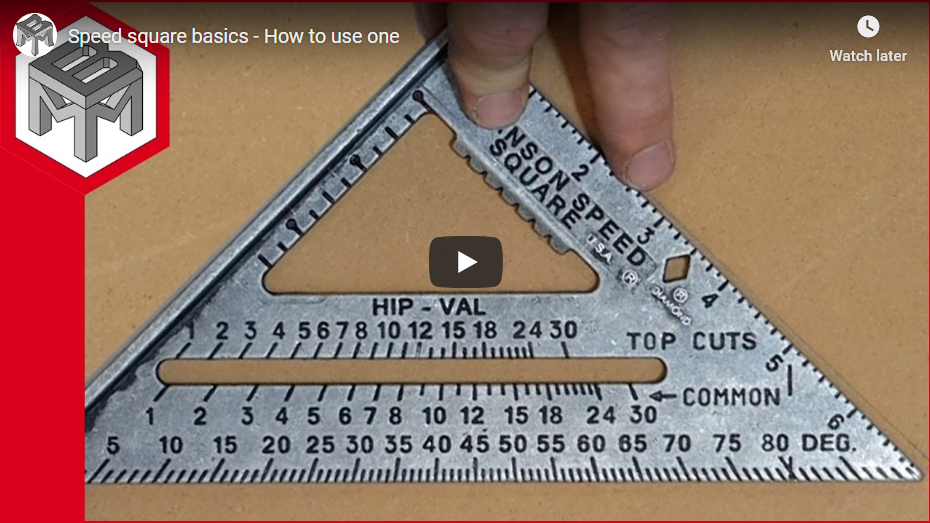
How to use a speed square. I discuss a couple of tricks and some practical uses of the Swanson speed square. I cover most of the uses that a hobbyist would need and a few other roof framing features too.
(affiliate links) – These help fund the videos at no extra cost to you.
WARNING:
This video is only for entertainment purposes. If you rely on the information portrayed in this video, you assume the responsibility for the results. Always think ahead. Every project you try is at YOUR OWN RISK.
Comments Off on Speed square basics – How to use one
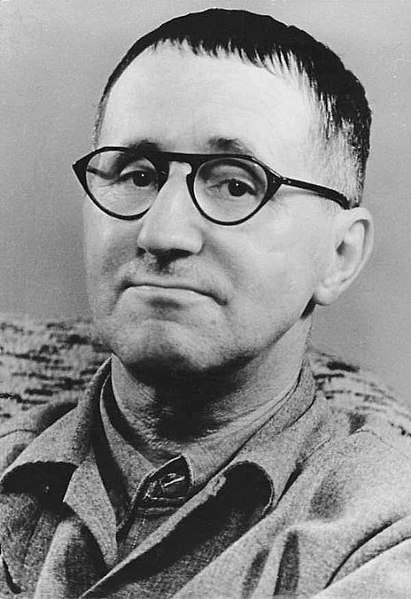
German theatre director, dramatist, poet and theorist Bertolt Brecht in 1954. Via Wikimedia Commons.
Nach dem Aufstand des 17. Juni
Ließ der Sekretär des Schriftstellerverbands
In der Stalinallee Flugblätter verteilen
Auf denen zu lesen war, daß das Volk
Das Vertrauen der Regierung verscherzt habe
Und es nur durch verdoppelte Arbeit
zurückerobern könne. Wäre es da
Nicht doch einfacher, die Regierung
Löste das Volk auf und
Wählte ein anderes?
After the uprising of June 17th
The Secretary of the Authors’ Union
Had leaflets distributed in the Stalinallee
Which said that the people
Had forfeited the government’s confidence
And could only win it back
By redoubled labour. Wouldn’t it
Be simpler in that case if the government
Dissolved the people and
Elected another?
The Textron TAPV (Tactical Armoured Patrol Vehicle) is an armoured car currently in use by the Canadian Army. It is based on the M1117 Armoured Security Vehicle, developed for use by the military police of the US Armed Forces.
The Tactical Armoured Patrol Vehicle (TAPV) program began in 2009, and in 2012 the contract was awarded to Textron Systems, Inc. On August 16, 2016, Textron systems delivered the first Tactical Armoured Patrol Vehicle (TAPV) to the Canadian Army. An eventual 500 vehicles will be purchased, with the option to order an additional 100.
Sorry for the re-upload, thanks to those who want to make my life more difficult.
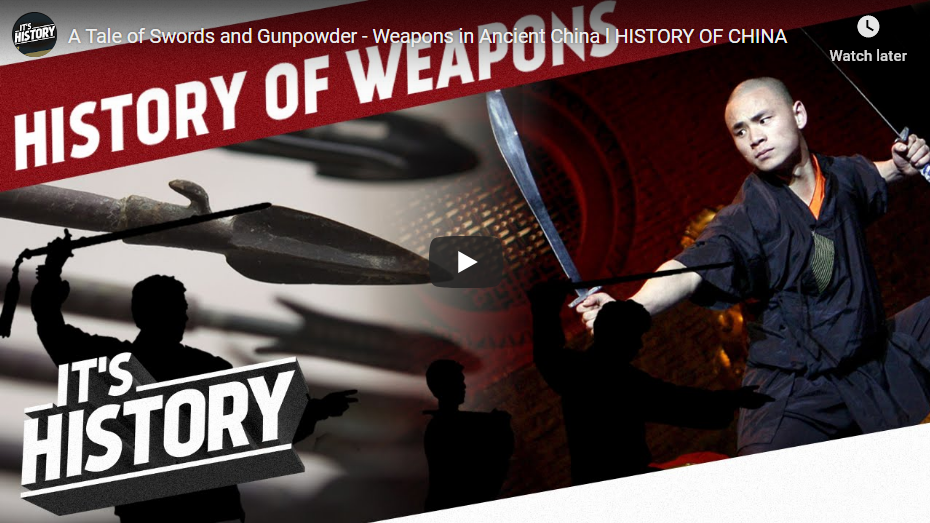
Dao, Gun, Jian and Quiang are the four main traditional fighting weapons of China. Even though, the Chinese had already invented gunpowder by the end of the tenth century. So besides of having an arsenal of swords, spears, sabres, crossbows and bow and arrows, the Chinese military could also choose from cannons, rockets, mines and even handheld firearms. Still, close combat would remain the favoured means of battle for a long time. All about the history of Chinas weaponry now on IT’S HISTORY!
» SOURCES
Videos: British Pathé (https://www.youtube.com/user/britishp…)
Pictures: mainly Picture Alliance
Content:
Lu Gwei-Djen, Joseph Needham and Phan Chi-Hsing (1988): “The Oldest Representation of a Bombard”. In: Technology and Culture 29 (3), pp. 594-605
Needham, Joseph (1986): Science and Civilization in China. Volume 5, Chemistry and Chemical Technology, Part 7, Military Technology; the Gunpowder Epic. Taipei
Tittmann, Wilfried/ Nibler, Ferdinand & John, Wolfgang ()
“Salpeter und Salpetergewinnung im Übergang vom Mittelalter zur Neuzeit”: http://www.ruhr-uni-bochum.de/technik…
Wang Ling (1947): “On the Invention and Use of Gunpowder and Firearms in China”. In: Isis 37 (3/4), 160-178
» ABOUT US
IT’S HISTORY is a ride through history – Join us discovering the world’s most important eras in IN TIME, BIOGRAPHIES of the GREATEST MINDS and the most important INVENTIONS.
» HOW CAN I SUPPORT YOUR CHANNEL?
You can support us by sharing our videos with your friends and spreading the word about our work.
» CAN I EMBED YOUR VIDEOS ON MY WEBSITE?
Of course, you can embed our videos on your website. We are happy if you show our channel to your friends, fellow students, classmates, professors, teachers or neighbors. Or just share our videos on Facebook, Twitter, Reddit etc. Subscribe to our channel and like our videos with a thumbs up.
» CAN I SHOW YOUR VIDEOS IN CLASS?
Of course! Tell your teachers or professors about our channel and our videos. We’re happy if we can contribute with our videos.
» CREDITS
Presented by: Guy Kiddey
Script by: Martin Haldenmair
Directed by: Daniel Czepelczauer
Director of Photography: Markus Kretzschmar
Music: Markus Kretzschmar
Sound Design: Bojan Novic
Editing: Franz Jänich
A Mediakraft Networks original channel
Based on a concept by Florian Wittig and Daniel Czepelczauer
Executive Producers: Astrid Deinhard-Olsson, Spartacus Olsson
Head of Production: Michael Wendt
Producer: Daniel Czepelczauer
Social Media Manager: Laura Pagan and Florian Wittig
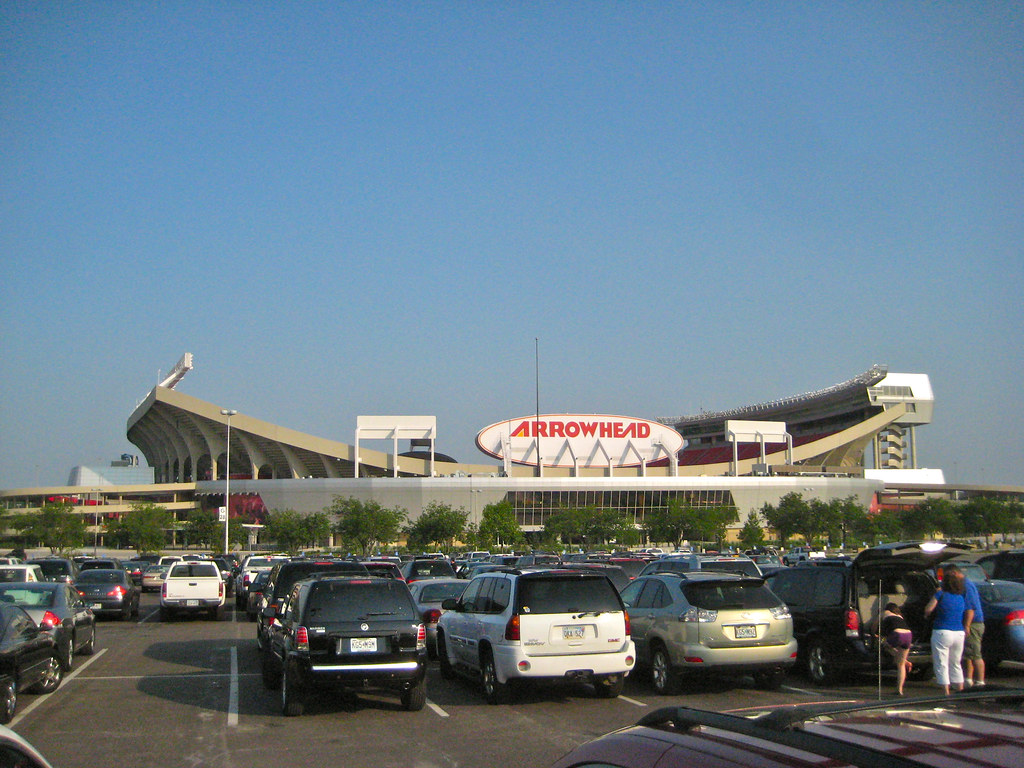
On Sunday afternoon, the 6-2 Minnesota Vikings visited the 5-3 Kansas City Chiefs at Arrowhead Stadium. Both teams were hoping to get recently injured stars back in time for the game, with Minnesota’s star wide receiver Adam Thielen recovering from a hamstring injury suffered in the Detroit Lions game and the Chiefs’ starting quarterback Patrick Mahomes (reigning NFL MVP) having suffered a knee injury (the Chiefs activated Chad Henne from injured reserve on Saturday as insurance). The Vikings hadn’t won a game at Arrowhead since December 1974, a 35-15 result, and came in hoping to change that and move to 7-2 on the season.
Adam Thielen started the game, but was quickly benched as his injury flared up again. Mahomes was not active for the Chiefs, so Matt Moore got the start.
Although the Vikings had the NFL rushing leader, they started the game with a run-deficient plan that saw quarterback Kirk Cousins throw three times on the opening “drive”, then yield to Britton Colquitt to punt the ball away. The second Vikings possession went by just as quickly with three plays and a punt. The Chiefs got on the scoreboard on their second possession with a long pass to Tyreek Hill that beat the Vikings’ coverage. The following drive may have featured the best play by former first-round pick wide receiver Laquon Treadwell, who had two key receptions on the drive that was capped off with a touchdown pass to Olabisi Johnson to tie the game at 7-7.
The second quarter saw each team eke out a field goal to keep the score tied 10-10 at the half. At that point, it was clear that November Kirk Cousins is a poor second to October Kirk Cousins, who was the NFC Offensive player of the month … 9 of 21 for 101 yards isn’t the kind of thing we’d been led to expect from the Vikings quarterback.
In the third quarter, the TV announcers re-iterated that Kansas City wasn’t known for their running game, just in time for a 91-yard scoring run by Damien Williams (have you ever noticed that TV announcers have a knack for pointing out something relevant about the game just before a big play happens…). The score was tied in the last few minutes, but the Chiefs were in field goal range and scored the winner just before time expired.
You knew from the very first drive that it was Bad Kirk time on Sunday afternoon at Arrowhead Stadium.
The Minnesota Vikings opened their contest against the Kansas City Chiefs in a manner that did not reflect their last four weeks of offensive excellence. Dalvin Cook had a pass bounce off his hands on the opening play and then Kirk Cousins tentatively flipped a pass into the flat in the direction of Adam Thielen but the low throw not only fell incomplete, it ended Thielen’s day. He came into the game with a “questionable” designation with a hamstring injury and did not see the field after the first drive.
[…]
Cousins overcame some frustration — that was caught, as always, by the FOX TV cameras — to give his team a chance to win.
The defense, however, showed its weakness again. After sacking Moore on second down, the Chiefs’ quarterback found Hill open over the middle for a first down. He created separation from Xavier Rhodes, who has struggled to shut down receivers as he did in the golden age of the Vikings defense. Moore then heaved the ball up to Hill down the sideline and he jumped over Trae Waynes for a 41-yard to put KC in field goal position.
Harrison Smith came through with a sack on third down but the Chiefs were still able to tie the game at 23.
Bad Kirk returned on the subsequent drive. Not only did he go three-and-out but Cousins’ only completion was a 7-yard loss.
The Vikings’ defense had a chance to redeem itself for a day of allowing big plays in big spots after Colquitt shanked a 27-yard punt to put KC at mid-field. Maybe two years ago they would have. This time around, Hill found space in the middle of the field for a first down to set up a game-winning field goal.
Here’s what it means: If the Vikings want to prove themselves as legit contenders, they can’t have Bad Kirk show up for any length of time. They can’t put everything on their defense. Otherwise they will end up walking off with the same defeated feeling as they did on Sunday at Arrowhead.
Everybody on the Vikings is going to have a rough go of it on Monday when they watch the game film of this loss.
Quarterback Kirk Cousins, whose inaccuracy throughout the first half left first downs and points on the field, will hardly be able to re-examine some of his poor showing. His offensive line won’t have an easier time of it, watching themselves bullied by their Chief opponents from quarter one to quarter four.
Vikings’ offensive coordinator Kevin Stefanksi may have to leave the room as the film comes to its last minutes, lest he see just how bland and predictable his playcalling was in the Vikings’ final two possessions.
Mike Zimmer may be the most uncomfortable of all Viking players and coaches, having to re-experience the fact that the one player his defense should have kept in check (Chiefs WR Tyreek Hill) had six catches for 160 yards and a touchdown in the game.
Buy: Adam Thielen was healing and close to playing. Thielen is a big part of this offense and makes it immeasurably better. His hamstring injury was described as minor all along, so it felt like missing the Redskins game and then having 10 days off would be a smart plan for him getting back on the field.
Sell: Playing Adam Thielen. Yet, that plan backfired early. Thielen tweaked his hamstring on the Vikes first or second drive and didn’t return. Now the team is dealing with an injury that can linger for weeks, and no one truly knows how long he’ll be out. The smart play would be to keep him out for the next two games, as that leads into the bye week. Will that be enough time, though? Hamstring injuries are the worst, and they can linger for a lot longer than three weeks. It’s something that can be problematic for the rest of the season if Thielen pushes too hard, and when he’s out it affects what the offense can do. One thing we all agreed on coming into the season was the Vikings WR depth after Thielen and Diggs, and now here we are two months into the season with no real go to guys after Diggs.
Treadwell had a good game today, Bisi Johnson has had his moments, and maybe we’ll see something out of Josh Doctson in the coming weeks. But not addressing WR3 in the off-season has officially come back to bite this team in the ass, at the worst possible time.
Buy: Kirk’s decisiveness to run on third and 7 early second quarter. One of the things that Mike Zimmer wanted to see from Kirk Cousins this year was more decisiveness when deciding to keep the ball and run with it. Early in the second quarter today, Kirk bailed from the pocket and took off, with a lot of open field in front of him.
Sell: Kirk sliding and coming up short of first down. Yet, with all the open field, Kansas City closed in pursuit, Kirk gave himself up, and went into the “steal second base” dive. The only problem with that was that he was a yard short of the first down, bringing up fourth down. Minnesota ended up kicking the ball away to the Chiefs, who took the ball and ended up kicking a field goal.
Buy: Getting the ball twice late in the 4th quarter with a legitimate chance to win the game. With a 23-20 lead, Minnesota got the ball with 7:47 left. A team that’s serious about putting away opponents goes on a long, clock eating drive there, and ends the game. But they didn’t. Still, with the score tied at 23, Minnesota got the ball back again with 2:30 left. All they needed to do was drive about 50 yards to get into field goal range and get out of there with a win.
Sell: Winning the game. Those last two drives were particularly frustrating. The Vikes had momentum on that first drive, as the offense had scored and then the defense forced the Chiefs to punt. A long drive there that ends in points seals the game. Even with that last drive, it was a very doable situation. They had the 2 minute warning, two timeouts, and the ball on the 25. It wouldn’t take much against one of the worst defenses in the NFL to get into scoring position, kick a field goal, and win the game. Yet, in those two drives, the VIkings ran six plays and lost seven yards. Remarkable.
Buy: Kirk Cousins with three touchdown passes. Sometimes Kirk Cousins makes a throw, and I have to rewind my DVR to make sure what I saw just happened. His TD throw to Kyle Rudolph, for example, was one of those throws. It was in traffic, down in the red zone, and he placed the ball in a spot that only Rudolph could get it. Incredible throw and catch
Sell: Kirk Cousins, airmail specialist. Other times, Kirk Cousins makes a throw and I also have to rewind my DVR to make sure what I saw just happened, because I ask myself how the hell a vet with that much time in the league airmails that many throws? It felt like he overthrew guys seven or eight times today, easy. Very frustrating to watch, when a couple of those plays looked like they were going to go for some big yards if he makes those throws.
Buy: The re-emergence of Laquon Treadwell. With Adam Thielen’s hamstring now officially “a thing”, Treadwell stepping up today was a welcome turn of events. Someone is going to need to become WR2, and why not Treadwell?
Sell: Laquon Treadwell having more receiving yards than Stefon Diggs. Still, let’s chat about Treadwell having more receiving yards than Stefon Diggs today, because THAT is NOT a recipe for success. One catch, four yards. Really??
Buy: Going for it on 4th and 1 right before the half. I loved the call. Minnesota was driving, and got down to the KC 15 with 29 seconds left. On 4th and 1, the Vikes decided to go for it, and Cousins found Irv Smith for a four yard gain, and a first down at the Chiefs 11.
Sell: The play call sequence after that 4th down conversion. Maybe it’s me, but it kind of felt that after the Vikes got the first down, they were content with settling for the field goal at that point. On first down Cousins was pressured and threw it towards Treadwell. On second down and third down Cousins threw it out of the left corner of the end zone. Really poor play calls for the pressure KC was bringing, and the Vikes still had a timeout to play with. Just seemed like a haphazard plan, and it turned out to be one of the turning points in the game.
Comments Off on Minnesota Vikings 23, Kansas City Chiefs 26
While the MkII (1905) iteration of the Ross rifle had resolved most of the major mechanical problems from the MkI, it retained a number of characteristics that the Canadian (and British) military was not fond of. In particular, it was not suited to the use of stripper clips. Starting with experimentation on sporting rifles, Ross substantially redesigned the action for the final 1910 pattern – aka the MkIII.
The MkIII used a rotating bolt as before, but with six locking lugs in two rows of three, instead of two large lugs as the MkI and II. The magazine was replaced by a conventional single-stack design, with a stripper clip guide built into the receiver, and with a nicely adjustable rear aperture sight. This would be the model to equip the Canadian infantry who went to Europe to fight in 1914 and 1915 – and it is there that a new set of problems would begin to plague the Ross.
In keeping with its sporting legacy and reputation for outstanding accuracy, the MkIII Ross was made with a rather tight chamber, optimized for the excellent-quality Canadian production .303 ammunition. Britain had been forced to massively increase ammunition supply as the war lengthened, and British standards had widened to accept ammunition that was really of rather questionable quality. The SMLE rifles used by British forces had chambers made to accommodate this, but the Rosses did not. Canadian ammunition was supposed to follow the Canadian troops, but it was usually diverted to other services because of its high quality, and the Canadians left with ammo that was difficult to chamber or extract in the Ross.
This led to men having to beat open rifle bolts, which led to damage to locking lugs, in a viscous circle of escalating problems. By the time of the German gas attack at Ypres, Canadians were ditching their Rosses for Lee Enfields by the thousands, despite specific orders to the contrary. General Haig finally had enough of the issues, and ordered the Ross removed from combat in 1916, to be replaced by the SMLE (which was finally available in sufficient numbers to arm the Canadian troops).
Contact:
Forgotten Weapons
6281 N. Oracle #36270
Tucson, AZ 85704
Comments Off on The Ross in the Great War: The Mk III (and MkIIIB)
Knowledge of the effects of government interference with market prices makes us comprehend the economic causes of a momentous historical event, the decline of ancient civilization.
[…]
The Roman Empire in the second century, the age of the Antonines, the “good” emperors, had reached a high stage of the social division of labour and of interregional commerce. Several metropolitan centres, a considerable number of middle-sized towns, and many small towns were the seats of a refined civilisation […]. There was an extensive trade between the various regions of the vast empire. Not only in the processing industries, but also in agriculture there was a tendency toward further specialization. The various parts of the empire were no longer economically self-sufficient. They were interdependent.
What brought about the decline of the empire and the decay of its civilization was the disintegration of this economic interconnectedness, not the barbarian invasions. The alien aggressors merely took advantage of an opportunity which the internal weakness of the empire offered to them. From a military point of view the tribes which invaded the empire in the fourth and fifth centuries were not more formidable than the armies which the legions had easily defeated in earlier times. But the empire had changed. Its economic and social structure was already medieval […]
[I]n the political troubles of the third and fourth centuries the emperors resorted to currency debasement. With the system of maximum prices the practice of debasement completely paralysed both the production and the marketing of the vital foodstuffs and disintegrated society’s economic organisation. The more eagerness the authorities displayed in enforcing the maximum prices, the more desperate became the conditions of the urban masses dependent on the purchase of food. Commerce in grain and other necessities vanished altogether. To avoid starving, people deserted the cities, settled on the countryside, and tried to grow grain, oil, wine, and other necessities for themselves.
Ludwig von Mises, Human Action, 1949.
Comments Off on QotD: Ludwig von Mises explains the fall of the western Roman empire
We’ve talked about the magnificence of Angkor at its peak, but how did this sprawling metropolis become a city of ruins? The city of Angkor depended on the reliability of the seasonal monsoon. Several decades of drought left them with little choice than to modify the whole water system. But when the waters returned, they returned in force. As did enemy forces. Thus begins the death spiral of the city of Angkor.
From the comments:
Extra Credits
1 day ago
Always 👏 maintain 👏 your 👏 water 👏 infrastructure !!!
Comments Off on Building Angkor – A Drowning City – Extra History – #4
In response to a column by Andrew Coyne in the National Post, Colby Cosh outlines the intellectual origins of carbon pricing:
As Andrew knows, the intellectual origins of carbon pricing are purely classical-liberal. Maybe you have to belong to our club to spot that he has carefully not called it an invention of the “left.” When I was an undergraduate, it was the unfashionable libertarian and Hayekian zanies, not the despondent post-Cold-War Marxists, who were preaching what would become mainstream environmental economics. The left has been slow rather than fast to accept the idea of putting a mere price on what they regard as an inherent evil.
British economist Arthur C. Pigou (1877-1959). Photo via Wikimedia Commons.
All of the foundations of carbon pricing were developed by economists that the left, in all varieties, now regards as cartoonish modern-day demonoids. The gentle Arthur Pigou, who developed the concept of economic externalities and the idea of taxing them, might still pass muster. But Pigou’s reformer-reviser Ronald Coase is deeply suspect, having pioneered an amoral analysis of externalities that tackles social-cost problems like environmental pollution without assigning blame to, or even necessarily acting against, the polluters.
In his paragraph Andrew almost explicitly outlines the theory of the “double dividend” from replacing bad, economically distorting taxes (like the one we impose on incomes) with taxes laid directly on externalities like carbon. The double dividend is pure Gordon Tullock, who is now a hate figure on the left for his role in creating public choice economics.
You can see that this analysis gets pretty complicated in a hurry. The idea of carbon taxation isn’t really of the right or the left. The best term for it might be “neoliberal,” although some people think there is no useful place for that word. To the degree that the left has accepted carbon pricing, they have done so as a (perhaps mostly unwitting) compromise with otherwise abominable thinkers like Coase and Tullock. Total state command-and-control of the economy isn’t an option in today’s Western world, and since there’s a neo-Malthusian crisis in the atmosphere around us, we had better try to solve it without having to execute a global socialist revolution first.
But if instinctive suspicion of the state is a feature of the conservative mind, carbon pricing doesn’t solve the problem completely. Canadian carbon tax designs have been given redistributive features, which makes them more acceptable politically to people who aren’t instinctive or innate conservatives, but creates confusion and distaste for those who are. And to the degree conservatives are inclined to doubt that the state will cut other taxes to make carbon prices revenue-neutral, they have been partly justified, so far, by the history of Alberta and B.C. The “double dividend” is a good idea: can governments be trusted to actually let us collect it?
In a nutshell, that lack of trust is why I’m generally opposed to the federal carbon tax system, even though the idea of carbon taxes (when properly implemented) are far less distorting to the economy than the hodge-podge of taxes and regulations we have now.
Comments Off on Colby Cosh on the origins of carbon taxes


 The National Football League has certain rules and requirements of the head coaches of all the teams, including a certain amount of mandatory contact with … ugh! … the media. Minnesota Vikings head coach Mike Zimmer follows these rules — probably unwillingly, and certainly without much enjoyment or enthusiasm — but generally guards his tongue very carefully, not giving out any more information than he absolutely has to and couching that information in ways that are obscure and often inscrutable to the uninitiated media schlub or everyday fan. Fortunately, the Daily Norseman has on their staff