
Spartacus has had enough. He has been taken advantage of for too many years and he has suffered trade deficits for far too long. Complaints to the regulators have fallen on deaf ears so now time has come to take the necessary action to put this to an end.
For far too long, Spartacus has run a significant trade deficit with Woolworths and Coles; not only for groceries but for petrol also.
Spartacus keeps buying things from Woolworths and Coles but they never buy anything from him. Those bastards even occasionally “dump” products in their stores meaning that Spartacus can buy groceries for less than he would normally. This is completely unsatisfactory.
Effective immediately, pursuant to SEO 1 (Spartacus Executive Order 1), Spartacus has declared a trade war on Woolworths and Coles. Hence forth, rather than buying quality and (relatively) well priced groceries from these trade cheaters, Spartacus will grow his own fruit, vegetables and meat. And rather than buying petrol, Spartacus will walk or otherwise ride his 2 wheeled chariot. Importantly also, when it comes to paper products, particularly of the toilet paper variety, well, the Fairfax papers will be used for their natural purpose.
Yes. Spartacus will have less leisure time, less disposable income and less grocery choice, but he will no longer have a trade deficit with Woolworths and Coles. This is a trade war Spartacus can win.
And if a sore “butt” comes to pass, what would be colonic damage. Sorry. Collateral damage.
“Spartacus”, “Spartacus’ Trade War”, Catallaxy Files, 2018-03-11.
April 3, 2018
QotD: How to win a trade war
April 2, 2018
African-American history
At According to Hoyt, Amanda S. Green is doing a deep dive on Thomas Sowell’s book Black Rednecks and White Liberals. In this installment, she discusses the history of African-Americans from first arrival in the early 1600s to the post bellum exodus from former slave states to the northern cities:
If you were to ask most anyone how African-Americans first came to the United States, you’d be told they came as slaves. Thanks to our schools and public misconception, we are not taught about those who came as indentured servants. Of course, we aren’t taught about the whites who came over in similar circumstances. To be honest, it is something I learned the hard way when I was in school too many years ago to count. I made the mistake of asking about indentured servants in a history class and being told such things hadn’t existed here in the States, at least not for whites. Funny, I have the original handwritten advertisement that had to be published notifying the people of New Jersey that my own ancestors had fulfilled the terms of their indenture and were now free persons.
That is a part of our history, be you speaking about black or white history, we have chosen to forget. Unfortunately, that has led to more than a little “confusion” about our nation and problems we still encounter today.
The first misconception that needs to be shattered is that blacks first came to America as slaves. That’s wrong. The first Africans brought to Colonial Virginia in 1619 came as indentured servants, a status shared by a number of whites. (BRAWL, pg. 41) This status of being “indentured” meant they could work off their indenture or buy it out. Once they had, they became free persons. The first law recognizing perpetual slavery was passed in 1661 in Virginia. (Note, this is part of the “red neck” sector of what would become the United States. More on that later.)
[…]
Many of the issues caused by this mass migration to the North came about because of the differences between the “free people of color” native to the North and those moving there. The northern “free people of color” were more literate and more urbanized than their Southern counterparts. In 1850, most free people of color in the North were literate while most slaves were not. It would take 50 years for most people of color to become literate or, to put it into context, two generations. Urbanization didn’t really occur until 1940. As Sowell notes, the “size of the free black population increased after the United States came into existence as an independent nation, as the ideology of freedom associated with the American revolution led most Northern states to abolish slavery, and even in the South, enough white slave owners freed their slaves to cause the free black population there to nearly double and then redouble between 1790 and 1810.” (BRAWL, pg. 41)
Among the consequences of the extreme range of education and acculturation within the Negro community has been the larger society’s erection of racial barriers provoked by black rednecks, which barriers then deeply offended those individuals at the other end of the cultural spectrum … That internal social barriers within the black community became more pronounced at the same time as white barriers against blacks in general suggests that more than coincidence was involved, since both occurred in the wake of the mass arrival of black rednecks from the South. (BRAWL, pg. 44-45)
These barriers prevented the “cultural elites from separating themselves as much as they would like from the lower class blacks”. It forced them to live close to those they wanted to be set apart from. It forced them to share schools, churches and other institutions essential to their way of life. This led to a hypocrisy Sowell notes – one where these elites protested against the social and economic barriers raised by the whites while, in turn, wanting to erect those same barriers between themselves and the lower class blacks.
Another thing Sowell points out is that it took more than a light complexion or money to become an elite in this society. There was a behavioral aspect as well. One illustration of this behavior is the more stable family life the black elites enjoyed. Stable families with few separations or divorces marked this black elite society, unlike its counterpart.
So what changed? What curbed the social freedoms the “free people of color” enjoyed in the North prior to the Civil War?
Vikings – did they actually exist?
Lindybeige
Published on 9 Oct 2015The term ‘Viking’ is used inaccurately most of the time. Scandinavia was home to many Norse-speaking farmers, fishermen, carpenters, and cheese-makers, who spent between none and very little of their time carrying out sea raids.
Lindybeige: a channel of archaeology, ancient and medieval warfare, rants, swing dance, travelogues, evolution, and whatever else occurs to me to make.
The amateur woodworker’s six stages of tool addiction
Christopher Schwarz explains the painful path most amateur woodworkers follow as they begin gathering tools:
Get Tools, Any Tools
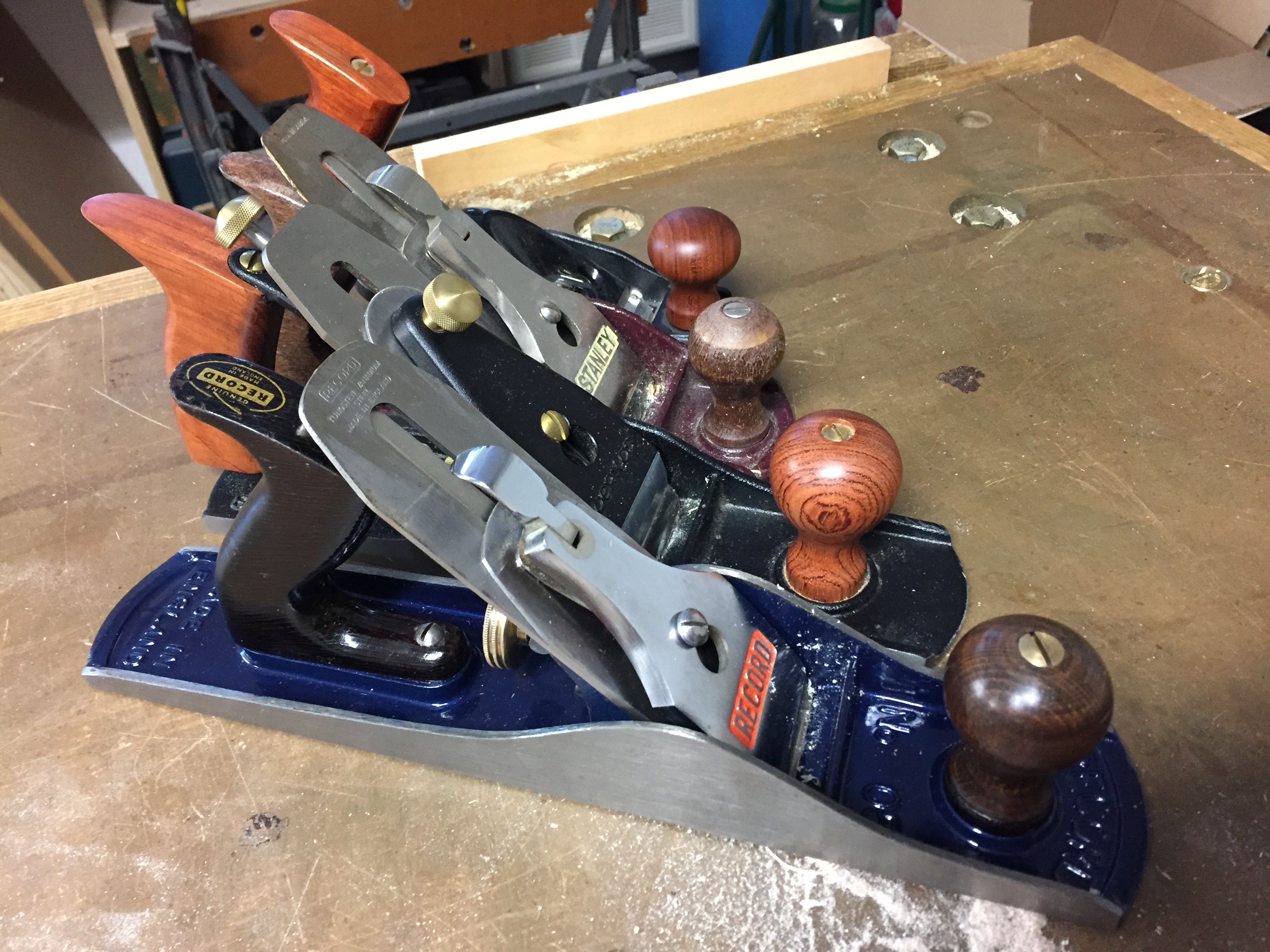
When I first decided to make furniture, I knew I needed tools. So I went to a 24-hour Walmart in the middle of the night and bought a set of tools that looked useful, including a chisel, a block plane, a level, a coping saw and a miter box saw. I had no idea how to use them, but they looked like things a furniture-maker would own (as opposed to a plumber).The next day I started to make some shutters for our house, and realized I needed other tools. So I went to the hardware store and picked up another pile of junk. This cycle continued for a long time until I decided to start reading about woodworking instead of making things up as I went along.
Obsess Over Statistics
You get every catalog out there. You find every website that sells tools and machinery. You discover tool reviews – wait there’s something better than a Walmart block plane? And you discover statistics. Table flatness, arbor runout, Rockwell hardness, the different grades of carbide.The idea is that if you can process all of these statistics, you will be able to pick the best tools to replace your dimestore tools.
[…]
Buy Jigs to Replace Skills
The next two stages are dangerous because if you get stuck in one of them, you can go bankrupt. During the “jig” phase, you start using your statistically perfect tools and realize there is something missing because your results suck.It can’t be the tool. You did all the reading, and it is the best one out there. What’s missing is skill, but you conclude that what is missing are the jigs and accessories.
Example: Your first hand-cut dovetails look terrible, so you buy a router and an entry-level commercial jig. After weeks of messing with the jig, your dovetails look better but they are so uniform that they look boring.
So you dip back into your statistics phase and read all about dovetail jigs and buy a commercial jig that allows you to variably space your tails. But this jig only has an 18” capacity, so….
[…]
Upgrade & Stockpile
As you become more skilled, you enter the most dangerous phase of all. This is the phase where you find you have some success with a tool, such as a shoulder plane, and so you buy seven examples of it to find the one you like the best. Different sizes, different grips, different makers.You upgrade your benchtop table saw because you can finally understand the benefits of a contractor or cabinet saw. You end up with four smoothing planes, six routers and a huge credit card bill. You start comparing scratch awls and screwdrivers. You divert your online tool purchases to your workplace so your spouse doesn’t notice.
On the bright side, there is hope, or as he calls it the “Great Psychic Break”, followed (for the fortunate) by the “Please, No More Tools” phase of spiritual enlightenment.
The Five Forms of Ancient Egyptian Writing!
The Study of Antiquity and the Middle Ages
Published on 12 Mar 2018In this brief video I discuss the five different forms of writing in Ancient Egypt!
QotD: Is Danish following the same path as Maltese?
… while I was in Denmark I kept tripping over odd facts that pointed to a possibly disturbing conclusion: though the Danes don’t seem to notice it themselves, their native language appears to me to be dying. Here are some of the facts that disturbed me:
- I was told that Danish phonology has been mutating so rapidly over the last 50 years that it is often possible to tell by the accent of an emigre returning to Denmark what decade they left in.
- The Dane with whom I was staying remarked that, having absorbed spoken Danish as a child, he found learning written English easier than learning written Danish.
- Modern Danish is not spoken so much as it is mumbled. Norwegians and Swedes say that Danes talk like they’ve constantly got potatoes in their mouths, and it’s true. Most of the phonemic distinctions you’d think ought to be there from looking at the orthography of written Danish (and which actually are there in Norwegian and Swedish) collapse into a sort of glottalized mud in contemporary spoken Danish.
- At least half the advertising signs in Denmark – and a not inconsiderable percentage of street signs – are in English. Danes usually speak passable English; many routinely code-switch to English even when there are no foreigners involved, in particular for technical discussions.
The overall picture I got of Danish was of a language in an extreme stage of phonological degeneration, extremely divergent from its written form, and functionally unnecessary to many of its younger speakers.
I contemplated all this and thought of Maltese.
Maltese originated as a creole fusing Arabic grammar and structure with loanwords from French and Italian. I have read that since 1800 (and especially since WWII) Maltese has been so heavily influenced by bilingual English and Maltese speakers that much of what is now called “Maltese” is actually “Maltenglish”, rather more like a Maltese-English fusion, with “pure” Maltese only spoken by a dwindling cohort of the very old and very rural. Analysis of this phenomenon is complicated by the fact that the Maltese themselves tend to deny it, insisting for reasons of ethno-tribal identity that they speak more Maltese and less Maltenglish than they actually do.
Based on what I saw and heard in Denmark, I think Danish may be headed down a similar diglossic road, with “pure” Danish preserved as an ethno-tribal museum artifact and common Danish increasingly blending with English until its identity is essentially lost except as a source of picturesque dialect words. For a look at a late stage in this sort of process, consider Lallans, the lowland Scots fusion of Scots Gaelic and English.
Eric S. Raymond, “Is Danish Dying?”, Armed and Dangerous,2009-05-17.
April 1, 2018
Genghis Khan – Lies – Extra History – #7
Extra Credits
Published on 31 Mar 2018How DO you pronounce Genghis Khan’s name? What cool stories did we have to leave out of the main animated series? And how does Walpole fit into all this? It’s time for Lies, featuring Jac Kjellberg (writer) and James Portnow!
When science itself becomes politically incorrect
Andrew Sullivan discusses the unwelcome discoveries of geneticists:
Last weekend, a rather seismic op-ed appeared in the New York Times, and it was for a while one of the most popular pieces in the newspaper. It’s by David Reich, a professor of genetics at Harvard, who carefully advanced the case that there are genetic variations between subpopulations of humans, that these are caused, as in every other species, by natural selection, and that some of these variations are not entirely superficial and do indeed overlap with our idea of race. This argument should not be so controversial — every species is subject to these variations — and yet it is. For many on the academic and journalistic left, genetics are deemed largely irrelevant when it comes to humans. Our large brains and the societies we have constructed with them, many argue, swamp almost all genetic influences.
Humans, in this view, are the only species on Earth largely unaffected by recent (or ancient) evolution, the only species where, for example, the natural division of labor between male and female has no salience at all, the only species, in fact, where natural variations are almost entirely social constructions, subject to reinvention. We are, in this worldview, alone on the planet, born as blank slates, to be written on solely by culture. All differences between men and women are a function of this social effect; as are all differences between the races. If, in the aggregate, any differences in outcome between groups emerge, it is entirely because of oppression, patriarchy, white supremacy, etc. And it is a matter of great urgency that we use whatever power we have to combat these inequalities.
Reich simply points out that this utopian fiction is in danger of collapse because it is not true and because genetic research is increasingly proving it untrue. On the male-female divide, for example, Reich cites profound differences, “reflecting more than 100 million years of evolution and adaptation.” On race, he is both agnostic about what we will eventually find out with respect to the scale of genetic differences, and also insistent that genetic differences do exist: “You will sometimes hear that any biological differences among populations are likely to be small, because humans have diverged too recently from common ancestors for substantial differences to have arisen under the pressure of natural selection. This is not true. The ancestors of East Asians, Europeans, West Africans and Australians were, until recently, almost completely isolated from one another for 40,000 years or longer, which is more than sufficient time for the forces of evolution to work.” Which means to say that the differences could be (and actually are) substantial.
This will lead to subtle variations in human brains, and thereby differences in intelligence tests, which will affect social and economic outcomes in the aggregate in a multiracial, capitalist, post-industrial society. The danger in actively suppressing and stigmatizing this inconvenient truth, he maintains, is that a responsible treatment of these genetic influences will be siloed in the academic field of genetics, will be rendered too toxic for public debate, and will thereby only leak out to people in the outside world via the worst kind of racists and bigots who will distort these truths to their own ends. If you don’t establish a reasonable forum for debate on this, Reich argues, if you don’t establish the principle is that we do not have to be afraid of any of this, it will be monopolized by truly unreasonable and indeed dangerous racists. And those racists will have the added prestige for their followers of revealing forbidden knowledge. And so there are two arguments against the suppression of this truth and the stigmatization of its defenders: that it’s intellectually dishonest and politically counterproductive.
German Armored Cars in WW1 I THE GREAT WAR On The Road
The Great War
Published on 31 Mar 2018The German Tank Museum on YouTube: https://www.youtube.com/daspanzermuseum
Germany only fielded 20-40 armored cars in World War 1, mostly on the Eastern Front. Not much about their operational history is known but they did play an important role in the German Civil War and the Weimar Republic.
The Royal Air Force at 100
In The Register, Gareth Corfield notes the amusing detail of the RAF’s birthday happening to fall on April 1st by publishing a couple of days early (so nobody thinks he’s pulling their collective legs):

This Sunday marks the 100th birthday of the Royal Air Force – Britain’s military arm for the skies – as a separate Armed Force in its own right. The RAF has been at the forefront of many technological innovations over the last century, many of which are still in use to this day.
From the earliest days of biplanes (and triplanes), through the invention of radar, the jet engine, vertical takeoff tech, and aircraft designs that were decades ahead of their time.
While traditionally these types of “birthday journalism” articles are published on the actual birthday, we at El Reg still reckon it’s a bit weird that the RAF’s official foundation also takes place on April Fool’s Day, so here it is before smart-arses feel compelled to claim this is some kind of windup.
Going back through the history books, the RAF’s main technological achievements include developments in aerial navigation, aircraft sensing and ground-based control, and, somewhat controversially, the jet engine, though the actual milestones for that one are shared with Germany.
[…]
All in all, the RAF has been an aeronautical force for good, with the service developing the basics for many things that commercial passengers today take for granted. Its technological developments and innovations have contributed to making the world both safer and smaller, as aircraft fly ever faster, building upon the principles established and researched by the Air Force. Even those with grievous injuries have been benefited by the RAF, thanks to the pioneering work of the RAF Institute of Aviation Medicine.
Let’s just hope it manages to shrug off the problem of having its birthday on the same day as April Fool’s Day…
Update: Samizdata relates the tale of the 50th anniversary non-celebration.
Today I would like to note one incident in the RAF’s history, which came at the ‘half-way’ mark, when in 1968, (actually on 5th April) after Harold Wilson’s Labour government decided not to commemorate the RAF’s 50th anniversary with a fly-past, and this did not go down well at all. In fact, it went down so badly that one RAF pilot, the heroic Flight Lieutenant Alan Pollock, threw away his career and very nearly his freedom in the ‘Tower Bridge incident‘, when, in protest at the lack of a commemoration, in his Hawker Hunter jet, he ‘buzzed’ the Houses of Parliament. Then on the spur of the moment, going down the Thames towards the sea, he flew under the top span of Tower Bridge at around 400 mph, and also ‘beat up’ a few airfields inverted, before landing, getting arrested but avoiding a court martial after being demobilised on health grounds by superiors eager to avoid the publicity of a trial, which is a weird echo of a similar ruse used in Viktor Suvorov’s ‘The Liberators’ when a Soviet Army soldier’s conduct presented a bureaucratic embarrassment that could not be concealed from higher authority. The jet only just missed hitting the top span of Tower Bridge with its tail, so no harm was done, however, it was close, there was a double-decker bus on the bridge at the time, and a cyclist on the bridge ripped his trousers dismounting in haste. Flt-Lt Pollock gallantly offered to pay for the trousers, but the cyclist declined.
Wikipedia has more detail on the Hawker Hunter Tower Bridge incident.
Boarding Schools – what are they like?
Lindybeige
Published on 15 Oct 2016For two years, I went to a British public boarding school, and recently, I attended a reunion. I talk about them.
Support me on Patreon: https://www.patreon.com/LindybeigeIt was difficult in the edit to achieve the balance I wanted, but this can be redressed in later videos. I recorded a few more pieces to camera and took more shots of the school. I don’t feature the people there because this was a personal project, and it would be unfair to involve them in something they may find expresses opinions and ideas with which they disagree. Besides, I wanted to talk to old friends, not poke a camera in their faces.
Lindybeige: a channel of archaeology, ancient and medieval warfare, rants, swing dance, travelogues, evolution, and whatever else occurs to me to make.
QotD: Modularity
I was able to repair my sewer system because everything in it was modular. The pipe leading out of the house was made up of identical sections of fired clay pipe put together like legos. They were made of durable stuff, and they were installed to work using gravity alone. They worked for over one hundred years despite the efforts of dozens of people to screw them up in the interim. If they were a unitary system of some sort, and they failed, I would have been forced to replace them as a unitary system. To translate, that would have meant moving into a cardboard box behind a strip mall dumpster.
I could fix the broken components, and leave the others alone. Don’t underestimate the importance of this concept. In housing, everyone desires everything to be unitary, and wants it to be brand new forever. I can’t fix a modern house. I’m a dolt, but that’s not why I can’t fix it. In general, everything to do with a modern house can be replaced, but it can’t be fixed. If your hardwood strip flooring is worn, you can sand it and refinish it and get another fifty years out of it. If someone puts a coal out on your Pergo floor, you can lump it, or you can replace it. It’s sold as permanent. In real life, “permanent” really means “disposable.” The word “sustainable” is similar. It really means “in need of massive, permanent subsidy.”
Sippican, “You May Not Believe This, But ‘Weapons-Grade Nuts’ Is the Name of My Psychedelic Furs Tribute Band. But I Digress”, Sippican Cottage, 2016-03-16.


