
On his Substack, Lorenzo Warby returns to the issue of how we describe the (theoretical) predominant economic system by which the west has risen to wealth and power using terms coined by the man who hated it more than any other:
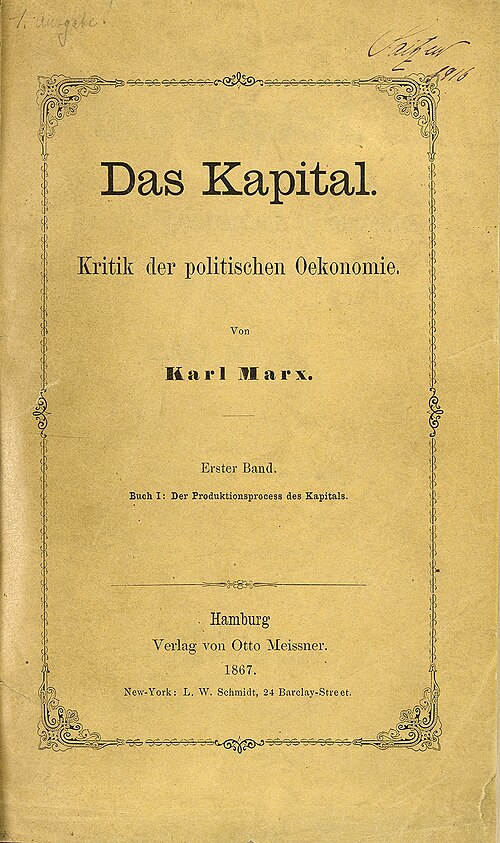
Title page of Das Kapital in the first German edition of Volume 1.
Wikimedia Commons.
It would be a great improvement to our understanding of social dynamics if people stopped using the terms capitalism and capitalist. Given how ubiquitous these terms are, this may seem a strong claim, but it is one that is easy to sustain.
The Marxist definition of capitalism is:
The socio-economic system where social relations are based on commodities for exchange, in particular private ownership of the means of production and on the exploitation of wage labour.
According to Wikipedia:
Capitalism is an economic system based on the private ownership of the means of production and its use for the purpose of obtaining profit.
The first problem is the ism. There is no role for the state here. The state becomes, implicitly or explicitly, a “reflection” of the economic system, despite the fact that people do not describe non-state societies as “capitalist” even though such societies can have lots of private ownership used for the purposes of gaining income.
Non-state societies cannot manage the scale of economic activity so as to have, for example, firms. Their economic production is overwhelmingly centred on households.
Sedentism — living in dwellings — created households that then became, for millennia, the centre of most economic activity. Even states were governed out of royal or imperial households. It is factories, and offices, that move economic activity out of households.
The mass energy-use take-off we call the Industrial Revolution has brought the arc of economic history that began with sedentism to an end. When economist Robin Hanson writes about the shift from farmer “back” to forager patterns, it is the effects of the supplanting of households from the centre of economic activity that he is pointing to (without fully grasping that).
Note that this shift away from households being central to economic activity is very much about energy use: it applies to both commerce and to state activity (including state production). It is not inherently “capitalist”.
State production also produces commodities: calling such “state capitalism” just shows how much capitalism is a ridiculously protean term.
Eliding the state
The exclusion of the state in defining capitalism is not analytically benign. A classic and continuing use of the term capitalism is to romanticise the state. By viewing the state as a “reflection” of the economic system, all bad things, all disliked features, can be based on the malign influence of “capitalists”, of the dynamics of “capitalism”, with the state reduced to an instrument or reflection of such dynamics. (The same thing can be done in reverse, blaming all bad things on the state — see anarcho-capitalism — but that is much less common.)
The natural — and used — implication of blaming private commerce for all bad things is that, if good people, with good intentions, and proper understanding, run the state, it can do anything needed for their program to be achieved. This is very obvious if one, for example, reads the program of the Democratic Socialists of America.
The term capitalism thereby becomes a vehicle for getting the state profoundly wrong; for not understanding that the state is a fundamental structuring feature of any state society; for not understanding that, across history, states have been the dominant extractor and creator of surplus, and so of class structures. That, when it comes to state societies, the state itself is fundamental.


