
I keep hearing about how tax cuts are “giveaways” for the rich. Never mind that some rich people will see their taxes go up. This is philosophically grotesque. The people saying it may be more civilized and restrained than the pro-government mobs in the streets of Caracas, but it’s still basically the same idea: “The People” or “the nation” own everything. The state is the expression of the peoples’ spirit or of the nation’s “will”, and therefore it effectively owns everything. Thus, taking less money from you is the same as giving you more money.
This is why populism and nationalism, taken to their natural conclusions, always lead to statism. The state is the only expression of the national or popular will that encompasses everybody. So, the more you talk about how the fundamental unit of society is a mythologized collective called “The People” or the nation, the more you are rhetorically empowering the state.
Sure, the Constitution begins with the words “We the People,” but that is not a populist sentiment — it’s a statement of precedence in terms of authority: The people come before the government (not the European notion of the state). The spirit of the Constitution is entirely about the fact that The People are not all one thing. It places the rights of a single person above those of the entire federal government! It assumes not only that the people will disagree among themselves, but that the country will be better off if there is such disagreement. No populist frets about the tyranny of the majority. American patriots do.
But if you recognize that humans create wealth with their brains and their industry and that it therefore belongs to them, you’ll be a little more humble about the state’s “right” to take as much as it wants to spend how it wants. Human ingenuity is the engine of wealth creation, and there is no other.
But that doesn’t mean government doesn’t play a role. Because, as I said, there will be no wealth creation if there is no rule of law. There will be no investment or ingenuity if there is no guarantee that you will be able to collect on that investment or reap the benefits of your innovation. Without such an environment, the biggest mob wins. And when the mob wins, children starve to death in what should be one of the richest countries in the world.
Jonah Goldberg, “America and the ‘Original Position'”, National Review, 2017-12-22.
March 4, 2020
QotD: Tax cuts “for the rich”
January 22, 2020
QotD: National “wealth”
While working on my book, I read all these different accounts of where capitalism comes from. I was amazed by how many of them start from the assumption that wealth is … stuff. Depending on which Marxist you’re talking to, capitalism is the ill-gotten-booty of the Industrial Revolution, slavery, imperialism, and the rest. I don’t want to get into all of that here — there will be plenty of time when the book comes out.
But all of these assumptions are based on the idea that having stuff makes you rich. Now, in fairness, that’s true for individuals. But it doesn’t really work that way for societies. Writing about Venezuela earlier this week is what got this in my head. Venezuela is poor and getting poorer by the minute: Babies are dying from starvation.
Meanwhile, Venezuela has the largest proven oil reserves in the world. According to lots of people, not just Marxists, this should make no sense. Oil is valuable. If you have more of it than anyone else, you should be able to make money. For a decade, the American Left loved Hugo Chávez and then Nicolás Maduro because they allegedly redistributed all of the country’s wealth from the rich to the poor. These dictators were using The Peoples’ resources for the common good. Blah blah blah.
It turns out that the greatest resource a country has is its institutions. In economics, an institution is just a rule, which is why the rule of law in general and property rights in particular are the most important institutions there are, with the exception of the family. Take away the rule of law in any country, anywhere and that country will get very poor, very fast. Stop protecting the fruits of someone’s labor, enforcing legal contracts, guarding against theft from the state or the mob (a distinction without a difference in Venezuela’s case) and wealth starts to evaporate.
But even that is too complicated. Oil is worthless on its own. If you went back in time to the Arabian Peninsula before oil became a valuable commodity, you wouldn’t look at the squabbling nomads and call them rich, even though they were playing polo with a goat’s head above billions of barrels of oil. Go get lost in the Amazon by yourself. What would you rather have, a map or big-ass diamond? The diamond only has value once you get out of the jungle, but you can’t get out without the map.
Jonah Goldberg, “America and the ‘Original Position'”, National Review, 2017-12-22.
September 30, 2019
QotD: Oil price volatility
There was a wave of nationalisation in the oil industry beginning in the 1960s. Today some 90 per cent of oil reserves are held by nationalised companies. ExxonMobil and BP are minnows compared with the whales owned by the governments of Saudi Arabia, Venezuela, Iran, Iraq, Kuwait, the United Arab Emirates, Nigeria and Russia. Post-colonial nationalisation affected many resource-based industries, but whereas many mineral and metal companies were privatised in the 1990s as their grotesque inefficiencies became visible, the same has not happened to state oil companies.
The consequence is that most oil is produced by companies that are milked by politicians, and consequently starved of cash (or incentives) for innovation and productivity. Lamenting “politicians’ extraordinary ability to mess things up”, the two authors note “the severely destructive role that can be played by political fights over the oil rent and its use”.
If politicians don’t get in the way, and we have two decades of relatively cheap oil it will be bad news for petro-dictators, oil-igarchs, ISIS thugs, and the promoters of wind power, solar power, nuclear energy and electric cars. But it is good news for everybody else, especially those on modest incomes.
Matt Ridley, “Low oil prices are a good thing”, The Rational Optimist, 2016-02-14.
June 28, 2019
The “V-word” in political discussions
Kristian Niemietz explains why “Venezuela” isn’t a sensible or satisfactory answer to claims in favour of socialism:
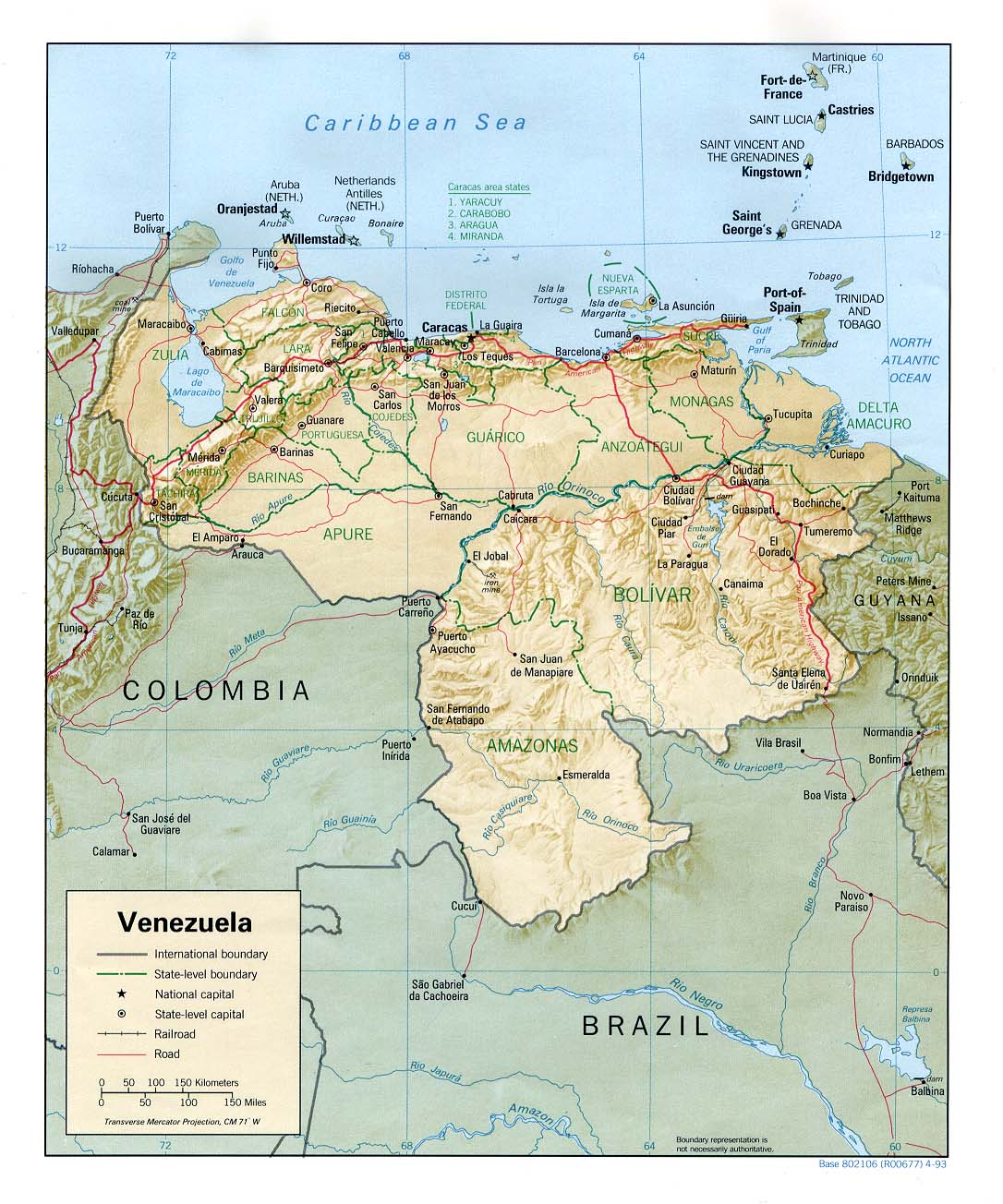
Shaded relief map of Venezuela, 1993 (via Wikimedia)
The main point to note is that Venezuela is an actual country, not a shorthand for “everything I don’t like about the Left”. It is a country that is in trouble for specific, identifiable reasons, not for being, somehow, generically, “too left-wing”. This sounds obvious when you put it like that, but deviations from this point are the main cause of V-word inflation.
So when somebody on the Left proposes to, for example, raise income tax, wealth taxes, or corporation tax, people on the pro-market side should not respond by shouting “Venezuela!”. Because that’s not what happened in Venezuela. Venezuela is not a high-tax economy, or at least, their tax burden is not what ruined them.
In the same way, if somebody on the Left proposes to hike the minimum wage, to abolish university tuition fees, or to ban zero-hour contracts, shouting “Venezuela!” is not the answer either. Those are bad ideas, sure. But those are not the ideas that destroyed Venezuela.
In short, we shouldn’t bring up Venezuela in a discussion of run-of-the-mill left-wing policies, which bear little relationship to anything that Chávez and/or Maduro did.
Furthermore, when somebody points out a genuine social problem in Britain, “Yeah but Venezuela!” is not much of a reply. Socialists are sometimes good at identifying problems, even if they are terrible at developing solutions. It is true that we have some of the highest housing costs in the world. It is true that our productivity performance, and as a result, wage growth, are poor, and have been poor for far too long. It is true that our welfare system is riddled with flaws, and often fails to support people who have fallen on hard times.
“It’s much worse in Venezuela, which is the system you lot want!” is not good enough. “It’s much better in capitalist countries X and Y – which is the system we should learn from” is more like it. So in such cases, it’s best to leave Venezuela out of it. Let “Venezuela” be a country, not a rhetorical all-purpose put-down.
That said – don’t declare that moratorium just yet. When prominent British socialists call for mass nationalisations, when they call for price controls and capital controls, when they deride the rule of law as a mere “bourgeois” construct that only serves “the elites” – then yes, it is absolutely fair to point out that this is exactly what happened in Venezuela. Here, we’re not talking about some allegorical “Venezuela”, but about the actual country, and about specific things that happened there. These are the very policies, and this is the very mindset, which turned what was once South America’s richest country into a basket case. This argument may not “resonate with people” – but it’s true.
Further to that: when socialists claim that “their” version of socialism will be completely different from any of its previous incarnations, that it will be genuinely democratic, empowering, grassroots-based and non-hierarchical – then it is fair to point that this is exactly what the Chavistas also used to say.
Some Western socialists are currently trying to convince themselves that Chávez and Maduro just never really aspired to a different kind of socialism, that authoritarian populism is all they ever wanted. This is fundamentally untrue, and Western socialists used to know this very well. The project of Venezuelan socialism started with the aspiration that this time would be different, that this time, “socialism” would not mean an all-powerful state controlling everything. It started with the aspiration that there could be completely different forms of collective ownership, which had nothing to do with the top-down nationalised industries of the past.
The appeal of Millennial Socialism rests on the delusion that the democratic, bottom-up socialism Millennial Socialists aspire to is a fundamentally novel aspiration, and that nobody in history has ever tried to build anything like this before.
But it is not a new aspiration. This was precisely what Chávez’s and Maduro’s “21st Century Socialism” was also about, which is why it used to be so popular in the West. A moratorium on the V-word would just play into the hands of those who now want to pretend that none of this ever happened, and that “Millennial Socialism” is novel, untried and untested.
August 22, 2018
August 4, 2018
QotD: Supply and demand
… that terribly simplistic stuff about supply and demand in those econ 101 classes is actually true. Prices are not some arbitrary numbers thrown at something by the capitalist neoliberals in order to do down the proletariat. They’re vital and essential information about who wants what and who is willing to produce what. Where the supply and demand curves meet is where the market will clear and the market price will be the market clearing price. The meaning of this is that when you decide to arbitrarily throw a price at something you’re going to up set that balance. And if you tell producers that the price will be lower than the market one then they will produce less. And as demand curves slope downwards so will consumers desire more at that lower price. Thus price fixing below the market price produces a shortage, a dearth.
This is not some optional feature, it’s an essential fact about our universe. It is the explanation for those food shortages that Venezuela has been having. More than that it’s the only explanation we need or desire. Fix prices below the market price and you will have shortages. Stop fixing prices and you will stop having shortages.
So, well done to Venezuela for giving in to reality there. And this is something that we need to take on board too. Rent controls which fix the price of housing below the market price will lead to a shortage of housing. And the opposite applies too – fix the price of labour above that market price with a minimum wage and you’ll have an excess supply of labour. Or, as we usually call that, an excess of unemployment.
The price of something simply is the price of something and don’t ever forget it.
Tim Worstall, “Congratulations To Bolivarian Socialism – Finally A Sensible Economic Policy In Venezuela”, Forbes, 2016-10-15.
July 28, 2018
June 3, 2018
QotD: Price controls just make things more expensive in real terms
One of the perennial, and pernicious, political ideas is that if things are “too expensive” then we can fix that by just passing a law to make them less expensive. We see this just about everywhere and its sadly not limited to the more idiot sector of the left. Although of course it thrives there. Venezuela is a complete and total mess because Hugo Chavez and Nicolas Maduro thought they would make life cheaper by limiting prices by law. Payday lending doesn’t exist in certain states because people like Elizabeth Warren insist that interest rates should not go “too high”. Those usury laws mean that interest rates are infinite – as the lending simply isn’t available at all. And yes, people over on the right have made the same sort of mistake – Nixon tried to fix gas prices after all.
Price fixing just always leads to things getting more expensive. As David Friedman explains:
The result – that price control results in a cost to the consumer, pecuniary plus nonpecuniary, higher than the uncontrolled price – does not depend on the details of the [supply and demand] diagram. Consumers cannot consume more gas than producers produce, so the nonpecuniary cost must be large enough to drive quantity demanded down to quantity supplied. Quantity supplied is lower than without price control, so cost to the consumer must be higher.
Tim Worstall, “Memo For Would Be Price Fixers – Price Controls Always Make Things More Expensive”, Forbes.com, 2016-08-16.
April 4, 2018
DicKtionary – I is for Investment – Gregor MacGregor
TimeGhost
Published on 3 Apr 2018I for investment, for financial success,
Or for a failure, cause it’s hard to guess,
But if there’s one man who could make you a beggar,
It’s today’s star, Gregor MacGregor.Join us on Patreon: https://www.patreon.com/TimeGhostHistory
Written and Hosted by: Indy Neidell
Based on a concept by Astrid Deinhard and Indy Neidell
Produced by: Spartacus Olsson
Executive Producers: Bodo Rittenauer, Astrid Deinhard, Indy Neidell, Spartacus Olsson
Camera by: Ryan Tebo
Edited by: Bastian BeißwengerA TimeGhost format produced by OnLion Entertainment GmbH
March 16, 2018
August 5, 2017
At least someone on the left is willing to find fault with Venezuela’s leadership
Of course, when I say “find fault”, I mean “criticize for not being even more horrible“:
Ken Livingstone, a former mayor of London, has blamed the turmoil in Venezuela on the unwillingness of the former president, Hugo Chávez, to execute “oligarchs” after he came to power.
Livingstone, who is suspended from the Labour party, also blamed the economic crisis in the country on the government’s failure to take his advice on investment in infrastructure, which he said would have reduced the Latin American state’s dependence on oil.
The former mayor, a longtime supporter of the late president Chávez and his successor Nicolás Maduro, said the socialist leader’s enemies wanted to restore their power.
“One of the things that Chávez did when he came to power, he didn’t kill all the oligarchs. There was about 200 families who controlled about 80% of the wealth in Venezuela,” Livingstone told Talk Radio.
“He allowed them to live, to carry on. I suspect a lot of them are using their power and control over imports and exports to make it difficult and to undermine Maduro.” When pressed, Livingstone said he was “not in favour of killing anyone”.
Livingstone visited Venezuela during his time in office as mayor of London, striking a cut-price oil deal with Maduro to supply Transport for London. The Labour leader, Jeremy Corbyn, has also regularly expressed his admiration for Chávez, saying in 2013 he was “an inspiration to all of us fighting back against austerity and neoliberal economics in Europe”.
August 4, 2017
Short memories and willing self-deception over Venezuela
In the Los Angeles Times, James Kirchick took the pundits to task for their adulation of Venezuela’s government as it plunged deliberately into a humanitarian disaster:
On Sunday, Venezuelan President Nicolas Maduro claimed victory in a referendum designed to rewrite the country’s constitution and confer on him dictatorial powers. The sham vote, boycotted by the opposition, was but the latest stage in the “Bolivarian Revolution” launched by Maduro’s predecessor, the late Hugo Chavez. First elected in 1998 on a wave of popular goodwill, Chavez’s legacy is one of utter devastation.Shaded relief map of Venezuela, 1993 (via Wikimedia)
Thanks to Chavismo’s vast social welfare schemes (initially buoyed by high oil prices), cronyism and corruption, a country that once boasted massive budget surpluses is today the world’s most indebted. Contraction in per capita GDP is so severe that “Venezuela’s economic catastrophe dwarfs any in the history of the U.S., Western Europe or the rest of Latin America” according to Ricardo Hausmann, former chief economist of the Inter-American Development Bank. Transparency International lists Venezuela as the only country in the Americas among the world’s 10 most corrupt.
Socialist economic policies — price controls, factory nationalizations, government takeovers of food distribution and the like — have real human costs. Eighty percent of Venezuelan bakeries don’t have flour. Eleven percent of children under 5 are malnourished, infant mortality has increased by 30% and maternal mortality is up 66%. The Maduro regime has met protests against its misrule with violence. More than 100 people have died in anti-government demonstrations and thousands have been arrested. Loyal police officers are rewarded with rolls of toilet paper.
The list of Western leftists who once sang the Venezuelan government’s praises is long, and Naomi Klein figures near the top.
In 2004, she signed a petition headlined, “We would vote for Hugo Chavez.” Three years later, she lauded Venezuela as a place where “citizens had renewed their faith in the power of democracy to improve their lives.” In her 2007 book, The Shock Doctrine, she portrayed capitalism as a sort of global conspiracy that instigates financial crises and exploits poor countries in the wake of natural disasters. But Klein declared that Venezuela had been rendered immune to the “shocks” administered by free market fundamentalists thanks to Chavez’s “21st Century Socialism,” which had created “a zone of relative economic calm and predictability.”
Chavez’s untimely death from cancer in 2013 saw an outpouring of grief from the global left. The caudillo “demonstrated that it is possible to resist the neo-liberal dogma that holds sway over much of humanity,” wrote British journalist Owen Jones. “I mourn a great hero to the majority of his people,” said Oliver Stone, who would go on to replace Chavez with Vladimir Putin as the object of his twisted affection.

May 23, 2017
February 7, 2017
Simón Bolívar – Lies – Extra History
Published on Jan 21, 2017
James talks about our mistakes, and adds additional stories, for the Simón Bolívar series!
February 4, 2017
Simón Bolívar – VI: All Good Things – Extra History
Published on Dec 24, 2016
Simón Bolívar hoped to bring the nations of South America together in one great federation, but he feared that people would think he meant to make himself a king. He tried to step back, but revolution threatened from within his ranks and his body had grown weak with illness.


