Quotulatiousness

June 14, 2025

Damian Penny’s diligent recycling efforts pay off

Filed under: Media, Middle East, Military, Weapons — Tags: , , , — Nicholas @ 03:00

At Rigid Thinking, Damian Penny has to be given top marks for recycling this week, although it’s not newspapers or plastic cartons he’s getting to do twice the work:

Please keep psychotic Twitter accounts with animated-squirrel avatars in your thoughts and prayers this weekend. They’re going through a tough time right now.

And, once again, the point I made last week is proven:

    Did this operation really do as much damage as the Ukrainians Israelis say? I dunno. I don’t begrudge the Ukrainians Israelis their own propaganda weapons.

    (Plus, these are Russian planes Shah-era jets for which getting parts is a massive pain in the ass, so there’s a good chance they might have just exploded on their own, like a Soviet television set left plugged in overnight.)

    But the mere fact that Ukraine Israel was able to pull this off at all, right under the Russians’ Iranians’ noses, is a game changer. The message to Czar Vladimir the Mullahs, that we can strike literally anywhere, couldn’t be more clear.

    We’ll get the whole story from the Ukrainian Israeli side soon enough. What I’m chomping at the bit to see is what’s in the Russian Iranian archives someday, when Putin the “Islamic Republic” is gone and McDonald’s has been restored to its rightful place in Red Square Azadi Square.

    A few weeks after the Russian invasion, when it became clear that they were in for a much harder time than anticipated, I wrote about how what would appear to be an authoritarian government’s great advantage over liberal democracy — the ability for its leaders to just “get stuff done” instead of having to put up with the horse-trading and lobbying and arguing and mean tweets which make can make things so exhausting and frustrating for a more open society — eventually becomes a disadvantage.

    […]

    If the leader can do whatever he wants without any serious resistance, everyone else learns to keep their heads down and not do nor say anything which will make him angry.

    Because you really, really wouldn’t like him when he’s angry.

    As a result, the guy in charge is surrounded by sycophants and yes-men who will nod along and feign enthusiasm for whatever he wants to do, even if they know it’s really risky and/or really, really stupid.

    That filters down to the drones (the human kind) and proles, too. I’m not a betting man, but I’d bet my entire hoard of Hawk Tuah meme coins that Russian Iranian intelligence services actually knew, or at least strongly suspected, that something like Operation Spiderweb Operation Rising Lion was in the works.

    Good for them. Now, you go and tell the Czar Ayatollah that there are Ukrainian Mossad operatives (and, at the risk of wishcasting, some Russians Iranians brave enough to assist them) thousands of miles away from Ukraine Israel, ready to take out much of the strategic bomber fleet air defences.

    Ukraine Israel, by contrast, is an open enough society to learn from its mistakes, see what actually works, and adapt accordingly. Russia Iran is a closed society which keeps doubling down on what it was already doing, and woe is you if you suggest a change of course.

    It doesn’t matter how much stronger you are in terms of weaponry, if your society and political system punishes anyone who might tell the leader he’s wrong.

Well, that was surprisingly easy to write about. Here’s hoping I don’t get lazy and get into the habit of throwing on old reruns, assuming you kids won’t know the difference.

June 6, 2025

Former Putin advisor claims nuclear strike is an appropriate reaction to Ukraine attacks

Filed under: Europe, Military, Russia, Weapons — Tags: , , , , — Nicholas @ 03:00

Mark Steyn surveys the media reaction to Sergey Markov’s foaming-at-the-mouth threats of nuclear escalation in the Russo-Ukraine conflict:

Here’s a cheery headline from the Russian press:

    Markov: an attack on Russia’s strategic aviation is grounds for the use of nuclear weapons.

That would be Sergey Markov, former advisor to Tsar Vlad, who admittedly is somewhat partial to nuke-rattling: in the early stages of the Ukraine war, he threatened to nuke the UK, for what reason I forget — the exciting new Islamic blasphemy laws? the paedo rape gangs?

This time, however, Mr Markov was responding to the weekend’s Ukrainian drone strike deep inside Russia. By “deep”, I mean Siberia. Which supposedly took out forty of Putin’s 120 strategic bombers using drones smuggled into the country via trucks which then fanned out and parked within range of various air bases.

Which is brilliant and innovative, in the sense that Castro blowing up a third of the USAF during the Cuban missile-crisis negotiations would have been. Right now, the only thing standing between the planet and the Third World War is Vladimir Putin’s forbearance. And, as all the smart people assured us in the spring of 2022, the Russian not-so-strongman was “dying” (Christopher Steele, sole proprietor of Dossiers R Us) or dead, either of which condition can make one’s nuclear-war judgment a little erratic. Headline from the UK Daily Mirror, almost exactly three years ago:

    Vladimir Putin may already be dead with body double taking his place, MI6 chiefs claim

That headline is 100 per cent accurate if you remove the words “Vladimir” and “Putin” and replace them with “Joe” and “Biden” respectively. Incidentally, analyse each nation’s advances in body-double technology by comparing “Biden”‘s ability to host a G7 with “Putin”‘s ability to host a BRICS summit. That’s the way to bet if it comes to World War Three. Sen. Lindsey Graham (R – Zakarpattia), was in Kiev to meet with Zelenskyyyy the day before Operation Bring It On. He had the affect of a chap who knew what was coming — although one notes he has yet to make good on his comparatively less ambitious pledge to sink Greta Thunberg’s Gaza boat.

Forty years ago, everybody claimed to be super-worried about imminent mushroom clouds. A bestselling poster of the day:

Anyone care to remake the above with Senator Graham and Victoria Nuland, She-Wolf of the Donbass? Ah, but maybe it doesn’t work as well with Deep State non-household-names in the leads. It’s not so long since Lindsey was telling Zelenskyyyy to resign, but he’s apparently back on board. And, more generally, most western media were happy to report the drone strike as more of a poke in the eye to Trump than to Putin. Headline from National Review:

    Country That Allegedly Had No Cards to Play Keeps Finding New Cards to Play

This is in reference to Trump’s jibe from February that Ukraine had “no cards to play”. The question then arises: Where did Z find these “new cards”? When Pete Hegseth took over as US Defence Secretary, he quickly confirmed what every sentient creature had long suspected — that the Pentagon had been micro-managing Ukraine’s end of the war for the previous three years. Are they still doing so? In defiance of their nominal commander-in-chief?

June 3, 2025

Ukraine’s strategic strikes against Russian airbases

Filed under: Military, Russia — Tags: , , , , — Nicholas @ 04:00

CDR Salamander on the lessons to be learned from the latest dramatic turn in the Russo-Ukrainian war with Ukraine carefully avoiding letting their American supporters know about the attack before it went in:

[This] picture from 2012 of Norfolk is what I want you to think about.

We talked about the superbly executed Ukrainian attack on Russian bomber bases for most of yesterday’s Midrats, and what keeps coming to mind for me is not the details of that attack, but the stark warning it is giving us.

The threat of drone strikes isn’t a new warning, but in my mind it intersect almost perfectly with the self-inflicted vulnerability of the US Navy’s fleet — its concentration.

The growing utility of attack drones isn’t an insight that is unique to the Russo-Ukrainian War. The topic has come up here and on Midrats for almost two decades. We’re not alone. Heck, broad thinking people like our friend Matt Hipple was pondering it over at CIMSEC thirteen years ago a few months before the picture at the top of the post was made.

I’ll tie in the picture a bit, but let’s take a moment to give the Ukrainians credit where credit is due. They executed precision strikes against the RUS bomber fleet across the entire two-thirds of the Euro-Asian landmass.

We will find out more details, a dozen or 40+ high-demand/low-density strategic bombers were taken off the battle line. RUS is not building any more of them. As missile carriers, they have been a cornerstone of the city terrors for most of the last four years. You would be hard-pressed to find a more honorable, or legitimate target.

Streiff over at Red State has a good summary with what we think we know as of Sunday afternoon:

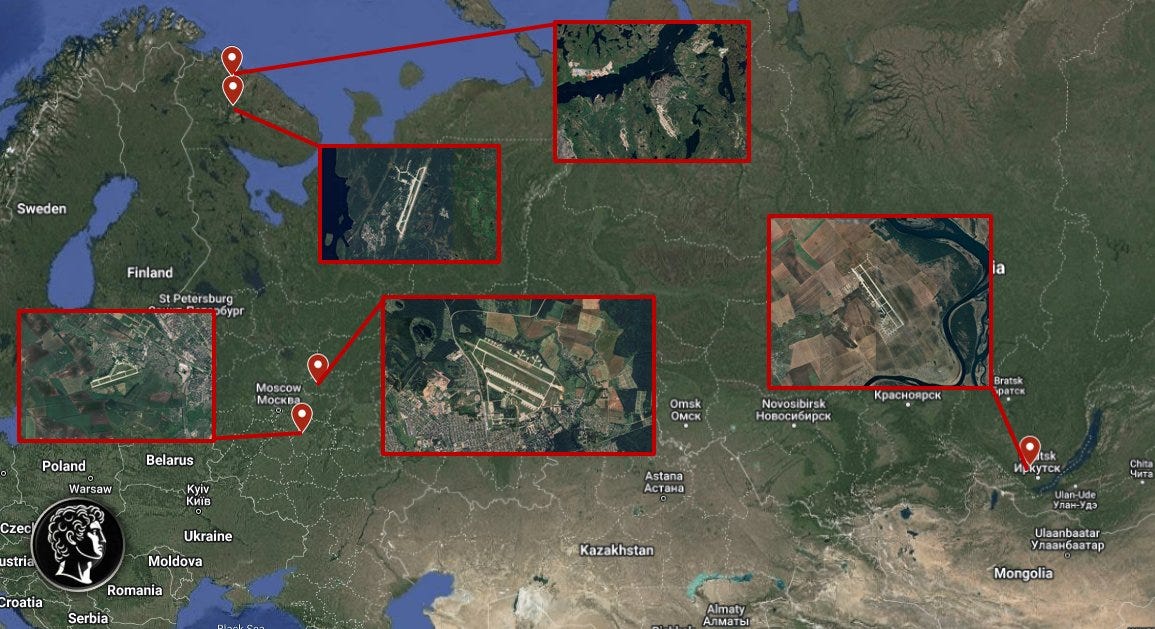
    The airbases are the home to Russia’s fleet of Tu-22, Tu-95M, and Tu-160 nuclear-capable strategic bombers as well as AS-50 battle management aircraft. They were located from the Siberian Far East to the Arctic Circle. The furthest target, Belaya Airbase in Irkutsk, is over 2700 miles from Ukraine.

    Reports indicate that at least 41 aircraft were hit. The unofficial tally indicates 24 Tu-22, 8 Tu-95MS, and 5 Tu-16 were hit. MiG-31 fighters and Il-76 transports were also hit. To put this in context, open-source data says Russia’s bomber inventory is about 58 Tu-22, 47 Tu-95MS, and 15 Tu-160. These planes are the ones used to launch most of the missiles fired at Ukrainian cities.

    By any standard, this was a devastating attack. Nearly half of the Tu-22, a quarter of the Tu-95MS, and a third of the Tu-160 fleet, representing just over 30 percent of Russia’s strategic bomber force, were damaged or destroyed in one attack. When you consider the operational readiness rate, Russia probably has less than 50 aircraft capable of flying … on the bright side, they have plenty of aircraft to cannibalize for parts. The Tu-22 and Tu-95MS production lines are closed, and the Tu-160 production is one, yes, one per year. For all intents and purposes, this represents a permanent decrease in the size of the Russian strategic bomber fleet.

Before we discuss what the USA needs to take away, let’s look at the top-4 primary and second-order effects this will have on the Russian Federation.

First Order Effects

  • Fewer raiding assets to use against UKR.
  • The weakest leg of their nuclear triad (bombers are dual use) is even weaker.
  • PSYOP defeat as RUS now know even their most valuable weapons, stationed deep into RUS rear, are vulnerable.
  • Paranoia elevated into an already paranoid national psyche under duress of year four of a grinding war.

Second Order Effects

  • Inefficiencies in both civilian logistics and manpower are the natural response to every tractor-trailer being a weapons delivery vehicle at range … and the need to defend important bases as a result, sinks into an already stressed nation.
  • Loss of face. RUS launched a war of choice against nation 1/4th its size and much weaker than it from any measure, and four years on, still has only made marginal progress. Now that nation proved it can operate with impunity anywhere inside RUS. The “R” in BRICS is not impressing its friends.
  • It shouldn’t, but this is going to get the nuclear autists the jitters. All theory, but yes, UKR took out one-third or more of the fully mission capable nuclear capable bombers that form one leg — but as mentioned above the weakest leg — of RUS’s nuclear deterrence. Those who work in the theory-dominated nuclear world will have all their gauges twitching, yes, but in the end analysis, it won’t matter.
  • UKR morale just got a big boost. Wars of attrition usually last until one side or the other loses either the material ability or the will to fight. At least from the “will” line of operation, that decisive point just shifted to the right.

Simply a superb operation. How do you defend against weapons like this disguised in a trailer’s false roof?

August 30, 2023

The endless search for the “Easy mode” in military conflict

Filed under: History, Military, Russia, Technology, Weapons — Tags: , , , — Nicholas @ 03:00

CDR Salamander on the search for shortcuts to military excellence, despite literal millennia of evidence that there are no such shortcuts:

As the Russo-Ukrainian War reaches its 20th month, I hope everyone has been sufficiently sobered up to stand firmly against those promoting the “72-hour War” or spin an attractive story about some transformational secret sauce that provides an “easy button” for those tasked to do the very hard work of preparing a nation for war should, and if, it were to come.

See the Battle of Hostomel if you need a recent example of where buying this wishcasting can get you.

There is a reason we have continually railed against this Potomac Flotilla mindset for the better part of two decades here — it is the self-delusion of faculty lounge theories running up against the Gods of the Military Copybook Headings reality what we have thousands of years of experience to reference.

We are not smarter than previous generations. There is no secret weapon or war winning technology — or magic beans — that will allow us to skip past the hard work of a viable strategy backed up by a properly resourced industrial capacity to build, maintain, deploy, and sustain a fighting force on the other side of the Pacific for years if needed.

Not 24-hours. Not 72-hours. Think 72-weeks to 72-months and you have your mind right.

[…]

We do no one any good allowing free run towards the national security version of the prosperity gospel, a branch of the transformationalist cult, and their “name it and claim it” attitude towards solving hard problems.

From LCS to DDG-1000, to optimal manning, to six-sigma supply nightmares, to 100-hour workweeks, to 72-hour war CONOPS, to the “Deter by Punishment,” to “1,000 ship navy,” to the offset of this POM cycle, to counter-historical excuses for … again … not doing the hard work that takes so long to bear fruit that someone else will get credit for it.

Every time we have our top leaders — smart hard working professionals with the best intentions — step up to sound more like this guy — the worse we will all be.

Image result for Carpetbagger Josie Wales

It degrades them and endangers everyone.

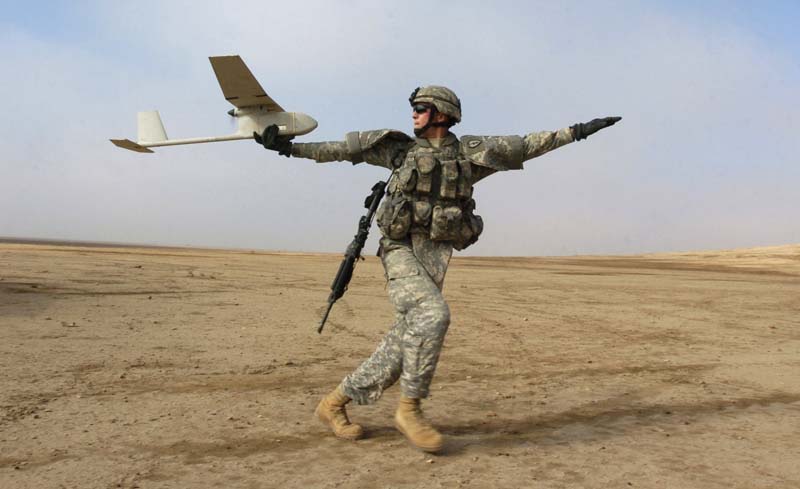
We don’t need to sell the utility of small drones being used down to the lowest levels of responsibility — it is demonstrated every day.

What we do need sold is Congress’s need to fund a revitalization of our defense industrial capacity and a focus on the naval and aerospace forces that will do most of the fighting in any expected war west of the International Dateline.

Supported by swarms of drones of all shapes and sizes.

December 1, 2022

Crisis? Which crisis?

In The Line, Matt Gurney makes the case that was NATO (and western governments in general) needs is something called “deliverology”:

I couldn’t have asked for a more topical example of exactly what I’m talking about here: the lull between realization and reaction. There were no problems with “expectations” at the top of the federal government in February [during the Freedom Convoy 2022 protests]. Everyone in a position of authority was seized with the urgency of the situation and the need for rapid action. There wasn’t any denial, doubt or incomprehension, which are the usual enemies when I write about our expectations being a problem. 

February was an example of a different issue: realizing there was a crisis but not really knowing what to do about it, or whose job it was to do it, and wasting a lot of precious time trying to figure it all out. When days and even hours count, governments can’t spend weeks or months figuring out what to do. But that’s what happened during the convoys, and during COVID, and other incidents I could rattle off. Does anyone think it won’t happen again next time, whatever that threat may be?

And some version of that concern came up over and over in Halifax [at the Halifax International Security Forum]. And not just among Canadians. The world is changing very quickly and even when we recognize a problem, we aren’t moving fast enough to keep up. So on top of our expectations, we’ve got another challenge: response times. They’re just too damned long.

I hope the readers will forgive me for being a little vague in this next section; some of the conversations I’m thinking of here were in off-the-record sessions. Rather than trying to splice together any specific quote or anecdote, I’ll just wrap it all up under the theme of “There are things we should be doing now that we weren’t, and things we should have been doing a long time ago that we only started on way too late.”

An obvious example? The rush to get Europe off of Russian fossil fuels and on to either locally generated renewables or energy imports from allies and friendly nations. (If only there was a “business case” for Canada doing more. Sigh.) Another fascinating example that came up was air defences. Two decades of post-Cold-War-style thinking among the allies has led to widespread neglect among the NATO countries of air-defence weapons. Why bother? The Taliban didn’t have an air force, right? 

Most countries have fighter jets and inventories of air-to-air missiles suitable for their planes. However, across the alliance, there are very few ground-based air-defence systems suited to shooting down not just attacking aircraft, but incoming cruise missiles and drones. 

Drones pose a particular challenge. They fly slow and low and are highly manoeuvrable, plus they are so cheap that they can be a true asymmetrical weapon: you’ll go broke real quick firing million-dollar missiles at a drone that costs your enemy $50,000 or so. And your enemy may send a few hundred at once in a swarm that simply overwhelms your defences. It’s not that drones are unbeatable. The opposite is true: drones are easily destroyed, if you have the right defences available. 

We don’t, though. Oops.

The NATO powers actually had a preview of this element of the ongoing war between Ukraine and Russia during the 2020 conflict between Azerbaijan and Armenia, where drones were used to devastating effect. Every military affairs watcher I know sat up a bit straighter after watching what the Azeris did to Armenia, with shocking speed. Swarms of drones first killed Armenia’s air defences and then went to work on Armenian ground forces. The U.S. and NATO allies have been studying that conflict, and considering how to adapt our own strategies, for both offence and defence. But right now, nine months into the Ukraine war and two years after the conflict in the Caucasus, there still aren’t enough NATO systems available even for our own needs, let alone to share with Ukraine. Russia keeps hammering away at critical Ukrainian civilian infrastructure and the Ukrainians keep begging for help, but we have nothing to send. To be clear, a few systems have been sent to Ukraine, which include not just the weapons but the radars and computers necessary to detect and engage targets. But they can only be delivered as fast as they can be built. There is no real production pipeline here, and certainly no pre-stocked inventories in NATO armouries. 

August 30, 2018

A Drone at Pompeii

Filed under: Europe, History, Italy, Science — Tags: , , , — Nicholas @ 02:00

pdvaeriennes
Published on Mar 3, 2015

August 8, 2015

Tom Kratman on “killer ‘bots”

Filed under: Military, Technology, Weapons — Tags: , , , — Nicholas @ 03:00

SF author (and former US Army officer) Tom Kratman answers a few questions about drones, artificial intelligence, and the threat/promise of intelligent, self-directed weapon platforms in the near future:

Ordinarily, in this space, I try to give some answers. I’m going to try again, in an area in which I am, at least at a technological level, admittedly inexpert. Feel free to argue.

Question 1: Are unmanned aerial drones going to take over from manned combat aircraft?

I am assuming here that at some point in time the total situational awareness package of the drone operator will be sufficient for him to compete or even prevail against a manned aircraft in aerial combat. In other words, the drone operator is going to climb into a cockpit far below ground and the only way he’ll be able to tell he’s not in an aircraft is that he’ll feel no inertia beyond the bare minimum for a touch of realism, to improve his situational awareness, but with no chance of blacking out due to high G maneuvers..

Still, I think the answer to the question is “no,” at least as long as the drones remain under the control of an operator, usually far, far to the rear. Why not? Because to the extent the things are effective they will invite a proportional, or even more than proportional, response to defeat or at least mitigate their effectiveness. That’s just in the nature of war. This is exacerbated by there being at least three or four routes to attack the remote controlled drone. One is by attacking the operator or the base; if the drone is effective enough, it will justify the effort of making those attacks. Yes, he may be bunkered or hidden or both, but he has a signal and a signature, which can probably be found. To the extent the drone is similar in size and support needs to a manned aircraft, that runway and base will be obvious.

The second target of attack is the drone itself. Both of these targets, base/operator and aircraft, are replicated in the vulnerabilities of the manned aircraft, itself and its base. However, the remote controlled drone has an additional vulnerability: the linkage between itself and its operator. Yes, signals can be encrypted. But almost any signal, to include the encryption, can be captured, stored, delayed, amplified, and repeated, while there are practical limits on how frequently the codes can be changed. Almost anything can be jammed. To the extent the drone is dependent on one or another, or all, of the global positioning systems around the world, that signal, too, can be jammed or captured, stored, delayed, amplified and repeated. Moreover, EMP, electro-magnetic pulse, can be generated with devices well short of the nuclear. EMP may not bother people directly, but a purely electronic, remote controlled device will tend to be at least somewhat vulnerable, even if it’s been hardened,

Question 2: Will unmanned aircraft, flown by Artificial Intelligences, take over from manned combat aircraft?

The advantages of the unmanned combat aircraft, however, ranging from immunity to high G forces, to less airframe being required without the need for life support, or, alternatively, for a greater fuel or ordnance load, to expendability, because Unit 278-B356 is no one’s precious little darling, back home, to the same Unit’s invulnerability, so far as I can conceive, to torture-induced propaganda confessions, still argue for the eventual, at least partial, triumph of the self-directing, unmanned, aerial combat aircraft.

Even, so, I’m going to go out on a limb and go with my instincts and one reason. The reason is that I have never yet met an AI for a wargame I couldn’t beat the digital snot out of, while even fairly dumb human opponents can present problems. Coupled with that, my instincts tell me that that the better arrangement is going to be a mix of manned and unmanned, possibly with the manned retaining control of the unmanned until the last second before action.

This presupposes, of course, that we don’t come up with something – quite powerful lasers and/or renunciation of the ban on blinding lasers – to sweep all aircraft from the sky.

April 21, 2015

US Navy and Marine Corps to go all-drone after F-35

Filed under: Military, Technology, USA — Tags: , , , — Nicholas @ 02:00

In the USNI News, Sam LaGrone says the F-35 is the last piloted strike fighter the US Navy and USMC will ever “buy or fly”:

Secretary of the Navy Ray Mabus said the Lockheed Martin F-35 Joint Strike Fighter (JSF) will be “almost certainly will be, the last manned strike fighter aircraft the Department of the Navy will ever buy or fly,” signaling key assumptions in the Navy’s aviation future as the service prepares to develop follow-ons to the Boeing F/A-18E/F Super Hornet.

“Unmanned systems, particularly autonomous ones, have to be the new normal in ever-increasing areas,” Mabus said. “For example, as good as it is, and as much as we need it and look forward to having it in the fleet for many years, the F-35 should be, and almost certainly will be, the last manned strike fighter aircraft the Department of the Navy will ever buy or fly.”

To address the emerging role unmanned weapon systems, Mabus announced a new deputy assistant secretary of the Navy for unmanned systems and a new Navy staff position — alongside warfare directorates like surface and air warfare — N-99.

The positions were created “so that all aspects of unmanned – in all domains – over, on and under the sea and coming from the sea to operate on land – will be coordinated and championed,” Mabus said.

Unmanned aerial vehicles are currently part of the Navy’s N2/N6 Information Dominance portfolio as primarily information, surveillance and reconnaissance (ISR) platform while undersea and surface unmanned systems are owned by a myriad of agencies.

March 17, 2015

The drones in the FAA don’t want you posting drone footage to YouTube

Filed under: Government, Technology, USA — Tags: , , , — Nicholas @ 04:00

Take it away, Tamara:

The FAA says no posting of drone footage on YouTube?

AHAHAHAHAHAHAHAHAHA!

That’s a good one, Canute. Have fun with that.

Anyone want to start a betting pool on how long before we have a drone footage on YouTube of another drone hovering along with a Guy Fawkes mask over its camera?

October 12, 2014

The unique challenges to UAVs in the Canadian Arctic

Filed under: Cancon, Environment, Science, Technology — Tags: , , , — Nicholas @ 00:02

Ben Makuch looks at the severe environment of Canada’s Arctic and how UAV design is constrained by those conditions:

The rotary-wing UAV tested, and its view from the sky. Image: DRDC

The rotary-wing UAV tested, and its view from the sky. Image: DRDC

“A lot of these systems — UAVs particularly, and rotor-wing (that is to say helicopters or quadrotors) — are even more sensitive. They require a good understanding of what they’re heading in. And by heading, that’s kind of the direction you’re facing,” said Monckton.

And because of those difficulties, finding headings for aerial drones in the Arctic requires stronger GPS systems to establish a “line segment” of locational data, ripped, according to Monckton, from a “crown” of satellites hovering on top of Earth.

In terms of weather conditions, the extreme sub-zero temperatures is devastating on a UAV when you mix in fog or clouds. While crisp cool air with clear skies provides excellent flying conditions, once you mix in ice fog, it becomes a major risk to small UAVs.

“The biggest risk in the Arctic is structural icing,” said Monckton who explained that water in the clouds is so cool that when “you strike it, it actually crystallizes on contact.”

At CFS Alert, the Multi-Agent Tactical Sentry (MATS) UGV travels through rough Arctic terrain during an autonomous path-following test without the use of GPS. The Canadian Armed Forces Joint Arctic Experiment (CAFJAE) 2014 tests autonomous technology for Arctic conditions and explores its potential for future concepts of military operations through experiments carried out August 2014 at Canadian Forces Station Alert, Nunavut.  CAF and Defence Research and Development Canada's (DRDC) JAE work will benefit multiple government partners and centers around a fictitious satellite crash with hazard identification, telecommunication and other search and rescue tasks.

At CFS Alert, the Multi-Agent Tactical Sentry (MATS) UGV travels through rough Arctic terrain during an autonomous path-following test without the use of GPS. The Canadian Armed Forces Joint Arctic Experiment (CAFJAE) 2014 tests autonomous technology for Arctic conditions and explores its potential for future concepts of military operations through experiments carried out August 2014 at Canadian Forces Station Alert, Nunavut. CAF and Defence Research and Development Canada’s (DRDC) JAE work will benefit multiple government partners and centers around a fictitious satellite crash with hazard identification, telecommunication and other search and rescue tasks. Image: DRDC

Unsurprisingly, the wings of a drone being enveloped in ice presents “a major impediment to general unmanned air operations,” Monckton said. In part, because “UAVs are too small to carry standard deicing equipment [as used] on a commercial aircraft. So that’s a major problem.”

For the project, DRDC took a previously manned helicopter and modified it into an unmanned vehicle. They had help from Calgary-based Meggit Canada for the project, a defence and security contractor also responsible for this armed training hexicopter.

As for ground drones, or unmanned ground vehicles, Monckton said weather and temperature were an afterthought. The real challenge, was the actual terrain.

“The arctic has a really peculiar surface,” said Monckton, adding that the high Arctic offers mostly marshlands, rocky outcrops, or elevated permafrost that produces spiky formations. “So the UGV was kind of going between easy riding on sloppy stuff and then getting pounded to pieces on the rough frost boils.”

February 3, 2014

New technology invades the vineyards – is it now the Côte-du-Drône?

Filed under: Europe, France, Technology, Wine — Tags: , — Nicholas @ 09:48

Jack Flanagan talks about the most recent technological intrusions into innovations being introduced into traditional European winemaking:

It is a new age in winemaking. The old days of doing everything by hand is ending. And while large-scale harvesters and flood-lights might not be news, the vintners of tomorrow have a few tricks up their sleeves.

[…]

And yet as advanced technology, the sort-of thing that requires a Masters of Science to understand, becomes available at lower prices (well, hovering among the thousands), vineyards in France and areas outside are adopting them.

Perhaps least surprising, if you’ve noticed a trend lately, is the addition of drones. Right now, they have a simple task: flying over vineyards, checking for damage or anything suspicious.

In the future, however, they may be required to do more labour-intensive tasks such as vine maintenance, e.g. pruning and checking how ripe the grapes are. This, specifically, is the task of a little droid resembling a rover: it skates along the vineyard floor, analysing and remembering the details of the vines. If they’re getting too long, the robot prunes them back.

January 25, 2014

War in the 21st century

Filed under: Military, Technology — Tags: , , , , — Nicholas @ 00:01

Jim Dunnigan wrote this short piece as a proposal for a longer work to follow-on to his book The Perfect Soldier in 2003.

There are many new trends producing the dramatic changes in warfare. Many of these changes are missed by the media and even many military analysts because so much has changed so quickly. The new technologies and trends include;

Robots. Combat robots have actually been around for over a century. Naval mines and torpedoes are robotic weapons that proved themselves in the early years of the 20th century. There were some more robotic weapons in World War II (cruise and ballistic missiles plus the first “smart shells”), but the momentum for combat robots really didn’t get going until the late 20th century, when smaller, cheaper and more reliable microprocessors and similar electronics made it possible to create inexpensive, “smart”, dependable and useful battle droids. Combat robots have sneaked into the military, without many people in, or out of, uniform paying a lot of attention. That’s still the case, especially because the media and even many senior military and political leaders don’t fully understand the technology nor how it is implemented. One example of this confusion can be seen with the constant reference to UAVs (unmanned aerial vehicles) as “drones” or “robots.” They are neither, they are simply remotely controlled aircraft, something that’s been around for over half a century. But these UAVs are being given more and more robotic (operating autonomously) capabilities. This isn’t new either, as torpedoes have had this ability for over 60 years and missiles for over 50 years.

Battlefield Internet. The Internet appeared as a mass-market product in the mid-1990s just as a generation of PC savvy officers were rising up the chain of command. These guys had encountered the first PCs as teenagers and then had access to the pre-World Wide Web Internet in college. PCs and the web were not mysteries, but tools they were familiar with. By 2001 these men and women were majors and colonels, the people the generals turn to when they want something done, or explained. When the World Wide Web showed up in the mid-1990s, generals turned to the majors and colonels for an update and were told, “no problem sir, good stuff. We can use it.” There followed a scramble to create a workable “battlefield Internet.” But there was another trend operating, the 1980s effort to implement “information technology.” But as the ideas merged with workable and affordable hardware and software, sparks began to fly. Unlike earlier ventures into new technology, this was not just a case of the troops being given new gadgets and shown how to use them. With Internet stuff, and Internet savvy troops, a lot of the new technology was being invented by the users. This has created high speed development of new technology, putting new stuff through development, testing and into use much faster than ever before.

[…]

Commandos. These specialists have always been around. Think of the “Knights of the Round Table” or any legendary super warrior. During the 20th century, methods were developed to produce commando class troops at will. This was not possible in the past. While commandos are specialist troops that are only useful in certain situations, when you can use them, they often have a devastating effect. Those nations with large commando forces (the US, Britain, Russia, etc.) have a military advantage that is often the margin of victory.

Off the Shelf Mentality. Since the 1980s, the military has increasingly looked to commercial companies for the latest combat equipment. This recognizes that military procurement has become too slow, and technological advances too rapid to get the latest gear into the hands of troops before it becomes obsolete. In most cases, civilian equipment works fine, as is, for the military. This is because over half the troops that work at jobs that never take them from shops or offices indistinguishable from the work places civilians use. But even the combat troops can find a lot of equipment that is rugged enough for the battlefield. Soldiers have long noted that civilian camping equipment is superior to most of the stuff they are issued, and many soldiers have supplemented, or replaced, issued equipment with better off-the-shelf gear. In the last decade, it’s been common for combat troops to bring civilian electronics gear with them. Everything from laser range finders to GPS units, all of which are issued, but the official stuff tends to be heavier and less capable.

November 25, 2013

What hasn’t been told in the official story about drone hit on USS Chancellorsville

Filed under: Military, Technology, USA — Tags: , , , — Nicholas @ 00:01

Recently the guided missile cruiser USS Chancellorsville was hit by a target drone that reported malfunctioned. There were some injuries onboard, but none were said to be serious and the ship was safe and could continue operations. However, as this post shows, there are some pretty big open questions based on what the US Navy’s public relations department has shared:

The Navy tells us the drone malfunctioned, and apparently the combat system on the ship had no problems if the ship remains capable of operations, so based on those details of the press release the officers and crew of the USS Chancellorsville tracked the target missile drone — during the radar tracking exercise — apparently as it scored a direct hit into side of the ship.

But the ship was unable to defend itself? I get it that the safety systems were probably engaged that would prevent the full capabilities of the AEGIS combat system from being employed against the rogue drone, but what about the independent close-in point defenses of the cruiser?

The official story, based on the details as released officially, is that the most advanced AEGIS warship in the world tracked a direct hit by a missile drone and was apparently unable to defend itself successfully. Did the ship even try to defend itself from a rogue drone? We don’t know, because the press release focuses on telling the public the technology of the ship is sufficient enough for the ship to conduct normal operations, but tells us no details at all regarding what the crew did or did not do to defend the ship from a direct hit.

There is a detail that is omitted in the official press release, and because it is a detail of the incident known at the time of the press release, we can only assume the omission is intentional for purposes of protecting a reputation. The ships officers and crew apparently did try to defend the ship. The CIWS apparently fired at the BQM-74 but was unsuccessful in defending the ship. That detail matters, because the omission of that detail is the difference between protecting the reputation of the ships officers and crew who tried to defend the ship, or protecting the reputation of a piece of technology that was unsuccessful — for unknown reasons — in performing the technologies primary role as the last line of defense for the ship.

You can understand why a detail like that would fail to make the cut for what the PR department wanted to release to the media.

H/T to John Donovan for the link.

August 21, 2013

Ottawa deploys drone to … chase away geese

Filed under: Business, Cancon, Technology — Tags: , — Nicholas @ 08:48

Not every drone carries missiles:

Fed up with geese fouling the grass and water at its Petrie Island beaches, the city government is calling in drone strikes.

It’s proving amazingly effective, said Orléans Coun. Bob Monette. The place used to be haunted by as many as 140 geese, which can eat several pounds of grass in a day and poop out nearly as much in waste.

“Now we’re down to anywhere from 15 to 20 on a daily basis,” Monette said. The weapon the city’s deployed is a “hexcopter,” a remote-controlled chopper with rotors that can hover, soar, circle and — most importantly — scoot along just above the ground, scaring the bejesus out of dozing geese. It’s operated by contractor Steve Wambolt, a former IT worker who launched his own business after one too many layoffs.

“When he takes it out, they put their backs up straight and they’re watching,” Monette said. “When he starts it and it goes up off the ground, they sort of walk into a formation, and as soon as it starts moving, they all take off and they don’t come back until the next day.”

Wambolt starts buzzing the geese at about 4 a.m. The drone also works on seagulls, though they’re a bit braver and have to be harassed almost constantly to keep them away. Both sorts of birds can be territorial and nasty to beachgoers. Their droppings also feed bacteria in the water, which can make swimming dangerous.

Update: Reason.tv attended a recent gathering of civilian drone manufacturers and users:

When you hear the word drone you may immediately think of bombs being dropped in the Middle East or the surveillance of citizens here in the United States, but engineers and aviation geeks have wondered for decades if unmanned flight might solve a few of our world’s problems or just make our lives a little easier.

Over 30 years ago, science magazines wondered if drones would “sniff out pollution,” or, “make pilots obsolete,” and engineers are saying that those ideas may be possible now.

“The technology has reached a point where it can be very inexpensive to buy [unmanned aerial system technology],” says John Villasenor, an engineer at UCLA and a senior fellow at the Brookings Institution. Villasenor says that advances in GPS, airframe design, and flight control methods have made unmanned flight available to pretty much anyone.

As a part of the FAA’s re-authorization of funds in February 2012, Congress passed a bill that included the integration of unmanned aircraft into U.S. airspace. First for public entities like law enforcement or fire fighters and second for civilians like farmers or filmmakers with full integration by 2015. In July, the FAA approved two drones for commercial use which could fly as early as 2013.

May 18, 2013

US Navy’s UAV conducts touch-and-go landing on carrier deck

Filed under: Military, Technology, USA — Tags: , , — Nicholas @ 08:24

It’s still a work in progress: perfect conditions, no particular weather concerns, totally clear flight deck, but it shows that unmanned aircraft are becoming capable of much more than they’ve done so far:

An X-47B Unmanned Combat Air System (UCAS) demonstrator conducts a touch and go landing on the flight deck of the aircraft carrier USS George H.W. Bush (CVN 77), marking the first time any unmanned aircraft has completed a touch and go landing at sea. George H.W. Bush is conducting training operations in the Atlantic Ocean.

Older Posts »

Powered by WordPress