Published on 20 Mar 2014
Remy updates the Alanis Morissette hit for a certain senior senator from California.
Approximately 2 minutes.
Written by Remy. Video and animation by Meredith Bragg. Music performed, produced, recorded, mixed and mastered by Ben Karlstrom.
For full text, links, downloadable versions and more, go to: http://reason.com/reasontv/2014/03/20/remy-isnt-it-ironic.
Lyrics:
A Senator lady
Got the news one day
The country’s being spied on
by the NSASo she went out defending
on each TV set
but when she found out she’d been snooped on
she got all upsetAnd isn’t it ironic?
I mean, don’t you think?It’s like you’re at Chris Brown’s
and there’s punch in the fridge
or if The Bachelor
passed a geography quizLearning Ted Kennedy
happened to be good at bridge.
And who would have thought?
It figures.Senator, this may surprise you
and the irony bites
but Congresspeople ain’t the only ones
with 4th Amendment rightsIt’s like a minimalist
who does their laundry
with All
or if Woody Allen liked to watch
Kids in the Hallit’s like FDR
got locked in a Honda Accord
a cheap healthcare plan
that you just can’t affordIf Oscar Pistorius
really hated The Doors
and who would have thought?
It figures.I heard the government
is sneaking up on you.
Life has a funny, funny way
of calling you out
calling you out.
March 23, 2014
Isn’t it Ironic: Government Surveillance Version (with Remy)
March 13, 2014
It’s amazing how much data can be derived from “mere” metadata
Two Stanford grad students conducted a research project to find out what kind of actual data can be derived from mobile phone metadata:
Two Stanford computer science students were able to acquire detailed information about people’s lives just from telephone metadata — the phone number of the caller and recipient, the particular serial number of the phones involved, the time and duration of calls and possibly the location of each person when the call occurred.
The researchers did not do any illegal snooping — they worked with the phone records of 546 volunteers, matching phone numbers against the public Yelp and Google Places directories to see who was being called.
From the phone numbers, it was possible to determine that 57 percent of the volunteers made at least one medical call. Forty percent made a call related to financial services.
The volunteers called 33,688 unique numbers; 6,107 of those numbers, or 18 percent, were isolated to a particular identity.
[…]
They crowdsourced the data using an Android application and conducted an analysis of individual calls made by the volunteers to sensitive numbers, connecting the patterns of calls to emphasize the detail available in telephone metadata, Mayer said.
“A pattern of calls will, of course, reveal more than individual call records,” he said. “In our analysis, we identified a number of patterns that were highly indicative of sensitive activities or traits.”
For example, one participant called several local neurology groups, a specialty pharmacy, a rare-condition management service, and a pharmaceutical hotline used for multiple sclerosis.
Another contacted a home improvement store, locksmiths, a hydroponics dealer and a head shop.
The researchers initially shared the same hypothesis as their computer science colleagues, Mayer said. They did not anticipate finding much evidence one way or the other.
“We were wrong. Phone metadata is unambiguously sensitive, even over a small sample and short time window. We were able to infer medical conditions, firearm ownership and more, using solely phone metadata,” he said.
March 12, 2014
March 11, 2014
Surveillance game – Nothing to Hide
If you’re not worried about the government (or other governments) watching your every move — because you’ve “got nothing to hide” — you might be interested in this game:
The tongue-in-cheek game Nothing to Hide was born out of creator Nicky Case’s dedication to privacy rights. Using the game, he intends to chip away at confidence in National Security Agency (NSA) procedures and give advocates something to think about.
The “anti-stealth” framework is an “inversion” of more familiar stealth-based video games. In the Panopticon-inspired environment, players must control behavior to please monitoring powers. Rather than avoid surveillance equipment, players actively work to remain in sight of yellow, triangle cyclops-eyed cameras. If a player walks outside the view of the camera, he or she risks death by summary, trial-free execution — because clearly he or she is a criminal with something to hide.
The name Nothing to Hide is, of course, taken from a common blasé reaction to state surveillance: “Well, I’ve got nothing to hide.” The game confronts this attitude by drawing attention to the unpleasantness of being constantly monitored. Players are thrust into a dystopian environment devoid of privacy. Digital posters with creepy comments like “Smile for the camera” and “Thank you for participating in your own surveillance” cover the walls.
March 10, 2014
When we do it, it’s “intelligence gathering”, when they do it, it’s “cyberwar”
Bruce Schneier on the odd linguistic tic of how we describe an act depending on who the actor is:
Back when we first started getting reports of the Chinese breaking into U.S. computer networks for espionage purposes, we described it in some very strong language. We called the Chinese actions cyber–attacks. We sometimes even invoked the word cyberwar, and declared that a cyber-attack was an act of war.
When Edward Snowden revealed that the NSA has been doing exactly the same thing as the Chinese to computer networks around the world, we used much more moderate language to describe U.S. actions: words like espionage, or intelligence gathering, or spying. We stressed that it’s a peacetime activity, and that everyone does it.
The reality is somewhere in the middle, and the problem is that our intuitions are based on history.
Electronic espionage is different today than it was in the pre-Internet days of the Cold War. Eavesdropping isn’t passive anymore. It’s not the electronic equivalent of sitting close to someone and overhearing a conversation. It’s not passively monitoring a communications circuit. It’s more likely to involve actively breaking into an adversary’s computer network — be it Chinese, Brazilian, or Belgian — and installing malicious software designed to take over that network.
In other words, it’s hacking. Cyber-espionage is a form of cyber-attack. It’s an offensive action. It violates the sovereignty of another country, and we’re doing it with far too little consideration of its diplomatic and geopolitical costs.
February 11, 2014
Michael Geist on what Canadians can do about mass surveillance
A post at Michael Geist’s website advises Canadians about their options to protest the government’s role in internet surveillance:
… we know that U.S. law provides fewer protections to personal information of non-U.S. citizens, suggesting that Canadian data residing in cloud-based servers in the U.S. are particularly vulnerable. Meanwhile, the Canadian legal rules remain largely shrouded in secrecy, with officials maintaining that programs fall within the law despite the obvious privacy interests in metadata and statutory restrictions on domestic surveillance.
[…]
Today is the day that Canadians can send a message that this official is wrong. The Day We Fight Back Against Mass Surveillance is a global effort to galvanize people around the world to speak out against ubiquitous surveillance. Canadians can learn more here, but the key ask is to contact your Member of Parliament. If you are concerned with widespread surveillance in Canada, take a couple of moments to send an email or letter (no stamp required) to your MP and let them know how you feel (alternatively, you can fill out the form at this site). In addition, you can sign onto a global petition supported by hundreds of groups around the world.
I’ve written about the need for changes here and many others — including Interim Privacy Commissioner Chantal Bernier, Kent Roach, Wesley Wark, Ron Diebert, David Fraser, Ontario Privacy Commissioner Ann Cavoukian and Avner Levin, Craig Forcese, and Lisa Austin — have highlighted other potential changes. There are no shortage of ideas for reform. What we need now are Canadians to speak out to demand an open review and reform of Canadian surveillance law and policy.
February 3, 2014
If you object to anything the government does, Cass Sunstein says you’re paranoid
Justin Raimondo on the former head of the White House Office of Information and Regulatory Affairs and his “with us or against us” views of dissent. Any dissent:
Taking up where Princeton University historian and Clintonista Sean Wilentz left off, Sunstein avers:
“It can be found on the political right, in familiar objections to gun control, progressive taxation, environmental protection and health-care reform. It can also be found on the left, in familiar objections to religious displays at public institutions and to efforts to reduce the risk of terrorism.”
In short, any objection to the Obama administration’s agenda is indicative of “paranoia” on both sides of the political spectrum. While it would be tempting to write this off as mere partisan bombast, this isn’t the case with Sunstein, an ideologue whose faith in the beneficence of government action underlies all his public pronouncements. If government sees some benefit to state-sponsored displays of religiosity, well then what’s your problem? And as for the Surveillance State – it’s just a program to “reduce the risk of terrorism,” and has absolutely nothing to do with industrial espionage, compiling dossiers on innocent Americans, and tapping Angela Merkel’s phone.
[…]
So how do you spot these libertarian subversives who deserve to be “cognitively infiltrated” and quite possibly suppressed? According to Professor Sunstein, they share five characteristics:
“The first is a wildly exaggerated sense of risks – a belief that if government is engaging in certain action (such as surveillance or gun control), it will inevitably use its authority so as to jeopardize civil liberties and perhaps democracy itself. In practice, of course, the risk might be real. But paranoid libertarians are convinced of its reality whether or not they have good reason for their conviction.”
What would be a “good reason,” in Sunstein’s view? He doesn’t say, conveniently enough, but what about secrecy? Shouldn’t our suspicions be aroused by the fact that the NSA started spying on us behind our backs? Not even the author of the Patriot Act knew it was being utilized by this administration – and its predecessor – to justify scooping up all telephonic and Internet data generated within our borders and far beyond. Why was it all done in the dark, with even the court proceedings “legalizing” this anti-constitutional coup kept secret? The answer is clearly because such brazen chicanery could never stand the light of day.
And surely Sunstein’s argument can be turned around and aimed at its author: isn’t his proposal that the US government hire paid snoops to “cognitively infiltrate” so-called conspiracy theorists on the Internet (and elsewhere) using a hammer to kill a flea? In his infamous paper, he cites polls showing a good proportion of the people of New York believe the 9/11 attacks were the work of the US government, but even if this somewhat dubious statistic reflects reality what is the risk of failing to confront it with government action? Does Sunstein expect 9/11 “truthers” to take over the state of New York anytime soon? Who’s paranoid now?
January 31, 2014
The maple-flavoured NSA used airport Wi-Fi to track travellers
With so much talk about the NSA and GCHQ using every electronic means at their disposal, it was inevitable that some of the documents being released by Edward Snowden would implicate Canadian intelligence in similar activities:
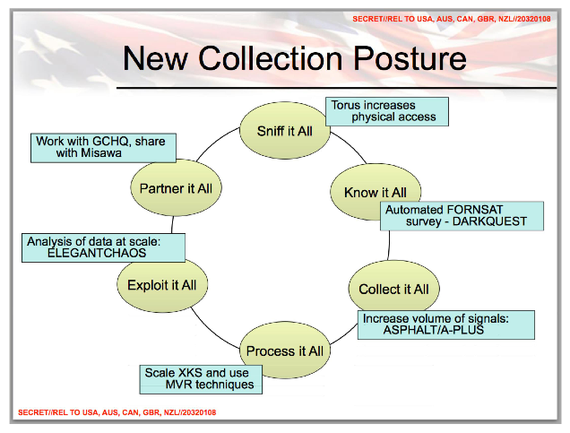
A top secret document retrieved by U.S. whistleblower Edward Snowden and obtained by CBC News shows that Canada’s electronic spy agency used information from the free internet service at a major Canadian airport to track the wireless devices of thousands of ordinary airline passengers for days after they left the terminal.
After reviewing the document, one of Canada’s foremost authorities on cyber-security says the clandestine operation by the Communications Security Establishment Canada (CSEC) was almost certainly illegal.
Ronald Deibert told CBC News: “I can’t see any circumstance in which this would not be unlawful, under current Canadian law, under our Charter, under CSEC’s mandates.”
The spy agency is supposed to be collecting primarily foreign intelligence by intercepting overseas phone and internet traffic, and is prohibited by law from targeting Canadians or anyone in Canada without a judicial warrant.
As CSEC chief John Forster recently stated: “I can tell you that we do not target Canadians at home or abroad in our foreign intelligence activities, nor do we target anyone in Canada.
“In fact, it’s prohibited by law. Protecting the privacy of Canadians is our most important principle.”
But security experts who have been apprised of the document point out the airline passengers in a Canadian airport were clearly in Canada.
CSEC said in a written statement to CBC News that it is “mandated to collect foreign signals intelligence to protect Canada and Canadians. And in order to fulfill that key foreign intelligence role for the country, CSEC is legally authorized to collect and analyze metadata.”
Metadata reveals a trove of information including, for example, the location and telephone numbers of all calls a person makes and receives — but not the content of the call, which would legally be considered a private communication and cannot be intercepted without a warrant.
“No Canadian communications were (or are) targeted, collected or used,” the agency says.
In the case of the airport tracking operation, the metadata apparently identified travelers’ wireless devices, but not the content of calls made or emails sent from them.
January 25, 2014
QotD: The US Constitution
SEEN ON FACEBOOK: “Maybe we should start emailing each other copies of the Constitution, so we can know that the government has read it.”
Glenn Reynolds, Instapundit, 2014-01-24.
January 15, 2014
The NSA’s rise to being the “centerpiece of the entire intelligence system”
In Wired, Felix Salmon explains that “Quants don’t know everything”:
By now, nearly everyone from the president of the United States on down has admitted that the National Security Agency went too far. Documents leaked by Edward Snowden, the rogue NSA contractor who has since gained asylum in Russia, paint a picture of an organization with access to seemingly every word typed or spoken on any electronic device, anywhere in the world. And when news of the NSA’s reach became public — as it was surely bound to do at some point — the entire US intelligence apparatus was thrust into what The New York Times recently called a “crisis of purpose and legitimacy.”
It was a crisis many years in the making. Over the course of three decades, the NSA slowly transformed itself from the nation’s junior spy agency to the centerpiece of the entire intelligence system. As the amount of data in the world doubled, and doubled again, and again, the NSA kept up with it — even as America’s human intelligence capability, as typified by old-fashioned CIA spies in the field, struggled to do anything useful with the unprecedented quantities of signals intelligence they had access to. Trained agency linguists capable of parsing massive quantities of Arabic- and Farsi-language intercepts don’t scale up nearly as easily as data centers do.
That, however, wasn’t the computer geeks’ problem. Once it was clear that the NSA could do something, it seemed inarguable that the agency should do it — even after the bounds of information overload (billions of records added to bulging databases every day) or basic decency (spying on allied heads of state, for example) had long since been surpassed. The value of every marginal gigabyte of high tech signals intelligence was, at least in theory, quantifiable. The downside — the inability to prioritize essential intelligence and act on it; the damage to America’s democratic legitimacy — was not. As a result, during the past couple of decades spycraft went from being a pursuit driven by human judgment calls to one driven by technical capability.
January 11, 2014
February 11th 2014 is The Day We Fight Back Against Mass Surveillance
It may be only a token gesture, but mark 11 February on your calendar:
DEAR USERS OF THE INTERNET,
In January 2012 we defeated the SOPA and PIPA censorship legislation with the largest Internet protest in history. A year ago this month one of that movement’s leaders, Aaron Swartz, tragically passed away.
Today we face a different threat, one that undermines the Internet, and the notion that any of us live in a genuinely free society: mass surveillance.
If Aaron were alive, he’d be on the front lines, fighting against a world in which governments observe, collect, and analyze our every digital action.
Now, on the eve of the anniversary of Aaron’s passing, and in celebration of the win against SOPA and PIPA that he helped make possible, we are announcing a day of protest against mass surveillance, to take place this February 11th.
[…]
We’re creating embeddable banners and widgets that you’ll be able to add to your site to encourage visitors to participate in the day of action. The photo above is just a draft — the final design is yet to come.
January 9, 2014
Oh, that’s okay then – Congress has the same constitutional protections as other Americans (i.e., none whatsoever)
Like Andrew Napolitano, I’m sure all members of congress heaved a sigh of relief when the NSA said that they have exactly the same constitutional right to privacy from surveillance as every other American does. Wait, what?
Last week, Sen. Bernie Sanders, I-Vt., wrote to Gen. Keith Alexander, director of the National Security Administration (NSA), and asked plainly whether the NSA has been or is now spying on members of Congress or other public officials. The senator’s letter was no doubt prompted by the revelations of Edward Snowden to the effect that the federal government’s lust for personal private data about all Americans and many foreigners knows no bounds, and its respect for the constitutionally protected and statutorily enforced right to privacy is nonexistent.
[…]
All of this is background to the timing of Sanders’ letter. That Clapper perjured himself before, and Alexander misled, Congress is nothing new. And the punishments for lying to Congress and for misleading Congress are identical: five years per lie or per misleading statement. Hence, the silence from the NSA to Sanders.
Well, it wasn’t exactly silence, but rather a refusal to answer a simple question. The NSA did reply to Sanders by stating — in an absurd oxymoron — that members of Congress receive the same constitutional protections as other Americans: that is to say, none from the NSA.
The NSA’s refusal to answer Sanders’ question directly is a tacit admission, because we are all well aware that the NSA collects identifying data on and the content of virtually every email, text message and phone call sent or received in the U.S. In fact, just last week, the secret FISA court renewed the order authorizing massive records collection for the 36th time. If members of Congress are treated no differently than the American public, then the NSA is keeping tabs on every email, text and phone call members of Congress send and receive, too.
That raises a host of constitutional questions. Under the Constitution, Congress and the executive branch are equals. The president — for whom the NSA works — can no more legally spy on members of Congress without a search warrant about the members to be spied upon than Congress can legally spy on the president. Surely the president, a former lecturer in constitutional law at the University of Chicago Law School, knows this.
There was a time when the NSA’s failure to answer such a straightforward question as Sanders has asked would have led to hearings and bipartisan investigations. However, Democrats are largely silent, choosing party and personality over principle, and Republicans know all of this started under President George W. Bush and are afraid to open a can of worms — except for King, who apparently likes to be spied upon.
January 8, 2014
“Silicon Valley was … collateral damage in the war on terror”
In Wired, Steven Levy explains how the NSA nearly killed the internet:
On June 6, 2013, Washington Post reporters called the communications departments of Apple, Facebook, Google, Yahoo, and other Internet companies. The day before, a report in the British newspaper The Guardian had shocked Americans with evidence that the telecommunications giant Verizon had voluntarily handed a database of every call made on its network to the National Security Agency. The piece was by reporter Glenn Greenwald, and the information came from Edward Snowden, a 29-year-old IT consultant who had left the US with hundreds of thousands of documents detailing the NSA’s secret procedures.
Greenwald was the first but not the only journalist that Snowden reached out to. The Post’s Barton Gellman had also connected with him. Now, collaborating with documentary filmmaker and Snowden confidante Laura Poitras, he was going to extend the story to Silicon Valley. Gellman wanted to be the first to expose a top-secret NSA program called Prism. Snowden’s files indicated that some of the biggest companies on the web had granted the NSA and FBI direct access to their servers, giving the agencies the ability to grab a person’s audio, video, photos, emails, and documents. The government urged Gellman not to identify the firms involved, but Gellman thought it was important. “Naming those companies is what would make it real to Americans,” he says. Now a team of Post reporters was reaching out to those companies for comment.
It would be the start of a chain reaction that threatened the foundations of the industry. The subject would dominate headlines for months and become the prime topic of conversation in tech circles. For years, the tech companies’ key policy issue had been negotiating the delicate balance between maintaining customers’ privacy and providing them benefits based on their personal data. It was new and controversial territory, sometimes eclipsing the substance of current law, but over time the companies had achieved a rough equilibrium that allowed them to push forward. The instant those phone calls from reporters came in, that balance was destabilized, as the tech world found itself ensnared in a fight far bigger than the ones involving oversharing on Facebook or ads on Gmail. Over the coming months, they would find themselves at war with their own government, in a fight for the very future of the Internet.