Quotulatiousness

March 28, 2019

Canada and the Battle of the Atlantic, part 2 by Alex Funk

Filed under: Cancon, History, Military, WW2 — Tags: , , , , — Nicholas @ 05:00

Editor’s Note: This series was originally published by Alex Funk on the TimeGhostArmy forums (original URL – https://community.timeghost.tv/t/canada-and-the-battle-of-the-atlantic-part-1-edited/1433).

Sources:

  • The Far Distant Ships, Joseph Schull, ISBN 10 0773721606 (An official operational account published in 1950, somewhat sensationalist)
    [Schull’s book was published in part because the funding for the official history team had been cut and they did not feel that the RCN’s contribution to the Battle of the Atlantic should have no official recognition. It is very much an artifact of its era, and needs to be read that way. A more balanced (and weighty) history didn’t appear until the publication of No Higher Purpose and A Blue Water Navy in 2002, parts 1 and 2 of the Official Operational History of the RCN in WW2, covering 1939-1943 and 1943-1945, respectively.]
  • North Atlantic Run: the Royal Canadian Navy and the battle for the convoys, Marc Milner, ISBN 10 0802025447 (Written in an attempt to give a more strategic view of Canada’s contribution than Schull’s work, published 1985)
  • Reader’s Digest: The Canadians At War: Volumes 1 & 2 ISBN 10 0888501617 (A compilation of articles ranging from personal stories to overviews of Canadian involvement in a particular campaign. Contains excerpts from a number of more obscure Canadian books written after the war, published 1969)
  • All photos used exist in the Public Domain and are from the National Archives of Canada, unless otherwise noted in the caption.

I have inserted occasional comments in [square brackets] and links to other sources that do not appear in the original posts. A few minor edits have also been made for clarity.

Part 2 — The Admiralty takes control

On August 26, just a few days before the official outbreak of war, a single word Admiralty telegram was received in Ottawa from London: FUNNEL. With that message all British merchant vessels passed under Admiralty control. The same transfer took place in Canada on the same day. No Canadian-registered ship, no merchant ship in any Canadian port could sail without the authority of the Royal Canadian Navy. Naval control officers faced an enormous task. All British merchant vessels in North American waters would have to be gathered in from the wide face of the sea, assembled, bunkered, stored, provided with codes and orders. Vessels of every type would have to be formed into orderly fleets, sailed at precise times and by specified routes with the precision of a crack railway, all in absolute secrecy. Halifax stirred once again with the grim vitality of a key port in a world at war. Ships put in, their schedules interrupted, their captains angry, demanding explanations they didn’t get. Painting parties descended to defile clean white ships with the drab gray of military vessels. Old naval guns were mounted on merchantmen and a few ships were issued machine guns.

[Editor’s Note: Unlike the Royal Navy’s comparatively vast administrative resources for organizing convoys, the RCN had to draw heavily upon a small number of retired RN and RCN officers living in Canada and the United States to gather enough officials to establish convoy control in Canadian ports (the same pool would also be used to recruit convoy commodores). It’s difficult for modern readers, used to networked computers with online databases, to realize just how much literal paperwork had to be created and maintained from scratch to even begin organizing the convoy system from North America to the UK: that it was done at all is amazing. That it was done about as well as could be hoped is incredible.]


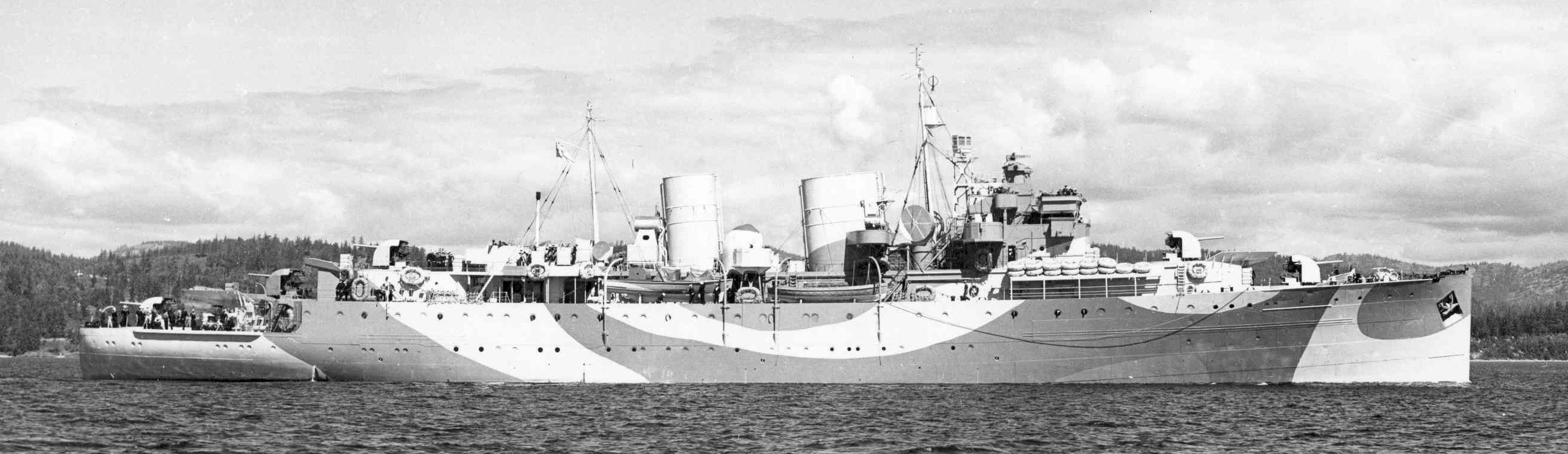
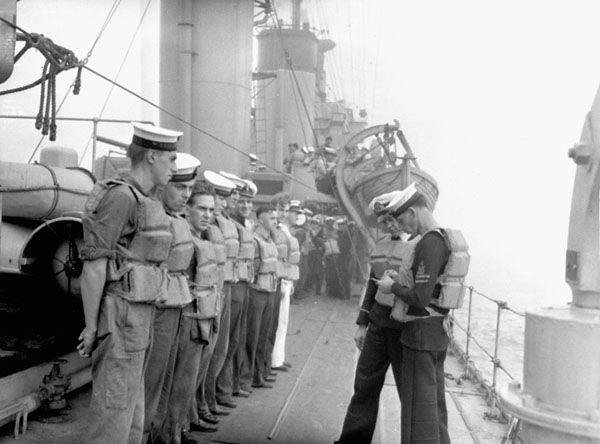
Ratings mustered along the starboard side of HMCS Assiniboine at sea, ca. September 1940.
Canada. Dept. of National Defence / Library and Archives Canada / PA-104105

On August 31st HMCS Fraser and St. Laurent were re-deployed to the east coast from the west coast.

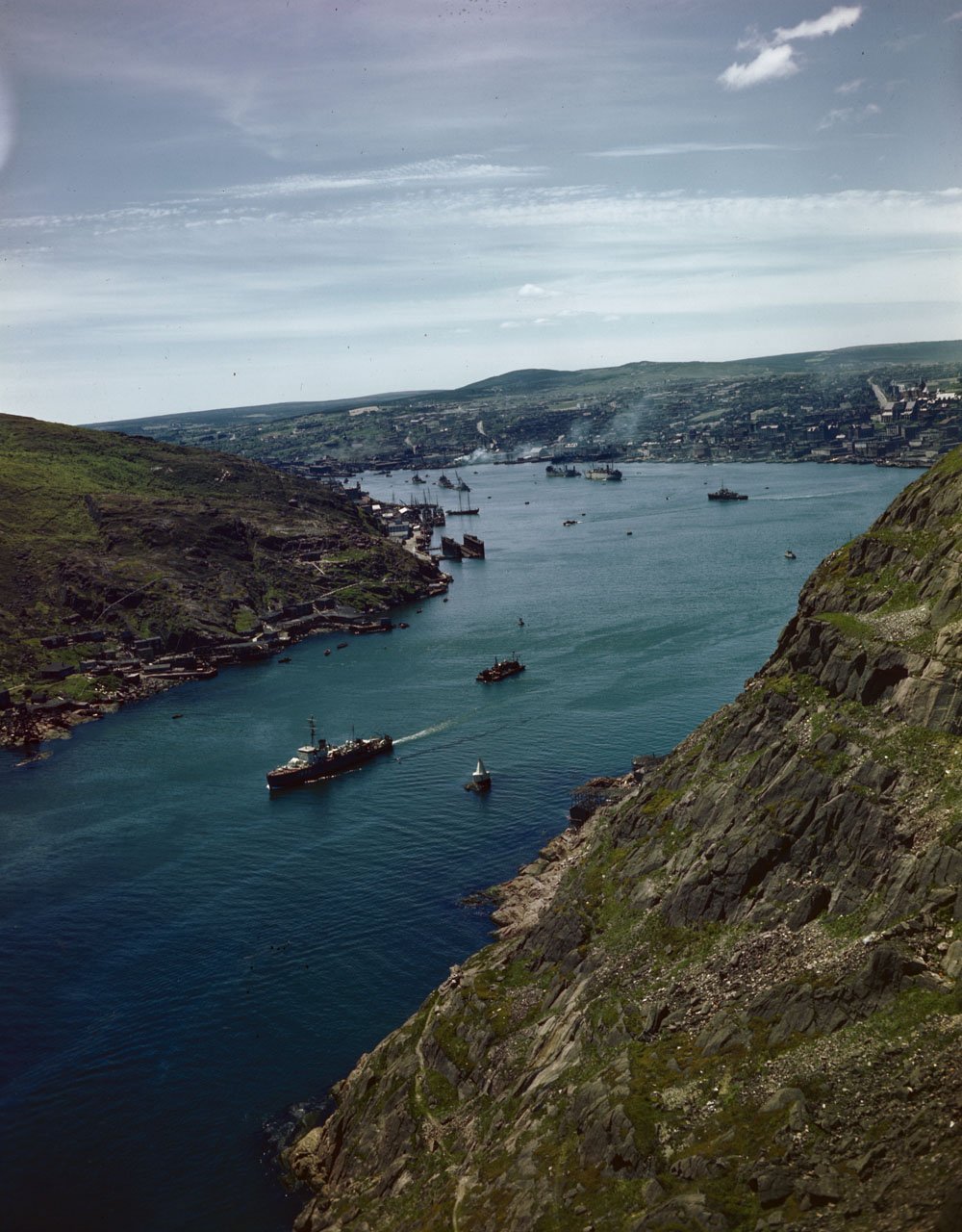
On September 16th, six days after Canada declared war, the destroyers St. Laurent and Saguenay moved out through the Halifax approaches. Following behind were the 18 merchant ships of convoy HX-1, Halifax to the UK. Awaiting them offshore were the Royal Navy cruisers HMS Berwick and HMS York. The crossing was uneventful, but these 18 were the first of a grand total of 25,343 merchant vessels that would sail from North America under Canadian escort.

To briefly discuss the convoy system itself, it’s fairly simple: merchant vessels sail in organized groups rather than on their own and are provided some form of naval escort to protect them from hostile vessels. Even lightly guarded convoys are immensely preferable to ships sailing on their own, reducing the width of the target area and forcing any potential attacker to weigh the risk of counter-attack by the escorts. [Editor’s Note: It may seem odd to landlubbers like most of us, but even a large convoy is not much easier to find than a single ship in the wide ocean. Fewer discrete targets requires more search time by enemy submarines and surface raiders.] The speedier the convoy, the better, but the limited speed of many of the merchant ships necessitated a system of fast and slow convoys with different starting points in the Americas, and different codes for identification. The merchant vessels are described by Alan Easton, captain of the corvette HMCS Baddeck in 50 North: Canada’s Atlantic Battleground [Easton’s book is factual in most ways except for the dialogue and some of the names being changed]:

We sailed to Sydney, Nova Scotia. There we spent the night, topped up with fuel and stood out of the harbour early the next morning, where we were to await the convoy we had been instructed to escort. Many ships were lying at anchor that morning in the fine, land-locked harbour, ships of numerous different Allied and neutral nations, for this was the assembly port for the eastbound slow Atlantic convoys in those days. As we moved back and forth off the harbour mouth, I fell to examining the ships as they came out, one behind the other at intervals of three or four minutes, led by the Commodore’s ship. It was always intensely interesting to me to gaze at the ships. The more weatherbeaten and decrepit the ship, the more attractive she was to me; she had a story to tell and I could sometimes discern a part of it by just looking. The newest might have been ten years old, the oldest perhaps forty or fifty. Some were built of iron — the inch-thick plating of the 1880s, before the days of steel. They were large and small, from about nine hundred tons to nine thousand. You could tell almost at a glance their nationality, or the country in which they were built, by the shape of their hulls and the construction of their upperworks. But as they came out they flew their ensigns, soon to be hauled down, so that you could not mistake their identity. They were all heavily laden, few that were not down to their Plimsoll marks and some with little freeboard, perhaps four feet between the water and the well deck.

The first ship moved slowly, marking time as it were, to allow the others to take their stations, so that the whole could form into three columns. Soon after noon, the Commodore seemed to be satisfied that all were in their correct places for he ran up a flag hoist indicating that the speed of the convoy was to be seven knots. When every ship had signified that she understood his signal, the Commodore hauled his flags down and the engines of this heterogeneous collection of vessels simultaneously moved faster, although to the onlooker there was no perceptible change in speed.

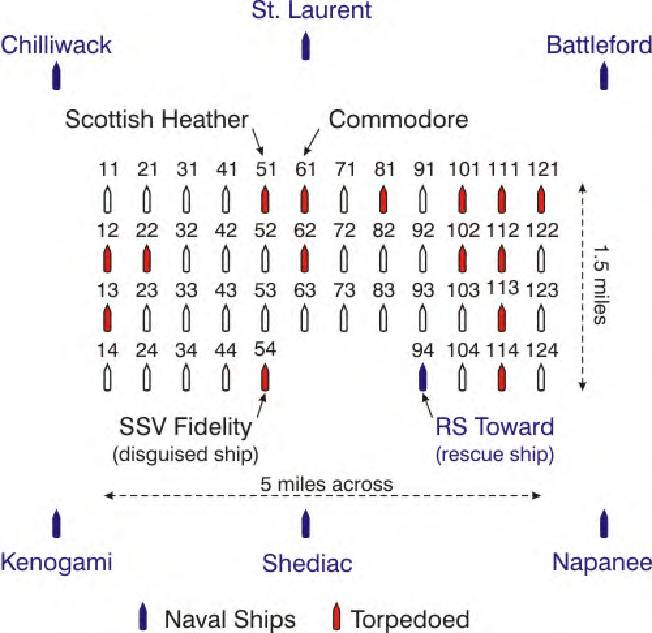
The fast/slow system was implemented fairly early on, and by August 1940 slow convoys were more often being formed in Sydney, Nova Scotia, the faster convoys in Halifax. By 1941, fast convoys left every six days and made the crossing in around 13 to 14 days. Slow convoys left every six days as well, but took 16 to 17 days to cross. The size of the convoys varied. The largest convoy to ever make the crossing was HXS-300 consisting of 167 ships, but a good benchmark was 40 or so merchant vessels. These ships are positioned in a grid with nine columns, 920 metres apart, and in each column five ships, 550 metres apart. Ships carrying dangerous cargoes, such as gas, fuel, or explosives are placed in the centre, the position that affords the most protection against enemy torpedoes. The convoy commodore, in most cases a retired naval officer, is on board one of the merchant ships to take defensive measures as required and ensure coordination with the escort.

[Editor’s Note: An image from Swansea Docks showing the schematic arrangement of slow convoy ONS-154 returning to Halifax later in the war:]

Convoy ONS-154 in December, 1942. The numbers indicate the column and row designations for each merchant ship in the convoy.
Image by Ron Tovey, Swansea Docks – click the image to visit his site.

The following system of codes was used for identification of trans-Atlantic convoys:

    HX: Fast convoys (9 knots or over) sailing from Halifax (or later New York)
    SC: Slow convoys (under 9 knots) sailing from Sydney, Halifax, or New York
    ON: westbound convoys sailing from Great Britain to North America
    ONS: slow westbound convoys sailing from Great Britain to North America

The following system of call letters was used for identification of coastal convoys:

    BX: Boston to Halifax
    XB: Halifax to Boston
    SQ: Sydney to Quebec City (via the St. Lawrence River)
    QS: Quebec to Sydney

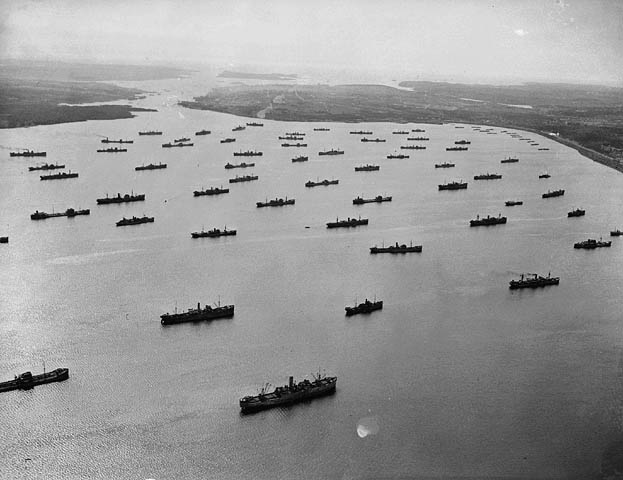
Convoy forming in Bedford Basin, 1 April, 1942
Canada. Dept. of National Defence / Library and Archives Canada / PA-112993

There was much debate among Canadian politicians as to the role Canada would play in the war in general. In the first few weeks, much debate was had as to which services would receive what money, and how they would be integrated into the allied war effort. Prime Minister Mackenzie King had somewhat sold the war to the nation as being different from the last war [Editor’s Note: where Canada provided an over-strength army corps for the Western Front, suffering nearly 60,000 combat deaths, slightly more than the US combat losses in that war]. Finance Minister J. L. Ralston publicly envisaged a program that would be “practical rather than spectacular”. The Prime Minister spoke of protecting Canada by sending food and raw materials to Britain and building a navy and air force and munitions industry, even the first musings of what would become the BCATP [British Commonwealth Air Training Plan] (though these early plans paled in comparison to what it would eventually become.) Canada would contribute vast amounts of resources to the allied cause, but there was not going to be a need for a large land army to fight and die in Europe. The army was just as short of equipment as the navy was and the air force consisted of 3100 men and 270 mostly obsolete aircraft, with just 19 modern Hurricanes. The old issue of conscription that had led to riots in Montreal in 1917 immediately reappeared, and an important provincial election in Quebec had been called within two weeks of the declaration of war in almost direct response to it. [Editor’s Note: The risk of another conscription crisis haunted the Canadian government from the very start of the war: English Canada was heavily in favour, but Quebec was just as opposed, and the ruling Liberal Party couldn’t risk losing their support in Quebec.] What soldiers Canada did have departed Halifax as part of convoy TC-1 in early December, and by the end of the month Canada had 15,000 men in England (the 1st Canadian Infantry Division).

It is the opinion of my sources that the idea of a limited war were extremely favorable to the navy and air force in the early months. Canadian naval vessels and aircraft fighting alongside the United Kingdom was seen as an appropriate contribution, whilst at the same time, seen as far less costly in terms of lives than a large expeditionary army, which Mackenzie King was steadfastly opposed to (fear of conscription crisis was ever present). Canada’s merchant fleet was at Britain’s disposal without question, combined with the vast natural resources she could provide, quite nicely rounded out the “limited war” concept. Industrial military capacity was small, almost non-existent, and building ships, aircraft and munitions would help it grow.

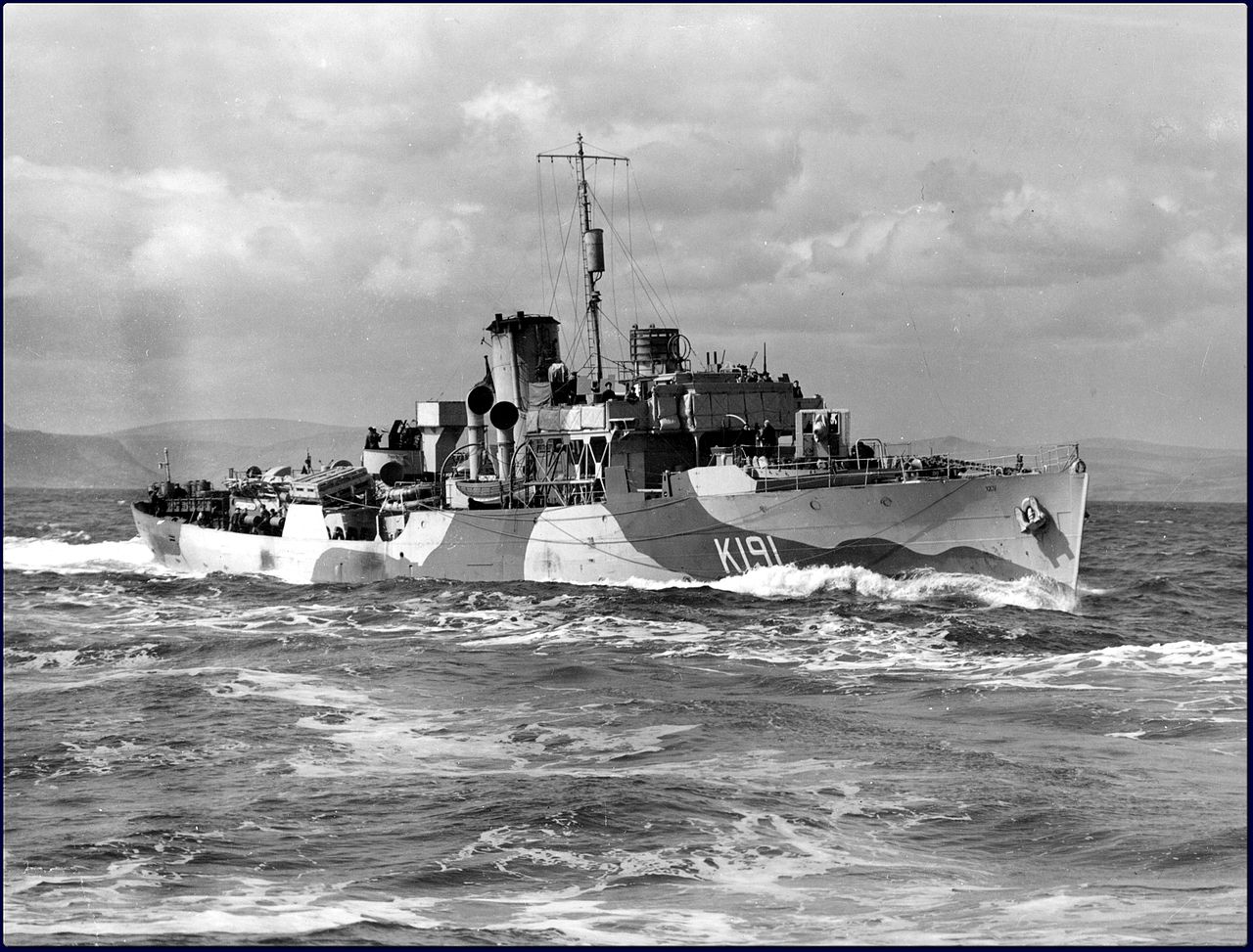
Focusing specifically on the navy itself, what few ships it had were immediately deployed on patrols and put to work escorting coastal convoys within coastal waters, and trans-Atlantic convoys to a handover point mid-voyage. The reserves were activated and sent to the coasts. In November all the Canadian destroyers were placed under the command of the Royal Navy’s North America and West Indies station (somewhat to the Government’s dismay, although not the navy’s: most RCN officers had close peacetime ties to the British squadron and felt it was the natural choice. They had actually requested this at the start of the war and had been refused by the government, who wanted the RCN’s ships kept close to home.) This placement also had the benefit of assuring the RCN that they would participate in the types of operations they had trained for; fleet work, or sweeps for surface raiders. October 1939 saw the purchase of a another destroyer, re-named HMCS Assiniboine in Canadian service. These seven River-class destroyers would form the backbone of the navy well into 1943. A modest attempt had been made in 1938 to give Canadian yards some experience building warships with a minesweeper program. Despite the dispersal of the contracts to both Atlantic and Pacific yards for four Fundy-class minesweepers, the Canadian shipbuilding industry was unprepared for the demands wartime was to make of it.

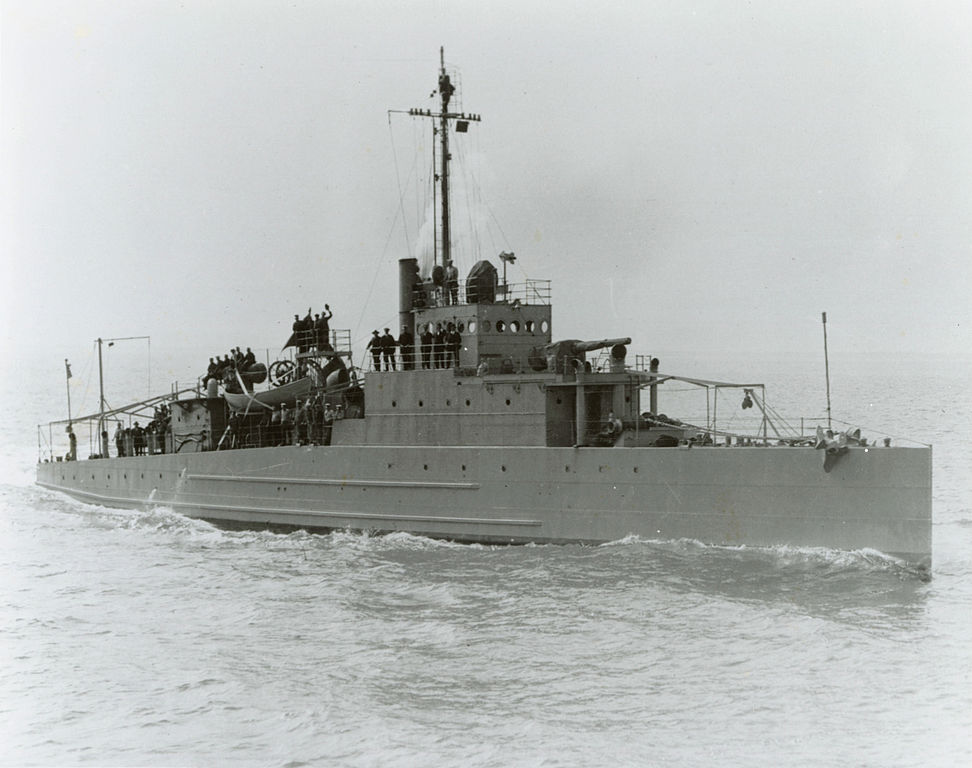
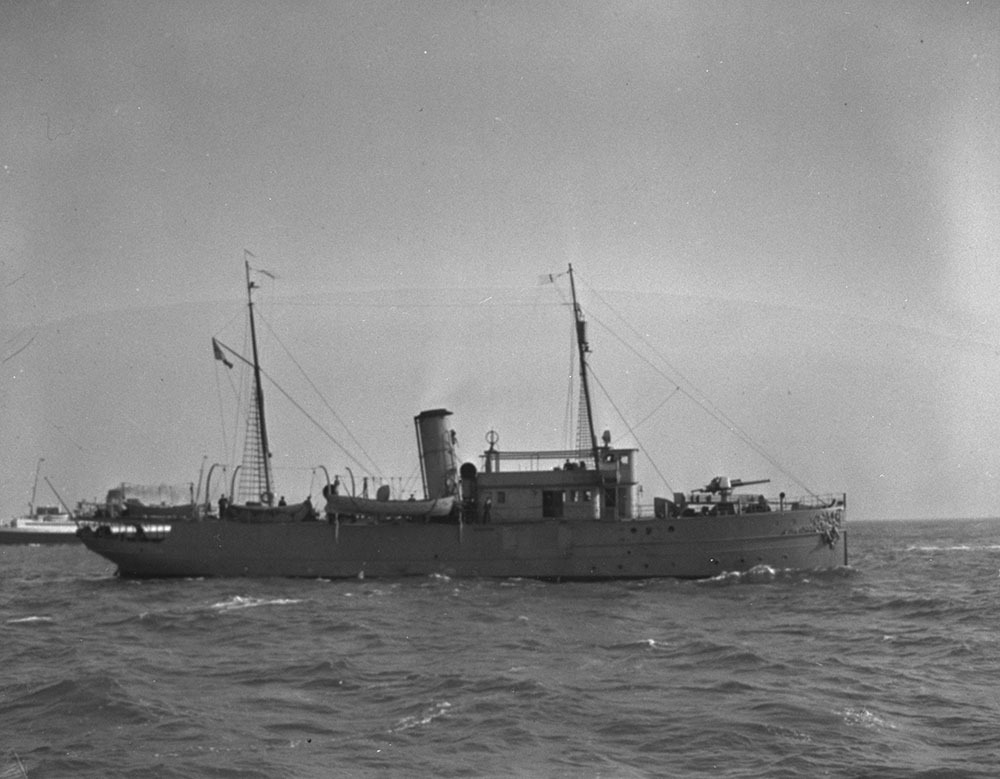
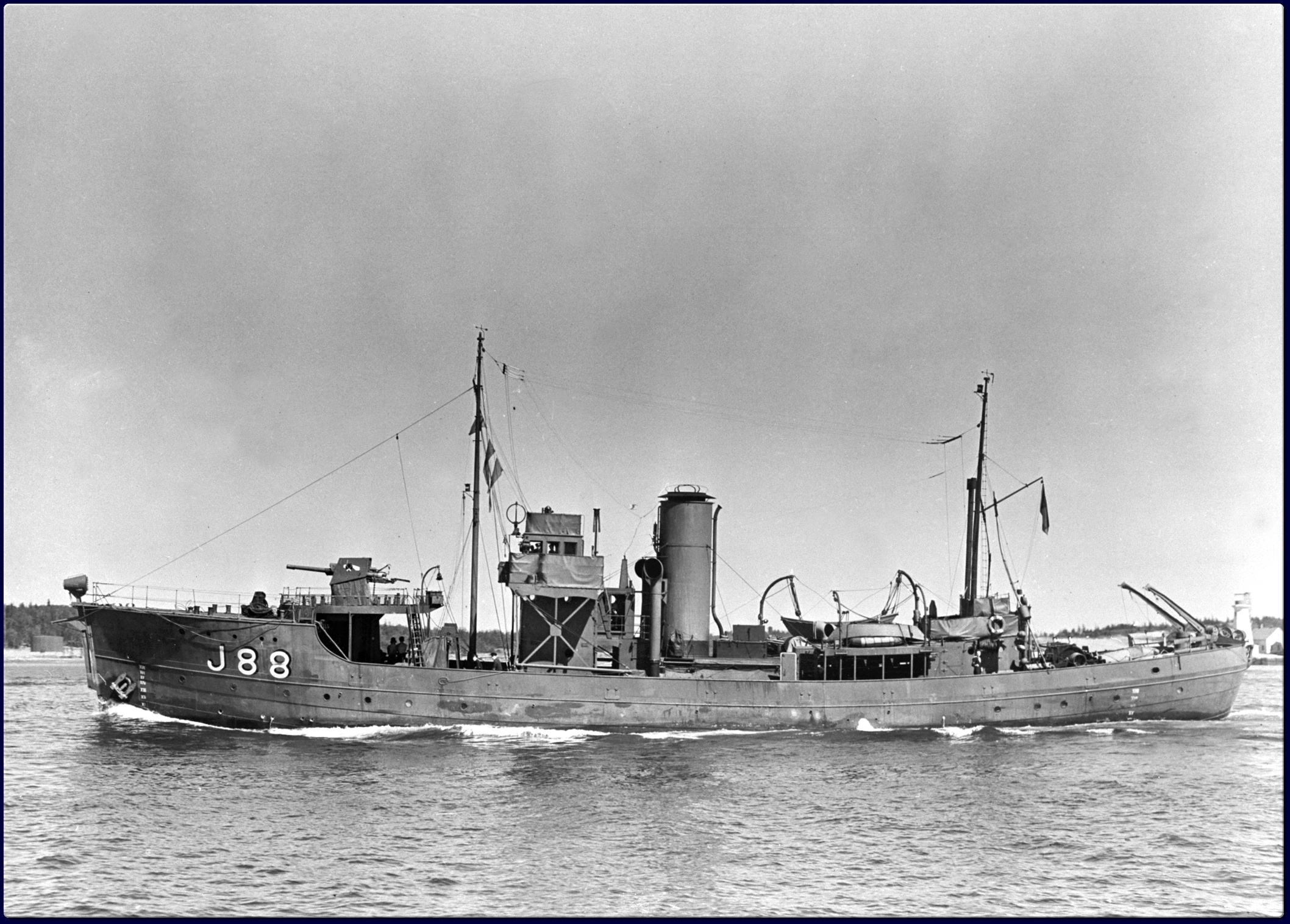
Undated photograph of RCN minesweeper HMCS Fundy (J88).
Canadian Navy Heritage website. Image Negative Number NP-1404 via Wikimedia Commons.

In North Atlantic Run, Marc Milner discusses the Ottawa front of the RCN’s early wartime struggles:

In the government the navy actually had a friend, as it discovered when planners began to submit estimates for expansion. As the late Admiral L.W. Murray, RCN (in September 1939, the Director of Operations and Training) recalled, the navy was given a carte blanche to plan its growth over the succeeding four or five years. When in February 1940 Murray and the deputy minister presented the first wartime naval estimates before the Finance Committee of the cabinet, they passed despite a “fine-tooth comb” inspection. The fact was that the navy’s expansion and its attendant shipbuilding programs suited the government’s intention to profit from what was seen as a limited European war. The prime minister, W.L. Mackenzie King, was steadfastly opposed to fielding yet another large army in Europe, which might lead to high casualties and a call for conscription. Rather, his government sought to channel Canada’s war effort into the sinews of war and into much less personnel-intensive services such as the air force and the navy. Both of these services also offered excellent opportunities for the development of Canadian industry.

The link between industrial and naval expansion also went deeper than simply the building of ships. In July 1940, the expansion of the navy was given impetus by the appointment of a separate minister of Defence for the Naval Service. King chose Angus L. Macdonald, former premier of Nova Scotia. Although once rather uncharitably described as “lightweight”, Macdonald was extremely popular in his home province and a strong voice for Nova Scotia in Ottawa. Macdonald and two other prominent Nova Scotians, Colonel J.L. Ralston, the Minister of Defence, and J.L. Ilsley, the Minister of National Revenue, formed the right wing of King’s cabinet — what J.W. Dafoe called the “Tory Imperialists”. All supported a full war effort, a position that led in 1944 to a bitter break between King and the two defence ministers over the issue of conscription. But apart from Macdonald’s desire to see Canada fully represented at the front, he shared many of King’s beliefs, including the notion that the preservation of the free world depended upon the retention of power in Canada by the Liberal Party.

Macdonald also believed that Canada could and should progress industrially from the war. Long a crusader for the re-industrialization of Nova Scotia, he saw an opportunity to funnel some of government investment into his own province. There was, moreover, a direct link between industrial growth and a large navy. “What use could it be to increase our agricultural production … or to put forth the magnificent industrial effort that we have,” Macdonald asked in 1945, “unless this food and these munitions could be got safely across the sea?” Although in the end he failed to restore to Nova Scotia its past lustre, this was precisely the rationale used to justify building destroyers in Halifax during the war. In the most fundamental sense, then, the aspirations of the [full-time, professional] navy and the government coincided.

March 27, 2019

Canada and the Battle of the Atlantic, part 1 by Alex Funk

Filed under: Cancon, History, Military, WW1, WW2 — Tags: , , , — Nicholas @ 05:00

Editor’s Note: This series was originally published by Alex Funk on the TimeGhostArmy forums (original URL – https://community.timeghost.tv/t/canada-and-the-battle-of-the-atlantic-part-1-edited/1433).

Sources:

  • The Far Distant Ships, Joseph Schull, ISBN 10 0773721606 (An official operational account published in 1950, somewhat sensationalist) [Schull’s book was published in part because the funding for the official history team had been cut and they did not feel that the RCN’s contribution to the Battle of the Atlantic should have no official recognition. It is very much an artifact of its era, and needs to be read that way. A more balanced (and weighty) history didn’t appear until the publication of No Higher Purpose and A Blue Water Navy in 2002, parts 1 and 2 of the Official Operational History of the RCN in WW2, covering 1939-1943 and 1943-1945 respectively.]
  • North Atlantic Run: the Royal Canadian Navy and the battle for the convoys, Marc Milner, ISBN 10 0802025447 (Written in an attempt to give a more strategic view of Canada’s contribution than Schull’s work, published 1985)
  • Reader’s Digest: The Canadians At War: Volumes 1 & 2 ISBN 10 0888501617 (A compilation of articles ranging from personal stories to overviews of Canadian involvement in a particular campaign. Contains excerpts from a number of more obscure Canadian books written after the war, published 1969)
  • All photos used exist in the Public Domain and are from the National Archives of Canada, unless otherwise noted in the caption.

I have inserted occasional comments in [square brackets] and links to other sources that do not appear in the original posts. A few minor edits have also been made for clarity.

Canada and the Battle of the Atlantic, part 1

Canada’s navy before WW2

This is my modest attempt to illustrate Canada’s contribution to the Battle of the Atlantic and the war at sea in general. In my honest opinion it was the most important thing we did as a nation aside from the BCATP (British Commonwealth Air Training Plan).

The Naval Service of Canada/Royal Canadian Navy before World War 2

The Royal Canadian Navy (RCN) was founded in 1910 under the Naval Service Bill re-introduced by Prime Minister Wilfrid Laurier (its first attempt at approval under George Foster in 1909 had failed), creating the Naval Service of Canada [Wikipedia – https://en.wikipedia.org/wiki/Origins_of_the_Royal_Canadian_Navy]. A distinct naval force for the Dominion of Canada to be maintained and manned by Canadians, which could be placed under British control if needs be. Two ex-Royal Navy vessels were obtained for the purposes of training [cruisers HMCS Niobe and HMCS Rainbow].

[There actually was an even earlier attempt to create a Canadian navy, as related by Joseph Schull:]

There had been one hint, in 1880, of an awareness of naval needs. A dispatch from the Governor General to the Colonial Secretary had suggested that Canada “would not be averse to instituting a ship for training purposes if the Imperial Government would provide the ship.” To the restrained enthusiasm of this proposal the Admiralty had responded with appropriate generosity. Charybdis, an ancient steam corvette, was at the time limping homeward from the China Station. The Canadian Government could have her.

When Charybdis arrived in the United Kingdom it was discovered that her boilers were worn out. Canada paid for their replacement. The ship was then coaxed and coddled across the Atlantic by a redoubtable Captain Scott, R.N., retired. Upon arrival in Saint John, Charybdis broke loose from her moorings in a gale and damaged much of the shipping in harbour. She had hardly been secured, and the clamour of aggrieved shipowners had not died down, when two Saint John citizens, attempting to come on board, fell through the rotting wood of her gangplank and were drowned. It was sufficient naval experience for the Canadian Government of that time. The wreck was towed from Saint John and turned over to the unwelcoming authorities of the Royal Navy. Charybdis became a gruesome memory, a political Flying Dutchman which heaved over the horizon when any naval proposal was advanced during the next thirty years.

The election of a new government (which had opposed the original bill) in 1911 left the new service in limbo. [Also in 1911, the Naval Service was given permission by King George V to rename itself the Royal Canadian Navy.] Nevertheless, between the two ex-Royal Navy vessels, two submarines purchased from the US [by the provincial government of British Columbia(!)], and two government patrol vessels pressed into military service the RCN spent the early years of World War 1 patrolling the east and west coasts of North America and sometimes as far south as Panama to deter the German naval threat. As that real or perceived threat slowly evaporated, the Canadian Navy’s patrols became less frequent.

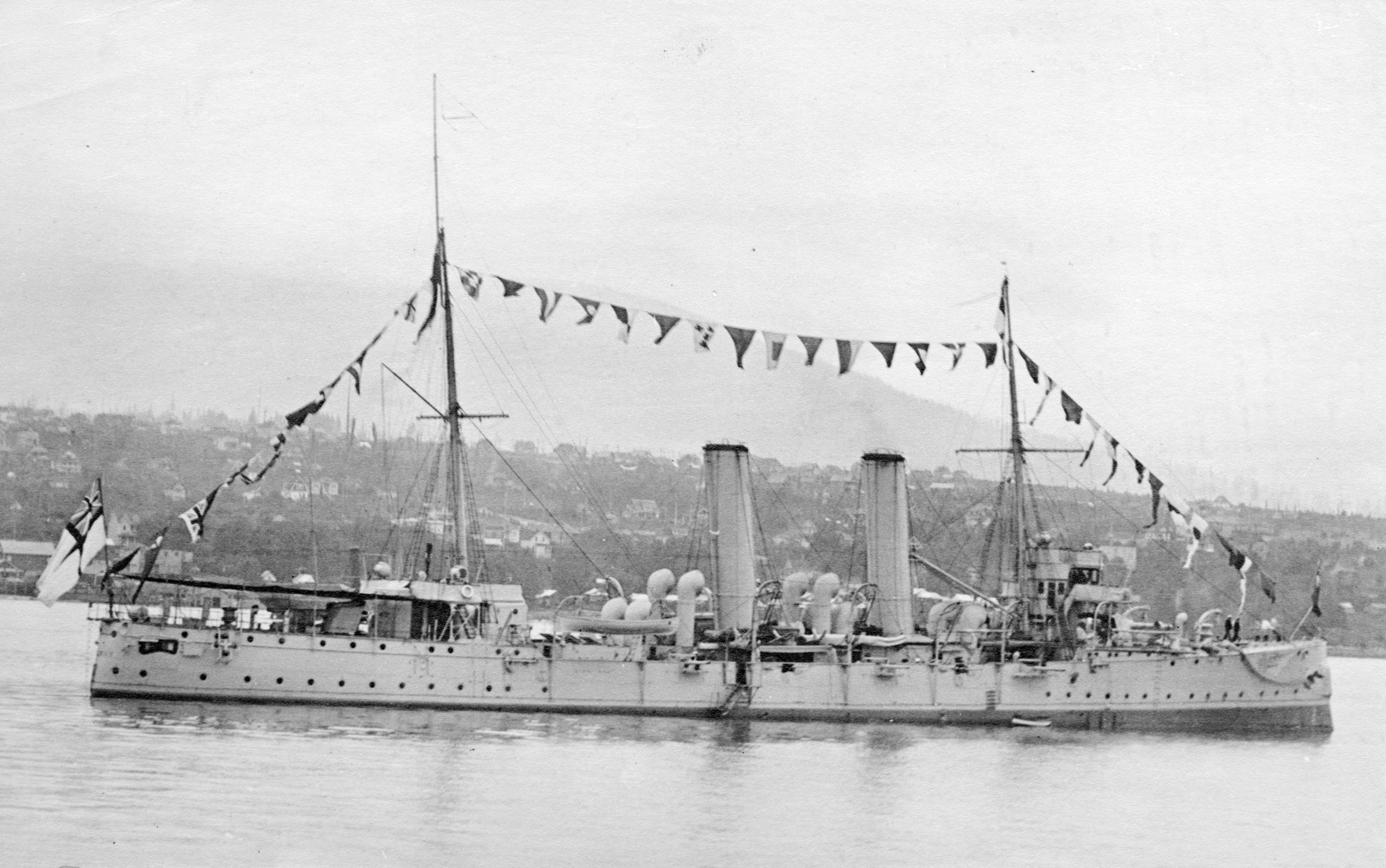
HMCS Rainbow at North Vancouver, 1910.

Photo from the City of Vancouver Library, the collection of Matthews, James Skitt, Major (1878-1970) via Wikimedia Commons.

The First World War saw the modest beginnings of the Canadian Navy, although it should be pointed out that many more Canadians chose to serve in the Royal Navy than the Canadian one, some as officers.

The inter-war years saw very little growth for the RCN. The post-war drawdown naturally occurred, and by 1922 the service had only 366 men and had paid off their only remaining cruiser. The Naval Volunteer Reserve was firmly established in Canadian cities across the country (and numbered around 1,000 men) but the Navy itself only kept two destroyers donated by the Royal Navy in service [HMCS Patriot and HMCS Patrician], until these were replaced by two more destroyers in the late 1920s (once again, ex-RN [ships renamed as HMCS Champlain and HMCS Vancouver]). 1931 saw a major facelift with the first ships built specifically for the RCN: HMCS Skeena and HMCS Saguenay.

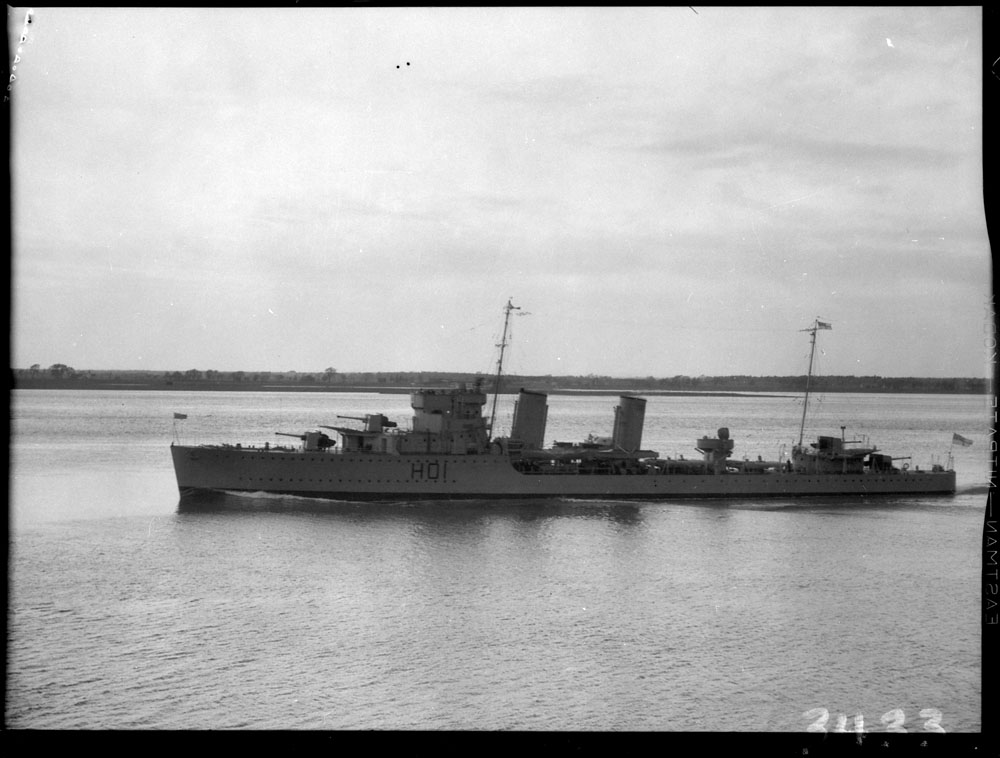
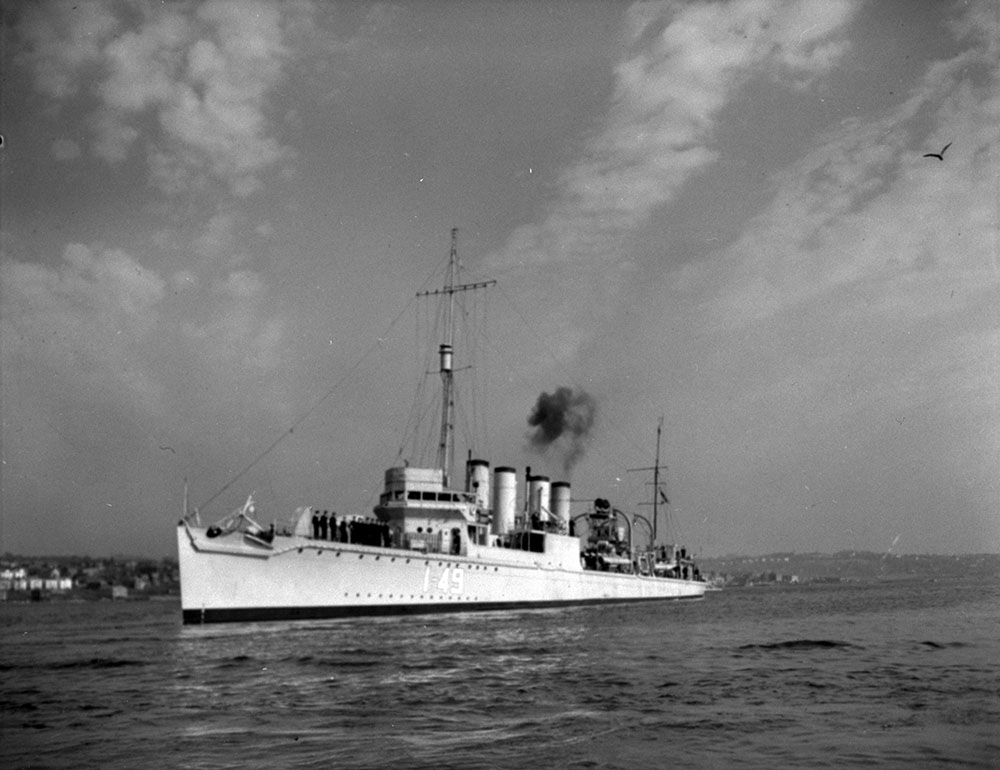
The early 1930s saw the Navy along with the other Canadian service branches almost completely starved of funding, although by the late 30s, escalating world tension convinced the Canadian government to slowly begin rebuilding. Two more destroyers were purchased from the Royal Navy in 1937 (HMCS Fraser and HMCS St Laurent) and then two more in 1938 (HMCS Ottawa and HMCS Restigouche).

Marc Milner outlines the RCN’s original expansion plans in North Atlantic Run:

In January 1939 the government, reacting to the Munich crisis, announced its intentions to proceed with building a fleet capable defending Canada’s two coasts. The expansion plan, when completed, would give the RCN a strength of eighteen modern destroyers, sixteen minesweepers, and eight anti-submarine vessels, the numbers split evenly between Pacific and Atlantic commands, and a flotilla of eight motor torpedo boats for the east coast. Not surprisingly, little came of this plan before war broke out. In fact, by May the government had sharply cut the navy’s estimates. The 1939 building program (four anti-submarine vessels and two motor torpedo boats) was scrapped, and there was just enough money left to acquire the necessary plans. It is, however, significant that the RCN’s expansion plans were laid down in the last days of peace. Later developments would thrust a new form of expansion on the RCN, one more easily attainable in wartime than a fleet of destroyers, yet one which did not conform to the long-term goals of the professional navy.

Thus, by the outbreak of the Second World War in September 1939, the RCN consisted of six River-class destroyers, five minesweepers, and two small training vessels.

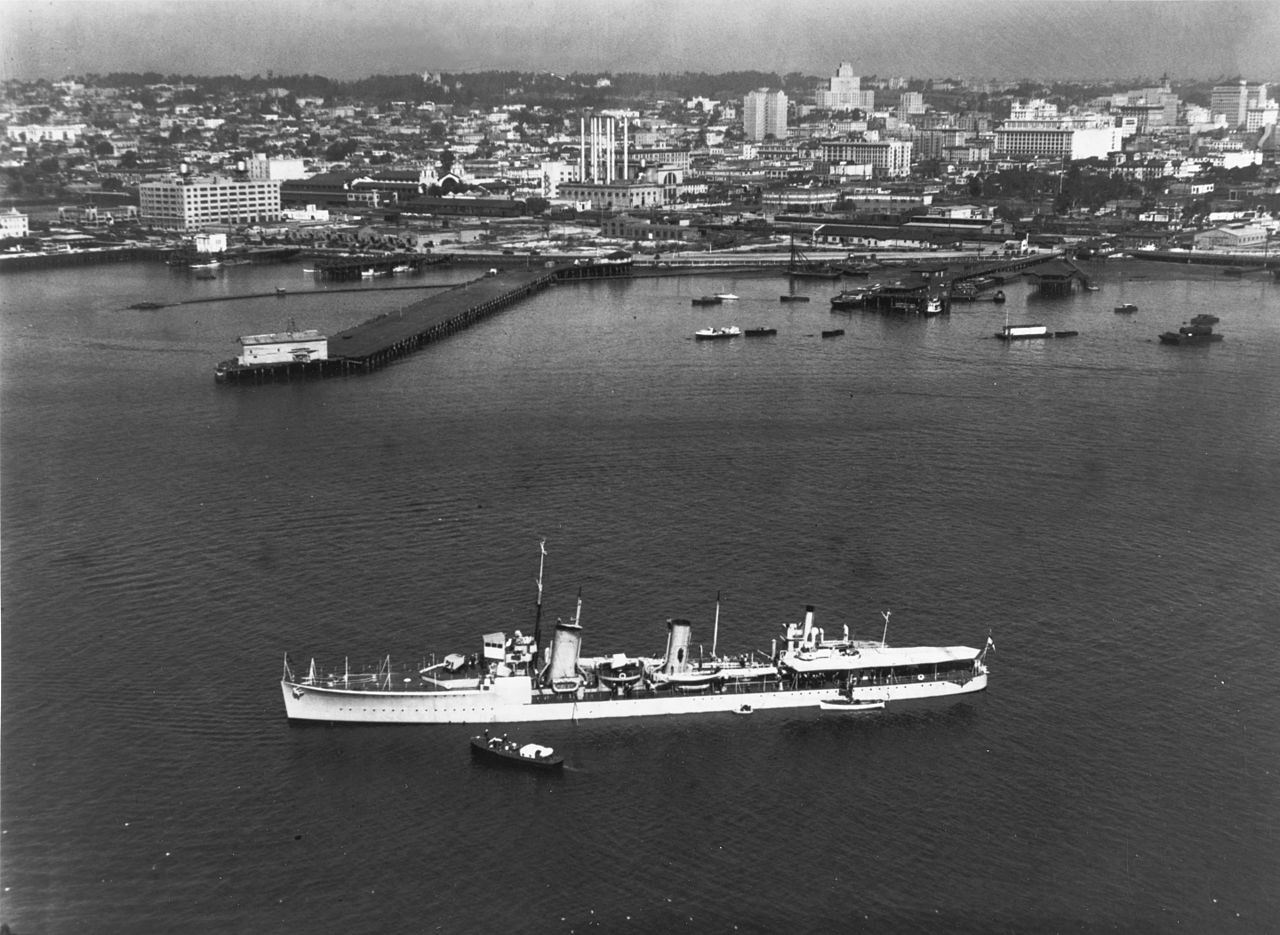
HMCS Vancouver (F6A) anchored off San Diego, California (USA), on 5 March 1929.
Official U.S. Navy photo 80-G-416377 from the U.S. Navy Naval History and Heritage Command, via Wikimedia Commons.

The January 1939 expansion plan belied the fact that the RCN was a traditional, gun-oriented navy. The experiences of the First World War and technological developments since had confirmed the sanctity of the gun as the pre-eminent naval weapon. Admittedly, the threat from Germany’s U-boats in 1917 had been grave. But her indiscriminate use of the submarine had brought the United States into the conflict on the Allied side and (or so it seemed) therefore cost Germany the war. It was felt that in future no nation would risk the sanction of a world coalition by resorting to “piracy” on the high seas. But even if Germany, or any other nation, turned once again to unrestricted submarine warfare on merchant shipping, the means of defeating the threat was already in service with Commonwealth navies — convoy and ASDIC.

During the First World War, before the adoption of the convoy system, German U-Boats preferred to use their deck guns to destroy lone merchant vessels, using their precious torpedoes sparingly. With the introduction of the convoy system, the days of easy targets vanished and the proximity of naval escort forced the U-Boat to either risk fighting an unequal surface battle against more heavily gunned escorts or to operate submerged. Convoys made the oceanic routes much safer, but this success was not unmixed. Cargo ships continued to sail independently and unescorted to and from convoy assembly ports in British coastal waters, and the U-boats resorted to submerged attack tactics inshore. Although Britain was never again threatened with defeat by starvation, losses to merchant shipping remained high for the rest of the war because of the virtual immunity of a submerged submarine to any threat of effective counter-attack by escort ships.

With the U-Boats relegated to nuisance status through the use of convoys, their final telling defeat simply awaited the perfection of a reliable underwater-detection device. The Allied Submarine Detection Investigation Committee was established in 1918 to resolve this problem, but it was not until the early twenties that an effective underwater sound locating and ranging set (now called sonar) was in use. ASDIC, as the British called the device, was to spell the doom of the submarine. As late as 1936 the First Sea Lord [the professional head of the Royal Navy], Admiral A.E.M. Chatfield, claimed that the RN’s anti-submarine measures were 80% effective. With location no longer a problem, it was believed that destruction of a submarine by a few well-placed depth charges would follow with equal certainty.

If anything, Canadian planners, like those elsewhere, were absorbed by the unknown dangers of air attack on trade (particularly on convoys) and by the very real threat of powerful enemy surface raiders. Both of these also presented Canada with the only real threat of direct enemy action. The RCN was therefore charged with defence against surface and air attacks on Canada and on trade in adjacent waters — the two were really inseparable. The “forms and scales of attack to which Canada would be subject,” as anticipated in 1939, reflected the preoccupation with surface and air threats. Bombardment by a single battleship and/or one or two large cruisers, by armed merchant cruisers (AMCs), or even by heavily gunned submarines was felt likely. Attacks could also be expected in the form of MTBs launched from larger ships, mines, small assault parties, or aircraft carrying torpedoes, bombs, or gas. Indeed, it was thought that aircraft launched from remote points along the Canadian coast might penetrate as far inland as Toronto. Certainly, the major coastal centres were in danger of quick and unexpected raids.

The expansion plan of January 1939 was naturally intended to counter these threats. To make good its intentions, the navy hoped to acquire the most powerful destroyers then in service, the Tribal-class. The Tribal’s high speed and heavy armament (eight 4.7-inch guns and four torpedo tubes) made it a veritable “pocket” cruiser, and several acting in concert posed a credible threat to a lone battleship. Not surprisingly, the RCN would pursue its intention to acquire Tribals throughout the entirety of the war, eventually absorbing dockyard space, resources, and trained manpower which could have been better used to maintain the escort fleet.

[Editor’s Note: On the other hand, had they not pursued a Tribal-class building program, the RCN might well have suffered a similar or even worse drawdown after the war as it did in 1919-22.]

On the eve of the Second World War the submarine was therefore considered by the RN to be a manageable problem. The same held true in the RCN. In a pre-war analysis of the threats to trade and possible countermeasures, Commodore Nelles summarized Canadian reaction to the submarine:

    If international law is complied with, Submarine attack should not prove serious. If unrestricted warfare is again resorted to, the means of combating Submarines are considered to have so advanced that by employing a system of of convoy and utilizing Air Forces, losses of Submarines would be very heavy and might compel the enemy to give up this form of attack.

Nelles went on to point out that the RCN would provide anti-submarine equipment and mines “for prosecution of offensive measures against submarine attack.” His choice of words illustrates clearly the thinking of naval contemporaries on how best to deal with submarines — offensive action. The countermeasures outlined by the CNS indicated that some lessons had been drawn from the previous war, and in the long term the combination of convoy, air power, and aggressive anti-submarine warfare proved more than a match for the U-boats. Unfortunately, Britain and her allies lacked the necessary means for a very long time, and the resilience of modern submarines proved a surprise to virtually everyone.

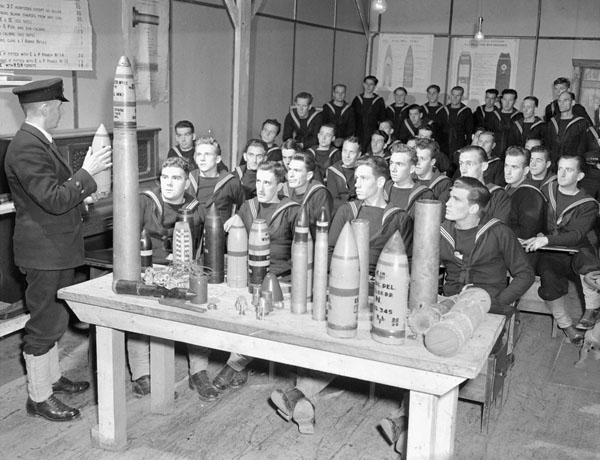
Chief Petty Officer Lowther delivering a lecture about various types of ammunition, Royal Canadian Navy Gunnery School, Halifax, Nova Scotia, Canada, 1940.
Credit: Canada. Dept. of National Defence / Library and Archives Canada / PA-104417

November 12, 2018

German U-Boat Line-Thrower Rifle Conversions

Filed under: Germany, History, Military, Weapons, WW1 — Tags: , , , — Nicholas @ 02:00

Forgotten Weapons
Published on 21 Oct 2018

https://www.forgottenweapons.com/germ…

http://www.patreon.com/ForgottenWeapons

These two Gewehr 98 rifles were converted by the Mauser factory to be used as naval line-throwing rifles. The exact nature of the line and lead projectiles is not clear, but they are clearly original military conversions and came form the Geoffrey Sturgess collection. Entirely new stocks were made for these guns, with a substantially increased length of pull to mitigate the harsh recoil of line throwing. The magazines were blocked with wooden plugs, allowing only one short (blank) round to be held, but allowing that round to be depressed enough to close the rifle’s bolt over it and keep the chamber empty. The barrels were replaced with launch tubes, on 10 inches long with a 2 inch bore and the other 10.5 inches long with a 1.75 inch bore.

Contact:
Forgotten Weapons
PO Box 87647
Tucson, AZ 85754

If you enjoy Forgotten Weapons, check out its sister channel, InRangeTV! http://www.youtube.com/InRangeTVShow

November 8, 2018

What do you do with decommissioned Royal Navy nuclear submarines?

Filed under: Britain, Military — Tags: , , — Nicholas @ 05:00

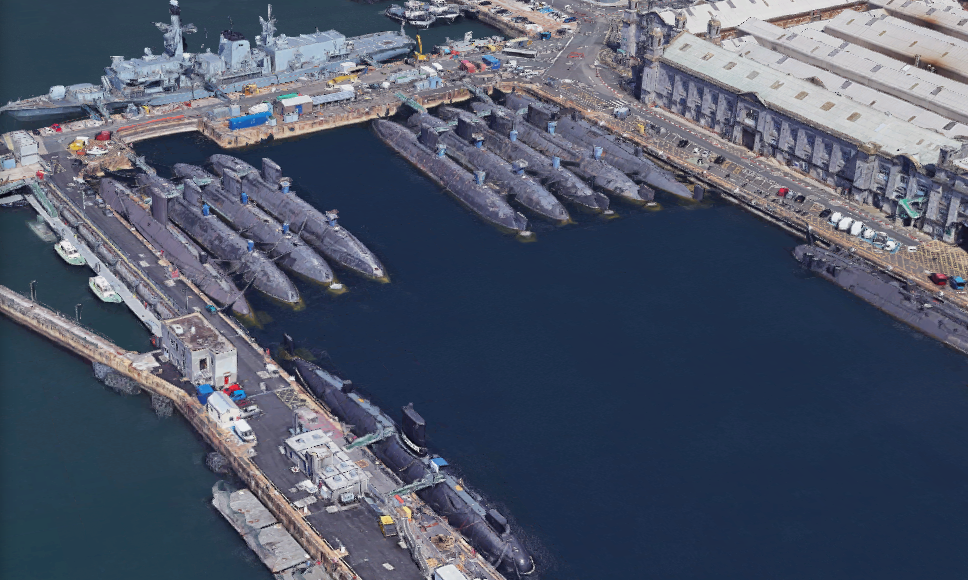
Apparently, based on current MoD practice, you leave them sitting around for decades, until you have more decommissioned boats in storage than the RN has in commission:

Decommissioned Royal Navy nuclear submarines at Devonport.
Screen capture from Google Maps.

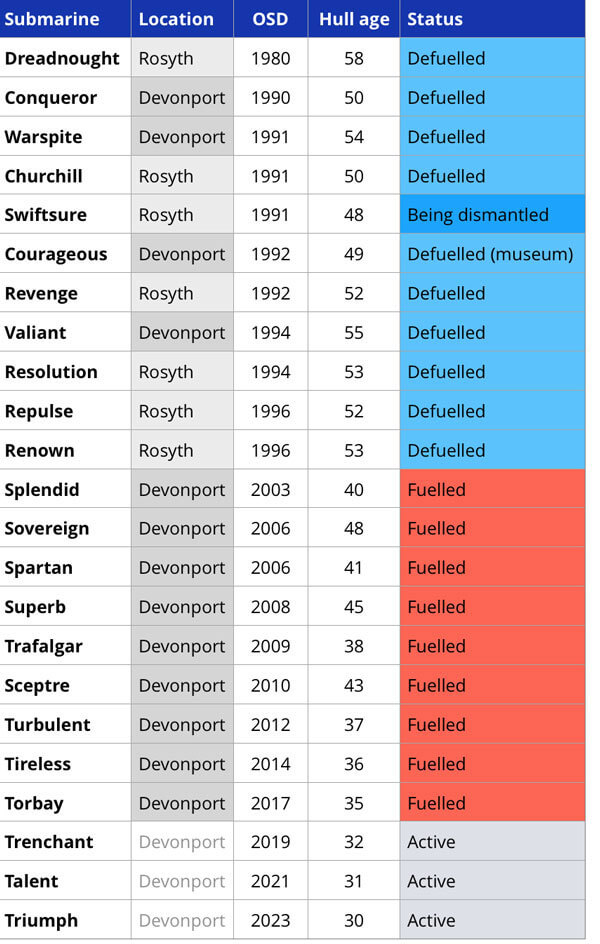
There are currently 20 former Royal Navy nuclear submarines awaiting disposal in Rosyth and Devonport. They do not represent a great hazard but maintaining them safely while they await dismantling is a growing drain on the defence budget. Nuclear submarines are arguably Britain’s most important defence assets but the failure to promptly deal with their legacy has been a national scandal. Although there has been discussion and consultation going back years, only recently has there been action to actually start the disposal process.

Status of Royal Navy submarine disposal in early 2018.
OSD – Out of Service Date. Hull age – years since hull laid down.


Plans for the safe and timely disposal of nuclear submarines should have been drawn up as far back as the 1970s but successive governments have avoided difficult decisions and handed the problem on to their successors. RN submarines were designed so the Reactor Pressure Vessel could be removed from the hull. Other nations cut the entire reactor compartment out of the submarine and transport it to land storage facilities. The US has successfully disposed of over 130 nuclear ships and submarines since the 1980s. The Russians have disposed of over 190 Soviet-era boats (with some international assistance) since the 1990s while France has already disposed of 3 boats from their much smaller numbers.

The first Royal Navy nuclear submarine, HMS Dreadnought decommissioned in 1980, has now been tied up in Rosyth awaiting disposal longer than she was in active service.

As any householder knows, It is sensible practice to dispose of your worn out items before you replace them with new ones.

The capacity to store more boats at Devonport is limited, every further delay adds to cost that will have to come from a defence budget that is much smaller in real terms than when the boats were conceived at the height of the Cold War. Apart from the attraction of deferring costs in the short-term, a major cause of delay has been the selection of a land storage site for the radioactive waste. It has also taken time to develop a method and ready the facilities needed to undertake the dismantling project.

Afloat storage

While awaiting dismantling, decommissioned submarines are stored afloat in a non-tidal basin in the dockyard [as seen in the image at the top of this post]. Classified equipment, stores and flammable materials are removed together with rudders, hydroplanes and propellers while the hull is given treatments to help preserve its life. The 7 submarines in Rosyth have all had their nuclear fuel rods removed but of the 13 in Devonport, 9 are still fuelled. This is because in 2003 the facilities for de-fuelling were deemed no longer safe enough to meet modern regulation standards and the process was halted. Submarines that have not had their fuel rods removed have the reactor primary circuit chemically treated to guarantee it remains inert and additional radiation monitoring equipment is fitted.

More than £16m was spent between 2010-15 just to maintain these old hulks alongside, and costs are rising. Apart from regular monitoring, the hulks need to be hauled out of the basin for occasional dry docking for inspection and repainting to protect the hull from corrosion. All this effort and expense is a drain on precious resources for no direct gain. Responsible care of the growing number of hulls means they pose little risk to the local population, but a tiny risk does remain. This makes some people living nearby uneasy and provides another grievance for those ideologically opposed to nuclear submarines and Trident.

October 21, 2018

The Submarine War – WW2 – 008 October 20 1939

Filed under: Europe, Germany, History, Military, Russia, WW2 — Tags: , , , , , — Nicholas @ 04:00

World War Two
Published on 20 Oct 2018

For the men in the navies of the warring nations in Europe, there was nothing phony about WW2 in October 1939 – mortal danger was immediately under the cold surface at the receiving end of a torpedo or a depth charge…

Join us on Patreon: https://www.patreon.com/TimeGhostHistory
Or join The TimeGhost Army directly at: https://timeghost.tv

Written and Hosted by: Indy Neidell
Produced and Directed by: Spartacus Olsson and Astrid Deinhard
Executive Producers: Bodo Rittenauer, Astrid Deinhard, Indy Neidell, Spartacus Olsson
Research by: Indy Neidell
Edited by: Spartacus Olsson an Ben Ollerenshaw
Trainee editor Sarvesh

Coloring by Spartacus Olsson, Olga Shirnina and Norman Stewart

Olga’s pictures: https://klimbim2014.wordpress.com
Norman’s pictures https://oldtimesincolor.blogspot.com/

Archive by Screenocean/Reuters https://www.screenocean.com

A TimeGhost chronological documentary produced by OnLion Entertainment GmbH

October 12, 2018

How Underwater Explosions damage Ships and Subs #Military101

Filed under: Military, Science, Technology, Weapons — Tags: , , — Nicholas @ 02:00

Military History Visualized
Published on 15 Sep 2017

This video looks at how underwater explosions damage ships and submarines. Script was proof-read by a physicist and is based on US Navy/Army and/or academic sources.

»» SUPPORT MHV ««
» patreon – https://www.patreon.com/mhv

Military History Visualized provides a series of short narrative and visual presentations like documentaries based on academic literature or sometimes primary sources. Videos are intended as introduction to military history, but also contain a lot of details for history buffs. Since the aim is to keep the episodes short and comprehensive some details are often cut.

September 24, 2018

Drafting – Poetry – Georg von Trapp I OUT OF THE TRENCHES

Filed under: Europe, History, Military, WW1 — Tags: , , , , — Nicholas @ 04:00

The Great War
Published on 22 Sep 2018

Chair of Wisdom Time!

August 14, 2018

German Submarine Warfare in World War 1 I THE GREAT WAR Special

Filed under: Britain, Germany, History, Military, WW1 — Tags: , , , — Nicholas @ 04:00

The Great War
Published on 13 Aug 2018

Find out more about War2Glory: https://war2glory.com/

Submarines played a vital part in Germany’s WW1 strategy. They would disrupt allied shipping despite the British Naval Blockade and ensue fear across the Atlantic and Mediterranean Sea.

July 8, 2018

Western Approaches – the bunker from which they won the war

Filed under: Britain, History, Military, WW2 — Tags: , , , — Nicholas @ 02:00

Lindybeige
Published on 17 Jun 2018

The command bunker ‘Western Approaches’ is now a museum in Liverpool. I was invited to take a look before it re-opened.
Support me on Patreon: https://www.patreon.com/Lindybeige

The Museum’s website: http://www.liverpoolwarmuseum.co.uk

Many thanks to Richard MacDonald for inviting me and showing me around (you saw him plugging the big fuse in).

Lindybeige: a channel of archaeology, ancient and medieval warfare, rants, swing dance, travelogues, evolution, and whatever else occurs to me to make.

July 2, 2018

Mark Steyn on 49th Parallel

Filed under: Cancon, Germany, History, Military, WW2 — Tags: , , , , — Nicholas @ 05:00

His annual Canada Day post this year featured a World War 2 British film about Canada intended for Americans:

The film stars, in order of billing, Leslie Howard, Laurence Olivier, Raymond Massey, Anton Walbrook, Eric Portman “and the music of Ralph Vaughan Williams”, which gets an above-the-title credit – as well it should. Vaughan Williams’ score is an integral part of the picture and, if not especially Canadian (save for a very short evocation of Calixa Lavallée’s “O Canada” right at the beginning), accompanies the country’s physical landscape beautifully, particularly in the opening travelogue, mostly shot by Freddie Young leaning out of a plane with a hand-held camera and edited back in England by David Lean. (Lean and Young, of course, subsequently worked together on Lawrence of Arabia, Doctor Zhivago and Ryan’s Daughter.) And, if you’re thinking that (with one exception) none of these participants seems terribly Canuck, well, if it’s any consolation, the English also get to play all the Nazis, too. The Canadians are largely relegated to small roles and extras – like the real seamen who play the survivors of the Canadian ship torpedoed in the Gulf of St Lawrence at the opening of the picture. “So,” pronounces the German U-boat commander, “the curtain rises on Canada.”

U-37 decides to flee to Hudson’s Bay to evade the RCAF and RCN patrols looking for it. Six Germans are put ashore to scout for supplies. But, even as they set foot on land, they hear the swoop of planes and look back to see Canadian bombers destroying their submarine. In order to lend verisimilitude to the scene, Michael Powell destroyed a real – or real-ish – sub, built for him in Halifax, Nova Scotia. The RCAF gave him two thousand-pound bombs to make it look good, and he put them on “U-37” and was cunning enough to neglect to tell the actors, lest it made them nervous. The sub was then towed to the Strait of Belle Isle between Labrador and Newfoundland to be blown sky high. That was Powell’s only mistake. Notwithstanding that he named the film after Canada’s southern border, the director’s grip on the country’s eastern border was a little hazier. He had forgotten that Newfoundland was not (yet) in Canada but was a British possession in its own right. So HM Customs impounded “U-37” and Powell had to go directly to the Governor to get it back.

Other than that, he and Pressburger didn’t put a foot wrong. The location footage was impressive in its day, and still striking in ours; Pressburger’s script is subtle and humane; and the episodic structure allows for plenty of variety. Following the loss of U-37, the six Germans are now beached in northern Canada and have to figure out a way to get to safe, neutral America. They make their way to a Hudson’s Bay trading post, where the factor (played by the great Scots actor Finlay Currie) is welcoming back an old friend who’s spent the last eleven months hunting in the wilds and so has no idea Canada is at war. Johnny is a French-Canadian trapper played by – who else? – Laurence Olivier. We first meet him in the bath tub singing “Alouette”, and, as often with Olivier, the attention to detail on the accent is so good that it becomes oddly intrusive: “Diss is one big country, but verra few pipple. Ever-wan know ever-body. You can’t make goosestep trew it widdout da police fine out,” he tells the senior German officer (Eric Portman).

The window shot Michael Powell uses to get the Nazis into the factor’s small cabin is cool and clinical and all the more chilling for it. The six Germans enter and announce that they’re now in control. When you’ve just come in off the tundra after eleven months and you want to have a soak in the tub and unwind, the Master Race showing up is a bit of a downer. “Okay, you are German. Why yell about it? I am Canadian,” says the Frenchie. “He is Canadian” – he points to the Scots factor – “and he is Canadian” – and to the smiling eskimo lad: French, English and Inuit all with the same unhyphenated label “Canadian”. That’s a lot simpler than the fractious diversity at Parliament Hill earlier today.

The Nazi lieutenant attempts to beguile his captives with a copy of Mein Kampf, but Trapper Johnny isn’t interested. “What’s the matter with Negroes?” he asks.

“They’re semi-apes,” explains the German. “One step above the Jews.” This is something of a remote concern at a Hudson’s Bay trading post. The Nazis seems as enraged by their prisoners’ geniality as by anything else. As they depart, one tears a portrait of the King and Queen off the wall and carves a swastika into the space.

Pressburger’s plot follows as you’d expect: There are six Germans, and soon there will be five, and then four, three, two… From Hudson’s Bay, they commandeer a seaplane that crashes near a Hutterite community in Manitoba, where a young pre-Mary Poppins Glynis Johns is sweetly trusting of them. They make their way to Indian Day in Banff National Park, for a rather Hitchcockian scene, and thence to a camp in the Rockies, where an arty pacifist (Leslie Howard) is discoursing on Thomas Mann. The tone is set by Olivier’s Frenchie coming in from the bush: He may not be interested in war, and nor is Glynis Johns or Leslie Howard. But war is interested in them. This was the purpose of the film, as the British Ministry of Information saw it: That’s why they wanted it set in Canada, rather than in, say, England, across the Channel from Occupied Europe. These trappers, Hutterites, and pacifists didn’t come looking for trouble. But, even five thousand miles from the fighting, trouble came looking for them – in big, empty, peaceable Canada. And the implicit message to America was: In the end, it will come for you, too. There is no 49th Parallel. Whichever side of it you’re on, it’s the same side.

June 18, 2018

The Only German Submarine Attack On US Shore in WW1 I OUT OF THE ETHER

Filed under: Germany, History, Military, USA, WW1 — Tags: , , , — Nicholas @ 04:00

The Great War
Published on 16 Jun 2018

Paul Hodos’ Book about U-Kreuzer: https://amzn.to/2JzXkIY

After a long time, we are back with our format Out Of The Ether and this week we tell you about the only time Germany directly attacked US mainland with a submarine.

May 30, 2018

Decisive Weapons S02E04 – U-Boat Killer: The Anti-Submarine Warship

Filed under: Britain, History, Military, WW2 — Tags: , , — Nicholas @ 04:00

erana19
Published on 25 Jan 2016

1996-1997 BBC documentary series. Series 2, Episode 4.

May 28, 2018

Naval Operations In The Dardanelles Campaign 1915 I THE GREAT WAR On The Road

Filed under: Britain, France, History, Middle East, Military, WW1 — Tags: , , , , — Nicholas @ 04:00

The Great War
Published on 25 May 2018

In our first episode filmed on the former Gallipoli battlefields, Indy and our guide Can Balcioglu explore the naval campaign that preceded the landings at Gallipoli in early 1915.

May 15, 2018

French protests over new British submarine in three, two, one…

Filed under: Britain, France, History, Military — Tags: , , — Nicholas @ 03:00

Gareth Corfield helpfully sums up the reasons for the French to take offence after the Royal Navy chose to name the next Astute-class nuclear submarine HMS Agincourt:

HMS Astute (S119), lead ship of her class, sails up the Clyde estuary into her home port of Faslane, Scotland.
MOD photo, via Wikimedia Commons.

The Royal Navy, always keeping up with the times, has named its newest attack submarine HMS Agincourt, after the 1415 battle where an English army beat French troops led by its nobility.

Agincourt the boat is the seventh and final Astute-class attack sub. The nuclear-powered vessels are used primarily to defend British interests from underwater, including seeing off marauding Russian vessels near British waters and also for sneaky-beaky missions of their own into foreign waters.

The £1.5bn submarine is under construction at BAE Systems’ yard in Barrow-in-Furness, Cumbria. Defence equipment minister Guto Bebb joyously declared: “Today’s announcement includes a £60m contract for Rolls-Royce, supporting over 700 jobs here in Derby as the factory continues to make the reactors that will power our state-of-the-art Dreadnought subs into the 2060s.”

And just to rile up any sensitive French souls, he also gives a thumbnail history of the battle the ship will be named for:

The name Agincourt is mildly controversial, inasmuch as it brings to mind the famous victory of King Henry V over France at a time where the English army, which was blundering around the Pas-de-Calais countryside, was largely thought to be on its last legs and cut off from its chances to retreat back home. In the words of the king’s (fictional, thanks to Shakespeare) eve-of-battle speech, it was “we few, we happy few, we band of brothers” up against the very best France had to offer.

Through “yew bow and cloth yard shaft”, as the chroniclers of the day put it, the English and Welsh longbowmen shot a torrent of arrows into the heavily armoured French knights. The arrows’ steel points penetrated the plate armour of the French nobles and the lightly equipped English then set about the bogged-in Frenchmen, whose weighty suits of armour were totally unsuited to the heavy mud of the battlefield.

In today’s world, where the UK and France are close allies and England has given way to the United Kingdom, naming the submarine Agincourt may be seen by some as a bit of an unintentional snub, bringing to mind Henry V’s slaughter of French prisoners of war and the failed negotiations that preceded the battle over Henry’s disputed claim to the title of King of France.

May 11, 2018

The Ostende Raid – Peace of Bucharest I THE GREAT WAR Week 198

Filed under: Britain, Europe, France, Germany, History, Military, WW1 — Tags: , , , , — Nicholas @ 04:00

The Great War
Published on 10 May 2018

Even though the first raid on Ostende and the Raid on Zeebrugge were not entirely successful, the Royal Navy is still determined to block access to the German submarine ports in Belgium. And this week they attack Ostende again. Meanwhile, the Germans are planning their next offensives for late May 1918 even though ten percent of the Western Front army has become a casualty in the offensives this year alone.

« Newer PostsOlder Posts »

Powered by WordPress