Quotulatiousness

June 29, 2020

Today on NeoNaziHuntingExpeditions, we track down Neo Nazi Bronies

Filed under: Media, Politics, USA — Tags: , , , , , , , — Nicholas @ 05:00

In Quillette, Daniel Friedman examines the claims made in a recent Atlantic investigation into Nazis in the My Little Pony community (that is, adult fans of the show, not little girls … I think):

Image found by searching for “Neo Nazi Bronies”, listed URL – http://www.democraticunderground.com/1014960111

The evidence of this Nazi problem in the My Little Pony fandom is that, on a My Little Pony imageboard called Derpibooru, over 900 images were tagged as “racist,” and images mocking Black Lives Matter were upvoted by users while images supporting the movement were downvoted, even as the site’s administrators made a statement of support for the protests. After much controversy, the imageboard banned uploading images “created for no reason other than to incite controversy” and removed the 926 images tagged “racism” or “racist.” This move was extremely controversial within the Derpibooru community, many members of which oppose any moderation.

Atlantic reporter Kaitlyn Tiffany suggests that the strong free-speech norms of the Derpibooru boards stem from its origins on 4Chan, which Tiffany describes as “the largest den of chaos and toxic beliefs available on the Internet.” She describes the Brony community as being divided between those who “genuinely enjoy My Little Pony and the wholesome escapism it provides” and trolls who think it is “edgy and provocative to be an adult obsessed with cartoon ponies.” This frames the Derpibooru imageboard as a place where innocent cartoon fans are unknowingly subjected to subversive, racist memes and images that may send people down a rabbit hole of far-right content.

However, claims that a significant portion of the Brony community are Nazis, or that a significant amount of the content on Brony imageboards is right-wing propaganda or racist memes has to be put in the proper context. First of all, the 926 images tagged “racist” exist on a board that hosts over two million images. If you order all the site’s various tags by how many images fall within their categories, there are 12 full pages of other, more popular tags you have to scroll through to find the “racism” tag. One thousand two hundred and seventy-five images are tagged “politics” and include images both supporting and opposing Black Lives Matter. Discussion of these issues is a tiny fraction of one percent of the content on the My Little Pony imageboard.

By contrast, 315,867 images on the Derpibooru forum are tagged as sexually explicit, a further 127,414 images are tagged as sexually suggestive and 105,521 images are tagged as containing “questionable” sexual content. The truth is that Derpibooru’s lax moderation norms and anti-censorship culture don’t exist to protect objectionable political content; this imageboard is unmoderated because it is an enormous repository of fan-made My Little Pony pornography.

The Atlantic article fails to place the 926 racist images in the context of the larger scope of the two million images hosted by the Derpibooru board, because less than one-quarter of one percent of the site’s content is of a political nature. And the Atlantic article avoids mentioning the half-million pornographic images the site hosts, because doing so reveals that the community’s widespread opposition to content moderation on their imageboard is about protecting sexually explicit content rather than creating a space for hateful politics to flourish, and it further reveals that the Bronies are 500 times more interested in having sex with My Little Pony characters than they are in spreading racist pony memes.

The article creates an impression that the alt-Right is using seemingly-innocent cartoon fandoms as a Trojan horse to conceal and spread a sinister ideology, but the truth is that the only thing these guys are interested in hiding inside a horse is their dicks.


June 6, 2020

QotD: The Fountainhead

Filed under: Architecture, Books, Humour, Quotations — Tags: , , — Nicholas @ 01:00

Like most of my contemporaries, I first read The Fountainhead when I was 18 years old. I loved it. I too missed the point. I thought it was a book about a strong-willed architect … and his love life … I deliberately skipped over all the passages about egoism and altruism. And I spent the next year hoping I would meet a gaunt, orange-haired architect who would rape me. Or failing that, an architect who would rape me. Or failing that, an architect. I am certain that The Fountainhead did a great deal more for architects than Architectural Forum ever dreamed.

Nora Ephron, The New York Times Book Review (1968), quoted in Reason Online

May 11, 2020

QotD: Certainty is liberation

Filed under: Education, Humour, Liberty, Quotations, USA — Tags: , , , — Nicholas @ 01:00

My last semester of college was a total blowoff. I already had enough credits to graduate at the end of the previous term, but I figured that since I was on scholarship, I might as well use the remaining time to really lock down a job. One fell into my lap over the break, but it was too late to withdraw my registration and file for graduation. And that wasn’t all. My GPA was such that I could’ve failed every single class in that final semester and still graduated. And finally, the job was all the way across the country …

In short, absolutely nothing I did, or didn’t do, that final semester meant anything at all. I was as responsibility-free as an “adult” human can ever hope to get.

This had some interesting consequences. I got laid a lot more, for one thing — sorry about the crudity, but it’s a great illustration of the principle. The principle being: “When you truly don’t care, you project this invincible vibe that attracts people.” My friends were all shocked — not just about the getting laid part, but the fact that my whole personality seemed to change. I am not, as you might imagine, the most outgoing, happy-go-lucky guy, but that semester I was.

I mean, why not? I’d hit on varsity cheerleaders and sorority goddesses. I turned in wildly counter-intuitive assignments, just to see what would happen. I signed up for Intro to Conversational Chinese. Totally bombed it, but seriously, why not? I’ve always wanted to know if I have a knack for languages (turns out I don’t), and that was the hardest one in the course catalog. So long as I stayed alive and out of jail, I could do whatever the hell I wanted … so I did.

The lesson I drew from this: Certainty is liberation. It’s bliss. I still had anxieties, of course — e.g. how was I going to do in my new life, all the way across the continent? — but in my current context, I had no worries at all. I was King of the Dorm, because, quite simply, I could afford to be. I had three hots and a cot, endless free time, and a give-a-damn meter stuck on zero.

If I were quicker on the uptake, I’d have identified that instant as my turn to the Shitlord side of the Force. What in god’s name am I doing, hitting on the homecoming queen? Doesn’t matter. She could blow me off so viciously that dudes three blocks over would wince and cover themselves,* and I couldn’t care less. Why not shoot for the moon? If I win, I’m a dorm legend; if I fail, I’m still a dorm legend for having the balls to try it. In two months, I’ll be a thousand miles away and nobody will care about either of us.

*She didn’t. She didn’t go out with me, of course, but she was very nice and gracious, as most truly pretty girls are. Another valuable lesson learned.

Severian, “The Emotion is the Tell”, Rotten Chestnuts, 2020-01-24.

March 23, 2020

QotD: Men’s blindness toward women

Filed under: Health, Politics, Quotations, USA — Tags: , , , , , , — Nicholas @ 01:00

There is a lot of talk about Toxic Masculinity. No one ever talks about Toxic Femininity. Though every woman who is a functional human being knows about it, as does anyone who has ever lived or worked in a predominantly female environment.

So, why does no one talk about it? Well, mostly because the left believes that “designated victims”™ are sacred and must never be called on their own bullshit, no matter how smelly. Hence also the bizarre idea of racial “privilege” that tells you holocaust survivors should be attacked for “white privilege” but the Obama girls raised as the creme de la creme, and never facing a day of privation in their lives don’t have any privilege and are victims.

But there’s also other stuff going into it. To an extent — to the extent that historically for biological reasons men dominated public life — the fact that no one talks about the bad side of female modes of being in society is the result of patriarchy.

Men are ridiculously, idiotically, insanely blinkered about women. They don’t really see women as they see other men, but through rosy glasses as much better than men. The “oh so smart” former president with the depth of a rain puddle in Colorado told us that women are so much better than men and that the world would be better under women. Which means he’s basically a bog standard male who has never given the matter a thought, and is going on what “everybody knows.” (It occurs to me this man, if he’d been born to an ultra conservative Arab family in one of the ultra conservative Muslim countries would also be telling us that women’s hair emits seductive rays. He’s a suit that speaks. Or an empty chair, if you prefer.)

Of course it is right evolutionarilly that men should feel that way about women. It keeps the species going. It is also bizarre though, and leaves men curiously defenseless now that women view themselves as an aggrieved class and are trying to take over public life and exclude men.

In fact it leaves as the only defense in society that most women — even the feminists who pretend otherwise — unless completely and extensively broken and indoctrinated know what other women are and therefore will not trust any of them. As they shouldn’t. I can’t imagine a worse hell than what Obama is proposing.

Sarah Hoyt, “Toxic Femininity”, According to Hoyt, 2019-12-18.

March 21, 2020

Modern Classics Summarized: Stranger In A Strange Land

Filed under: Books, Humour, Religion — Tags: , , , , , , — Nicholas @ 04:00

Overly Sarcastic Productions
Published 20 Mar 2020

This book is:
10% Mike
20% stars
15% concentrated power of mars
5% water
50% cult
and 100% topics that are very adult

This video was requested by our longtime patron Joshua A. Demic!

Can you use the “product of the times” defense if the book was wildly controversial for its time? Asking for a comment section…

Our content is intended for teenage audiences and up. No, seriously. We REALLY MEAN IT.

PATREON: https://www.Patreon.com/OSP

MERCH LINKS: https://www.redbubble.com/people/OSPY…

OUR WEBSITE: https://www.OverlySarcasticProductions.com
Find us on Twitter https://www.Twitter.com/OSPYouTube
Find us on Reddit https://www.Reddit.com/r/OSP/
Discord: https://discord.gg/h3AqJPe

March 1, 2020

QotD: Women who “drag home strangers for a little nail-and-bail”

Filed under: Health, Quotations — Tags: , , , — Nicholas @ 01:00

There are those women who, in bringing some himbo home for a hookup, really go that extra mile — taking a lot of turns on the way so he’ll never again find his way back to their apartment.

So, no, Sex and the City‘s Samantha isn’t a completely fictional character in how, after sex, she brushes men off herself like large, penis-equipped crumbs. […] I referenced research from anthropologist John Marshall Townsend, who discovered that Samantha’s post-sex detachment is pretty atypical — that many women who intend to use and lose a guy often find themselves going all clingypants the next morning.

Understanding what allows the Samantha type to escape this takes separating the women who have casual sex from those who feel okay about it afterward.

Women have casual sex for various reasons. For some, it seems the feminist thing to do — to prove they can do anything a man can do, whether it’s working on an oil rig or dragging home strangers for a little nail-and-bail. Townsend notes that women hook up because they aren’t ready for a relationship, because they’re trying to punch up their sex skills, or — as with rock groupies — to get some small piece of a guy they know is out of their league. Other women see hookups as the “free candy!” they can use to lure some unsuspecting man into the relationship van.

There’s a widespread belief, even held by some researchers, that higher testosterone levels in women mean a higher libido, but testosterone’s role in female desire is like that Facebook relationship status: “It’s complicated.” Research by clinical psychologist Nora Charles, among others, suggests that “factors other than … hormones” are behind which women become the Princess Shag-a-lots.

Personality seems to be one of those factors. In looking at what’s called “sociosexuality” — what sort of person has casual sex — psychologist Jeffrey A. Simpson finds that extraversion (being outgoing, exhibitionistic, and adventure-seeking), aggressiveness, and impulsivity are associated with greater willingness to have an uncommitted tumble.

However, once again, all the reasons a woman’s more likely to have casual sex don’t stop her from getting tangled up in feelings afterward. The deciding factor seems to be where she falls on what the late British psychiatrist John Bowlby called our “attachment system.” According to Bowlby, how you relate in close relationships — “securely,” “anxiously,” or “avoidantly” — appears to stem from how well your mother (or other primary caregiver) sussed out and responded to your needs and freakouts as an infant.

If she was consistently responsive (but not overprotective), you’re probably “securely attached,” meaning you have a solid emotional base and feel you can count on others to be there for you. This allows you to be both independent and interdependent.

Being “anxiously attached” comes out of having a caregiver who was inconsistently there for you (perhaps because they were worn thin) or who was overprotective. This leads to fear and clinginess in relationships (the human barnacle approach to love).

And finally, being “avoidantly attached” is a response to a cold, rejecting caregiver — one who just wasn’t all that interested in showing up for you. Not surprisingly, perhaps to avoid risking all-out rejection by being too demanding, the avoidantly attached tend to adapt by becoming people who push other people away.

It’s avoidantly attached women who social psychologist Phillip Shaver and his colleagues find can have casual sex without emotional intimacy — and, in fact, tend to see their “discard after using” attitude as a point of pride. (It sounds better to be a “sexual shopaholic” than a person with unresolved psychological problems.)

Amy Alkon, “Shaggedy Ann”, Advice Goddess, 2016-09-27.

January 20, 2020

A Drag Queen speaks out against Drag Queen Story Hour for kids

Filed under: Books, Education, Health, Politics, USA — Tags: , , , — Nicholas @ 03:00

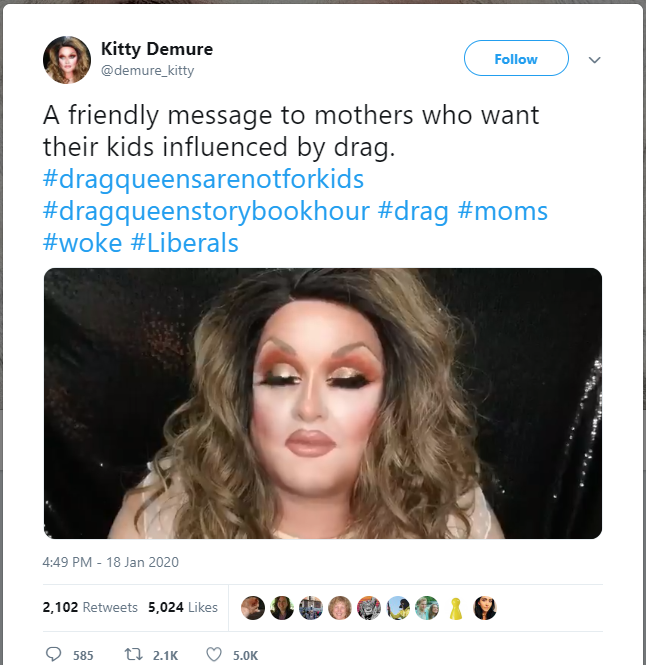
Libby Emmons reports on a rare bird indeed — a Drag Queen who doesn’t think it’s appropriate to have other Drag Queens visit schools and libraries to read to pre-teen kids:

Drag Queen Kitty Demure has taken to Twitter to speak out against the sexualization of children by woke people co-opting drag culture and rebranding it as an educational tool.

“I have absolutely no idea why you would want [drag queens] to influence your child. Would you want a stripper or porn star to influence your child?”

Demure notes that just as you wouldn’t take your kids out to see porn stars or strippers read stories while in full dress and makeup, you shouldn’t take them to see drag. There’s an effort to introduce kids earlier and earlier to adult sexuality. The idea is that this will help kids be more open-minded and understanding about the difference. What it really does is normalize deviant adult behaviour in children’s minds and override their own instincts. Giving children access to sexual content makes them think this kind of thing is for them, it opens doors that should stay closed until a child is of age.

Demure says here what all of us know: drag culture is adult entertainment. The look is sexualized. The names are sexualized. In fact, the entire concept of drag is a send-up of beauty queen culture. Beauty queen culture is sexualized as well, and while that is sometimes subsumed beneath the surface, it’s obviously fully part of it. That’s what drag plays on. Drag can be lots of fun, but it’s grown-up fun, not for kids.

January 5, 2020

More from Severian about modern girls at university

Filed under: Education, Humour, USA — Tags: , , , , — Nicholas @ 03:00

Having regaled us with shocking tales of the Basic College Girl (linked here), Severian now gets down to the not-very-salacious details of modern female mating behaviour at US colleges:

University College, University of Toronto (not one of the post-secondary institution Severian used to teach at).
Photo by “SurlyDuff” via Wikimedia Commons.

When people find out I’m retired from “higher” “”education,”” if they’re anything but rabid Leftists they usually ask me a series of questions: Why are professors such hypocritical assholes? and Is there really any point to ___ Studies? and Why do they pay the football coach umpteen zillion dollars a year to never finish higher than third in the conference? If the questioner is a man, though, and we’re out drinking, after a few martinis they always get around to: But what about … you know … the girls?

Where to start? Since there’s no avoiding prurience here let’s get one thing out of the way up front. This is TLP, not me, but it holds for coeds, too:

    These people are prone to two errors. A psychological one: fetishization; and a biological one: mistaking for beauty what is merely youth.

Taking the second first: I made the same mistake. I came to the ed biz later than most, having had a “real” job back in my other life, so when I first got to grad school I was amazed at how hot the girls were. Like everyone else I was a TA for Intro to Studies 101, but unlike everyone else I must’ve gotten the “sorority girls only” section, because every single chick in it was a knockout.

Now I’ll cop to being a little slow on the uptake, but I’m not that dumb. So I started looking a little closer — purely in the interests of science, you understand — and it wasn’t long until I realized that yeah, what I thought at first was smokin’ hotness was just youth. Back in the office I’d been surrounded by women who were equally attractive, but not equally young. A few years in a high-stress job puts a lot of miles on you.

But the other, fetishization element came into it too. Not like that, get your minds out of the gutter, let me explain:

I don’t think it ever really was, but if “coed” was a fetish its days are long past. In a country where the vast majority of people have at least a semester or two of college, not even “sorority girl” really moves the needle much. Rather, all the “fetish” stuff comes from the other side. After spending oh-god-sooooo-many hours getting harangued by the HR ladies about “sexual harassment,” even the most cynical teacher finds himself wondering what he’d do if some slinky young thing really did show up at office hours, close the door, and declare she’ll do anything to pass the class…

Which never happens, of course. I’ve never even heard of it, and I taught at lots of places, for many years, among male colleagues (and a lot of lesbians) who were desperately horny losers. The reason is twofold. The first, and most obvious, is that even if some girl really is that mercenary / sociopathic — and y’all have me on record, at great length, describing what little sociopaths modern kids are — there’s a much simpler alternative available: Straight-up bribery. But notice that’s the one thing you never even hear suggested, though it’s the easiest thing in the world. TAs get paid peanuts; I don’t know how low the bidding could’ve gone, but having seen the squalor in which lots of my fellow grad students lived, twenty bucks doesn’t seem unreasonable …

[…]

Ironically, I’d bet #MeToo and the rest of it actually result in more, not less, of this behavior. Like I always say, today’s blue-haired, nose-ringed slam poet is tomorrow’s obergruppenfuhrer, and one of the main reasons I say it is that I’ve been around a LOT of college people. Shrinking violets who need “safe spaces” everywhere very obviously long to knuckle under to power, any power. Goofy losers who suddenly find themselves with a lot of power naturally start carrying on like Heinrich Himmler. Put them together in the closest possible proximity, in a place explicitly designed to shield them from the real world, and, well, you figure it out.

January 1, 2020

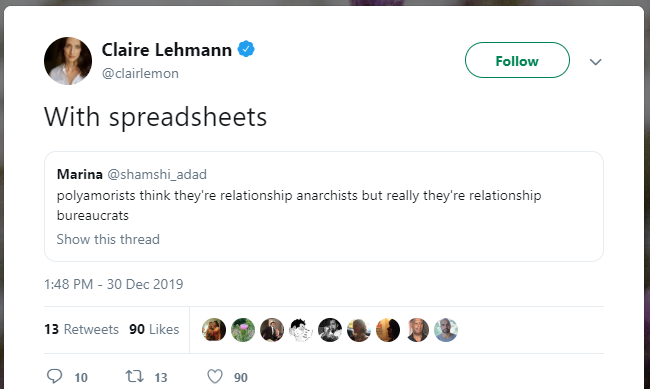
Dim views of polyamory

Filed under: Health, Humour — Tags: , — Nicholas @ 05:00

Claire Lehmann responded to a Tweet from @shamshi_adad on the topic of polyamory:

… which got some amusing responses:

November 18, 2019

“I can’t help but wonder if a large majority of men won’t opt for the conflict-free humanoid over the real thing, with all of our baggage and hormones and mothers-in-law”

Filed under: Business, Health, USA — Tags: , , , — Nicholas @ 05:00

In the (US) Spectator, Bridget Phetasy reports on her visit to the factory where Realdolls are made:

One of the sex dolls on offer at Aura Dolls in Mississauga, the first “sex doll brothel” in the Toronto area.
Photo originally published by BlogTO – https://www.blogto.com/city/2019/11/sex-doll-brothel-mississauga/.

The floor is slippery. I guess I shouldn’t be surprised, I’m taking a tour of Abyss Creations, the factory where the “Ferraris of love dolls”, RealDoll and Realbotix, are made. A thin layer of silicone coats almost every surface. A (real) woman in her late twenties, the PR coordinator, Catherine, shows me round. She has the attitude of a hostess at a theme-park restaurant: bored or stoned or maybe both. I’m sure she’s given hundreds of these tours, heard the same dumb jokes a million times and watched us all slap the ass of a doll reluctantly yet instinctively.

[…]

The employees look at the “love dolls” as more than just sexbots. They know their customers want a couch buddy. They want someone to cuddle at night. Perhaps they’ve lost a spouse and don’t feel like dating.

Whitney Cummings logged on to a forum for men who own the sex robots and monitored their conversations for months. “I thought they were going to be creeps, psychopaths,” she says. “I don’t know what to tell you. They’re very lovely men. They’re lovely. They adore their dolls. They marry their dolls. That is happening.”

What strikes me amid the body parts, the rows of eyes, the wall of nipples and the robot “brains”: these aren’t your weird uncle’s sex dolls. With the introduction of AI, these dolls are offering something their predecessors couldn’t: intimacy and affection.

“I always looked at them as art and I always found it funny that because it’s a sexually usable thing, it’s disqualified as art in the higher sense in a lot of people’s minds. They go, ‘Oh that’s not art, that’s just nasty'”, says McMullen. “And what’s funny about that is now we’re doing this serious engineering, artificial intelligence and robotics and now people aren’t so quick to dismiss it.”

Realbotix is the natural evolution of Abyss Creations, the company McMullen started in 1997 (in fact, Abyss Creations made the doll for Lars and the Real Girl). What began as just “real dolls” now has a robotic component, an AI team and an app.

McMullen talks about how he’s always wanted to break free of the sex toy stigma. “Yes people use them sexually, but they also get this huge sense of companionship from having a doll and a robot.”

November 7, 2019

Blanchard’s transsexualism typology

Filed under: Health, Science — Tags: , , , — Nicholas @ 05:00

At Quillette, Louise Perry interviews Dr. Ray Blanchard about transsexualism, and his controversial-in-the-LGBT-community typology of transsexualism:

Ray Blanchard, PhD.
Image from his Twitter profile.

Ray Blanchard is an adjunct Professor of Psychiatry at the University of Toronto who specialises in the study of human sexuality, with a particular focus on sexual orientation, paraphilias, and gender identity disorders. In the 1980s and 1990s he developed a theory around the causes of gender dysphoria in natal males that became known as “Blanchard’s transsexualism typology“. This typology — which continues to attract a great deal of controversy — categorizes trans women (that is, natal males who identify as women) into two discrete groups.

The first group is composed of “androphilic” (sometimes termed “homosexual”) trans women, who are exclusively sexually attracted to men and are markedly feminine in behaviour and appearance from a young age. They typically begin the process of medical transition before the age of 30.

The second group are motivated to transition as a result of what Blanchard termed “autogynephilia”: a sexual orientation defined by sexual arousal at the thought or image of oneself as a woman. Autogynephiles are typically sexually attracted to women, although they may also identify as asexual or bisexual. They are more likely to transition later in life and to have been conventionally masculine in presentation up until that point.

Although Blanchard’s typology is supported by a wide range of sexologists and other researchers, it is strongly rejected by most trans activists who dispute the existence of autogynephilia. The medical historian Alice Dreger, whose 2015 book Galileo’s Middle Finger included an account of the autogynephilia controversy, summarises the conflict:

    There’s a critical difference between autogynephilia and most other sexual orientations: Most other orientations aren’t erotically disrupted simply by being labeled. When you call a typical gay man homosexual, you’re not disturbing his sexual hopes and desires. By contrast, autogynephilia is perhaps best understood as a love that would really rather we didn’t speak its name. The ultimate eroticism of autogynephilia lies in the idea of really becoming or being a woman, not in being a natal male who desires to be a woman.

I interviewed Blanchard over email and Skype. The text has been lightly edited for clarity.

QotD: Evolved sexual differences

Filed under: Health, Humour, Media, Quotations — Tags: , , , — Nicholas @ 01:00

Because male sexuality is all about the visuals, men’s magazines are filled with pictures of naked women with freakishly large breasts and women’s magazines are filled with pictures of beauty products and ass-cantilevering $2,000 stilettos. Men evolved to go for signs of reproductively hot prospects — an hourglass figure, youth, clear skin, symmetrical faces and bodies, and long shiny hair: all indicators that a woman is a healthy, fertile candidate to pass on a man’s genes.

Women co-evolved to try to make themselves look reproductively hot, though that’s not how we think of it. […] Because men are turned on by disembodied photos of boobs, butts, and coochies, they’re quick to pull down their pants, click their cameraphone, and text some woman they just met a close-up of their zipperwurst. Really bad idea.

Men who’ve done this should pick up a Harlequin romance, which is basically porn for women (from the ravishing by some hot gazillionaire to the final commitment-gasm).

See any photo spreads of male crotch shots tucked in there anywhere, boys?

This is not an error of omission. Women aren’t fantasizing about seeing your willy; they’re fantasizing that somebody in the royal family will pluck them out of suburbia and marry them in Westminster Abbey.

Amy Alkon, Good Manners for Nice People Who Sometimes Say F*ck, 2014.

August 31, 2019

QotD: Thinning out the book collection

Filed under: Books, Humour, Quotations — Tags: , , — Nicholas @ 01:00

So out some stuff goes — including boxes and boxes of books. It feels wrong to get rid of books. It feels as though I’m shaving points off my IQ, such as it is. You’re supposed to keep books. You’re supposed to end your days surrounded with stacks and stacks of books, your rich old friends with whom you have spent so many golden hours. Well, most of the books hail from college era, and I really don’t need to keep my German post-war lit paperbacks, especially since most are from leftist authors with a grudging sympathy for the heaven on the other side of the wall. (The wall’s worst sin, if I remember, was aesthetic; its second fault, metaphysical.) Out. Ah: a collection of Tom Sharpe novels. He was a brilliant nasty British comic author who got a big push in the States in the early 80s. It didn’t work. Horrible cartoony covers. They stay. Someday I’ll read them again. The Hite Report: the world’s only Tolstoi-length Penthouse Forum letter. Out. Ah: all my Flashman novels, with the pages coming out. These I keep until they’re reissued. They were un-PC before there was such a thing as PC. I can quote from few novels, really, but I can always remember that line from the first book, in which Flashy recounts his cumulative sexual exploits: I have laid enough cane to build a banister around Hyde Park. Ah: here’s a box of books whose pages have all fused together. Whew. Out.

James Lileks, Bleat, 2004-07-06.

June 2, 2019

QotD: Explaining modern female sexuality

Filed under: Health, Law, Quotations — Tags: , , , — Nicholas @ 01:00

I have a theory that for many women, sex, or rather agreeing to have sex is difficult, and especially so for the first time with a new partner. How else to explain the fact that so many women admitted that their first time with a new man was generally experienced in an alcoholic haze? (For those who haven’t been keeping up, the source data is here.) So if confronting herself about her “slutty” behavior (even if the sluttiness is only in her own mind), a woman would like to have an excuse like “Oh, but I was drunk…” and thus can excuse away or justify the indiscretion. Or else, as the original study showed, women can even explain away the drunkenness as just a regular part of the dating process, so therefore it’s okay.

I also believe that this is why so many women have rape fantasies, because “Oh, he forced me to do it…” is likewise an expression that denies the woman’s [shameful] complicity in the act. (Of course, now that it’s become okay to accuse a previous partner with actual rape as part of the excuse, the whole thing has become considerably more sinister, especially as such accusations can take place months or years afterwards and still be considered valid by law enforcement. But for the sake of argument, let’s treat this scenario as but a blip on societal consciousness which will disappear at some point when women regain their sanity. We can only hope.) Certainly, this explains female submissiveness (outside a natural submissive personality anyway), which can be regarded (by women) as a kind of watered-down rape fantasy.

The only time, I think, when self-delusion disappears is when a woman encounters a universal object of female desire, such as a hunky actor or popular musician. Even then, there is a “safety in numbers” excuse — “OMG everybody is crazy about him!” — which makes it okay, or at least, provides a figleaf of an excuse for irresponsibility and sexual licentiousness. You only need a sliver of an excuse, and it will be acceptable, in other words.

Kim du Toit, “Seeking Excuses”, Splendid Isolation, 2017-04-24.

May 15, 2019

QotD: Women competing against other women

Filed under: Health, Quotations — Tags: , , — Nicholas @ 01:00

There are women out there who still see dressing to please a man as some sort of Stockholm syndrome thing — participating in your own (flouncy, spaghetti-strapped) subjugation. So, it’s possible that those advising you “Don’t change for a man!” are just trying to help you be a modern and empowered woman. Of course, one could argue that actually being a modern and empowered woman means you don’t have to dress like you’re hoping to get a call to clean out a sewer line.

Maybe those in your advice coven really do believe they’re acting in your best interest. Maybe. Social psychologists Roy Baumeister and Jean Twenge report that it’s widely believed that men drive the “cultural suppression of female sexuality” — which could include shaming women for how they dress. However, in reviewing the research, they make a persuasive case that it’s primarily women (often without awareness of their motives) who work to “stifle each other’s sexuality.”

This is right in keeping with research on female competition. While men fight openly — “Bring it! I will ruin you!” — women take a sneakier approach. As female competition researcher Tracy Vaillancourt explains it, women fight for their interests using “indirect aggression,” like gossip, mean looks, disparaging remarks, and other underhanded tactics to “reduce the mate value of a rival.” Underhanded tactics? You know — like suggesting you’re selling out womankind if you wear a skirt or winged eyeliner.

Amy Alkon, “Casual Coroner”, The Science Advice Goddess, 2016-09-20.

« Newer PostsOlder Posts »

Powered by WordPress