Quotulatiousness

May 6, 2010

That “no fly list” keeps getting worse

Filed under: Bureaucracy, Liberty, USA — Tags: , , , , , — Nicholas @ 07:42

It’s not bad enough that the list is filled with names of people who should never have been added, and that it’s incredibly difficult to get off the list, but now it’s proposed to restrict the rights of those people even more:

Seems Bloomberg (and Keith Olbermann, more about that in a moment) are on board with the idea the government should be able to take away people’s rights simply by putting them on a list. I don’t think they’d like that idea if say, George W. Bush were president and it was a right they liked. Hey maybe people on the list shouldn’t be able to exercise their First Amendment rights and post to Youtube. Why no Youtube? It’s a jihadi recruitment tool. Surely that’s a danger too.

Now, I’m not a legal expert but I’m pretty sure the 14th Amendment mentions something about “due process” before taking away a person’s rights. Again, not a legal expert but I’m thinking the mere act of the government putting your name on a list is not in fact “due process”.

Notice that Bloomberg calls people on the list “suspects”. Again, I wasn’t aware that rights could be taken away from people simply because the government “suspects” you’ve done something wrong without any notice or opportunity for redress.

May 5, 2010

Three reasons not to remove the Downfall parodies

Filed under: History, Law, Media, WW2 — Tags: , , , , — Nicholas @ 12:50

3 Reasons YouTube Shouldn’t Censor Downfall Parodies

[. . .]

It’s understandable why Downfall’s production company, Constantin Film, might be upset that such a serious movie is being burlesqued, but pushing YouTube to ban the parodies is a terrible idea for at least three reasons:

1. It’s fair use! The parodies, which transform a few minutes of a three-hour movie, are clearly legit under existing copyright laws. Because they clearly transform the original and have no possibility of confusing viewers, the parodies are clearly protected speech.

2. This is free promotion! As George Lucas could tell the filmmakers, fan-generated videos help keep the original source material vital and relevant. Lucas used to try to police all Star Wars knock-offs, until he realized that his audience was promoting his films more effectively than he ever could. More people have surely seen Downfall due to the popularity of the parodies.

3. Let’s keep the Internet creative! The greatest cultural development over the past 20 or so years has been technologies that allow producers and consumers to create and enjoy an ever-increasing array of creative expression in an ever-increasing array of circumstances. This development is nowhere more powerful than on the Internet, which has unleashed a whole new universe of writing, music, video, and more. Indeed, YouTube is itself one of the great conduits of cyberspace. Pulling down the Downfall parodies may be within YouTube’s rights, but it nonetheless strikes a blow to the heart of what is totally awesome about the Internet.

April 23, 2010

Senator McCain’s latest assault on “due process”

Filed under: Law, Liberty, USA — Tags: , , , , , — Nicholas @ 10:02

Whenever I think badly of President Obama (which is a pretty regular event), I have to remind myself that his main opponent in the 2008 US presidential campaign would have been even worse on civil liberties:

Senator John McCain (R-Ariz.) has introduced a bill that would allow the President to imprison an unlimited number of American citizens (as well as foreigners) indefinitely without trial. Known as The Enemy Belligerent Interrogation, Detention, and Prosecution Act of 2010, or S. 3081, the bill authorizes the President to deny a detainee a trial by jury simply by designating that person an “enemy belligerent.”

Even better, should someone manage to be released, the notion of “return to the battlefield” apparently includes exercising your freedom of speech:

[T]he U.S. military has officially classified many former Guantanamo detainees, such as England’s Tipton Three, as having “returned to the battlefield” for merely granting an interview for the movie The Road to Guantanamo. Another five innocent Uighur (Ethnic Turkish Muslims from China) detainees had been listed as having “returned to the battlefield” after their release because their lawyer had written an op-ed protesting their prolonged detention without trial after they had been mistakenly picked up by a greedy bounty hunter. Writing an opinion or speaking an opinion against the party in power in Washington can — and already has — made some people “enemy belligerents.”

So, thank goodness Senator McCain didn’t become president, even if it means putting up with Barack Obama for at least four years . . .

April 21, 2010

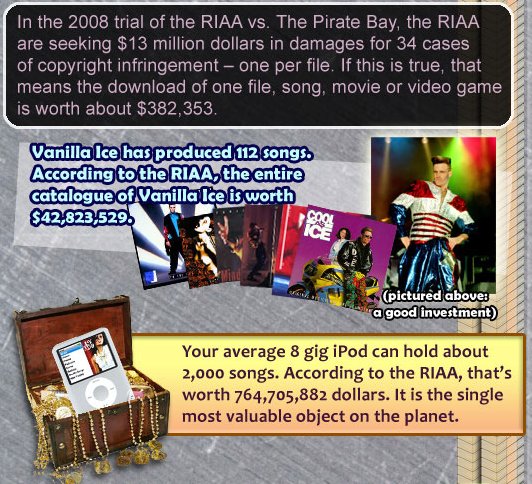
When copyright goes bad

Filed under: Law, Media, Technology — Tags: , , , , — Nicholas @ 12:09

H/T to Cory Doctorow.

“The biggest defeat for internet freedom in the UK since it opened for business”

Filed under: Britain, Law, Media, Technology — Tags: , , , , — Nicholas @ 10:12

Andrew Orlowski looks at the overwhelming legislative victory for the music industry in the UK:

Back in January, a senior music business figure explained to me that Clause 17, which gave open-ended powers to the Secretary of State, was unlikely to survive the wash-up. But he didn’t much care; the other sections which compelled the ISPs to take action against infringers were good enough. Anything else was a bonus – possibly even a distraction. Yet to the amazement of the music business, web blocking is now legislation.

I think this is a watershed in internet campaigning. It’s not just a tactical defeat, it’s a full-on charge of the light brigade, and the biggest defeat for internet freedom in the UK since it opened for business. I’ve spent time talking to legislators and protagonists, and concluded that it was avoidable. Much of the argument was already lost when the Bill was introduced last November, admittedly, but campaigners’ tactics made a bad situation worse. This explodes the idea — sometimes called the ‘Overton Window’ in the jargon — that by adopting an extreme position, you pull the centre ground your way. The digital rights campaigners forced waverers into the music business camp, and hardened their support for tougher measures against file sharers.

In the end, the BPI wiped the floor with the Open Rights Group.

April 20, 2010

Americans’ eroded right to be free from invasive searches

Filed under: Law, Liberty, USA — Tags: , , — Nicholas @ 07:23

John Perry Barlow shared a link to this Washington Times editorial, which clearly illustrates how the US federal government has managed to undermine Americans’ right to privacy:

Federal security workers are now free to snoop through more than just your undergarments and luggage at the airport. Thanks to a recent series of federal court decisions, the digital belongings of international fliers are now open for inspection. This includes reading the saved e-mails on your laptop, scanning the address book on your iPhone or BlackBerry and closely scrutinizing your digital vacation snapshots.

Unlike the more common confiscations of dangerous Evian bottles and fingernail clippers, these searches are not being done in the name of safety. The digital seizures instead are part of a disturbing trend of federal agencies using legal gimmicks to sidestep Fourth Amendment constitutional protections. This became clear in an April 8 court ruling that found admissible the evidence obtained by officials who had peeped at a passenger’s laptop files at George Bush Intercontinental Airport in Houston.

Didn’t you guys fight a war a couple of hundred years back over the 18th century equivalent of this kind of thing?

April 15, 2010

The technical term is “totally insane”

Filed under: Law, Media, Technology — Tags: , , , , — Nicholas @ 12:12

Cory Doctorow has a horrible dystopian future in mind. No, it’s not the background to his next science fiction novel — it’s what the MPAA and RIAA think our future should be like:

The MPAA and RIAA have submitted their master plan for enforcing copyright to the new Office of Intellectual Property Enforcement. As the Electronic Frontier Foundation’s Richard Esguerra points out, it’s a startlingly distopian work of science fiction. The entertainment industry calls for:

* spyware on your computer that detects and deletes infringing materials;
* mandatory censorware on all Internet connections to interdict transfers of infringing material;
* border searches of personal media players, laptops and thumb-drives;
* international bullying to force other countries to implement the same policies;
* and free copyright enforcement provided by Fed cops and agencies (including the Department of Homeland Security!).

There’s a technical term for this in policy circles. I believe it’s “Totally insane.”

I find the audacity of (as Cory calls ’em) “Big Content” to be breathtaking: it’s as if they’ve never heard of fairness or privacy. If they get their wish, we’ll never hear of ’em again either.

As Greg Sandoval points out, there’s almost no reliable data to quantify the problem all this draconian lawmaking and enforcement is supposed to address:

“Three widely cited U.S. government estimates of economic losses resulting from counterfeiting cannot be substantiated due to the absence of underlying studies,” the GAO said. “Each method (of measuring) has limitations, and most experts observed that it is difficult, if not impossible, to quantify the economy-wide impacts.”

In what appears to be a setback for Hollywood and the recording industry, the government said that it sees problems with the methodology used in studies those sectors have long relied on to support claims that piracy was destructive to their businesses. The accountability office even noted the existence of data that shows piracy may benefit consumers in some cases.

[. . .]

“Consumers may use pirated goods to ‘sample’ music, movies, software, or electronic games before purchasing legitimate copies,” the GAO continued. “(This) may lead to increased sales of legitimate goods.”

Properly defining what are “public goods”

Filed under: Economics, Law, Media, Technology — Tags: , , , , — Nicholas @ 07:50

Milena Popova, guest-blogging while Charles Stross is out experiencing Japan, has a long discussion up about public goods and why content (digitally speaking) is a classic example:

There’s a theory in economics about things called “public goods”. To understand the distinction between private goods, public goods and the couple of shades of grey in between, you first need to get your head around two concepts: rival and excludable.

Rival: (Wikipedia seems to call this “rivalrous”, but when I were a young economist lass we used to call it rival so I’ll stick with that.) A good is rival if my consumption of it diminishes the amount of the good that you can consume. Say we had 10 apples, and I ate one. There would now be 9 apples left which you could eat. If we had one apple and I ate all of it, tough luck, no apples for you. Knowing whether a good is rival or not tells you whether you want to use the market (if I were a good economist that would possibly be capital-M Market 😉 to allocate access to that good. If it’s rival, then the market is an efficient way of allocating the good; if it’s not, then you might want to think about other ways of getting your good to people. Remember that scary anti-piracy clip at the start of your DVDs which says “You wouldn’t steal a handbag”? Hold that thought for a minute.

Excludable: A good is excludable if you physically have a way of stopping people from consuming it. Back to the apples: if they’re in my fridge, inside my locked house and you don’t have a key, you can’t have my apples. (Yes, yes, you could break in. The law provides additional protection here, but ultimately there’s probably a better way for you to obtain an apple than breaking into my house, right?) Knowing whether a good is excludable tells you whether you can use the market to distribute the good. If your good is excludable, go ahead and sell it on the open market; if it’s not — you might struggle because you can’t stop people from just taking it for free.

So. Most of the goods you deal with in your day-to-day life are both rival and excludable. We call them pure private goods. But there’s a few things here and there that aren’t as clear-cut, and this is where it gets a little messy.

April 13, 2010

Why you should be worried about ACTA

Filed under: Law, Liberty, Media — Tags: , , , , — Nicholas @ 12:33

H/T to BoingBoing.

March 30, 2010

Policing for profit

Filed under: Law, Liberty, USA — Tags: , , — Nicholas @ 12:46

March 29, 2010

Don’t talk back to the man, part XLVI

Filed under: Law, Liberty — Tags: , , , — Nicholas @ 17:08

Ken at the Popehat blog has a beef with part of the message in “10 Rules for Dealing with Police” from Flex Your Rights:

See, if your goal is not to be abused, wrongfully arrested, falsely accused, searched without probable cause, or proned out on the pavement because you irritated someone with a gun and a badge, then “don’t be mouthy to a cop” is excellent practical advice. But dammit, we shouldn’t have to give that advice. The concept that you should expect to be abused if you aren’t meek (or, to be more realistic, subservient) in dealing with public servants ought to be abhorrent to a society of free people. Courtesy is admirable, and unnecessary rudeness is not, but rudeness ought not be seen as inviting government employees to break the law. But the reality is that our society largely issues apologias for, not denunciations of, police abuse. The prevailing belief is that claims of abuse are about lawyers or crooks trying to game the system, that people accused of crimes generally committed them, and that cops are heroes of the sort who deserve the benefit of the doubt when their account of a roadside encounter differs from that of a citizen. Our society, for the most part, indulges cops in their expectation that citizens will be subservient. As a result, “don’t talk back to a cop” remains tragically apt practical advice.

Moreover, the truth of it is that many cops will interpret an assertion of your constitutional rights, however politely delivered, as a rude challenge. They are supported in that view by four decades of “law and order” talk that classifies constitutional rights as mere instrumentalities of crime, not as the rules by which we have chosen to live.

Shame on us if we put up with that.

H/T to Radley Balko for the link, who also offers a graphic example of what can happen when you don’t follow the helpful advice in the video:

Last week, a panel from the 9th U.S. Circuit Court of Appeals ruled that three Seattle police officers were justified in using a taser three times on a pregnant woman for resisting arrest. The woman had been pulled over for going 32 mph in a school zone. She insisted it was the car ahead of her that was speeding, and refused to sign the ticket. That’s when they tased her.

The problem is that under Washington law, (a) you aren’t required to sign a traffic ticket, (b) speeding isn’t an arrestable offense, and (c) you can’t be arrested for resisting an unlawful arrest.

So the woman was completely within her rights. Yet asserting those rights got her the business end of a stun gun. Three times. And two of the three federal appellate judges to hear the case see nothing wrong with that.

March 23, 2010

The Canadian “flavour” of free speech

Filed under: Cancon, Liberty — Tags: , , , , , — Nicholas @ 10:15

Marni Soupcoff hits the nail on the head with this observation:

Do Canadians understand freedom of expression? For several years, I’ve been arguing that the majority of them don’t — that despite freedom of speech’s prominent place in the Charter, they think it means the ability to say critical things provided these things don’t offend or upset anybody. Protest away, as long as you don’t actually rock the boat.

It’s part of that notorious “Canadian nice” thing: we’re so terribly afraid of offending someone that we’ve empowered the state to monitor and “correct” our speech and behaviour. We like the idea of free speech, but we also undercut the spirit by carving out exceptions to ensure that free speech is not free to offend or insult or demean the listener (or bystanders, or people totally unconnected to the conversation).

This is the genesis of our “hate speech” legislation, which legally defines certain kinds of speech as being so harmful that the use must be proscribed. We appear to fear the use of certain words and phrases as much as if they were literal clubs or bludgeons or some other kind of blunt instrument. In other words, we think it worse to hear offensive speech than to be physically threatened with bodily harm.

This is why the University of Ottawa’s François Houle not only felt it necessary to warn Ann Coulter about our draconian speech laws, but almost certainly felt that without such a warning, those laws were likely to be put into motion. The unspoken but hardly concealed subtext is that we recognize that Americans are more mature than Canadians: they can hear those horrible, horrible words without taking damage or harm.

What initially sounds like another example of Canadian smugness turns out to be an example of Canadian inferiority. Again.

March 18, 2010

Adding “ordinary” criminals to the sex offender registry

Filed under: Government, Law, Liberty, USA — Tags: , — Nicholas @ 08:00

The sex offender registry in most jurisdictions doesn’t work — at least, it doesn’t work to deter re-offence and it almost certainly doesn’t work to protect the public. What these registries do quite successfully, however, is to continue punishing the criminals long after they have served their sentences.

People who appear in these registries have a long list of prohibited activities, most frequently requiring them to stay a certain distance from schools (which often means there is little or no choice for where they can live, work, or travel, as the legallly mandated distance exceeds the average distance between schools). Ordinary ex-cons have great difficulty getting employment even in a growing economy, and the situation for identified “sex offenders” is close to impossible.

As a general rule, having your name added to the sex offender registry is as close to a life sentence as possible, but with no hope of parole and no hope of even a semblance of living a normal life.

Georgia apparently thinks this situation is not only fine, but they’d like to add non-sexual offenders to the registry too:

Georgia’s Supreme Court is upholding the government’s right to put non-sex offenders on the state’s sex-offender registry, highlighting a little-noticed (but growing) nationwide practice.

Atlanta criminal defense attorney Ann Marie Fitz estimated that perhaps thousands of convicts convicted of non-sexual crimes have been placed in sex-offender databases. Fitz represents a convict who was charged with false imprisonment when he was 18 for briefly detaining a 17-year-old girl during a soured drug deal. He unsuccessfully challenged his mandatory, lifelong sex-offender listing to the Georgia Supreme Court, which ruled against him Monday.

Under the Adam Walsh Child Protection and Safety Act of 2007, the states are required to have statutes demanding sex-offender registration for those convicted of kidnapping or falsely imprisoning minors. The Georgia court ruled that the plain meaning of “sex offender” was overridden by the state’s law.

If it’s your world view that criminals should never be forgiven for their transgressions, then this sort of deliberate act is understandable. It’s morally indefensible, but it’s understandable.

March 11, 2010

News bulletin: school still sucks

Filed under: Bureaucracy, Education, Liberty, USA — Tags: , , , , — Nicholas @ 12:01

Things aren’t improving in schools, as this report from James Stephenson makes clear:

I remember the day they installed the cameras in my high school. Everyone was surprised when we walked and saw them hanging ominously from the ceiling.

Everyone except me: I moved to rural Virginia from the wealthier and more heavily populated region of northern Virginia. Cameras have watched me since middle school. So I wasn’t surprised, just disappointed. “What have we done?” asked one of my friends. It felt like the faculty was punishing us for something. A common justification for cameras is that they make students safer, and make them feel more secure. I can tell you from first hand experience that that argument is bullshit. Columbine had cameras, but they didn’t make the 15 people who died there any safer. Cameras don’t make you feel more secure; they make you feel twitchy and paranoid. Some people say that the only people who don’t like school cameras are the people that have something to hide. But having the cameras is a constant reminder that the school does not trust you and that the school is worried your fellow classmates might go on some sort of killing rampage.

Cameras aren’t the worst of the privacy violations. Staff perform random searches of cars and lockers. Most of the kids know about locker searches because they see the administration going though their stuff in the hall. But not everyone knows about the car searches, all the way out in the parking lot where administrators aren’t likely to be observed. (People don’t often bother to lock their cars, either).

In a world where everyone seems to be desperately worried about dangers to kids, the one thing that’s overlooked is the almost complete loss of human rights: being a student in the public school system means you don’t have many rights at all. It’s not much of an exaggeration to say that prisoners in jail have more rights — and better-protected rights — than children and teenagers in school.

Petty acts of rebellion–and innocent little covert activities–kept our spirits up. The school’s computer network may have been censored, but the sneakernet is alive and well. Just like in times past, high school students don’t have much money to buy music, movies or games, but all are avidly traded at every American high school. It used to be tapes; now it’s thumbdrives and flash disks. My friends and I once started an underground leaflet campaign that was a lot of fun. I even read about a girl who ran a library of banned books out of her locker. These trivial things are more important than they seem because they make students feel like they have some measure of control over their lives. Schools today are not training students to be good citizens: they are training students to be obedient.

Of course, obedience must be enforced.

March 2, 2010

QotD: The true nature of school

Filed under: Bureaucracy, Education, Humour, Quotations — Tags: , , , — Nicholas @ 13:04

If you objected to high school students getting spied on in their homes by school district-issued webcams, maybe junior high students under nonstop cam surveillance on school grounds by a tubby administrator with a chinbeard (but no chin) will be the charm [. . .] I’m creeped out by the obvious glee with which Beardy McBeardsworth describes his prey at a Bronx junior high school in almost exactly the same tones you hear from Air Force flacks narrating thermal footage of hits on insurgents. But I must acknowledge that the concept of school as a place where the rights of students are severely curtailed dates back at least to my own schooling during King Philip’s War, was recently upheld by the Supreme Court in the Bong Hits 4 Jesus case, and seems to enjoy broad popular support. For the majority of Americans alive today, the function of school has always been to break you for a workplace where you will meet obstruction and indignity every day, be subject to every type of invasive surveillance, and generally, as even that greatest of working stiffs Jerry Langford put it, “have idiots plaguing your life.”

Tim Cavanaugh, “Junior High Lives of Others”, Hit and Run, 2010-03-01

« Newer PostsOlder Posts »

Powered by WordPress