Quotulatiousness

April 4, 2020

Eighteenth century health improvements through “ventilators”

Filed under: Britain, Health, History, Technology — Tags: , , , , — Nicholas @ 03:00

In the latest Age of Invention newsletter, Anton Howes relates how a mistaken belief still led to a significant improvement in health:
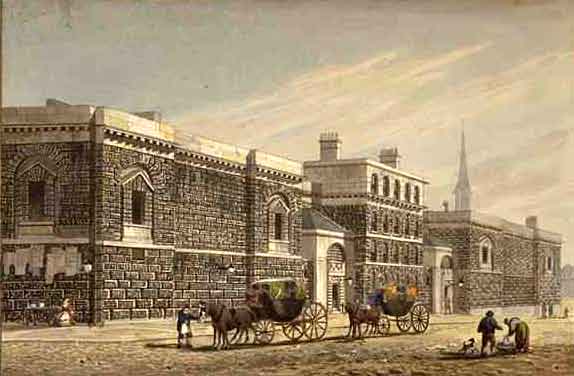
The west view of Newgate Prison, circa 1810, by George Shepherd (1784-1862).
Wikimedia Commons.

One of the most worrying diseases of the mid-eighteenth century was typhus. We now know that it is spread by lice or fleas, but at the time, like so many other diseases, it was thought to be caused by noxious air — “malaria”, for example, literally means “bad air”. This was not a silly theory. It was based on empirical observation, which perhaps explains why the belief in such noxious miasmas persisted for so long — well into the late nineteenth century, if not the early twentieth, before finally being ousted by germ theory. Our ancestors were not stupid, no matter how strange their beliefs might appear in hindsight. (Also take alchemy, or the belief that some animals spontaneously generated.)
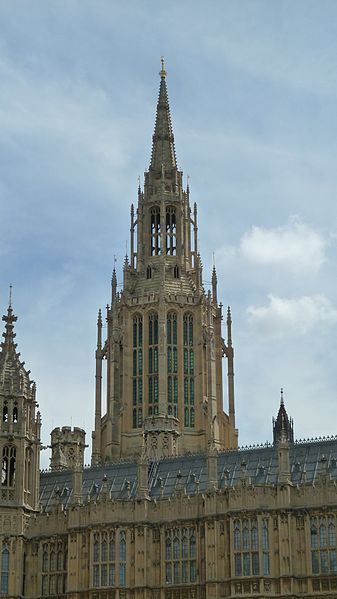
The Central Tower of the Palace of Westminster is actually a disguised ventilator.
Photo by Cary Bass via Wikimedia Commons.

Typhus fit the miasma theory especially well because it frequently appeared in confined spaces, like ships’ holds, prisons, mines, workhouses, and hospitals. The disease was thus often called “gaol fever”, or “hospital fever”. And there was the fact that at least one of the solutions designed to combat miasmas, the ventilator, actually seemed to work. This ventilator was not the kind that is in such high demand right now, used to help feed oxygen into patients’ lungs, but instead a machine used to get the air flowing in and out of confined spaces — like a 1740s air-conditioning unit.

At first glance, removing the stale air from a space shouldn’t do anything against typhus. But mortality declined drastically in the prisons and ships to which the ventilator was introduced. It halved the number of deaths per year in Newgate prison, where the bellows-like machinery was powered by a windmill, and the inmates of the Savoy prison fared even better. On ships, too, mortality declined among mariners, passengers, soldiers, and especially among the group that suffered most from long voyages across the eighteenth-century Atlantic: slaves.

But it’s not clear exactly why. After all, the ventilator did not kill the typhus-ridden lice or fleas. I have a few theories as to what must have been going on. Perhaps, by improving the supply of oxygen to confined spaces, people’s bodies were simply better served to deal with all manner of diseases. Surgeons aboard slave ships sometimes noted that, without proper ventilation, many slaves would simply die in the night of suffocation. Or perhaps the ventilator’s effectiveness had something to do with its drying effect. The machine was used to prevent grain stores from becoming humid, thus staving off damp-loving weevils. The ventilators might thus have staved off typhus through a similar means: although I’m not so certain about body lice, humid conditions are preferred by fleas. Regardless of the real reasons, the ventilators worked, and even when they did not reduce mortality, they made confined spaces more bearable for those who had to endure them. Ship captains reported that they did not even have to force their sailors to pump the ventilator’s bellows, because they liked the cool air so much. Ventilators were soon installed in the House of Commons, and in many of London’s theatres.

From the Wikipedia entry on architectural ventilation:

The development of forced ventilation was spurred by the common belief in the late 18th and early 19th century in the miasma theory of disease, where stagnant ‘airs’ were thought to spread illness. An early method of ventilation was the use of a ventilating fire near an air vent which would forcibly cause the air in the building to circulate. English engineer John Theophilus Desaguliers provided an early example of this, when he installed ventilating fires in the air tubes on the roof of the House of Commons. Starting with the Covent Garden Theatre, gas burning chandeliers on the ceiling were often specially designed to perform a ventilating role.

Mechanical systems
A more sophisticated system involving the use of mechanical equipment to circulate the air was developed in the mid 19th century. A basic system of bellows was put in place to ventilate Newgate Prison and outlying buildings, by the engineer Stephen Hales in the mid-1700s. The problem with these early devices was that they required constant human labour to operate. David Boswell Reid was called to testify before a Parliamentary committee on proposed architectural designs for the new House of Commons, after the old one burned down in a fire in 1834. In January 1840 Reid was appointed by the committee for the House of Lords dealing with the construction of the replacement for the Houses of Parliament. The post was in the capacity of ventilation engineer, in effect; and with its creation there began a long series of quarrels between Reid and Charles Barry, the architect.

Reid advocated the installation of a very advanced ventilation system in the new House. His design had air being drawn into an underground chamber, where it would undergo either heating or cooling. It would then ascend into the chamber through thousands of small holes drilled into the floor, and would be extracted through the ceiling by a special ventilation fire within a great stack.

Reid’s reputation was made by his work in Westminster.

March 27, 2020

The Wuhan Coronavirus sucks, our data on it sucks … but our media suck most of all

Filed under: China, Government, Health, Media, USA — Tags: , , , , , — Nicholas @ 05:00

The all-hysteria, all the time media will have much to regret once the worst of the Wuhan Coronavirus epidemic has run its course:

  • The data we have sucks, and thus any conclusions we are drawing mostly suck too. The data is worse than just being incomplete or bad — if it was randomly distributed, we could live with that. But the lack of test kits and how we have deployed the few we have means that the data is severely biased. We are only testing people who are strongly symptomatic. If there is a normal distribution of outcomes from this disease, we are only testing on the right side of the distribution. We have no idea where the median is or how long the tail is to the left side of asymptomatic outcomes. The only thing we absolutely know about the disease is its not as deadly as the media is portraying as we are missing hundreds of thousands of cases in the denominator of the mortality rates. The media has also been terrible about reporting on risk factors of those who died. When a bunch of people died suddenly in Seattle, one had to read down 5 paragraphs into the story to find that they were all over 70 in an old-age home. Or when prime-of-life people die, facts such as their being type 1 diabetics — a known severe risk factor for this virus (and one that makes it different from the flu) are left out.
  • The media is constantly confusing changes in measurement technique and intensity with changes in the underlying progress of the virus itself. Changes in case numbers have as much to do with testing patterns and availability than they do with the real spread of the disease.
  • While COVID-19 is likely worse than the normal flu, our perceptions of how much worse are strongly affected by observer bias. Frankly, if every news broadcast every night spent 15 minutes reciting flu deaths each day, we would all be hiding in our homes away from flu. They present a healthy man in his thirties dying clearly as the tragedy it is, but the spoken or unspoken subtext is, “this is abnormal so this thing is much worse.” But it seems abnormal because we do not report on the very real stories of healthy young people who die of the flu. My nephew who was 25 years old and totally healthy with no pre-existing conditions died of the flu last month — and no one featured this tragedy on the national news.
  • The data we are getting sucks worse because the media has decided, as one big group, that for our own good they are going to limit all facts about the virus to only the bad ones. There is a strong sense — you see it on Twitter both in Twitter’s policies as well as Twitter group attacks — that saying anything that might in any way reduce one’s fear of the disease should be banned for our own good. One of the more prominent examples was Medium removing an article NOT because it was proven wrong but because it took one side of a very open question and it was obviously decided it was “unsafe” to allow that side to even be aired.

Sensible risk management is not compatible with the “precautionary principle”

Filed under: Government, Health — Tags: , , , , , — Nicholas @ 03:00

David Zaruk wrote last week for Science 2.0 Europe:

Two decades of the precautionary principle as the key policy tool for managing uncertainties has neutered risk management capacities by offering, as the only approach, the systematic removal of any exposure to any hazard. As the risk-averse precautionary mindset cements itself, more and more of us have become passive docilians waiting to be nannied. We no longer trust and are no longer trusted with risk-benefit choices as we are channelled down over-engineered preventative paths. While it is important to reduce exposure to risks, our excessively-protective risk managers have, in their zeal, removed our capacity to manage risks ourselves. Precaution over information, safety over autonomy, dictation over accountability.

  • Whatever happened to “Keep out of reach of children”? Now we cannot be trusted and all products must be child-safe.
  • Whatever happened to “Handle with care”? Now safety by design has removed the need for individuals to exercise common sense or risk reduction measures.
  • Whatever happened to trust? Now individuals are no longer left with the capacity to make their own decisions in managing personal risks.

These are good things” precaution advocates would retort “since people often make mistakes and bad things can better be prevented!”. While continuous improvement of safety systems has its value, the bigger the fences, the less autonomously the individuals will react (creating a society of docile followers). The precautionary approach implies a lack of trust in individuals’ capacities to make their own (rational) choices. The over-engineered risk-management process would remove any situation where choices could be made. Fine for cases where there are no trade-offs, disruptions or loss of benefits (when the sheep have plenty of grass in their field), but in times of crisis (exposure to hazards), when precaution is your only tool, then sacrifice is the only solution.

[…]

When the public now sees everything of modern life (work, school, public events …) cancelled in a knee-jerk precautionary impulse, is it any wonder they are panicking? Enter the opportunist to sell you the silver solution or the naturopath detox remedy to put your mind at ease. Enter the quack to tell you to drink bleach. Enter the racist who will use the fear to mobilise outrage. Exit rationality and risk management.

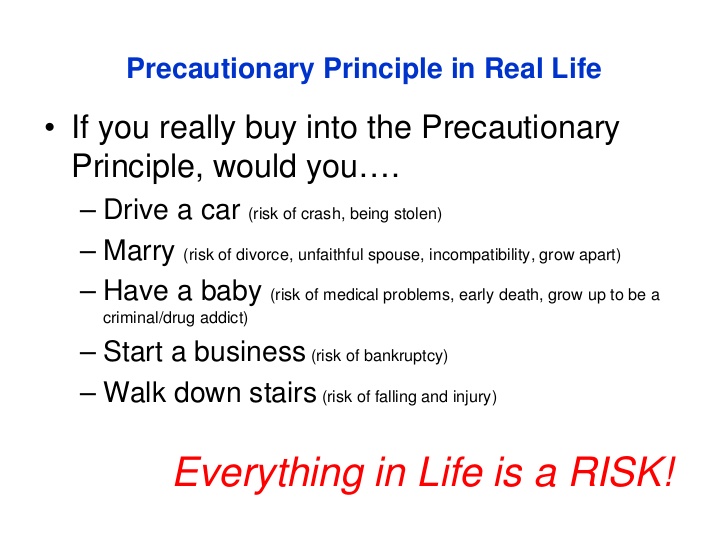
With no bullets left in the risk-management gun, the only thing left to do is run … or as it is more commonly called: apply the precautionary principle. Precaution should only be applied after other risk management measures have failed but given how horribly inadequate our capacities to govern have become, it is the only strategy our regulators have come to know.

Slide from a presentation by Patti Gettinger, 2011-07-11.
Original slideshow at https://fr.slideshare.net/regsgridlock/the-precautionary-principle-8656034

H/T to Johnathan Pearce for the link.

March 18, 2020

When You Run Out of Stuff to Hoard – Rationing 1940 – On the Homefront 001

Filed under: Britain, China, Europe, Food, Germany, History, India, Japan, WW2 — Tags: , , — Nicholas @ 04:00

World War Two
Published 17 Mar 2020

In this first episode of On the Homefront, Anna tells you about division of labour, food production and rationing in the early years of the war.

Join us on Patreon: https://www.patreon.com/TimeGhostHistory
Or join The TimeGhost Army directly at: https://timeghost.tv

Follow WW2 day by day on Instagram @World_war_two_realtime https://www.instagram.com/world_war_t…
Between 2 Wars: https://www.youtube.com/playlist?list…
Source list: http://bit.ly/WW2sources

Hosted by: Anna Deinhard
Written by: Spartacus Olsson
Produced and Directed by: Spartacus Olsson and Astrid Deinhard
Executive Producers: Bodo Rittenauer, Astrid Deinhard, Indy Neidell, Spartacus Olsson
Creative Producer: Joram Appel
Post-Production Director: Wieke Kapteijns
Research by: Spartacus Olsson
Edited by: Mikołaj Cackowski
Map animations: Eastory (https://www.youtube.com/c/eastory)

Sources:
IWM A 1699, A 7812, A 19891, D 6773, A 11856, A 11857, D 10565, D 9366, D 15530, D 10465, D 20087, D 20079, D 7958, D 2373, D 14667, D 7966
Taking blood pressure (SC 191775), National Museum of Health and Medicine https://www.flickr.com/photos/medical…
Picture of Elsie Widdowson and Robert McCance with their staff, courtesy of British Nutrition Foundation
Pie Chart by Ates Evren Aydinel from the Noun Project
Pie Diagram Half by Trevor Dsouza from the Noun Project
Farm by Symbolon from the Noun Project
Meat by chiccabubble from the Noun Project
Fish by Vectors Market from the Noun Project
butter by Nick Bluth from the Noun Project
potatoes by Vectors Point from the Noun Project
Vegetable by Eucalyp from the Noun Project
Poop by Jordan Díaz Andrés from the Noun Project
shelf by Zach Bogart from the Noun Project
Tea box by Tomas Knopp from the Noun Project
Jam by Vichanon Chaimsuk from the Noun Project
Biscuits by John Burraco from the Noun Project
Cheese by Erin Agnoli from the Noun Project
eggs by Oleksandr Panasovskyi from the Noun Project
butter by Imogen Oh from the Noun Project
can by Anniken & Andreas from the Noun Project

Soundtracks from the Epidemic Sound:
Gavin Luke – “Seasons of Change”
Johan Hynynen – “Dark Beginning”
Anthony Earls – “The Songs We Sing”
Fabien Tell – “Last Point of Safe Return”
Reynard Seidel – “Deflection”
Farell Wooten – “Blunt Object”
Johannes Bornlof – “The Inspector 4”
Howard Harper-Barnes – “Prescient”
Howard Harper-Barnes – “London”
Philip Ayers – “Under the Dome”

Archive by Screenocean/Reuters https://www.screenocean.com.

A TimeGhost chronological documentary produced by OnLion Entertainment GmbH.

From the comments:

World War Two
57 minutes ago (edited)
This is the first episode of On the Homefront. For those of you who haven’t watched our trailer or have seen the Between Two Wars episode on the Home Revolution, let me introduce you to Anna. She will be telling us all about the homefronts and the people on them in these monthly sub-series. Now, we know that this episode might seem to be playing on the Corona related hoarding that is going on, but this was already produced before any of that made the news. In any case, as many of you are sitting in your own homefronts, I hope this episode offers some relief and perspective. If you like it, do make sure to Join the TimeGhost Army to keep us running! You can do so at https://timeghost.tv or patreon.com/timeghosthistory
Cheers, Joram

March 11, 2020

QotD: Orthorexia

Filed under: Business, Food, Health, Media, Quotations, Science, USA — Tags: , , , , — Nicholas @ 01:00

The American media and our popular culture both celebrate a fear of safe, nutritious food if it is not labeled “organic.” To be consistent then, why don’t we also celebrate anti-vaxxers’ fear of safe vaccines, which are also not “organic?” To be clear, I am not an anti-vaxxer. I am strongly pro-vaccine. Everyone in my house is vaccinated, and I am appalled at the outbreaks of contagious diseases due to anti-vaxxers. But let’s be clear, a Venn diagram of those who obsess about organic food and anti-vaxxers will reveal a major overlap. If you know an anti-vaxxer, he is most likely committed to an organic diet.

Our culture accepts as a scientific fact that organic food is healthier than non-organic food. You can watch TV, read popular magazines, or listen to healthy-living gurus, and overwhelmingly you will be told that organic food is healthier than non-organic food. Recipes tend to call for organic produce and ingredients. And it goes beyond organic foods. Genetically-modified foods are slandered as “frankenfoods” concocted by mad scientists in a laboratory. Further, we are admonished to avoid anything that is not “natural.”

OK then. Vaccines are genetically modified, lab-made, and certainly not natural. Being anti-vax seems a logical extension of the natural, organic lifestyle.

I know several people — including family members — who have so completely bought into the natural-organic hype that they genuinely believe GMO and non-organic foods are poisonous. They would rather starve themselves and their children to death than ingest a gram of non-organic food. They look at the shelves of a regular grocery store and see rows and rows of poison. There is a medical term for this fear of safe healthy food — it’s called “orthorexia.” I am not shocked that some of these individuals are anti-vaxxers. Instead, I am shocked (and relieved) that some of the orthorexics I know actually do vaccinate themselves and their children.

Buck Throckmorton, “Organic Food & Anti-Vaxxers – Does The Fear of Safe Food Lead to Fear of Safe Vaccines”, Ace of Spades H.Q., 2019-12-08.

February 23, 2020

China’s government and the coronavirus epidemic

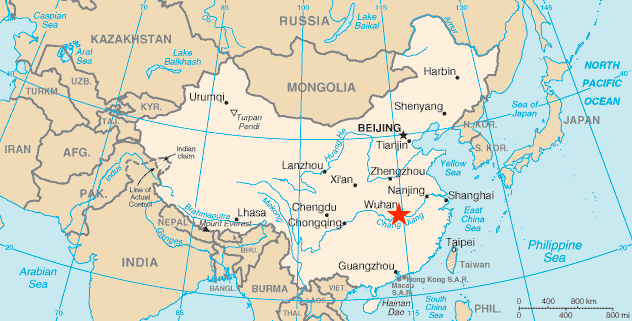
In Quillette, Aaron Sarin shows how the Chinese government has systematically failed to respond adequately to the epidemic which broke out late in 2019in Wuhan and risks “losing the Mandate of Heaven”:

As of this writing, the epidemic’s death toll is still rising, and many of these deaths can ultimately be traced to the paranoid rigidity of the Xi Jinping administration. By late December 2019, doctors in Wuhan were already sounding the alarm over cases of what appeared to them to be SARS. Instead of listening to their warnings, the authorities summoned eight of these doctors for a dressing-down. They were warned of the punishments they could face for “rumour-mongering.” News of their detention was broadcast to tens of millions: a clear message to anyone else who might have been thinking about discussing viruses in public.

The Party’s leaders actually knew enough to be worried by this point — they alerted the World Health Organisation on December 31st — and yet still they hid the truth from the public. This neurotic obsession with secrecy has certainly cost lives. If the medical community had been informed of the outbreak back in December, hospitals could have stockpiled the necessary supplies. But now there are drastic shortages, and patients are dying in hallways and waiting rooms.

Even the critics of authoritarian dictatorship will usually agree that the system beats democracy for sheer efficiency, but the coronavirus debacle has turned that old wisdom on its head. Where we might have expected cold and methodical governance, we have found dithering bureaucrats, unable to take a step in any direction, paralysed by what Xu Zhangrun calls “systemic impotence.” Weeks went by and citizens swarmed in and out of Wuhan, picking up the virus and transporting it to the far corners of the country. Local government officials stayed quiet, wary of the heavy hand of Xi Jinping. On January 23rd, a citywide quarantine was finally announced, but eight long hours passed before it was enacted — time enough for a million or more to flee the city.

The Wuhan lockdown was repeated in other parts of the country (most recently the southern megacity of Guangzhou), and some observers praised the speed with which new hospitals were constructed from scratch. These very visible displays of its power aside, the Party has moved far too slowly at every stage of the crisis. Diagnostic testing required samples to be sent all the way to a laboratory in Beijing, and this delayed the distribution of testing kits to many of the hospitals in Wuhan. Even when testing kits were available, patients still found themselves trapped in a Kafka-esque web of bureaucracy. According to Reuters, the tests have been refused to people who fail to make it through a complex reporting system involving hospital authorities, district authorities, city health authorities, and disease control officials.

None of this should come as a surprise. The cliché about the efficiency of authoritarian systems was always, on closer analysis, something of a low-resolution image. In the old days of the Soviet Union, speedy industrial growth obscured the reality of a fragile system largely devoid of autonomous decision making. During the 1920s, the Communist Party’s state planning committee Gosplan was established with the impressive-sounding mission of creating a series of five-year plans to govern the economy. But over the next 70 years, the vast majority of these plans were radically revised and rewritten, or more frequently ignored altogether in favour of Joseph Stalin’s arbitrary dictates. Indeed, Gosplan actively tried to avoid making decisions at all, because committee members knew Stalin would have them shot and replaced if their ideas produced unwelcome results. In the end, fear saps the efficiency of all authoritarian regimes, and the Chinese Communist Party is no exception.

Li Wenliang has emerged as the most vivid symbol of the Party’s latest failure. Li was one of the Wuhan doctors disgraced for discussing the coronavirus on social media. A few days after his police warning, he contracted the virus himself, and on February 6th he died. It was during the period of Li’s short illness that the Party apparently realised its error and decided to absolve the doctors, but still the central government would accept no blame for the tragedy. Instead, the Supreme Court (which is controlled by the CCP) scolded the local government in Wuhan — an unusual move, no doubt designed to create a scapegoat for surging public anger. The truth is that the city’s officials had been faced with an impossible job. They obediently followed orders, and now they will be punished for it.

December 5, 2019

QotD: [Literal] Health Nazis

Filed under: Germany, Health, History, Quotations — Tags: , , , , , — Nicholas @ 01:00

[T]he Nazis’ focus on the threats that risky habits pose to “public health” makes perfect sense in light of their collectivist ideology. “Brother national socialist,” said one bit of Nazi propaganda, “do you know that your Führer is against smoking and thinks that every German is responsible to the whole people for all his deeds and missions, and does not have the right to damage his body with drugs?”

Smith adds: “Clearly there were considerable links between the promotion of particular lifestyles and the racial hygiene movement. Tobacco and alcohol were seen as ‘genetic poisons,’ leading to degeneration of the German people.”

The point, I hasten to add, is not that today’s “public health” paternalists are Nazis. I am not suggesting that everyone who hates smoking is just like Hitler. But there is an unmistakable totalitarian logic to the notion that the government has a responsibility to promote “public health” by preventing us from engaging in activities that might lead to disease or injury. The implication is that we all have a duty to the collective to be as healthy as we can be, an idea the Nazis embraced but one that Americans ought to find troubling.

Jacob Sullum, “So What If Hitler Was an Anti-Smoker?”, Reason Hit and Run, 2004-12-17.

February 11, 2019

Tuberculosis – A Ten-Thousand Year Battle – Extra History – #2

Filed under: Health, History, Science — Tags: , , — Nicholas @ 04:00

Extra Credits
Published on 7 Feb 2019

Tuberculosis couldn’t be cured and eliminated by just one person like Dr. Robert Koch, but thanks to the collective efforts of the medical community since Koch’s time — including public health initiatives and the introduction of randomized clinical trials — TB is steadily being wiped out.

Join us on Patreon! http://bit.ly/EHPatreon

January 19, 2019

The Lancet‘s new guidelines are a great leap forward … to worse-than-WW2 rationing

Filed under: Britain, Environment, Food, Health, Media — Tags: , — Nicholas @ 13:17

A new initiative by The Lancet and EAT, a billionaire’s pro-starvation advocacy group, involves new food guidelines that may leave Britons feeling a tiny bit … hungry:

The Lancet has got into bed with EAT to transform the global food supply. EAT is a campaign group run by a Norwegian billionaire who flies around the world in a private jet telling people to eat less meat to save the planet. The Lancet‘s interest is in getting people to live off lentils for the good of their health.

How much less meat do these people think we should be eating? Much, much less. Less than a sausage a week would be the pork ration in their brave new world.

As “Captain Nemo” commented on David Thompson’s blog:

“It appeared that there had even been demonstrations to thank The Lancet for raising the sausage ration to seven grams a week. And only yesterday, he reflected, it had been announced that the ration was to be REDUCED to seven grams a week…”

My apologies to Orwell.

January 9, 2019

The past is a foreign – and very smelly – place

Filed under: Europe, Food, Health, History — Tags: , , , , — Nicholas @ 05:00

We moderns tend to take ordinary public health issues for granted, yet the development of adequate sanitation and improvements in personal hygiene have probably contributed more to eliminate disease and expand human lifespan than any number of medicinal innovations. Marian L. Tupy reminds us just how … aromatic … the past was, and why:

Most of us take modern restrooms for granted, but proper sanitation is a relatively modern phenomenon and is still far too rare in the poorest regions of the world.

The need to keep human and animal waste away from human contact may seem obvious today, but for millennia that was not the case. Before the emergence of the germ theory of disease, and the subsequent public health campaigns and construction of adequate sanitation infrastructure in most of the world, people and waste commingled – with catastrophic results.

Countless millions of people got sick or died from diseases such as diarrhoea, ascariasis (a type of intestinal worm infection), cholera, hepatitis, trachoma, polio, schistosomiasis and so on.

In due deference to our ancestors, it has to be noted that some cultures, such as ancient Rome, paid due attention to cleanliness. The Romans built numerous public baths, which were accessible even to the very poor for a nominal fee, and a sophisticated system of sewers that enabled Rome to grow and reach a population of over 1 million people around the start of the first millennium. That feat would not be replicated in Europe until London and Paris in the 19th century.

In general, however, standards of hygiene tended to be very poor. A typical urban dwelling had a cesspit underneath the house or next to it. That’s where human and kitchen waste accumulated and fermented. Inadequate drainage, irregular emptying and heavy rains could make the cesspit overflow and seep into the house. While discouraged by the city authorities, people often emptied their chamber pots into the streets below.

As Johan Norbeg of the Cato Institute wrote in his 2016 book Progress: Ten Reasons to Look Forward to the Future, “When pedestrians heard the shout of ‘Gardyloo!’ they ran for cover. This phrase, taken from the French for ‘Look out for the water,’ was your only warning that someone was about to throw their waste out of the window.”

In rural areas, people lived with their animals, including chickens and cows, and used both animal and human waste to fertilise their crops – an extremely dangerous practice compounded by the fact that people could go throughout much of their lives without ever washing their hands. That led to epidemics of disease as well as other unsavoury consequences.

December 5, 2018

The Spanish Flu I THE GREAT WAR Epilogue 2

Filed under: Europe, Health, History, Military, WW1 — Tags: , , , — Nicholas @ 04:00

The Great War
Published on 3 Dec 2018

The Spanish flu has quickly spread all over the world since the spring of 1918 and will become the disease that killed more people in a shorter period of time than any other disease in human history.

November 26, 2018

You can make a strong case that “nutrition science is not just misguided but actually harmful”

Filed under: Food, Health, Media, Science, USA — Tags: , — Nicholas @ 03:00

Alex Berezow outlines the ferment and upheaval in modern nutrition science reporting:

One day, coffee causes cancer; the next, it cures cancer. One day, wine is good for you; the next it kills you. Given its self-contradictory wishy-washiness, can nutrition science be trusted?

Not at all, say Edward Archer and his co-authors, in a new paper published in Frontiers in Nutrition. They believe nutrition research is so bad that they call our current scientific discourse on the relationship between diet and disease to be “fictional.”

This isn’t the first time that Dr. Archer lobbed a grenade into the field of nutrition. In an article for RealClearScience, he (in)famously called the U.S. dietary guidelines a “scientific fraud” based on “implausible” data that “create[s] fear and uncertainty in American citizens.”

Clearly, Dr. Archer believes that nutrition science is not just misguided but actually harmful. That’s an extraordinary statement that requires extraordinary evidence.

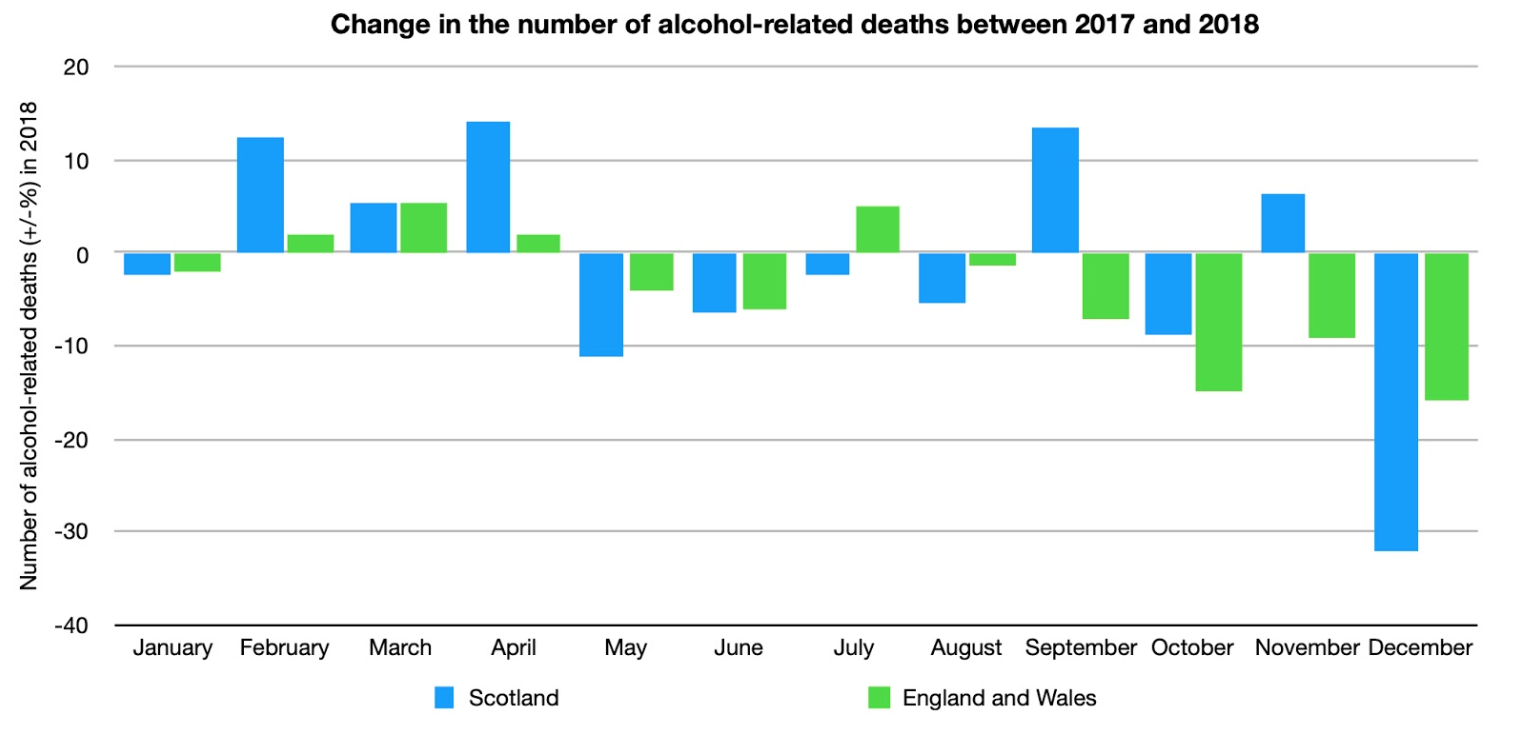
Any nutrition study that’s based on self-reporting depends on the participants to be honest and fully revealing of their food and drink intake. At a time when we’re food-shamed on a daily basis by the government and the media for our “failings”. Even mostly honest reporters are likely to ever-so-slightly under-report their intake of whatever foods are the subject of this week’s “two-minute hate”. One of my favourite examples of blatant under-reporting is that — if you believe the reports — approximately half of all the booze sold in Britain is just poured down the drain:

The only real pitfall in this kind of research is the problem of people under-reporting how much they drink. The amount of alcohol sold in the UK is about twice the amount that people claim to drink, so unless we throw away a huge amount of booze, it is certain that people either forget about how much they drink or they deliberately lie to researchers. In either case, we can assume that the people who say they consume two drinks a day are probably consuming three or four drinks, in which case the amount that you have to drink to assume the same level of risk as a non-drinker is even more than this graph suggests.

H/T to Blazing Cat Fur for the link.

November 6, 2018

An alternative explanation for the population explosion of the “land whales”

Filed under: Britain, Food, Health, History — Tags: , , — Nicholas @ 03:00

Tim Worstall suggests that the real reason for our collective expanding waistlines isn’t evil capitalist exploiters pushing us to eat unhealthy fast food:

We don’t, for example, eat more than our forefathers did. Sure, we can all play games with how much people lie on those self-reported surveys about calorie intake. True, to make sense of it being lies we’d have to assume that people lie more now than they used to. So, instead, let’s look at official guidance. In WW1 the aim was, for the Army, to stuff some 4,300 calories a day into each frontline soldier out there in the trenches. Something they largely achieved too. In WWII rationing peeps started to worry that diets of less than 2,900 calories a day would lead to weight loss. Today official guidance is that 2,500 a day for men, 2,000 for women. Well, that’s the last one I recall at least.

I suspect that people actually do lie more on self-reporting surveys of that kind than they once did, if only because we’ve had several decades of prissy lecturing about what we should consume … the temptation to shade the answers in the “right” direction I’m sure plays some part, but not enough to explain the obesity crisis. If you doubt that this happens, remember that a significant number of people vote for the party they expect to win rather than the party that best represents their interests or desires. Sucking up to teacher is a very common psychological trait.

However, back to the swelling obesity numbers:

Actually, 40 years ago is about when central heating became a commonplace in Britain. Anyone of my maturity in years – which includes G. Monbiot – and even those from thoroughly upper middle class backgrounds – both me and G. Monbiot – will recall ice on the inside of bedroom windows in winter. Houses simply were not fully heated throughout. Actually, pretty much the entire country was in what we’d now call fuel poverty. That fuel poverty that we have standards for these days, you should be able to heat the entire house to such and such a temperature on less than 10% of income. A standard which just about no one pre-1950 reached, few pre-1970 did.

America had that heating rather earlier than we did. Americans also became land whales that little bit earlier than we did. Anecdata I know but a move to the US in 1981 was marked with an observation of how warm Americans kept their houses in winter.

We do actually spend quite a lot on all this public health stuff these days. It might be worth someone doing a little study of correlations. Different nations became lardbuckets at different times. Different nations adopted central heating as a commonplace at different times. Why don’t we go see what the correlation between those two is?

After all, the idea that mammals use some significant portion of their energy intake for body temperature regulation isn’t exactly fringe science, is it?

August 30, 2018

Britain “forgets” to regulate e-cigarettes, youth smoking drops substantially

Filed under: Britain, Business, Health — Tags: , , , — Nicholas @ 03:00

Last month, Matt Ridley sang the praises of the regulators who didn’t regulate:

A selection of e-cigarettes
Photo by Ecig Click via Wikimedia Commons.

Britain is the world leader in vaping. More people use ecigarettes in the UK than in any other European country. It’s more officially encouraged than in the United States and more socially acceptable than in Australia, where it’s still banned. There is a thriving sector here of vape manufacturers, retailers, exporters, even researchers; there are 1,700 independent vape shops on Britain’s streets. It’s an entrepreneurial phenomenon and a billion-pound industry.

The British vaping revolution dismays some people, who see it as a return to social acceptability for something that looks like smoking with unknown risks. Yet here, more than anywhere in the world, the government disagrees. Public Health England says that vaping is 95% safer than smoking and the vast majority of people who vape are smokers who are partly or wholly quitting cigarettes. The Royal College of Physicians agrees: “The public can be reassured that ecigarettes are much safer than smoking.”

Lots of doctors are now recommending vaping as a way of quitting smoking. It is because of vaping that Britain now has the second lowest percentage of people who smoke in the European Union. The youth smoking rate in the UK has fallen from 26% to 19% in only six years.

How did this happen here? It’s partly the fault of the advertising executive Rory Sutherland; he is the Walter Raleigh of this revolution. In 2010, he walked into an office in Admiralty Arch to see an old friend, David Halpern, head of David Cameron’s new “nudge unit”, formally known as the Behavioural Insights Team. Sutherland pulled out an electronic cigarette he had bought online, and inhaled. By then, several countries including Australia, Brazil and Saudi Arabia had already banned the sale of electronic cigarettes — usually at the behest of tobacco interests or public-health pressure groups. California had passed a bill banning them, though Arnold Schwarzenegger, then the governor, had vetoed it. It looked inevitable that Britain would follow suit.

“I was a very early convert,” Sutherland tells me now. “Partly because I was a longtime ex-smoker myself who found them much better than constant relapses; I was also interested in the placebo effect they offered by mimicking the act of smoking. But I was almost equally fascinated by the psychology of the people who instinctively wanted to ban them.”

Halpern took notice. He knew the theory of “harm reduction” — that it is more effective to give somebody the lesser of two evils than insist unrealistically on immediate abstinence. So he asked his nudge team to get digging. Over coffee at No 10, he was surprised to learn that even the anti-smoking group Ash was leaning in favour of ecigarettes. So when public-health nannies started calling for them to be banned, Halpern made sure the government resisted.

In his book Inside the Nudge Unit, Halpern wrote: “We looked hard at the evidence and made a call: we minuted the PM and urged that the UK should move against banning e-cigs. Indeed, we went further. We argued we should deliberately seek to make e-cigs widely available, and to use regulation not to ban them but to improve their quality and reliability.”

H/T to Rafe Champion for the link.

August 2, 2018

1918 Flu Pandemic – Fighting the Ghost – Extra History – #4

Filed under: Health, History, USA, WW1 — Tags: , , , , — Nicholas @ 04:00

Extra Credits
Published on 28 Jul 2018

Philadelphia gets hit the hardest. New York fares somewhat better, but everyone is trying to keep hush-hush about a pandemic that still found its way into a children’s rhyme: influenza.

« Newer PostsOlder Posts »

Powered by WordPress