Quotulatiousness

June 26, 2010

The smell of burning police cars

Filed under: Cancon, Media, Politics — Tags: , , , , , , — Nicholas @ 21:34

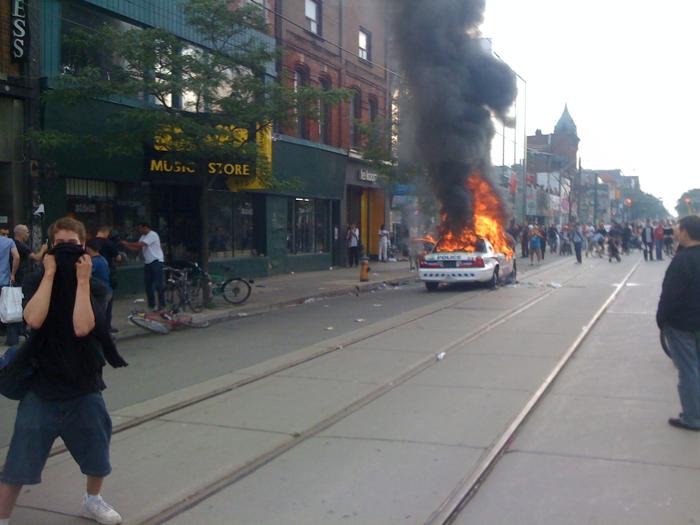
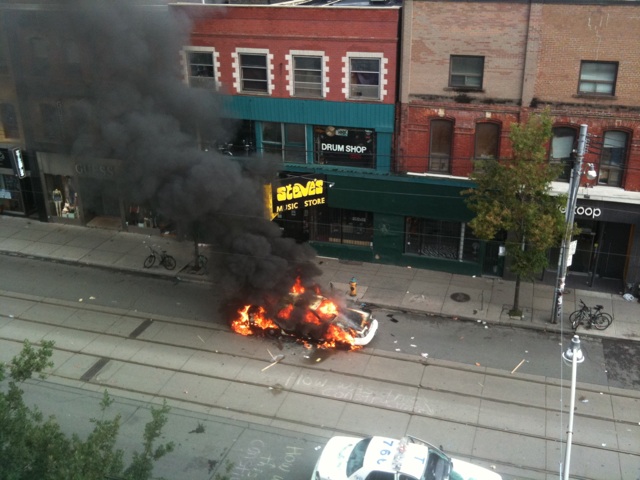
Just when you think the anarchists have decided to let the government look like fools, they pull stuff like this, allowing the security forces to justify the billion+ they’ve spent on the G8/G20 summit meetings:

Pic from Eric Squair.

Pic from Pete Forde. The second police car in this photo also gets the warm treatment from the anarchists.

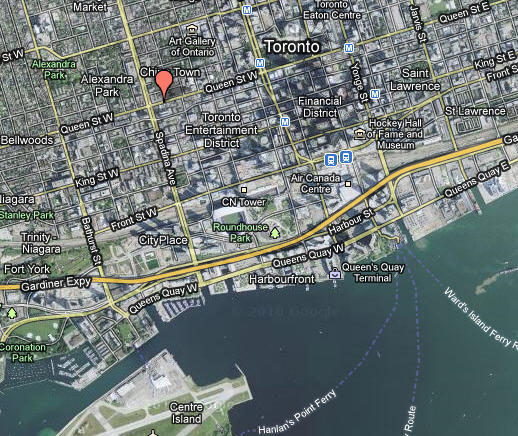
For those not familiar with Toronto, this is approximately here:

Update: Michael Coren has a suggestion to get the police more involved in deterring the rioters:

An idea. Tell the cops that these anarchist criminals are actually confused, gentle Polish visitors trying to find help at an airport. Not only will deadly force ensue but the police will lie about it all after the fact.

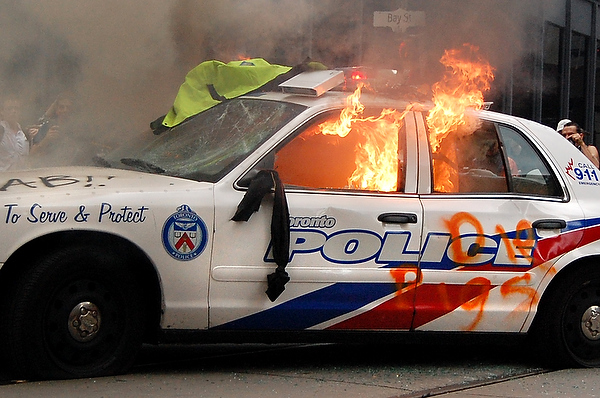
Update, the second: Another burning police car, further east at (I assume) Queen King St. and Bay St.

Pic by Marissa Nelson.

Update, the third: In spite of all the images available of burning or burnt-out police vehicles, the three above were the only ones. Rarely have so many twittered so much about so few . . .

G20 arrests not considered “major enough” to release details

Filed under: Cancon, Law, Media — Tags: , , , , , , , — Nicholas @ 12:25

Siri Agrell notes the inconsistency of Toronto police over the (32 at time of writing) arrests made around the G20 area:

When asked for details of the arrest of a deaf man at Friday night’s demonstration, Burrows [of the Integrated Security Unit] said he had neither a name or the charges.

“Very rarely do we ever release information unless it’s a major arrest, major charges, big investigation or something like that,” he said. “That’s our standard practice. This guy was arrested last night, there’s nothing major about it. we’d never put a release out about that.”

And yet, the police regularly release information about minor incidents, ranging from lost property to suspicious behaviour. Surely, the arrest of Toronto citizens exercising their right to protest during a major international event warrents some transparency?

Yet another example of the police taking advantage of the situation to expand their practical reach?

So teenagers sending sext messages, a lost urn and some guy trying to pick up Toronto women are worthy of police updates, but details of arrests made during the G20, when police have been given huge powers, aren’t worth releasing?

In a nutshell, yes.

What other “secret laws” did they pass?

Filed under: Cancon, Government, Law, Liberty — Tags: , , , , , , — Nicholas @ 11:37

Much noise and confusion over the discovery of a recently passed law allowing police to arrest anyone who fails to show ID within 5 metres of a “public work”. The law itself isn’t new, but the secret was the silent addition of the area of the G20 meetings as a “public work” for the definition of that law. Hijinks ensue:

Police are now able to jail anyone who refuses to furnish identification and submit to a search while within five metres of a designated security zone in downtown Toronto.

Critics reacted furiously to the new rules, which remained unpublicized until Thursday when a 32 year-old man was arrested in Toronto for refusing to show ID to police.

New Democrat MPP Peter Kormos said Friday the provincial Liberals created a “Kafka-esque” situation where people could be arrested for violating rules they didn’t know existed.

“This is very very repugnant stuff and should be troubling to everybody,” he said.

The Canadian Civil Liberties Association (CCLA) said it was “extremely concerned” that the new measures violate constitutional safeguards.

I’m not a fan of violent protests, but I don’t believe the police need this additional tool in order to arrest people who attempt to breach the barricades or attack other people: this is granting too much arbitrary power to police officers. The way the power was granted is even more disturbing . . . it shows that the government knew there’d be an outcry if they did it in the public view, so they arranged it so that nobody would know about it in time to do anything about it. Nice work, Ontario, got any other nasty legal surprises you want to spring on us?

Update, 29 June: According to a report in the National Post, the Ontario government denies that there was any such regulatory change and that no arrests were made using the authority of this act.

June 25, 2010

Ghost town T.O.

Scott Stinson finds that the constant warnings about disruptions, delays, closures, and protests has had a positive effect: anyone who can avoid downtown Toronto is avoiding the place.

We were to be besieged by The Man, and those who would shake their fists at The Man.

So it was more than a little surprising to find the commute on Thursday morning not one of snarled traffic and honking horns, but one of fast-moving, wide-open freeways. Given the number of vehicles on Toronto’s normally packed roads, you’d think the area had been hit a day earlier not by a mild earthquake, but by a nuclear bomb. From northeast of the city to the western waterfront in 40 minutes? If this is nuclear winter, then sign me up for Armageddon!

I’ve certainly been avoiding going into downtown since the barricades started to go up. I’m apparently one of the majority following the same basic script.

And why wouldn’t residents have made alternate plans? Consider this traffic advisory, issued on Tuesday: “Expect closures and restrictions in and around Toronto resulting in significant delays on major highways such as the 427, 401, Queen Elizabeth Way, Gardiner Expressway, the Don Valley Parkway and connecting roads.”

If you are unfamiliar with Toronto’s highways, a little background about those mentioned in that advisory: That’s pretty much all of them. Other than one highly expensive toll road across the north of the city, there’s no way to cover much ground in this place without traversing those highways that officialdom warns will have “significant delays.” Due to the prevailing security-first practice of releasing as little information as possible — which is to say, nothing — that road closure advisory doesn’t say which highways will be closed when, either. If we knew that, at least we could plan around the delays. Instead we get travel warnings that boil down to this: Seriously, stay away.

Update: Don Martin thinks it’s like a scene from a post-apocalyptic movie:

This is what a billion-dollar security net buys you. Canada’s largest city as a post-apocalyptic movie set. Massive worker inconvenience. Horrific productivity losses. Legions of bored cops on overtime. And a tourist scare-off that makes SARS look like a Halloween prank.

Everywhere in a city core swept clean of garbage collection bins and newspaper boxes, a fence runs through it.

The notorious barricade has gaps too small even for a child’s fingers to grasp and that makes it impossible to scale although, protesters take note, at three metres high it’s only half the world pole vault record so there’s at least one way to leap over it into the waiting hands of riot police.

Speaking of police, they already gather in jawdropping numbers as omnipresent clusters at every intersection or wander aimlessly as enforcement groups around buildings and down streets, wearing bulletproof vests with helmets dangling from their belts and earpieces connected to voices of undetermined origin.

At least there’s the scene set for some great TV and photography moments later in the weekend, when the massed forces of global anarchism (plus every other disgruntled group with both an axe to grind and physically active membership) look for their golden opportunities to induce police over-reaction. The only tourists in town aren’t interested in the sights or the shopping: they’re here for media appearances, protest marching, and (hopefully a tiny minority) a taste of violence.

Update, the second: Kelly McParland points out that the massive security precautions have actually made the protesters redundant:

[. . .] The [Toronto] Star edited out Dave and dwelt instead on the new law, which wasn’t debated in the legislature and resulted from an ‘extraordinary request’ by Toronto Police Chief Bill Blair, who wanted additional policing powers shortly after learning the G20 was coming to Toronto.” Evidently it didn’t occur to Premier Dalton McGuinty that he could say no. And why should he? It’s pretty clear that no one in any government — municipal, provincial or federal — has said no to anything dreamed up by any level of the national security apparatus since the day Stephen Harper told them he’d agreed to hold two summits at once. A billion dollar budget? You got it. New sound blasters for Toronto cops? You got it. An asinine fence snaking through the centre of the city? Done. The country’s financial centre brought to a screeching halt . . . all the major tourist spots closed . . . restaurants emptied . . . hotels commandeered . . . the waterfront shut down on a hot summer weekend . . . a million or so people kept from earning a living? Done, done and done.

This is what happens when you give security people a blank cheque and let them impose whatever paranoid restrictions they can dream up at their most fevered moments. Hey, let’s rip the saplings out of the ground! Let’s get a fork lift and move that three-ton elephant sculpture someplace where less ‘dangerous’! What’s dangerous about a three-ton elephant sculpture? Who knows, but we can do whatever we want! It’s about security!

What the protesters have missed is that they weren’t needed. The government’s done a fine job of making itself look foolish without any help from them. They could have stayed home for the weekend and watched the Michael Jackson testimonials. They sure wouldn’t have missed anything important.

June 22, 2010

UK photographers might want to pick up this magazine

Filed under: Britain, Law, Liberty — Tags: , , , , — Nicholas @ 10:02

BoingBoing advises that the July issue of Amateur Photographer is doing something to assist innocent photographers who are still encountering police and rent-a-cop harassment in public spaces:

The UK Amateur Photographer magazine is giving away free lenscloths silk-screened with the Photographers’ Bill of Rights with its July issue. UK anti-terror legislation gave the police sweeping powers to harass photographers for shooting in public places, and to compound matters, tabloid-driven hysteria over paedophilia has seen many photographers accused to paedophilia for taking pictures of (for example) public busses and empty playgrounds.

Between the anti-terror laws, the anti-pedophilia panic in the newspapers, and the general busy-bodiness of security guards, photographers in the UK are being treated like criminals. More on the anti-harassment campaign here.

June 17, 2010

The RCMP: determined to shed that do-good reputation

Filed under: Bureaucracy, Cancon, Law — Tags: , , , — Nicholas @ 12:08

Matt Gurney looks at the explicitly non-apologetic “apology” offered by the RCMP to the mother of Robert Dziekanski, and points out that the RCMP is its own worst enemy:

So, let’s get this straight. Four Mounties jump a confused, helpless man, who could have almost certainly been dealt with by a Polish-speaking translator and a few kind words, and they Taser him repeatedly, and he dies screaming and kicking. Then they confiscate the tape of the event, and an inquiry into the incident reveals appalling attempts by officers to provide false statements and generally whitewash the whole debacle. And the best the RCMP can muster up is to say, “Gee, that’s a shame. But we’re not really sorry.”

As soon as the tape of four Mounties repeatedly shocking a defenceless man became public, the Mounties should have realized they’d dug themselves an enormous hole and swiftly apologized for this tragedy. Instead, they circled the wagons and did their best to deny what was blindingly obvious — that their officers acted too fast, too violently and then refused to allow the medics who arrived soon after to properly treat a man who was dying before their eyes. It was callous and horrible and has badly shaken the faith millions of Canadians have in their police force, a force now known for corruption and institutional arrogance as much as they are for their iconic red uniforms.

That a high-ranked official such as Deputy Commissioner Bass would sit before a press conference and mouth words of sympathy and apology to the mother of a dead man whilst simultaneously assuring his colleagues that he doesn’t mean a word of it is disgusting and will only add to the calls for a total overhaul of the RCMP. It is a bitter irony that his make-believe apology was given, of all days, on April Fool’s Day. What will the next revelation in this unfolding farce be? Were his fingers crossed, too?

Update, 18 June: The report on this incident has been released, and while it stops short of calling the RCMP officers murderers, it does call the Tasering “unjustified”.

June 16, 2010

Policing for Profit

Filed under: Law, Liberty, USA — Tags: , , — Nicholas @ 09:54

June 8, 2010

Attention drivers: Ohio police can now just “estimate” your speed

Filed under: Law, Liberty, USA — Tags: , , , — Nicholas @ 07:33

. . . and then write you a ticket based on their estimate, no further proof needed:

Police don’t need radar to cite you for speeding.

The Ohio Supreme Court ruled this morning that an officer trained to estimate speed by sight doesn’t need an electronic gauge to catch speeders.

The 5-1 ruling was a defeat for 27-year-old Akron-area motorist Mark W. Jenney and speeders across the state. Jenney had challenged a visual speed estimate by a Copley police officer, but a trial court and the 9th District Court of Appeals upheld his conviction.

So, Ohio drivers, expect to see your state assess a lot more speeding tickets (a nice form of revenue for the depleted state coffers), now that the police have been given carte blanche. There’s little reason for them not to treat this as a newly imposed tax on drivers: no evidence is required, other than the officer’s estimate, and the court clearly isn’t too worried about the legal implications of this.

As Eric Moretti says:

Hey “Supreme Court Justices” why don’t you guys get this part of what laws are supposed to do through your thick skulls. It’s safe to say that officers might be trained to identify speeds, and they might even be great at it — but it blasts the notion of burden of proof being on the state out of the water. You didn’t just blast it out, you nuked that fish to dry land. There is no factual evidence when officers have the ability to do this, “I think you were going 120 mph.”

Where is the public recourse for police officers who abuse their abilities? We have to take an officer’s (the state) word that we committed a crime? Did you guys even go to law school?

June 3, 2010

Toronto Police tougher than the RCMP?

Filed under: Cancon, Law — Tags: , , , , — Nicholas @ 12:48

Kelly McParland notes that even though the RCMP have a lot of tough-guy things on their list of “will do”, there’s one thing Toronto Police will do that the RCMP won’t:

The RCMP will Taser an old lady at the drop of a hat.
They’ll Taser a guy in an airport because he’s holding a stapler and looks upset.
They’ll Taser the disabled.
They’ll Taser a 15-year-old girl in handcuffs.
They’ll Taser an 82-year-old heart patient in a hospital bed.
They’ll Taser someone who’s been hog-tied, pepper-sprayed, handcuffed and manacled.
They’ll Taser just about anything that can be Tasered. But they won’t use “sound cannons” in the middle of a city. Too risky.
Toronto police are buying four of the ear blasters for the G20 summit.

May 28, 2010

Is it too late to cancel?

Chris Selley rounds up the (almost unanimous) pundits’ opinions about the billion-dollar-boondoggle-summit-set:

Is it too late to cancel the G8 and G20 summits?

The National Post‘s Don Martin for the win: “No amount of righteous government bluster about living in post-9/11 protection paranoia, last week’s bank firebombing in Ottawa or the precedent of hosting two back-to-back summits can explain how an $18-million security tab for the G20 in Pittsburgh last September, which involved 4,000 police, must balloon to a billion dollars in Toronto requiring 10,000 cops on the ground.” Yup. It’s outrageous, and the government seems very oddly . . . proud of it. We can hardly wait for the Auditor-General and Parliamentary Budget Officer to find out just where this money went. Especially in a climate where Canadians are thoroughly cheesed off about government spending in the first place, it’s not too much of a stretch to say this is the sort of issue that might bring down a government.

“A case of bureaucracy gone wild,” is Jeffrey Simpson‘s uncontroversial verdict in The Globe and Mail, “or planning gone crazy, of fear sinking itself into every official’s and security person’s heart.” Imagine what we could have bought with that $1-billion! A bunch more Canada Research Chairs, or a whack of “clean-energy projects,” or assistance for “cultural groups” — so sleepy — or, hey, now we’re talking, a massive injection of cash for infrastructure on aboriginal reserves. Or, as Simpson says, “whatever.” Almost literally anything would be better. We’d arguably be better off flushing the $1-billion down the john.

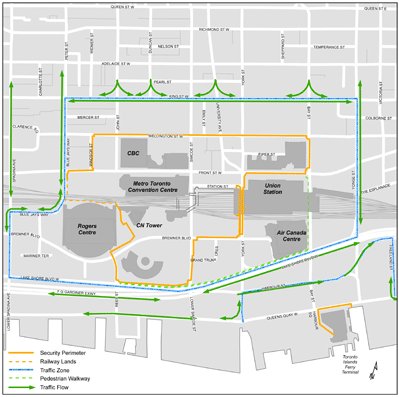
For those of you looking forward to suffering through the event, here’s the official map of the restricted area around the Metro Convention Centre:

The best advice — unless you’re hoping for a run-in with the police — is to avoid Toronto for that weekend (plus a few days in either direction).

May 17, 2010

“Of course . . . we care about winning the hearts and minds of people in Afghanistan . . .”

Filed under: Middle East, Military, USA — Tags: , , — Nicholas @ 18:00

Radley Balko contrasts the ease with which Police SWAT teams can operate compared to the rather more restrictive terms under which army units in Afghanistan have to operate:

A reader who asks his name not be used writes about the drug raid video from Columbia, Missouri:

I am a US Army officer, currently serving in Afghanistan. My first thought on reading this story is this: Most American police SWAT teams probably have fewer restrictions on conducting forced entry raids than do US forces in Afghanistan.

For our troops over here to conduct any kind of forced entry, day or night, they have to meet one of two conditions: have a bad guy (or guys) inside actively shooting at them; or obtain permission from a 2-star general, who must be convinced by available intelligence (evidence) that the person or persons they’re after is present at the location, and that it’s too dangerous to try less coercive methods. The general can be pretty tough to convince, too. (I’m a staff liason, and one of my jobs is to present these briefings to obtain the required permission.)

[. . .]

I’ve heard similar accounts from other members of the military. A couple of years ago after I’d given a speech on this issue, a retired military officer and former instructor at West Point specifically asked me to stop using the term “militarization,” because he thought comparing SWAT teams to the military reflected poorly on the military.

H/T to Tom Kelly, who sent the Instapundit link from which I got the title for this post.

QotD: Standing up for freedom

Filed under: Cancon, Liberty, Quotations, USA — Tags: , , , , — Nicholas @ 17:19

The Drug Wars in general, and the case of Marc Emery in particular, are a litmus test for those who say they believe in freedom. Everyone is for freedom, their own. It’s everyone else’s that makes them uncomfortable. It is easy to be for low taxes and light government regulation, when you run a business. It is easy to be for freedom of speech, when your livelihood depends on your keypad and fingers. It is easy enough to feel sympathetic for those whose freedom is taken away, when they are like you, when you can see yourself in their position. There, but by grace, go I. But this is not advocacy of freedom. It is nothing more than special pleading. The businessman who demands low taxes, and government subsidies, is not for freedom. The journalist who cries out when some powerful politician tries to silence him, then turns around and supports the Human Rights Tribunals, is not for freedom. The ordinary citizen, who is also the member of a minority ethnic group, who becomes indignant when the rights of his group are threatened, but shrugs his shoulders when those of other groups are trampled upon, he is not for freedom.

Publius, “Martyr to Freedom”, Gods of the Copybook Headings, 2010-05-17

May 13, 2010

To the drug warriors, this isn’t a bug: it’s a feature

Filed under: Law, Liberty, USA — Tags: , , — Nicholas @ 12:32

Jacob Sullum urges against the adoption of DUID (driving under the influence of drugs) laws:

Under these laws, a driver who has marijuana metabolites in his urine is automatically considered impaired, even though he probably isn’t. Because marijuana metabolites can be detected in urine long after the drug’s effects have worn off (up to two weeks for occasional users, months for frequent users), a “zero tolerance” DUID standard punishes pot smokers who have not harmed or endangered anyone. It is a way of imposing an extra punishment for marijuana use under the guise of traffic safety, sending unimpaired drivers to jail as public menaces because they smoked pot days or weeks before getting behind the wheel. It’s like arresting someone for drunk driving on a Wednesday because he drank a few beers the previous Saturday. And it is completely unnecessary, since a standard based on THC in the blood (analogous to the standard for DUI) would be a much better indicator of impairment.

All this is sensible, logical, and totally irrelevant to the mentality of most “drug warriors”: they love the idea of being able to punish drug users out of proportion to any harm they cause (or, in the vast majority of THC-intoxicated users, total lack of harm to the public).

May 12, 2010

QotD: National Post goes full Anarchist

Filed under: Law, Liberty, Quotations — Tags: , , — Nicholas @ 14:14

Speaking of Queen Victoria, the Calgary Herald‘s editorialists are disappointed that Banff National Park is banning alcohol at its campgrounds on the 24th of May weekend. Better enforcement would take care of “the young rowdies in the tents,” they insist, without denying “the family out for the weekend in the motorhome” a glass of wine with dinner. We suggest such families do as we did when we were young rowdies in tents on the 24th of May weekend at parks where alcohol was banned: Ignore it. This land is your land, this land is my land, pass me another Big Rock.

Chris Selley, “Full Pundit: Jesus comes to Ottawa”, National Post, 2010-05-12

May 3, 2010

“Remember when reporters had guts?”

Filed under: Media, Politics — Tags: , , , , , — Nicholas @ 13:16

Frequent commenter “Lickmuffin” sent this interesting link, suggesting:

This is sort of related to your “White House threatens to yank the ovaries out of those who would criticize The One” post [. . .] same tactics, really. And considering how reporters have become such wusses — perhaps they’ve all been hit with the German girlification spray — I believe it is accurate to say that all of them, especially the “males”, fear for their ovaries.

The White House post is here and the “girlification” post is here, in case you didn’t see them before.

Michael Malone is wondering where all the real reporters went, and remembers what it was like when he started in the field:

Remember when reporters had guts?

In the late Seventies, when I was just out of college, and even before I began my career as a journalist, I worked in public relations at Hewlett-Packard Co.

[. . .]

Simon broke insider stories, published internal strategy memos and pre-introduced secret projects, all with seeming abandon . . . leaving corporate PR departments, like us at HP, scrambling to do damage control and plug the leaks.

As the kid in HP corporate PR department, I both feared Simon for the damage he could do with his breaking stories — my turf was a hugely successful calculator business — and was in awe of his reporting skills. I also wasn’t allowed to talk much with him when he came into our offices for fear I would slip up and accidentally give my counterpart another news hook.It wasn’t until years later, when I was a reporter myself (and talked with Mark) that I came to realize that all Simon was doing was just good hard reporting.

So, what does this trip down memory lane have to do with modern reporters?

This week, Chen’s house was raided by officers from California’s Rapid Enforcement Allied Computer Team (REACT), a special task force of police officers and federal agents created to combat computer-related crimes — and which just happens to have Apple on its steering committee. The cops took all of Chen’s computer equipment. Meanwhile, the San Mateo County District Attorney is considering whether to bring charges against Chen. It all hinges around whether California’s journalist shield law covers bloggers. Well, speaking as someone who was an investigative reporter for one of the nation’s top ten newspapers: of course it does.

This is appalling. As Instapundit uber-blogger Glenn Reynolds has rightly noted, this is basically “gangland politics” with one side getting to use to the police as its muscle. He’s also correct in noting that neither the police nor Apple would never have tried this against, say, the San Jose Mercury-News (I know because I worked there).

I’m still not clear if Apple played the role of Mafia don and ordered up a hit on Chen (to be performed by their soldiers in the REACT mob), or if someone with authority over REACT used them to attempt to curry favour with “Don” Jobs. Either way, it’s a very disturbing development.

Either way, it will function to continue and even accellerate the subservience of the media to (certain) corporate and political interests, which is not good for the public, the media, or even the temporarily favoured entities.

« Newer PostsOlder Posts »

Powered by WordPress